

prEN 12094-13
(Main)Fixed firefighting systems - Components for gas extinguishing systems - Part 13: Requirements and test methods for check valves and non-return valves
- Abstract
This European Standard specifies requirements and describes test methods for check and non-return valves intended to be used in gas extinguishing systems (i.e. CO2, inert gas or halocarbon gas) installed in buildings as a part of a complete operating system.
This European Standard is applicable to check valves installed between container valve and manifold and non-return valves installed in pilot lines, except those valves which are tested in combination with non-electrical control devices.
- Status
- Not Published
- Publication Date
- 08-Jan-2018
- Technical Committee
- CEN/TC 191 - Fixed firefighting systems
- Drafting Committee
- CEN/TC 191/WG 6 - Gas extinguishing Systems and components
- Current Stage
- 4098 - Decision to abandon - Enquiry
- Start Date
- 12-Jun-2017
- Completion Date
- 07-Oct-2026

Overview
prEN 12094-13 - Fixed firefighting systems - Components for gas extinguishing systems - Part 13: Requirements and test methods for check valves and non-return valves (CEN) defines the characteristics, performance requirements and test procedures for check valves (between container valve and manifold) and non‑return valves (in pilot lines) used in gas extinguishing systems such as CO2, inert gas and halocarbon gas installations. It is part of the EN 12094 series and aligns assessment procedures with Regulation (EU) No. 305/2011 (CPR) through Annex ZA.
Key topics and requirements
- Scope and applicability
- Applies to check valves installed between container valve and manifold and non‑return valves in pilot lines.
- Excludes valves tested only in combination with non‑electrical control devices.
- Operational reliability
- Internal pressure tests tied to working pressure. Example: check valves for CO2 high‑pressure installations are assessed to developed container pressures (tabled, e.g. 140 bar for CO2 high‑pressure).
- Resistance to strength, leakage and impact with defined test methods and pass/fail reporting (no deterioration / no leakage / no damage).
- Function at ambient temperatures: operational range −20 °C to +50 °C. Check valves must reach fully open at ≤ 3 bar differential; non‑return valves at ≤ 10% of the pilot system minimum pressure.
- Durability
- Corrosion and stress‑corrosion resistance and vibration durability with specified test procedures.
- Flow characteristics
- Annex A covers flow data, resistance coefficient and two‑phase flow considerations for pressure‑drop calculations.
- Testing, assessment and AVCP
- Detailed test methods (Clause 5), sampling and reporting procedures.
- Assessment and Verification of Constancy of Performance (AVCP) requirements: factory production control (FPC), initial inspections, and continuous surveillance (Clause 6, Annex ZA).
Practical applications and who uses this standard
- Manufacturers of check valves and non‑return valves use prEN 12094-13 to design and verify components for gas extinguishing systems.
- Test laboratories and certification bodies apply the specified test methods and AVCP procedures for product compliance and CE marking support.
- Fire protection system designers and installers reference the standard when specifying components for CO2, inert gas and halocarbon fire suppression systems.
- Specifiers, building owners and authorities rely on documented test results and conformity evidence to ensure reliable fixed firefighting performance.
Related standards
- Other parts of EN 12094 series (Parts 1–16) covering control devices, container valves, selector valves, nozzles, pressure gauges and more - use together to specify complete gas extinguishing systems.
Keywords: prEN 12094-13, check valves, non-return valves, gas extinguishing systems, fixed firefighting systems, CO2, inert gas, halocarbon gas, test methods, AVCP, CEN.
Relations
- Effective Date
- 28-Jan-2026
- Effective Date
- 28-Jan-2026
- Effective Date
- 28-Jan-2026
- Effective Date
- 28-Jan-2026
- Effective Date
- 28-Jan-2026
- Effective Date
- 28-Jan-2026
- Effective Date
- 28-Jan-2026
- Effective Date
- 01-Apr-2015
Get Certified
Connect with accredited certification bodies for this standard

CIS Institut d.o.o.
Personal Protective Equipment (PPE) certification body. Notified Body NB-2890 for EU Regulation 2016/425 PPE.

Kiwa BDA Testing
Building and construction product certification.
Kmetijski inštitut Slovenije
Agricultural Institute of Slovenia. Soil testing, plant health, agricultural product analysis.
Sponsored listings
Frequently Asked Questions
prEN 12094-13 is a draft published by the European Committee for Standardization (CEN). Its full title is "Fixed firefighting systems - Components for gas extinguishing systems - Part 13: Requirements and test methods for check valves and non-return valves". This standard covers: This European Standard specifies requirements and describes test methods for check and non-return valves intended to be used in gas extinguishing systems (i.e. CO2, inert gas or halocarbon gas) installed in buildings as a part of a complete operating system. This European Standard is applicable to check valves installed between container valve and manifold and non-return valves installed in pilot lines, except those valves which are tested in combination with non-electrical control devices.
This European Standard specifies requirements and describes test methods for check and non-return valves intended to be used in gas extinguishing systems (i.e. CO2, inert gas or halocarbon gas) installed in buildings as a part of a complete operating system. This European Standard is applicable to check valves installed between container valve and manifold and non-return valves installed in pilot lines, except those valves which are tested in combination with non-electrical control devices.
prEN 12094-13 is classified under the following ICS (International Classification for Standards) categories: 13.220.20 - Fire protection. The ICS classification helps identify the subject area and facilitates finding related standards.
prEN 12094-13 has the following relationships with other standards: It is inter standard links to EN ISO 12402-9:2020, EN ISO 12402-10:2020, EN ISO 12402-4:2020, EN ISO 12402-3:2020, EN ISO 12402-6:2020, EN ISO 12402-5:2020, EN ISO 12402-2:2020, EN 12094-13:2001. Understanding these relationships helps ensure you are using the most current and applicable version of the standard.
prEN 12094-13 is associated with the following European legislation: EU Directives/Regulations: 305/2011; Standardization Mandates: M/109. When a standard is cited in the Official Journal of the European Union, products manufactured in conformity with it benefit from a presumption of conformity with the essential requirements of the corresponding EU directive or regulation.
prEN 12094-13 is available in PDF format for immediate download after purchase. The document can be added to your cart and obtained through the secure checkout process. Digital delivery ensures instant access to the complete standard document.
Standards Content (Sample)
SLOVENSKI STANDARD
01-december-2022
Vgrajene naprave za gašenje - Sestavni deli sistemov za gašenje s plinom - 13. del:
Značilnosti za kontrolne ventile in nepovratne ventile
Fixed firefighting systems - Components for gas extinguishing systems - Part 13:
Characteristics for check valves and non-return valves
Ortsfeste Brandbekämpfungsanlagen - Bauteile für Löschanlagen mit gasförmigen
Löschmitteln - Teil 13: Eigenschaften für Rückflussverhinderer und Rückschlagventile
Installations fixes de lutte contre l'incendie - Éléments constitutifs des installations
d'extinction à gaz - Partie 13 : Caractéristiques des clapets anti-retour de circuit
d'émission et de circuit de pilotage
Ta slovenski standard je istoveten z: prEN 12094-13
ICS:
13.220.10 Gašenje požara Fire-fighting
2003-01.Slovenski inštitut za standardizacijo. Razmnoževanje celote ali delov tega standarda ni dovoljeno.
DRAFT
EUROPEAN STANDARD
NORME EUROPÉENNE
EUROPÄISCHE NORM
October 2022
ICS 13.220.20 Will supersede EN 12094-13:2001
English Version
Fixed firefighting systems - Components for gas
extinguishing systems - Part 13: Characteristics for check
valves and non-return valves
Installations fixes de lutte contre l'incendie - Éléments Ortsfeste Brandbekämpfungsanlagen - Bauteile für
constitutifs des installations d'extinction à gaz - Partie Löschanlagen mit gasförmigen Löschmitteln - Teil 13:
13 : Caractéristiques des clapets anti-retour de circuit Eigenschaften für Rückflussverhinderer und
d'émission et de circuit de pilotage Rückschlagventile
This draft European Standard is submitted to CEN members for enquiry. It has been drawn up by the Technical Committee
CEN/TC 191.
If this draft becomes a European Standard, CEN members are bound to comply with the CEN/CENELEC Internal Regulations
which stipulate the conditions for giving this European Standard the status of a national standard without any alteration.
This draft European Standard was established by CEN in three official versions (English, French, German). A version in any other
language made by translation under the responsibility of a CEN member into its own language and notified to the CEN-CENELEC
Management Centre has the same status as the official versions.
CEN members are the national standards bodies of Austria, Belgium, Bulgaria, Croatia, Cyprus, Czech Republic, Denmark, Estonia,
Finland, France, Germany, Greece, Hungary, Iceland, Ireland, Italy, Latvia, Lithuania, Luxembourg, Malta, Netherlands, Norway,
Poland, Portugal, Republic of North Macedonia, Romania, Serbia, Slovakia, Slovenia, Spain, Sweden, Switzerland, Türkiye and
United Kingdom.
Recipients of this draft are invited to submit, with their comments, notification of any relevant patent rights of which they are
aware and to provide supporting documentation.
Warning : This document is not a European Standard. It is distributed for review and comments. It is subject to change without
notice and shall not be referred to as a European Standard.
EUROPEAN COMMITTEE FOR STANDARDIZATION
COMITÉ EUROPÉEN DE NORMALISATION
EUROPÄISCHES KOMITEE FÜR NORMUNG
CEN-CENELEC Management Centre: Rue de la Science 23, B-1040 Brussels
© 2022 CEN All rights of exploitation in any form and by any means reserved Ref. No. prEN 12094-13:2022 E
worldwide for CEN national Members.
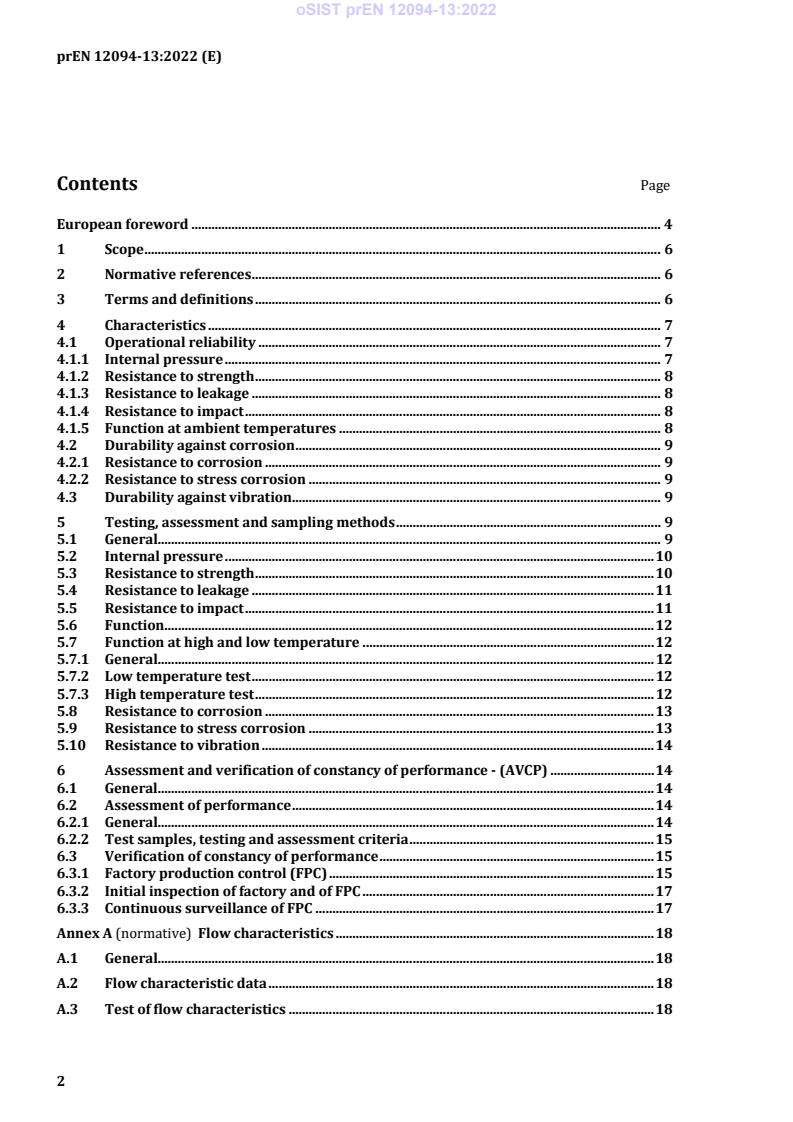
Contents Page
European foreword . 4
1 Scope . 6
2 Normative references . 6
3 Terms and definitions . 6
4 Characteristics . 7
4.1 Operational reliability . 7
4.1.1 Internal pressure . 7
4.1.2 Resistance to strength . 8
4.1.3 Resistance to leakage . 8
4.1.4 Resistance to impact . 8
4.1.5 Function at ambient temperatures . 8
4.2 Durability against corrosion . 9
4.2.1 Resistance to corrosion . 9
4.2.2 Resistance to stress corrosion . 9
4.3 Durability against vibration. 9
5 Testing, assessment and sampling methods . 9
5.1 General. 9
5.2 Internal pressure . 10
5.3 Resistance to strength . 10
5.4 Resistance to leakage . 11
5.5 Resistance to impact . 11
5.6 Function . 12
5.7 Function at high and low temperature . 12
5.7.1 General. 12
5.7.2 Low temperature test . 12
5.7.3 High temperature test . 12
5.8 Resistance to corrosion . 13
5.9 Resistance to stress corrosion . 13
5.10 Resistance to vibration . 14
6 Assessment and verification of constancy of performance - (AVCP) . 14
6.1 General. 14
6.2 Assessment of performance . 14
6.2.1 General. 14
6.2.2 Test samples, testing and assessment criteria . 15
6.3 Verification of constancy of performance . 15
6.3.1 Factory production control (FPC) . 15
6.3.2 Initial inspection of factory and of FPC . 17
6.3.3 Continuous surveillance of FPC . 17
Annex A (normative) Flow characteristics . 18
A.1 General. 18
A.2 Flow characteristic data . 18
A.3 Test of flow characteristics . 18
A.3.1 General . 18
A.3.2 Resistance coefficient . 18
Annex ZA (informative) Relationship of this European Standard with Regulation (EU)
No. 305/2011 . 20
ZA.1 Scope and relevant characteristics . 20
ZA.2 System of Assessment and Verification of Constancy of Performance . 21
European foreword
This document (prEN 12094-13:2022) has been prepared by Technical Committee CEN/TC 191 “Fixed
firefighting systems”, the secretariat of which is held by BSI.
This document is currently submitted to the CEN Enquiry.
This document will supersede EN 12094-13:2001.
In comparison with the previous edition, the following technical modifications have been made:
a) The whole structure of the document has been adapted to Regulation (EU) No. 305/2011 on
construction products (CPR);
b) Clause 4 Requirements has been renamed to Characteristics;
c) Clause 4.1 General design: Material specification for metal has been deleted;
d) Clause 4.2 Connection threads has been deleted;
e) Clause 4.5 flow way in combination with 5.3 Compliance has been deleted;
f) Clause 6 Marking has been deleted;
g) Clause 7 Evaluation and conformity has been renamed and restructured;
h) Annex ZA has been adopted according to the requirements of the CPR;
i) Bibliography has been deleted.
This document has been prepared under a mandate given to CEN by the European Commission and the
European Free Trade Association, and supports essential requirements of Regulation (EU) No. 305/2011.
For relationship with Regulation (EU) No. 305/2011, see informative Annex ZA, which is an integral part
of this document.
This document is part of the series of standards EN 12094, Fixed firefighting systems — Components for
gas extinguishing systems, which consist of the following parts:
— Part 1: Requirements and test methods for electrical automatic control and delay devices;
— Part 2: Requirements and test methods for non-electrical automatic control and delay devices;
— Part 3: Requirements and test methods for manual triggering and stop devices;
— Part 4: Requirements and test methods for container valve assemblies and their actuators;
— Part 5: Requirements and test methods for high and low pressure selector valves and their actuators;
— Part 6: Requirements and test methods for non-electrical disable devices;
— Part 7: Requirements and test methods for nozzles for CO systems;
— Part 8: Characteristics for connectors;
— Part 9: Requirements and test methods for special fire detectors;
— Part 10: Requirements and test methods for pressure gauges and pressure switches;
— Part 11: Requirements and test methods for mechanical weighing devices;
— Part 12: Requirements and test methods for pneumatic alarm devices;
— Part 13: Characteristics for check valves and non-return valves;
— Part 16: Requirements and test methods for odorizing devices for CO low pressure systems.
1 Scope
This document specifies the characteristics and describes test methods for check and non-return valves
for CO , inert gas or halocarbon gas fire extinguishing systems.
Non-return and check valves allow the passage in the direction of flow and they prevent flow in the
reverse direction.
This document is applicable to check valves installed between container valve and manifold and non-
return valves installed in pilot lines, except those valves which are tested in combination with non-
electrical control devices.
2 Normative references
There are no normative references in this document.
3 Terms and definitions
For the purposes of this document, the following terms and definitions apply.
ISO and IEC maintain terminological databases for use in standardization at the following addresses:
— IEC Electropedia: available at https://www.electropedia.org/
— ISO Online browsing platform: available at https://www.iso.org/obp
3.1
check valve
component intended for installation between container valve and manifold, which permits flow only in
one direction
3.2
CO -high-pressure installation
fire extinguishing installation in which the CO is stored at ambient temperature, e.g. the pressure of the
CO in storage is p = 58,6 bar at 21 °C
2 abs
3.3
CO -low-pressure installation
fire extinguishing installation in which the CO is stored at low temperature, normally at a temperature
of –19 °C to 21 °C
3.4
fill ratio
mass of extinguishing medium related to the net capacity of a container expressed as kilograms per litre
(kg/l)
3.5
gas extinguishing installation
system installed to provide fire protection
3.6
halocarbon gas
extinguishing agent that contains as primary components one or more organic compounds containing
one or more of the elements fluorine, chlorine, bromine or iodine
3.7
halocarbon gas installation
fire extinguishing installation in which the halocarbon gas is stored at ambient temperature
3.8
inert gas
non-liquefied gas or mixture of gases which extinguish the fire mainly by reducing the oxygen
concentration in the protected zone, e.g. argon, nitrogen or mixtures of these gases with CO
3.9
inert gas installation
fire extinguishing installation in which the inert gas is stored at ambient temperature
3.10
manifold
special pipe to collect the medium flow of two or more containers
3.11
non-return valve
component intended for installation in pilot lines, which permits flow only in one direction
3.12
resistance coefficient
value for the calculation of the pressure drop in a component under two-phase flow condition
3.13
two-phase flow
partitial change of phase of a fluid from liquid to vapour under flowing conditions
3.14
working pressure
pressure at which the component is used in the system
4 Characteristics
4.1 Operational reliability
4.1.1 Internal pressure
For establishing performance of the check valve and the non-return valve related to its working pressure,
Table 1 shall be used, considering the gas used in extinguishing system. For the respective level of the
working pressure (in bar), the procedure in accordance with 5.1 shall be carried out.
The following results shall be reported:
— the value of the decrease of the gas pressure, (in bar) rounded to the nearest whole bar, and
— the number of visible signs of deformation.
Table 1 — Check valve and non-return valve related working pressures
Type Working pressure in bar for
CO -high- CO -low-pressure Inert gas Halocarbon gas
2 2
component component
pressure component
component
a a
Check valve 140 not applicable
see
see
Non-return valve As specified by the manufacturer
a
This value is given as the developed pressure in the container at 50°C with the highest fill
ratio/superpressurization, where applicable.
4.1.2 Resistance to strength
The resistance to strength of non-return and check valves shall be determined in accordance with 5.3 and
the result, as the number of visible signs of bursting, reported.
The result obtained shall show no visible sign of deterioration of the non-return and check valves.
If this is so, the performance shall be expressed with the indication “no deterioration”.
EXAMPLE no deterioration.
4.1.3 Resistance to leakage
The resistance to leakage of non-return and check valves shall be determined in accordance with 5.4 and
the result, as the number of visible signs of leakage, shall be reported.
The result obtained shall show no visible signs of leakage of the non-return and check valves.
If this is so, the performance shall be expressed with the indication “no leakage”.
EXAMPLE no leakage.
4.1.4 Resistance to impact
The resistance to impact of non-return and check valves shall be determined in accordance with 5.5 and
the result, as the number of visible signs of damage, shall be reported.
The result obtained shall show no visible signs of damage of the non-return and check valves.
If this is so, the performance shall be expressed with the indication “no damage”.
EXAMPLE no damage
4.1.5 Function at ambient temperatures
Non-return and check valves shall operate in an ambient temperature range encompassing −20 °C to
+50 °C, when tested in accordance with 5.6 and 5.7.
Check valves shall have reached their fully open position at a differential pressure of 3 bar maximum.
Non-return valves shall have reached their fully open position at a differential pressure of not greater
than 10 % of the minimum system pressure in the pilot system
The result obtained shall show the fully open position of non-return and check valves.
If this is so, the performance shall be expressed with the indication “fully open”.
EXAMPLE no impairment of the flow path
4.2 Durability against corrosion
4.2.1 Resistance to corrosion
The resistance to corrosion of non-return and check valves, when tested in accordance with 5.6, after
being subjected to the corrosion test in accordance with 5.8.
The result obtained shall show the fully open position of non-return and check valves.
If this is so, the performance shall be expressed with the indication “fully open”.
EXAMPLE no impairment of the flow path
4.2.2 Resistance to stress corrosion
The resistance to stress corrosion of non-return and check valves with copper alloy part shall be
determined in accordance with 5.9 and the result, as the number of cracks, shall be reported.
The result obtained shall show no cracks of the non-return and check valves.
If this is so, the performance shall be expressed with the indication “no cracks”.
EXAMPLE no cracks
4.3 Durability against vibration
The durability against vibration of non-return and check valves shall be determined in accordance with
5.10 and the result, as the number of visible signs of damage, shall be reported.
The result obtained shall show no visible signs of damage of the non-return and check valves.
If this is so, the performance shall be expressed with the indication “no damage”.
EXAMPLE no damage
5 Testing, assessment and sampling methods
5.1 General
The components shall be tested assembled as recommended for installation by the manufacturer. The
tests shall be carried out at a temperature of (25 ± 10) °C, except when otherwise stated.
The tolerance for all test parameters is 5 %, unless otherwise stated.
Four samples shall be used for the tests. The order of tests shall be in accordance with Table 2.
Table 2 — Order of tests
Test method Test order for
sample A/B sample C sample D
5.2 Internal pressure 3
5.3 Resistance to strength 8
5.4 Resistance to leakage 2 3
a
5.5 Resistance to impact
5.6 Function 2/7 3
5.7 Function at high and low temperature 4
5.8 Resistance to corrosion 6
5.9 Resistance to stress corrosion 4
5.10 Resistance to vibration 5
a
For check valves only
5.2 Internal pressure
Considering before the relevant provisions in 5.1, the test procedure, related to internal pressure of non-
return and check vales, shall be as follows:
a) The non-return or check valve shall be connected via the outlet to a suitable hydraulic pressure
supply. Provision for venting shall be available.
b) The system of air shall be vented and the pressure shall be increased to 1,5 times the working
pressure and shall be maintained for 5 min.
c) The systems shall be depressurized and the function test shall be carried out in accordance with
5.6 b) and 5.6 c), respectively.
The test sample shall be examined whether shown any visible sign of damage.
The report of the test shall provide with the following information:
— number of visible signs of damage.
5.3 Resistance to strength
Considering before the relevant provisions in 5.1, the test procedure, related to resistance to strength of
non-return and check vales, shall be as follows:
a) The inlet of the test sample shall be connected to a suitable hydraulic pressure supply and the outlet
shall be blocked. The system shall be vented and the pressure shall be increased to 3 times the
working pressure.
b) This pressure shall be maintained for a period of 10 min. At the end of this period the hydraulic
pressure shall be released.
The test sample shall be examined whether shown any visible sign of deterioration.
The report of the test shall provide with the following information:
— number of visible signs of deterioration.
5.4 Resistance to leakage
Considering before the relevant provisions in 5.1, the test procedure, related to resistance to leakage of
non-return and check vales, shall be as follows:
a) The test unit shall consist of a pipe with the same diameter as the nominal diameter of the valve and
a length of (0,5 ± 0,1) m.
b) The check valve shall be installed with its outlet to the test pipe. An air, nitrogen or CO supply shall
be connected via a container valve. The check valve shall be pressurized to (20 ± 2) bar and plunged
into a water bath at an ambient temperature of (20 ± 5) °C. Maintain the pressure for a period of
2 min. Not more than 20 bubbles per minute shall be formed downstream of valves for manifolds.
c) The non-return valve shall be installed with its outlet to the test pipe. An air, nitrogen or CO supply
shall be connected via a container valve. The non-return valve shall be pressurized to (3 ± 0,1) bar
and plunged into a water bath at an ambient temperature of (20 ± 5) °C. The pressure shall be
maintained for a test period of 2 min. Then the pressure shall be increased to the working pressure
and maintained for another test period of 2 min. In both test periods no bubbles shall be formed
downstream of the valve.
The test sample shall be examined whether shown any leakage or visible sign of damage.
The report of the test shall provide with the following information:
— value of the decrease of the gas pressure, (in bar) rounded to the nearest whole bar;
— number of visible signs of damage.
5.5 Resistance to impact
Considering before the relevant provisions in 5.1, the test procedure, related to resistance to impact of
non-return and check vales, shall be as follows:
a) The test unit shall consist of a pipe with the same diameter as the nominal diameter of the valve and
a length of (0,5 ± 0,1) m.
b) Check valves which are normally in the open position shall be installed with their outlet connected
to the test pipe. Check valves which are normally in the closed position shall be installed with their
inlet connected to the test pipe. An air, nitrogen or CO supply shall be connected via a quick opening
high pressure container valve. The valve shall be pressurized 10 times with working pressure in
accordance with Table 1.
The test sample shall be examined whether shown any visible sign of damage.
The report of the test shall provide with the following information:
— number of visible signs of damage.
5.6 Function
Considering before the relevant provisions in 5.1, the test procedure, related to function o
...