

EN 16157-1:2018
(Main)Intelligent transport systems - DATEX II data exchange specifications for traffic management and information - Part 1: Context and framework
- Abstract
This document specifies and defines components required to support the exchange and shared use of data and information in the field of traffic and travel.
The components include the framework and context for the modelling approach, data content, data structure and relationships.
This document is applicable to:
- traffic and travel information which is of relevance to road networks (non-urban and urban),
- public transport information that is of direct relevance to the use of a road network (e.g. road link via train or ferry service),
- traffic and travel information in the case of Cooperative intelligent transport systems (C-ITS).
This document establishes specifications for data exchange between any two instances of the following actors:
- Traffic Information Centres (TICs),
- Traffic Control Centres (TCCs),
- Service Providers (SPs),
Use of this document can be applicable for use by other actors.
This document covers, at least, the following types of informational content:
- road traffic event information - planned and unplanned occurrences both on the road network and in the surrounding environment,
- information about operator-initiated actions - including both advisory and mandatory measures,
- road traffic measurement data, status data, and travel time data,
- travel information relevant to road users, including weather and environmental information,
- road traffic management information and information and advice relating to use of the road network.
This part of EN 16157 specifies the DATEX II framework of all parts of this European Standard, the context of use and the modelling approach taken and used throughout this European Standard. This approach is described using formal methods and provides the mandatory reference framework for all other parts.
- Status
- Published
- Publication Date
- 18-Dec-2018
- Withdrawal Date
- 29-Jun-2019
- Technical Committee
- CEN/TC 278 - Road transport and traffic telematics
- Drafting Committee
- CEN/TC 278/WG 8 - Road traffic data (RTD)
- Current Stage
- 9092 - Decision on results of review/2YR ENQ - revise - Review Enquiry
- Start Date
- 04-Jun-2024
- Completion Date
- 07-Oct-2026


Overview
EN 16157-1:2018 defines the context and framework for DATEX II - the CEN standard for data exchange in the field of traffic management and travel information. It specifies the modelling approach, mandatory reference framework, and components required to support interoperable exchange and shared use of traffic and travel data across boundaries (urban/non‑urban, network operators, service providers and C-ITS). EN 16157-1 is the foundation for all other parts of the EN 16157 series and describes formal methods used (UML-based metamodel and XML mapping).
Key topics and technical requirements
- Modelling approach and metamodel
- Platform Independent Model (PIM) rules and UML profile usage.
- Explicit UML 2-based metamodel and stereotype conventions.
- Data structure and semantics
- Definitions of classes, attributes, associations, enumerations, multiplicities and packages.
- Rules for conformance and extension (Level A model and Level B extensions).
- Platform Specific Mapping
- Mapping rules from the UML model to XML (XML Schema Definition) described in a normative annex.
- Guidance for other encodings (e.g., ASN.1/UPER referenced as alternatives).
- Scope of informational content
- Road traffic event information (planned/unplanned).
- Operator-initiated actions (advisory and mandatory measures).
- Traffic measurements, status and travel time data.
- Travel information relevant to road users, including weather/environmental data.
- Traffic management information and advice for network use.
- Actors and exchange scenarios
- Specified exchange between Traffic Information Centres (TICs), Traffic Control Centres (TCCs) and Service Providers (SPs); applicable to other actors where relevant.
- Normative references
- Uses standards such as ISO/IEC 19505-1 (UML) and ISO/IEC 14977 (EBNF) for formal specification.
Applications and who should use it
- Traffic management authorities and Traffic Control Centres implementing centre-to-centre interfaces.
- Traffic Information Centres and commercial Service Providers exchanging operational traffic and travel data.
- System architects and data modelers extending DATEX II for local or regional services (must follow extension rules).
- Developers implementing DATEX II XML schemas or alternative encodings for C-ITS, routing, traveler information, traffic forecasting and incident management.
Related standards
- EN 16157 (multi-part series) - EN 16157-1 provides the mandatory modelling framework for all parts.
- ISO/IEC 19505-1 (UML) and ISO/IEC 14977 (EBNF) cited as normative references.
EN 16157-1:2018 is essential for achieving interoperable, standards-based DATEX II data exchange in intelligent transport systems, enabling reliable traffic management, traveler information services and cross-border integration.
Relations
- Effective Date
- 08-Jun-2022
- Effective Date
- 25-Aug-2026
- Effective Date
- 25-Aug-2026
- Effective Date
- 28-Jan-2026
- Effective Date
- 28-Jan-2026
- Effective Date
- 22-Jul-2026
- Effective Date
- 28-Jan-2026
- Effective Date
- 28-Jan-2026
- Effective Date
- 28-Jan-2026
- Effective Date
- 28-Jan-2026
- Effective Date
- 28-Jan-2026
- Effective Date
- 28-Jan-2026
- Effective Date
- 28-Jan-2026
- Effective Date
- 28-Jan-2026
- Effective Date
- 28-Jan-2026
Get Certified
Connect with accredited certification bodies for this standard

BSI Group
BSI (British Standards Institution) is the business standards company that helps organizations make excellence a habit.

NYCE
Mexican standards and certification body.
Sponsored listings
Frequently Asked Questions
EN 16157-1:2018 is a standard published by the European Committee for Standardization (CEN). Its full title is "Intelligent transport systems - DATEX II data exchange specifications for traffic management and information - Part 1: Context and framework". This standard covers: This document specifies and defines components required to support the exchange and shared use of data and information in the field of traffic and travel. The components include the framework and context for the modelling approach, data content, data structure and relationships. This document is applicable to: - traffic and travel information which is of relevance to road networks (non-urban and urban), - public transport information that is of direct relevance to the use of a road network (e.g. road link via train or ferry service), - traffic and travel information in the case of Cooperative intelligent transport systems (C-ITS). This document establishes specifications for data exchange between any two instances of the following actors: - Traffic Information Centres (TICs), - Traffic Control Centres (TCCs), - Service Providers (SPs), Use of this document can be applicable for use by other actors. This document covers, at least, the following types of informational content: - road traffic event information - planned and unplanned occurrences both on the road network and in the surrounding environment, - information about operator-initiated actions - including both advisory and mandatory measures, - road traffic measurement data, status data, and travel time data, - travel information relevant to road users, including weather and environmental information, - road traffic management information and information and advice relating to use of the road network. This part of EN 16157 specifies the DATEX II framework of all parts of this European Standard, the context of use and the modelling approach taken and used throughout this European Standard. This approach is described using formal methods and provides the mandatory reference framework for all other parts.
This document specifies and defines components required to support the exchange and shared use of data and information in the field of traffic and travel. The components include the framework and context for the modelling approach, data content, data structure and relationships. This document is applicable to: - traffic and travel information which is of relevance to road networks (non-urban and urban), - public transport information that is of direct relevance to the use of a road network (e.g. road link via train or ferry service), - traffic and travel information in the case of Cooperative intelligent transport systems (C-ITS). This document establishes specifications for data exchange between any two instances of the following actors: - Traffic Information Centres (TICs), - Traffic Control Centres (TCCs), - Service Providers (SPs), Use of this document can be applicable for use by other actors. This document covers, at least, the following types of informational content: - road traffic event information - planned and unplanned occurrences both on the road network and in the surrounding environment, - information about operator-initiated actions - including both advisory and mandatory measures, - road traffic measurement data, status data, and travel time data, - travel information relevant to road users, including weather and environmental information, - road traffic management information and information and advice relating to use of the road network. This part of EN 16157 specifies the DATEX II framework of all parts of this European Standard, the context of use and the modelling approach taken and used throughout this European Standard. This approach is described using formal methods and provides the mandatory reference framework for all other parts.
EN 16157-1:2018 is classified under the following ICS (International Classification for Standards) categories: 35.240.60 - IT applications in transport. The ICS classification helps identify the subject area and facilitates finding related standards.
EN 16157-1:2018 has the following relationships with other standards: It is inter standard links to CEN/TS 16157-1:2011, ISO/IEC 19505-1:2012, ISO/IEC 14977:1996, EN 1846-2:2001+A3:2009, EN ISO 17640:2010, CEN/TS 16157-8:2026, CEN/TS 16157-11:2025, EN ISO 5817:2023, EN 16157-4:2021, EN ISO 15614-1:2017, CEN/TS 16157-11:2022, CEN/TS 17402:2020, EN ISO 25239-2:2020, EN 16157-7:2018, EN 13480-8:2024. Understanding these relationships helps ensure you are using the most current and applicable version of the standard.
EN 16157-1:2018 is associated with the following European legislation: EU Directives/Regulations: 2010/40/EU. When a standard is cited in the Official Journal of the European Union, products manufactured in conformity with it benefit from a presumption of conformity with the essential requirements of the corresponding EU directive or regulation.
EN 16157-1:2018 is available in PDF format for immediate download after purchase. The document can be added to your cart and obtained through the secure checkout process. Digital delivery ensures instant access to the complete standard document.
Standards Content (Sample)
2003-01.Slovenski inštitut za standardizacijo. Razmnoževanje celote ali delov tega standarda ni dovoljeno.Inteligentni transportni sistemi - Specifikacije za izmenjavo podatkov DATEX II pri upravljanju prometa in informiranju - 1. del: Kontekst in okvirIntelligente Verkehrssysteme - Datex II Datenaustauschspezifikation für Verkehrsmanagement und Verkehrsinformation - Teil 1: Kontext und RahmenwerkSystèmes de transport intelligents - Spécifications DATEX II d'échange de données pour la gestion du trafic et l'information routière - Partie 1: Contexte et cadre généralIntelligent transport systems - DATEX II data exchange specifications for traffic management and information - Part 1: Context and Framework35.240.60Uporabniške rešitve IT v prometuIT applications in transportICS:Ta slovenski standard je istoveten z:EN 16157-1:2018SIST EN 16157-1:2019en,fr,de01-februar-2019SIST EN 16157-1:2019SLOVENSKI
STANDARDSIST-TS CEN/TS 16157-1:20111DGRPHãþD
EUROPEAN STANDARD NORME EUROPÉENNE EUROPÄISCHE NORM
EN 16157-1
December
t r s z English Version
Intelligent transport systems æ DATEX II data exchange specifications for traffic management and information æ Part
sã Context and framework Systèmes de transport intelligents æ Spécifications DATEX II d 5échange de données pour la gestion du trafic et l 5information routière æ Partie
sã Contexte et cadre général
Intelligente Verkehrssysteme æ Datex II Datenaustauschspezifikation für Verkehrsmanagement und Verkehrsinformation æ Teil
sã Kontext und Rahmenwerk This European Standard was approved by CEN on
u September
t r s zä
egulations which stipulate the conditions for giving this European Standard the status of a national standard without any alterationä Upætoædate lists and bibliographical references concerning such national standards may be obtained on application to the CENæCENELEC Management Centre or to any CEN memberä
translation under the responsibility of a CEN member into its own language and notified to the CENæCENELEC Management Centre has the same status as the official versionsä
CEN members are the national standards bodies of Austriaá Belgiumá Bulgariaá Croatiaá Cyprusá Czech Republicá Denmarká Estoniaá Finlandá Former Yugoslav Republic of Macedoniaá Franceá Germanyá Greeceá Hungaryá Icelandá Irelandá Italyá Latviaá Lithuaniaá Luxembourgá Maltaá Netherlandsá Norwayá Polandá Portugalá Romaniaá Serbiaá Slovakiaá Sloveniaá Spainá Swedená Switzerlandá Turkey and United Kingdomä
EUROPEAN COMMITTEE FOR STANDARDIZATION COMITÉ EUROPÉEN DE NORMALISATION EUROPÄISCHES KOMITEE FÜR NORMUNG
CEN-CENELEC Management Centre:
Rue de la Science 23,
B-1040 Brussels
t r s z CEN All rights of exploitation in any form and by any means reserved worldwide for CEN national Membersä Refä Noä EN
s x s w yæ sã t r s z ESIST EN 16157-1:2019
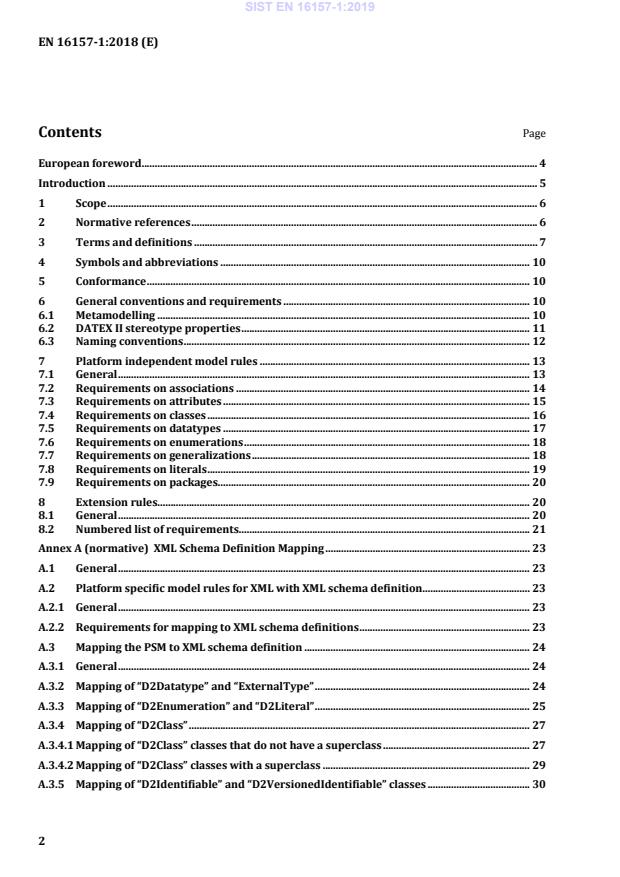
Page European foreword . 4 Introduction . 5 1 Scope . 6 2 Normative references . 6 3 Terms and definitions . 7 4 Symbols and abbreviations . 10 5 Conformance . 10 6 General conventions and requirements . 10 6.1 Metamodelling . 10 6.2 DATEX II stereotype properties . 11 6.3 Naming conventions . 12 7 Platform independent model rules . 13 7.1 General . 13 7.2 Requirements on associations . 14 7.3 Requirements on attributes . 15 7.4 Requirements on classes . 16 7.5 Requirements on datatypes . 17 7.6 Requirements on enumerations . 18 7.7 Requirements on generalizations . 18 7.8 Requirements on literals . 19 7.9 Requirements on packages . 20 8 Extension rules. 20 8.1 General . 20 8.2 Numbered list of requirements. 21 Annex A (normative)
XML Schema Definition Mapping . 23 A.1 General . 23 A.2 Platform specific model rules for XML with XML schema definition. 23 A.2.1 General . 23 A.2.2 Requirements for mapping to XML schema definitions . 23 A.3 Mapping the PSM to XML schema definition . 24 A.3.1 General . 24 A.3.2 Mapping of “D2Datatype” and “ExternalType” . 24 A.3.3 Mapping of “D2Enumeration” and “D2Literal” . 25 A.3.4 Mapping of “D2Class” . 27 A.3.4.1 Mapping of “D2Class” classes that do not have a superclass . 27 A.3.4.2 Mapping of “D2Class” classes with a superclass . 29 A.3.5 Mapping of “D2Identifiable” and “D2VersionedIdentifiable” classes . 30 SIST EN 16157-1:2019
IEC Electropedia: available at http://www.electropedia.org/
ISO Online browsing platform: available at http://www.iso.org/obp
3.1 Terms and definitions adapted from ISO/IEC 19505-1:2012: NOTE Definitions have been adapted to meet the particular use of UML within this specification. 3.1.1 Association semantic relationship between classes 3.1.2 Attribute named slot within a class that describes a range of values that instances of the class may hold 3.1.3 Class description of a set of objects that share the same attributes, relationships, and semantics 3.1.4 Composition association between two classes, where one class is a composite and the other is a part Note 1 to entry: This characteristic is expressed in UML with an attribute named “isComposite” on the part end of the Association being set to “true”. 3.1.5 Dependency implementation or functioning of one or more elements that requires the presence of one or more other elements 3.1.6 Enumeration data type whose range is a list of predefined values, called enumeration literals 3.1.7 Enumeration literal element of the value space of an enumeration data type
3.1.8 Generalization taxonomic relationship between a more general element and a more specific element SIST EN 16157-1:2019
letter ,
{ letter
| digit } letter ::=
“A” | “B” | “C” | “D” | “E” | “F” | “G” | “H” | “I” | “J” | “K” | “L” | “M” | “N” | “O” | “P” | “Q” | “R” | “S” | “T” | “U” | “V” | “W” | “X” | “Y” | “Z” | “a” | “b” | “c” | “d” | “e” | “f” | “g” | “h” | “i” | “j” | “k” | “l” | “m” | “n” | “o” | “p” | “q” | “r” | “s” | “t” | “u” | “v” | “w” | “x” | “y” | “z” digit ::=
“0” | “1” | “2” | “3” | “4” | “5” | “6” | “7” | “8” | “9” 6.3.3 The names of the instances of the following UML metaclasses shall be in Upper Camel Case notation, i.e. they shall start with an upper case letter (‘A’ to ‘Z’), they shall consist of one or more logical components, and each component itself shall again begin with an upper case letter (Example: Component1Component2Component3): Class, DataType, Enumeration, Package
6.3.4 The names of the instances of the following UML metaclasses shall be in Lower Camel Case notation, i.e. they shall start with a lower case letter (‘a’ to ‘z’), they shall consist of one or more logical components, and each component starting with the second component shall begin with an upper case letter (Example: component1Component2Component3): Attribute, Property
6.3.5 In all DATEX II names, acronyms should be avoided, but in cases where they are used, their capitalization shall be modified to comply with the provisions in Subclauses 6.3.3 and 6.3.4. NOTE In some parts of this document, default names are defined by turning names of other constructs from Upper Camel Case to Lower Camel Case. This transformation is strictly defined as turning only the first character from upper case to lower case. Example: a proper class name may be “ANameExample”. If referred by another class via a composition without role name and qualifier, the XML schema encoding of the enclosing class will contain an attribute that will implicitly be named “aNameExample”. 6.3.6 The names of the following DATEX II UML constructs shall be unique in their namespace: Class, DataType, Enumeration
7 Platform independent model rules 7.1 General The DATEX II modelling methodology implies a certain structure of a UML model that seeks to claim compliance with this European Standard. This subclause states the requirements that UML models shall comply with in terms of constraints on the use of certain UML constructs. Note that no statements are made concerning other UML constructs, i.e. models that contain other UML constructs may still claim DATEX II compliance, as long as all requirements for the named UML constructs are met. SIST EN 16157-1:2019
Figure 1 — Associations 7.2.2 DATEX II models may contain UML Core::Constructs::Association with two memberEnd instances (i.e. binary association) where one memberEnd.isComposite attribute set to “true”. Such binary compositions may have a “D2Relation” stereotype from the “UML Profile for DATEX II” assigned to it. Binary compositions with this stereotype assigned are called “DATEX II relations” for brevity in the rest of this document. 7.2.3 DATEX II models may contain UML Core::Constructs::Association that have no “D2Relation” stereotype or have other stereotypes assigned. Associations without “D2Relation” stereotype assigned and other stereotypes on associations are not governed by this European Standard and have no semantics in the DATEX II specifications. 7.2.4 If the “name” meta-attribute of a DATEX II relation is empty, the default assumption is a name constructed from the name of the connected memberEnd UML Class, with its first character turned to lower case. 7.2.5 If the multiplicity of a DATEX II relations memberEnd is not explicitly specified, the default value for Multiplicity.lower as well as for Multiplicity.upper is “1”. SIST EN 16157-1:2019
Figure 2 — Attributes 7.3.2 Attributes of DATEX II classes may have a “D2Attribute” stereotype assigned. Such attributes are called “DATEX II attributes” for brevity in the rest of this document. 7.3.3 DATEX II models may contain attributes that have no “D2Attribute” stereotype or have other stereotypes assigned. Attributes without “D2Attribute” stereotype assigned and other stereotypes on attributes are not governed by this European Standard, i.e. they have no semantics in the context of the DATEX II specifications. 7.3.4 The type of a DATEX II attribute shall be a UML DataType with stereotype “D2Datatype” (note that built-in UML types are not allowed) or “ExternalType”, or it shall be a UML Enumeration with stereotype “D2Enumeration”. If the assigned type is either “Reference” or “VersionedReference”, the “D2Attribute” stereotype may have a non-empty “targetClass” property, which shall provide a name of a DATEX II class that has an “D2Identifiable” or “D2VersionedIdentifiable” stereotype assigned, respectively. 7.3.5 The “definition” property of a DATEX II attribute shall not be empty and shall contain a clear, comprehensible and unambiguous definition of the modelled concept. SIST EN 16157-1:2019
Figure 3 — Classes 7.4.2 DATEX II models may use UML Core::Basic::Class. Such classes may have a “D2Class”, “D2ModelRoot”, “D2Identifiable”, “D2VersionedIdentifiable” or a “ExternalClass” stereotype from the “UML Profile for DATEX II” assigned to it. Classes with one of these stereotypes except “ExternalClass” assigned are called “DATEX II classes” for brevity in the rest of this document. 7.4.3 DATEX II classes shall not have more than one stereotype “D2Class”, “D2ModelRoot”, “D2Identifiable”, “D2VersionedIdentifiable” or “ExternalClass” assigned 7.4.4 DATEX II models may contain UML Core::Basic::Classes that have none of the following stereotypes “D2Class”, “D2ModelRoot”, “D2Identifiable”, “D2VersionedIdentifiable” or a “ExternalClass” assigned or they may have other stereotypes assigned. Classes without “D2Class”, “D2ModelRoot”, “D2Identifiable”, “D2VersionedIdentifiable” or a “ExternalClass” stereotype assigned and other stereotypes on classes are not governed by this European Standard, i.e. they have no semantics in the context of the DATEX II specifications. 7.4.5 The “definition” property of a DATEX II class (except for “ExternalClass”) shall not be empty and shall contain a clear, comprehensible and unambiguous definition of the class modelled. 7.4.6 A UML model that claims conformance with this European Standard shall contain at least one class with a “D2ModelRoot” stereotype assigned to it. SIST EN 16157-1:2019
Figure 4 — Datatypes 7.5.2 DATEX II models may use UML Core::Basic::DataType. Such datatypes may have a “D2Datatype” or an “ExternalType” stereotype from the “UML Profile for DATEX II” assigned to it. Datatypes with a “D2Datatype” stereotype assigned are called “DATEX II datatypes” for brevity in the rest of this document. 7.5.3 DATEX II datatypes shall not have both stereotypes “D2Datatype” and “ExternalType” assigned. 7.5.4 DATEX II models may contain UML Core::Basic::DataType that have no “D2Datatype” or “ExternalType” stereotype assigned or they may have other stereotypes assigned. Datatypes without “D2Datatype” or “ExternalType” stereotype assigned and other stereotypes on datatypes are not governed by this European Standard, i.e. they have no semantics in the context of the DATEX II specifications. SIST EN 16157-1:2019
Figure 5 — Enumerations 7.6.2 DATEX II models may use UML Core::Basic::Enumeration. Such enumerations may have a “D2Enumeration” stereotype from the “UML Profile for DATEX II” assigned to it. Enumerations with this stereotype assigned are called “DATEX II enumerations” for brevity in the rest of this document. 7.6.3 DATEX II models may contain UML Core::Basic::Enumeration that have no “D2Enumeration” stereotype or have other stereotypes assigned. Enumerations without “D2Enumeration” stereotype assigned and other stereotypes on enumerations are not governed by this European Standard, i.e. they have no semantics in the context of the DATEX II specifications. 7.6.4 The “definition” property of a DATEX II enumeration shall not be empty and shall contain a clear, comprehensible and unambiguous definition of the enumeration modelled. 7.7 Requirements on generalizations 7.7.1 Figure 6 depicts the stereotype “D2LevelBExtension” defined for DATEX II extensions. This type of generalization can be used to depict level B extensions of classes (generalization from a D2Class in a level B extension namespace to a D2Class in the core model) or enumerations (generalization from a D2Enumeration in a level B extension namespace to a D2Enumeration in the core model). SIST EN 16157-1:2019
Figure 6 — Generalizations 7.7.2 DATEX II generalizations may have a “D2LevelBExtension” stereotype assigned. 7.8 Requirements on literals 7.8.1 Figure 7 depicts the stereotype “D2Literal” defined for the literals of DATEX II enumerations.
Figure 7 — Literals 7.8.2 Literals of DATEX II enumerations may have a “D2Literal” stereotype assigned. Such attributes are called “DATEX II literals” for brevity in the rest of this document. 7.8.3 DATEX II models may contain literals that have no “D2Literal” stereotype or have other stereotypes assigned. Literals without “D2Literal” stereotype assigned and other stereotypes on literals are not governed by this European Standard, i.e. they have no semantics in the context of the DATEX II specifications. 7.8.4 The “definition” property of a DATEX II literal shall not be empty and shall contain a clear, comprehensible and unambiguous definition of the modelled concept. SIST EN 16157-1:2019
Figur
...