

EN 1938:2010
(Main)Personal eye protection - Goggles for motorcycle and moped users
- Abstract
This European Standard specifies requirements and test methods for goggles for use by all motorcycle and moped drivers and passengers, intended for eye-protection during the use of motorcycle and moped, both on the road and for off-road sport or leisure use, subject to the following exclusion. The goggles for official races and competitions are not included within the scope of this standard.
- Status
- Published
- Publication Date
- 20-Jul-2010
- Withdrawal Date
- 30-Jan-2011
- Technical Committee
- CEN/TC 85 - Eye-protective equipment
- Drafting Committee
- CEN/TC 85/WG 5 - Eye protectors for vehicles users
- Current Stage
- 9060 - Closure of 2 Year Review Enquiry - Review Enquiry
- Start Date
- 03-Jun-2020
- Completion Date
- 03-Jun-2020
- Directive
- 2016/425 - Regulation (EU) 2016/425 of the European Parliament and of the Council of 9 March 2016 on personal protective equipment and repealing Council Directive 89/686/EECOJ Ref: C, C 113 OJ Date: 27-Mar-2018
89/686/EEC - Personal protective equipment (PPE)OJ Ref: C, C 205 OJ Date: 09-Jul-2011

Overview
EN 1938:2010 - Personal eye protection: Goggles for motorcycle and moped users (CEN) - specifies requirements and test methods for protective goggles intended for motorcycle and moped drivers and passengers (road and off‑road sport/leisure). Goggles for official races and competitions are excluded. This European Standard sets design, optical, mechanical, material and labelling criteria to ensure safe, comfortable eye protection in normal riding conditions.
Key Topics and technical requirements
- Scope & exclusions: Eye-protection for riders and passengers; excludes official racing/competition goggles.
- Design and manufacture: Goggles must be free of projections and sharp edges likely to cause injury; vents must not significantly reduce peripheral vision.
- Materials & skin safety: Materials in contact with skin shall not cause irritation or sensitisation. Metallic parts are tested for nickel release (EN 1811); limit < 0.5 µg/cm²/week.
- Sit and fit: Retaining straps must be adjustable/flexible, retain position during use and resist stresses without tearing or permanent deformation. Goggles must adapt to face shape using soft contact surfaces.
- Ventilation: Venting must provide air exchange without allowing spherical objects ≥ 1.5 mm to pass (where openings are provided).
- Optical requirements:
- Field of vision: Minimum field defined relative to EN 168 head‑forms (oculars positioned 25 mm from eye); specified elliptical test area (horizontal 32.0 mm × vertical 25.0 mm; centre distance d = pupillary distance + 20 mm).
- Refractive tolerances: Limits for spherical and astigmatic powers and prismatic differences (e.g. typical tolerances ±0.12 D; difference left/right < 0.18 D).
- Transmittance/filter categories: Three visible-light categories for luminous transmittance: Category 0 = 80–100%, Category 1 = 43–80%, Category 2 = 18–43% (overlaps ±2% allowed between 0 and 1). Mandatory UV transmittance and optional enhanced infrared claims are specified. Warning required for lenses <75% luminous transmittance: “Not suitable for night driving or twilight condition.”
- Non‑optical performance: Impact resistance, resistance to surface damage by fine particles, optional anti‑fogging requirements and visual inspections.
- Testing & documentation: Standard includes conditioning, test methods (field of vision, refractive power, transmittance, UV, impact, fogging), marking and information the manufacturer must supply. Annex ZA links the standard to EU Directive 89/686/EEC (PPE).
Applications - who uses this standard
- Manufacturers and designers of motorcycle and moped goggles (product design, materials selection, testing).
- Test laboratories performing conformity and type testing for PPE and eye protection.
- Regulatory authorities, procurement officers and retailers verifying compliance with European PPE requirements.
- Safety managers and riders seeking certified personal eye protection for road and leisure/off‑road use.
Related standards
- EN 165 (vocabulary), EN 167 (optical test methods), EN 168 (non‑optical test methods)
- EN 1836 (sunglasses and sun glare filters), EN 1811 (nickel release)
- ISO 11664 series (colorimetry)
Keywords: EN 1938:2010, personal eye protection, motorcycle goggles, moped goggles, CEN standard, eye protection requirements, field of vision, lens transmittance, impact resistance, PPE compliance.
Relations
- Effective Date
- 24-Jul-2010
- Effective Date
- 09-Feb-2026
- Effective Date
- 28-Jan-2026
- Effective Date
- 28-Jan-2026
- Effective Date
- 28-Jan-2026
- Effective Date
- 28-Jan-2026
- Effective Date
- 28-Jan-2026
- Effective Date
- 28-Jan-2026
Get Certified
Connect with accredited certification bodies for this standard

CIS Institut d.o.o.
Personal Protective Equipment (PPE) certification body. Notified Body NB-2890 for EU Regulation 2016/425 PPE.

Kiwa BDA Testing
Building and construction product certification.
Kmetijski inštitut Slovenije
Agricultural Institute of Slovenia. Soil testing, plant health, agricultural product analysis.
Sponsored listings
Frequently Asked Questions
EN 1938:2010 is a standard published by the European Committee for Standardization (CEN). Its full title is "Personal eye protection - Goggles for motorcycle and moped users". This standard covers: This European Standard specifies requirements and test methods for goggles for use by all motorcycle and moped drivers and passengers, intended for eye-protection during the use of motorcycle and moped, both on the road and for off-road sport or leisure use, subject to the following exclusion. The goggles for official races and competitions are not included within the scope of this standard.
This European Standard specifies requirements and test methods for goggles for use by all motorcycle and moped drivers and passengers, intended for eye-protection during the use of motorcycle and moped, both on the road and for off-road sport or leisure use, subject to the following exclusion. The goggles for official races and competitions are not included within the scope of this standard.
EN 1938:2010 is classified under the following ICS (International Classification for Standards) categories: 13.340.20 - Head protective equipment. The ICS classification helps identify the subject area and facilitates finding related standards.
EN 1938:2010 has the following relationships with other standards: It is inter standard links to EN 1938:1998, ISO 11664-1:2007, EN 16128:2025, EN 168:2001, EN 167:2001, EN 1836:2005+A1:2007, EN 1811:2023, EN 165:2005. Understanding these relationships helps ensure you are using the most current and applicable version of the standard.
EN 1938:2010 is associated with the following European legislation: EU Directives/Regulations: 2016/425, 89/686/EEC. When a standard is cited in the Official Journal of the European Union, products manufactured in conformity with it benefit from a presumption of conformity with the essential requirements of the corresponding EU directive or regulation.
EN 1938:2010 is available in PDF format for immediate download after purchase. The document can be added to your cart and obtained through the secure checkout process. Digital delivery ensures instant access to the complete standard document.
Standards Content (Sample)
2003-01.Slovenski inštitut za standardizacijo. Razmnoževanje celote ali delov tega standarda ni dovoljeno.Persönlicher Augenschutz - Schutzbrillen für Motorrad- und MopedfahrerProtection individuelle de l'oeil - Lunettes-masques pour motocyclistes et cyclomotoristesPersonal eye protection - Goggles for motorcycle and moped users43.140Motorna kolesa in mopediMotor cycles and mopeds13.340.20Varovalna oprema za glavoHead protective equipmentICS:Ta slovenski standard je istoveten z:EN 1938:2010SIST EN 1938:2010en,fr,de01-oktober-2010SIST EN 1938:2010SLOVENSKI
STANDARDSIST EN 1938:19991DGRPHãþD
EUROPEAN STANDARD NORME EUROPÉENNE EUROPÄISCHE NORM
EN 1938
July 2010 ICS 13.340.20 Supersedes EN 1938:1998English Version
Personal eye protection - Goggles for motorcycle and moped users
Protection individuelle de l'oeil - Lunettes-masques pour motocyclistes et cyclomotoristes
Persönlicher Augenschutz - Schutzbrillen für Motorrad-und Mopedfahrer This European Standard was approved by CEN on 19 June 2010.
CEN members are bound to comply with the CEN/CENELEC Internal Regulations which stipulate the conditions for giving this European Standard the status of a national standard without any alteration. Up-to-date lists and bibliographical references concerning such national standards may be obtained on application to the CEN Management Centre or to any CEN member.
This European Standard exists in three official versions (English, French, German). A version in any other language made by translation under the responsibility of a CEN member into its own language and notified to the CEN Management Centre has the same status as the official versions.
CEN members are the national standards bodies of Austria, Belgium, Bulgaria, Croatia, Cyprus, Czech Republic, Denmark, Estonia, Finland, France, Germany, Greece, Hungary, Iceland, Ireland, Italy, Latvia, Lithuania, Luxembourg, Malta, Netherlands, Norway, Poland, Portugal, Romania, Slovakia, Slovenia, Spain, Sweden, Switzerland and United Kingdom.
EUROPEAN COMMITTEE FOR STANDARDIZATION
COMITÉ EUROPÉEN DE NORMALISATION EUROPÄISCHES KOMITEE FÜR NORMUNG
Management Centre:
Avenue Marnix 17,
B-1000 Brussels © 2010 CEN All rights of exploitation in any form and by any means reserved worldwide for CEN national Members. Ref. No. EN 1938:2010: ESIST EN 1938:2010
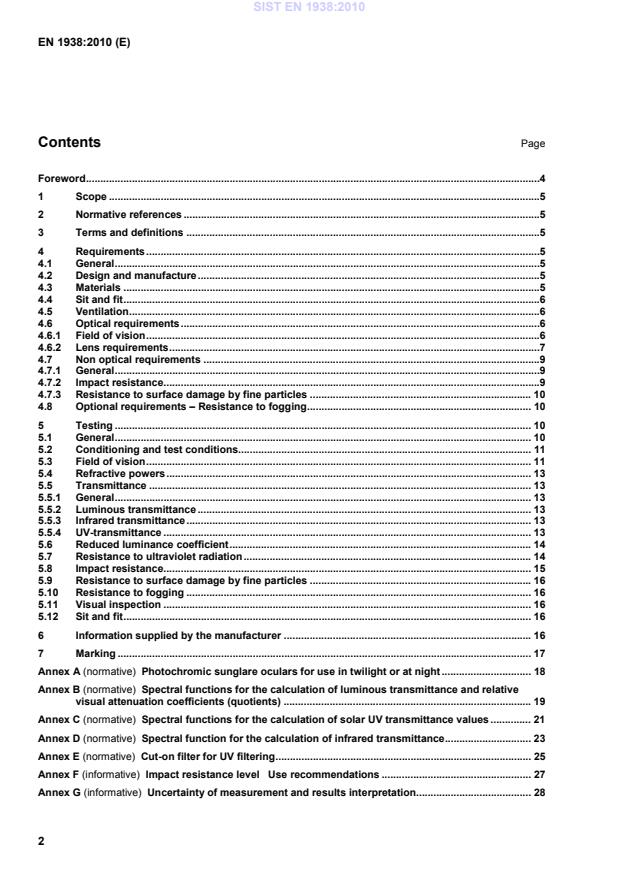
Photochromic sunglare oculars for use in twilight or at night . 18Annex B (normative)
Spectral functions for the calculation of luminous transmittance and relative visual attenuation coefficients (quotients) . 19Annex C (normative)
Spectral functions for the calculation of solar UV transmittance values . 21Annex D (normative)
Spectral function for the calculation of infrared transmittance . 23Annex E (normative)
Cut-on filter for UV filtering . 25Annex F (informative)
Impact resistance level
Use recommendations . 27Annex G (informative)
Uncertainty of measurement and results interpretation. 28SIST EN 1938:2010
Significant technical changes between this European Standard and the previous edition . 30Annex ZA (informative)
Relationship between this European Standard and the Essential Requirements of EU Directive 89/686/EEC – Personal Protective Equipment . 32Bibliography . 34 SIST EN 1938:2010
EN 1836:2005+A1:2007 apply. 4 Requirements 4.1 General All the samples tested shall comply with the requirements of this European Standard. Goggles can be provided with different oculars. 4.2 Design and manufacture Goggles shall be free from projections, sharp edges or other defects which are likely to cause discomfort or injury during use. The verification of this requirement shall be made according to 5.11 and 5.12. 4.3 Materials Any materials (or combination of materials) may be used, provided they meet the requirements of this European Standard. SIST EN 1938:2010
Figure 1 — Definition of the field of vision 4.6.2 Lens requirements 4.6.2.1 General The lens requirements shall be as given in Table 1. The requirements apply to goggles with all the oculars declared by the manufacturer. SIST EN 1938:2010
Spherical refractive power Astigmatic refractive powerDifference in prismatic refractive power cm/m Permissible tolerances for refractive powers of mounted oculars D1D22+ D,m-1 l D1-D2 l D,m-1 Horizontal D∆ VerticalD∆ Base out Base in ± 0,12 0,12 1,00 0,25 0,25 Difference between the spherical powers of the left and right visual points Less than 0,18 D,m-1 Luminous transmittance According to 4.6.2.2 Uniformity of luminous transmittance According to 4.1.3.1 of EN 1836:2005+A1:2007 Maximum reduced luminance coefficient Single lens goggles: ≤ 1 cd/m²/lx Multiple lens goggles: ≤ 2 cd/m²/lx Quality of material and surface According to 4.4 of EN 1836:2005+A1:2007 Resistance to ultraviolet radiation After the testing according to 5.7, the maximum reduced luminance coefficient shall not exceed the values shown in this table.
4.6.2.2 Permissible transmittance and filter categories There are three transmittance categories for oculars for goggles for motorcycle and moped users. The range of the luminous transmittance for these three categories is given by the values in Table 2. An overlap of the transmittance values of not more than ±
2 % (absolute) is permitted between the categories 0,1 and 2. If the supplier declares a luminous transmittance value, the tolerance for the value is ±
3 % absolute for transmittance values. When describing the transmittance properties of photochromic filters, two categories for transmittance values are generally used. These two values correspond to the faded state and to the darkened state of the filter. In the case of gradient filters the transmittance value at the reference point is used to characterise the luminous transmittance / category of the oculars. Table 2 also specifies the mandatory UV requirements for oculars for goggles for motorcycle and moped users. Oculars for which the enhanced infrared absorption is claimed, shall meet the requirements of the last column of Table 2. SIST EN 1938:2010
Ultraviolet Spectral range Visible Spectral range Enhanced infrared absorption a Maximum value of spectral transmittance τF
(λ) Maximum value of solar UVA transmittance τSUVA (λ) Range of luminous transmittance
τ V Maximum value of solar infrared transmittance
τSIR 280 nm to 315 nm 315 nm to 350 nm 315 nm to 380 nm 0 0,1 . τV τV τV 80 % to 100 % τV 1 0,1 . τV τV τV 43 % to 80 % τV 2 0,1 . τV τV τV 18 % to 43 % τV a Only applicable to goggles recommended by the manufacturer as a protection against infrared radiation. In case of oculars with a luminous transmittance of less than 75 % the manufacturer shall include in the information to be supplied the warning: “Not suitable for night driving or twilight condition”.
4.6.2.3 Special transmittance requirements and claimed transmittance properties If the oculars have special transmittance requirements and/or the claimed transmittance properties described in 4.1.3 and 4.1.4 of EN 1836:2005+A1:2007 then the oculars shall satisfy the requirements described in each corresponding clause of EN 1836:2005+A1:2007. All oculars shall have a luminous transmittance value greater than or equal to 18 %. 4.6.2.4 Requirements for road driving 4.6.2.4.1 Recognition of signal lights
The goggles shall satisfy the requirement of the recognition of signal lights according to 4.1.3.2.3 of EN 1836:2005+A1:2007. 4.6.2.4.2 Spectral transmittance The goggles shall satisfy the requirement of the spectral transmittance according to 4.1.3.2.2 of EN 1836:2005+A1:2007. 4.7 Non optical requirements 4.7.1 General The requirements apply to goggles with all the oculars declared by the manufacturer. If the only difference between oculars is the colour, the compliance can be verified only on one type. 4.7.2 Impact resistance The requirement is satisfied if the goggles withstand the impact of a steel ball, when tested in accordance with 5.8. SIST EN 1938:2010
2 Sit and fit 4.4 +
3 Ventilation 4.5 +
4 Quality of material and surface 4.6.2 +
5 Reduced luminance coefficient 4.6.2 +1)
6 Transmittances, Uniformity of luminous transmittance 4.6.2 +1)
7 Field of vision 4.6.1
+
8 Refractive power 4.6.2
+1)
9 Difference in prismatic refractive power 4.6.2
+
10 Resistance to ultraviolet radiation 4.6.2 +1)
11 Impact resistance 4.7.2
+
12 Resistance to surface damage by fine particles 4.7.3
+2)
13 Resistance to fogging 4.8
+2) Explanation of the symbols: + Testing to be carried out on the indicated specimen
Empty field: No testing specified
1) Three oculars from the left and three oculars from the right eye
2) Two oculars from the left and two oculars from the right eye
5.2 Conditioning and test conditions Immediately before starting the test series, the test specimen shall be conditioned for at least 4 h in an atmosphere maintained at a temperature of (23 ± 5) °C and a relative humidity of (50 ± 20) %. Actual testing shall be carried out within 1 h after removal from the conditioning cabinet in an atmosphere maintained within the same temperature band. 5.3 Field of vision The size of the field of vision shall be measured with a perimeter in conjunction with the medium size head-form as defined in Clause 17 of EN 168:2001. The size of the field of vision of goggles for children shall be measured with a perimeter in conjunction with the small size head-form of EN 168:2001. The goggle shall be mounted as shown in Figure 2 so that the two axes of rotation A and B and the optical axis C intersect in the front surface of one eye at the interpupillary distance. Radiation is provided by a laser beam of (1 ± 0,5) mm diameter along axis C. SIST EN 1938:2010
Key 1 laser A, B, C
axis (see text) Figure 2 — Test assembly for the measurement of the field of vision At (250 ± 5) mm distance from the surface of the eyes of the test head a transparent screen is placed centred to the middle of the eyes. On this screen the two ellipses shown in Figure 3 are drawn. The horizontal length of the ellipses shall be of 320 mm, the vertical width of the ellipses shall be of 250 mm. The centre distance of the two ellipses shall be d' = c + (200 ± 1) mm, where c is the pupillary distance. The pupillary distance is 64 mm for the medium head-form and 54 mm for the small head-form, or it may be specified differently by the manufacturer. In this case, for a pupillary distance up to 56 mm the small head-form shall be used for the test. The horizontal axis shall be parallel to and 7 mm below the height of the line connecting the centres of the two eyes. The plane of the ellipses shall be parallel to the back flat portion of the head-form. The arrangement is rotated around axis A and the axis B so that the circumference of the ellipse is hit by the laser beam. Such a beam shall not be shielded by the frame of the goggle. The test shall be done for both eyes. SIST EN 1938:2010
Figure 3 — Test ellipses for the measurement of the field of vision 5.4 Refractive powers The refractive powers shall be measured in accordance with 3.2 of EN 167:2001. 5.5 Transmittance 5.5.1 General Test methods for the determination of transmittance shall be in accordance with Clause 6 of EN 167:2001. 5.5.2 Luminous transmittance The spectral distribution of standard illuminant D 65 according to ISO 11664-2:2007 and the standard spectral va
...