

prEN 1129
(Main)Furniture - Foldaway beds - Safety requirements and test methods
- Abstract
This document specifies safety requirements and test methods for foldaway beds for domestic and non-domestic use.
The requirements are only applicable to the foldaway function of the bed.
The safety, strength and durability of the bed itself, including high beds and bunk beds, as well as other functions e.g. seating, tables or storage, are covered by other European Standards.
Safety that is dependent upon the structure of the building is not included.
It does not include requirements for electrical safety.
It does not include requirements for the resistance to ageing, degradation and flammability.
The requirements are applicable without regard to materials, design, construction or manufacturing process.
This document does not apply to folding beds, camping beds and convertible bed/chairs or settees which are covered by other European safety standards.
- Status
- Not Published
- Publication Date
- 11-Nov-2027
- Technical Committee
- CEN/TC 207 - Furniture
- Drafting Committee
- CEN/TC 207/WG 1 - Domestic furniture
- Current Stage
- 4020 - Submission to enquiry - Enquiry
- Start Date
- 08-Oct-2026
- Completion Date
- 08-Oct-2026

Overview
prEN 1129:2025 (CEN) - Furniture - Foldaway beds - Safety requirements and test methods - is a draft European standard that specifies safety requirements and test methods focused exclusively on the foldaway function of beds for domestic and non‑domestic use. It consolidates and updates previous EN 1129 parts, introduces tests for free‑standing units and electrically operated mechanisms, and aligns requirements with other furniture standards. The standard applies irrespective of materials, design or manufacturing process and excludes electrical safety, flammability, ageing/degradation, building‑structure dependent safety, and camping/folding/conversion beds covered elsewhere.
Key topics and technical requirements
- Scope and definitions: Clarifies terms such as foldaway bed, open/closed positions, locking mechanism, equilibrium zone, anchor device.
- General test conditions: Samples tested as delivered and assembled per manufacturer instructions; worst‑case configurations used; indoor test temp range recorded if outside 15–27 °C.
- Application of forces and tolerances: Static loads applied slowly (10–15 s hold); durability cycle forces applied (2 ± 1) s per action; standard tolerances for forces, dimensions and angles specified.
- Safety checks and test methods:
- Shearing and compression point assessment
- Stability tests for free‑standing beds (forward and rearward)
- Mounting and anchoring to building structure, with associated test method
- Intended opening and closing performance tests
- Durability tests for non‑electrically and electrically operated mechanisms (new in 2025 draft)
- Tests for unintended closing/opening and locking mechanism requirements and durability
- Information and documentation: Requirements for installation instructions, marking, point‑of‑sale and purchase information, and a structured test report.
- Annexes: Informative Annex A (rationale) and Annex B (examples for determining number of fixings per anchor device).
Applications and who uses it
prEN 1129 is practical for:
- Furniture manufacturers designing foldaway beds and integrated seating/table functions - to ensure safe foldaway operation and comply with CEN requirements.
- Test laboratories and conformity assessors performing standardized safety and durability tests.
- Specifiers, architects and installers who need to understand mounting, anchoring and installation instructions for safe fit‑out.
- Retailers and purchasers requiring point‑of‑sale and purchase information to evaluate product safety.
- Regulators and product safety specialists assessing compliance and risk associated with foldaway mechanisms.
Related standards
- Supersedes EN 1129‑1:1995 and EN 1129‑2:1995 (combined and updated).
- References other furniture test standards (e.g., EN 1728 for seating where applicable).
- Note: electrical safety, flammability and other structural strength aspects are covered by separate standards.
Keywords: foldaway beds, safety requirements, test methods, prEN 1129, CEN, durability tests, locking mechanism, stability, mounting, foldaway function.
Relations
- Effective Date
- 28-Jan-2026
- Revises
EN 1129-2:1995 - Furniture - Foldaway beds - Safety requirements and testing - Part 2: Test methods - Effective Date
- 14-Apr-2025
- Effective Date
- 08-Sep-2021
Frequently Asked Questions
prEN 1129 is a draft published by the European Committee for Standardization (CEN). Its full title is "Furniture - Foldaway beds - Safety requirements and test methods". This standard covers: This document specifies safety requirements and test methods for foldaway beds for domestic and non-domestic use. The requirements are only applicable to the foldaway function of the bed. The safety, strength and durability of the bed itself, including high beds and bunk beds, as well as other functions e.g. seating, tables or storage, are covered by other European Standards. Safety that is dependent upon the structure of the building is not included. It does not include requirements for electrical safety. It does not include requirements for the resistance to ageing, degradation and flammability. The requirements are applicable without regard to materials, design, construction or manufacturing process. This document does not apply to folding beds, camping beds and convertible bed/chairs or settees which are covered by other European safety standards.
This document specifies safety requirements and test methods for foldaway beds for domestic and non-domestic use. The requirements are only applicable to the foldaway function of the bed. The safety, strength and durability of the bed itself, including high beds and bunk beds, as well as other functions e.g. seating, tables or storage, are covered by other European Standards. Safety that is dependent upon the structure of the building is not included. It does not include requirements for electrical safety. It does not include requirements for the resistance to ageing, degradation and flammability. The requirements are applicable without regard to materials, design, construction or manufacturing process. This document does not apply to folding beds, camping beds and convertible bed/chairs or settees which are covered by other European safety standards.
prEN 1129 is classified under the following ICS (International Classification for Standards) categories: 97.140 - Furniture. The ICS classification helps identify the subject area and facilitates finding related standards.
prEN 1129 has the following relationships with other standards: It is inter standard links to EN ISO 22435:2024, EN 1129-2:1995, EN 1129-1:1995. Understanding these relationships helps ensure you are using the most current and applicable version of the standard.
prEN 1129 is available in PDF format for immediate download after purchase. The document can be added to your cart and obtained through the secure checkout process. Digital delivery ensures instant access to the complete standard document.
Standards Content (Sample)
SLOVENSKI STANDARD
01-november-2025
Pohištvo - Sklopne postelje - Varnostne zahteve in preskusne metode
Furniture - Foldaway beds - Safety requirements and test methods
Möbel - Klappbetten - Sicherheitstechnische Anforderungen und Prüfverfahren
Ameublement - Lits rabattables - Exigences de sécurité et méthodes d’essai
Ta slovenski standard je istoveten z: prEN 1129
ICS:
97.140 Pohištvo Furniture
2003-01.Slovenski inštitut za standardizacijo. Razmnoževanje celote ali delov tega standarda ni dovoljeno.
DRAFT
EUROPEAN STANDARD
NORME EUROPÉENNE
EUROPÄISCHE NORM
August 2025
ICS 97.140 Will supersede EN 1129-1:1995, EN 1129-2:1995
English Version
Furniture - Foldaway beds - Safety requirements and test
methods
Ameublement - Lits rabattables - Exigences de sécurité Möbel - Klappbetten - Sicherheitstechnische
et méthodes d'essai Anforderungen und Prüfverfahren
This draft European Standard is submitted to CEN members for enquiry. It has been drawn up by the Technical Committee
CEN/TC 207.
If this draft becomes a European Standard, CEN members are bound to comply with the CEN/CENELEC Internal Regulations
which stipulate the conditions for giving this European Standard the status of a national standard without any alteration.
This draft European Standard was established by CEN in three official versions (English, French, German). A version in any other
language made by translation under the responsibility of a CEN member into its own language and notified to the CEN-CENELEC
Management Centre has the same status as the official versions.
CEN members are the national standards bodies of Austria, Belgium, Bulgaria, Croatia, Cyprus, Czech Republic, Denmark, Estonia,
Finland, France, Germany, Greece, Hungary, Iceland, Ireland, Italy, Latvia, Lithuania, Luxembourg, Malta, Netherlands, Norway,
Poland, Portugal, Republic of North Macedonia, Romania, Serbia, Slovakia, Slovenia, Spain, Sweden, Switzerland, Türkiye and
United Kingdom.
Recipients of this draft are invited to submit, with their comments, notification of any relevant patent rights of which they are
aware and to provide supporting documentation.
Warning : This document is not a European Standard. It is distributed for review and comments. It is subject to change without
notice and shall not be referred to as a European Standard.
EUROPEAN COMMITTEE FOR STANDARDIZATION
COMITÉ EUROPÉEN DE NORMALISATION
EUROPÄISCHES KOMITEE FÜR NORMUNG
CEN-CENELEC Management Centre: Rue de la Science 23, B-1040 Brussels
© 2025 CEN All rights of exploitation in any form and by any means reserved Ref. No. prEN 1129:2025 E
worldwide for CEN national Members.
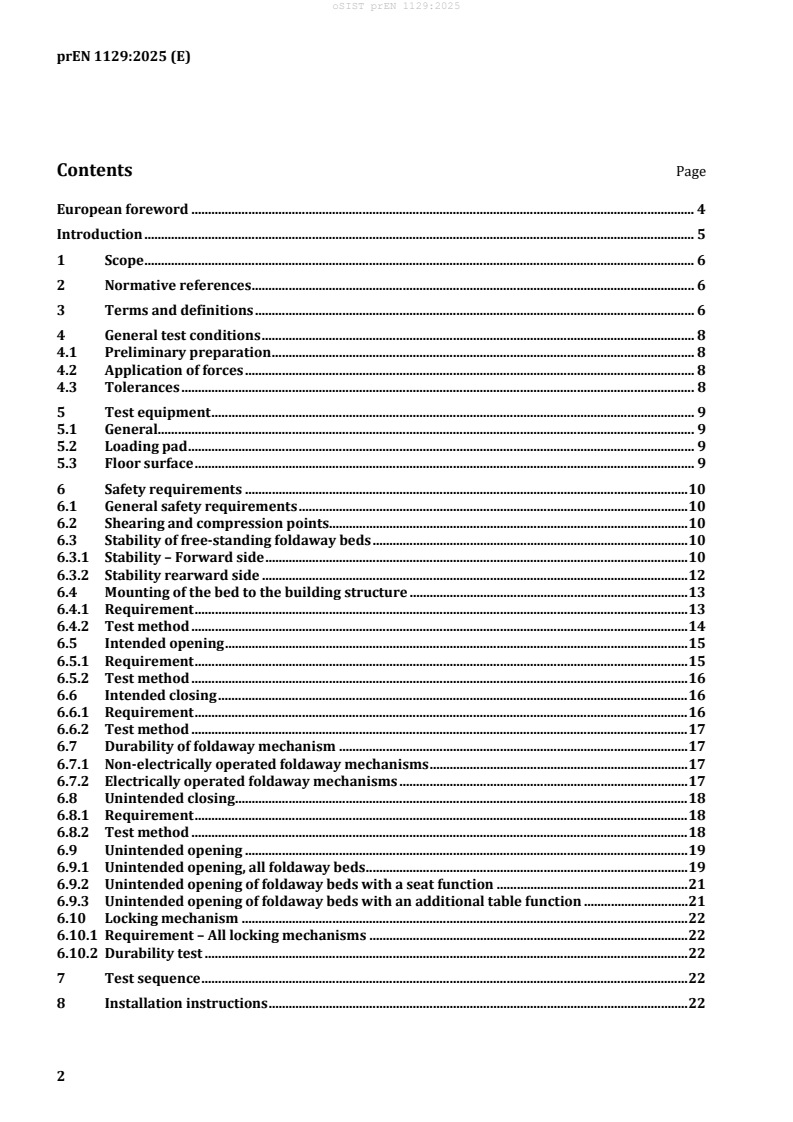
Contents Page
European foreword . 4
Introduction . 5
1 Scope . 6
2 Normative references . 6
3 Terms and definitions . 6
4 General test conditions . 8
4.1 Preliminary preparation . 8
4.2 Application of forces . 8
4.3 Tolerances . 8
5 Test equipment . 9
5.1 General. 9
5.2 Loading pad . 9
5.3 Floor surface . 9
6 Safety requirements . 10
6.1 General safety requirements . 10
6.2 Shearing and compression points. 10
6.3 Stability of free-standing foldaway beds . 10
6.3.1 Stability – Forward side . 10
6.3.2 Stability rearward side . 12
6.4 Mounting of the bed to the building structure . 13
6.4.1 Requirement . 13
6.4.2 Test method . 14
6.5 Intended opening . 15
6.5.1 Requirement . 15
6.5.2 Test method . 16
6.6 Intended closing . 16
6.6.1 Requirement . 16
6.6.2 Test method . 17
6.7 Durability of foldaway mechanism . 17
6.7.1 Non-electrically operated foldaway mechanisms . 17
6.7.2 Electrically operated foldaway mechanisms . 17
6.8 Unintended closing. 18
6.8.1 Requirement . 18
6.8.2 Test method . 18
6.9 Unintended opening . 19
6.9.1 Unintended opening, all foldaway beds . 19
6.9.2 Unintended opening of foldaway beds with a seat function . 21
6.9.3 Unintended opening of foldaway beds with an additional table function . 21
6.10 Locking mechanism . 22
6.10.1 Requirement – All locking mechanisms . 22
6.10.2 Durability test . 22
7 Test sequence . 22
8 Installation instructions . 22
9 Marking . 23
10 Purchase information . 23
11 Test report . 24
Annex A (informative) Rationale . 25
Annex B (informative) Explanation of the determination of the number of fixings required
per anchor device . 27
European foreword
This document (prEN 1129:2025) has been prepared by Technical Committee CEN/TC 207 “Furniture”,
the secretariat of which is held by UNI.
This document is currently submitted to the CEN Enquiry.
This document will supersede EN 1129-1:1995 and EN 1129-2:1995.
EN 1129-2:1995:
— combination of requirements and test methods;
— test methods updated/modified in order to serve requirements properly;
— introduction of requirements for free-standing foldaway beds;
— introduction of a durability test for electrically operated foldaway bed mechanisms;
— introduction of requirements for foldaway beds with additional functions, such as seating and tables
functions;
— structure revised and requirements/text aligned with other furniture standards;
— modification of requirements relating to unintended closing/opening to reflect actual risks;
— introduction of locking mechanism requirements and durability;
— update of the requirements for instructions for use;
— addition of requirements for point of sale information;
— incorporation of the test scheme from Annex A of the previous version into the main text;
— addition of a new informative Annex A containing a rationale of the tests and requirements;
— addition of a new informative Annex B with gives examples for the determination of the number of
fixings required per anchor device.
Introduction
This document contains two Annexes:
— Annex A (informative) – Rationale;
— Annex B (informative) – Explanation of the determination of the number of fixings required per
anchor device.
1 Scope
This document specifies safety requirements and test methods for foldaway beds for domestic and non-
domestic use.
The requirements only apply to the foldaway function of the bed.
The safety, strength and durability of the bed itself, including high beds and bunk beds, as well as other
functions e.g. seating, tables or storage, are covered by other European Standards.
Safety that is dependent upon the structure of the building is not included.
It does not include requirements for electrical safety.
It does not include requirements for the resistance to ageing, degradation and flammability.
The requirements apply without regard to materials, design, construction or manufacturing process.
This document does not apply to folding beds, camping beds and convertible bed/chairs or settees which
are covered by other European safety standards.
2 Normative references
The following documents are referred to in the text in such a way that some or all of their content
constitutes requirements of this document. For dated references, only the edition cited applies. For
undated references, the latest edition of the referenced document (including any amendments) applies.
EN 1728:2012, Furniture — Seating — Test methods for the determination of strength and durability
3 Terms and definitions
For the purposes of this document, the following terms and definitions apply.
ISO and IEC maintain terminology databases for use in standardization at the following addresses:
— ISO Online browsing platform: available at https://www.iso.org/obp
— IEC Electropedia: available at https://www.electropedia.org/
3.1
foldaway bed
bed equipped with an opening/closing mechanism, which is rotated about at least one horizontal axis,
allowing the bed to be stored against a wall, or in a cabinet when not in use
Note 1 to entry: The entire bed is either freestanding or fixed to the building structure.
3.2
open position
bed in the sleeping position
3.3
closed position
bed in the stored position
3.4
parts accessible during opening and closing
parts to which access can only be gained when opening and closing the bed, when a mattress equivalent
to the minimum size of mattress recommended by the manufacturer is on the sleeping surface
3.5
sleeping surface
part on which a mattress is placed
3.6
resisting force
force required to initiate movement of the foldaway function, either for opening or closing
3.7
end pivot bed
foldaway bed pivoting around one short side of the sleeping surface
3.8
side pivot bed
foldaway bed pivoting around one long side of the sleeping surface
3.9
levelling device
adjustable device intended to keep the item of furniture perpendicular to the floor
3.10
locking mechanism
assembly consisting of one or more locking device(s) and one or more operating device(s)
Note 1 to entry: Example for a locking mechanism: automatic latch lock.
3.11
locking device
component that maintains part(s) of the product in the position of use
EXAMPLE Latch, a hook, an over centre lock.
3.12
operating device
part of the locking mechanism(s) designed to be activated by the user by one or several action(s)
3.13
equilibrium
state in which opposing forces or influences are balanced
3.14
equilibrium zone
zone where the foldaway bed is between open position and closed position, measured in degrees from
the closed position, in which the state of equilibrium exists
3.15
pilot hole
small hole drilled as a guide for the insertion of a nail or screw, or for the drilling of a larger hole
3.16
anchor device
component to fix the foldaway bed structure to a building structure
3.17
duty cycle
length of time an electrically powered operating mechanism may be operated without impairing its useful
life
4 General test conditions
4.1 Preliminary preparation
The bed shall be tested as delivered. The bed shall be assembled and/or configured according to the
instructions supplied. Unless otherwise stated, the most adverse configuration shall be used for each test.
If mounting or assembly instructions are not supplied, the mounting or assembly method shall be
recorded in the test report. Fittings shall be tightened before testing and shall not be retightened unless
specifically required in the manufacturer’s instructions. If the configuration needs to be changed in order
to produce worst-case conditions, this shall be recorded in the test report.
Levelling devices shall be set as near as possible to 5 mm from their fully open position, whilst ensuring
the unit is horizontal to the floor.
For free-standing beds fitted with castors, the castors shall be set to the most adverse position and, for
lockable castors, the castors shall be locked.
Unless otherwise specified by the manufacturer, the sample for test shall be stored in indoor ambient
conditions for at least 24 h immediately prior to testing.
The tests shall be carried out at indoor ambient conditions but if during a test the temperature is outside
the range 15 °C to 27 °C the maximum and/or minimum temperature shall be recorded in the test report.
If a test cannot be carried out as specified, e.g. because a loading pad cannot be used for the application
of a force due to the design of a product, the test shall be carried out as closely as possible to that specified.
Any modification to the test method shall be technically justified and recorded in the test report. Before
beginning the testing, visually inspect the bed thoroughly. Record any defects so that they are not
assumed to have been caused by the tests. Carry out measurements, if specified.
4.2 Application of forces
The test forces in the static load tests shall be applied sufficiently slowly to ensure that negligible dynamic
load is applied. Unless otherwise specified, each specified force shall be maintained for not less than 10 s
and not more than 15 s.
The test forces in durability tests shall be applied at a rate to ensure that excessive heating does not occur.
Unless otherwise specified, each test force shall be maintained for (2 ± 1) s.
The forces may be replaced by masses. The relationship 10 N = 1 kg shall be used.
The weight of the loading pad and any associated equipment shall be considered when applying the test
load.
4.3 Tolerances
Unless otherwise stated the following tolerances are applicable:
— forces: ± 5 % of the nominal force;
— velocities: ± 5 % of the nominal velocity;
— masses: ± 1 % of the nominal mass;
— dimensions:
— all dimensions less than 200 mm shall have a tolerance of ± 1 mm of the nominal dimension;
— all other dimensions shall have a tolerance of ± 0,5 % of the nominal dimension;
— angles: ± 2° of the nominal angle.
The accuracy for the positioning of loading pads shall be ± 5 mm.
NOTE For the purposes of uncertainty measurement, test results are not considered to be adversely affected
when the above tolerances are met.
5 Test equipment
5.1 General
Unless otherwise stated, the tests may be applied by any suitable device, because results are dependent
only upon correctly applied forces and not on the apparatus.
The equipment shall not inhibit deformation of the bed, i.e. it shall move so that it can follow the
deformation of the bed during testing, so that the loads are always applied at the specified points and in
the specified directions.
5.2 Loading pad
Rigid disc 200 mm in diameter, the face of which has a convex spherical curvature of (300 ± 5) mm radius,
with a 12 mm edge radius (see Figure 1).
Dimensions in millimetres
Figure 1 — Loading pad
5.3 Floor surface
A rigid, horizontal and flat surface.
6 Safety requirements
6.1 General safety requirements
All assembly and pilot holes shall be made by the manufacturer.
It shall not be possible to dismantle the bed or its components without the use of a tool.
During operation of the foldaway function (i.e. moving the bed from the closed position to the open
position and back):
a) Edges and corners of parts accessible during opening and closing shall be rounded or chamfered and
free from burrs and sharp edges.
b) There shall be no open-ended tubes in parts accessible during opening and closing.
The maximum and minimum weight of the mattress recommended by the manufacturer shall be taken
into account during the test.
6.2 Shearing and compression points
If handles/handgrips are used to open/close the bed, they, shall have safety distances in any position of
movement of ≤ 8 mm or ≥ 18 mm, between the handles/handgrips and other components.
If there are no handles/handgrips there shall be no shearing and compression points that can
reach < 18 mm between rigid moving and/or rigid stationary parts when operating the bed. This applies
to a zone measured from 1 000 mm up to and including 1 600 mm, measured vertically from the floor
surface, and 60 mm from the edge’s users may use for closing the bed.
6.3 Stability of free-standing foldaway beds
6.3.1 Stability – Forward side
6.3.1.1 Requirements
This requirement does not apply to beds, and their associated components (e.g. wardrobes into which
the bed is mounted) that are intended to be fixed to the structure of the building.
When tested in accordance with 6.3.1.2 the product shall not overturn.
6.3.1.2 Test method
Place the product on the test floor (5.3).
Place the heaviest mattress recommended by the manufacturer on the sleeping surface or apply an evenly
distributed load to the sleeping surface such that the total load and centre of gravity is equivalent to the
maximum mattress weight and dimensions recommended by the manufacturer.
Castors shall be in the position most likely to cause overturning.
Open and close the bed 10 times.
Block the foldaway mechanism at a 70° angle in relation to vertical with a strap fixed from the upright
structure to the bed base structure, or by other suitable means, without preventing lifting and/or tipping
of the bed (see Figure 2).
Apply a force to the front edge of the movable part vertically with 750 N, (see Figure 2). Record if the
product overturns.
For beds with multiple sleeping surfaces in a structure that can be opened and closed separately, the tests
shall be carried out as follows:
— Open the beds.
— Position the heaviest mattresses in the beds.
— Block the foldaway mechanism of the lower bed at a 70° angle in relation to vertical with a strap fixed
from the upright structure to the bed base structure, or by other suitable means, without preventing
lifting and/or tipping of the bed. Simultaneous, apply on the lower bed, a force to the front edge of
the movable part vertically with 750 N and on the highest, a force of 750 N bed on a line located
inwards 200 mm from the outer side opposed to the axis of rotation of the bed (see Figure 3).
— Record if the product overturns.
Repeat the test with the lightest mattress recommended by the manufacturer on the sleeping surface, or
an evenly distributed load such that the total load and centre of gravity is equivalent to the minimum
mattress weight recommended by the manufacturer.
For safety during this test, the foldaway bed shall be secured so that it cannot tip more than 10° in relation
to vertical.
This test also verifies, in the event of a foldaway mechanism jamming, that the self-stabilizing function is
maintained.
Key
1 foldaway bed structure
2 foldaway bed sleeping surface
3 strap
F force
Figure 2 — Stability of free-standing foldaway beds
Key
1 foldaway bed structure
2 foldaway bed sleeping surface
3 mattress
Figure 3 — Stability of free-standing foldaway multiple beds
6.3.2 Stability rearward side
6.3.2.1 Requirements
This requirement does not apply to beds, and their associated components (e.g. wardrobes into which
the bed is mounted) that are intended to be fixed to the structure of the building.
When tested in accordance with 6.3.2.2 the product shall not tip over at an angle of greater than
15 degrees and at the start of tilt, the minimum force shall be greater than 150 N.
6.3.2.2 Test method
Place the product on the test floor (5.3), without a mattress on the sleeping surface.
The foldaway bed shall be in closed position.
Apply a horizontal force of maximum 500 N acting rearward, from the side where the bed is opened/
manoeuvred, acting 50 mm from the top edge of the foldaway bed or maximum 1 300 mm from the floor.
If the foldaway bed starts to tilt continue applying the force until it starts to tip over or until it has moved
15 degrees from the original position. Record the maximum tilting force applied and the reached angle of
movement.”.
Key
1 foldaway bed structure
2 front of the product
F force applied
d distance from the top edge of the foldaway bed to the point of application of F, 50 mm
h distance from the floor to the point of application of F, with a maximum of 1 300 mm
Figure 4 — Stability of free-standing foldaway multiple beds
6.4 Mounting of the bed to the building structure
6.4.1 Requirement
This requirement does not apply to beds that are intended to be free standing and to construction not
supported by the floor in the closed position and/or the sleeping surface in the open position is not
supported directly by the floor.
NOTE 1 If a construction is not supported by the floor in the closed position and/or the sleeping surface in the
open position is not supported directly by the floor, (additional) individual considerations for a safe mounting are
needed.
The bed shall be constructed such that its mountings comply with the following requirements:
a) there shall be at least two anchor devices, and;
b) there shall be at least two holes for attachment in each of the anchor devices, and;
c) the distance between the centre of any two mounting holes shall be greater than 50 mm, and;
d) the design of the anchor devices shall be such that no additional stress shall be transferred to the
anchor devices caused by the sagging of the floor by up to 10 mm maximum.
NOTE 2 Sagging of the floor can be caused by the use of carpets or rugs for example. An anchor device with a
vertical oblong hole allowing a minimum adjustment of 10 mm represents an acceptable solution if the instructions
for use are explicit on the assembly of the product in order to compensate for any sagging of the product after initial
assembly.
e) It shall not be possible to release the fixing devices without the use of tool.
f) The force F (see 6.4.2) shall be ≥ 400 N. For safety reasons, if the calculated F is < 400 N, consider
c c
F as 400 N. The information of the value shall be permanently attached on the rear side of the bed
c
and in the installation instruction to make clear what is the relevant tensile force acting at the level
and where the anchor devices are positioned.
NOTE 3 Explanation of the determination of the number of fixings required per anchor point/fixing device can
be found in Annex B.
6.4.2 Test method
Place the heaviest mattress recommended by the manufacturer on the sleeping surface, or apply an
evenly distributed load to the sleeping surface such that the total load and centre of gravity is equivalent
to the maximum mattress weight and dimensions recommended by
...