

FprEN 13035-2
(Main)Machines and plants for the manufacture, treatment and processing of flat glass - Safety requirements - Part 2: Storage, handling and transportation equipment outside the factory
General Information
- Abstract
1.1 This document includes safety requirements for the design and installation of equipment that is intended for storage, handling and transportation of flat glass outside the factory. It applies to machinery within the scope of Machinery Directive as well as to equipment that is not covered by Machinery Directive (see Figure F.1). If machines and equipment are not only used outside the factory, the requirements of EN 13035-1:2008 also apply.
1.2 This document specifies safety requirements for the following machinery for storage (see 3.2.1), handling (see 3.2.2) and transportation (see 3.2.3) of flat glass outside the factory (see 3.1.1):
- vehicle-mounted frails with motorized adjustment of the angle of lean for loading and unloading, which are used for road transport;
- inloader for road transport outside the factory, where loading and unloading is only made on virtually horizontal and sufficiently stable grounds that are free of significant irregularities;
- specific self-propelled equipment for securing the glass (inloader load-securing system, see 3.2.9);
- equipment for picking up single glass plates, firmly-attached glass plates or glass packs for transportation between different locations where the retention force or lifting force is generated by engine power.
1.3 This document specifies additional requirements in Annex A for the following equipment that is not covered by Machinery Directive:
- vehicle-mounted frails without an adjustable angle of lean for loading and unloading, which are used for road transport;
- movable storage equipment designed to transport the glass outside the factory (e.g. inloader stillages, see Figure C.6);
- glass-securing devices or systems for transport stillages (e.g. spring tensioning rods, stanchions).
NOTE Specific hazards due to the use inside the factory are dealt with in EN 13035-1:2008. This standard is still under review and is published as prEN 13035-1:2020 Machines and plants for the manufacture, treatment, and processing of flat glass - Safety requirements - Part 1: Storage, handling, and transportation equipment inside the factory.
1.4 This document deals with road transport as well as rail transport.
1.5 This document only deals with equipment which is in direct contact with the glass. This document does not apply to manual handling equipment such as carrying straps and manual vacuum lifting devices and to all packaging for glass which always opened and closed in the factory (see EN 13035-1:2008). Tractors, cranes, hoists and forklift trucks as well as elements of self-propelled vehicles, which are not in contact with the glass, are out of the scope. This document does not apply to the transport of glazed windows/frames, neither does it apply to equipment for different transportation than on road or on rail, e.g. by ships.
1.6 This document deals with all significant hazards, hazardous situations and hazardous events, which are relevant to equipment for storage, handling and transportation of flat glass, when they are used as intended and under the conditions of misuse which are reasonably foreseeable by the manufacturer (see Annex B). This document specifies the appropriate technical measures to eliminate or reduce risks arising from the significant hazards during commissioning, operation and maintenance. Noise hazards have not been considered significant for any type of equipment within the scope of this document. This document does not cover all phases of life of the product like transport to the customer, assembly, dismantling, disabling or scrapping.
1.7 This document does not apply to equipment for storage, handling and transportation of flat glass outside the factory, which is manufactured before the date of publication of this document as EN.
- Status
- Not Published
- Publication Date
- 28-Aug-2022
- Technical Committee
- CEN/TC 151 - Construction equipment and building material machines - Safety
- Current Stage
- 5098 - Decision to abandon - Formal Approval
- Start Date
- 15-Jul-2024
- Completion Date
- 30-Sep-2026

Overview
FprEN 13035-2 (prEN 13035-2:2020) is a CEN type-C standard that specifies safety requirements for equipment used to store, handle and transport flat glass outside the factory. It covers machinery and devices that are in direct contact with flat glass for road and rail transport, including vehicle-mounted frails, inloader vehicles, self‑propelled load‑securing systems and powered lifting/retention equipment. The standard applies to machinery within the scope of the EU Machinery Directive as well as certain equipment outside that scope (see Annex A). It complements EN 13035-1, which addresses equipment used inside the factory.
Key topics and technical requirements
- Scope and applicability: Defines which types of equipment are covered (frails with/without motorized angle adjustment, inloader vehicles, load‑securing systems, powered pickup devices) and what is excluded (manual lifting devices, cranes and vehicle elements not in contact with glass, glazed windows/frames, marine transport).
- Design and installation safety: Requirements for mechanical strength, bearer and cladding materials, and the construction of stillages and pallets intended for outdoor use.
- Glass‑retention and load‑securing: Rules for retention devices (stanchions, straps, hydraulic/pneumatic systems, airbags) and guidelines to prevent glass movement or impact during transport.
- Special systems: Particular provisions for inloader vehicles, truck/van‑mounted frails (angle of lean), vacuum lifting devices and rail transport configurations.
- Verification and information: Procedures for verification of compliance, marking, operator instructions, signals and documentation for safe commissioning, operation and maintenance.
- Risk coverage: Addresses foreseeable misuse and significant hazards during use while excluding noise (not considered significant here). Annex B lists significant hazards; Annex D provides guidance on retention devices.
Practical applications and users
This standard is practical for:
- Manufacturers of storage racks, inloader vehicles, frails, load‑securing systems and powered glass handling equipment.
- System integrators and fleet operators specifying safe transport equipment for flat glass.
- Health & safety professionals and market surveillance authorities assessing compliance with machine safety.
- Maintenance and service providers responsible for commissioning and in‑field checks. Using EN 13035-2 helps reduce breakage, worker injury and liability by standardizing safe equipment design and information for road and rail transport of flat glass.
Related standards
- EN 13035-1 (safety for storage, handling and transport inside the factory)
- EN ISO 12100 (general principles of risk assessment - type‑C standard relationship)
- Machinery Directive 2006/42/EC (relevance for equipment within scope)
Keywords: flat glass safety, storage handling transportation equipment, EN 13035-2, CEN, inloader, frails, load‑securing, glass retention devices.
Relations
- Effective Date
- 12-Jun-2019
Frequently Asked Questions
FprEN 13035-2 is a draft published by the European Committee for Standardization (CEN). Its full title is "Machines and plants for the manufacture, treatment and processing of flat glass - Safety requirements - Part 2: Storage, handling and transportation equipment outside the factory". This standard covers: 1.1 This document includes safety requirements for the design and installation of equipment that is intended for storage, handling and transportation of flat glass outside the factory. It applies to machinery within the scope of Machinery Directive as well as to equipment that is not covered by Machinery Directive (see Figure F.1). If machines and equipment are not only used outside the factory, the requirements of EN 13035-1:2008 also apply. 1.2 This document specifies safety requirements for the following machinery for storage (see 3.2.1), handling (see 3.2.2) and transportation (see 3.2.3) of flat glass outside the factory (see 3.1.1): - vehicle-mounted frails with motorized adjustment of the angle of lean for loading and unloading, which are used for road transport; - inloader for road transport outside the factory, where loading and unloading is only made on virtually horizontal and sufficiently stable grounds that are free of significant irregularities; - specific self-propelled equipment for securing the glass (inloader load-securing system, see 3.2.9); - equipment for picking up single glass plates, firmly-attached glass plates or glass packs for transportation between different locations where the retention force or lifting force is generated by engine power. 1.3 This document specifies additional requirements in Annex A for the following equipment that is not covered by Machinery Directive: - vehicle-mounted frails without an adjustable angle of lean for loading and unloading, which are used for road transport; - movable storage equipment designed to transport the glass outside the factory (e.g. inloader stillages, see Figure C.6); - glass-securing devices or systems for transport stillages (e.g. spring tensioning rods, stanchions). NOTE Specific hazards due to the use inside the factory are dealt with in EN 13035-1:2008. This standard is still under review and is published as prEN 13035-1:2020 Machines and plants for the manufacture, treatment, and processing of flat glass - Safety requirements - Part 1: Storage, handling, and transportation equipment inside the factory. 1.4 This document deals with road transport as well as rail transport. 1.5 This document only deals with equipment which is in direct contact with the glass. This document does not apply to manual handling equipment such as carrying straps and manual vacuum lifting devices and to all packaging for glass which always opened and closed in the factory (see EN 13035-1:2008). Tractors, cranes, hoists and forklift trucks as well as elements of self-propelled vehicles, which are not in contact with the glass, are out of the scope. This document does not apply to the transport of glazed windows/frames, neither does it apply to equipment for different transportation than on road or on rail, e.g. by ships. 1.6 This document deals with all significant hazards, hazardous situations and hazardous events, which are relevant to equipment for storage, handling and transportation of flat glass, when they are used as intended and under the conditions of misuse which are reasonably foreseeable by the manufacturer (see Annex B). This document specifies the appropriate technical measures to eliminate or reduce risks arising from the significant hazards during commissioning, operation and maintenance. Noise hazards have not been considered significant for any type of equipment within the scope of this document. This document does not cover all phases of life of the product like transport to the customer, assembly, dismantling, disabling or scrapping. 1.7 This document does not apply to equipment for storage, handling and transportation of flat glass outside the factory, which is manufactured before the date of publication of this document as EN.
1.1 This document includes safety requirements for the design and installation of equipment that is intended for storage, handling and transportation of flat glass outside the factory. It applies to machinery within the scope of Machinery Directive as well as to equipment that is not covered by Machinery Directive (see Figure F.1). If machines and equipment are not only used outside the factory, the requirements of EN 13035-1:2008 also apply. 1.2 This document specifies safety requirements for the following machinery for storage (see 3.2.1), handling (see 3.2.2) and transportation (see 3.2.3) of flat glass outside the factory (see 3.1.1): - vehicle-mounted frails with motorized adjustment of the angle of lean for loading and unloading, which are used for road transport; - inloader for road transport outside the factory, where loading and unloading is only made on virtually horizontal and sufficiently stable grounds that are free of significant irregularities; - specific self-propelled equipment for securing the glass (inloader load-securing system, see 3.2.9); - equipment for picking up single glass plates, firmly-attached glass plates or glass packs for transportation between different locations where the retention force or lifting force is generated by engine power. 1.3 This document specifies additional requirements in Annex A for the following equipment that is not covered by Machinery Directive: - vehicle-mounted frails without an adjustable angle of lean for loading and unloading, which are used for road transport; - movable storage equipment designed to transport the glass outside the factory (e.g. inloader stillages, see Figure C.6); - glass-securing devices or systems for transport stillages (e.g. spring tensioning rods, stanchions). NOTE Specific hazards due to the use inside the factory are dealt with in EN 13035-1:2008. This standard is still under review and is published as prEN 13035-1:2020 Machines and plants for the manufacture, treatment, and processing of flat glass - Safety requirements - Part 1: Storage, handling, and transportation equipment inside the factory. 1.4 This document deals with road transport as well as rail transport. 1.5 This document only deals with equipment which is in direct contact with the glass. This document does not apply to manual handling equipment such as carrying straps and manual vacuum lifting devices and to all packaging for glass which always opened and closed in the factory (see EN 13035-1:2008). Tractors, cranes, hoists and forklift trucks as well as elements of self-propelled vehicles, which are not in contact with the glass, are out of the scope. This document does not apply to the transport of glazed windows/frames, neither does it apply to equipment for different transportation than on road or on rail, e.g. by ships. 1.6 This document deals with all significant hazards, hazardous situations and hazardous events, which are relevant to equipment for storage, handling and transportation of flat glass, when they are used as intended and under the conditions of misuse which are reasonably foreseeable by the manufacturer (see Annex B). This document specifies the appropriate technical measures to eliminate or reduce risks arising from the significant hazards during commissioning, operation and maintenance. Noise hazards have not been considered significant for any type of equipment within the scope of this document. This document does not cover all phases of life of the product like transport to the customer, assembly, dismantling, disabling or scrapping. 1.7 This document does not apply to equipment for storage, handling and transportation of flat glass outside the factory, which is manufactured before the date of publication of this document as EN.
FprEN 13035-2 is classified under the following ICS (International Classification for Standards) categories: 81.100 - Equipment for the glass and ceramics industries. The ICS classification helps identify the subject area and facilitates finding related standards.
FprEN 13035-2 has the following relationships with other standards: It is inter standard links to EN 13035-2:2008. Understanding these relationships helps ensure you are using the most current and applicable version of the standard.
FprEN 13035-2 is associated with the following European legislation: EU Directives/Regulations: 2006/42/EC; Standardization Mandates: M/396, M/BC/CEN/88/13. When a standard is cited in the Official Journal of the European Union, products manufactured in conformity with it benefit from a presumption of conformity with the essential requirements of the corresponding EU directive or regulation.
FprEN 13035-2 is available in PDF format for immediate download after purchase. The document can be added to your cart and obtained through the secure checkout process. Digital delivery ensures instant access to the complete standard document.
Standards Content (Sample)
SLOVENSKI STANDARD
oSIST prEN 13035-2:2020
01-julij-2020
Stroji in obrati za proizvodnjo, obdelavo in predelavo ravnega stekla - Varnostne
zahteve - 2. del: Oprema za skladiščenje, ravnanje s steklom in transport zunaj
tovarne
Machines and plants for the manufacture, treatment and processing of flat glass - Safety
requirements - Part 2: Storage, handling and transportation equipment outside the
factory
Maschinen und Anlagen für die Herstellung, Be- und Verarbeitung von Flachglas -
Sicherheitsanforderungen - Teil 2: Einrichtungen zum Lagern, Handhaben und
Transportieren außerhalb des Werks
Machines et installations pour la production, le façonnage et la transformation du verre
plat - Exigences de sécurité - Partie 2 : Équipements de stockage, de manutention et de
transport à l'extérieur de l'usine
Ta slovenski standard je istoveten z: prEN 13035-2
ICS:
81.100 Oprema za steklarsko in Equipment for the glass and
keramično industrijo ceramics industries
oSIST prEN 13035-2:2020 en,fr,de
2003-01.Slovenski inštitut za standardizacijo. Razmnoževanje celote ali delov tega standarda ni dovoljeno.
oSIST prEN 13035-2:2020
oSIST prEN 13035-2:2020
DRAFT
EUROPEAN STANDARD
prEN 13035-2
NORME EUROPÉENNE
EUROPÄISCHE NORM
May 2020
ICS 81.100 Will supersede EN 13035-2:2008
English Version
Machines and plants for the manufacture, treatment and
processing of flat glass - Safety requirements - Part 2:
Storage, handling and transportation equipment outside
the factory
Machines et installations pour la production, le Maschinen und Anlagen für die Herstellung, Be- und
façonnage et la transformation du verre plat - Verarbeitung von Flachglas - Sicherheitsanforderungen
Exigences de sécurité - Partie 2 : Équipements de - Teil 2: Einrichtungen zum Lagern, Handhaben und
stockage, de manutention et de transport à l'extérieur Transportieren außerhalb des Werks
de l'usine
This draft European Standard is submitted to CEN members for enquiry. It has been drawn up by the Technical Committee
CEN/TC 151.
If this draft becomes a European Standard, CEN members are bound to comply with the CEN/CENELEC Internal Regulations
which stipulate the conditions for giving this European Standard the status of a national standard without any alteration.
This draft European Standard was established by CEN in three official versions (English, French, German). A version in any other
language made by translation under the responsibility of a CEN member into its own language and notified to the CEN-CENELEC
Management Centre has the same status as the official versions.
CEN members are the national standards bodies of Austria, Belgium, Bulgaria, Croatia, Cyprus, Czech Republic, Denmark, Estonia,
Finland, France, Germany, Greece, Hungary, Iceland, Ireland, Italy, Latvia, Lithuania, Luxembourg, Malta, Netherlands, Norway,
Poland, Portugal, Republic of North Macedonia, Romania, Serbia, Slovakia, Slovenia, Spain, Sweden, Switzerland, Turkey and
United Kingdom.
Recipients of this draft are invited to submit, with their comments, notification of any relevant patent rights of which they are
aware and to provide supporting documentation.
Warning : This document is not a European Standard. It is distributed for review and comments. It is subject to change without
notice and shall not be referred to as a European Standard.
EUROPEAN COMMITTEE FOR STANDARDIZATION
COMITÉ EUROPÉEN DE NORMALISATION
EUROPÄISCHES KOMITEE FÜR NORMUNG
CEN-CENELEC Management Centre: Rue de la Science 23, B-1040 Brussels
© 2020 CEN All rights of exploitation in any form and by any means reserved Ref. No. prEN 13035-2:2020 E
worldwide for CEN national Members.
oSIST prEN 13035-2:2020
prEN 13035-2:2020 (E)
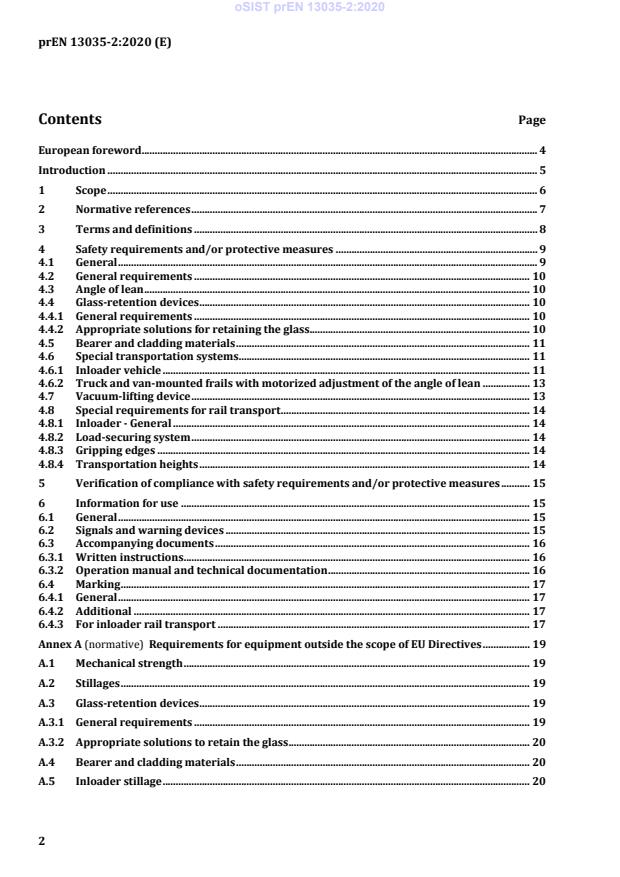
Contents Page
European foreword . 4
Introduction . 5
1 Scope . 6
2 Normative references . 7
3 Terms and definitions . 8
4 Safety requirements and/or protective measures . 9
4.1 General . 9
4.2 General requirements . 10
4.3 Angle of lean . 10
4.4 Glass-retention devices . 10
4.4.1 General requirements . 10
4.4.2 Appropriate solutions for retaining the glass. 10
4.5 Bearer and cladding materials . 11
4.6 Special transportation systems . 11
4.6.1 Inloader vehicle . 11
4.6.2 Truck and van-mounted frails with motorized adjustment of the angle of lean . 13
4.7 Vacuum-lifting device . 13
4.8 Special requirements for rail transport . 14
4.8.1 Inloader - General . 14
4.8.2 Load-securing system . 14
4.8.3 Gripping edges . 14
4.8.4 Transportation heights . 14
5 Verification of compliance with safety requirements and/or protective measures . 15
6 Information for use . 15
6.1 General . 15
6.2 Signals and warning devices . 15
6.3 Accompanying documents . 16
6.3.1 Written instructions . 16
6.3.2 Operation manual and technical documentation . 16
6.4 Marking . 17
6.4.1 General . 17
6.4.2 Additional . 17
6.4.3 For inloader rail transport . 17
Annex A (normative) Requirements for equipment outside the scope of EU Directives . 19
A.1 Mechanical strength . 19
A.2 Stillages . 19
A.3 Glass-retention devices . 19
A.3.1 General requirements . 19
A.3.2 Appropriate solutions to retain the glass . 20
A.4 Bearer and cladding materials . 20
A.5 Inloader stillage . 20
oSIST prEN 13035-2:2020
prEN 13035-2:2020 (E)
A.6 Truck and van mounted frails . 21
A.7 Stillages and pallets . 21
A.8 Special requirements for rail transport of stillages . 21
A.9 Verification of compliance with safety requirements and/or protective measures . 21
A.10 Information for use and marking . 22
A.10.2 Marking . 23
Annex B (informative) List of significant hazards . 24
B.1 General . 24
B.2 During transport and handling . 24
B.3 During loading and unloading of glass . 26
B.4 Flat-glass transportation by inloader . 28
Annex C (informative) Different types of equipment . 30
Annex D (informative) Guidelines for glass retention devices . 35
D.1 Hydraulic and pneumatic retention devices . 35
D.2 Airbags/cushions . 35
D.3 Stanchions for retention on frails . 35
D.4 Protection of the belts against glass impact by means of an edge protection . 35
D.5 (Ratchet) Straps . 35
Annex E (informative) Symbols for labels and signs . 36
Annex F (informative) Overview over the equipment for the storage, handling and
transportation of glass . 37
Annex G (informative) Significant technical changes in this European Standard compared to
the previous edition . 38
Annex ZA (informative) Relationship between this European Standard and the essential
requirements of Directive2006/42/EC aimed to be covered . 39
Bibliography . 48
oSIST prEN 13035-2:2020
prEN 13035-2:2020 (E)
European foreword
This document (prEN 13035-2:2020) has been prepared by Technical Committee CEN/TC 151
“Construction equipment and building material machines - Safety”, the secretariat of which is held by
DIN.
This document is currently submitted to the CEN Enquiry.
This document will supersede EN 13035-2:2008.
This document has been prepared under a standardization request given to CEN by the European
Commission and the European Free Trade Association, and supports essential requirements of
EU Directive(s).
For relationship with EU Directive(s), see informative Annex ZA, which is an integral part of this
document.
oSIST prEN 13035-2:2020
prEN 13035-2:2020 (E)
Introduction
This document is a type-C standard as stated in EN ISO 12100.
This document is of relevance, in particular, for the following stakeholder groups representing the market
players with regard to machinery safety:
a) machine manufacturers (small, medium and large enterprises);
b) health and safety bodies (regulators, accident prevention organizations, market surveillance, etc.).
Others can be affected by the level of machinery safety achieved with the means of the document by the
above-mentioned stakeholder groups:
a) machine users/employers (small, medium and large enterprises);
b) machine users/employees (e.g. trade unions, organizations for people with special needs);
c) service providers, e.g. for maintenance (small, medium and large enterprises);
d) consumers (in case of machinery intended for use by consumers).
The above-mentioned stakeholder groups have been given the possibility to participate at the drafting
process of this document.
The machinery and equipment concerned and the extent to which hazards, hazardous situations and
hazardous events are covered are indicated in the scope of this document.
When requirements of this type-C standard are different from those which are stated in type-A or type-B
standards, the requirements of this type-C standard take precedence over the requirements of the other
standards for machines that have been designed and built according to the requirements of this type-C
standard.
In this document it is assumed that
— negotiation occurs between the manufacturer and the user/purchaser concerning particular
conditions of use not dealt with in this document;
— stationary storage equipment with or without mobile support and mechanical handling devices (see
EN 13035-1) are not intended for use outside the factory;
— mobile stillages and inloader stillages can only be used on virtually horizontal and sufficiently stable
grounds that are free of significant irregularities (see Clause 6).
oSIST prEN 13035-2:2020
prEN 13035-2:2020 (E)
1 Scope
1.1 This document includes safety requirements for the design and installation of equipment that is
intended for storage, handling and transportation of flat glass outside the factory. It applies to machinery
within in the scope of EU Directives as well as to equipment that is covered by non-harmonized
documents.
1.2 This document specifies safety requirements for the following equipment for storage (see 3.2.1),
handling (see 3.2.2) and transportation (see 3.2.3) of flat glass outside the factory (see 3.1.1):
— vehicle-mounted frails with motorized adjustment of the angle of lean for loading and unloading,
which are used for road transport;
— inloader vehicles for road transport outside the factory, where loading and unloading is only made
on virtually horizontal and sufficiently stable grounds that are free of significant irregularities;
— specific self-propelled equipment for securing the glass (inloader load-securing systems);
— equipment for picking up single glass plates, firmly-attached glass plates or glass packs for
transportation between different locations where the retention force or lifting force is generated by
engine power.
1.3 This document specifies additional requirements for the following equipment that is not covered
by EU Directives:
— vehicle-mounted frails without an adjustable angle of lean for loading and unloading, which are used
for road transport;
— movable storage equipment designed to transport the glass outside the factory (e.g. inloader
stillages, see Figure C.6);
— glass-securing devices or systems for transport stillages (e.g. spring tensioning rods, stanchions).
NOTE Specific hazards due to the use inside the factory are dealt with in EN 13035-1.
1.4 This document deals with road transport as wells as rail transport.
1.5 This document only deals with equipment which is in direct contact with the glass. This document
does not apply to manual handling equipment such as carrying straps and manual vacuum lifting devices
and to all packaging for glass which always opened and closed in the factory (see EN 13035-1). Tractors,
cranes, hoists and forklift trucks as well as elements of self-propelled vehicles, which are not in contact
with the glass, are out of the scope. This document does not apply to the transport of glazed
windows/frames, neither does it apply to equipment for different transportation than on road or on rail,
e.g. by ships.
1.6 This document deals with all significant hazards, hazardous situations and hazardous events, which
are relevant to equipment for storage, handling and transportation of flat glass, when they are used as
intended and under the conditions of misuse which are reasonably foreseeable by the manufacturer (see
Annex B). This document specifies the appropriate technical measures to eliminate or reduce risks
arising from the significant hazards during commissioning, operation and maintenance. Noise hazards
have not been considered significant for any type of equipment within the scope of this document.
1.7 This document does not apply to equipment for storage, handling and transportation of flat glass
outside the factory, which is manufactured before the date of publication of this document as EN.
oSIST prEN 13035-2:2020
prEN 13035-2:2020 (E)
2 Normative references
The following documents are referred to in the text in such a way that some or all of their content
constitutes requirements of this document. For dated references, only the edition cited applies. For
undated references, the latest edition of the referenced document (including any amendments) applies.
EN 981:1996+A1:2008, Safety of machinery — System of auditory and visual danger and information
signals
1)
EN 1993-1-1:2005, Eurocode 3: Design of steel structures — Part 1-1: General rules and rules for
buildings
EN 12195-1:2010, Load restraining on road vehicles — Safety — Part 1: Calculation of securing forces
prEN 13035-1:2020, Machines and plants for the manufacture, treatment and processing of flat glass —
Safety requirements — Part 1: Storage, handling and transportation equipment inside the factory
EN 13044-3:2011, Intermodal Loading Units — Marking — Part 3: Markings of semi-trailers related to rail
operation
EN 13155:2020, Crane — Safety — Non-fixed load lifting attachments
EN 60204-1:2018, Safety of machinery — Electrical equipment of machines — Part 1: General
requirements (IEC 60204-1:2016, modified)
EN ISO 11201:2010, Acoustics — Noise emitted by machinery and equipment — Determination of emission
sound pressure levels at a work station and at other specified positions in an essentially free field over a
reflecting plane with negligible environmental corrections (ISO 11201:2010)
EN ISO 11202:2010, Acoustics — Noise emitted by machinery and equipment — Determination of emission
sound pressure levels at a work station and at other specified positions applying approximate environmental
corrections (ISO 11202:2010)
EN ISO 12100:2010, Safety of machinery — General principles for design — Risk assessment and risk
reduction (ISO 12100:2010)
EN ISO 13849-1:2015, Safety of machinery — Safety-related parts of control systems — Part 1: General
principles for design (ISO 13849-1:2015)
EN ISO 13850:2015, Safety of machinery — Emergency stop function — Principles for design
(ISO 13850:2015)
EN ISO 13855:2010, Safety of machinery — Positioning of safeguards with respect to the approach speeds
of parts of the human body (ISO 13855:2010)
EN ISO 13857:2019, Safety of machinery — Safety distances to prevent hazard zones being reached by
upper and lower limbs (ISO 13857:2019)
EN ISO 14118:2018, Safety of machinery — Prevention of unexpected start-up (ISO 14118:2017)
1)
This document is impacted by EN 1993-1-1:2005/A1:2014.
oSIST prEN 13035-2:2020
prEN 13035-2:2020 (E)
EN ISO 14119:2013, Safety of machinery — Interlocking devices associated with guards — Principles for
design and selection (ISO 14119:2013)
EN ISO 14120:2015, Safety of machinery — Guards — General requirements for the design and
construction of fixed and movable guards (ISO 14120:2015)
EN ISO 14122-1:2016, Safety of machinery — Permanent means of access to machinery — Part 1: Choice
of fixed means and general requirements of access (ISO 14122-1:2016)
EN ISO 14122-2:2016, Safety of machinery — Permanent means of access to machinery — Part 2: Working
platforms and walkways (ISO 14122-2:2016)
EN ISO 14122-3:2016, Safety of machinery — Permanent means of access to machinery — Part 3: Stairs,
stepladders and guard-rails (ISO 14122-3:2016)
EN ISO 14122-4:2016, Safety of machinery — Permanent means of access to machinery — Part 4: Fixed
ladders (ISO 14122-4:2016)
prEN ISO 7010:2019, Graphical symbols — Safety colours and safety signs — Registered safety signs
(ISO 7010:2019)
UIC Leaflet 50596-5, Transport of road vehicles on wagons — Technical Organization — Conveyance of
semi-trailers with P coding or N coding on recess wagons, 1st edition, June 2018
3 Terms and definitions
For the purposes of this document, the terms and definitions given in EN ISO 12100, EN 13035-1 and the
following apply.
ISO and IEC maintain terminological databases for use in standardization at the following addresses:
— ISO Online browsing platform: available at http://www.iso.org/obp
— IEC Electropedia: available at http://www.electropedia.org/
3.1
General terms and definitions
3.1.1
outside the factory
all areas outside of enclosed buildings and company premises for the manufacture, treatment and
processing of glass, where the glass is stored and transported, and outside of storage facilities, e.g.
building sites
3.1.2
unattended combined traffic (rail transport)
transportation of flat glass using inloaders without a tractor unit by means of a rail-bound traffic system
(railway) where loading is carried out by lifting operation
3.1.3
gust
sudden wind speed increase
oSIST prEN 13035-2:2020
prEN 13035-2:2020 (E)
3.2
Definitions and definitions relating to the equipment
3.2.1
storage equipment
stationary, movable or mobile equipment for storing glass packs, firmly-attached glass plates or single
plates; certain equipment is also used for transportation
3.2.2
handling equipment
specifically, designed device to support and retain a single glass plate, firmly-attached glass plates or a
glass pack during transportation between different locations
3.2.3
transportation equipment
equipment for the movement of glass or storage equipment in unloaded and loaded condition or for the
movement by means of load-lifting attachments (Figure C.7)
3.2.4
frail
equipment for transportation of glass plates in a nearly vertical position which is fixed or mounted to the
outside of a vehicle (see Figures C.1, C.2 and C.3)
3.2.5
inloader
transportation equipment (usually a semi-trailer) with a self-loading and self-locking mechanism for
stillages according to 3.2.6 with or without glass plates/glass pack(s) (see Figure C.5)
3.2.6
inloader stillage
movable equipment for retaining and supporting glass packs or single glass plates in order to allow
transport by semi-trailers according to 3.2.5 (Figure C.6)
3.2.7
thin glass frames
storage and transportation equipment for glass packs with a thickness of usually less than 2,5 mm
3.2.8
gripping edge
lifting points for vertical lifting of the semi-trailer
4 Safety requirements and/or protective measures
4.1 General
Machinery shall comply with the safety requirements and/or protective measures of this clause. In
addition, the machine shall be designed according to the principles of EN ISO 12100:2010 for relevant,
but not significant, and which are not dealt with by this document (e.g. sharp edges).
For the applications of a type-B document, such as EN 60204-1:2018, EN ISO 13849-1:2015,
EN ISO 13850:2015, EN ISO 13855:2010, EN ISO 13857:2019, EN ISO 14118:2018, EN ISO 14119:2013,
EN ISO 14120:2015, the manufacturer shall carry out an adequate risk assessment in relation to the
requirements contained in these standards and that need to be selected.
oSIST prEN 13035-2:2020
prEN 13035-2:2020 (E)
NOTE This specific risk assessment is part of the general risk assessment relating to the hazards that are not
covered by this document.
4.2 General requirements
4.2.1 Equipment shall be designed in accordance with EN ISO 12100:2010, 6.2.3, and shall be
manufactured using materials complying with EN ISO 12100:2010, 6.2.3.
Equipment shall comply with prEN 13035-1:2020, unless otherwise stated in this clause.
4.2.2 Mechanical strength
Inloaders, inloader load-securing devices and frails with power-driven function shall be capable of
resisting a load of at least 1,5 times the maximum permissible load without permanent deformation. For
transportation by all types of vehicles, all equipment shall be capable of resisting a force caused by an
acceleration of 0,8 g in the driving direction (longitudinally) and 0,5 g in the perpendicular direction
(laterally), which results from the dynamic forces. If the equipment, e.g. stillages, is not able to resist these
forces by design, then it is necessary to give information about how to withstand these forces by using a
further (additional) retention device.
4.2.3 Mechanical strength for combined transport
If equipment is intended to be also used for rail transport, it shall be designed, in addition to 4.2.2, such
that it resists a force resulting from dynamic forces caused by an acceleration of 1,0 g longitudinally and
0,5 g in perpendicular direction.
4.3 Angle of lean
4.3.1 Frails shall have an angle of lean of at least 4° if the vehicle is parked on horizontal ground under
the most unfavourable loading conditions.
4.3.2 For loading or unloading single plates, the frail shall be provided with an indication device
showing to the operator that the angle of lean is maintained correctly (see Figure C.4)).
4.4 Glass-retention devices
4.4.1 General requirements
Provisions shall be made for retaining the glass. If retention devices are not part of the equipment,
appropriate instructions shall be included in the operating manual (see 6.3).
The design of glass-retention devices shall demonstrate sufficient resistance to the glass; the mass of the
glass to be transported, the dynamic forces and the friction forces (see A.2 Stillages), which can occur
under extreme operating conditions, shall be taken into account for:
a) prevention of damage to the glass;
b) prevention of damage by the glass;
c) measures against failure or unintended deactivation of the retention function.
4.4.2 Appropriate solutions for retaining the glass
Appropriate solutions for retaining the glass are:
a) hydraulic and pneumatic retention devices;
b) airbags/cushions;
oSIST prEN 13035-2:2020
prEN 13035-2:2020 (E)
c) stanchions;
d) belts/straps.
See Annex D (informative) for additional guidance.
4.5 Bearer and cladding materials
4.5.1 Cladding materials shall be used in order to prevent contact with any substance harder than the
glass; it shall be softer than the glass. All fixing materials shall be sufficiently countersunk below any
surface likely to come in contact with the glass in order to avoid such contact even at maximum load.
4.5.2 Back bearers
Cladding materials for back bearers and stanchions shall be sufficiently resilient to cushion the glass.
4.5.3 Base bearers
Cladding materials for base bearers shall be able to resist the weight of the glass.
4.6 Special transportation systems
4.6.1 Inloader vehicle
4.6.1.1 For reversing operation, an automatically acting visual or auditory warning device in
accordance with EN 981:1996+A1:2008 is necessary to warn persons outside the viewable area and to
indicate to leave the area at the rear of the inloader.
4.6.1.2 All work stations and maintenance locations shall be accessible from floor level, or
appropriate means for access in accordance with the EN ISO 14122:2016 series shall be provided.
Integral task-specific lighting with an illuminance of at least 100 lx for work stations and of at least 50 lx
for maintenance locations shall be provided
a) where access is assumed to be frequent (more than once a day);
b) where it can be assumed that general ambient lighting at the place of use is not sufficient (e.g. inside
the load compartment and on the inside of the front platform).
4.6.1.3 Around the vehicle, the design shall provide for a minimum gap of 100 mm between the
ground and parts of the vehicle, except inside the load compartment and for those elements which are
necessary to pick up the load. In these areas, a minimum distance of 50 mm shall be provided.
Measures against fall (of persons) from platforms from a falling height of more than one meter, e.g. the
front platform inside the vehicle, are necessary in form of suitable barriers, e.g. a handrail at a height
between 1,00 m and 1,10 m and a knee rail at approximately half the height.
Parts inside the inloader where slipping, tripping or impact hazards are present shall be clearly marked
by yellow and contrasting black stripes in accordance with ISO 3864-1.
If a stillage is present inside the load compartment, access to this load compartment inside the vehicle
shall be prohibited by a prohibition sign in accordance with Figure E.2, completed by a supplementary
sign stating “Access prohibited when stillage inside” in accordance with ISO 3864-1.
A device shall be provided (e.g. a fixing bar) for locking the rear door in each normal open position (e.g.
90° and 270°) to prevent the door being closed due to gust.
oSIST prEN 13035-2:2020
prEN 13035-2:2020 (E)
4.6.1.4 For movable kingpin frames, a locking device is necessary in the lifted position. This locking
device can be a mechanical or a redundant hydraulic locking device, e.g. with dual releasable non-return
check valves on two cylinders. If the unlocked position is possible, it shall be indicated by optical means
located close to the locking control device (e.g. by a yellow indicator light). Reaching the driving height
shall be indicated by marking, e.g. a pointer.
If the vehicle is equipped with a fixed king pin frame, the requirements for operating heights at the semi-
trailer coupling point of the tractor unit shall be indicated near the semi-trailer coupling point.
Furthermore, the specification of permissible dimensions of the profile of inloader stillages to be
transported is required for these types of vehicles.
4.6.1.5 A device for keeping the load in balance in all directions during lifting and lowering shall be
provided. If these devices make use of the inloader wheel-suspension system, this can be achieved by e.g.
an electronically controlled air-suspension system.
To avoid unexpected movement during lifting and lowering, an approved brake-release function is
necessary.
A device (fail-safe system) is required to avoid contact of the load (stillage) with the ground during
transportation (operating manual). The device shall be readily accessible from ground level and be
operable even when wearing the required personal protective equipment (e.g. gloves).
4.6.1.6 Control actuators and displays for the rear door, the kingpin frame and the load-securing
system (even if only parts of it are activated or deactivated) shall be arranged outside of the area from
which the danger zone can be reached, and they shall be clearly and unambiguously marked (e.g. function,
operating mode (functionality), preferably by using pictograms).
At the control station for closing and opening the rear door, the unobstructed view of the main closing
edge shall be possible. All other edges of the door shall be at a minimum distance of 25 mm to the vehicle
body. The free space can be filled with sufficiently soft material, e.g. foam rubber. In addition, a warning
sign (see Figure E.1) indicating the danger of finger crushing near the main closing edge is required.
A movement of the powered load-securing device shall only be possible by means of a hold-to-run control
device. The control device shall be accessible only after opening the rear door, and it shall enable the
operator to move to a location that is outside the danger zone of falling glass, e.g. by using a cable remote
control. The related parts of the control system shall be in accordance with of EN ISO 13849-1:2015,
performance level c. Close to the hold-to-run control device, an emergency-stop device for controlling the
load-securing system with a control circuit at least in accordance with EN ISO 13849-1:2015,
performance level c, is necessary. Devices indicating that the load-securing system has reached the end
position shall be provided for the glass-retaining position and the open position, where the glass-
retaining position shall be indicated permanently.
Engaging the door-locking device shall not be possible without prior activation of the load-securing
device. If no load-securing device is needed or with an empty “L” rack or during empty run, an
acknowledgement key shall be actuated which is located on the side of the inloader that is opposite to the
control units of the door-closing mechanism and the load-securing mechanism. This key shall be designed
as a hold-to-run control.
4.6.1.7 Technical measures shall be taken against the unexpected start of dangerous movements
after power return (e.g. when changing the tractor unit). This applies in particular to the load-securing
system and the rear door.
Measures are required to prevent the operation by unauthorised persons (e.g. by locking the control
actuators).
In order to prevent hydraulic movements during interventions, an isolating device such as a (pump) main
switch or a plug connection to the tractor unit (lockable) is required.
oSIST prEN 13035-2:2020
prEN 13035-2:2020 (E)
4.6.1.8 If the load-securing device is not self–locking, a device is necessary to warn the driver during
transportation in case the load-securing device fails. This device shall be visual and/or auditory and
directly or indirectly perceivable from the driver's position. Unless the device indicates the normal load-
securing condition, the indicator device shall be redundant.
4.6.1.9 For hydraulic load-securing devices (e.g. hydro-push system), a pressure gauge is required.
This device shall be visible from the operator's position during the load-securing process. The safe
operating range of the load-securing system shall be clearly visible, e.g. by a red/green marking.
4.6.1.10 The stillage inside of the inloader shall be secured rearwards against an acceleration of 0,5 g.
This can be achieved by e.g. improving the friction value.
4.6.2 Truck and van-mounted frails with motorized adjustment of the angle of lean
4.6.2.1 An indication device is necessary to inform the operator that the angle of lean is adequate for
the loading and unloading process. Systems indicating the current angle of lean shall clearly differentiate
between the working range and the dangerous range, e.g. by a two-colour system.
4.6.2.2 A device for tilting the frail to an angle ≥ 4° for the loading and unloading process is required.
This can be achieved by the following methods:
a) adjustment of the frail (e.g. Figures C.1 and C.2);
b) adjustment of the vehicle frame (e.g. Figure C.3).
For adjustment methods that include control functions, the relevant parts of the control system shall be
at least in accordance with EN ISO 13849-1:2015, performance level c. For other systems, the adjusted
position shall be maintained, e.g. by using automatic self-locking systems.
4.6.2.3 A retention device is necessary in the front and at the back of each load on the frail to prevent
the glass plates from sliding out in the travel direction as well as in the opposite direction. In combination
with the other load-securing elements, the devices shall comply with the requirements of 4.2.2.
4.6.2.4 Frails shall be mounted on vehicles complying with the requirements specified by the vehicle
manufacturer.
4.7 Vacuum-lifting device
Regardless of the type of hoisting mechanism, vacuum-lifting devices for flat glass shall comply with the
requirements of EN 13155:2020 and with the additional requirements stated below.
Reliability shall be such that failure of one vacuum circuit has no effect on the rated capacity that is
required according to EN 13155:2020.
If vacuum-lifting devices are intended to be used in an area where it is difficult to leave the danger zone
or to warn persons within the danger zone, the requirements of EN 13155:2020, 5.2.2.8, only apply to the
extent that one single fault (e.g. failure of the largest sub-circuit) shall not lead to the condition that the
remaining circuits are not being able to hold twice the rated capacity at the end of the work range. Rating
the capacity of the vacuum-lifting device according to EN 13155 (twice the capacity) shall be done
independently from the type of the lifting device and its capacity. The plate geometry shall be considered
especially for horizontal use. The test according to EN 13155:2020, Annex C, shall be carried out for all
single faults.
The safety-related part of the control system should at least comply with EN ISO 13849-1:2015,
performance level c. Cableless controls shall comply with EN 60204-1:2018, 9.2.7.
oSIST prEN 13035-2:2020
prEN 13035-2:2020 (E)
All movements shall be controlled using a hold-to-run control device. These devices shall be secured
against unintended actuation.
NOTE When designing vacuum-lifting devices for flat glass, the nature of the glass surface (e.g. smooth or
textured, coated or powdered) it needs to be taken into account.
4.8 Special requirements for rail transport
4.8.1 Inloader - General
The inloader shall contain a device to fix the stillage in order to prevent gliding during transport while
travelling in reverse direction. It shall be dimensioned in accordance with appropriate specifications in
order to be able to withstand longitudinal acceleration according to EN 12195-1:2010.
4.8.2 Load-securing system
The load-securing system shall maintain its full securing function even if the transport takes places over
an extended period of time, even for several days.
Climatic influences shall not affect the functionality under no circumstances. For this reason, the load-
securing system shall
a) be equipped with an on-board energy supply (e.g. a battery), and/or
b) be designed mechanically (e.g. spindle drive) and/or hydraulically (e.g. check valves) self-locking.
4.8.3 Gripping edges
Design and arrangement of the lifting points shall comply with the currently published UIC Leaflet 50596-
5.
Positioning of the gripping-edge system shall ensure nearly symmetric loading of the lifting device, with
a maximum permissible deviation in accordance with UIC Leaflet 50596-5.
The structure of the inloader chassis shall be such that a sufficient load-bearing connection between the
gripping edges and the inloader mounting profile is provided.
NOTE This is proven by a test carried out by a recognized railway organization and documented by issuing a
certificate. The inloader needs to be marked accordingly after having received the certificate (see 6.4 and
Figure E.3).
4.8.4 Transportation heights
During rail transport, the front of the inloader is connected to the fifth-wheel coupling of the railway
wagon. The fifth-wheel coupling height of the railway wagon shall be adjusted to 1 130 mm. The inloader
shall correspond to that fifth-wheel coupling height.
The inloader shall be arranged on the railway wagon such that it is in horizontal position in its
longitudinal direction at the specified fifth-wheel coupling height and with unpressurized air suspension
(bogie).
Therefore, it shall be supplied with a height-adjustment device at the bogies, by which the necessary
inloader height with unpressurized air suspension can be adjusted at the bogie.
The height-adjustment device shall be designed sufficiently stable and shall be provided on all axles.
The structure of the inloader regarding its height and shape shall comply with the structural clearance
which has been determined by a recognized railway organization.
The railway wagon shall be fundamentally capable of retaining and transporting glass inloaders and shall
therefore fulfil the following conditions:
oSIST prEN 13035-2:2020
prEN 13035-2:2020 (E)
a) the railway wagon shall provide a sufficient loading width in order to transfer the inloader-axle load
at the tyre-contact patch and no vertical forces occur inside the tyre walls of the inloader;
b) all tyres of the inloader shall rest over their entire contact patch on the ground of the railway wagon;
c) the reinforcing profiles on the ground of the railway wagon shall not exceed a height of 120 mm so
that the reinforcing profiles cannot come in contact with the base of the glass stillage during
transport;
d) the position of reinforcing cross beams on the ground of the railway wagon shall be selected such
that they do not conflict with the wheels of the inloader.
5 Verification of compliance with safety requirements an
...