


EN 15269-3:2022
(Main)Extended application of test results for fire resistance and/or smoke control for doorsets, shutter and openable window assemblies, including their elements of building hardware - Part 3: Fire resistance of hinged and pivoted timber doorsets and openable timber framed windows
Extended application of test results for fire resistance and/or smoke control for doorsets, shutter and openable window assemblies, including their elements of building hardware - Part 3: Fire resistance of hinged and pivoted timber doorsets and openable timber framed windows
This document covers hinged or pivoted doorsets and door assemblies with wood-based door leaves and/or timber framed glazed door leaves and openable timber framed windows. Throughout this document, the term “doorset” will be used to cover doorsets, door assemblies and openable windows. It prescribes the rules for extending the application of test results obtained from fire resistance test(s) conducted in accordance with EN 1634-1.
This document covers only doorsets with wood-based or metal frames. The door leaves are comprised of wood-based perimeter framing and wood-based structural facings.
Subject to the completion of the appropriate test or tests, the extended application can cover all or some of the following examples:
- integrity (E), integrity & radiation (EW) or integrity & insulation (EI1 or EI2) classifications;
- glazing within the doorset, e.g. side and over panels, vision panels and framed glazed doorsets;
- air transfer grilles (e.g. ventilation grilles/louvres);
- side, transom or over panels;
- items of building hardware;
- decorative and protective finishes;
- intumescent strips and non-intumescent seals (e.g. smoke, draught or acoustic seals);
- alternative supporting construction(s).
This document covers only the effect on the fire resistance classifications E, EW, EI1 and EI2.
This document does not cover horizontal doorsets.
Erweiterte Anwendung von Prüfergebnissen zur Feuerwiderstandsfähigkeit und/oder Rauchdichtigkeit von Türen, Toren und Fenstern einschließlich ihrer Baubeschläge - Teil 3: Feuerwiderstandsfähigkeit von Drehflügeltüren und zu öffnenden Fenstern aus Holz
Dieses Dokument behandelt Drehflügeltüren mit Türblättern aus Holzwerkstoffen und/oder verglasten Türblättern aus Holz und zu öffnende Fenster aus Holz. In diesem Dokument wird der Begriff „Tür“ verwendet, um Türelemente, aus verschiedenen Elementen bestehende Türeinheiten und zu öffnende Fenster abzudecken. Es schreibt die Regeln zur Erweiterung der Anwendung von Prüfergebnissen aus Prüfungen der Feuerwiderstandsfähigkeit nach EN 1634 1 vor.
Dieses Dokument behandelt nur Türen mit Zargen aus Holzwerkstoffen oder Metall. Die Türblätter bestehen aus einem umlaufenden Rahmen aus Holzwerkstoffen und einer aussteifenden Konstruktion aus Holzwerkstoffen.
In Abhängigkeit von der Durchführung der entsprechenden Prüfung(en) kann die erweiterte Anwendung einige oder alle der folgenden Bereiche abdecken:
— Klassifizierungen Raumabschluss (E), Raumabschluss/Strahlung (EW) oder Raumabschluss/Wärmedämmung (EI1 oder EI2);
— Verglasung in der Tür, z. B. Seitenteile und Oberteile, Glasfenster und verglaste Türen;
— Luftübertragungsgitter (Lüftungsgitter und/oder -öffnungen);
— Seitenteile, Oberteile mit oder ohne Kämpfer;
— Baubeschläge;
— dekorative Beschichtungen und/oder Schutzbeschichtungen;
— dämmschichtbildende Streifen und nicht-dämmschichtbildende Dichtungen (z. B. Dichtungen zur Behinderung von Rauchdurchtritt [Rauchschutzdichtungen], Durchzug oder Schallübertragung [Schallschutz¬dichtungen]);
— alternative Tragkonstruktion(en).
Dieses Dokument behandelt nur die Auswirkungen auf die Feuerwiderstandsklassen E, EW, EI1 und EI2.
Dieses Dokument behandelt keine horizontalen Türen.
Application étendue des résultats d'essais en matière de résistance au feu et/ou d'étanchéité à la fumée des blocs-portes, blocs-fermetures et ouvrants de fenêtre, y compris leurs éléments de quincaillerie intégrés - Partie 3 : Résistance au feu des blocs-portes battants et pivotants en bois et des fenêtres à ossature bois
Le présent document couvre les blocs-portes et les portes pivotants ou battants avec des vantaux à base de bois et/ou des portes vitrées à ossature bois et les fenêtres ouvrantes à ossature bois. Tout au long du présent document, le terme « bloc-porte » désigne les blocs-portes, les portes et les fenêtres ouvrantes. Il prescrit les règles permettant d'étendre l'application des résultats obtenus à partir d'un ou plusieurs essais de résistance au feu effectués conformément à l'EN 1634-1.
Le présent document traite uniquement des blocs-portes avec des dormants à base de bois ou en métal. Les vantaux sont constitués d'un encadrement à base de bois et de parements structuraux à base de bois.
Sous réserve de la réalisation du ou des essais appropriés, l'application étendue peut couvrir tout ou partie des exemples suivants :
— classements de l'étanchéité au feu (E), de l'étanchéité au feu et rayonnements (EW) ou de l'étanchéité au feu et l'isolation (EI1 ou EI2) ;
— vitrage dans le bloc-porte, par ex. panneaux latéraux ou supérieurs, regards vitrés et blocs-portes vitrés à ossature ;
— jalousies (grilles de ventilation/d'aération) ;
— panneaux latéraux, panneaux d'impostes ou panneaux supérieurs ;
— éléments de quincaillerie de bâtiment ;
— finitions décoratives ou protectrices ;
— bandes intumescentes et joints (par ex. d'étanchéité à la fumée, à l'air ou acoustiques) non intumescents ;
— autre(s) construction(s) support.
Le présent document couvre uniquement l'effet sur les classements de la résistance au feu E, EW, EI1 et EI2.
Le présent document ne couvre pas les blocs-portes horizontaux.
Razširjena uporaba rezultatov preskusov požarne odpornosti in/ali dimotesnosti za vrata, zaporne elemente in okna, ki se odpirajo, vključno z njihovim okovjem - 3. del: Požarna odpornost lesenih vrat in oken s tečaji
Ta evropski standard zajema vrata z lesenim vrtljivim krilom, vrata z leseno oblogo in lesena okna s tečaji. Predpisuje metodologijo za razširitev uporabe rezultatov preskusa, pridobljenih iz preskusov požarne odpornosti, izvedenih v skladu s standardom EN 1634-1.
Razširjena uporaba lahko (glede na opravljene ustrezne preskuse) zajema vse naslednje primere ali nekatere od njih:
– razvrstitev integriteta (E), integriteta/sevanje (EW) ali integriteta/izolacija (EI1 ali EI2);
– stekleni elementi, vključno z zastekljenimi ploščami in steklenimi vrati;
– prezračevalne rešetke z žaluzijskimi loputami in/ali prezračevalne odprtine;
– stranice, tramovi ali podboji;
– elementi stavbnega okovja;
– okrasni zaključki;
– intumescentna, dimna, akustična tesnila in tesnila za preprečevanje prepiha;
– alternativne podporne konstrukcije.
Ta evropski standard ne obravnava učinka na razvrstitev C za vrata v skladu s postopkom razširjene uporabe.
General Information
- Status
- Published
- Publication Date
- 08-Nov-2022
- Technical Committee
- CEN/TC 127 - Fire safety in buildings
- Drafting Committee
- CEN/TC 127/WG 3 - Fire Doors
- Current Stage
- 6060 - Definitive text made available (DAV) - Publishing
- Start Date
- 09-Nov-2022
- Due Date
- 08-Mar-2022
- Completion Date
- 09-Nov-2022
Relations
- Effective Date
- 15-Feb-2017
- Effective Date
- 28-Jan-2026
- Effective Date
- 28-Jan-2026
- Effective Date
- 28-Jan-2026
- Effective Date
- 28-Jan-2026
- Effective Date
- 28-Jan-2026
- Effective Date
- 28-Jan-2026
- Effective Date
- 28-Jan-2026
- Refers
EN 1154:1996 - Building hardware - Controlled door closing devices - Requirements and test methods - Effective Date
- 28-Jan-2026
- Effective Date
- 28-Jan-2026
- Effective Date
- 28-Jan-2026
- Effective Date
- 28-Jan-2026
- Effective Date
- 28-Jan-2026
- Effective Date
- 28-Jan-2026
- Effective Date
- 28-Jan-2026
Overview
EN 15269-3:2022 (CEN) defines rules for the extended application of fire resistance test results for hinged and pivoted timber doorsets and openable timber‑framed windows. It applies when at least one representative doorset has been tested in accordance with EN 1634-1 and classified following EN 13501-2. The standard covers doorsets with wood‑based door leaves and either wood‑based or metal frames, and limits its scope to the fire‑resistance classifications E, EW, EI1 and EI2. Horizontal doorsets are excluded.
Key topics and technical requirements
- Preconditions:
- At least one representative specimen must be tested per EN 1634-1.
- Extended application can only claim classifications equal to or less demanding than the achieved test classification (per EN 13501-2).
- Construction parameter variations (normative Annex A):
- Door leaf construction, core, structural facings, lippings and finishes.
- Frame types (timber or metal), frame infill and attachment.
- Items of building hardware (hinges, locks, closers), including spring hinges and powered drives.
- Thresholds, meeting edge details and latched/unlatched conditions.
- Glazing and panels:
- Rules for glazed vision panels, framed glazed doorsets and side/transom/over panels.
- Glazing systems, beads, capping and permissible changes.
- Seals and finishes:
- Intumescent strips (exposed and concealed), non‑intumescent seals (smoke, draught, acoustic) and decorative/protective finishes.
- Supporting construction:
- Conditions for alternative supporting constructions and their effect on classification.
- Documentation:
- Requirements for an extended application report and a classification report (see EN 15725 for extended application report format guidance).
- Annexes B–D:
- Configuration matrices for timber leaf/timber frame and timber leaf/metal frame arrangements; guidance on using matrices.
Practical applications and users
Who uses EN 15269-3:2022:
- Doorset and window manufacturers seeking to extend type‑test results across product ranges.
- Fire test laboratories and certification bodies preparing extended application determinations.
- Fire engineers, specifiers and consultants verifying compliance of timber doors/windows with required fire‑resistance ratings.
- Building control authorities and project installers assessing allowable variations (glazing, hardware, seals, finishes).
Practical benefits:
- Reduces need for repetitive full‑scale fire tests by defining which variations are permitted from a reference test.
- Facilitates product development and market approval of timber doorsets and openable windows while maintaining fire safety classification.
Related standards
- EN 1634-1 (fire resistance test method)
- EN 13501-2 (classification using test data)
- EN 15725 (extended application report format)
- EN 15269-1 (general requirements for extended application series)
Keywords: EN 15269-3:2022, fire resistance, timber doorsets, hinged doors, pivoted doors, timber framed windows, EN 1634-1, extended application, E EW EI1 EI2, intumescent strips, glazing, building hardware.



Get Certified
Connect with accredited certification bodies for this standard

ICC Evaluation Service
Building products evaluation and certification.

NSF International
Global independent organization facilitating standards development and certification.

QAI Laboratories
Building and construction product testing and certification.
Sponsored listings
Frequently Asked Questions
EN 15269-3:2022 is a standard published by the European Committee for Standardization (CEN). Its full title is "Extended application of test results for fire resistance and/or smoke control for doorsets, shutter and openable window assemblies, including their elements of building hardware - Part 3: Fire resistance of hinged and pivoted timber doorsets and openable timber framed windows". This standard covers: This document covers hinged or pivoted doorsets and door assemblies with wood-based door leaves and/or timber framed glazed door leaves and openable timber framed windows. Throughout this document, the term “doorset” will be used to cover doorsets, door assemblies and openable windows. It prescribes the rules for extending the application of test results obtained from fire resistance test(s) conducted in accordance with EN 1634-1. This document covers only doorsets with wood-based or metal frames. The door leaves are comprised of wood-based perimeter framing and wood-based structural facings. Subject to the completion of the appropriate test or tests, the extended application can cover all or some of the following examples: - integrity (E), integrity & radiation (EW) or integrity & insulation (EI1 or EI2) classifications; - glazing within the doorset, e.g. side and over panels, vision panels and framed glazed doorsets; - air transfer grilles (e.g. ventilation grilles/louvres); - side, transom or over panels; - items of building hardware; - decorative and protective finishes; - intumescent strips and non-intumescent seals (e.g. smoke, draught or acoustic seals); - alternative supporting construction(s). This document covers only the effect on the fire resistance classifications E, EW, EI1 and EI2. This document does not cover horizontal doorsets.
This document covers hinged or pivoted doorsets and door assemblies with wood-based door leaves and/or timber framed glazed door leaves and openable timber framed windows. Throughout this document, the term “doorset” will be used to cover doorsets, door assemblies and openable windows. It prescribes the rules for extending the application of test results obtained from fire resistance test(s) conducted in accordance with EN 1634-1. This document covers only doorsets with wood-based or metal frames. The door leaves are comprised of wood-based perimeter framing and wood-based structural facings. Subject to the completion of the appropriate test or tests, the extended application can cover all or some of the following examples: - integrity (E), integrity & radiation (EW) or integrity & insulation (EI1 or EI2) classifications; - glazing within the doorset, e.g. side and over panels, vision panels and framed glazed doorsets; - air transfer grilles (e.g. ventilation grilles/louvres); - side, transom or over panels; - items of building hardware; - decorative and protective finishes; - intumescent strips and non-intumescent seals (e.g. smoke, draught or acoustic seals); - alternative supporting construction(s). This document covers only the effect on the fire resistance classifications E, EW, EI1 and EI2. This document does not cover horizontal doorsets.
EN 15269-3:2022 is classified under the following ICS (International Classification for Standards) categories: 13.220.50 - Fire-resistance of building materials and elements; 91.060.50 - Doors and windows. The ICS classification helps identify the subject area and facilitates finding related standards.
EN 15269-3:2022 has the following relationships with other standards: It is inter standard links to EN 15269-3:2012, EN 923:2015, EN 1155:1997, EN 15254-4:2018, EN 13381-8:2013, EN 15725:2023, EN 17372:2021, EN 1634-2:2008, EN 1154:1996, EN 179:2008, EN 1158:1997, EN 12519:2018, EN 13381-4:2013, EN 1363-1:2020, EN ISO 13943:2023. Understanding these relationships helps ensure you are using the most current and applicable version of the standard.
EN 15269-3:2022 is associated with the following European legislation: EU Directives/Regulations: 305/2011; Standardization Mandates: M/117. When a standard is cited in the Official Journal of the European Union, products manufactured in conformity with it benefit from a presumption of conformity with the essential requirements of the corresponding EU directive or regulation.
EN 15269-3:2022 is available in PDF format for immediate download after purchase. The document can be added to your cart and obtained through the secure checkout process. Digital delivery ensures instant access to the complete standard document.
Standards Content (Sample)
SLOVENSKI STANDARD
01-februar-2023
Nadomešča:
SIST EN 15269-3:2012
Razširjena uporaba rezultatov preskusov požarne odpornosti in/ali dimotesnosti
za vrata, zaporne elemente in okna, ki se odpirajo, vključno z njihovim okovjem - 3.
del: Požarna odpornost lesenih vrat in oken s tečaji
Extended application of test results for fire resistance and/or smoke control for doorsets,
shutter and openable window assemblies, including their elements of building hardware -
Part 3: Fire resistance of hinged and pivoted timber doorsets and openable timber
framed windows
Erweiterter Anwendungsbereich von Prüfergebnissen zur Feuerwiderstandsfähigkeit
und/oder Rauchdichtigkeit von Türen, Toren und Fenstern einschließlich ihrer
Baubeschläge - Teil 3: Feuerwiderstandsfähigkeit von Drehflügeltüren und Fenstern aus
Holz
Application étendue des résultats d'essais en matière de résistance au feu et/ou
d'étanchéité à la fumée des blocs-portes, blocs-fermetures et ouvrants de fenêtre, y
compris leurs éléments de quincaillerie intégrés - Partie 3 : Résistance au feu des blocs-
portes battants et pivotants en bois et des fenêtres à ossature bois
Ta slovenski standard je istoveten z: EN 15269-3:2022
ICS:
13.220.50 Požarna odpornost Fire-resistance of building
gradbenih materialov in materials and elements
elementov
91.060.50 Vrata in okna Doors and windows
2003-01.Slovenski inštitut za standardizacijo. Razmnoževanje celote ali delov tega standarda ni dovoljeno.
EN 15269-3
EUROPEAN STANDARD
NORME EUROPÉENNE
November 2022
EUROPÄISCHE NORM
ICS 13.220.50; 91.060.50 Supersedes EN 15269-3:2012
English Version
Extended application of test results for fire resistance
and/or smoke control for doorsets, shutter and openable
window assemblies, including their elements of building
hardware - Part 3: Fire resistance of hinged and pivoted
timber doorsets and openable timber framed windows
Application étendue des résultats d'essais en matière Erweiterter Anwendungsbereich von Prüfergebnissen
de résistance au feu et/ou d'étanchéité à la fumée des zur Feuerwiderstandsfähigkeit und/oder
blocs-portes, blocs-fermetures et ouvrants de fenêtre, y Rauchdichtigkeit von Türen, Toren und Fenstern
compris leurs éléments de quincaillerie intégrés - einschließlich ihrer Baubeschläge - Teil 3:
Partie 3 : Résistance au feu des blocs-portes battants et Feuerwiderstandsfähigkeit von Drehflügeltüren und
pivotants en bois et des fenêtres à ossature bois Fenstern aus Holz
This European Standard was approved by CEN on 19 September 2022.
CEN members are bound to comply with the CEN/CENELEC Internal Regulations which stipulate the conditions for giving this
European Standard the status of a national standard without any alteration. Up-to-date lists and bibliographical references
concerning such national standards may be obtained on application to the CEN-CENELEC Management Centre or to any CEN
member.
This European Standard exists in three official versions (English, French, German). A version in any other language made by
translation under the responsibility of a CEN member into its own language and notified to the CEN-CENELEC Management
Centre has the same status as the official versions.
CEN members are the national standards bodies of Austria, Belgium, Bulgaria, Croatia, Cyprus, Czech Republic, Denmark, Estonia,
Finland, France, Germany, Greece, Hungary, Iceland, Ireland, Italy, Latvia, Lithuania, Luxembourg, Malta, Netherlands, Norway,
Poland, Portugal, Republic of North Macedonia, Romania, Serbia, Slovakia, Slovenia, Spain, Sweden, Switzerland, Türkiye and
United Kingdom.
EUROPEAN COMMITTEE FOR STANDARDIZATION
COMITÉ EUROPÉEN DE NORMALISATION
EUROPÄISCHES KOMITEE FÜR NORMUNG
CEN-CENELEC Management Centre: Rue de la Science 23, B-1040 Brussels
© 2022 CEN All rights of exploitation in any form and by any means reserved Ref. No. EN 15269-3:2022 E
worldwide for CEN national Members.
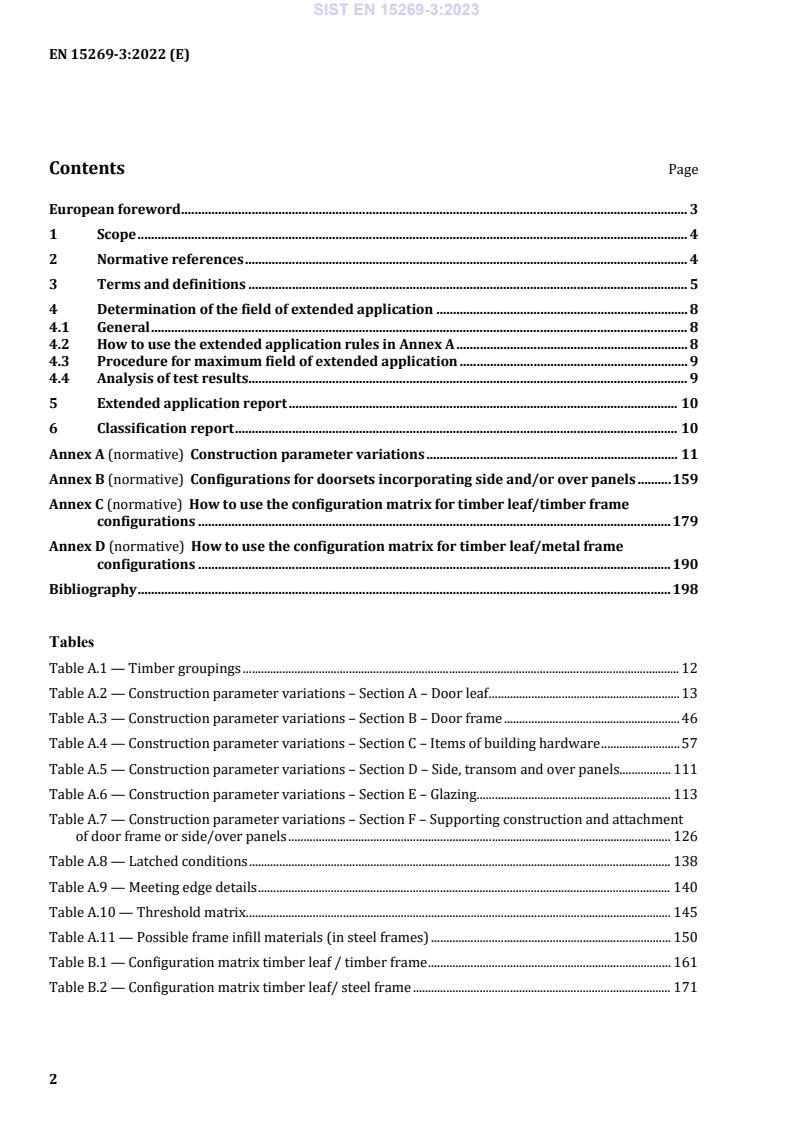
Contents Page
European foreword . 3
1 Scope . 4
2 Normative references . 4
3 Terms and definitions . 5
4 Determination of the field of extended application . 8
4.1 General . 8
4.2 How to use the extended application rules in Annex A . 8
4.3 Procedure for maximum field of extended application . 9
4.4 Analysis of test results . 9
5 Extended application report . 10
6 Classification report . 10
Annex A (normative) Construction parameter variations . 11
Annex B (normative) Configurations for doorsets incorporating side and/or over panels . 159
Annex C (normative) How to use the configuration matrix for timber leaf/timber frame
configurations . 179
Annex D (normative) How to use the configuration matrix for timber leaf/metal frame
configurations . 190
Bibliography . 198
Tables
Table A.1 — Timber groupings . 12
Table A.2 — Construction parameter variations – Section A – Door leaf . 13
Table A.3 — Construction parameter variations – Section B – Door frame . 46
Table A.4 — Construction parameter variations – Section C – Items of building hardware . 57
Table A.5 — Construction parameter variations – Section D – Side, transom and over panels. 111
Table A.6 — Construction parameter variations – Section E – Glazing . 113
Table A.7 — Construction parameter variations – Section F – Supporting construction and attachment
of door frame or side/over panels . 126
Table A.8 — Latched conditions . 138
Table A.9 — Meeting edge details . 140
Table A.10 — Threshold matrix . 145
Table A.11 — Possible frame infill materials (in steel frames) . 150
Table B.1 — Configuration matrix timber leaf / timber frame . 161
Table B.2 — Configuration matrix timber leaf/ steel frame . 171
European foreword
This document (EN 15269-3:2022) has been prepared by Technical Committee CEN/TC 127 “Fire safety
in buildings”, the secretariat of which is held by BSI.
This European Standard shall be given the status of a national standard, either by publication of an
identical text or by endorsement, at the latest by May 2023 and conflicting national standards shall be
withdrawn at the latest by May 2023.
Attention is drawn to the possibility that some of the elements of this document may be the subject of
patent rights. CEN shall not be held responsible for identifying any or all such patent rights.
This document supersedes EN 15269-3:2012.
This document has been prepared under a Standardization Request given to CEN by the European
Commission and the European Free Trade Association.
In comparison with the previous edition, the following significant changes have been made:
a) Scope clarified;
b) Normative references updated;
c) Definitions updated;
d) Main text updated;
e) Annex A rewritten and updated;
f) Annex B updated;
g) Annex C and D added.
A list of all parts in the EN 15269 series can be found on the CEN website.
Any feedback and questions on this document should be directed to the users’ national standards body.
A complete listing of these bodies can be found on the CEN website.
According to the CEN-CENELEC Internal Regulations, the national standards organizations of the
following countries are bound to implement this European Standard: Austria, Belgium, Bulgaria, Croatia,
Cyprus, Czech Republic, Denmark, Estonia, Finland, France, Germany, Greece, Hungary, Iceland, Ireland,
Italy, Latvia, Lithuania, Luxembourg, Malta, Netherlands, Norway, Poland, Portugal, Republic of North
Macedonia, Romania, Serbia, Slovakia, Slovenia, Spain, Sweden, Switzerland, Türkiye and the United
Kingdom.
1 Scope
This document covers hinged or pivoted doorsets and door assemblies with wood-based door leaves
and/or timber framed glazed door leaves and openable timber framed windows. Throughout this
document, the term “doorset” will be used to cover doorsets, door assemblies and openable windows. It
prescribes the rules for extending the application of test results obtained from fire resistance test(s)
conducted in accordance with EN 1634-1.
This document covers only doorsets with wood-based or metal frames. The door leaves are comprised of
wood-based perimeter framing and wood-based structural facings.
Subject to the completion of the appropriate test or tests, the extended application can cover all or some
of the following examples:
— integrity (E), integrity & radiation (EW) or integrity & insulation (EI or EI ) classifications;
1 2
— glazing within the doorset, e.g. side and over panels, vision panels and framed glazed doorsets;
— air transfer grilles (e.g. ventilation grilles/louvres);
— side, transom or over panels;
— items of building hardware;
— decorative and protective finishes;
— intumescent strips and non-intumescent seals (e.g. smoke, draught or acoustic seals);
— alternative supporting construction(s).
This document covers only the effect on the fire resistance classifications E, EW, EI and EI .
1 2
This document does not cover horizontal doorsets.
2 Normative references
The following documents are referred to in the text in such a way that some or all their content constitutes
requirements of this document. For dated references, only the edition cited applies. For undated
references, the latest edition of the referenced document (including any amendments) applies.
EN 179, Building hardware - Emergency exit devices operated by a lever handle or push pad, for use on
escape routes - Requirements and test methods
EN 844, Round and sawn timber - Terminology
EN 923, Adhesives - Terms and definitions
EN 1125, Building hardware - Panic exit devices operated by a horizontal bar, for use on escape routes -
Requirements and test methods
EN 1154, Building hardware - Controlled door closing devices - Requirements and test methods
EN 1155, Building hardware - Electrically powered hold-open devices for swing doors - Requirements and
test methods
EN 1158, Building hardware - Door coordinator devices - Requirements and test methods
EN 1363-1, Fire resistance tests - Part 1: General requirements
EN 1634-1, Fire resistance and smoke control tests for door and shutter assemblies, openable windows and
elements of building hardware - Part 1: Fire resistance test for door and shutter assemblies and openable
windows
EN 1634-2, Fire resistance and smoke control tests for door, shutter and openable window assemblies and
elements of building hardware - Part 2: Fire resistance characterisation test for elements of building
hardware
EN 1935, Building hardware - Single-axis hinges - Requirements and test methods
EN 12519, Windows and pedestrian doors - Terminology
EN 13381-4, Test methods for determining the contribution to the fire resistance of structural members -
Part 4: Applied passive protection to steel members
EN 13381-8, Test methods for determining the contribution to the fire resistance of structural members -
Part 8: Applied reactive protection to steel members
EN 13501-2, Fire classification of construction products and building elements - Part 2: Classification using
data from fire resistance tests, excluding ventilation services
EN 15254-4:2018, Extended application of results from fire resistance tests - Non-loadbearing walls - Part
4: Glazed constructions
EN 15269-1, Extended application of test results for fire resistance and/or smoke control for door, shutter
and openable window assemblies, including their elements of building hardware - Part 1: General
requirements
EN 15725, Extended application reports on the fire performance of construction products and building
elements
EN 17372, Power operated pedestrian swing door drives with self closing function - Requirements and test
methods
EN ISO 13943, Fire safety - Vocabulary (ISO 13943)
3 Terms and definitions
For the purposes of this document, the terms and definitions given in EN 1363-1, EN 12519, EN 844,
EN ISO 13943, EN 1634-1, EN 1634-2 and EN 15269-1, EN 15725 and the following apply.
ISO and IEC maintain terminological databases for use in standardization at the following addresses:
— IEC Electropedia: available at https://www.electropedia.org/
— ISO Online browsing platform: available at https://www.iso.org/obp
3.1
core
material fitted centrally within the thickness of a door leaf which may consist of a single sheet of material
or a combination either of sheets of the same material or layers of different materials
3.2
effective rebate depth
dimension of the door leaf thickness of overlapping adjacent edges of the door leaf relative to the door
frame, transom or side panel or flush over panel as well as at door leaf meeting edges
Note 1 to entry: See Figure 1.
Key
x1 example of effective rebate depth in doorset to be tested
x2 example of resulting effective rebate depth during testing after movement of 20 mm
y1 example of over rebate to frame face clearance in doorset to be tested
y2 example of over rebate to frame face clearance in doorset after movement of 20 mm
NOTE The dimensions 5 mm, 50 mm, 25 mm and 30 mm are examples only.
Figure 1 — Effective rebate depth
3.3
leaf symmetry
construction of a door leaf, without consideration of any leaf edge rebates, viewed either side of an
imaginary plane drawn centrally in the thickness of the door leaf
Note 1 to entry: A symmetrical door leaf will be identical either side of this imaginary plane, whilst an
asymmetrical door leaf will differ.
3.4
exposed intumescent strip
intumescent strip which is fitted in the perimeter of the door leaf or in the door frame and is visible when
the door leaf is in the open position
3.5
concealed intumescent strip
intumescent strip which is fitted in the perimeter of the door leaf or in the door frame and is not visible
when the door leaf is in the open position, including strips behind veneers and laminates
3.6
decorative and/or protective finishes
outer layer of material on the door leaf or panel, only used for decorative and/or protective (not for
structural) purposes
3.7
structural facing
layer (or layers) of material between the core and the decorative and/or protective finishes (if fitted) in
the door leaf or panel used for structural purposes
3.8
lipping
edge piece added to the door leaf for structural purpose
Note 1 to entry: In this document, lippings of more than 30 mm thickness are handled as a part of the door leaf
framing element. Lippings of less than 3 mm thick are handled as decorative finishes.
3.9
representative specimen
door leaf design that has ‘fundamentally the same’ or ‘similar’ construction as another door leaf design
for the purpose of evaluating parameter variations providing the relevant aspects of tested performance
are considered
Note 1 to entry: See EN 15269-1 for further guidance on evaluation of similar/fundamentally the same.
3.10
cladding
protective or decorative layer that is fixed to the doorset with clips/hooks or similar, which creates an
air gap between the surface and the cladding
3.11
spring hinge
any door hinge where the energy for closing the door is stored within a spring being part of the hinge
mechanism and which may contain simple damping mechanisms without the provision for controlling
the closing speed (e.g. without valves)
3.12
glazing system
all components used to retain and seal around the glass within the aperture of the door leaf and/or side
and over panel
Note 1 to entry: See Figure A.38.
3.13
capping
decorative or protective facing on the visible parts of the glazing bead
4 Determination of the field of extended application
4.1 General
4.1.1 Before there can be any consideration for extended application (EXAP), at least one
representative doorset shall have been tested in accordance with EN 1634-1 to achieve a test result which
could generate a fire resistance classification in accordance with EN 13501-2 at least equal to the fire
resistance classification subsequently required from extended application considerations.
4.1.2 A review of the doorset construction parameters can indicate that one or more characteristics
may be improved by a particular parameter variation. All evaluations shall be made on the basis of
retaining the fire resistance classifications obtainable from testing to EN 1634-1, including those lower
than the test duration. However, this shall never lead to an increased fire resistance classification for any
specific parameter beyond that achieved during any one test, unless specifically identified in the relevant
Construction Parameter Variation tables.
4.1.3 If no extended application rule exists for a particular parameter variation, then no extension or
change of this particular parameter is possible without further testing.
4.1.4 Hardware performance sheet (HPS), according to EN 16035 may be part of the documentation
for the assessment and determination of the extended application.
4.2 How to use the extended application rules in Annex A
4.2.1 Identify the variations from the original test specimen(s), which are required to be covered by an
extended application report.
4.2.2 Locate the variations in the appropriate parameter variation by reference to columns (1) and (2)
of Table A.2 to Table A.7 of Annex A.
4.2.3 Establish from the contents of column (3) of Table A.2 to Table A.7 of Annex A whether any
extended application is available beyond the direct application rules (DIAP) in EN 1634-1 without the
need for further testing.
4.2.4 Where this is deemed to be possible, it may be recorded in the extended application report
together with any appropriate restrictions and the stated rules from column (3) of Table A.2 to Table A.7
of Annex A.
4.2.5 Where the variations required can only be achieved from additional testing, the additional test
shall be made on a representative specimen type i.e., a doorset of the same or more onerous configuration.
Alternatively, column (4) of Table A.2 to Table A.7 of Annex A identifies an option for alternative testing
and relevant test parameters.
Most onerous configuration shall be the one with the lowest relevant performance in terms of mode of
failure and/or highest distortion but shall also be evaluated taking the intended construction parameter
variation(s) into account.
Example: If the construction parameter variation involves a change to glazing or side panel and over
panel configurations then the previous result where these have been tested would need to be used to
make the evaluation of most onerous. The result for a single unglazed doorset would not be suitable and
may therefore be discounted when making the evaluation.
4.3 Procedure for maximum field of extended application
4.3.1 It is possible to provide an extended field of application from a single test. However, where a
manufacturer envisages to manufacture a range of doorsets incorporating single leaf doorsets and also
double leaf doorsets with or without side, transom or over panels, with or without glazing, air transfer
grilles (e.g. ventilation grilles/louvres), with alternative items of building hardware, etc. It is
recommended that careful consideration is given to the complete range of doorset designs and options.
This helps to minimise the testing required before testing commences.
4.3.2 Establish all the parameter variations, which are required to be part of the product range.
4.3.3 Determine which are the most important specification requirements and incorporate as many as
possible into the specimen(s) for the first tests in the series.
4.3.4 Conduct the first fire resistance test or a series of tests and then establish which of the original
desired parameter variations have not been covered by the fire resistance tests, including direct
application possibilities.
4.3.5 Identify these parameter variations in Table A.2 to Table A.7 of Annex A and establish if any
extended application is possible without further testing.
4.3.6 Record this for the extended application report together with any restrictions and rules given in
column (3) in Table A.2 to Table A.7 of Annex A.
4.3.7 Evaluate which, if any, of the desired parameter variations have not been covered by the field of
direct application or the initial field of extended application derived from 4.3.5.
4.3.8 Determine if the product range is to include only single leaf doorsets or if the range is to also
include double leaf configurations. Where only single leaf doorsets are to be part of the product range,
the outstanding construction parameter variations shall only be incorporated into specimens for the
single leaf doorset. Where single leaf and double leaf doorsets are to be included in the product range,
the outstanding construction parameter variations for the extended application of single leaf doorsets
may be incorporated into either repeated single leaf doorset tests or, in the most onerous option, as
defined in column (4) of Table A.2 to Table A.7 of Annex A, double leaf doorset configurations. See also
the rules in Annex B.
4.3.9 Select the required outstanding parameter variations from column (1) and column (2) of Table
A.2 to Table A.7 of Annex A and observe from column (4) which are the most appropriate, most onerous
options for further testing.
4.3.10 If the complete selection of required parameter variations has not been covered by the tests
completed in accordance with 4.3.8 and 4.3.9 above, then an appropriate test or tests may be repeated
with the additional product variations incorporated.
4.4 Analysis of test results
4.4.1 In order to maximise the field of extended application, it is important that the test reports shall
record details of any premature integrity and/or insulation failure, as well as details of any significant
distortion.
4.4.2 Where a series of tests forms the basis for the extended application, the field of extended
application shall be based on the lowest performance achieved from the complete series of tests unless
premature failure has been attributed to one or more specific construction parameter variations.
4.4.3 Where it has been possible to clearly identify specific parameter failures, the extended application
for all other construction parameter variations may be based on the performance achieved after isolating
the premature failure(s), provided the requirements of 4.1.1 are met. Where the specific construction
parameter variation requires Category B performance and where failures can be identified as having no
relevance to this aspect of the construction, they may be disregarded, and the failure time and associated
Category revised accordingly.
5 Extended application report
Prepare an extended application report in line with EN 15725 and in accordance with the requirements
of EN 15269-1, based on the results of evaluations in accordance with the above.
When additional test data based on representative specimens are used to extend the field of application,
the rationale for using the test data shall be mentioned in the EXAP report.
If the results of the extended application procedure lead to a classification that only covers one side
(opening or closing) of the doorset, this shall be unambiguously stated in the report.
6 Classification report
The classification report shall be determined from the results of the extended application report and
presented in accordance with EN 13501-2.
Annex A
(normative)
Construction parameter variations
This table is designed to be used by experts competent in the field of fire resistance testing of products
covered by the scope of this standard.
This table shall only be used to assess a field of extended application when at least one positive fire
resistance test to EN 1634-1 has generated a fire resistance classification according to EN 13501-2. Only
results from fire resistance tests in accordance with European Standards may be used as basis for
extended application.
The first two columns identify possible variations to the construction details of the specimen tested.
For some parameters, it is necessary to evaluate whether the specimen displayed a high, medium or low
level of distortion during the fire resistance test. Where this is the case, the following levels shall be used
to establish high, medium and low distortion doorsets as measured using the maximum relative
movement at any position between the edge of the door leaf and door frame or between the meeting
edges of door leaves or the relative movement of the framing members for side and over panels. The
measurements shall be taken from the start of the fire resistance test at any time during the complete
required classification period. The deflections shall be measured at the positions given in EN 1634-1:
— Low: < 40 % of effective rebate depth;
— Medium: ≥ 40 % and ≤ 85 % of effective rebate depth;
— High: > 85 % of effective rebate depth.
Where there is one intumescent strip, the depth of the rebate is the one in which the intumescent strip is
fitted. If no intumescent strip or more than one intumescent strip is fitted, it is the depth of the largest
rebate (see Figure 1).
The evaluation of the influence of a parameter variation on performance characteristics (E/EW/EI /EI )
1 2
lead to the judgement of the possibility of the extension of the field of application, the results of which are
given in column (3) of the following tables. In certain cases in column (3), it is a requirement to achieve
Category B; the requirements for this are given in EN 1634-1.
If the conditions specified in column (3) is not fulfilled, additional fire resistance tests are deemed to be
necessary. In this case, the type of specimen approved for incorporation of the changed parameter is
defined in column (4) and Annex B. Where no specific test configuration is described in column (4) of
each rule in the following tables, the additional test may be on either single or double leaf doorset, for the
relevant classification time, from the most onerous direction and cover the other configuration.
Where it is possible to use information from fire resistance tests performed on one configuration for
evidence on a different configuration, this allowance has been made in order to reduce the overall number
of fire resistance tests required for extended application evaluation, e.g. single action doorsets to double
action doorsets.
In order to maximize the possible field of extended application from a minimum number of fire resistance
tests, the parameter changes have been spread over a series of test specimens. The recommended tests
for each parameter are dependent on the classification required and the preferred options.
Where more than a single parameter variation is required, the influence on other variations shall also be
taken into account.
When specific rules refer to melting points of different materials, this may be evaluated based on
commonly available information about material behaviour.
Some parameter variations may result in a door leaf with increased weight. For all design variations
contained within this EXAP standard, the total weight of any design shall not exceed the loadbearing
capacity of the supporting items of building hardware.
Table A.1 — Timber groupings
Solid timber may be replaced by other solid timber of the
same group of equal or higher nominal density or solid timber
of a higher group, where Group 4 is the highest group.
Group No. Type of timber Nominal density
kg/m
1 Softwood > 350 < 450
2 Hardwood > 350 < 450
3 Softwood ≥ 450
3a Beech (Fagus sylvatica) All
4 Hardwood ≥ 450
NOTE The density is normally declared at a moisture level of 12 % according to EN 350.
The clause numbers in brackets in column (1) of Table A.2 to Table A.7 below, refer to the clause number
from EN 15269-3:2012. These are added for information only.
Table A.2 — Construction parameter variations – Section A – Door leaf
Construction Variation Possibility of extension Additional Evidence
Parameter Required
(1) (2) (3) (4)
A. Door leaf
In certain cases, the rules given in Section A are also appropriate to side, transom and over panels or the door frame; where this is the case it is clearly
indicated in column (1) by the word “panel”. For double leaf doorsets, both leaves shall be of the same basic construction.
A.1 General
A.1.1 Number of leaves. Single leaf from double Possible only for doorsets with wood-based door frames and Annex B gives the test protocol
leaf doorset test. provided that: and hierarchy for various
options on door leaf (and panel)
• The distortion of the door leaf is low
configurations.
• The doorsets have exposed or no intumescent strips
• The passive door leaf of the tested doorset shall be bolted at
the top or at the top and the bottom;
otherwise not possible without additional test.
For doorsets with wood-based door frames, where there is an
inactive and an active door leaf, only the construction and
parameters of the active door leaf may be used for the single leaf
doorset. Intumescent strips and their positioning shall be
retained in the (primary) active leaf or positioned in the door
frame if they were in the inactive leaf. The rebate dimensions of
the meeting edges of the double leaf doorset shall be replicated
on both door leaf and door frame of the single leaf doorset.
For doorsets with wood-based frames with side- or over panels,
where the configuration matrix in Annex B is used, the rules and
definitions of Annex C for doorsets shall be considered.
For doorsets with metal frames, where the configuration matrix
in Annex B is used, the rules and definitions of Annex D for
doorsets shall be considered. Single leaf doorsets with metal
frames shall be tested in accordance with Annex D, D.2.1.
Construction Variation Possibility of extension Additional Evidence
Parameter Required
(1) (2) (3) (4)
A.1.2 Number of door Double leaf from single Not possible without additional test. Annex B gives the test protocol
leaves. leaf doorset test. and hierarchy for various
options on door leaf (and
panel) configurations.
A.1.3 Shape of door From tested rectangular It is possible to make a door leaf or panel with angled head Additional test to include the
leaf. into an angled head on (chamfered form) on the top if the cross-section dimensions of required detail in a
the top (chamfered perimeter framing elements of the leaf or panel don´t decrease. representative specimen.
Figure A.1
form).
The maximum tested distance to the upper hinge and to the
main lock shall not be increased.
The rules for hinges in Section C.3 shall be fulfilled.
A.1.4 Shape of door From tested rectangular It is possible for single leaf doorsets only to make a door leaf or Additional test to include the
leaf. into a round arch or panel with round arch or segment arch on the top if the cross- required detail in a
segment arch on the top. section dimension of perimeter framing elements of the door representative specimen.
Figure A.2
leaf or panel don´t decrease.
The rules for hinges in Section C.3 shall be fulfilled.
A.1.5a Intumescent Add / Increase. It is not possible to add any intumescent strips if no Additional test to include
strips (fitted at door intumescent strip was present in the tested specimen. maximum size of intumescent
leaf to door frame strips. For intumescent strips
Possible for latched doorsets to increase the dimensions of the
interface or in meeting at meeting edges, test of double
intumescent strip, by up to 50 % in cross sectional area or by a
edge). leaf doorset is required.
proportionate amount with a door leaf thickness increase
(A.4.29) otherwise additional test is required.
Not possible to increase dimensions of the intumescent strip
for un-latched doorsets.
Construction Variation Possibility of extension Additional Evidence
Parameter Required
(1) (2) (3) (4)
A.1.5b Intumescent Remove / Decrease. Not possible without additional test. Test to include minimum size
strips (fitted at door of intumescent strips.
leaf to door frame
interface or in meeting
edge).
(A.4.30)
A.1.6 Intumescent Change location. Possible to change the tested strip arrangement from the door Additional test to include strip
strips (fitted in leaf in which it was tested to the opposite door leaf providing fitted in the required position.
meeting edge). the door leaves were low distortion and the strips arrangement
is replicated, and the minimum tested length of intumescent
(A.1.5)
strip is retained (including at positions of items of building
hardware), otherwise not possible without additional test.
A.1.7 Intumescent Change location. Possible to change from door leaf to door frame and vice versa Additional test to include strip
strips (fitted at door for exposed intumescent strip if there is no additional cut-out fitted in the required position.
leaf to door frame at the intumescent strip (e.g. for items of building hardware) Test may be single or double
interface). and the position relative to the rebate remains unchanged and leaf doorset depending on the
the doorset is low distortion. required configuration.
Figure A.3
Possible provided the relative position e/f remain within a
(A.1.3, A.1.4, A.1.6)
tolerance of +/- 10 % and/or is in line with an increase in door
leaf thickness and/or effective door frame rebate depth and/or
an increase in the dimension of the strip.
A.1.8 Exposed Change to concealed Not possible without additional test. Additional test to include
intumescent strip required detail of intumescent
intumescent strip.
(fitted within door leaf
strips.
or door frame).
(A.4.31)
Construction Variation Possibility of extension Additional Evidence
Parameter Required
(1) (2) (3) (4)
A.1.9 Exposed Change to intumescent Possible to cover an intumescent strip with paint, veneer or Additional test to include
intumescent strip strip covered by high-pressure laminate and plastic no thicker than 0,8 mm, required detail of intumescent
(fitted within door leaf decorative edge finish. except for ammonium phosphate based intumescent strips strips.
or door frame). where cover is not possible.
A.1.10 Intumescent Change to exposed Not possible without additional test. Additional test to include
strip concealed with > intumescent strip. required detail of intumescent
0,8 mm material (fitted strips.
within door leaf or
door frame).
(A.4.32)
A.1.11 Intumescent Change from intumescent Possible to expose an intumescent strip that was tested with a Additional test to include
strip covered with ≤ strip covered by cover of paint, veneer or high-pressure laminate and plastic no required detail of intumescent
0,8 mm material (fitted decorative edge finish to thicker than 0,8 mm. strips.
within door leaf or exposed intumescent
door frame). strip.
A.1.12 Intumescent Change Possible if the type, material, composition, and characteristics Test with the required
strips (fitted at door supplier/manufacturer. are proved identical. material in a representative
leaf to door frame specimen.
interface).
(A.4.33)
A.1.13 Intumescent Change type/material. Not possible without additional test. Test with the required material
strips (fitted at door in a representative specimen.
leaf to door frame
interface).
(A.4.34)
Construction Variation Possibility of extension Additional Evidence
Parameter Required
(1) (2) (3) (4)
A.1.14 Non- Add / Increase. Increase dimensions: Additional test to include seal
intumescent seals fitted in the required position
Possible to increase the cross-section dimensions of the seal up
fitted in door leaf or and/or the maximum size on a
to a maximum of 20 % and providing the gap is not increased
door frame including representative doorset. Test
and the expansion of any intumescent strip is not affected. If
threshold may be single or double leaf
the frame rebate is increased, the seal dimensions may also be
(draught/smoke/ doorset.
increased with the same percentage.
acoustic,etc.), not
In the case of a double leaf
Add non-intumescent seal:
including drop seals
doorset test, the door leaf to
Possible to add a seal if the seal material is reaction to fire class
(see C.27).
frame seals may be different
A1 or A2, providing the gap is not increased and the effective
(A.1.9, A.1.11, A.4.35, between the two door leaves
rebate depth is not decreased and the expansion of the
A.4.37) generating evidence on
intumescent strip is not affected.
alternative types of seals from
a single test.
A.1.15 Non Additional test to prove the
Remove / Decrease. Not possible to remove a seal.
intumescent seals door leaf to door frame detail
Possible to decrease the cross-section dimensions of the seal
fitted in door leaf or with no seal fitted or with the
up to a maximum of 20 % and providing the gap is not
door frame including minimum size of seal. Test may
increased and the expansion of any intumescent strip is not
threshold be single or double leaf
affected.
(draught/smoke/ doorset.
Not possible for seal with reaction to fire class A1 and A2.
acoustic, etc.), not
including drop seals
(see C.27).
(A.1.10, A.1.12, A.4.36,
A.4.38)
Construction Variation Possibility of extension Additional Evidence
Parameter Required
(1) (2) (3) (4)
A.1.16 Non Change location. Possible to change from door leaf to door frame and vice versa Additional test to include seal
intumescent seals and from one door leaf to the opposing door leaf at the meeting fitted in the required position.
fitted in door leaf or edges providing the seal arrangement is replicated and the Test may be single or double
door frame including expansion of any intumescent strip is not affected. leaf doorset.
threshold
Also possible in line with an increase of the rebate depth or the
(draught/smoke/
door leaf thickness.
acoustic, etc.), not
including drop seals
(see C.27).
(A.1.7, A.1.8)
A.1.17 Non Change Possible if the type, material, composition, and characteristics Test with the required
intumescent seals supplier/manufacturer. are proved identical, or in line with A.1.18 and A.1.19. material in a representative
fitted in door leaf or
specimen.
door frame including
threshold
(draught/smoke/
acoustic, etc.), not
including drop seals
(see C.27).
(A.4.39)
Construction Variation Possibility of extension Additional Evidence
Parameter Required
(1) (2) (3) (4)
A.1.18 Type of non- Alternative material. Possible for timber door frames and in the meeting edges, Additional test to include the
intumescent seals providing the product is of the same generic type of material, required seal. Test may be
(fitted in door leaf or the gap is not increased and the size of the seal is not reduced, single or double leaf doorset.
door frame) including otherwise not possible without an additional test.
threshold
Not possible for steel door frames.
(draught/smoke/
acoustic, etc.), not
including drop seals
(see C.27).
(A.4.40 and A.4.41)
A.1.19 Type of non- Different shape. Alternative shape is possible provided the material is in line Additional test to include the
intumescent seals with rule A.1.18, the rules for dimensions are fulfilled (A.1.14 required seal. Test may be
(fitted in door leaf or
and A.1.15) and providing the gap is not increased. single or double leaf doorset.
door frame) including
threshold
(draught/smoke/
acoustic, etc.), not
including drop seals
(see C.27).
Construction Variation Possibility of extension Additional Evidence
Parameter Required
(1) (2) (3) (4)
A.1.20 Non- Additional. Possible to add an additional seal of the same type as tested, Additional test to include seal
intumescent seals otherwise not possible. fitted in the required position
(dr
...
Questions, Comments and Discussion
Ask us and Technical Secretary will try to provide an answer. You can facilitate discussion about the standard in here.
Loading comments...