

EN ISO 19085-4:2024
(Main)Woodworking machines - Safety - Part 4: Vertical panel circular sawing machines (ISO 19085-4:2024)
- Abstract
This document specifies the safety requirements and measures for manually loaded and unloaded vertical panel circular sawing machines (defined in 3.1) capable of continuous production use, with hand feed or integrated feed, hereinafter referred to also as “machines”.
This document deals with all significant hazards, hazardous situations and events, as listed in Annex A, relevant to the machines, when operated, adjusted and maintained as intended and under the conditions foreseen by the manufacturer, including reasonably foreseeable misuse. Transport, assembly, dismantling, disabling and scrapping phases are also taken into account.
This document is also applicable to machines fitted with one or more of the following devices/additional working units, whose hazards have been dealt with:
— an integrated feed device;
— a device for scoring;
— an angle cutting device;
— a middle support device;
— programmable end stops for parallel vertical cuts;
— a device for grooving with a milling tool with a cutting width not exceeding 27 mm;
— a panel pusher;
— a panel lowering device;
— stop devices for workpiece during horizontal cuts.
The machines are designed for cutting panels consisting of:
a) solid wood;
b) material with similar physical characteristics to wood (see ISO 19085-1:2021, 3.2);
c) composite materials with core consisting, for example, of polyurethane or mineral material laminated with light alloy;
d) polymer-matrix composite materials and reinforced thermoplastic/thermoset/elastomeric materials;
e) gypsum boards, gypsum bounded fibreboards;
f) honeycomb aluminium boards;
g) matrix engineered mineral boards, silicate boards;
h) aluminium light alloy plates;
i) composite boards made from the materials listed above.
This document does not apply to machines
— with pressure beam and saw unit mounted behind the workpiece support,
— where the guide rails on which the saw unit moves vertically are fixed on the machine frame and the horizontal cut can only be made by manually feeding the panel,
— designed to cut in vertical direction only,
— automatically performing two or more cutting cycles in sequence,
— intended for use in potentially explosive atmosphere, and
— manufactured prior to the publication of this document.
- Status
- Published
- Publication Date
- 01-Oct-2024
- Technical Committee
- CEN/TC 142 - Woodworking machines - Safety
- Current Stage
- 6060 - Definitive text made available (DAV) - Publishing
- Start Date
- 02-Oct-2024
- Completion Date
- 02-Oct-2024
- Directive
- 2006/42/EC - Directive 2006/42/EC of the European Parliament and of the Council of 17 May 2006 on machinery, and amending Directive 95/16/EC (recast)OJ Ref: OJ L, 2026/2015 OJ Date: 07-Sep-2026

Overview
EN ISO 19085-4:2024 - published by CEN - is the safety standard for vertical panel circular sawing machines used in continuous production. It defines safety requirements and measures for manually loaded and unloaded machines (hand feed or integrated feed) and covers operation, adjustment and maintenance under intended and reasonably foreseeable misuse. The standard also addresses transport, assembly, dismantling, disabling and scrapping phases and applies to machines fitted with common additional units (scoring, angle cutting, integrated feed, grooving with cutter ≤ 27 mm, panel pushers, supports, etc.).
Key materials in scope include solid wood, wood-like materials (see ISO 19085-1:2021), composite panels, polymer-matrix composites, gypsum boards, honeycomb aluminium and similar engineered boards. Exclusions are explicitly listed (for example machines designed to cut only vertically, machines with certain pressure-beam configurations, or machines for explosive atmospheres).
Key Topics
- Control systems and devices: safety and reliability of controls, start/stop functions, emergency stop, mode selection, manual reset, teleservice and monitoring.
- Stopping and braking: braking functions for tools, maximum run-down time, brake release and braking strategy for circular saw blades.
- Mechanical safety: stability, risk of break-up, tool-holder and spindle locking, blade fixing and flange dimensions.
- Guards and protective equipment: fixed guards, interlocking movable guards, hold-to-run and two-hand controls, and electro-sensitive protective equipment (ESPE).
- Monitoring & diagnostics: standstill detection, moving-part speed monitoring, time-delay and failure-of-power-supply requirements.
- Hazard coverage & lifecycle: addresses hazards listed in Annex A and considers transport, assembly, servicing and scrapping.
- Additional units: requirements for integrated feed devices, scoring units, angle cutting, middle supports, programmable end stops, grooving tools (≤ 27 mm), panel pushers and lowering devices.
Applications
- Machine manufacturers and designers: to design vertical panel circular sawing machines that meet modern safety requirements and support CE compliance.
- Safety engineers and compliance officers: to assess conformity with the Machinery Directive (Directive 2006/42/EC) and to apply presumption of conformity where the standard is cited (see Annex ZA).
- Production managers and procurement: to specify safe equipment for panel cutting lines and integrated feed workflows.
- Maintenance teams and trainers: to follow safe servicing, isolation and lockout procedures specified for these machines.
- Test labs and certification bodies: to evaluate guarding, braking and control-system requirements.
Related Standards
- ISO 19085 series (see ISO 19085-1:2021 for materials similar to wood)
- Machinery Directive 2006/42/EC (Annex ZA explains the relationship and presumption of conformity)
Keywords: EN ISO 19085-4:2024, vertical panel circular sawing machines, woodworking machines safety, CEN, machine guards, braking, control systems, CE conformity.
Relations
- Effective Date
- 18-Jan-2023
- Effective Date
- 20-May-2026
- Effective Date
- 20-May-2026
- Effective Date
- 09-Feb-2026
- Effective Date
- 09-Feb-2026
- Effective Date
- 28-Jan-2026
- Effective Date
- 28-Jan-2026
- Effective Date
- 28-Jan-2026
- Consolidated By
ISO 19085-4:2024 - Woodworking machines — Safety — Part 4: Vertical panel circular sawing machines - Effective Date
- 12-Feb-2026
- Effective Date
- 09-Jul-2025
Get Certified
Connect with accredited certification bodies for this standard

CIS Institut d.o.o.
Personal Protective Equipment (PPE) certification body. Notified Body NB-2890 for EU Regulation 2016/425 PPE.
Gozdarski inštitut Slovenije
Slovenian Forestry Institute. Forest management certification support, timber testing.

Kiwa BDA Testing
Building and construction product certification.
Sponsored listings
Frequently Asked Questions
EN ISO 19085-4:2024 is a standard published by the European Committee for Standardization (CEN). Its full title is "Woodworking machines - Safety - Part 4: Vertical panel circular sawing machines (ISO 19085-4:2024)". This standard covers: This document specifies the safety requirements and measures for manually loaded and unloaded vertical panel circular sawing machines (defined in 3.1) capable of continuous production use, with hand feed or integrated feed, hereinafter referred to also as “machines”. This document deals with all significant hazards, hazardous situations and events, as listed in Annex A, relevant to the machines, when operated, adjusted and maintained as intended and under the conditions foreseen by the manufacturer, including reasonably foreseeable misuse. Transport, assembly, dismantling, disabling and scrapping phases are also taken into account. This document is also applicable to machines fitted with one or more of the following devices/additional working units, whose hazards have been dealt with: — an integrated feed device; — a device for scoring; — an angle cutting device; — a middle support device; — programmable end stops for parallel vertical cuts; — a device for grooving with a milling tool with a cutting width not exceeding 27 mm; — a panel pusher; — a panel lowering device; — stop devices for workpiece during horizontal cuts. The machines are designed for cutting panels consisting of: a) solid wood; b) material with similar physical characteristics to wood (see ISO 19085-1:2021, 3.2); c) composite materials with core consisting, for example, of polyurethane or mineral material laminated with light alloy; d) polymer-matrix composite materials and reinforced thermoplastic/thermoset/elastomeric materials; e) gypsum boards, gypsum bounded fibreboards; f) honeycomb aluminium boards; g) matrix engineered mineral boards, silicate boards; h) aluminium light alloy plates; i) composite boards made from the materials listed above. This document does not apply to machines — with pressure beam and saw unit mounted behind the workpiece support, — where the guide rails on which the saw unit moves vertically are fixed on the machine frame and the horizontal cut can only be made by manually feeding the panel, — designed to cut in vertical direction only, — automatically performing two or more cutting cycles in sequence, — intended for use in potentially explosive atmosphere, and — manufactured prior to the publication of this document.
This document specifies the safety requirements and measures for manually loaded and unloaded vertical panel circular sawing machines (defined in 3.1) capable of continuous production use, with hand feed or integrated feed, hereinafter referred to also as “machines”. This document deals with all significant hazards, hazardous situations and events, as listed in Annex A, relevant to the machines, when operated, adjusted and maintained as intended and under the conditions foreseen by the manufacturer, including reasonably foreseeable misuse. Transport, assembly, dismantling, disabling and scrapping phases are also taken into account. This document is also applicable to machines fitted with one or more of the following devices/additional working units, whose hazards have been dealt with: — an integrated feed device; — a device for scoring; — an angle cutting device; — a middle support device; — programmable end stops for parallel vertical cuts; — a device for grooving with a milling tool with a cutting width not exceeding 27 mm; — a panel pusher; — a panel lowering device; — stop devices for workpiece during horizontal cuts. The machines are designed for cutting panels consisting of: a) solid wood; b) material with similar physical characteristics to wood (see ISO 19085-1:2021, 3.2); c) composite materials with core consisting, for example, of polyurethane or mineral material laminated with light alloy; d) polymer-matrix composite materials and reinforced thermoplastic/thermoset/elastomeric materials; e) gypsum boards, gypsum bounded fibreboards; f) honeycomb aluminium boards; g) matrix engineered mineral boards, silicate boards; h) aluminium light alloy plates; i) composite boards made from the materials listed above. This document does not apply to machines — with pressure beam and saw unit mounted behind the workpiece support, — where the guide rails on which the saw unit moves vertically are fixed on the machine frame and the horizontal cut can only be made by manually feeding the panel, — designed to cut in vertical direction only, — automatically performing two or more cutting cycles in sequence, — intended for use in potentially explosive atmosphere, and — manufactured prior to the publication of this document.
EN ISO 19085-4:2024 is classified under the following ICS (International Classification for Standards) categories: 13.110 - Safety of machinery; 79.120.10 - Woodworking machines. The ICS classification helps identify the subject area and facilitates finding related standards.
EN ISO 19085-4:2024 has the following relationships with other standards: It is inter standard links to EN ISO 19085-4:2018, ISO 13849-1:2023, ISO 19085-1:2021, ISO 13857:2019, ISO 12100:2010, EN 1300:2023, EN 847-1:2017, EN 847-3:2004, ISO 19085-4:2024, prEN ISO 19085-4. Understanding these relationships helps ensure you are using the most current and applicable version of the standard.
EN ISO 19085-4:2024 is associated with the following European legislation: EU Directives/Regulations: 2006/42/EC; Standardization Mandates: M/396. When a standard is cited in the Official Journal of the European Union, products manufactured in conformity with it benefit from a presumption of conformity with the essential requirements of the corresponding EU directive or regulation.
EN ISO 19085-4:2024 is available in PDF format for immediate download after purchase. The document can be added to your cart and obtained through the secure checkout process. Digital delivery ensures instant access to the complete standard document.
Standards Content (Sample)
SLOVENSKI STANDARD
01-januar-2025
Lesnoobdelovalni stroji - Varnost - 4. del: Krožne žage z vertikalno ploščo (ISO
19085-4:2024)
Woodworking machines - Safety - Part 4: Vertical panel circular sawing machines (ISO
19085-4:2024)
Holzbearbeitungsmaschinen - Sicherheit - Teil 4: Vertikalplattenkreissägemaschinen
(ISO 19085-4:2024)
Machines à bois - Sécurité - Partie 4: Scies circulaires à panneaux verticales (ISO 19085
-4:2024)
Ta slovenski standard je istoveten z: EN ISO 19085-4:2024
ICS:
13.110 Varnost strojev Safety of machinery
25.080.60 Strojne žage Sawing machines
79.120.10 Lesnoobdelovalni stroji Woodworking machines
2003-01.Slovenski inštitut za standardizacijo. Razmnoževanje celote ali delov tega standarda ni dovoljeno.
EN ISO 19085-4
EUROPEAN STANDARD
NORME EUROPÉENNE
October 2024
EUROPÄISCHE NORM
ICS 13.110; 79.120.10 Supersedes EN ISO 19085-4:2018
English Version
Woodworking machines - Safety - Part 4: Vertical panel
circular sawing machines (ISO 19085-4:2024)
Machines à bois - Sécurité - Partie 4: Scies circulaires à Holzbearbeitungsmaschinen - Sicherheit - Teil 4:
panneaux verticales (ISO 19085-4:2024) Vertikalplattenkreissägemaschinen (ISO 19085-
4:2024)
This European Standard was approved by CEN on 23 May 2024.
CEN members are bound to comply with the CEN/CENELEC Internal Regulations which stipulate the conditions for giving this
European Standard the status of a national standard without any alteration. Up-to-date lists and bibliographical references
concerning such national standards may be obtained on application to the CEN-CENELEC Management Centre or to any CEN
member.
This European Standard exists in three official versions (English, French, German). A version in any other language made by
translation under the responsibility of a CEN member into its own language and notified to the CEN-CENELEC Management
Centre has the same status as the official versions.
CEN members are the national standards bodies of Austria, Belgium, Bulgaria, Croatia, Cyprus, Czech Republic, Denmark, Estonia,
Finland, France, Germany, Greece, Hungary, Iceland, Ireland, Italy, Latvia, Lithuania, Luxembourg, Malta, Netherlands, Norway,
Poland, Portugal, Republic of North Macedonia, Romania, Serbia, Slovakia, Slovenia, Spain, Sweden, Switzerland, Türkiye and
United Kingdom.
EUROPEAN COMMITTEE FOR STANDARDIZATION
COMITÉ EUROPÉEN DE NORMALISATION
EUROPÄISCHES KOMITEE FÜR NORMUNG
CEN-CENELEC Management Centre: Rue de la Science 23, B-1040 Brussels
© 2024 CEN All rights of exploitation in any form and by any means reserved Ref. No. EN ISO 19085-4:2024 E
worldwide for CEN national Members.
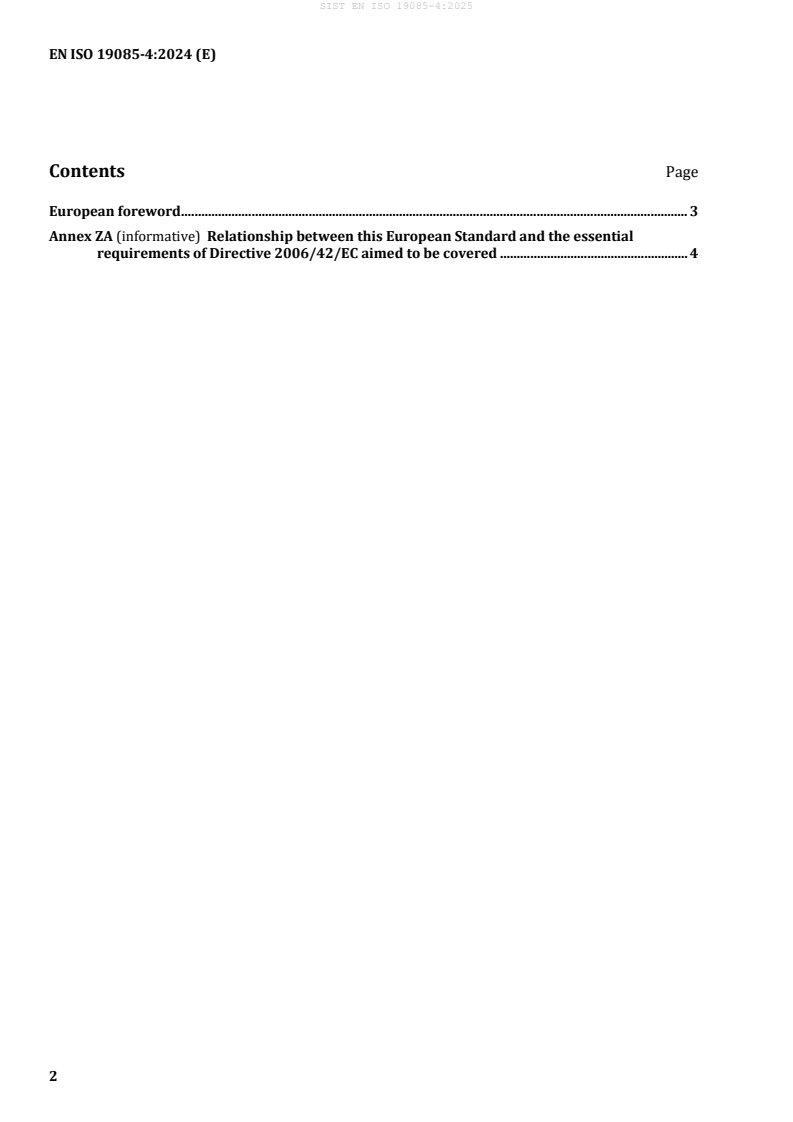
Contents Page
European foreword . 3
Annex ZA (informative) Relationship between this European Standard and the essential
requirements of Directive 2006/42/EC aimed to be covered . 4
European foreword
This document (EN ISO 19085-4:2024) has been prepared by Technical Committee ISO/TC 39 "Machine
tools" in collaboration with Technical Committee CEN/TC 142 “Woodworking machines - Safety” the
secretariat of which is held by UNI.
This European Standard shall be given the status of a national standard, either by publication of an
identical text or by endorsement, at the latest by April 2025, and conflicting national standards shall be
withdrawn at the latest by October 2026.
Attention is drawn to the possibility that some of the elements of this document may be the subject of
patent rights. CEN shall not be held responsible for identifying any or all such patent rights.
This document supersedes EN ISO 19085-4:2018.
This document has been prepared under a standardization request addressed to CEN by the European
Commission. The Standing Committee of the EFTA States subsequently approves these requests for its
Member States.
For the relationship with EU Legislation, see informative Annex ZA, which is an integral part of this
document.
Any feedback and questions on this document should be directed to the users’ national standards
body/national committee. A complete listing of these bodies can be found on the CEN website.
According to the CEN-CENELEC Internal Regulations, the national standards organizations of the
following countries are bound to implement this European Standard: Austria, Belgium, Bulgaria,
Croatia, Cyprus, Czech Republic, Denmark, Estonia, Finland, France, Germany, Greece, Hungary, Iceland,
Ireland, Italy, Latvia, Lithuania, Luxembourg, Malta, Netherlands, Norway, Poland, Portugal, Republic of
North Macedonia, Romania, Serbia, Slovakia, Slovenia, Spain, Sweden, Switzerland, Türkiye and the
United Kingdom.
Endorsement notice
The text of ISO 19085-4:2024 has been approved by CEN as EN ISO 19085-4:2024 without any
modification.
Annex ZA
(informative)
Relationship between this European Standard and the essential
requirements of Directive 2006/42/EC aimed to be covered
This European Standard has been prepared under a Commission’s standardization request “M/396
Mandate to CEN and CENELEC for Standardisation in the field of machinery” to provide one voluntary
means of conforming to essential requirements of Directive 2006/42/EC of the European Parliament
and of the Council of 17 May 2006 on machinery, and amending Directive 95/16/EC (recast).
Once this standard is cited in the Official Journal of the European Union under that Directive,
compliance with the normative clauses of this standard given in Table ZA.1 confers, within the limits of
the scope of this standard, a presumption of conformity with the corresponding essential requirements
of that Directive and associated EFTA regulations.
Table ZA.1 — Correspondence between this European Standard and Annex I of Directive
2006/42/EC
The relevant Essential Requirements of Directive Clause(s)/subclause(s Remarks/Note
2006/42/EC ) of this EN s
1.1.2 Principles of safety integration
a) fitted for its function Clauses 4, 5, 6, 7
c) intended use and reasonably foreseeable misuse Clauses 4, 5, 6, 7
d) constraints in use Clauses 4, 5, 6, 7
1.1.3 Materials and products 5.2, 6.3
1.1.5 Design of machinery to facilitate its handling 6.5, 7.3
1.1.6 Ergonomics 6.5
1.2.1 Safety and reliability of control systems 4.1, 4.3.1, 4.4.1, 4.7.3,
4.11, 6.5
1.2.2 Control devices 4.2, 4.3, 4.4, 4.7
1.2.3 Starting 4.3
1.2.4.1 Normal stop 4.4.1, 4.4.2, 4.5, 5.4
1.2.4.3 Emergency stop 4.4.1, 4.4.4, 4.5, 5.4
1.2.6 Failure of the power supply 4.8, 6.7
1.3.1 Risk of loss of stability 5.1, 7.3
1.3.2 Risk of break-up during operation 4.3.1, 5.2, 5.9, 6.7, 6.14,
7.3
1.3.3 Risks due to falling or ejected objects 5.2, 5.3, 5.5, 5.8, 5.9, 7.3
1.3.6 Risks relating to variations in the operating 4.7, 5.6
conditions
1.3.7 Risks related to moving parts 5.5, 5.6, 5.7, 5.8, 7.3
1.3.8 Choice of protection against risks related to moving 5.5, 5.6, 5.7, 5.8
parts
1.3.8.1 Moving transmission parts 5.5, 5.6, 5.7, 5.8
1.3.8.2 Moving parts involved in the process 5.5, 5.6
1.3.9 Risk of uncontrolled movements 4.1, 4.3.1, 4.5, 5.4
1.4.1 General requirements 5.2, 5.5, 5.6, 5.9, 6.3
1.4.2.1 Fixed guards 5.5.1
1.4.2.2 Interlocking movable guards 5.5.2
1.4.3 Special requirements for protective devices 5.5.3, 5.5.5, 5.5.6
1.5.1 Electricity supply 6.4, 6.13
1.5.2 Static electricity 6.11
1.5.3 Energy supply other than electricity 6.7
1.5.4 Errors of fitting 6.12
1.5.6 Fire 6.1
1.5.8 Noise 6.2
1.5.11 External radiation 6.9
1.5.12 Laser equipment 6.10
1.5.13 Emission of hazardous materials and substances 6.3
1.6.1 Machinery maintenance 6.14, 7.3
1.6.2 Access to operating position and servicing points 6.14, 7.3
1.6.3 Isolation of energy sources 6.13, 7.3
1.6.4 Operator intervention 6.14, 7.3
1.6.5 Cleaning of internal parts 6.14, 7.3
1.7.1 Information and warnings on the machinery 6.10, 7.1, 7.2
1.7.2 Warning devices 6.10, 7.1
1.7.3 Marking of machinery 7.2
1.7.4 Instructions 6.10, 7.3, Annex F
2.3 Machinery for working wood and analogous materials
a) guiding 5.1, 5.10
b) ejection 5.9
c) brake 4.5, 5.4
d) accidental tool contact 5.5, 5.6
WARNING 1 — Presumption of conformity stays valid only as long as a reference to this European
Standard is maintained in the list published in the Official Journal of the European Union. Users of this
standard should consult frequently the latest list published in the Official Journal of the European
Union.
WARNING 2 — Other Union legislation may be applicable to the product(s) falling within the scope of
this standard.
International
Standard
ISO 19085-4
Second edition
Woodworking machines — Safety —
2024-07
Part 4:
Vertical panel circular sawing
machines
Machines à bois — Sécurité —
Partie 4: Scies circulaires à panneaux verticales
Reference number
ISO 19085-4:2024(en) © ISO 2024
ISO 19085-4:2024(en)
© ISO 2024
All rights reserved. Unless otherwise specified, or required in the context of its implementation, no part of this publication may
be reproduced or utilized otherwise in any form or by any means, electronic or mechanical, including photocopying, or posting on
the internet or an intranet, without prior written permission. Permission can be requested from either ISO at the address below
or ISO’s member body in the country of the requester.
ISO copyright office
CP 401 • Ch. de Blandonnet 8
CH-1214 Vernier, Geneva
Phone: +41 22 749 01 11
Email: copyright@iso.org
Website: www.iso.org
Published in Switzerland
ii
ISO 19085-4:2024(en)
Contents Page
Foreword .v
Introduction .vi
1 Scope . 1
2 Normative references . 2
3 Terms and definitions . 2
4 Safety requirements and measures for controls . 6
4.1 Safety and reliability of control systems.6
4.2 Control devices .6
4.3 Start .6
4.3.1 Direct start .6
4.3.2 Start via control power-on .7
4.4 Safe stops .7
4.4.1 General .7
4.4.2 Normal stop .7
4.4.3 Operational stop .7
4.4.4 Emergency stop .7
4.5 Braking function of tools .7
4.6 Mode selection .8
4.7 Tool speed changing .8
4.7.1 Speed changing by shifting the belts on the pulleys .8
4.7.2 Speed changing by incremental speed change motor .8
4.7.3 Infinitely variable speed by frequency inverter .8
4.8 Failure of any power supply .8
4.9 Manual reset control .8
4.10 Standstill detection and monitoring .8
4.11 Machine moving parts speed monitoring.8
4.12 Time delay.8
4.13 Teleservice .8
5 Safety requirements and measures for protection against mechanical hazards . 9
5.1 Stability .9
5.2 Risk of break-up during operation .9
5.3 Tool holder and tool design .9
5.3.1 General .9
5.3.2 Spindle locking .9
5.3.3 Circular saw blade fixing device .9
5.3.4 Flange dimension for circular saw blades .9
5.4 Braking .9
5.4.1 Braking of tools .9
5.4.2 Maximum run-down time .9
5.4.3 Brake release .9
5.5 Safeguards .10
5.5.1 Fixed guards .10
5.5.2 Interlocking movable guards .10
5.5.3 Hold-to-run control .10
5.5.4 Two-hand control .10
5.5.5 Electro-sensitive protective equipment (ESPE) .10
5.5.6 Pressure-sensitive protective equipment (PSPE) .10
5.5.7 Enabling control .11
5.6 Prevention of access to hazardous moving parts .11
5.6.1 Guarding of tools .11
5.6.2 Safeguarding of shearing and crushing zones . 13
5.6.3 Guarding of the rear side . 13
5.6.4 Guarding of drives . 13
iii
ISO 19085-4:2024(en)
5.7 Impact hazard . 13
5.8 Clamping devices . 13
5.9 Measures against ejection .14
5.9.1 General .14
5.9.2 Guards materials and characteristics .14
5.9.3 Anti-kickback devices .14
5.10 Workpiece supports and guides . .16
5.10.1 Workpiece support .16
5.10.2 Middle support device .16
5.10.3 Angle cutting device .16
6 Safety requirements and measures for protection against other hazards . 17
6.1 Fire .17
6.2 Noise .17
6.2.1 Noise reduction at the design stage .17
6.2.2 Noise emission measurement .17
6.3 Emission of chips and dust .17
6.4 Electricity .17
6.5 Ergonomics and handling .17
6.6 Lighting .18
6.7 Pneumatics .18
6.8 Hydraulics .18
6.9 Electromagnetic compatibility.18
6.10 Laser .19
6.11 Static electricity.19
6.12 Errors of fitting .19
6.13 Isolation .19
6.14 Maintenance .19
6.15 Relevant but not significant hazards .19
7 Information for use . 19
7.1 Warning devices .19
7.2 Marking .19
7.2.1 General .19
7.2.2 Additional markings .19
7.3 Instruction handbook. 20
7.3.1 General . 20
7.3.2 Additional information . 20
Annex A (informative) List of significant hazards .21
Annex B (informative) Performance level required .23
Annex C (informative) Stability test .25
Annex D (normative) Test for braking function .26
Annex E (normative) Impact test for guards . .27
Annex F (normative) Noise test code . .28
Annex G (normative) Riving knife rigidity tests .31
iv
ISO 19085-4:2024(en)
Foreword
ISO (the International Organization for Standardization) is a worldwide federation of national standards
bodies (ISO member bodies). The work of preparing International Standards is normally carried out through
ISO technical committees. Each member body interested in a subject for which a technical committee
has been established has the right to be represented on that committee. International organizations,
governmental and non-governmental, in liaison with ISO, also take part in the work. ISO collaborates closely
with the International Electrotechnical Commission (IEC) on all matters of electrotechnical standardization.
The procedures used to develop this document and those intended for its further maintenance are described
in the ISO/IEC Directives, Part 1. In particular, the different approval criteria needed for the different types
of ISO document should be noted. This document was drafted in accordance with the editorial rules of the
ISO/IEC Directives, Part 2 (see www.iso.org/directives).
ISO draws attention to the possibility that the implementation of this document may involve the use of (a)
patent(s). ISO takes no position concerning the evidence, validity or applicability of any claimed patent
rights in respect thereof. As of the date of publication of this document, ISO had not received notice of (a)
patent(s) which may be required to implement this document. However, implementers are cautioned that
this may not represent the latest information, which may be obtained from the patent database available at
www.iso.org/patents. ISO shall not be held responsible for identifying any or all such patent rights.
Any trade name used in this document is information given for the convenience of users and does not
constitute an endorsement.
For an explanation of the voluntary nature of standards, the meaning of ISO specific terms and expressions
related to conformity assessment, as well as information about ISO's adherence to the World Trade
Organization (WTO) principles in the Technical Barriers to Trade (TBT), see www.iso.org/iso/foreword.html.
This document was prepared by Technical Committee ISO/TC 39, Machine tools, Subcommittee SC 4,
Woodworking machines, in collaboration with the European Committee for Standardization (CEN) Technical
Committee CEN/TC 142, Woodworking machines — Safety, in accordance with the Agreement on technical
cooperation between ISO and CEN (Vienna Agreement).
This second edition cancels and replaces the first edition (ISO 19085-4:2018), which has been technically
revised.
The main changes are as follows:
— the Scope now specifies that machines are intended for continuous production use;
— the main definitions have been improved (machine and cutting cycle) with the addition of defined
intermediate terms;
— the list of significant hazards has been moved to a new Annex A;
— the structure has been simplified and modified, in particular in 5.6;
— the panel lowering device and relevant requirements have been added;
— subclause 6.2 has been updated and a new full noise test code has been added in Annex F.
A list of all parts in the ISO 19085 series can be found on the ISO website.
Any feedback or questions on this document should be directed to the user’s national standards body. A
complete listing of these bodies can be found at www.iso.org/members.html.
v
ISO 19085-4:2024(en)
Introduction
The ISO 19085 series provides technical safety requirements for the design and construction of
woodworking machinery, as well as for the content of the relevant instruction handbook. It concerns
designers, manufacturers, suppliers and importers of the machines specified in the Scope.
This document is a type-C standard as defined in ISO 12100.
This document is of relevance, in particular, for the following stakeholder groups representing the market
players with regard to machinery safety:
— machine manufacturers (small, medium and large enterprises);
— health and safety bodies (e.g. regulators, accident prevention organisations, market surveillance).
Others can be affected by the level of machinery safety achieved with the means of the document by the
above-mentioned stakeholder groups:
— machine users/employers (small, medium and large enterprises);
— machine users/employees (e.g. trade unions, organizations for people with special needs);
— service providers, for example, for maintenance (small, medium and large enterprises);
— consumers (in case of machinery intended for use by consumers).
The above-mentioned stakeholder groups have been given the possibility to participate in the drafting
process of this document.
The machinery concerned and the extent to which hazards, hazardous situations or hazardous events are
covered are indicated in the Scope of this document.
When requirements of this type-C standard are different from those which are stated in type-A or type-B
standards (as defined in ISO 12100), the requirements of this type-C standard take precedence over the
requirements of the other standards for machines that have been designed and built according to the
requirements of this type-C standard.
The full set of requirements for a particular type of woodworking machine are those given in the part of the
ISO 19085 series applicable to that type, together with the relevant requirements from ISO 19085-1, to the
extent specified in the Scope of the applicable part of the ISO 19085 series.
As far as possible, the safety requirements of parts of the ISO 19085 series refer to the relevant subclauses
of ISO 19085-1. Each part includes replacements and additions to the common requirements given in
ISO 19085-1.
All parts of the ISO 19085 series have the same structure, so that reference to ISO 19085-1 is made always
and only from and to the same subclause number at the last indent level.
Clauses 1 to 3 are specific to each part and, therefore are distinct from ISO 19085-1:2021, Clauses 1 to 3.
For Clauses 4 to 7 and the annexes, each subclause in ISO 19085-1:2021 is cited as either:
— confirmed as a whole;
— confirmed with additions;
— excluded entirely; or
— replaced with specific text.
This is indicated by one of the following possible statements:
— “ISO 19085-1:2021, [subclause/Annex], applies”;
vi
ISO 19085-4:2024(en)
— “ISO 19085-1:2021, [subclause/Annex], applies with the following additions.” or “ISO 19085-1:2021,
[subclause/Annex], applies with the following additions, subdivided into further specific subclauses.”;
— “ISO 19085-1:2021, [subclause/Annex], does not apply.”;
— “ISO 19085-1:2021, [subclause/Annex], is replaced by the following text.” or “ISO 19085-1:2021,
[subclause/Annex], is replaced by the following text, subdivided into further specific subclauses.”.
Other subclauses and annexes specific to this document are indicated by the introductory sentence:
“Subclause/Annex specific to this document.”.
vii
International Standard ISO 19085-4:2024(en)
Woodworking machines — Safety —
Part 4:
Vertical panel circular sawing machines
1 Scope
This document specifies the safety requirements and measures for manually loaded and unloaded vertical
panel circular sawing machines (defined in 3.1) capable of continuous production use, with hand feed or
integrated feed, hereinafter referred to also as “machines”.
This document deals with all significant hazards, hazardous situations and events, as listed in Annex A,
relevant to the machines, when operated, adjusted and maintained as intended and under the conditions
foreseen by the manufacturer, including reasonably foreseeable misuse. Transport, assembly, dismantling,
disabling and scrapping phases are also taken into account.
This document is also applicable to machines fitted with one or more of the following devices/additional
working units, whose hazards have been dealt with:
— an integrated feed device;
— a device for scoring;
— an angle cutting device;
— a middle support device;
— programmable end stops for parallel vertical cuts;
— a device for grooving with a milling tool with a cutting width not exceeding 27 mm;
— a panel pusher;
— a panel lowering device;
— stop devices for workpiece during horizontal cuts.
The machines are designed for cutting panels consisting of:
a) solid wood;
b) material with similar physical characteristics to wood (see ISO 19085-1:2021, 3.2);
c) composite materials with core consisting, for example, of polyurethane or mineral material laminated
with light alloy;
d) polymer-matrix composite materials and reinforced thermoplastic/thermoset/elastomeric materials;
e) gypsum boards, gypsum bounded fibreboards;
f) honeycomb aluminium boards;
g) matrix engineered mineral boards, silicate boards;
h) aluminium light alloy plates;
i) composite boards made from the materials listed above.
ISO 19085-4:2024(en)
This document does not apply to machines
— with pressure beam and saw unit mounted behind the workpiece support,
— where the guide rails on which the saw unit moves vertically are fixed on the machine frame and the
horizontal cut can only be made by manually feeding the panel,
— designed to cut in vertical direction only,
— automatically performing two or more cutting cycles in sequence,
— intended for use in potentially explosive atmosphere, and
— manufactured prior to the publication of this document.
2 Normative references
The following documents are referred to in the text in such a way that some or all of their content constitutes
requirements of this document. For dated references, only the edition cited applies. For undated references,
the latest edition of the referenced document (including any amendments) applies.
ISO 12100:2010, Safety of machinery — General principles for design — Risk assessment and risk reduction
ISO 13849-1:2023, Safety of machinery — Safety-related parts of control systems — Part 1: General principles
for design
ISO 13857:2019, Safety of machinery — Safety distances to prevent hazard zones being reached by upper and
lower limbs
ISO 19085-1:2021, Woodworking machines — Safety — Part 1: Common requirements
EN 847-1:2017, Tools for woodworking — Safety requirements — Part 1: Milling tools, circular saw blades
3 Terms and definitions
For the purposes of this document, the terms and definitions given in ISO 12100:2010, ISO 13849-1:2023,
ISO 19085-1:2021 and the following apply.
ISO and IEC maintain terminology databases for use in standardization at the following addresses:
— ISO Online browsing platform: available at https:// www .iso .org/ obp
— IEC Electropedia: available at https:// www .electropedia .org/
3.1
vertical panel circular sawing machine
machine, designed for cutting panels, with a nearly vertical workpiece support, a beam mounted parallel to
it and moving horizontally along it, carrying a saw unit (3.2) mounted in front of the workpiece support
Note 1 to entry: An example of a vertical panel circular sawing machine is shown in Figure 1. The machine can have a
hand feed or an integrated feed (see ISO 19085-1:2021, 3.11 and 3.12).
ISO 19085-4:2024(en)
Key
1 frame 5 middle support device
2 moving beam 6 programmable end stop
3 saw unit 7 panel pusher with clamping system
4 base of workpiece support 8 panel lowering device with clamping system
Figure 1 — Example of a vertical panel circular sawing machine
3.2
saw unit
unit, incorporating and supporting the tools, mounted onto the moving beam
Note 1 to entry: The tools in the saw unit can be saw blades or a milling tool.
Note 2 to entry: The saw unit has two movements in regard to the moving beam: along its whole length for vertical
cuts, and perpendicular to it for infeed (3.8) and outfeed (3.9) movements.
3.3
main saw blade
circular saw blade used to cut the workpiece into smaller pieces
3.4
scoring saw blade
circular saw blade used to pre-cut the workpiece surface, to avoid its damage by the main saw blade (3.3)
3.5
rest position
position of the saw unit (3.2) most far away from the workpiece support
3.6
pivoting
saw unit rotation, either manual or power driven, between the two perpendicular orientations to perform
horizontal or vertical cuts
ISO 19085-4:2024(en)
3.7
cutting stroke
vertical or horizontal feed from the beginning to the end of a cut
Note 1 to entry: to perform a cutting stroke, either the saw unit (3.2) moves along the moving beam, or the moving
beam, with the saw unit fixed to it, moves along the workpiece support.
3.8
infeed movement
short movement of the saw unit (3.2) perpendicular to the moving beam from the rest position (3.5) towards
the workpiece support before a cutting stroke (3.7)
Note 1 to entry: The infeed movement is power driven on machines with integrated feed and can be power driven or
not on machines with manual feed.
3.9
outfeed movement
short movement of the saw unit (3.2) perpendicular to the moving beam back to the rest position (3.5) after
a cutting stroke (3.7)
Note 1 to entry: The outfeed movement is power driven on machines with integrated feed and can be power driven or
not on machines with manual feed.
3.10
cutting cycle
single cut operation consisting of a continuous sequence of infeed movement
(3.8), cutting stroke (3.7) and outfeed movement (3.9)
Note 1 to entry: A further movement of the saw unit back to its starting position can follow.
3.11
middle support device
device fitted to the workpiece support for supporting a workpiece with small dimensions
3.12
angle cutting device
device fitted to the workpiece support of the machine to position the workpiece in angled orientation
Note 1 to entry: An example of an angle cutting device is shown in Figure 2.
ISO 19085-4:2024(en)
Key
1 support system 4 workpiece support
2 lockable device for adjusting the cutting angle
...