

EN 16889:2016
(Main)Food hygiene - Production and dispense of hot beverages from hot beverage appliances - Hygiene requirements, migration test
- Abstract
This European Standard specifies hygiene requirements which establish prerequisites for production of hot beverages, such as coffee and coffee specialities, tea, cocoa and dairy beverages from hot beverage appliances for commercial and household use in conformity with the food hygiene regulations and for placing on the market. Appliances for self-service are within the scope of this standard.
For this purpose, this standard specifies general hygienic requirements for the construction, material and operation of the appliances concerned. It contains, in particular, requirements for hygienic and professional operation, for cleaning, disinfection and descaling as well as requirements for a migration test.
This European Standard applies to appliances before their entering on the market (new machines) and it also gives an informative Annex for appliances already in use (see Annex A).
This European Standard does not deal with any requirements relevant to work safety. This European Standard deals neither with electrical safety nor with performance requirements. EN 60335 2 15 and EN 60335 2 75 are used for commercially used appliances. Methods for measuring the performance of electric household coffee makers are provided in EN 60661.
- Status
- Published
- Publication Date
- 17-May-2016
- Withdrawal Date
- 29-Nov-2016
- Technical Committee
- CEN/SS C01 - Food products
- Drafting Committee
- CEN/SS C01 - Food products
- Current Stage
- 9093 - Decision to confirm - Review Enquiry
- Start Date
- 29-Jun-2022
- Completion Date
- 07-Oct-2026



Overview
EN 16889:2016 - Food hygiene: Production and dispense of hot beverages from hot beverage appliances - Hygiene requirements, migration test (CEN) sets European hygiene prerequisites for hot beverage appliances used in commercial and household settings. It covers coffee (and coffee specialities), tea, cocoa and dairy-based drinks, including self‑service equipment. The standard defines construction, material and operational hygiene requirements and describes a specific migration test to verify that materials do not transfer harmful substances into beverages. EN 16889:2016 applies to new machines before market placement and includes an informative annex for appliances already in use.
Key topics and technical requirements
Hygienic construction and materials
- Food-contact materials must meet legal food-contact requirements, be corrosion-resistant, not impart off‑taste/odour, and resist cleaning, disinfection and descaling agents.
- Food-area surfaces must have appropriate surface quality, be abrasion-proof and temperature-resistant for intended use.
- Joints in food areas must be liquid-tight; drainage must prevent retained liquids that could contaminate beverages.
Operational hygiene
- Devices must be cleaned, disinfected and descaled according to manufacturer instructions; recommended agents must be used to ensure functionality and hygiene.
- Water used for beverage preparation must reach a minimum of 65 °C during production.
Migration test (material transfer)
- Manufacturers must perform migration testing (type test) to demonstrate no inadmissible release (e.g., lead, nickel) into beverages.
- Test water composition, pH (7.5), hardness and storage conditions are specified; samples are taken after defined operating and static‑hold conditions (24 ±1 h).
- Sample volumes and steam‑test procedures are specified (e.g., 120 ml sample, 1 000 ml if hydraulic system >1 000 ml); metal analysis requires acidification to 1 % HNO3.
- If guideline values are exceeded, testing is repeated on three additional identical samples; the arithmetic mean of four results must not exceed guideline values and individual results must not exceed 150% of the guideline.
Applications and users
- Appliance manufacturers: design, materials selection, type testing and documentation for market access.
- Product designers and R&D: ensure hygienic construction and ease of cleaning/maintenance.
- Test laboratories and conformity assessors: perform migration and hygiene verification tests.
- Foodservice operators, vending and hospitality procurement: select compliant self‑service and commercial machines and apply correct cleaning/descaling regimes.
- Regulatory and compliance teams: demonstrate conformity with EU food-contact and hygiene regulations.
Related standards
- EN 1672‑2 (hygienic construction for food processing machinery)
- EN 60335‑2‑15 and EN 60335‑2‑75 (electrical safety for household/commercial appliances)
- EN 60661 (performance measurement for household coffee makers)
- References relevant to food-contact material limits (SRL concept)
Keywords: EN 16889:2016, food hygiene, hot beverage appliances, migration test, cleaning, descaling, hygienic construction, self‑service vending, material migration.
Relations
- Effective Date
- 09-Feb-2026
- Effective Date
- 09-Feb-2026
- Effective Date
- 28-Jan-2026
- Effective Date
- 28-Jan-2026
Get Certified
Connect with accredited certification bodies for this standard

BSI Group
BSI (British Standards Institution) is the business standards company that helps organizations make excellence a habit.

Bureau Veritas
Bureau Veritas is a world leader in laboratory testing, inspection and certification services.

DNV
DNV is an independent assurance and risk management provider.
Sponsored listings
Frequently Asked Questions
EN 16889:2016 is a standard published by the European Committee for Standardization (CEN). Its full title is "Food hygiene - Production and dispense of hot beverages from hot beverage appliances - Hygiene requirements, migration test". This standard covers: This European Standard specifies hygiene requirements which establish prerequisites for production of hot beverages, such as coffee and coffee specialities, tea, cocoa and dairy beverages from hot beverage appliances for commercial and household use in conformity with the food hygiene regulations and for placing on the market. Appliances for self-service are within the scope of this standard. For this purpose, this standard specifies general hygienic requirements for the construction, material and operation of the appliances concerned. It contains, in particular, requirements for hygienic and professional operation, for cleaning, disinfection and descaling as well as requirements for a migration test. This European Standard applies to appliances before their entering on the market (new machines) and it also gives an informative Annex for appliances already in use (see Annex A). This European Standard does not deal with any requirements relevant to work safety. This European Standard deals neither with electrical safety nor with performance requirements. EN 60335 2 15 and EN 60335 2 75 are used for commercially used appliances. Methods for measuring the performance of electric household coffee makers are provided in EN 60661.
This European Standard specifies hygiene requirements which establish prerequisites for production of hot beverages, such as coffee and coffee specialities, tea, cocoa and dairy beverages from hot beverage appliances for commercial and household use in conformity with the food hygiene regulations and for placing on the market. Appliances for self-service are within the scope of this standard. For this purpose, this standard specifies general hygienic requirements for the construction, material and operation of the appliances concerned. It contains, in particular, requirements for hygienic and professional operation, for cleaning, disinfection and descaling as well as requirements for a migration test. This European Standard applies to appliances before their entering on the market (new machines) and it also gives an informative Annex for appliances already in use (see Annex A). This European Standard does not deal with any requirements relevant to work safety. This European Standard deals neither with electrical safety nor with performance requirements. EN 60335 2 15 and EN 60335 2 75 are used for commercially used appliances. Methods for measuring the performance of electric household coffee makers are provided in EN 60661.
EN 16889:2016 is classified under the following ICS (International Classification for Standards) categories: 67.020 - Processes in the food industry; 67.260 - Plants and equipment for the food industry; 97.040.50 - Small kitchen appliances. The ICS classification helps identify the subject area and facilitates finding related standards.
EN 16889:2016 has the following relationships with other standards: It is inter standard links to EN 60335-2-75:2004, EN 60335-2-15:2016, EN 1672-2:2020, EN ISO 12100:2010. Understanding these relationships helps ensure you are using the most current and applicable version of the standard.
EN 16889:2016 is available in PDF format for immediate download after purchase. The document can be added to your cart and obtained through the secure checkout process. Digital delivery ensures instant access to the complete standard document.
Standards Content (Sample)
2003-01.Slovenski inštitut za standardizacijo. Razmnoževanje celote ali delov tega standarda ni dovoljeno.Higiena živil - Priprava in dostava toplih napitkov iz naprav za tople napitke - Higienske zahteve, migracijski preskusLebensmittelhygiene - Herstellung und Abgabe von Heißgetränken aus Heißgetränkebereitern - Hygieneanforderungen, MigrationsprüfungHygiène alimentaire - Production et remise de boissons chaudes préparées par des producteurs de boissons chaudes - Exigences hygiéniquesFood hygiene - Production and dispense of hot beverages from hot beverage appliances - Hygiene requirements, migration test97.040.50Majhni gospodinjski aparatiSmall kitchen appliances67.160.01Beverages in generalICS:Ta slovenski standard je istoveten z:EN 16889:2016SIST EN 16889:2016en,fr,de01-julij-2016SIST EN 16889:2016SLOVENSKI
STANDARD
EUROPEAN STANDARD NORME EUROPÉENNE EUROPÄISCHE NORM
EN 16889
May
t r s x ICS
x yä r t râ
x yä t x râ
{ yä r v rä w r English Version
Food hygiene æ Production and dispense of hot beverages from hot beverage appliances æ Hygiene requirementsá migration test Hygiène alimentaire æ Production et distribution de boissons chaudes par des appareils de préparation de boissons chaudes æ Exigences sanitairesá essai de migration
Lebensmittelhygiene æ Herstellung und Abgabe von Heißgetränken aus Heißgetränkebereitern æ Hygieneanforderungená Migrationsprüfung This European Standard was approved by CEN on
s s March
t r s xä
egulations which stipulate the conditions for giving this European Standard the status of a national standard without any alterationä Upætoædate lists and bibliographical references concerning such national standards may be obtained on application to the CENæCENELEC Management Centre or to any CEN memberä
translation under the responsibility of a CEN member into its own language and notified to the CENæCENELEC Management Centre has the same status as the official versionsä
CEN members are the national standards bodies of Austriaá Belgiumá Bulgariaá Croatiaá Cyprusá Czech Republicá Denmarká Estoniaá Finlandá Former Yugoslav Republic of Macedoniaá Franceá Germanyá Greeceá Hungaryá Icelandá Irelandá Italyá Latviaá Lithuaniaá Luxembourgá Maltaá Netherlandsá Norwayá Polandá Portugalá Romaniaá Slovakiaá Sloveniaá Spainá Swedená Switzerlandá Turkey andUnited Kingdomä
EUROPEAN COMMITTEE FOR STANDARDIZATION COMITÉ EUROPÉEN DE NORMALISATION EUROPÄISCHES KOMITEE FÜR NORMUNG
CEN-CENELEC Management Centre:
Avenue Marnix 17,
B-1000 Brussels
t r s x CEN All rights of exploitation in any form and by any means reserved worldwide for CEN national Membersä Refä Noä EN
s x z z {ã t r s x ESIST EN 16889:2016
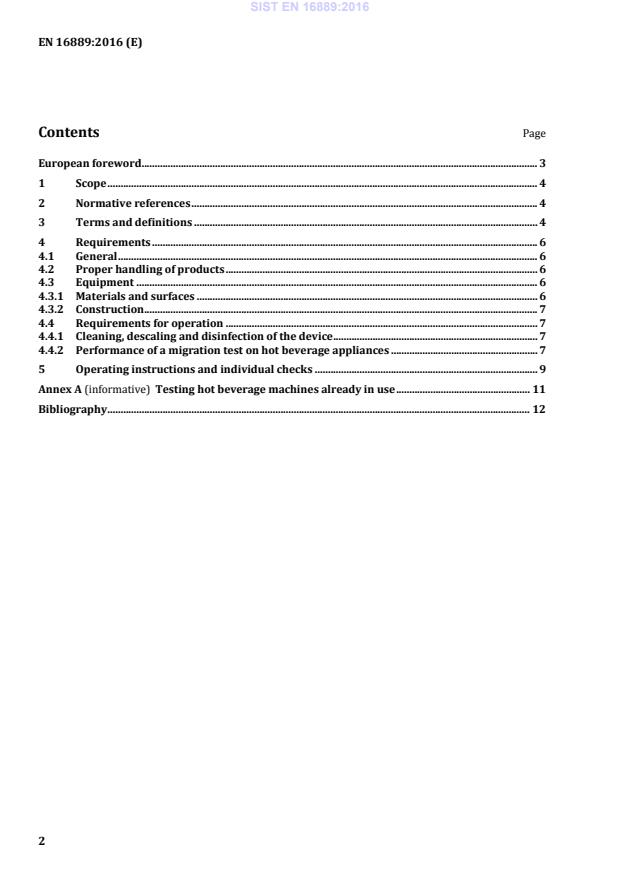
Testing hot beverage machines already in use . 11 Bibliography . 12
1) This document is impacted by the amendments EN 60335-2-75:2004/A1:2005, EN 60335-2-75:2004/A2:2008, EN 60335-2-75:2004/A11:2006, and EN 60335-2-75:2004/A12:2010. SIST EN 16889:2016
Note 1 to entry: According to the Directorate for the Quality of Medicines and HealthCare of the Council of Europe (EDQM): Metals and alloys used in food contact materials and articles, Council of Europe, 2013 [1]. ISBN: 978–92–871–7703–2. 4 Requirements 4.1 General For the production and dispensation of hot beverages from hot beverage appliances to the user, the requirements for each relevant legal provision shall be conformed to.
NOTE In particular, the Regulation (EC) No 1935/2004 [2], Regulation (EC) No 2023/2006 [3] and the applicable hygiene provisions (see bibliography) apply. To ensure this for the production and dispensation of hot beverages from hot beverage appliances, the following requirements shall be conformed to. 4.2 Proper handling of products a) Hot beverages shall be placed on the market by way of hot beverage appliances, so that they, under observation of the necessary care, are not exposed to adverse influences during processing, storage and distribution. Depending on product, each product-specific temperature shall be taken into account. b) Water for hot beverages from hot beverage appliances shall reach a minimum temperature of 65 °C over the course of the product preparation. 4.3 Equipment 4.3.1 Materials and surfaces Materials in the food area shall fulfil the following requirements: a) they shall correspond to the legal requirements; b) they shall not dispense any parts of materials into the beverage which are questionable in regards to health, odour or taste or are technically avoidable; c) they shall be corrosion-resistant. NOTE 1 Corrosion-resistant materials resist the usual chemical or electrochemical stresses. This includes production processes, cleaning and disinfection in accordance with the operating instructions. NOTE 2 For materials in the food area, Article 3 of Regulation (EC) No 1935/2004 [2] applies. Materials in the food and splash area shall fulfil the following requirements: d) they shall demonstrate a surface quality which corresponds with the specific operational and hygienic requirements; e) they shall be abrasion-proof in correspondence with the intended application; SIST EN 16889:2016
The hot beverage appliances shall be constructed so that they fulfil the basic requir
...