

FprEN 304
(Main)Heating boilers - Test code for heating boilers for atomizing oil burners
- Abstract
This document applies to the determination of the performances of heating boilers and combi boilers fired by liquid fuels. The requirements for the heating performances are laid down in EN 303-1 and EN 303-2.
This test code includes the requirements and recommendations for carrying out and evaluating the procedure for testing boilers and also the details of the technical conditions under which the tests will be carried out.
The requirements and the performance of testing for the sanitary hot water production of combi boilers are laid down in EN 303-6.
- Status
- Not Published
- Publication Date
- 17-Aug-2025
- Technical Committee
- CEN/TC 57 - Central heating boilers
- Current Stage
- 4599 - Dispatch of FV draft to CMC - Finalization for Vote
- Start Date
- 21-Mar-2025
- Due Date
- 04-Jun-2024
- Completion Date
- 21-Mar-2025

Overview
FprEN 304:2023 - published by CEN (Technical Committee CEN/TC 57) - is the European test code for determining the performance of heating boilers and combi boilers fired by liquid fuels with atomizing oil burners. Designed to supersede EN 304:2017, this document defines the technical conditions, test procedures and evaluation methods used to measure boiler outputs, efficiencies and related performance parameters. It supports conformity assessment and aligns with EU ecodesign requirements (see Annex ZA/ZB).
Key topics and technical requirements
- Scope and application
- Applies to heating and combi boilers with atomizing oil burners; sanitary hot water testing for combi boilers is addressed by EN 303-6.
- Heating performance requirements reference EN 303‑1 and EN 303‑2.
- Test rig and laboratory qualifications
- Tests should be performed by laboratories compliant with EN ISO/IEC 17025.
- The test sample must be representative of the marketed product including accessories.
- Measured performance parameters
- Determination of nominal heat output and boiler efficiency at nominal and 30% load (time- and load-dependent methods).
- Standby heat loss determination and auxiliary electrical energy consumption.
- Seasonal space‑heating efficiency, waterside resistance, and verification of condensing output and condensation formation.
- Emissions testing for NOx and CO.
- Measurement accuracies and uncertainties
- Atmospheric pressure: ≤ 50 Pa
- Water flow rate: ≤ 1% of measured value
- Air volume flow: ≤ 2%
- Temperatures: ambient 2 K; water 1 K; combustion products 2 K
- Gas analyzers: O2 and CO ranges specified; NOx and hydrocarbons resolution indicated
- Flue gas pressure: 1 Pa (≤ 60 Pa) or 2% (> 60 Pa)
- Overall efficiency determinations must meet an uncertainty target of approximately ±2 percentage points.
- Test procedures and clauses
- Clauses cover draught adjustment, steady‑state establishment, test periods, detailed calculations (Annex A), test-rig setup (Annex D) and alternative calculation methods (new Annex F).
Applications and users
Who uses FprEN 304:
- Boiler and burner manufacturers - for product development, validation and factory testing.
- Independent test laboratories and notified bodies - for type testing and certification.
- Certification and conformity assessment schemes - to demonstrate compliance with EN standards and EU ecodesign.
- Regulators, energy auditors and specifiers - to assess emissions, efficiency and suitability for installations.
- R&D teams and installers - to verify performance under controlled conditions.
Practical uses:
- Type approval, performance labeling and claims verification
- Comparative product testing and optimization of burner‑boiler assemblies
- Supporting compliance with EU energy and emissions regulations
Related standards
- EN 303-1:2017 (general heating boiler requirements)
- EN 303-2:2017 (special requirements for atomizing oil burners)
- EN 303-6 (domestic hot water and combi boiler testing)
- EN 267:2020 (forced draught burners for liquid fuels)
- EN ISO/IEC 17025 (laboratory competence)
For full test methods, calculation formulas and normative requirements, consult the complete FprEN 304:2023 document from your national CEN member or standards body.
Relations
- Effective Date
- 19-Jan-2023
Get Certified
Connect with accredited certification bodies for this standard

DIBt (Deutsches Institut für Bautechnik)
German Institute for Building Technology.
DIN CERTCO
DIN Group product certification.

Aboma Certification B.V.
Specialized in construction, metal, and transport sectors.
Sponsored listings
Frequently Asked Questions
FprEN 304 is a draft published by the European Committee for Standardization (CEN). Its full title is "Heating boilers - Test code for heating boilers for atomizing oil burners". This standard covers: This document applies to the determination of the performances of heating boilers and combi boilers fired by liquid fuels. The requirements for the heating performances are laid down in EN 303-1 and EN 303-2. This test code includes the requirements and recommendations for carrying out and evaluating the procedure for testing boilers and also the details of the technical conditions under which the tests will be carried out. The requirements and the performance of testing for the sanitary hot water production of combi boilers are laid down in EN 303-6.
This document applies to the determination of the performances of heating boilers and combi boilers fired by liquid fuels. The requirements for the heating performances are laid down in EN 303-1 and EN 303-2. This test code includes the requirements and recommendations for carrying out and evaluating the procedure for testing boilers and also the details of the technical conditions under which the tests will be carried out. The requirements and the performance of testing for the sanitary hot water production of combi boilers are laid down in EN 303-6.
FprEN 304 is classified under the following ICS (International Classification for Standards) categories: 91.140.10 - Central heating systems. The ICS classification helps identify the subject area and facilitates finding related standards.
FprEN 304 has the following relationships with other standards: It is inter standard links to EN 304:2017. Understanding these relationships helps ensure you are using the most current and applicable version of the standard.
FprEN 304 is associated with the following European legislation: EU Directives/Regulations: 811/2013, 813/2013; Standardization Mandates: M/434, M/535. When a standard is cited in the Official Journal of the European Union, products manufactured in conformity with it benefit from a presumption of conformity with the essential requirements of the corresponding EU directive or regulation.
FprEN 304 is available in PDF format for immediate download after purchase. The document can be added to your cart and obtained through the secure checkout process. Digital delivery ensures instant access to the complete standard document.
Standards Content (Sample)
SLOVENSKI STANDARD
01-marec-2023
Kotli za ogrevanje - Preskušanje kotlov za ogrevanje z razprševalnimi oljnimi
gorilniki
Heating boilers - Test code for heating boilers for atomizing oil burners
Heizkessel - Prüfregeln für Heizkessel mit Ölzerstäubungsbrennern
Chaudières de chauffage - Règles d'essai pour les chaudières avec brûleurs fioul à
pulvérisation
Ta slovenski standard je istoveten z: prEN 304
ICS:
27.060.10 Gorilniki na tekoče in trdo Liquid and solid fuel burners
gorivo
91.140.10 Sistemi centralnega Central heating systems
ogrevanja
97.100.40 Grelniki na tekoče gorivo Liquid fuel heaters
2003-01.Slovenski inštitut za standardizacijo. Razmnoževanje celote ali delov tega standarda ni dovoljeno.
DRAFT
EUROPEAN STANDARD
prEN 304
NORME EUROPÉENNE
EUROPÄISCHE NORM
March 2023
ICS 91.140.10 Will supersede EN 304:2017
English Version
Heating boilers - Test code for heating boilers for
atomizing oil burners
Chaudières de chauffage - Règles d'essai pour les Heizkessel - Prüfregeln für Heizkessel mit
chaudières avec brûleurs fioul à pulvérisation Ölzerstäubungsbrennern
This draft European Standard is submitted to CEN members for enquiry. It has been drawn up by the Technical Committee
CEN/TC 57.
If this draft becomes a European Standard, CEN members are bound to comply with the CEN/CENELEC Internal Regulations
which stipulate the conditions for giving this European Standard the status of a national standard without any alteration.
This draft European Standard was established by CEN in three official versions (English, French, German). A version in any other
language made by translation under the responsibility of a CEN member into its own language and notified to the CEN-CENELEC
Management Centre has the same status as the official versions.
CEN members are the national standards bodies of Austria, Belgium, Bulgaria, Croatia, Cyprus, Czech Republic, Denmark, Estonia,
Finland, France, Germany, Greece, Hungary, Iceland, Ireland, Italy, Latvia, Lithuania, Luxembourg, Malta, Netherlands, Norway,
Poland, Portugal, Republic of North Macedonia, Romania, Serbia, Slovakia, Slovenia, Spain, Sweden, Switzerland, Türkiye and
United Kingdom.
Recipients of this draft are invited to submit, with their comments, notification of any relevant patent rights of which they are
aware and to provide supporting documentation.
Warning : This document is not a European Standard. It is distributed for review and comments. It is subject to change without
notice and shall not be referred to as a European Standard.
EUROPEAN COMMITTEE FOR STANDARDIZATION
COMITÉ EUROPÉEN DE NORMALISATION
EUROPÄISCHES KOMITEE FÜR NORMUNG
CEN-CENELEC Management Centre: Rue de la Science 23, B-1040 Brussels
© 2023 CEN All rights of exploitation in any form and by any means reserved Ref. No. prEN 304:2023 E
worldwide for CEN national Members.
prEN 304:2023 (E)
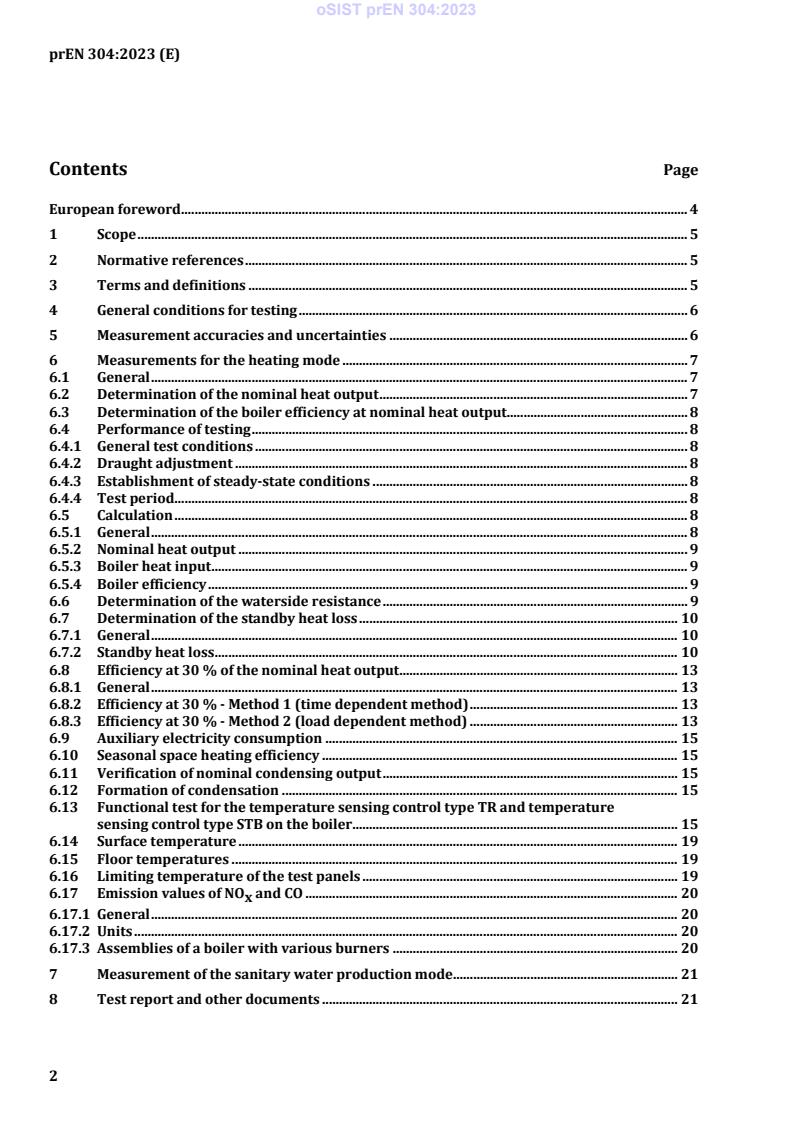
Contents Page
European foreword . 4
1 Scope . 5
2 Normative references . 5
3 Terms and definitions . 5
4 General conditions for testing . 6
5 Measurement accuracies and uncertainties . 6
6 Measurements for the heating mode . 7
6.1 General . 7
6.2 Determination of the nominal heat output . 7
6.3 Determination of the boiler efficiency at nominal heat output. 8
6.4 Performance of testing . 8
6.4.1 General test conditions . 8
6.4.2 Draught adjustment . 8
6.4.3 Establishment of steady-state conditions . 8
6.4.4 Test period . 8
6.5 Calculation . 8
6.5.1 General . 8
6.5.2 Nominal heat output . 9
6.5.3 Boiler heat input . 9
6.5.4 Boiler efficiency . 9
6.6 Determination of the waterside resistance . 9
6.7 Determination of the standby heat loss . 10
6.7.1 General . 10
6.7.2 Standby heat loss . 10
6.8 Efficiency at 30 % of the nominal heat output . 13
6.8.1 General . 13
6.8.2 Efficiency at 30 % - Method 1 (time dependent method) . 13
6.8.3 Efficiency at 30 % - Method 2 (load dependent method) . 13
6.9 Auxiliary electricity consumption . 15
6.10 Seasonal space heating efficiency . 15
6.11 Verification of nominal condensing output . 15
6.12 Formation of condensation . 15
6.13 Functional test for the temperature sensing control type TR and temperature
sensing control type STB on the boiler . 15
6.14 Surface temperature . 19
6.15 Floor temperatures . 19
6.16 Limiting temperature of the test panels . 19
6.17 Emission values of NO and CO . 20
x
6.17.1 General . 20
6.17.2 Units . 20
6.17.3 Assemblies of a boiler with various burners . 20
7 Measurement of the sanitary water production mode . 21
8 Test report and other documents . 21
prEN 304:2023 (E)
Annex A (normative) Calculations for the heating mode . 22
A.1 Volume measurement . 22
A.2 Calculation of combustion parameters . 22
A.3 Determination of air factor (𝜆𝜆) and excess air (e) . 26
A.4 Test rigs . 28
A.5 Calculation of the nominal heat output P . 29
N
A.6 Calculation of the heat input . 30
A.7 Calculation of efficiency . 30
A.8 Calculation of the heat losses q , q , q . 32
A U S
A.9 Standby heat loss (P ) . 35
Stby
A.10 Calculation of the seasonal space heating energy efficiency . 36
A.11 Fuel characteristics . 39
Annex B (informative) Applicable symbols and units . 41
Annex C (informative) Criteria for the adaptation of forced draught burners using liquid
fuels to heating boilers . 44
Annex D (informative) Information for setting up and evaluation of the test rig . 46
Annex E (informative) Determination of the heat losses of the test rig . 47
Annex F (informative) Alternative method for heat output as enthalpy difference. 48
F.1 General . 48
F2 Heat output calculation . 48
F.3 Water enthalpy (Hw) calculation . 49
F.4 Introduction. 49
F.5 Introduction. 50
Annex ZA (informative) Relationship between this European Standard and the ecodesign
requirements of Commission Regulation (EU) No [813/2013] aimed to be covered . 51
Annex ZB (informative) Relationship between this European Standard and the ecodesign
requirements of Commission Delegated Regulation (EU) No [811/2013] aimed to be
covered . 52
Bibliography . 53
prEN 304:2023 (E)
European foreword
This document (prEN 304:2023) has been prepared by Technical Committee CEN/TC 57 “Central
heating boilers”, the secretariat of which is held by DIN.
This document will supersede EN 304:2017.
For relationship with EU Directive(s), see informative Annexes ZA and ZB, which are an integral part of
this document.
This document has been prepared under a Standardization Request given to CEN by the European
Commission and the European Free Trade Association, and supports essential requirements of EU
Directive(s) / Regulation(s).
For relationship with EU Directive(s) / Regulation(s), see informative Annexes ZA and ZB, which is an
integral part of this document.
The main technical changes compared to EN 303-2:2017 are the following:
a) new Annex F for calculation clarification was added;
b) new clause marking and instructions was added;
c) updated Normative References;
d) standby heat loss method 1 was deleted.
prEN 304:2023 (E)
1 Scope
This document applies to the determination of the performances of heating boilers and combi boilers
fired by liquid fuels. The requirements for the heating performances are laid down in EN 303-1 and
EN 303-2.
This test code includes the requirements and recommendations for carrying out and evaluating the
procedure for testing boilers and also the details of the technical conditions under which the tests will
be carried out.
The requirements and the performance of testing for the sanitary hot water production of combi boilers
are laid down in EN 303-6.
2 Normative references
The following documents, in whole or in part, are normatively referenced in this document and are
indispensable for its application. For dated references, only the edition cited applies. For undated
references, the latest edition of the referenced document (including any amendments) applies.
EN 267:2020, Forced draught burners for liquid fuels
EN 303-1:2017, Heating boilers — Part 1: Heating boilers with forced draught burners — Terminology,
general requirements, testing and marking
EN 303-2:2017, Heating boilers — Part 2: Heating boilers with forced draught burners — Special
requirements for boilers with atomizing oil burners
EN 303-6, Heating boilers — Part 6: Heating boilers with forced draught burners — Specific
requirements for the domestic hot water operation and energy performance of water heaters and
combination boilers with atomizing oil burners of nominal heat input not exceeding 70 kW
EN 15456, Heating boilers — Electrical power consumption for heat generators — System boundaries —
Measurements
3 Terms and definitions
For the purposes of this document, the terms and definitions given in EN 303-1:2017 and
EN 303-2:2017 and the following apply.
3.1
minimum continuous heat output
P
minC
lowest heat output which is maintained automatically by the control device in continuous operation
which is specified for each type of fuel in accordance with the requirements of this document
As impacted by EN 303-6/prA1.
prEN 304:2023 (E)
4 General conditions for testing
The performance tests of the boiler should be carried out by a test laboratory complying with the
requirements of EN ISO/IEC 17025.
The test sample shall correspond to a boiler as placed on the market including all parts and accessories
necessary for the operation of the boiler. Boilers to be equipped with different burners shall be tested
with one specified forced draught burner.
The boiler and the burner shall be operated in accordance with the operation manual throughout all
tests.
When determining the thermal outputs P and 30 % P of a combi boiler, no sanitary hot water shall
N N
be drawn off during the test. The thermal outputs shall be determined from the heating circuit only.
Sanitary hot water tests for combination boiler shall be done according to EN 303-6.
5 Measurement accuracies and uncertainties
The accuracy of the measurement devices for the following parameters shall not exceed:
a) atmospheric pressure 50 Pa;
b) waterside pressure loss 2 % of measured value;
c) water flow rate 1 % of measured value;
d) air volume flow rate 2 % of measured value;
e) time
1) up to 1 h: 0,2 s;
2) beyond 1 h: 0,1 % of measured value;
f) auxiliary electrical energy 2 % of measured value;
g) temperatures:
1) ambient 2 K;
2) water 1 K;
3) combustion products 2 K;
4) surface 2 K;
h) CO, CO , O , NO , C H :
2 2 x x y
1) CO -content: 0,1 % volume from full scale;
2) O -content: 0,1 % volume from full scale;
3) CO-content: 5 ml/m ;
4) NO -content: 5 ml/m ;
x
prEN 304:2023 (E)
5) C H -content: 5 ml/m ;
x y
i) Mass 0,05 % of the full scale;
j) Pressure flue gas:
1) ≤ 60 Pa: 1Pa;
2) > 60 Pa: 2 % of the measured value.
The full range of the measuring apparatus shall be chosen in such a way that it is suitable for maximum
anticipated value. The measurement accuracies indicated above concern individual measurements.
For measurements requiring a combination of individual measurements, the lower accuracies
associated with individual measurements may be necessary to attain the total required uncertainty. The
test rig shall be set up in such a way that the efficiency can be determined within an uncertainty of 2 %
points.
6 Measurements for the heating mode
6.1 General
The amount of useful heat output transmitted to the heat carrier (water) is measured. It can be
determined in the boiler circuit or by means of a secondary heat exchanger.
The useful heat output transmitted to the water is determined either by measuring:
a) the mass flow of cold water entering the boiler circuit and the rise of temperature between the
outlet water temperature and the inlet water temperature; or
b) the mass flow of the water circulating in the boiler circuit and its temperature rise; or
c) the mass flow and the temperature rise over a secondary heat exchanger corrected by the heat loss
of this secondary heat exchanger. The heat produced by the boiler is transferred to the cooling
water by means of a secondary heat exchanger. The heat received by the latter is calculated from
the mass flow and the temperature rise of the cooling water. The heat losses from the well-
insulated connections between the boiler and the secondary heat exchanger and those of the
secondary heat exchanger itself, are determined either by preliminary tests or by calculation. The
heat output of the boiler is the sum of the two amounts of heat.
6.2 Determination of the nominal heat output
The tests for the determination of the nominal heat output shall be carried out at a firing rate such that
the output is at least 100 %, but does not exceed 105 % of the nominal value, and the requirements
concerning the nominal heat output shall be met.
If the heat output exceeds 105 %, a second test shall be carried out at a firing rate between 95 % and
100 % of the nominal heat output of the boiler.
The actual value for the nominal heat output shall be determined by linear interpolation between the
two test results.
The nominal heat output shall be determined at a water rate that is adjusted to obtain a return water
temperature of (60 ± 1) °C and a temperature difference between the flow and return water
temperature of (20 ± 2) °C.
prEN 304:2023 (E)
NOTE The conditions for determination of the rated heat output in former versions of EN 304 have been a
mean flow temperature of between 80 °C and 90 °C, and the mean temperature difference between flow and
return has been between 10 K and 25 K. However, this is not in line with the Regulation EU 813/2013.
6.3 Determination of the boiler efficiency at nominal heat output
The boiler efficiency at nominal heat output is measured as the determination of the nominal heat
output (see 6.2).
The efficiency shall be determined on the basis of the net calorific value NCV.
The direct method according to 6.5.4.1 shall be applied. The indirect method allows an additional check
of test accuracy of the test rig to be made by means of an energy balance.
6.4 Performance of testing
6.4.1 General test conditions
The boiler is installed in accordance with the technical instructions in a well-ventilated, draught free
room (air speed less than 0,5 m/s), which has an ambient temperature of (20 ± 5) K. The boiler is
protected from direct solar radiation.
The settings of the burner shall not be manually changed after adjustment. No change shall be made to
the water flow or any other test parameter during one test period.
The temperature, pressure and composition of the products of combustion shall be measured
continuously and shall be recorded with a sampling rate below 10 s.
The flow temperature t and the return temperature t shall not differ by more than ±0,5 K over the
F R
test period at the beginning and the end of the test period.
6.4.2 Draught adjustment
6.4.2.1 Boilers operating under negative pressure
For boilers operating under negative pressure the draught at the boiler outlet shall be adjusted so that
there is a negative pressure in the combustion chamber. The draught shall be measured.
6.4.2.2 Boilers operating under positive pressure
In positive pressure boilers the pressure shall be set at the boiler outlet close to 0 Pa. The pressure
difference between combustion chamber and boiler outlet shall be measured.
6.4.3 Establishment of steady-state conditions
The boiler shall be operated for at least 1 h before the start of the performance and efficiency test at the
output intended for the test without any further interference.
The steady-state condition is reached once the water temperatures t and t do not differ by more
F R
than ± 0,5 K.
6.4.4 Test period
The test period shall be at least 60 min.
6.5 Calculation
6.5.1 General
The calculations shall be based on the mean values of the individual readings of all recorded parameters
during the test period of 2 consecutive 30 min test sequences which meet the requirements of 6.4.4.
prEN 304:2023 (E)
6.5.2 Nominal heat output
The necessary formulae relevant to the individual test methods are given in A.5.
6.5.3 Boiler heat input
For these calculations, formulae in A.6 are to be used.
6.5.4 Boiler efficiency
6.5.4.1 Direct method
In the direct method the boiler efficiency shall be determined by:
P
(1)
η ×100
K
Q
B
P and Q as described in Annex A.
B
NOTE P equals either P or 30 % P
N N.
6.5.4.2 Indirect method
The indirect method is used for checking purposes only. The indirect boiler efficiency is given by:
(2)
η =1− q−−qq
k A US
where
q is the loss assensible heat of the products of combustion (values relative to the heat input);
A
q is the loss as incomplete combustion (values relative to the heat input);
U
q is the loss as radiation, convection and conduction (values relative to the heat input).
S
These heat losses are calculated in A.8.
6.6 Determination of the waterside resistance
The hydraulic resistance of a boiler (measured in mbar) shall be determined for the water rate
corresponding to operation of the boiler at the nominal heat input with a water flow temperature of
80 °C and a temperature difference between the flow and the return water of 20 K.
Other conditions are accepted if documented.
The test is carried out with the water at ambient temperature.
The test rig is specified in Figure 1. Before or after the test, the two test pipes are connected directly to
each other in order to determine their own resistance for the specified flow rate.
=
prEN 304:2023 (E)
Key
1 vent
2 differential manometer
3 flexible tubes
4 boiler
5 test pipe
a section at “X” rotated through 90°
6 flexible pipe
7 orifice ⌀ 3 mm smoothed internally
Figure 1 — Determination of the hydraulic resistance
6.7 Determination of the standby heat loss
6.7.1 General
No useful heat shall be extracted for heating or sanitary hot water production.
6.7.2 Standby heat loss
The test installation is described in Figures 3, 4 and 5.
prEN 304:2023 (E)
The circuits joining the different parts of the installation shall be insulated and as short as possible. The
inherent losses of the test installation and the thermal contribution of the pump for the different flow
rates shall be determined at the beginning to be able to take account of them (see Annex B).
The boiler is fitted with the largest diameter test flue stated by the manufacturer in the technical
instructions and equipped with a burner but is not in operation. Normally the test is carried out with a
burner without air dampers. If a burner with air dampers is used this shall be stated in the test report.
NOTE The ideal distance is 1 m.
The average boiler water temperature is brought to a mean temperature of (30 ± 5) K above ambient
temperature. The pump (11, Figure 2) and the boiler pump, if any, are stopped, the exchanger circuit
(12, Figure 2) is shut off.
With the water circulating continuously by means of the pump (5, Figure 2) of the test rig, the thermal
contribution of the electric boiler is adjusted so as to obtain, in the steady-state condition, a difference
of (30 ± 5) K between the mean water temperature and the ambient temperature.
Throughout the test the variation in room temperature shall not exceed 2 °C/h.
The following parameters shall be recorded:
— P in kW, the electrical power consumed by the auxiliary electric boiler, corrected for the losses of
m
the test rig and the thermal contribution of the pump (5, Figure 2);
— T in °C, the mean water temperature equal to the mean of the temperature indicated by the two
probes (2, Figure 2) at the return and the flow of the boiler during the test;
— T in °C, the mean ambient temperature during the test.
A
The standby heat loss, expressed for a mean water temperature of 30 K above an ambient temperature
of 20 °C are given in kW, by:
1,25
PP= (6)
stby m
−TT
A
Determination of the heat losses from the test rig and the heat contributions of the circulating pump of
the test rig are given in Annex E.
The standby losses of combi boilers with storage tank measured in method 2 of this document are
determined as described in EN 15502-1:2012+A1:2015, 9.4.2.
prEN 304:2023 (E)
Key
1 boiler with the burner
2 temperature probes
3 low inertia thermocouple
4 recorder
5 pump with a rate such that the temperature difference between the two probes is between 2 °C and 4 °C at
the maximum test temperature
6 auxiliary electric boiler
7 device for measuring the electric power
8 voltage regulator
9 1/4 turn valves
10 electrical supply
11 additional pump (if necessary)
12 heat exchanger
Figure 2 — Test installation to determine the heat emissions of the boiler when the burner is off
and the thermal capacity of the boiler
prEN 304:2023 (E)
6.8 Efficiency at 30 % of the nominal heat output
6.8.1 General
To determine the efficiency at a load corresponding to 30 % of the nominal heat output, or the
arithmetic mean of the maximum and minimum heat output for range-rated boilers, one of the
following methods shall be used:
The boiler is operated as for the determination of the useful efficiency at nominal heat input or at the
arithmetic mean of the maximum and minimum heat input in the case of range-rated boilers.
Throughout the test, the water volume rate is maintained constant within ± 1 %, taking into account the
temperature variations, and the pump operates continuously.
The efficiency shall be determined on the basis of the net calorific value NCV.
The direct method according to 6.5.4.1 shall be applied.
6.8.2 Efficiency at 30 % - Method 1 (time dependent method)
The boiler is installed as described in A.4, fitted to the thermally insulated test rig shown schematically
in Figure 2 or Figure 3 (or any other test rig giving at least comparable results and equivalent
measurement accuracies).
For standard boilers, the return temperature is held constant at (47 ± 1 °C), with a maximum variation
in this temperature during the measurement period of ± 1 K. For low temperature boilers the test is
carried out at (37 ± 1) °C and for condensing boilers the test is carried out at (30 ± 1) °C.
If the boiler control does not permit operation at a return temperature as low as 47 °C, the test is made
with the lowest return temperature compatible with the operation of the boiler.
A timer is connected to the terminals of the room thermostat so as to obtain a complete operating cycle
of 10 min.
The shutdown and operating times are calculated as indicated in Table 1.
The temperatures are measured continuously directly on the flow and return of the boiler.
The boiler is considered to be in thermal equilibrium when the efficiency measurement of three
consecutive cycles, combining any two results from three, does not vary by more than 0,5 percentage
points. In this case, the result is equal to the average value of at least three consecutive measurement
cycles. For any other case, the average value shall be calculated from at least 10 consecutive cycles.
The respective fuel and water consumption’s over complete cycles are measured.
Temperatures t and t are measured continuously.
1 2
The heat output P and the heat input Q as calculated according to Annex A. A variation of ± 2 % points,
B
with respect to the 30 % of the nominal heat output is permitted. For variations up to ± 4 % points, it is
necessary to carry out two measurements, one above and one below 30 % of the nominal heat output.
The efficiency corresponding to 30 % is determined by linear interpolation.
6.8.3 Efficiency at 30 % - Method 2 (load dependent method)
The boiler is installed as described in A.4, fitted to the thermally insulated test rig shown schematically
in Figure 2 or Figure 3 (or any other test rig giving at least comparable results and equivalent
measurement accuracy’s).
The boiler flow and return temperatures and the operating on and off cycles are given by the boiler
control when a heat input leading to a heat output of the boiler of (30 ± 2) % of the nominal heat output
(or the arithmetic mean of the maximum and minimum output for range-rated boilers) is drawn
through the heat exchanger.
prEN 304:2023 (E)
The temperatures are measured continuously at the flow and at the return of the boiler.
The average water temperature shall be no less than 50 °C for standard boilers and 40 °C for low
temperature boilers. For condensing boilers, a return temperature of 30 °C has to be set.
If the boiler control does not permit operation at a return temperature as low as 50 °C, the test is
carried out at the lowest return temperature compatible with the operation of the boiler.
The boiler is considered to be in thermal equilibrium when the efficiency measurement of three
consecutive cycles, combining any two results from three, does not vary by more than 0,5 %. In this
case, the result is equal to the average value of at least three consecutive measurement cycles. For any
other case, the average value shall be calculated from at least 10 consecutive cycles.
The respective fuel and water consumption’s over complete cycles are measured.
The efficiency is determined using the formula in 6.5.4.1.
A variation of ± 2 % points with respect to the 30 % of the nominal heat output is permitted. For
variations up to ± 4 % points, it is necessary to carry out two measurements, one above and one below
30 % of the nominal heat output. The efficiency corresponding to 30 % is determined by linear
interpolation.
Table 1 — Calculation of cycling times for efficiency at 30 % - Method 1
Conditions of Heat output Cycle times
operation
1 30 % reduced P = 0,3 × P t = 600 s
1 N 2
rate
2 Full rate P = P t = 180 s
4 N 1
Controlled shut - t = 420 s
down
3 Reduced rate P > 0,3 × P
180s× P
1 N
t =
P
Controlled shut - t = 600 s − t
3 2
down
4 Full rate P = P
180s×−PP600×
4 N
t =
PP−
Reduced rate P < 0,3 × P t = 600 s − t
1 N 3 1
5 Full rate P = P t = measured value
4 N 1
Reduced rate P
1 180s×tP×
( )
t =
P
Controlled shut - t = 600 s − (t + t ) ≥ 0
3 3 2
down
prEN 304:2023 (E)
6.9 Auxiliary electricity consumption
The auxiliary electricity consumption at nominal heat output (el ), the auxiliary electricity
max
consumption at 30 % part load (el ) and auxiliary electricity consumption in standby mode (P )
min SB
shall be measured according to EN 15456 taking into account the following conditions.
For assemblies of one boiler and one burner (unit) the test is carried out without any circulation pump
of the boiler in the water circuit.
For assemblies of one boiler and various burners, auxiliary electricity consumption is measured
according to this standard on one assembly of a burner and the boiler like a unit.
Additional auxiliary electricity consumption for this burner alone shall be measured according to
EN 15456. The measurement is not necessary if corresponding values are available in the technical
documentation of the burner.
Other burners may be used with the same values for auxiliary electricity consumption for the whole
assembly if the values for the alternative burner are not exceeding the corresponding values for the
burner in the assembly measured. If this criterion is not met the auxiliary electricity consumption of the
assembly has to be recalculated.
NOTE The recalculation of the auxiliary electricity consumption leads to recalculation of seasonal space
heating efficiency.
6.10 Seasonal space heating efficiency
The seasonal space heating efficiency expressed on gross calorific value GCV shall be calculated
according to A.10 of this document.
6.11 Verification of nominal condensing output
The water rate is adjusted so as to obtain a return water temperature of (30 ± 1) °C and a temperature
difference between flow and return temperature of (20 ± 2) K.
6.12 Formation of condensation
The boiler shall operate continuously for 4 h under the test conditions of 6.11. The condensate mass
flow is recorded.
6.13 Functional test for the temperature sensing control type TR and temperature
sensing control type STB on the boiler
The water flow rate and the water temperature shall be adjusted as for the determination of the
nominal heat output of the boiler. The heat input shall be adjusted to give the nominal heat output of
the boiler.
After reaching steady-state conditions the heat output shall be reduced from the test rig to (40 ± 5) % of
the nominal heat output while the temperature sensing control type TR shall be fixed at the maximum
possible value.
The circulation pump shall be kept in operation. In no case a shutdown by the temperature sensing
control type STB shall occur.
The same test shall be carried out with the temperature sensing control type TR out of operation.
The temperature sensing control type STB shall switch off at a temperature equal to or less than the
temperature specified for the boiler but not exceeding 110 °C.
The temperature sensing control type STB shall cause a safety shutdown before the water flow
temperature exceeds the preset value of STB.
prEN 304:2023 (E)
Key
1 fuel supply
2 tube fixing
3 balance
4 oil storage tank
d diameter of the oil supply pipe
P pressure in the combustion chamber
K
Figure 3 — Measuring installation to determine the amount of fuel
Key
I section for draught measuring
II section for temperature measuring
measuring device for flue gas analysis (sampling cross)
III section for measuring the smoke contents in the flue gas
1 draught limiter
2 insulating t = 40
P draught of the chimney
Zug
D diameter of the flue gas section
Figure 4 — Flue gas section — general
prEN 304:2023 (E)
I Connection for draught II Flue gas III Probe for
measurement (flush with
temperature immersion depth E
internal wall of flue gas pipe.
measurement immersion
Internal welding point
depth E
deburred)
a) with horizontal measuring section = D/3
b) with vertical measuring section = D/2
Key
3 connection for recording instrument
4 connection for indicating instrument
5 thermocouple
6 well sealed
Figure 5 — Flue gas section — probe installation
For measurements
in built-in
installations only
Immersion depth of
the thermocouples
E = 0,10 D
E = 0,17 D
a)
E = 0,24 D
3 b)
E = 0,30 D
E = 0,37 D
II a) A flue gas temperature III a) Connection for smoke test
measurement by means of 5 immersion depth
thermocouples (TH ); recommended in
i a) with horizontal measuring
cases where unequal temperature section = D/3
distribution is expected
b) with vertical measuring
section = D/3
Key
6 well sealed
Figure 6 — Flue gas section — temperature measurement
prEN 304:2023 (E)
Dimensions in millimetres
Key
1 measuring point for air temperature
2 squared timber frame
3 white wood with tongue and groove joint
4 glass wool
5 empty tube measuring cables
6 measuring point
7 test base for temperature measurements
a, b width of boiler contact surface to the bottom
H height of boiler
Figure 7 — Test configuration for the determination of base temperatures
prEN 304:2023 (E)
Dimensions in millimetres
Key
1 thermocouple soldered to the copper plate
2 bore hole for fixing of the copper plate
Figure 8 — Configuration of a thermocouple for measuring the surface temperatures of the test
base
6.14 Surface temperature
The mean surface temperature for the determination of q shall be measured under nominal heat
s
output conditions. For this a minimum of 5 points on each boiler surface shall be measured. Under the
same conditions the critical temperatures (e.g. boiler doors, operating levers) shall be measured.
6.15 Floor temperatures
In order to determine the floor temperature below the boiler, the boiler is installed on a test base as for
example in Figure 7. The surface temperatures of this test base shall be measured in at least 5 points
under maximum nominal output conditions.
It is recommended that the surface temperatures of the test base are measured using thermocouples in
accordance with for example Figure 7 or with commercial surface thermometers.
6.16 Limiting temperature of the test panels
According to its design, the boiler is installed on a horizontal or vertical test panel of wood.
For boilers of which the manufacturer states that they may be installed near a wall or walls out of
combustible materials or with combustible materials, the distances between the side and back walls of
the boiler and the wooden test panels are those stated by the manufacturer or, in the case of boilers
designed to be mounted on the wall, those provided by the method of fixing; however, in no case shall
this distance exceed 100 mm.
This distance is measured from the closest part of the boiler. The side panel is placed on the side of the
boiler exhibiting the highest temperatures. For boilers, which the manufacturer states may be installed
under a shelf or in a similar installation position, an appropriate panel is placed above the boiler at the
minimum distance appearing in the installation instructions.
When the manufacturer gives no details on the installation of the boiler close to a wall or walls, or
under a shelf, the test is carried out with appropriate panels placed in contact with the boiler.
The wooden panels shall be (25 ± 1) mm thick and it shall be painted matt black; their dimensions are
at least 5 cm greater than the corresponding dimensions of the boiler.
prEN 304:2023 (E)
Temperature sensors are incorporated into the panels at the centre of 10 cm squares and penetrate the
panels from the outside so that the hot junctions are situated 3 mm from the surface facing the boiler.
After the boiler has been left to operate, the temperatures of the test panels are measured when these
are stable to within 2 K.
When the manufacturer states in the instructions that some form of protection has to be used, another
test is carried out with this protection in position.
The ambient temperature is measured at a height of 1,50 m above the floor and at a minimum distance
of 1,5 m from the boiler, with a temperature sensor protected against radiation from the test
installation.
6.17 Emission values of NO and CO
x
6.17.1 General
The emission values of NO and CO are determined by means of methods and instruments as described
x
in EN 267.
The calculation of NO is performed according to EN 267:2009+A1:2011, Annex B using the same
x
corrections and reference conditions.
6.17.2 Units
Table 2 — NO values
x
≤ 400 kW Measurement of NO Weighted value
x
at
ON / OFF Q NO (Q )
N x N
Modulating and Multi Stage Q and Q 0,85 NO (Q ) + 0,15 NO (Q )
N minC x minC x N
6.17.3 Assemblies of a boiler with various burners
Every burner shall comply with Annex D of this document.
Every burner shall have NO emissions ≤ 120 mg/kWh according to EN 267 but expressed in GCV.
X
NO are measured according to this standard on one assembly of a burner and the boiler and weighted
X
according to Table 2 (for units above). The value measured for the assembly is compared to the
declared value of the burner according to EN 267.
— If the declared value of the used burner is higher or equal than the measured value of the assembly,
any burner can be used to fulfil the requirement “NO emissions ≤ 120 mg/kWh”.
X
— If the declared value of the used burner is lower than the measured value of the assembly, only
burners with NO e
...