


EN 17197:2023
(Main)Construction products: Assessment of release of dangerous substances - Analysis of inorganic substances in eluates and digests - Analysis by inductively coupled plasma optical emission spectrometry (ICP-OES)
General Information
- Abstract
This document specifies the method for the determination of major, minor and trace elements in eluates and in aqua regia and nitric acid digests of construction products by inductively coupled plasma optical emission spectrometry (ICP-OES). It refers to the following 44 elements:
Aluminium (Al), antimony (Sb), arsenic (As), barium (Ba), beryllium (Be), bismuth (Bi), boron (B), cadmium (Cd), calcium (Ca), cerium (Ce), chromium (Cr), cobalt (Co), copper (Cu), iron (Fe), lanthanum (La), lead (Pb), lithium (Li), magnesium (Mg), manganese (Mn), mercury (Hg), molybdenum (Mo), neodymium (Nd), nickel (Ni), phosphorus (P), potassium (K), praseodymium (Pr), samarium (Sm), scandium (Sc), selenium (Se), silicon (Si), silver (Ag), sodium (Na), strontium (Sr), sulphur (S), tellurium (Te), thallium (Tl), thorium (Th), tin (Sn), titanium (Ti), tungsten (W), uranium (U), vanadium (V), zinc (Zn), and zirconium (Zr).
For the determination of low levels of As, Hg, Se and Sb, chemical vapour generation systems can be applied. This method is described in Annex E (normative).
NOTE Construction products include e.g. mineral-based products (S); bituminous products (B); metals (M); wood-based products (W); plastics and rubbers (P); sealants and adhesives (A); paints and coatings (C), see also CEN/TR 16045.
The method in this document is applicable to construction products and validated for the product types listed in Annex C (informative).
- Status
- Published
- Publication Date
- 21-Nov-2023
- Withdrawal Date
- 03-Jan-2023
- Technical Committee
- CEN/TC 351 - Construction Products - Assessment of release of dangerous substances
- Drafting Committee
- CEN/TC 351/WG 5 - Content and eluate analysis in construction products
- Current Stage
- 6060 - Definitive text made available (DAV) - Publishing
- Start Date
- 22-Nov-2023
- Due Date
- 11-Aug-2022
- Completion Date
- 22-Nov-2023

Overview
EN 17197:2023 is a European Standard developed by CEN for the analysis of inorganic substances released from construction products. It describes a robust analytical method using inductively coupled plasma optical emission spectrometry (ICP-OES) to measure a wide spectrum of elements in eluates (leachates) and acid digests from various construction materials. The standard supports the assessment of the release of dangerous substances, a key aspect in verifying the safety and environmental compliance of construction products across the European market.
This method is applicable to the determination of 44 major, minor, and trace elements, including aluminium, cadmium, chromium, lead, mercury, arsenic, zinc, and many others. Special approaches, such as chemical vapour generation, are recommended for the detection of low levels of arsenic, mercury, selenium, and antimony.
Key Topics
- Scope: Specifies the use of ICP-OES for analyzing eluates and digests for 44 target elements in construction products.
- Product Coverage: Includes mineral-based products, metals, wood-based materials, plastics, rubbers, sealants, adhesives, paints, and coatings.
- Sample Types: Both leachates (obtained via standardized leaching tests) and acid digests (aqua regia, nitric acid) are addressed.
- Interference Management: Guidance on recognizing and correcting for spectral and non-spectral interferences in multi-element analysis.
- Calibration & Quality Assurance: Instructions on preparing calibration standards, internal standards, method blanks, and performing instrument checks.
- Performance Data: Incorporates validation data and performance characteristics to ensure reliable results.
Applications
Implementing EN 17197:2023 offers practical solutions for:
- Regulatory Compliance: Supporting CE marking and meeting European regulatory requirements regarding the release of dangerous substances from construction products.
- Environmental Protection: Assessing potential environmental impacts by monitoring the leaching of hazardous inorganic substances into soil or water.
- Product Safety Evaluation: Ensuring that construction materials such as concrete, bricks, asphalt, sealants, or paints do not release inorganic elements above permissible limits.
- Quality Control and Certification: Laboratories, manufacturers, and third-party certifiers use EN 17197:2023 to test, document, and verify the safety profiles of building products.
- Research and Development: Facilitating innovation in material design to reduce emissions of hazardous substances.
Related Standards
A modular approach connects EN 17197:2023 with several other CEN standards that together provide a full framework for the assessment of dangerous substance release from construction products:
- EN 17196: Digestion by aqua regia for subsequent analysis of inorganic substances.
- EN 16637-2: Horizontal dynamic surface leaching test.
- EN 16637-3: Horizontal up-flow percolation test.
- EN 17087: Preparation of test portions for testing release and analysis of content.
- EN 16687: Terminology relevant to dangerous substances and construction products.
These standards facilitate harmonized testing, analysis, and reporting throughout Europe, supporting environmental safety and trade.
Summary
EN 17197:2023 is central for laboratories and manufacturers engaged in the chemical analysis of construction products. Its comprehensive, modular method enables the accurate determination of inorganic element release and ensures products comply with environmental and safety standards. The use of ICP-OES offers high sensitivity, reliability, and efficiency in multi-element analysis, making this standard essential for a wide range of applications in the construction and environmental sectors.
Relations
- Effective Date
- 19-Jan-2023
- Effective Date
- 28-Jan-2026
- Effective Date
- 28-Jan-2026
- Effective Date
- 28-Jan-2026
- Effective Date
- 28-Jan-2026
- Refers
EN 16687:2023 - Construction products: Assessment of release of dangerous substances - Terminology - Effective Date
- 28-Jan-2026
- Effective Date
- 28-Jan-2026
- Effective Date
- 28-Jan-2026
Get Certified
Connect with accredited certification bodies for this standard

DIBt (Deutsches Institut für Bautechnik)
German Institute for Building Technology.
DIN CERTCO
DIN Group product certification.

Aboma Certification B.V.
Specialized in construction, metal, and transport sectors.
Sponsored listings
Frequently Asked Questions
EN 17197:2023 is a standard published by the European Committee for Standardization (CEN). Its full title is "Construction products: Assessment of release of dangerous substances - Analysis of inorganic substances in eluates and digests - Analysis by inductively coupled plasma optical emission spectrometry (ICP-OES)". This standard covers: This document specifies the method for the determination of major, minor and trace elements in eluates and in aqua regia and nitric acid digests of construction products by inductively coupled plasma optical emission spectrometry (ICP-OES). It refers to the following 44 elements: Aluminium (Al), antimony (Sb), arsenic (As), barium (Ba), beryllium (Be), bismuth (Bi), boron (B), cadmium (Cd), calcium (Ca), cerium (Ce), chromium (Cr), cobalt (Co), copper (Cu), iron (Fe), lanthanum (La), lead (Pb), lithium (Li), magnesium (Mg), manganese (Mn), mercury (Hg), molybdenum (Mo), neodymium (Nd), nickel (Ni), phosphorus (P), potassium (K), praseodymium (Pr), samarium (Sm), scandium (Sc), selenium (Se), silicon (Si), silver (Ag), sodium (Na), strontium (Sr), sulphur (S), tellurium (Te), thallium (Tl), thorium (Th), tin (Sn), titanium (Ti), tungsten (W), uranium (U), vanadium (V), zinc (Zn), and zirconium (Zr). For the determination of low levels of As, Hg, Se and Sb, chemical vapour generation systems can be applied. This method is described in Annex E (normative). NOTE Construction products include e.g. mineral-based products (S); bituminous products (B); metals (M); wood-based products (W); plastics and rubbers (P); sealants and adhesives (A); paints and coatings (C), see also CEN/TR 16045. The method in this document is applicable to construction products and validated for the product types listed in Annex C (informative).
This document specifies the method for the determination of major, minor and trace elements in eluates and in aqua regia and nitric acid digests of construction products by inductively coupled plasma optical emission spectrometry (ICP-OES). It refers to the following 44 elements: Aluminium (Al), antimony (Sb), arsenic (As), barium (Ba), beryllium (Be), bismuth (Bi), boron (B), cadmium (Cd), calcium (Ca), cerium (Ce), chromium (Cr), cobalt (Co), copper (Cu), iron (Fe), lanthanum (La), lead (Pb), lithium (Li), magnesium (Mg), manganese (Mn), mercury (Hg), molybdenum (Mo), neodymium (Nd), nickel (Ni), phosphorus (P), potassium (K), praseodymium (Pr), samarium (Sm), scandium (Sc), selenium (Se), silicon (Si), silver (Ag), sodium (Na), strontium (Sr), sulphur (S), tellurium (Te), thallium (Tl), thorium (Th), tin (Sn), titanium (Ti), tungsten (W), uranium (U), vanadium (V), zinc (Zn), and zirconium (Zr). For the determination of low levels of As, Hg, Se and Sb, chemical vapour generation systems can be applied. This method is described in Annex E (normative). NOTE Construction products include e.g. mineral-based products (S); bituminous products (B); metals (M); wood-based products (W); plastics and rubbers (P); sealants and adhesives (A); paints and coatings (C), see also CEN/TR 16045. The method in this document is applicable to construction products and validated for the product types listed in Annex C (informative).
EN 17197:2023 is classified under the following ICS (International Classification for Standards) categories: 91.100.01 - Construction materials in general. The ICS classification helps identify the subject area and facilitates finding related standards.
EN 17197:2023 has the following relationships with other standards: It is inter standard links to CEN/TS 17197:2018+AC:2018, EN 16637-3:2023, EN 17196:2023, EN 17087:2019, EN 16637-2:2023, EN 16687:2023, EN 17195:2023, EN 17201:2023. Understanding these relationships helps ensure you are using the most current and applicable version of the standard.
EN 17197:2023 is associated with the following European legislation: EU Directives/Regulations: 305/2011; Standardization Mandates: M/366. When a standard is cited in the Official Journal of the European Union, products manufactured in conformity with it benefit from a presumption of conformity with the essential requirements of the corresponding EU directive or regulation.
EN 17197:2023 is available in PDF format for immediate download after purchase. The document can be added to your cart and obtained through the secure checkout process. Digital delivery ensures instant access to the complete standard document.
Standards Content (Sample)
SLOVENSKI STANDARD
01-april-2024
Nadomešča:
SIST-TS CEN/TS 17197:2019+AC:2019
Gradbeni proizvodi - Ocenjevanje sproščanja nevarnih snovi - Analiza
anorganskih snovi po razklopu in v izlužkih - Analiza z optično emisijsko
spektrometrijo z induktivno sklopljeno plazmo (ICP-OES)
Construction products - Assessment of release of dangerous substances - Analysis of
inorganic substances in digests and eluates - Analysis by inductively coupled plasma
optical emission spectrometry (ICP-OES)
Bauprodukte - Bewertung der Freisetzung von gefährlichen Stoffen - Analyse von
anorganischen Stoffen in Aufschlusslösungen und Eluaten - Analyse mit induktiv
gekoppeltem Plasma - Optische Emissionsspektrometrie (ICP-OES)
Produits de construction - Évaluation de l'émission de substances dangereuses -
Analyse des substances inorganiques dans les éluats et les digestats - Analyse par
spectrométrie d'émission optique avec plasma à couplage inductif (ICP-OES)
Ta slovenski standard je istoveten z: EN 17197:2023
ICS:
13.020.99 Drugi standardi v zvezi z Other standards related to
varstvom okolja environmental protection
71.040.50 Fizikalnokemijske analitske Physicochemical methods of
metode analysis
91.100.01 Gradbeni materiali na Construction materials in
splošno general
2003-01.Slovenski inštitut za standardizacijo. Razmnoževanje celote ali delov tega standarda ni dovoljeno.
EN 17197
EUROPEAN STANDARD
NORME EUROPÉENNE
November 2023
EUROPÄISCHE NORM
ICS 91.100.01 Supersedes CEN/TS 17197:2018+AC:2018
English Version
Construction products: Assessment of release of
dangerous substances - Analysis of inorganic substances in
eluates and digests - Analysis by inductively coupled
plasma optical emission spectrometry (ICP-OES)
Produits de construction : Évaluation de l'émission de Bauprodukte: Bewertung der Freisetzung von
substances dangereuses - Analyse des substances gefährlichen Stoffen - Analyse von anorganischen
inorganiques dans les éluats et les digestats - Analyse Stoffen in Aufschlusslösungen und Eluaten - Analyse
par spectrométrie d'émission optique avec plasma à mit induktiv gekoppeltem Plasma - Optische
couplage inductif (ICP-OES) Emissionsspektrometrie (ICP-OES)
This European Standard was approved by CEN on 14 August 2023.
CEN members are bound to comply with the CEN/CENELEC Internal Regulations which stipulate the conditions for giving this
European Standard the status of a national standard without any alteration. Up-to-date lists and bibliographical references
concerning such national standards may be obtained on application to the CEN-CENELEC Management Centre or to any CEN
member.
This European Standard exists in three official versions (English, French, German). A version in any other language made by
translation under the responsibility of a CEN member into its own language and notified to the CEN-CENELEC Management
Centre has the same status as the official versions.
CEN members are the national standards bodies of Austria, Belgium, Bulgaria, Croatia, Cyprus, Czech Republic, Denmark, Estonia,
Finland, France, Germany, Greece, Hungary, Iceland, Ireland, Italy, Latvia, Lithuania, Luxembourg, Malta, Netherlands, Norway,
Poland, Portugal, Republic of North Macedonia, Romania, Serbia, Slovakia, Slovenia, Spain, Sweden, Switzerland, Türkiye and
United Kingdom.
EUROPEAN COMMITTEE FOR STANDARDIZATION
COMITÉ EUROPÉEN DE NORMALISATION
EUROPÄISCHES KOMITEE FÜR NORMUNG
CEN-CENELEC Management Centre: Rue de la Science 23, B-1040 Brussels
© 2023 CEN All rights of exploitation in any form and by any means reserved Ref. No. EN 17197:2023 E
worldwide for CEN national Members.
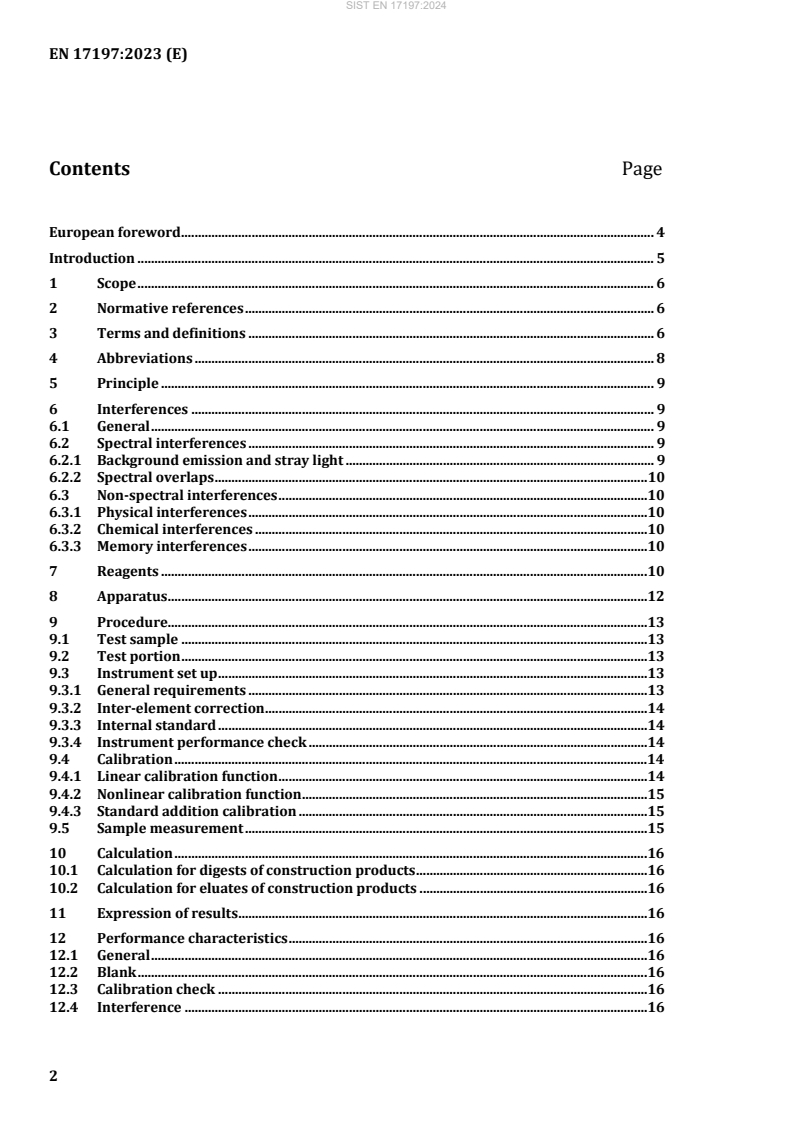
Contents Page
European foreword . 4
Introduction . 5
1 Scope . 6
2 Normative references . 6
3 Terms and definitions . 6
4 Abbreviations . 8
5 Principle . 9
6 Interferences . 9
6.1 General . 9
6.2 Spectral interferences . 9
6.2.1 Background emission and stray light . 9
6.2.2 Spectral overlaps .10
6.3 Non-spectral interferences .10
6.3.1 Physical interferences .10
6.3.2 Chemical interferences .10
6.3.3 Memory interferences .10
7 Reagents .10
8 Apparatus .12
9 Procedure.13
9.1 Test sample .13
9.2 Test portion .13
9.3 Instrument set up .13
9.3.1 General requirements .13
9.3.2 Inter-element correction .14
9.3.3 Internal standard .14
9.3.4 Instrument performance check .14
9.4 Calibration .14
9.4.1 Linear calibration function .14
9.4.2 Nonlinear calibration function .15
9.4.3 Standard addition calibration .15
9.5 Sample measurement .15
10 Calculation .16
10.1 Calculation for digests of construction products .16
10.2 Calculation for eluates of construction products .16
11 Expression of results .16
12 Performance characteristics .16
12.1 General .16
12.2 Blank .16
12.3 Calibration check .16
12.4 Interference .16
12.5 Recovery . 17
12.6 Indicative values for MDL . 17
13 Test performance . 17
14 Test report . 18
Annex A (informative) Wavelengths, spectral interferences and estimated method
detection limits . 19
Annex B (informative) Indicative values for MDL . 23
Annex C (informative) Validation results for analysis of inorganic substances in digest and
eluates from construction products . 24
C.1 General . 24
C.2 Precision data for analysis of eluates from construction products . 24
C.3 Precision data for analysis of aqua regia digests from construction products . 31
Annex D (informative) Inter element correction (IEC) . 38
Annex E (normative) Determination of arsenic, antimony, mercury and selenium using
chemical vapour generation ICP-OES . 40
E.1 Scope . 40
E.2 Principle . 40
E.3 Apparatus . 40
E.4 Reagents . 41
E.5 Procedure . 42
E.6 Calculation . 43
Bibliography . 44
European foreword
This document (EN 17197:2023) has been prepared by Technical Committee CEN/TC 351 “Construction
products: Assessment of release of dangerous substances”, the secretariat of which is held by NEN.
This European Standard shall be given the status of a national standard, either by publication of an
identical text or by endorsement, at the latest by May 2024, and conflicting national standards shall be
withdrawn at the latest by May 2024.
Attention is drawn to the possibility that some of the elements of this document may be the subject of
patent rights. CEN shall not be held responsible for identifying any or all such patent rights.
This document supersedes CEN/TS 17197:2018+AC:2018.
In comparison with the previous edition, the following technical modifications have been made:
— the addition of performance data and data from intercomparison validation;
— alignment of terms and definitions within the working groups of CEN/TC 351, i.e. through the revised
version of EN 16687.
This document has been prepared under a Standardization Request given to CEN by the European
Commission and the European Free Trade Association.
Any feedback and questions on this document should be directed to the users’ national standards body.
A complete listing of these bodies can be found on the CEN website.
According to the CEN-CENELEC Internal Regulations, the national standards organisations of the
following countries are bound to implement this European Standard: Austria, Belgium, Bulgaria, Croatia,
Cyprus, Czech Republic, Denmark, Estonia, Finland, France, Germany, Greece, Hungary, Iceland, Ireland,
Italy, Latvia, Lithuania, Luxembourg, Malta, Netherlands, Norway, Poland, Portugal, Republic of North
Macedonia, Romania, Serbia, Slovakia, Slovenia, Spain, Sweden, Switzerland, Türkiye and the United
Kingdom.
Introduction
Following an extended evaluation of available methods for content and eluate analysis in construction
products (CEN/TR 16045) it was concluded that multi element analysis methods have preference over
methods developed for single elements or small groups of elements. This implies that for inorganic
substances ICP methods are preferred for the analysis of extracts obtained from digestion or eluates
obtained from leaching.
This document has been adopted from the work carried out in the context of CEN/TC 400
(project HORIZONTAL) and is very similar to EN 16170:2016.
This document is part of a modular horizontal approach which was adopted in CEN/TC 351. “Horizontal”
means that the methods can be used for a wide range of materials and products with certain properties.
“Modular” means that a test standard developed in this approach concerns a specific step in assessing a
property and not the whole chain of measurement (from sampling to analyses). Beneficial features of this
approach are that modules can be replaced by better ones without jeopardizing the standard chain and
duplication of work in different Technical Committees for products can be avoided as far as possible.
The modules that relate to the standards developed in CEN/TC 351 are specified in CEN/TR 16220, which
distinguishes between the modules. This document belongs to the analytical step.
The use of modular horizontal standards implies the drawing of test schemes as well. Before executing
a test on a certain construction product to determine certain characteristics, it is necessary to draw up
a protocol in which the adequate modules are selected and together form the basis for the entire test
procedure.
1 Scope
This document specifies the method for the determination of major, minor and trace elements in eluates
and in aqua regia and nitric acid digests of construction products by inductively coupled plasma optical
emission spectrometry (ICP-OES). It refers to the following 44 elements:
Aluminium (Al), antimony (Sb), arsenic (As), barium (Ba), beryllium (Be), bismuth (Bi), boron (B),
cadmium (Cd), calcium (Ca), cerium (Ce), chromium (Cr), cobalt (Co), copper (Cu), iron (Fe),
lanthanum (La), lead (Pb), lithium (Li), magnesium (Mg), manganese (Mn), mercury (Hg),
molybdenum (Mo), neodymium (Nd), nickel (Ni), phosphorus (P), potassium (K), praseodymium (Pr),
samarium (Sm), scandium (Sc), selenium (Se), silicon (Si), silver (Ag), sodium (Na), strontium (Sr),
sulphur (S), tellurium (Te), thallium (Tl), thorium (Th), tin (Sn), titanium (Ti), tungsten (W), uranium (U),
vanadium (V), zinc (Zn), and zirconium (Zr).
For the determination of low levels of As, Hg, Se and Sb, chemical vapour generation systems can be
applied. This method is described in Annex E (normative).
NOTE Construction products include e.g. mineral-based products (S); bituminous products (B); metals (M);
wood-based products (W); plastics and rubbers (P); sealants and adhesives (A); paints and coatings (C), see also
CEN/TR 16045.
The method in this document is applicable to construction products and validated for the product types
listed in Annex C (informative).
2 Normative references
The following documents are referred to in the text in such a way that some or all of their content
constitutes requirements of this document. For dated references, only the edition cited applies. For
undated references, the latest edition of the referenced document (including any amendments) applies.
EN 16637-2, Construction products: Assessment of release of dangerous substances — Part 2: Horizontal
dynamic surface leaching test
EN 16637-3, Construction products: Assessment of release of dangerous substances — Part 3: Horizontal
up-flow percolation
EN 16687:2023, Construction products: Assessment of release of dangerous substances — Terminology
EN 17087, Construction products: Assessment of release of dangerous substances — Preparation of test
portions from the laboratory sample for testing of release and analysis of content
EN 17196, Construction products: Assessment of release of dangerous substances — Digestion by aqua regia
for subsequent analysis of inorganic substances
3 Terms and definitions
For the purposes of this document, the terms and definitions given in EN 16687:2023 and the following
apply.
ISO and IEC maintain terminology databases for use in standardization at the following addresses:
— ISO Online browsing platform: available at https://www.iso.org/obp
— IEC Electropedia: available at https://www.electropedia.org/
3.1
analyte
determinant
element, ion or substance to be determined by an analytical method
[SOURCE: EN 16687:2023, 3.3.1.11]
3.2
aqua regia
solution obtained by mixing one volume of nitric acid and three volumes of hydrochloric acid
[SOURCE: EN 16687:2023, 3.2.2.10]
3.3
digest
solution resulting from acid digestion of a sample
[SOURCE: EN 16687:2023, 3.2.2.8]
3.4
eluate
solution obtained from a leaching test
[SOURCE: EN 16687:2023, 3.3.2.8]
3.5
instrument detection limit
IDL
smallest analyte concentration that can be detected with a defined statistical probability using a
contaminant free instrument and a blank calibration solution
[SOURCE: EN 16687:2023, 3.3.1.13 – modified, Note 1 to entry removed]
3.6
laboratory sample
sample or sub-sample(s) sent to or received by the laboratory
[SOURCE: EN 16687:2023, 3.2.2.1 – modified, Notes to entry removed]
3.7
method detection limit
MDL
lowest analyte concentration that can be detected with a specified analytical method including sample
preparation with a defined statistical probability
[SOURCE: EN 16687:2023, 3.3.1.12; modified – Note 1 to entry removed]
3.8
sample
portion of material selected from a larger quantity of material
[SOURCE: EN 16687:2023, 3.2.1.5 – modified, Notes to entry removed]
3.9
test portion
analytical portion
amount of the test sample taken for testing/analysis purposes, usually of known dimension, mass or
volume
[SOURCE: EN 16687:2023, 3.2.2.3 – modified, Examples removed]
3.10
test sample
analytical sample
sample, prepared from the laboratory sample, from which test portions are removed for testing or for
analysis
[SOURCE: EN 16687:2023, 3.2.2.2]
4 Abbreviations
For the purposes of this document, the following abbreviations apply.
ICP Inductively coupled plasma
ICS Interference check solution
IDL Instrumental detection limit
IEC Inter-element correction
LOD Limit of detection
MS Mass spectrometry
MSF Multicomponent spectral fitting
OES Optical emission spectrometry
QC Quality control
5 Principle
This method describes multi-elemental determinations by ICP-OES using sequential or simultaneous
optical systems and axial or radial viewing of the plasma. The instrument measures characteristic
emission spectra by optical spectrometry. Samples are nebulized and the resulting aerosol is transported
to the plasma torch. Element-specific emission spectra are produced by a radio-frequency inductively
coupled plasma. The spectra are dispersed by a grating spectrometer, and the intensities of the emission
lines are monitored by photosensitive devices. Background correction is required for trace element
determination. Background correction is not required in cases of line broadening where a background
correction measurement would actually degrade the analytical result. Additional interferences and
matrix effects shall be recognized and appropriate corrections made; tests for their presence are
described.
Alternatively, users may choose multivariate calibration methods (e.g. multicomponent spectral fitting).
In this case, point selections for background correction are superfluous since whole spectral regions are
processed.
For the determination of low levels of As, Hg, Se and Sb, chemical vapour generation can be applied. This
method is described in Annex E (normative).
6 Interferences
6.1 General
Several types of interference effects can contribute to inaccuracies in the determination of elements.
Spectral interferences are caused by background emission from continuous or recombination
phenomena, stray light from the line emission of high concentration elements, overlap of a spectral line
from another element, or unresolved overlap of molecular band spectra.
Non-spectral interferences, usually called matrix effects, can have their origin in three different processes
or locations: in the nebulization process, in the plasma, and in the interface and the lens area. These types
of interferences also include blockage of the nebulizer, torch injector tube and sampling cone caused by
high concentrations of dissolved matter or the nebulization of organic solvents.
When operative and uncorrected, interferences will produce false positive determinations and be
reported as analyte concentrations. The interferences are listed in Annex A (informative).
Detailed information on spectral and non-spectral interferences is given in Clause 6 of
EN ISO 11885:2009.
6.2 Spectral interferences
6.2.1 Background emission and stray light
Background emission and stray light can usually be compensated for by subtracting the background
emission determined by measurements adjacent to the analyte wavelength peak. Spectral scans of
samples or single element solutions in the analyte regions can indicate when alternate wavelengths are
desirable because of severe spectral interference. These scans will also show whether the most
appropriate estimate of the background emission is provided by an interpolation from measurements on
both sides of the wavelength peak or by measured emission on only one side. The locations selected for
the measurement of background intensity will be determined by the complexity of the spectrum adjacent
to the wavelength peak. The locations used for routine measurement shall be free of off-line spectral
interference (inter-element or molecular) or adequately corrected to reflect the same change in
background intensity as occurs at the wavelength peak.
6.2.2 Spectral overlaps
Spectral overlaps can be avoided by using an alternate wavelength or can be compensated by equations
that correct for inter-element contributions. Instruments that use equations for inter-element correction
require the interfering elements be analysed at the same time as the element of interest.
6.3 Non-spectral interferences
6.3.1 Physical interferences
Physical interferences are effects associated with the sample nebulization and transport processes.
Changes in viscosity and surface tension can cause significant inaccuracies, especially in samples
containing high dissolved solids or high acid concentrations. If physical interferences are present, they
shall be reduced by diluting the sample, by using an internal standard or a high solids nebulizer. They can
also be minimized by matrix matching particularly by matching the acid concentration.
6.3.2 Chemical interferences
Chemical interferences include molecular compound formation, ionization effects, and solute
vaporization effects. Normally, these effects are not significant with the ICP technique, but if observed,
can be minimized by careful selection of operating conditions (radio-frequency power, observation
position, gas flow rate and so forth), by buffering of the sample, by matrix matching, and by standard
addition procedures. Chemical interferences are highly dependent on matrix type and the specific analyte
element.
6.3.3 Memory interferences
Memory interferences result when analytes in a previous sample contribute to the signals measured in a
new sample. Memory effects can result from sample deposition in the uptake tubing or to the nebulizer
and from the build-up of sample material in the plasma torch and spray chamber. The occurrence of
memory effects depend on the element and can be minimized by flushing the system with a rinse blank
between samples. The possibility of memory interferences shall be recognized within an analytical run
and suitable rinse times shall be used to reduce them. The rinse times necessary for a particular element
shall be estimated prior to analysis during method development.
7 Reagents
For the determination of elements at trace and ultra-trace level, the reagents shall be of adequate purity.
The concentration of the analyte or interfering substances in the reagents and the water shall be
negligible compared to the lowest concentration to be determined.
7.1 Water, with a specific conductivity not higher than 0,2 mS/m at 25 °C.
7.2 Nitric acid, molar concentration c(HNO ) = 16 mol/l, mass concentration ρ ~ 1,4 kg/l.
NOTE Nitric acid is available both as ρ(HNO3) = 1,40 kg/l (w(HNO3) = 650 g/kg) and ρ(HNO3) = 1,42 kg/l
(w(HNO3) = 690 g/kg). Both are suitable for use in this method provided they have a minimal content of the analytes
of interest.
7.3 Hydrochloric acid, c(HCl) = 12 mol/l, ρ ~ 1,18 kg/l.
7.4 Single-element standard stock solutions.
Ag, Al, As, B, Ba, Be, Bi, Ca, Cd, Ce, Co, Cr, Cu, Fe, Hg, K, La, Li, Mg, Mn, Mo, Na, Nd, Ni, P, Pb, Pr, (total) S, Si,
Sb, Sc, Se, Sm, Sn, Sr, Te, Ti, Th, Tl, U, V, W, Zn, Zr, ρ = 1 000 mg/l each.
Both single-element stock solutions and multi-element stock solutions with adequate specification
stating the acid used and the preparation technique are commercially available. Single element solutions
can be made from high purity metals.
These solutions are considered to be stable for more than one year, but in reference to guaranteed
stability, the recommendations of the manufacturer shall be considered.
7.5 Multi-element standard stock solutions.
7.5.1 General
Depending on the scope, different multi-element calibration solutions can be necessary. In general, when
combining multi-element calibration solutions, their chemical compatibility and the possible hydrolysis
of the components shall be regarded. Care shall be taken to prevent chemical reactions (e.g.
precipitation).
NOTE In multi-element standards precipitation of Ag, Ba or Pb can occur; Ag is only stable in high hydrochloric
acid concentrations or nitric acid.
The multi-element calibration solutions are considered to be stable for several months, if stored in the
dark. This does not apply to multi-element calibration solutions that are prone to hydrolysis, in particular
solutions of Bi, Mo, Sn, Sb, Te, W, Hf and Zr.
7.5.2 Multi-element standard stock solution A at the mg/l level may contain the following elements:
Ag, Al, As, B, Ba, Be, Bi, Cd, Ce, Co, Cr, Cs, Cu, La, Li, Mn, Ni, Pb, Rb, Sr, Th, Tl, U, V, Se, Zn.
Use nitric acid for stabilization of standard solution A.
7.5.3 Multi-element standard stock solution B at the mg/l level may contain the following elements:
Mo, Sb, Sn, W, Zr.
Use hydrochloric acid (7.3) for stabilization of multi-element standard stock solution B. Other elements
of interest may be added to the standard stock solution, provided that the resulting multi-element
solution is stable.
7.5.4 Multi-element standard stock solution C at the mg/l level may contain the following elements:
Ca, Mg, Na, K, P, S.
Use nitric acid (7.2) for stabilization of multi-element standard stock solution C.
7.6 Multi-element calibration solutions.
Prepare in one or more steps calibration solutions at the highest concentration of interest. If more
concentration levels are needed, prepare those similarly in an equidistant concentration range.
Add acids (7.2 and/or 7.3) to match the acid concentration of samples closely.
If traceability of the values is not established check the validity by comparison with a (traceable)
independent standard.
Check the stability of the calibration solutions.
7.7 Internal standard solution.
The use of an internal standard can be a suitable method to correct for non-spectral interferences.
The approach involves the addition of a known amount of a substance to the sample and calibration
solutions. The ratio of responses of the analyte and the internal standard are measured in the sample and
calibration solution. The observation for the internal standard is used to relate the analyte signal to the
analyte concentration.
The choice of elements for an internal standard solution depends on the analytical problem. The solution
of this/these internal standard(s) shall cover the mass range of interest. The concentrations of the
selected elements (used as internal standard) shall be negligibly low in the digests of samples. The
elements Sc, Y, In and Rh have been found suitable for this purpose.
Generally, a suitable concentration of the internal standard in samples and calibration solutions is 1 mg/l
to 10 mg/l.
7.8 Calibration blank.
Prepare the calibration blank by acidifying water (7.1) to the same concentrations of the acids found in
the calibration solutions, eluates and digests.
7.9 Method blank.
The method blank shall contain all of the reagents in the same volumes as used in the processing of the
samples. The method blank shall be carried through the complete procedure and contain the same acid
concentration in the final solution as the sample solution used for analysis.
7.10 Calibration check solution.
Prepare the calibration check solution, purchased from a different supplier, by acidifying water (7.1) to
the same concentration of the acids used in the calibration solutions, using the same standards used for
calibration at an upper concentration level.
7.11 Interference check solution (ICS).
If interference cannot be excluded (see Table A.1) prepare the interference check solution to contain
known concentrations of interfering elements that will provide an adequate test of the correction factors.
The choice of the concentration and interfering element are matrix dependent.
Avoid two or more interferents for an analyte in the same interference check solution. Spike the sample
with the analytes of interest, particularly those with known interferences at 0,5 mg/l to 1 mg/l. In the
absence of measurable analyte, overcorrection could go undetected because a negative value could be
reported as zero. If the particular instrument will display overcorrection as a negative number, this
spiking procedure will not be necessary.
8 Apparatus
8.1 Inductively coupled argon plasma emission spectrometer.
— computer-controlled emission spectrometer with background correction;
— radio-frequency generator;
— optional mass flow controller for argon nebulizer gas supply;
— optional peristaltic pump;
— optional auto sampler;
— argon gas supply – high purity (e.g. ≥ 999,5 ml/l).
NOTE The ICP-OES instruments come in different varieties i.e. axial or radial viewing or a combination of both.
Axial viewing gives more signal intensity due to the increased observation path length of the normal analytical zone
of the plasma. This will in most cases lead to a higher signal but an increase of interference relative to radial viewing
is commonly observed for many elements. Most instruments however have special adaptations to overcome the
excessive interference by radiation from the bullet zone and molecular region of the plasma. Especially for low UV
(e.g. Pb, Zn, As, Cd, P, Se and S) the Signal to Background Ratios are more or less the same for both types. Several
instruments are equipped with dual view by using additional mirrors. This allows the choice by the operator to
select the most suitable option but can give limitations use due to the lower light intensity and because of different
torch design (longer neck), lead to faster blockage and decreased long term stability. For environmental samples
axial viewing can be advantageous.
8.2 Volumetric flasks of suitable precision and accuracy.
8.3 Volumetric pipettes of suitable precision and accuracy.
NOTE It is advised to avoid dispensing of a volume of less than 50 µl by means of a pipette.
9 Procedure
9.1 Test sample
The test sample shall be a particle free aqua regia digest obtained by EN 17196 or an eluate obtained by
EN 16637-2 or EN 16637-3.
9.2 Test portion
The test portion may be directly obtained from the digest or may be diluted from the test sample to
accommodate the measurement range or to dilute the matrix. The acidity of the test portion shall match
the acidity of calibration solutions.
Ensure that all elements are present in a non-volatile form. Volatile species shall be converted to non-
volatile ones, e.g. sulphide oxidation by hydrogen peroxide.
9.3 Instrument set up
9.3.1 General requirements
Adjust the instrumental parameters of the ICP-OES system in accordance with the manufacturer’s
manual. Develop a method (set of instrument parameters) depending on the type of samples and matrices
to be measured.
Define the wavelengths of the analytes of interest and the need for corresponding corrections according
to Table A.1. Alternatively, apply multivariate calibration procedures.
Define the rinsing times depending on the length of the flow path; the time for rinsing the sample
introduction system between the subsequent samples shall be long enough to rinse all the analytes of
interest from the system.
NOTE 1 A guideline for method development and instrument set up is given in [19].
NOTE 2 ICP-OES has excellent multi-element capability. Nevertheless, it does not mean that all elements can be
analysed during one measurement run. The sensitivity of determination depends on numerous parameters
(nebulizer flow, radio-frequency power, viewing height, etc.). The optimal instrument settings cannot be reached
for all elements at once.
9.3.2 Inter-element correction
Investigate whether the interfering elements in Table A.1 can result in measured values higher than three
times the IDL or 0,5 times the lowest concentration to be reported. If so, correct for interference. See
Annex D (informative) for determining the IEC factors.
9.3.3 Internal standard
If the types of samples to be measured strongly vary, matrix matching might not be possible. Investigate
the application of an internal standard to reduce the effect of the mismatch on analyte sensitivity. The
internal standard method can be applied independently from the calibration procedure.
If the internal standard procedure insufficiently reduces matrix effects, apply standard addition
calibration (9.4.3).
The use of an internal standard is recommended. Add the internal standard solution (7.7) to all solutions
to be measured. Online dilution and mixing of the sample flow with internal standard solution by means
of the peristaltic pump of the nebulizer is common practice. In such case the calibration solutions are
diluted the same way as the sample solutions.
The mass concentration of the reference-elements shall be the same in all solutions. Divide the response
of the analyte by the response of the internal standard in the calibration solution(s) and use this ratio in
the calibration function.
9.3.4 Instrument performance check
About 30 min prior to measurement, adjust the instrument to working condition.
Before each series of measurement check the sensitivity and the stability of the system and minimize
interference e.g. by using the interference check solution (7.11).
Check the resolution and the mass calibration as often as required by the manufacturer.
Check the wavelength calibration as often as required by the manufacturer.
9.4 Calibration
9.4.1 Linear calibration function
If more than two concentration levels, including zero, are used apply weighted linear regression to obtain
the linear calibration function.
NOTE 1 ICP-OES provides a large measurement range. The dispersion of blank measurements is usually much
smaller than the dispersion at full scale. Ordinary linear regression assumes that the dispersion is constant over the
entire range. As a consequence, a much higher percentage of the calculated intercepts is out of the range expected
from the spread of blanks: a non-zero blank value is calculated that is actually not there. Weighted linear regression
forces the line through points of low dispersion, resulting in the expected intercept dispersion. Unfortunately, many
data systems cannot handle weighted regression. An alternative approach, but less efficient, is ordinary linear
regression where the line is forced through the blank value or through zero. The most inexpensive way however is
a (single or multiple) two-point calibration. If calibration lines are linear, as they are usually in ICP-OES, this
procedure is valid and efficient.
If weighted linear regression is not possible apply linear regression forced through the blank value or
through zero. In the latter case check regularly by running a blank sample whether the assumption on
the absence of a blank value is justified.
NOTE 2 Weighted linear regression is not suitable for lower element concentrations.
A two-point calibration is allowed if the calibration function is linear, which usually is the case. Check
regularly with a calibration solution of known dilution whether the assumption on linearity is justified.
Instead of one measurement per level more measurements can be performed to reduce the uncertainty
of the calibration line.
9.4.2 Nonlinear calibration function
Alkali and alkaline earth metals may have nonlinear response curves due to ionization and self-
absorption effects.
Calculate the calibration function from weighted polynomial regression (second degree).
If this option is not possible use polynomial regression under the condition that the function is forced
through the blank or through zero. In the latter case check regularly whether the assumption on the
absence of a blank value is justified.
9.4.3 Standard addition calibration
Add a known amount of standard solution (V ) of the analyte and an equal amount of blank solution (V )
s b
to two separate but equal portions of the sample solution (or its dilution). Minimize dilution or correct
for spike dilution. The added amount of standard solution shall be between 0,4 times and 2 times the
expected sample mass concentration. Measure both solutions as a sample solution. Determine the
‘measured spike concentration’ as the difference in mass concentration between the two spiked sample
portions. Use the ratio ‘true spike concentration’ versus ‘measured spike concentration’ as a correction
factor for the initially measured concentration of the sample portion.
9.5 Sample measurement
Run one or more calibration solutions and a calibration blank.
Run the interference check solution(s) to establish interference correction or to check presence of
interference.
Every 25 samples or less and at the beginning and end, run a calibration blank and a calibration check
solution of an independent source (7.10).
Every 50 samples or less and at the end of a run, analyse an interference check solution (ICS) (7.11).
Run all samples including one or more method blanks.
Run at least one post digestion spiked sample from the series to check recovery.
NOTE If standard addition calibration is applied to all samples it is advised to leave out recovery check.
Whenever a new or unusual sample matrix is encountered check:
— matrix effects by running the spike sample;
— matrix effects by running a fivefold diluted sample;
— inter-element interference analysing a different wavelength.
It is essential that the analyte concentrations after dilution be at least higher than twice the lowest
concentration to be reported.
10 Calculation
10.1 Calculation for digests of construction products
Calculate the mass fraction of the element in the digested construction product according to Formula (1).
ρρ− ××f 100
( )
10 a
w= (1)
m× dw
where
w is the mass fraction of the element in the solid sample, in μg/g or mg/kg;
ρ is the mass concentration of the element in the test sample, in μg/l;
ρ is the mass concentration of the element in the blank, in μg/l;
f is the dilution factor of the test portion;
a
m is the mass of the digested sample, in g;
dw is the dry weight of the sample, in g.
10.2 Calculation for eluates of construction products
For eluates the calculations are described in the respective EN 16637-2 and EN 16637-3.
11 Expression of results
State as many significant digits as are acceptable according to the precision of the measuring values, but
not more than three significant digits.
12 Performance characteristics
12.1 General
The performance of this analytical m
...