

EN 17252:2020
(Main)Foodstuffs - Determination of phomopsin A in lupin seeds and lupin derived products by HPLC-MS/MS
- Abstract
This document specifies a procedure for the determination of phomopsin A in lupin seeds and lupin-derived products based on liquid chromatography with tandem mass spectrometry (LC-MS/MS). Several phomopsins exist, i.e. phomopsin A, B, C and D, but the method only deals with the quantitative measurement of phomopsin A due to lack of commercially available analytical reference standards for the other phomopsins.
The method has been validated for phomopsin A in naturally contaminated lupin seeds, lupin flour and crisp bread at levels ranging from approximately 5 µg/kg to 60 µg/kg
- Status
- Published
- Publication Date
- 07-Jan-2020
- Withdrawal Date
- 30-Jul-2020
- Technical Committee
- CEN/TC 275 - Food analysis - Horizontal methods
- Drafting Committee
- CEN/TC 275/WG 5 - Biotoxins
- Current Stage
- 9093 - Decision to confirm - Review Enquiry
- Start Date
- 23-Sep-2025
- Completion Date
- 14-Oct-2026



Overview
EN 17252:2020 (CEN) specifies a validated LC-MS/MS (HPLC-MS/MS) method for the determination of phomopsin A in lupin seeds and lupin‑derived food products. The standard covers sample preparation, extraction, instrumental analysis, identification and quantification criteria, and reporting. The method is validated for naturally contaminated lupin seeds, lupin flour and lupin‑based crisp bread at levels of approximately 5 µg/kg to 60 µg/kg. Only phomopsin A is quantified because reference standards for other phomopsins are not commercially available.
Key topics and technical requirements
- Scope and matrixes: Lupin seeds, lupin flour and lupin‑derived products (validated range ~5–60 µg/kg).
- Analytical principle: Extraction with acetonitrile/water/acetic acid (80 + 19 + 1, v/v/v), centrifugation, dilution/optional filtration, and analysis by LC‑MS/MS with tandem mass spectrometry and selected reaction monitoring (SRM).
- Sample preparation: Typical test portion: 5 g homogenized sample; add 20.0 ml extraction solution; extraction by shaking (~60 min); centrifuge (~3 500 g); prepare final aliquots (e.g., 500 µl extract + 500 µl water).
- Calibration and quantification: Matrix‑matched multi‑level calibration using prepared matrix blanks and serial intermediate standards; calibration accepted if individual points deviate < 20% from nominal.
- Identification criteria: retention time tolerance (±0.2 min; ±0.1 min for UHPLC), ion ratio deviation < 30% relative to calibration, reagent blank checks, and S/N requirements (use responses with S/N > 10 for ion ratio calculation).
- Reagents and equipment: LC‑MS grade solvents, phomopsin A reference standard (≥ 98% purity), LC column providing retention factor ≥ 2, LC pump, MS/MS detector and data evaluation system.
- Quality and safety: Use only appropriate analytical‑grade reagents and follow safety warnings for hazardous chemicals.
Applications and users
EN 17252:2020 is intended for:
- Food control and public health laboratories performing routine monitoring of lupin ingredients for mycotoxin contamination.
- Food manufacturers and ingredient suppliers who need to verify lupin flour or lupin‑containing products for phomopsin A to support product safety and regulatory compliance.
- Contract testing labs offering LC‑MS/MS mycotoxin analyses. Practical benefits include reproducible quantification at low µg/kg levels and standardized criteria for identification and reporting.
Related standards
- EN ISO 3696 - Water for analytical laboratory use (referenced for water quality).
- Developed under CEN/TC 275 (“Food analysis – Horizontal methods”); consult CEN resources for national implementation and related mycotoxin methods.
Keywords: EN 17252:2020, phomopsin A, lupin seeds, lupin flour, HPLC‑MS/MS, LC‑MS/MS, mycotoxin analysis, matrix‑matched calibration, food safety.
Relations
- Effective Date
- 28-Jan-2026
Get Certified
Connect with accredited certification bodies for this standard

BSI Group
BSI (British Standards Institution) is the business standards company that helps organizations make excellence a habit.

Bureau Veritas
Bureau Veritas is a world leader in laboratory testing, inspection and certification services.

DNV
DNV is an independent assurance and risk management provider.
Sponsored listings
Frequently Asked Questions
EN 17252:2020 is a standard published by the European Committee for Standardization (CEN). Its full title is "Foodstuffs - Determination of phomopsin A in lupin seeds and lupin derived products by HPLC-MS/MS". This standard covers: This document specifies a procedure for the determination of phomopsin A in lupin seeds and lupin-derived products based on liquid chromatography with tandem mass spectrometry (LC-MS/MS). Several phomopsins exist, i.e. phomopsin A, B, C and D, but the method only deals with the quantitative measurement of phomopsin A due to lack of commercially available analytical reference standards for the other phomopsins. The method has been validated for phomopsin A in naturally contaminated lupin seeds, lupin flour and crisp bread at levels ranging from approximately 5 µg/kg to 60 µg/kg
This document specifies a procedure for the determination of phomopsin A in lupin seeds and lupin-derived products based on liquid chromatography with tandem mass spectrometry (LC-MS/MS). Several phomopsins exist, i.e. phomopsin A, B, C and D, but the method only deals with the quantitative measurement of phomopsin A due to lack of commercially available analytical reference standards for the other phomopsins. The method has been validated for phomopsin A in naturally contaminated lupin seeds, lupin flour and crisp bread at levels ranging from approximately 5 µg/kg to 60 µg/kg
EN 17252:2020 is classified under the following ICS (International Classification for Standards) categories: 67.060 - Cereals, pulses and derived products. The ICS classification helps identify the subject area and facilitates finding related standards.
EN 17252:2020 has the following relationships with other standards: It is inter standard links to EN ISO 3696:1995. Understanding these relationships helps ensure you are using the most current and applicable version of the standard.
EN 17252:2020 is associated with the following European legislation: EU Directives/Regulations: 882/2004; Standardization Mandates: M/520. When a standard is cited in the Official Journal of the European Union, products manufactured in conformity with it benefit from a presumption of conformity with the essential requirements of the corresponding EU directive or regulation.
EN 17252:2020 is available in PDF format for immediate download after purchase. The document can be added to your cart and obtained through the secure checkout process. Digital delivery ensures instant access to the complete standard document.
Standards Content (Sample)
SLOVENSKI STANDARD
01-marec-2020
Živila - Določevanje fomopsina A v semenih volčjega boba in predelanih
proizvodih s HPLC-MS/MS
Foodstuffs - Determination of phomopsin A in lupin seeds and lupin derived products by
HPLC-MS/MS
Lebensmittel - Bestimmung von Phomopsin A in Lupinensamen und
Lupinenerzeugnissen mit LC-MS/MS
Produits alimentaires - Détermination de la teneur en phomopsine A dans les graines de
lupin et les produits dérivés du lupin par CL-SM/SM
Ta slovenski standard je istoveten z: EN 17252:2020
ICS:
67.060 Žita, stročnice in proizvodi iz Cereals, pulses and derived
njih products
2003-01.Slovenski inštitut za standardizacijo. Razmnoževanje celote ali delov tega standarda ni dovoljeno.
EN 17252
EUROPEAN STANDARD
NORME EUROPÉENNE
January 2020
EUROPÄISCHE NORM
ICS 67.060
English Version
Foodstuffs - Determination of phomopsin A in lupin seeds
and lupin derived products by HPLC-MS/MS
Produits alimentaires - Détermination de la teneur en Lebensmittel - Bestimmung von Phomopsin A in
phomopsine A dans les graines de lupin et les produits Lupinensamen und Lupinenerzeugnissen mit
dérivés du lupin par CL-SM/SM LC-MS/MS
This European Standard was approved by CEN on 9 October 2019.
CEN members are bound to comply with the CEN/CENELEC Internal Regulations which stipulate the conditions for giving this
European Standard the status of a national standard without any alteration. Up-to-date lists and bibliographical references
concerning such national standards may be obtained on application to the CEN-CENELEC Management Centre or to any CEN
member.
This European Standard exists in three official versions (English, French, German). A version in any other language made by
translation under the responsibility of a CEN member into its own language and notified to the CEN-CENELEC Management
Centre has the same status as the official versions.
CEN members are the national standards bodies of Austria, Belgium, Bulgaria, Croatia, Cyprus, Czech Republic, Denmark, Estonia,
Finland, France, Germany, Greece, Hungary, Iceland, Ireland, Italy, Latvia, Lithuania, Luxembourg, Malta, Netherlands, Norway,
Poland, Portugal, Republic of North Macedonia, Romania, Serbia, Slovakia, Slovenia, Spain, Sweden, Switzerland, Turkey and
United Kingdom.
EUROPEAN COMMITTEE FOR STANDARDIZATION
COMITÉ EUROPÉEN DE NORMALISATIO N
EUROPÄISCHES KOMITEE FÜR NORMUN G
CEN-CENELEC Management Centre: Rue de la Science 23, B-1040 Brussels
© 2020 CEN All rights of exploitation in any form and by any means reserved Ref. No. EN 17252:2020 E
worldwide for CEN national Members.
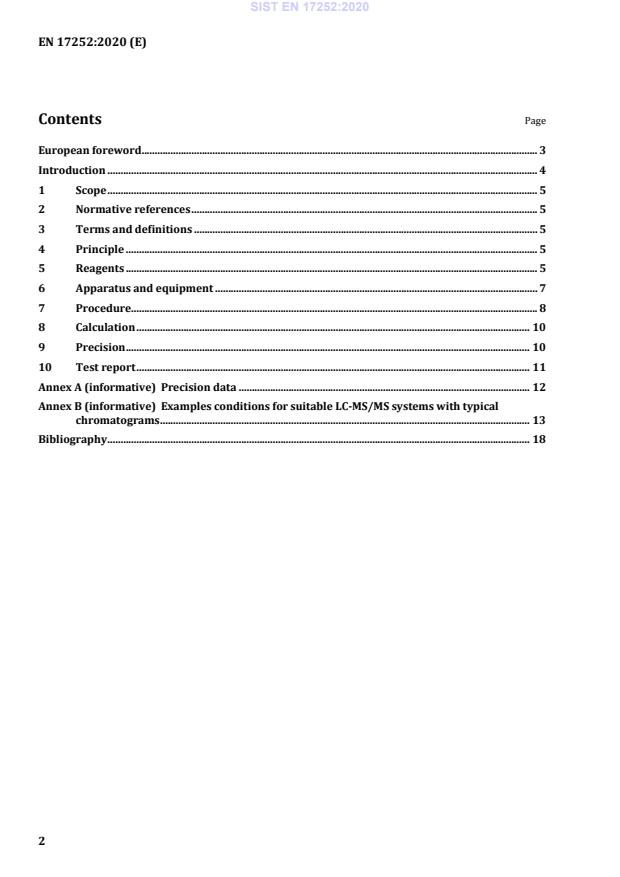
Contents Page
European foreword . 3
Introduction . 4
1 Scope . 5
2 Normative references . 5
3 Terms and definitions . 5
4 Principle . 5
5 Reagents . 5
6 Apparatus and equipment . 7
7 Procedure. 8
8 Calculation . 10
9 Precision . 10
10 Test report . 11
Annex A (informative) Precision data . 12
Annex B (informative) Examples conditions for suitable LC-MS/MS systems with typical
chromatograms . 13
Bibliography . 18
European foreword
This document (EN 17252:2020) has been prepared by Technical Committee CEN/TC 275 “Food
analysis - Horizontal methods”, the secretariat of which is held by DIN.
This European Standard shall be given the status of a national standard, either by publication of an
identical text or by endorsement, at the latest by July 2020, and conflicting national standards shall be
withdrawn at the latest by July 2020.
Attention is drawn to the possibility that some of the elements of this document may be the subject of
patent rights. CEN shall not be held responsible for identifying any or all such patent rights.
This document has been prepared under a mandate given to CEN by the European Commission and the
European Free Trade Association.
According to the CEN-CENELEC Internal Regulations, the national standards organisations of the
following countries are bound to implement this European Standard: Austria, Belgium, Bulgaria,
Croatia, Cyprus, Czech Republic, Denmark, Estonia, Finland, France, Germany, Greece, Hungary, Iceland,
Ireland, Italy, Latvia, Lithuania, Luxembourg, Malta, Netherlands, Norway, Poland, Portugal, Republic of
North Macedonia, Romania, Serbia, Slovakia, Slovenia, Spain, Sweden, Switzerland, Turkey and the
United Kingdom.
Introduction
Phomopsins are mycotoxins produced by the fungus Diaporthe toxica. There are several phomopsins of
which phomopsin A is the major toxic congener. The main host of the fungus are lupins (Lupinus L.).
Lupin seeds are being used as food ingredients and therefore phomopsin A might occur in food
ingredients and food products containing lupin seeds or lupin flour.
WARNING 1 — Suitable precaution and protection measures need to be taken when carrying out
working steps with harmful chemicals. The latest version of the hazardous substances ordinance (EU)
1907/2006 [3] should be taken into account as well as appropriate national statements.
WARNING 2 — The use of this document can involve hazardous materials, operations and equipment.
This document does not purport to address all the safety problems associated with its use. It is the
responsibility of the user of this document to establish appropriate safety and health practices and
determine the applicability of regulatory limitations prior to use.
1 Scope
This document specifies a procedure for the determination of phomopsin A in lupin seeds and lupin-
derived products based on liquid chromatography with tandem mass spectrometry (LC-MS/MS).
Several phomopsins exist, i.e. phomopsin A, B, C and D, but the method only deals with the quantitative
measurement of phomopsin A due to lack of commercially available analytical reference standards for
the other phomopsins.
The method has been validated for phomopsin A in naturally contaminated lupin seeds, lupin flour and
crisp bread at levels ranging from approximately 5 µg/kg to 60 µg/kg.
2 Normative references
The following documents are referred to in the text in such a way that some or all of their content
constitutes requirements of this document. For dated references, only the edition cited applies. For
undated references, the latest edition of the referenced document (including any amendments) applies.
EN ISO 3696, Water for analytical laboratory use — Specification and test methods (ISO 3696)
3 Terms and definitions
No terms and definitions are listed in this document.
ISO and IEC maintain terminological databases for use in standardization at the following addresses:
• IEC Electropedia: available at http://www.electropedia.org/
• ISO Online browsing platform: available at https://www.iso.org/obp
4 Principle
Phomopsin A is extracted from the homogenized sample material by shaking with a mixture of
acetonitrile/water/acetic acid (80+19+1, v+v+v). After centrifugation, an aliquot of the extract is
diluted with water, optionally filtered, and analysed by liquid chromatography coupled to tandem mass
spectrometry (LC-MS/MS). Phomopsin A is quantified by multi-level matrix-matched calibration.
5 Reagents
Use only reagents of recognized analytical grade and water complying with grade 1 of EN ISO 3696,
unless otherwise specified. Solutions shall be of quality for LC analysis, unless otherwise specified.
5.1 Water, deionised.
5.2 Water, LC-MS grade.
5.3 Acetonitrile, pro analysis (p.a.).
5.4 Methanol, LC-MS grade.
5.5 Acetic acid, purity greater than mass fraction w ≥ 98 %.
5.6 Ammonium formate, p.a.
5.7 Extraction solution acetonitrile/water/acetic acid, (80+19+1, v+v+v).
Mix 800 ml of acetonitrile (5.3), 190 ml of water (5.1 or 5.2) and 10 ml of acetic acid (5.5) in a bottle of
1 000 ml. This solution can be used for 3 months if stored at room temperature.
5.8 Phomopsin A, isolated from Phomopsis leptostromiformis, purity greater than w ≥ 98 %.
5.9 Phomopsin A stock solution (STD 1), mass concentration ρ = 500 mg/l.
Weigh 5 mg of the phomopsin A standard (5.8) to the nearest 0,1 mg into a 10 ml volumetric flask and
make up to the volume with methanol (5.4). Take into account the exact weight and the purity of the
standard. The solution can be used for 3 months if stored in an amber flask in the refrigerator at
approximately 4 °C.
5.10 Standard solution of phomopsin A (STD 2), ρ = 10 mg/l.
Pipette 100 µl of the standard solution (STD 1) (5.9) into a volumetric flask of 5 ml and make up to the
volume with methanol (5.4). The solution can be used for 3 months if stored in an amber vial in the
refrigerator at approximately 4 °C.
5.11 Standard solution of phomopsin A (STD 3), ρ = 250 µg/l.
Pipette 250 µl of the standard solution (STD 2) (5.10) into a volumetric flask of 10 ml and make up to
the volume with methanol (5.4).
5.12 Intermediate solutions for preparation of the matrix-matched standards.
To seven vials (6.9) add different volumes of the standard solution of phomopsin A (STD 3) (5.11) and
methanol (5.4) according to Table 1. Cap the vials and mix. Prepare these solutions freshly for each
batch of analysis.
Table 1 — Intermediate standard solutions of phomopsin A in methanol
Standard solution Methanol (5.4) Mass concentration
Intermediate solution
(STD 3) (5.11)
no µl µl µg/l
1 25 975 6,25
2 50 950 12,5
3 100 900 25
4 200 800 50
5 350 650 87,5
6 500 500 125
7 650 350 162,5
5.13 Matrix matched calibration solutions
Prepare matrix-matched calibration solutions in vials (6.9) according to Table 2.
The matrix matched calibration solutions may also be prepared directly in auto sampler vials with
insert or filter vials. In that case, proportionally reduce the volumes indicated in Table 2.
Table 2 — Matrix matched calibration solutions of phomopsin A in blank matrix extract
Calibration Mass Blank Intermediate Water Equivalent to mass
solution concentration extract solutions (5.2) fraction in sample
(7.2) (5.12) see
Table 1
no µg/l µl µl µl µg/kg
0 0 500 0 500 0
1 0,3125 450 50 µl no 1 500 2,5
2 0,625 450 50 µl no 2 500 5,0
3 1,25 450 50 µl no 3 500 10,0
4 2,5 450 50 µl no 4 500 20,0
5 4,375 450 50 µl no 5 500 35,0
6 6,25 450 50 µl no 6 500 50,0
7 8,125 450 50 µl no 7 500 65,0
6 Apparatus and equipment
Usual laboratory glassware and equipment, in particular, the following:
6.1 Conical polypropylene screw cap centrifuge tubes, 50 ml with caps.
6.2 Volumetric flasks, 5 ml and 10 ml.
6.3 Analytical balance, accuracy 0,1 mg.
6.4 Laboratory balance, accuracy 0,01 g.
6.5 Pipettes, e.g. 10 µl to 1 000 µl, for organic solutions.
6.6 Adjustable mechanical vertical or horizontal shaker or rotary tumbling machine.
6.7 Laboratory shaker.
6.8 Centrifuge, capable of generating a relative centrifugal force of 3 500 g.
6.9 Vials, 1,5 ml to 2 ml, used for intermediate solutions (5.12), made of glass or polypropylene, with
screw cap.
6.10 Syringe filter, 0,20 µm to 0,45 µm, nylon or polytetrafluoroethylene (PTFE) (for optional
filtration of final extracts).
6.11 Auto sampler vials, of appropriate size for the auto sampler in use, e.g. glass with insert vials, or
filter vials (PTFE 0,45 μm), with crimp cap or equivalent.
6.12 LC-MS/MS system with the following components:
6.12.1 LC pump, capable of delivering a binary gradient at flow rates appropriate for the analytical
column in use with sufficient accuracy.
6.12.2 Injection system, capable of injecting an appropriate volume of injection solution with
sufficient accuracy.
6.12.3 LC column, capable of retaining phomopsin A with a retention factor of at least two and that
ensures base line separation to distinguish peaks of phomopsin A from all other signals. Examples of
suitable columns are listed in Annex B.
6.12.4 Column oven, capable of maintaining a constant temperature.
6.12.5 Tandem mass spectrometer (MS/MS), capable of performing ionization of phomopsin A and
selected reaction monitoring (SRM), with a sufficiently wide dynamic
...