

prEN 13157
(Main)Cranes - Safety - Hand powered cranes
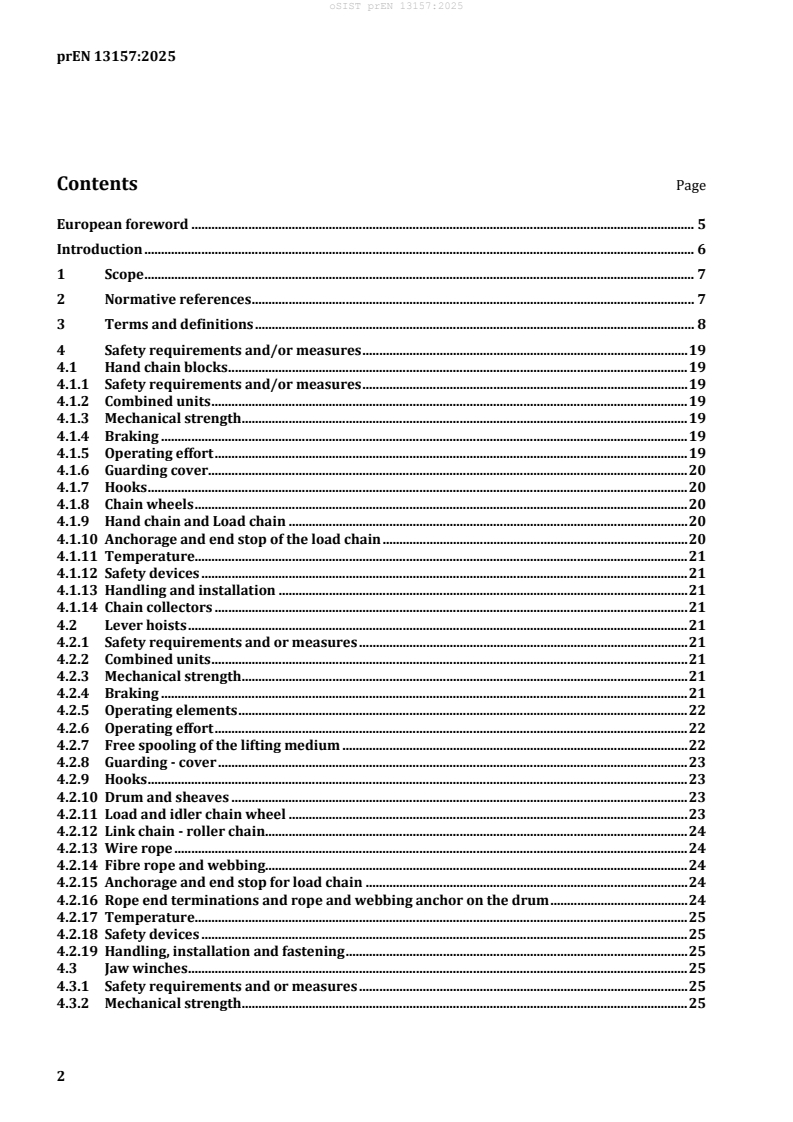
- Abstract
This document specifies requirements for the following hand powered cranes defined in Clause 3:
- hand chain blocks;
- lever hoists;
- jaw winches;
- hand powered trolleys supporting lifting machines;
NOTE Hand powered trolleys placed on the market on their own and intended to be used with products within the scope of this document are considered as interchangeable equipment as defined in Directive 2006/42/EC.
- drum winches;
- pulley blocks.
This document deals with the following significant hazards, hazardous situations or hazardous events relevant to hand powered cranes, when it is used as intended and under conditions of misuse which are reasonably foreseeable by the manufacturer:
- mechanical hazards;
- thermal hazards;
- material/substance hazards;
- ergonomic hazards;
- hazards associated with the environment in which they are used.
This document does not cover hazards related to the lifting of persons.
This document is not applicable to hand powered cranes for:
- use in ambient temperature outside the range of - 10°C to + 50°C, however for some lifting medium the minimum temperature will be higher than −10 °C;
- use in direct contact with food stuffs or pharmaceuticals requiring a high level of cleanliness for hygiene reasons;
- handling specific hazardous materials (e.g. explosives, hot molten masses, radiating materials);
- operation in an explosive atmosphere.
This document is not applicable to hand powered cranes manufactured before the date of its publication.
- Status
- Not Published
- Publication Date
- 07-Apr-2026
- Technical Committee
- CEN/TC 147 - Cranes - Safety
- Drafting Committee
- CEN/TC 147/WG 20 - Hand powered cranes
- Current Stage
- 4060 - Closure of enquiry - Enquiry
- Start Date
- 08-Jan-2026
- Due Date
- 19-Mar-2025
- Completion Date
- 08-Jan-2026

Overview
prEN 13157 (CEN) - "Cranes - Safety - Hand powered cranes" sets safety requirements for a range of manually operated lifting gear. The draft standard applies to hand chain blocks, lever hoists, jaw winches, drum winches, pulley blocks and hand powered trolleys supporting lifting machines. It addresses significant hazards when these devices are used as intended or under reasonably foreseeable misuse and establishes verification methods for conformity.
Key searchable terms: prEN 13157:2025, hand powered cranes standard, cranes safety, CEN hand chain blocks, lever hoists safety.
Key Topics and Requirements
- Scope of equipment: hand chain blocks, lever hoists, jaw winches, drum winches, pulley blocks, and hand-powered trolleys (trolleys placed on the market alone are considered interchangeable equipment under Directive 2006/42/EC).
- Hazard coverage: mechanical, thermal, material/substance, ergonomic, and environment-related hazards. The standard explicitly excludes lifting of persons.
- Operational limits: not applicable for ambient temperatures outside −10 °C to +50 °C (note: some lifting media may require higher minimum temperatures).
- Excluded applications: direct use in contact with food/pharmaceuticals requiring high-level hygiene, handling specific hazardous materials (explosives, molten masses, radiating materials), and operation in explosive atmospheres.
- Technical topics (by equipment type): mechanical strength, braking systems, operating effort, guarding/covers, hooks and anchorage, chain/rope/drum design, free-spooling, anti-derailment and anti-tilt features, temperature considerations, and safety devices.
- Verification and testing: defines categories - verification, type verification, and individual verification - and methods including calculation checks, examinations, measurements and physical testing.
Practical Applications and Users
Who uses prEN 13157:
- Manufacturers and designers of hand operated lifting equipment to design safe products and demonstrate conformity.
- Safety and compliance engineers, conformity assessment bodies, and test laboratories validating mechanical strength, braking, and operating forces.
- Purchasing teams and plant operators selecting hand powered cranes for workshops, maintenance, construction and industrial lifting tasks.
- Maintenance personnel and trainers referencing safe operation limits, guarding and inspection points.
Practical value:
- Ensures safer design and selection of hand operated lifting equipment.
- Supports compliance with EU machinery requirements (reference to Directive 2006/42/EC for interchangeable equipment).
- Provides test and verification pathways to reduce mechanical and ergonomic risk during use.
Related Standards
- prEN 13157:2025 is intended to supersede EN 13157:2004+A1:2009.
- Reference to Directive 2006/42/EC for interchangeable equipment classification.
For compliance planning, procurement or technical specification writing, prEN 13157 is the essential reference for safe design, verification and deployment of hand powered cranes.
Relations
- Effective Date
- 28-Jan-2023
Frequently Asked Questions
prEN 13157 is a draft published by the European Committee for Standardization (CEN). Its full title is "Cranes - Safety - Hand powered cranes". This standard covers: This document specifies requirements for the following hand powered cranes defined in Clause 3: - hand chain blocks; - lever hoists; - jaw winches; - hand powered trolleys supporting lifting machines; NOTE Hand powered trolleys placed on the market on their own and intended to be used with products within the scope of this document are considered as interchangeable equipment as defined in Directive 2006/42/EC. - drum winches; - pulley blocks. This document deals with the following significant hazards, hazardous situations or hazardous events relevant to hand powered cranes, when it is used as intended and under conditions of misuse which are reasonably foreseeable by the manufacturer: - mechanical hazards; - thermal hazards; - material/substance hazards; - ergonomic hazards; - hazards associated with the environment in which they are used. This document does not cover hazards related to the lifting of persons. This document is not applicable to hand powered cranes for: - use in ambient temperature outside the range of - 10°C to + 50°C, however for some lifting medium the minimum temperature will be higher than −10 °C; - use in direct contact with food stuffs or pharmaceuticals requiring a high level of cleanliness for hygiene reasons; - handling specific hazardous materials (e.g. explosives, hot molten masses, radiating materials); - operation in an explosive atmosphere. This document is not applicable to hand powered cranes manufactured before the date of its publication.
This document specifies requirements for the following hand powered cranes defined in Clause 3: - hand chain blocks; - lever hoists; - jaw winches; - hand powered trolleys supporting lifting machines; NOTE Hand powered trolleys placed on the market on their own and intended to be used with products within the scope of this document are considered as interchangeable equipment as defined in Directive 2006/42/EC. - drum winches; - pulley blocks. This document deals with the following significant hazards, hazardous situations or hazardous events relevant to hand powered cranes, when it is used as intended and under conditions of misuse which are reasonably foreseeable by the manufacturer: - mechanical hazards; - thermal hazards; - material/substance hazards; - ergonomic hazards; - hazards associated with the environment in which they are used. This document does not cover hazards related to the lifting of persons. This document is not applicable to hand powered cranes for: - use in ambient temperature outside the range of - 10°C to + 50°C, however for some lifting medium the minimum temperature will be higher than −10 °C; - use in direct contact with food stuffs or pharmaceuticals requiring a high level of cleanliness for hygiene reasons; - handling specific hazardous materials (e.g. explosives, hot molten masses, radiating materials); - operation in an explosive atmosphere. This document is not applicable to hand powered cranes manufactured before the date of its publication.
prEN 13157 is classified under the following ICS (International Classification for Standards) categories: 53.020.20 - Cranes. The ICS classification helps identify the subject area and facilitates finding related standards.
prEN 13157 has the following relationships with other standards: It is inter standard links to EN 13157:2004+A1:2009. Understanding these relationships helps ensure you are using the most current and applicable version of the standard.
prEN 13157 is associated with the following European legislation: EU Directives/Regulations: 2006/42/EC, 2023/1230, 2023/1230, 2023/1230, 2023/1230; Standardization Mandates: M/396, M/605. When a standard is cited in the Official Journal of the European Union, products manufactured in conformity with it benefit from a presumption of conformity with the essential requirements of the corresponding EU directive or regulation.
prEN 13157 is available in PDF format for immediate download after purchase. The document can be added to your cart and obtained through the secure checkout process. Digital delivery ensures instant access to the complete standard document.
Standards Content (Sample)
SLOVENSKI STANDARD
01-december-2025
Dvigala - Varnost - Dvigala na ročni pogon
Cranes - Safety - Hand powered cranes
Krane - Sicherheit - Handbetriebene Krane
Appareils de levage à charge suspendue - Sécurité - Appareils de levage à bras
Ta slovenski standard je istoveten z: prEN 13157
ICS:
53.020.20 Dvigala Cranes
2003-01.Slovenski inštitut za standardizacijo. Razmnoževanje celote ali delov tega standarda ni dovoljeno.
DRAFT
EUROPEAN STANDARD
NORME EUROPÉENNE
EUROPÄISCHE NORM
October 2025
ICS 53.020.20 Will supersede EN 13157:2004+A1:2009
English Version
Cranes - Safety - Hand powered cranes
Appareils de levage à charge suspendue - Sécurité - Krane - Sicherheit - Handbetriebene Krane
Appareils de levage à bras
This draft European Standard is submitted to CEN members for enquiry. It has been drawn up by the Technical Committee
CEN/TC 147.
If this draft becomes a European Standard, CEN members are bound to comply with the CEN/CENELEC Internal Regulations
which stipulate the conditions for giving this European Standard the status of a national standard without any alteration.
This draft European Standard was established by CEN in three official versions (English, French, German). A version in any other
language made by translation under the responsibility of a CEN member into its own language and notified to the CEN-CENELEC
Management Centre has the same status as the official versions.
CEN members are the national standards bodies of Austria, Belgium, Bulgaria, Croatia, Cyprus, Czech Republic, Denmark, Estonia,
Finland, France, Germany, Greece, Hungary, Iceland, Ireland, Italy, Latvia, Lithuania, Luxembourg, Malta, Netherlands, Norway,
Poland, Portugal, Republic of North Macedonia, Romania, Serbia, Slovakia, Slovenia, Spain, Sweden, Switzerland, Türkiye and
United Kingdom.
Recipients of this draft are invited to submit, with their comments, notification of any relevant patent rights of which they are
aware and to provide supporting documentation.
Warning : This document is not a European Standard. It is distributed for review and comments. It is subject to change without
notice and shall not be referred to as a European Standard.
EUROPEAN COMMITTEE FOR STANDARDIZATION
COMITÉ EUROPÉEN DE NORMALISATION
EUROPÄISCHES KOMITEE FÜR NORMUNG
CEN-CENELEC Management Centre: Rue de la Science 23, B-1040 Brussels
© 2025 CEN All rights of exploitation in any form and by any means reserved Ref. No. prEN 13157:2025 E
worldwide for CEN national Members.
Contents Page
European foreword . 5
Introduction . 6
1 Scope . 7
2 Normative references . 7
3 Terms and definitions . 8
4 Safety requirements and/or measures . 19
4.1 Hand chain blocks . 19
4.1.1 Safety requirements and/or measures . 19
4.1.2 Combined units . 19
4.1.3 Mechanical strength . 19
4.1.4 Braking . 19
4.1.5 Operating effort . 19
4.1.6 Guarding cover. 20
4.1.7 Hooks . 20
4.1.8 Chain wheels . 20
4.1.9 Hand chain and Load chain . 20
4.1.10 Anchorage and end stop of the load chain . 20
4.1.11 Temperature. 21
4.1.12 Safety devices . 21
4.1.13 Handling and installation . 21
4.1.14 Chain collectors . 21
4.2 Lever hoists . 21
4.2.1 Safety requirements and or measures . 21
4.2.2 Combined units . 21
4.2.3 Mechanical strength . 21
4.2.4 Braking . 21
4.2.5 Operating elements . 22
4.2.6 Operating effort . 22
4.2.7 Free spooling of the lifting medium . 22
4.2.8 Guarding - cover . 23
4.2.9 Hooks . 23
4.2.10 Drum and sheaves . 23
4.2.11 Load and idler chain wheel . 23
4.2.12 Link chain - roller chain. 24
4.2.13 Wire rope . 24
4.2.14 Fibre rope and webbing. 24
4.2.15 Anchorage and end stop for load chain . 24
4.2.16 Rope end terminations and rope and webbing anchor on the drum . 24
4.2.17 Temperature. 25
4.2.18 Safety devices . 25
4.2.19 Handling, installation and fastening . 25
4.3 Jaw winches . 25
4.3.1 Safety requirements and or measures . 25
4.3.2 Mechanical strength . 25
4.3.3 Braking . 25
4.3.4 Springs . 26
4.3.5 Operating elements. 26
4.3.6 Operating effort . 26
4.3.7 Disengagement of the jaws . 26
4.3.8 Guarding - cover . 26
4.3.9 Hook – anchorage . 26
4.3.10 Wire rope clamping mechanism . 26
4.3.11 Wire rope . 26
4.3.12 Wire rope terminations . 27
4.3.13 Temperature . 27
4.3.14 Safety devices . 27
4.3.15 Handling, installation and fastening . 27
4.3.16 Safety requirements and/or measures . 27
4.3.17 Combined units. 27
4.3.18 Mechanical strength . 27
4.3.19 Braking . 28
4.3.20 Operating effort . 28
4.3.21 Anti-Derailment . 28
4.3.22 Wheels and fall prevention . 28
4.3.23 Hand chains . 28
4.3.24 Stops . 28
4.3.25 Temperature . 28
4.3.26 Safety devices . 28
4.3.27 Anti-tilt . 28
4.3.28 Guarding . 28
4.4 Drum winches . 29
4.4.1 Safety requirements and/or measures . 29
4.4.2 Mechanical strength . 29
4.4.3 Braking . 29
4.4.4 Operating elements. 29
4.4.5 Operating effort . 29
4.4.6 Freespooling of the lifting medium . 30
4.4.7 Guarding - cover . 30
4.4.8 Hooks . 30
4.4.9 Drum - Drum flanges . 30
4.4.10 Wire rope . 30
4.4.11 Fibre rope and webbing . 30
4.4.12 Anchorage/ Securing from running of the lifting medium . 30
4.4.13 Wire ropes terminations . 31
4.4.14 Temperature . 31
4.4.15 Safety devices . 31
4.5 Pulley blocks . 31
4.5.1 Safety requirements and/or measures . 31
4.5.2 Mechanical strength . 31
4.5.3 Opening system - disengagement . 31
4.5.4 Means of attachment . 31
4.5.5 Sheaves for wire ropes. 32
4.5.6 Sheaves for fibre ropes . 32
4.5.7 Sheaves for webbing . 32
4.5.8 Temperature . 32
5 Verification of the safety requirements and/or measures . 33
5.1 General. 33
5.2 Categories of verification . 35
5.2.1 Verification . 35
5.2.2 Type verification . 35
5.2.3 Individual verification . 35
5.3 Verification methods . 35
5.3.1 Check of calculation, examination and measurement . 35
5.3.2 Testing . 35
5.3.3 Additional tests for Chain blocks . 36
5.3.4 Additional tests for lever hoists . 37
5.3.5 Additional tests for jaw winches . 38
5.3.6 Additional tests for drum winches . 38
6 Information for use . 39
6.1 General Instructions for use . 39
6.1.1 General. 39
6.1.2 Additional Instructions for hand chain blocks . 40
6.1.3 Additional Instructions for Chain Lever Hoists . 40
6.1.4 Additional Instructions for jaw winches . 41
6.1.5 Additional Instructions for hand powered trolleys . 41
6.1.6 Additional Instructions for drum winches . 41
6.1.7 Instructions for pulley blocks and deflection pulleys . 41
6.2 General instructions on periodic verification and testing of hand chain blocks . 42
6.3 General Marking Requirements . 42
6.3.1 General. 42
6.3.2 Additional Marking for lever hoists . 43
6.3.3 Additional Marking for jaw winches . 43
6.3.4 Additional Marking for drum winches . 43
Annex A (informative) List of significant hazards . 44
Annex ZA (informative) Relationship between this European Standard and the Essential
Requirements of EU Directive 2006/42/EC aimed to be covered . 46
Annex ZB (informative) Relationship between this European Standard and the essential
requirements of Regulation (EU) 2023/1230 aimed to be covered . 48
Bibliography . 50
European foreword
This document (prEN 13157:2025) has been prepared by Technical Committee CEN/TC 147 “Cranes -
Safety”, the secretariat of which is held by SFS.
This document is currently submitted to the CEN Enquiry.
This document will supersede EN 13157:2004+A1:2009.
The main modifications between EN 13157:2004+A1:2009 and prEN 13157 are
— Standardization of the design verification by calculation.
— Allowance for higher grades of chain.
— Simplification of the the verification tables
— Improvements to the general quality of the hand powered cranes placed on the EU market.
This document has been prepared under a standardization request addressed to CEN by the European
Commission. The Standing Committee of the EFTA States subsequently approves these requests for its
Member States.
For the relationship with EU Legislation see informative Annex ZA and Annex ZB, which are integral
parts of this document.
Introduction
This document has been prepared to be a harmonized standard to provide one means for hand powered
cranes to conform to the essential health and safety requirements of the Machinery Directive, as
amended.
This European Standard is a type-C standard as stated in EN ISO 12100.
This document is of relevance, in particular, for the following stakeholder groups representing the
market players with regard to machinery safety:
— machine manufacturers (small, medium and large enterprises);
— health and safety bodies (regulators, accident prevention organizations, market surveillance etc.).
Others can be affected by the level of machinery safety achieved with the means of the document by the
above-mentioned stakeholder groups:
— machine users/employers (small, medium and large enterprises);
The above-mentioned stakeholder groups have been given the possibility to participate at the drafting
process of this document.
The machinery concerned and the extent to which hazards are covered are indicated in the scope of this
standard.
When requirements of this type-C standard are different from those which are stated in type-A or type-
B standards, the requirements of this type-C standard take precedence over the requirements of the
other standards for machines that have been designed and built according to the requirements of this
type-C standard.
1 Scope
This document specifies requirements for the following hand powered cranes defined in Clause 3:
— hand chain blocks;
— lever hoists;
— jaw winches;
— hand powered trolleys supporting lifting machines;
NOTE Hand powered trolleys placed on the market on their own and intended to be used with products
within the scope of this document are considered as interchangeable equipment as defined in Directive
2006/42/EC.
— drum winches;
— pulley blocks.
This document deals with the following significant hazards, hazardous situations or hazardous events
relevant to hand powered cranes, when it is used as intended and under conditions of misuse which are
reasonably foreseeable by the manufacturer:
— mechanical hazards;
— thermal hazards;
— material/substance hazards;
— ergonomic hazards;
— hazards associated with the environment in which they are used.
This document does not cover hazards related to the lifting of persons.
This document is not applicable to hand powered cranes for:
— use in ambient temperature outside the range of - 10°C to + 50°C, however for some lifting medium
the minimum temperature will be higher than −10 °C;
— use in direct contact with food stuffs or pharmaceuticals requiring a high level of cleanliness for
hygiene reasons;
— handling specific hazardous materials (e.g. explosives, hot molten masses, radiating materials);
— operation in an explosive atmosphere.
This document is not applicable to hand powered cranes manufactured before the date of its
publication.
2 Normative references
The following documents are referred to in the text in such a way that some or all of their content
constitutes requirements of this document. For dated references, only the edition cited applies. For
undated references, the latest edition of the referenced document (including any amendments) applies.
EN 818-7:2002+A1:2008, Short link chain for lifting purposes - Safety - Part 7: Fine tolerance hoist chain,
Grade T (Types T, DAT and DT)
EN 1677-2:2000+A1:2008, Components for slings - Safety - Part 2: Forged steel lifting hooks with latch,
Grade 8
EN 1677-5:2001+A1:2008, Components for slings - Safety - Part 5: Forged steel lifting hooks with latch -
Grade 4
EN 12385-1:2002+A1:2008, Steel wire ropes - Safety - Part 1: General requirements
EN 12385-4:2002+A1:2008, Steel wire ropes - Safety - Part 4: Stranded ropes for general lifting
applications
EN 13001-2:2021, Crane safety - General design - Part 2: Load actions
EN 13001-3-5:2016+A1:2021, Cranes - General design - Part 3-5: Limit states and proof of competence of
forged and cast hooks
EN 13411-1:2002+A1:2008, Terminations for steel wire ropes - Safety - Part 1: Thimbles for steel wire
rope slings
EN 13411-3:2022, Terminations for steel wire ropes - Safety - Part 3: Ferrules and ferrule-securing
EN 13411-4:2021, Terminations for steel wire ropes - Safety - Part 4: Metal and resin socketing
EN 13411-6:2004+A1:2008, Terminations for steel wire ropes - Safety - Part 6: Asymmetric wedge socket
EN 13411-7:2021, Terminations for steel wire ropes - Safety - Part 7: Symmetric wedge socket
EN ISO 12100:2010, Safety of machinery - General principles for design - Risk assessment and risk
reduction (ISO 12100:2010)
EN ISO 14120:2015, Safety of machinery - Guards - General requirements for the design and construction
of fixed and movable guards (ISO 14120:2015)
ISO 606:2015, Short-pitch transmission precision roller and bush chains, attachments and associated
chain sprockets
ISO 4309:2017, Cranes — Wire ropes — Care and maintenance, inspection and discard
ISO 16872:2015, Round steel short link chains for lifting purposes — Fine tolerance hoist chains for hand
operated chain hoists — Grade VH
ISO 16877:2015, Round steel short link chains for lifting purposes — Fine tolerance hoist chains for hand
operated chain hoists — Grade TH
ISO 17440:2014, Cranes — General design — Limit states and proof of competence of forged steel hooks
3 Terms and definitions
For the purposes of this document, the following terms and definitions apply:
ISO and IEC maintain terminology databases for use in standardization at the following addresses:
— ISO Online browsing platform: available at https://www.iso.org/obp/
— IEC Electropedia: available at https://www.electropedia.org/
3.1
working coefficient (safety coefficient)
ratio between the maximum load to which the component can be subjected without breaking and the
specified maximum working load that should not be exceeded during use
3.2
combined unit
combination of a trolley and a hoist which are connected (see Figure 1)
3.3
dynamic test
testing by operating the lifting equipment to lift a test load equal to the rated capacity multiplied by the
dynamic test coefficient
3.4
lifting
change in level during the movement
NOTE Lifting incorporates the vertical or the vertical and horizontal movement of the load or all
combinations
3.5
rated capacity
load that the lifting equipment is designed to lift for a given operating condition (e.g. configuration,
position of the load)
Figure 1 — Example of combined units
3.6
static test
testing of lifting equipment by applying a test load equal to the rated capacity multiplied by the static
test coefficient
3.7
test coefficient
ratio between the load used for static and dynamic tests and the rated capacity
3.8
D/d ratio
ratio of the minimum pitch circle diameter of the first rope layer of the drum or sheave to the calculated
minimum diameter of the rope
3.9
D/s ratio
ratio of the belt sheave and drum diameter to the webbing thickness under no tension
3.10
pitch circle diameter
twice the distance between the drum or the sheave axle and the middle of the rope or webbing in direct
contact with the drum or sheaves (first layer on drum)
3.11
operation cycle
lifting movement plus lowering movement over the minimum vertical distance such that every load
bearing component of the mechanism is loaded at least once
Note 1 to entry: This is for test purposes only.
3.12
chain container
device to collect the slack load chain
3.13
hand chain block
device for lifting and lowering a load suspended from one chain (the load chain) by means of human
effort applied to another chain (the hand chain) and for holding this load (see Figure 2)
Key
1 hand chain 5 fixed end anchorage
2 hand chain wheel 6 load hook
3 cover 7 load chain
4 load chain wheel 8 slack end anchor
9 top hook
Figure 2 — Example of a hand chain block
3.14
lever hoist
device for lifting and lowering a load suspended from a lifting medium by means of human effort
applied to a lever and to hold it by means of a braking devices
Note 1 to entry: An arrangement drawing of a lever hoist ios shown in Figure 3.
Key
1 lever 6 slack end anchor
2 hook 7 load chain
3 drum 8 rope
4 load chain wheel 9 webbing
5 fixed end anchorage
Figure 3 — Example of lever hoists
3.15
jaw winches
device for lifting, lowering and holding a load by means of a rope, where the rope is gripped or moved
by jaws using human effort on a lever or levers (see Figure 4)
Key
1 removable lever 5 hook
2 guard case of the jaw and actuating mechanisms 6 rope
3 declutching lever 7 rope termination
4 anchorage
Figure 4 — Example of a jaw winch
3.16
hand powered trolleys
equipment fitted with wheels which are designed for the hand powered travelling of a hooked or
combined lifting machine along a monorail
3.17
geared travel trolley
hand powered trolley permitting horizontal travel, driven by a hand wheel which is operated by an
operating chain (see Figure 5)
Figure 5 — Example of geared travel trolley
3.18
monorail
equipment comprising an overhead beam or section along which suspended loads can be moved with a
trolley
Note 1 to entry: This equipment can also have curves, points, turntables etc.
3.19
push travel trolley
hand powered trolleys permitting horizontal travel by pushing or pulling manually on the load (see
Figure 6)
Key
1 wheel
2 wheels flange
3 buffer
4 monorail
Figure 6 — Example of a push travel trolley
3.20
drum winch
device for lifting, lowering and holding a load connected to a rope or webbing wound onto a drum by
means of (a) crank handle(s) or operating wheel(s) activated by human effort (see Figure 7)
3.21
drum pitch circle diameter
twice the distance between the drum or the sheave axle and the middle of the rope or webbing in direct
contact with the drum or sheaves (first layer on drum)
Key
1 crank handle or operating wheel 7 drum flange
2 disengagement – de clutching device 8 wire rope
3 guarding – cover 9 termination
4 hook D drum pitch diameter
5 latch d minimum calculated rope diameter
6 drum
Figure 7 — Example of a drum winch
3.22
pulley block
assembly of one or more sheaves, rotating freely on one or more shafts used to change the direction of a
rope (see Figure 8)
3.23
pitch diameter
twice the distance between the sheave axle and the middle of the rope or webbing in direct contact with
the drum or sheaves (first layer on drum)
3.24
sheave
wheel with a groove supporting a wire rope or a fibre rope
3.25
range of lift
maximum vertical travel distance of the hook bearing point from the finished floor level. This is also
commonly referred to as Height of Lift (H.O.L)
Key
1 pening angle between the sides of the sheave 6 sheave
2 radius of the groove 7 anchorage
3 depth of the sheave groove D sheave pitch circle diameter
4 means of suspension d nominal diameter of the lifting medium
5 wire rope or rope guide
Figure 8 — Pulley block
4 Safety requirements and/or measures
4.1 Hand chain blocks
4.1.1 Safety requirements and/or measures
The hand chain block shall comply with the safety requirements and/or measures of this clause. In
addition, the lifting equipment shall be designed according to the principles of EN ISO 12100:2010 for
hazards relevant but not significant which are not dealt with by this European Standard.
4.1.2 Combined units
The trolley of a combined trolley and hand chain block shall be in accordance with .4.
4.1.3 Mechanical strength
The mechanical strength shall be checked in accordance with EN 13001-2 2021 with the exception that
the dynamic factor Φ = 1. Hand chain blocks shall have a working coefficient (safety coefficient) of at
i
least 4.
Hand chain blocks shall be designed to withstand 1 500 operation cycles with 110 % of the rated
capacity with no failure or replacement of parts, no resting time, a lifting path of the load chain of at
least 300 mm per cycle.
4.1.4 Braking
Hand chain blocks shall have an automatic braking function during the lifting and lowering operation.
The braking function shall be automatic when the operating force ceases, whether the motion is lifting
or lowering.
The braking device shall allow a controlled descent under operator control whatever the position of the
load.
The fracture of the pawl spring shall not lead to failure of the brake this can be achieved by
incorporating two or more pawls, or by incorporation of a single guided pressure spring, or by using
several springs. Guided pressure springs shall have a distance between the coils of less than or equal to
the wire diameter. When using several springs, in the case of the failure of one spring, the remaining
spring(s) shall ensure that the retention is maintained.
The brakes shall not contain asbestos.
The chain block shall sustain a minimum load of 5 % of the rated capacity.
Note this can be achieved by either the braking mechanism or the gearing system.
4.1.5 Operating effort
If no overload protection systems are provided, to avoid overloading, the operating effort to lift the
rated capacity shall be between the following values:
a) rated capacity ≤ 1 000 kg: 20 daN up to 40 daN on the hand chain
b) 1 000 kg < rated capacity < 5 000 kg: 25 daN up to 40 daN on the hand chain
c) 5 000 kg ≤ rated capacity: 30 daN up to 45 daN on the hand chain
If the operating effort is beneath 20 daN at rated capacity is required, the hand chain block shall be
equipped with an overload protection system. The overload system shall be independent from the
braking device and shall operate in a way that the lowering function is maintained and that the load
remains under control. The triggering shall not lead to sudden release of the hand chain.
4.1.6 Guarding cover
Accessible parts of the hand chain block shall have no sharp edges, no sharp angles, and no rough
surfaces likely to cause injury.
To prevent damage or injury caused by accidental ingress, gearing shall be guarded in accordance with
EN ISO 14120:2015.
4.1.7 Hooks
Hooks shall be fitted with safety latches to prevent unintentional detachment.
The top hook shall be capable of swivelling for correct positioning.
The bottom hook should be free to swivel under load to prevent twisting of the load chain.
Load hooks which are not manufactured in accordance with a recognized standard, such as
EN 13001-3-5:2016+A1:2021, ISO 17440:2014, EN 1677-2:2000+A1:2008 and
EN 1677-5:2001+A1:2008, shall not show permanent deformation at a static load of 2-times the rated
capacity. At a static load of 4-times the rated capacity, the hook shall be allowed to deform, but the load
shall not be released.
This shall be ensured by selecting the appropriate materials and by the heat treatment.
NOTE Standards for hooks are listed in Annex A.
Hooks shall be capable of being disassembled so that they can be inspected and maintained in service.
4.1.8 Chain wheels
A chain guide shall be provided to prevent the hand chain and the load chain from jumping off the chain
wheels.
A stripper shall be included to prevent jamming of the chain with the load wheel. Load chain wheels
shall be made in one piece.
4.1.9 Hand chain and Load chain
The working coefficient shall be at least 4 for welded load bearing calibrated link chains;
— Load chains shall be in accordance with EN 818-7:2002+A1:2008 (type T), ISO 16877:2015 (grade
TH) or ISO 16872:2015 (grade VH), for fine tolerance short link chains.
The fitted length of the load chain shall be such as to allow the full stated range of lift to be made
without imposing load on the slack end anchorage.
Hand chains shall have no sharpness around the welds.
The connecting links of the hand chain shall resist without permanent deformation a force of at least
120 daN.
4.1.10 Anchorage and end stop of the load chain
Chain anchorage devices of the fixed end type, refer to Figure 1 item 5, shall withstand 4 times the static
chain tensile force at rated capacity without rupture.
The free end of the load chain shall be fitted with an anchorage to prevent it from passing through
completely. This anchorage shall withstand without rupture 2,5 times the static chain tensile force at
rated capacity.
4.1.11 Temperature
The mechanical strength of chain blocks shall not be adversely affected by temperatures as low as
−10 °C and as high as 50 °C and therefore no reduction in working load limit is necessary on this
account.
4.1.12 Safety devices
It shall not be possible to remove, modify, replace or neutralize the braking system or the overload
protection system without the use of tools.
4.1.13 Handling and installation
For safe handling, hooks, handles or other means for handling shall be provided unless unless the
design of chain block provides natural gripping points
4.1.14 Chain collectors
If a chain collector is supplied, then it shall be of sufficient strength and size with respect to the chain
size and length. There shall also be a drain hole present to prevent the build up of water.
4.2 Lever hoists
4.2.1 Safety requirements and or measures
The lever hoist shall comply with the safety requirements and/or measures of this clause. In addition,
the lifting equipment shall be designed according to the principles of EN ISO 12100:2010 for hazards
relevant but not significant which are not dealt with by this European Standard.
4.2.2 Combined units
The trolley of a combined trolley and lever hoist shall be in accordance with 4.4.
4.2.3 Mechanical strength
The mechanical strength shall be checked in accordance with EN 13001-2 2021 with the exception that
the dynamic factor Φ = 1. Lever hoists shall have a working coefficient (safety coefficient) of at least 4.
i
The lever hoist shall be designed to withstand 1 500 cycles with 110 % of the rated capacity with no
failure, no replacement of parts, no resting time, except for lubrication, a lifting path of the lifting
medium of at least 300 mm per cycle in order to get at least one complete revolution of the load chain
wheel or drum.
4.2.4 Braking
Lever hoists shall have an automatic braking function during the lifting and lowering operation.
The braking function shall be automatic when the operating force ceases, whether the motion is lifting
or lowering.
The braking device shall allow a controlled descent under operator control whatever the position of the
load.
The fracture of the pawl spring shall not lead to failure of the brake this can be achieved by
incorporating two or more pawls, or by incorporation of a single guided pressure spring, or by using
several springs. Guided pressure springs sha
...