

EN 12405-1:2021
(Main)Gas meters - Conversion devices - Part 1: Volume conversion
- Abstract
This document specifies the requirements and tests for the construction, performance, safety and conformity of gas-volume electronic conversion devices associated to gas meters, used to measure volumes of fuel gases of the 1st and 2nd families according to EN 437.
This document is intended for type testing, the detailed relevant provisions of which are given in Annex A.
Only three kinds of conversion are treated in this document:
- conversion as a function of temperature only (called T conversion);
- conversion as a function of the pressure and of the temperature with constant compression factor (called PT conversion);
- conversion as a function of the pressure, the temperature and taking into account the compression factor (called PTZ conversion).
This document is not relevant to temperature conversion integrated into gas meters which only indicate the converted volume.
Gas-volume conversion devices consist of a calculator and a temperature transducer or a calculator, a temperature transducer and a pressure transducer locally installed.
For application of this document, a conversion device may be, as a choice of the manufacturer, considered as a complete instrument (Type 1) or made of separate elements (Type 2), according to the definitions given in 3.1.20.1 and 3.1.20.2.
In this last case, the provisions concerning pressure transducers, temperature sensors and temperature transducers are given in Annexes B, C and D respectively.
Any conversion device can provide an error curve correction for a gas meter.
NOTE When rendering an account to an end user the readings from the conversion device can be used in conjunction with the readings from a gas meter conforming to EN 1359, EN 12480, or EN 12261, as appropriate, or to any other appropriate and relevant international or national standard for gas meters, without prejudice of national regulations.
- Status
- Published
- Publication Date
- 05-Oct-2021
- Withdrawal Date
- 29-Apr-2022
- Technical Committee
- CEN/TC 237 - Gas meters
- Drafting Committee
- CEN/TC 237/WG 4 - Associated conversion devices
- Current Stage
- 6060 - Definitive text made available (DAV) - Publishing
- Start Date
- 06-Oct-2021
- Due Date
- 29-Dec-2020
- Completion Date
- 06-Oct-2021
- Directive
- 2014/32/EU - Directive 2014/32/EU of the European Parliament and of the Council of 26 February 2014 on the harmonisation of the laws of the Member States relating to the making available on the market of measuring instrumentsOJ Ref: 2025/375, OJ, OJ L, OJ L, 2025/375 OJ Date: 27-Feb-2025

Overview
EN 12405-1:2021 - "Gas meters - Conversion devices - Part 1: Volume conversion" defines requirements and test methods for electronic gas-volume conversion devices used with gas meters. The standard covers construction, performance, safety and conformity for devices that convert measured gas volumes of the 1st and 2nd fuel gas families (per EN 437) to reference conditions. It is intended primarily for type testing (details in Annex A) and applies to standalone conversion devices and locally installed sensor-plus-calculator assemblies.
Key topics and technical requirements
- Scope of conversion methods
- T conversion: correction as a function of temperature only.
- PT conversion: correction as a function of pressure and temperature with a constant compression factor.
- PTZ conversion: correction as a function of pressure, temperature and the gas compression factor (non‑ideal gas behavior).
- Device architecture
- Conversion devices consist of a calculator and a temperature transducer, or a calculator plus temperature and pressure transducer locally installed.
- Manufacturer may supply a conversion device as Type 1 (complete instrument) or Type 2 (separate elements); Annexes B, C and D address pressure transducers, temperature sensors and transducers.
- Performance and accuracy
- Rated operating conditions, maximum permissible errors, repeatability, durability and reliability requirements are specified.
- Provisions for error curve correction of a gas meter are included.
- Construction and installation
- Requirements for casings, indications, inputs, battery power operation, alarms, and environmental classes (mechanical and electromagnetic) are detailed.
- Testing and conformity
- Type test procedures (Annex A) cover reference-condition accuracy, ambient influences, humidity, power disturbances, electrical immunity, durability and matching of Type 2 elements.
- Marking and documentation
- Rules for marking, installation and operating instructions are specified to ensure safe and compliant field deployment.
Applications - who uses this standard
- Manufacturers of gas-volume conversion devices and meter integrators validating product design and compliance.
- Gas utilities and metering service providers specifying equipment for billing and custody transfer.
- Test laboratories and conformity assessment bodies performing type testing and certification.
- Regulators and system designers establishing metering accuracy, installation and safety requirements for fuel gas distribution.
Related standards
- EN 437 (gas families and test gases)
- EN 1359, EN 12480, EN 12261 (gas meter standards referenced for combined use)
- ICS classification: 91.140.40 (Gas supply systems)
Keywords: EN 12405-1:2021, gas meters, conversion devices, volume conversion, T conversion, PT conversion, PTZ conversion, type testing, pressure transducer, temperature transducer, gas metering.
Relations
- Effective Date
- 26-Dec-2018
- Refers
EN 60079-6:2015 - Explosive atmospheres - Part 6: Equipment protection by liquid immersion "o" - Effective Date
- 09-Feb-2026
- Effective Date
- 09-Feb-2026
- Effective Date
- 09-Feb-2026
- Effective Date
- 09-Feb-2026
- Effective Date
- 09-Feb-2026
- Effective Date
- 09-Feb-2026
- Refers
EN 60079-2:2014 - Explosive atmospheres - Part 2: Equipment protection by pressurized enclosure "p" - Effective Date
- 09-Feb-2026
- Effective Date
- 09-Feb-2026
- Effective Date
- 09-Feb-2026
- Effective Date
- 09-Feb-2026
- Effective Date
- 09-Feb-2026
- Effective Date
- 09-Feb-2026
- Effective Date
- 09-Feb-2026
- Refers
EN 60950-1:2006/A2:2013 - Information technology equipment - Safety - Part 1: General requirements - Effective Date
- 09-Feb-2026
Get Certified
Connect with accredited certification bodies for this standard

DIBt (Deutsches Institut für Bautechnik)
German Institute for Building Technology.
DIN CERTCO
DIN Group product certification.

Aboma Certification B.V.
Specialized in construction, metal, and transport sectors.
Sponsored listings
Frequently Asked Questions
EN 12405-1:2021 is a standard published by the European Committee for Standardization (CEN). Its full title is "Gas meters - Conversion devices - Part 1: Volume conversion". This standard covers: This document specifies the requirements and tests for the construction, performance, safety and conformity of gas-volume electronic conversion devices associated to gas meters, used to measure volumes of fuel gases of the 1st and 2nd families according to EN 437. This document is intended for type testing, the detailed relevant provisions of which are given in Annex A. Only three kinds of conversion are treated in this document: - conversion as a function of temperature only (called T conversion); - conversion as a function of the pressure and of the temperature with constant compression factor (called PT conversion); - conversion as a function of the pressure, the temperature and taking into account the compression factor (called PTZ conversion). This document is not relevant to temperature conversion integrated into gas meters which only indicate the converted volume. Gas-volume conversion devices consist of a calculator and a temperature transducer or a calculator, a temperature transducer and a pressure transducer locally installed. For application of this document, a conversion device may be, as a choice of the manufacturer, considered as a complete instrument (Type 1) or made of separate elements (Type 2), according to the definitions given in 3.1.20.1 and 3.1.20.2. In this last case, the provisions concerning pressure transducers, temperature sensors and temperature transducers are given in Annexes B, C and D respectively. Any conversion device can provide an error curve correction for a gas meter. NOTE When rendering an account to an end user the readings from the conversion device can be used in conjunction with the readings from a gas meter conforming to EN 1359, EN 12480, or EN 12261, as appropriate, or to any other appropriate and relevant international or national standard for gas meters, without prejudice of national regulations.
This document specifies the requirements and tests for the construction, performance, safety and conformity of gas-volume electronic conversion devices associated to gas meters, used to measure volumes of fuel gases of the 1st and 2nd families according to EN 437. This document is intended for type testing, the detailed relevant provisions of which are given in Annex A. Only three kinds of conversion are treated in this document: - conversion as a function of temperature only (called T conversion); - conversion as a function of the pressure and of the temperature with constant compression factor (called PT conversion); - conversion as a function of the pressure, the temperature and taking into account the compression factor (called PTZ conversion). This document is not relevant to temperature conversion integrated into gas meters which only indicate the converted volume. Gas-volume conversion devices consist of a calculator and a temperature transducer or a calculator, a temperature transducer and a pressure transducer locally installed. For application of this document, a conversion device may be, as a choice of the manufacturer, considered as a complete instrument (Type 1) or made of separate elements (Type 2), according to the definitions given in 3.1.20.1 and 3.1.20.2. In this last case, the provisions concerning pressure transducers, temperature sensors and temperature transducers are given in Annexes B, C and D respectively. Any conversion device can provide an error curve correction for a gas meter. NOTE When rendering an account to an end user the readings from the conversion device can be used in conjunction with the readings from a gas meter conforming to EN 1359, EN 12480, or EN 12261, as appropriate, or to any other appropriate and relevant international or national standard for gas meters, without prejudice of national regulations.
EN 12405-1:2021 is classified under the following ICS (International Classification for Standards) categories: 91.140.40 - Gas supply systems. The ICS classification helps identify the subject area and facilitates finding related standards.
EN 12405-1:2021 has the following relationships with other standards: It is inter standard links to EN 12405-1:2018, EN 60079-6:2015, EN 60950-1:2006, EN 61000-4-4:2012, EN 60730-1:2016/A1:2019, EN 61000-4-3:2006, EN 60079-25:2010, EN 60079-2:2014, EN 60068-2-2:2007, EN 55011:2016/A11:2020, EN 60068-2-64:2008/A1:2019, EN 60068-2-31:2008, EN 61000-4-2:2009, EN 60529:1991/A2:2013, EN 60950-1:2006/A2:2013. Understanding these relationships helps ensure you are using the most current and applicable version of the standard.
EN 12405-1:2021 is associated with the following European legislation: EU Directives/Regulations: 2014/32/EU; Standardization Mandates: M/374, M/541. When a standard is cited in the Official Journal of the European Union, products manufactured in conformity with it benefit from a presumption of conformity with the essential requirements of the corresponding EU directive or regulation.
EN 12405-1:2021 is available in PDF format for immediate download after purchase. The document can be added to your cart and obtained through the secure checkout process. Digital delivery ensures instant access to the complete standard document.
Standards Content (Sample)
SLOVENSKI STANDARD
01-februar-2022
Nadomešča:
SIST EN 12405-1:2018
Plinomeri - Korektorji - 1. del: Volumska korekcija
Gas meters - Conversion devices - Part 1: Volume conversion
Gaszähler - Umwerter - Teil 1: Volumenumwertung
Compteurs de gaz - Dispositifs de conversion - Partie 1 : Conversion de volume
Ta slovenski standard je istoveten z: EN 12405-1:2021
ICS:
91.140.40 Sistemi za oskrbo s plinom Gas supply systems
2003-01.Slovenski inštitut za standardizacijo. Razmnoževanje celote ali delov tega standarda ni dovoljeno.
EN 12405-1
EUROPEAN STANDARD
NORME EUROPÉENNE
October 2021
EUROPÄISCHE NORM
ICS 91.140.40 Supersedes EN 12405-1:2018
English Version
Gas meters - Conversion devices - Part 1: Volume
conversion
Compteurs de gaz - Dispositifs de conversion - Partie 1 Gaszähler - Umwerter - Teil 1: Volumenumwertung
: Conversion de volume
This European Standard was approved by CEN on 18 July 2021.
CEN members are bound to comply with the CEN/CENELEC Internal Regulations which stipulate the conditions for giving this
European Standard the status of a national standard without any alteration. Up-to-date lists and bibliographical references
concerning such national standards may be obtained on application to the CEN-CENELEC Management Centre or to any CEN
member.
This European Standard exists in three official versions (English, French, German). A version in any other language made by
translation under the responsibility of a CEN member into its own language and notified to the CEN-CENELEC Management
Centre has the same status as the official versions.
CEN members are the national standards bodies of Austria, Belgium, Bulgaria, Croatia, Cyprus, Czech Republic, Denmark, Estonia,
Finland, France, Germany, Greece, Hungary, Iceland, Ireland, Italy, Latvia, Lithuania, Luxembourg, Malta, Netherlands, Norway,
Poland, Portugal, Republic of North Macedonia, Romania, Serbia, Slovakia, Slovenia, Spain, Sweden, Switzerland, Turkey and
United Kingdom.
EUROPEAN COMMITTEE FOR STANDARDIZATION
COMITÉ EUROPÉEN DE NORMALISATION
EUROPÄISCHES KOMITEE FÜR NORMUNG
CEN-CENELEC Management Centre: Rue de la Science 23, B-1040 Brussels
© 2021 CEN All rights of exploitation in any form and by any means reserved Ref. No. EN 12405-1:2021 E
worldwide for CEN national Members.
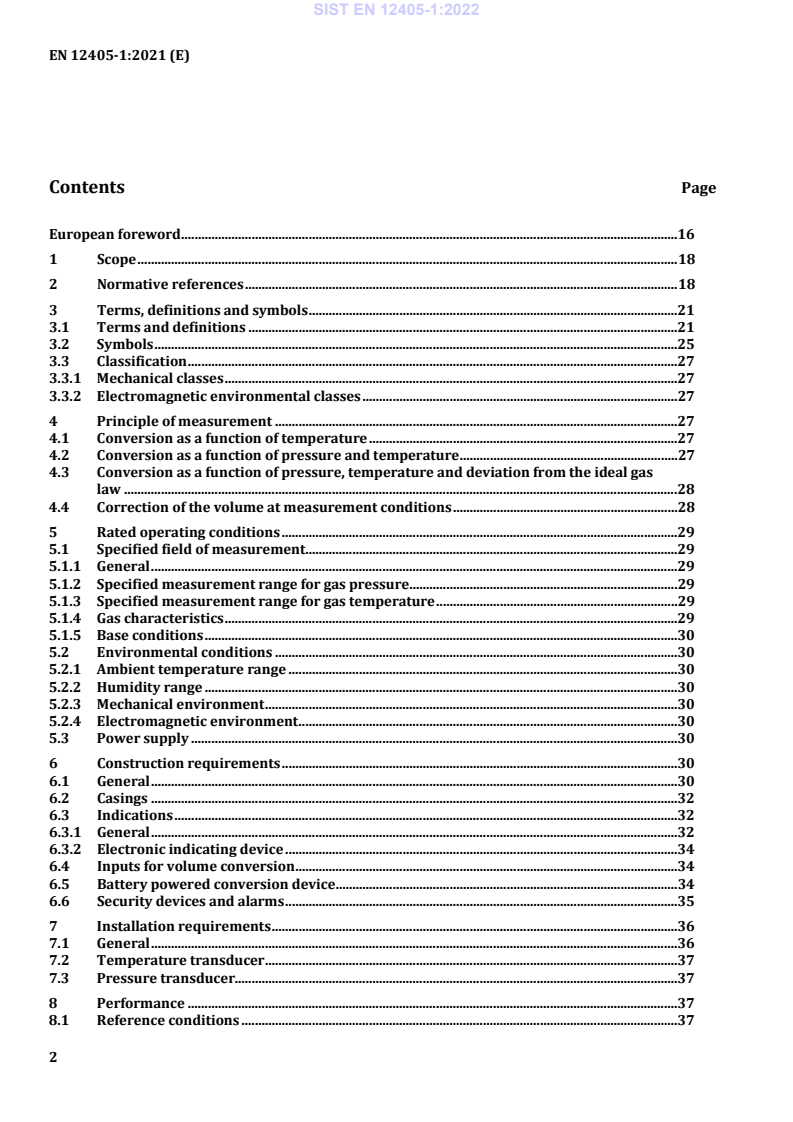
Contents Page
European foreword .16
1 Scope .18
2 Normative references .18
3 Terms, definitions and symbols .21
3.1 Terms and definitions .21
3.2 Symbols .25
3.3 Classification .27
3.3.1 Mechanical classes .27
3.3.2 Electromagnetic environmental classes .27
4 Principle of measurement .27
4.1 Conversion as a function of temperature .27
4.2 Conversion as a function of pressure and temperature .27
4.3 Conversion as a function of pressure, temperature and deviation from the ideal gas
law .28
4.4 Correction of the volume at measurement conditions .28
5 Rated operating conditions .29
5.1 Specified field of measurement.29
5.1.1 General .29
5.1.2 Specified measurement range for gas pressure .29
5.1.3 Specified measurement range for gas temperature .29
5.1.4 Gas characteristics .29
5.1.5 Base conditions .30
5.2 Environmental conditions .30
5.2.1 Ambient temperature range .30
5.2.2 Humidity range .30
5.2.3 Mechanical environment .30
5.2.4 Electromagnetic environment .30
5.3 Power supply .30
6 Construction requirements .30
6.1 General .30
6.2 Casings .32
6.3 Indications .32
6.3.1 General .32
6.3.2 Electronic indicating device .34
6.4 Inputs for volume conversion .34
6.5 Battery powered conversion device .34
6.6 Security devices and alarms .35
7 Installation requirements .36
7.1 General .36
7.2 Temperature transducer .37
7.3 Pressure transducer.37
8 Performance .37
8.1 Reference conditions .37
8.2 Rated operating conditions. 38
8.3 Maximum permissible errors . 38
8.3.1 General . 38
8.3.2 Error of conversion . 39
8.3.3 Specific errors for a gas-volume conversion device, type 2 . 39
8.4 Conditions of matching the constituent elements of a conversion device type 2 . 40
8.5 Influence factors . 40
8.6 Disturbances. 40
8.7 Durability . 41
8.8 Repeatability . 41
8.9 Reliability . 41
9 Tests of conformity . 41
9.1 Verification of the construction requirements . 41
9.2 Verification of the performance requirements (type tests). 41
9.2.1 Test conditions . 41
9.2.2 Samples of gas volume conversion device type 1 required for testing . 42
9.2.3 Samples of gas volume conversion devices type 2 required for testing . 46
9.2.4 Test report . 46
10 Marking . 46
11 Installation and operating instructions . 47
Annex A (normative) Type test . 48
A.1 General conditions . 48
A.1.1 General . 48
A.1.2 Additional conditions specific to gas volume conversion devices type 1 . 48
A.1.3 Additional conditions specific to gas-volume conversion devices type 2 . 48
A.1.4 Test procedures . 49
A.1.4.1 Test procedure 1 (PR1) . 49
A.1.4.1.1 Test conditions . 49
A.1.4.1.2 Performance of the test . 49
A.1.4.1.2.1 T conversion . 49
A.1.4.1.2.2 PT and PTZ conversion . 49
A.1.4.2 Test procedure 2 (PR2) . 50
A.1.4.3 Test procedure 3 (PR3) . 50
A.1.4.4 Test procedure 4 (PR4) . 50
A.1.4.5 Test procedure 5 (PR5) . 50
A.1.5 Verification of the construction requirements . 50
A.2 Accuracy tests under reference conditions . 50
A.2.1 Objective . 50
A.2.2 Reference to documents . 51
A.2.3 Procedure . 51
A.2.4 Acceptance criteria . 51
A.3 Effect of ambient temperature . 51
A.3.1 Objective .51
A.3.2 Reference to documents .51
A.3.3 Procedure.51
A.3.4 Acceptance criteria .51
A.4 Effect of damp heat, steady-state test .51
A.4.1 Objective .51
A.4.2 Reference to documents .51
A.4.3 Procedure.51
A.4.4 Acceptance criteria .52
A.5 Effect of damp heat, cyclic test .52
A.5.1 Objective .52
A.5.2 Reference to documents .52
A.5.3 Procedure.52
A.5.4 Acceptance criteria .52
A.6 Electrical power variation .53
A.6.1 Objective .53
A.6.2 Reference to documents .53
A.6.3 Procedure.53
A.6.4 Acceptance criteria .53
A.7 Short time power reductions .53
A.7.1 Objective .53
A.7.2 Reference to documents .53
A.7.3 Procedure.53
A.7.4 Acceptance criteria .54
A.8 Electrical bursts .54
A.8.1 Objective .54
A.8.2 Reference to documents .54
A.8.3 Procedure.54
A.8.4 Acceptance criteria .54
A.9 Electromagnetic susceptibility .54
A.9.1 Objective .54
A.9.2 Reference to documents .54
A.9.3 Procedure.54
A.9.4 Acceptance criteria .55
A.10 Electrostatic discharges .55
A.10.1 Objective .55
A.10.2 Reference to documents . 55
A.10.3 Procedure . 55
A.10.4 Acceptance criteria . 55
A.11 Overload of pressure (only for type 1 and pressure transducers) . 55
A.11.1 Objective . 55
A.11.2 Reference to documents . 55
A.11.3 Procedure . 55
A.11.4 Acceptance criteria . 56
A.12 Effect of vibrations . 56
A.12.1 Objective . 56
A.12.2 Reference to documents . 56
A.12.3 Procedure . 56
A.12.4 Acceptance criteria . 56
A.13 Effect of shocks . 56
A.13.1 Objective . 56
A.13.2 Reference to documents . 56
A.13.3 Procedure . 56
A.13.4 Acceptance criteria . 57
A.14 Overload of pressure (mechanical) . 57
A.14.1 Objective . 57
A.14.2 Reference to documents . 57
A.14.3 Procedure . 57
A.14.4 Acceptance criteria . 57
A.15 Durability . 57
A.15.1 Objective . 57
A.15.2 Reference to documents . 57
A.15.3 Procedure . 58
A.15.4 Acceptance criteria . 58
A.16 Alarms operation . 58
A.16.1 Objective . 58
A.16.2 Reference to documents . 58
A.16.3 Procedure . 58
A.16.4 Acceptance criteria . 58
A.17 Repeatability . 59
A.17.1 Objective . 59
A.17.2 Reference to standards . 59
A.17.3 Procedure.59
A.17.4 Acceptance criteria .59
A.18 Short time DC power variations .59
A.18.1 Objective .59
A.18.2 Reference to standards .59
A.18.3 Procedure.59
A.18.4 Acceptance criteria .59
A.19 Surges on supply lines and/or signal lines .60
A.19.1 Objective .60
A.19.2 Reference to standards .60
A.19.3 Procedure.60
A.19.4 Acceptance criteria .60
A.20 Power frequency magnetic field .60
A.20.1 Objective .60
A.20.2 Reference to standards .60
A.20.3 Procedure.60
A.20.4 Acceptance criteria .60
A.21 Functionality “Error curve correction” of a gas meter (optional) .61
A.21.1 Objective .61
A.21.2 Reference to documents .61
A.21.3 Procedure.61
A.21.4 Acceptance criteria .61
Annex B (normative) Pressure transducers .62
B.1 Scope .62
B.2 Rated operating conditions .62
B.2.1 Specified measurement range for pressure .62
B.2.2 Environmental class .62
B.2.3 Power supply .62
B.3 Construction requirements .62
B.3.1 General .62
B.3.2 Casings .62
B.3.3 Indications .62
B.3.3.1 General .62
B.3.3.2 Electronic indicating device .63
B.4 Performances .63
B.4.1 Reference conditions .63
B.4.2 Rated operating conditions. 63
B.4.3 Maximum permissible errors . 63
B.4.4 Influence factors . 63
B.4.5 Disturbances. 63
B.4.6 Durability . 63
B.5 Tests of conformity . 64
B.5.1 Test conditions . 64
B.5.2 Tests . 64
B.5.3 Sample of pressure transducers required for testing . 64
B.6 Marking . 64
Annex C (normative) Platinum resistance thermometer sensors . 65
C.1 Scope . 65
C.2 Operating rated conditions . 65
C.2.1 Specified measurement range for temperature . 65
C.2.2 Environmental class . 65
C.3 Construction requirements . 65
C.4 Performances . 65
C.5 Marking . 66
C.5.1 Required markings . 66
C.5.2 Verification mark . 66
C.6 Metrological verifications . 66
C.6.1 Type approval . 66
C.6.2 Initial verification . 66
C.7 Verification procedure . 67
C.7.1 Visual inspection . 67
C.7.2 Type testing (type approval) . 67
C.7.3 Samples of PRT required for testing . 67
C.7.4 Initial verification . 67
Annex D (normative) Temperature transducers . 69
D.1 Scope . 69
D.2 Rated operating conditions. 69
D.2.1 Specified measurement range for temperature . 69
D.2.2 Environmental class . 69
D.2.3 Power supply . 69
D.3 Construction requirements . 69
D.3.1 General . 69
D.3.2 Casings .69
D.3.3 Indications .69
D.3.3.1 General .69
D.3.3.2 Electronic indicating device .70
D.4 Performances .70
D.4.1 Reference conditions .70
D.4.2 Rated operating conditions .70
D.4.3 Maximum permissible errors .70
D.4.4 Influence factors .70
D.4.5 Disturbances .70
D.4.6 Durability .70
D.5 Tests of conformity .71
D.5.1 Test conditions .71
D.5.2 Tests .71
D.5.3 Sample of temperature transducers required for testing .71
D.6 Marking .71
Annex E (informative) Model type test report for conversion devices .72
E.1 General .72
E.1.1 General remarks .72
E.1.2 Number of pages .72
E.1.3 Laboratory's identification .72
E.1.4 Applicant .72
E.1.5 Identification of device(s) submitted for testing .72
E.2 Accuracy tests under reference conditions .72
E.2.1 Ambient temperature during the test .72
E.2.2 Test equipment used.73
E.2.3 Test results .73
E.3 Ambient temperature .74
E.3.1 Effect of dry heat .74
E.3.1.1 Ambient temperature during the test .74
E.3.1.2 Test equipment used.74
E.3.1.3 Test results .
...