


FprEN 18142
(Main)Self-loading mobile concrete mixers - Safety requirements and verification
General Information
- Abstract
This document specifies general safety requirements for self-loading mobile concrete mixers (here-after referred to as "SLMs") as defined in ISO 18650-1:2021, with rigid or articulated wheeled chassis.
This document applies to SLMs which are designed for front or rear loading and can be provided with a slewing and/or tilting frame where the rotating drum and the self-loading equipment (lift arms and bucket) are mounted on. SLMs can also be fitted with accessories such as water dosing means and a weighing system.
This document is not applicable to the following:
- machines designed primarily for earth moving, such as loaders or dumpers (see applicable parts of the EN 474 series);
- truck mixers (see EN 12609).
This document deals with all significant hazards, hazardous situations and events relevant to SLMs, whether used as intended and under conditions foreseen or under conditions of misuse reasonably foreseeable by the manufacturer (see Annex A).
This document does not provide performance levels required for safety related functions of control systems.
NOTE A document providing detailed description of safety functions for SLMs and related performance levels required is under development.
This document does not address hazards that can occur:
- during manufacture;
- when using SLMs on public roads, where specific local road regulations can apply;
- when operating in potentially explosive atmospheres.
This document does not address hazards specifically related to:
- SLMs designed to operate with varying levels of autonomy or when SLMs have embedded safety-systems with fully or partially self-evolving behaviour or logic using machine learning approaches, including collaborative applications;
- SLMs when intended to be connected to the internet or to an external network or device that communicates with it (protection against corruption).
This document is not applicable to SLMs manufactured before the date of its publication.
- Status
- Not Published
- Publication Date
- 21-Oct-2026
- Technical Committee
- CEN/TC 151 - Construction equipment and building material machines - Safety
- Drafting Committee
- CEN/TC 151/WG 8 - Concrete preparation and handling equipment - Safety
- Current Stage
- 5020 - Submission to Vote - Formal Approval
- Start Date
- 02-Jul-2026
- Due Date
- 15-May-2026
- Completion Date
- 02-Jul-2026

Overview
FprEN 18142: Self-loading Mobile Concrete Mixers - Safety Requirements and Verification is a draft European Standard developed by CEN/TC 151. This document sets out the essential safety requirements and verification procedures for self-loading mobile concrete mixers (SLMs) equipped with rigid or articulated wheeled chassis. SLMs addressed by this standard are capable of front or rear loading, and may feature slewing or tilting frames for the rotating drum and self-loading equipment, such as lift arms and buckets. Accessories including water dosing and weighing systems may also be included.
The standard is focused on minimizing significant risks associated with the design, operation, and maintenance of SLMs when used as intended or under reasonably foreseeable misuse. It does not apply to earth-moving machines like loaders or dumpers, nor to truck mixers.
Key Topics
Scope and Definitions
- Applies to SLMs as defined in ISO 18650-1:2021
- Covers machines for front or rear loading, with the possibility of additional accessories
Hazard Identification
- Addresses all significant hazards and hazardous situations related to SLMs
- Includes provisions for preventive and protective measures
Operator Safety
- Requirements for safe access systems and operator stations
- Design specifications to prevent accidental contact with moving parts
- Field of view, visibility aids, lighting, and warning devices
Structural Integrity and Protective Systems
- Standards for roll-over and falling object protective structures
- Requirements for robust brake and steering systems
Systems and Controls
- Safety devices for hydraulic and electrical systems, including over-current protection and emergency stop functions
- Marking, labeling, and operator/maintenance manual requirements
Maintenance and Transportation
- Provisions for safe maintenance access
- Requirements for retrieval, lifting, tying-down, and transportation of SLMs
Excluded Areas
- Manufacture stage, road usage, explosive atmospheres
- SLMs with autonomous or integrated self-evolving safety logic
- Internet connectivity or remote data communication scenarios
Applications
FprEN 18142 is relevant for a wide spectrum of industry players, including:
- Manufacturers: Ensuring compliance with the essential safety requirements during the design and production of SLMs.
- Health and Safety Bodies: Assisting regulators and safety organizations in standardizing audit and inspection criteria for SLMs on construction sites.
- Operators and Employers: Providing clear safety requirements for purchasing, operating, and maintaining SLMs, thus minimizing risks of workplace accidents.
- Service and Maintenance Providers: Guiding safe routine maintenance practices and risk reduction strategies through detailed manual and marking requirements.
The scope and requirements detailed in FprEN 18142 contribute to improved worker safety, machine reliability, and industry-wide harmonization of best practices for self-loading mobile concrete mixers in the European construction sector.
Related Standards
Proper application of FprEN 18142 should be considered alongside related standards, such as:
- EN ISO 12100: General principles for risk assessment and risk reduction in machinery
- ISO 18650-1:2021: Definitions and classifications for concrete mixers
- EN 12609: Truck mixers - Safety requirements
- EN 474 Series: Earth-moving machinery standards
- EN ISO 2867, EN ISO 3411, EN ISO 3457: Access systems, dimensions, and guards
- EN ISO 19014-1, EN ISO 13766: Functional safety and electromagnetic compatibility for construction machinery
By following FprEN 18142 together with these referenced standards, stakeholders can achieve compliance with both sector-specific and harmonized European machinery safety regulations.
Get Certified
Connect with accredited certification bodies for this standard

DIBt (Deutsches Institut für Bautechnik)
German Institute for Building Technology.
DIN CERTCO
DIN Group product certification.

Aboma Certification B.V.
Specialized in construction, metal, and transport sectors.
Sponsored listings
Frequently Asked Questions
FprEN 18142 is a draft published by the European Committee for Standardization (CEN). Its full title is "Self-loading mobile concrete mixers - Safety requirements and verification". This standard covers: This document specifies general safety requirements for self-loading mobile concrete mixers (here-after referred to as "SLMs") as defined in ISO 18650-1:2021, with rigid or articulated wheeled chassis. This document applies to SLMs which are designed for front or rear loading and can be provided with a slewing and/or tilting frame where the rotating drum and the self-loading equipment (lift arms and bucket) are mounted on. SLMs can also be fitted with accessories such as water dosing means and a weighing system. This document is not applicable to the following: - machines designed primarily for earth moving, such as loaders or dumpers (see applicable parts of the EN 474 series); - truck mixers (see EN 12609). This document deals with all significant hazards, hazardous situations and events relevant to SLMs, whether used as intended and under conditions foreseen or under conditions of misuse reasonably foreseeable by the manufacturer (see Annex A). This document does not provide performance levels required for safety related functions of control systems. NOTE A document providing detailed description of safety functions for SLMs and related performance levels required is under development. This document does not address hazards that can occur: - during manufacture; - when using SLMs on public roads, where specific local road regulations can apply; - when operating in potentially explosive atmospheres. This document does not address hazards specifically related to: - SLMs designed to operate with varying levels of autonomy or when SLMs have embedded safety-systems with fully or partially self-evolving behaviour or logic using machine learning approaches, including collaborative applications; - SLMs when intended to be connected to the internet or to an external network or device that communicates with it (protection against corruption). This document is not applicable to SLMs manufactured before the date of its publication.
This document specifies general safety requirements for self-loading mobile concrete mixers (here-after referred to as "SLMs") as defined in ISO 18650-1:2021, with rigid or articulated wheeled chassis. This document applies to SLMs which are designed for front or rear loading and can be provided with a slewing and/or tilting frame where the rotating drum and the self-loading equipment (lift arms and bucket) are mounted on. SLMs can also be fitted with accessories such as water dosing means and a weighing system. This document is not applicable to the following: - machines designed primarily for earth moving, such as loaders or dumpers (see applicable parts of the EN 474 series); - truck mixers (see EN 12609). This document deals with all significant hazards, hazardous situations and events relevant to SLMs, whether used as intended and under conditions foreseen or under conditions of misuse reasonably foreseeable by the manufacturer (see Annex A). This document does not provide performance levels required for safety related functions of control systems. NOTE A document providing detailed description of safety functions for SLMs and related performance levels required is under development. This document does not address hazards that can occur: - during manufacture; - when using SLMs on public roads, where specific local road regulations can apply; - when operating in potentially explosive atmospheres. This document does not address hazards specifically related to: - SLMs designed to operate with varying levels of autonomy or when SLMs have embedded safety-systems with fully or partially self-evolving behaviour or logic using machine learning approaches, including collaborative applications; - SLMs when intended to be connected to the internet or to an external network or device that communicates with it (protection against corruption). This document is not applicable to SLMs manufactured before the date of its publication.
FprEN 18142 is classified under the following ICS (International Classification for Standards) categories: 91.220 - Construction equipment. The ICS classification helps identify the subject area and facilitates finding related standards.
FprEN 18142 is associated with the following European legislation: EU Directives/Regulations: 2006/42/EC, 2023/1230; Standardization Mandates: M/396, M/605. When a standard is cited in the Official Journal of the European Union, products manufactured in conformity with it benefit from a presumption of conformity with the essential requirements of the corresponding EU directive or regulation.
FprEN 18142 is available in PDF format for immediate download after purchase. The document can be added to your cart and obtained through the secure checkout process. Digital delivery ensures instant access to the complete standard document.
Standards Content (Sample)
SLOVENSKI STANDARD
oSIST prEN 18142:2025
01-junij-2025
Samonakladalni mobilni betonski mešalniki - Varnostne zahteve in preverjanje
Self-loading mobile concrete mixers - Safety requirements and verification
Selbstladende mobile Betonmischer - Sicherheitsanforderungen und Überprüfung
Malaxeurs à béton mobiles avec autochargeur - Exigences de sécurité et vérification
Ta slovenski standard je istoveten z: prEN 18142
ICS:
91.220 Gradbena oprema Construction equipment
oSIST prEN 18142:2025 en,fr,de
2003-01.Slovenski inštitut za standardizacijo. Razmnoževanje celote ali delov tega standarda ni dovoljeno.
oSIST prEN 18142:2025
oSIST prEN 18142:2025
DRAFT
EUROPEAN STANDARD
prEN 18142
NORME EUROPÉENNE
EUROPÄISCHE NORM
March 2025
ICS 91.220
English Version
Self-loading mobile concrete mixers - Safety requirements
and verification
Malaxeurs à béton mobiles avec autochargeur - Selbstladende mobile Betonmischer -
Exigences de sécurité et vérification Sicherheitsanforderungen und Überprüfung
This draft European Standard is submitted to CEN members for enquiry. It has been drawn up by the Technical Committee
CEN/TC 151.
If this draft becomes a European Standard, CEN members are bound to comply with the CEN/CENELEC Internal Regulations
which stipulate the conditions for giving this European Standard the status of a national standard without any alteration.
This draft European Standard was established by CEN in three official versions (English, French, German). A version in any other
language made by translation under the responsibility of a CEN member into its own language and notified to the CEN-CENELEC
Management Centre has the same status as the official versions.
CEN members are the national standards bodies of Austria, Belgium, Bulgaria, Croatia, Cyprus, Czech Republic, Denmark, Estonia,
Finland, France, Germany, Greece, Hungary, Iceland, Ireland, Italy, Latvia, Lithuania, Luxembourg, Malta, Netherlands, Norway,
Poland, Portugal, Republic of North Macedonia, Romania, Serbia, Slovakia, Slovenia, Spain, Sweden, Switzerland, Türkiye and
United Kingdom.
Recipients of this draft are invited to submit, with their comments, notification of any relevant patent rights of which they are
aware and to provide supporting documentation.
Warning : This document is not a European Standard. It is distributed for review and comments. It is subject to change without
notice and shall not be referred to as a European Standard.
EUROPEAN COMMITTEE FOR STANDARDIZATION
COMITÉ EUROPÉEN DE NORMALISATION
EUROPÄISCHES KOMITEE FÜR NORMUNG
CEN-CENELEC Management Centre: Rue de la Science 23, B-1040 Brussels
© 2025 CEN All rights of exploitation in any form and by any means reserved Ref. No. prEN 18142:2025 E
worldwide for CEN national Members.
oSIST prEN 18142:2025
prEN 18142:2025 (E)
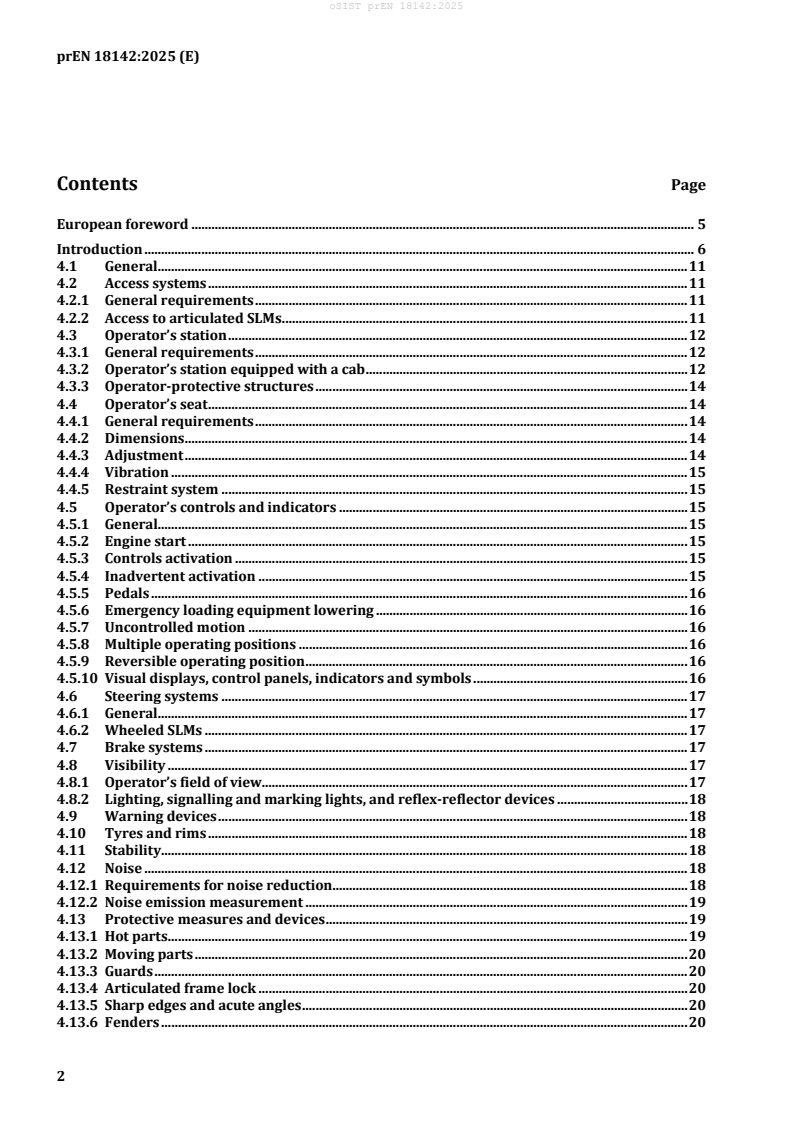
Contents Page
European foreword . 5
Introduction . 6
4.1 General. 11
4.2 Access systems . 11
4.2.1 General requirements . 11
4.2.2 Access to articulated SLMs . 11
4.3 Operator’s station . 12
4.3.1 General requirements . 12
4.3.2 Operator’s station equipped with a cab . 12
4.3.3 Operator-protective structures . 14
4.4 Operator’s seat . 14
4.4.1 General requirements . 14
4.4.2 Dimensions. 14
4.4.3 Adjustment . 14
4.4.4 Vibration . 15
4.4.5 Restraint system . 15
4.5 Operator’s controls and indicators . 15
4.5.1 General. 15
4.5.2 Engine start . 15
4.5.3 Controls activation . 15
4.5.4 Inadvertent activation . 15
4.5.5 Pedals . 16
4.5.6 Emergency loading equipment lowering . 16
4.5.7 Uncontrolled motion . 16
4.5.8 Multiple operating positions . 16
4.5.9 Reversible operating position . 16
4.5.10 Visual displays, control panels, indicators and symbols . 16
4.6 Steering systems . 17
4.6.1 General. 17
4.6.2 Wheeled SLMs . 17
4.7 Brake systems . 17
4.8 Visibility . 17
4.8.1 Operator’s field of view . 17
4.8.2 Lighting, signalling and marking lights, and reflex-reflector devices . 18
4.9 Warning devices . 18
4.10 Tyres and rims . 18
4.11 Stability . 18
4.12 Noise . 18
4.12.1 Requirements for noise reduction. 18
4.12.2 Noise emission measurement . 19
4.13 Protective measures and devices . 19
4.13.1 Hot parts . 19
4.13.2 Moving parts . 20
4.13.3 Guards . 20
4.13.4 Articulated frame lock . 20
4.13.5 Sharp edges and acute angles . 20
4.13.6 Fenders . 20
oSIST prEN 18142:2025
prEN 18142:2025 (E)
4.14 Retrieval, transportation, lifting and towing . 20
4.14.1 Common use . 20
4.14.2 Retrieval . 21
4.14.3 Tying-down . 21
4.14.4 Lifting . 21
4.14.5 Off-road towing . 21
4.14.6 Transportation . 21
4.15 Electromagnetic compatibility . 21
4.16 Electrical and electronic systems . 21
4.16.1 General . 21
4.16.2 Degree of protection . 21
4.16.3 Electrical connections . 22
4.16.4 Over-current protective devices . 22
4.16.5 Batteries . 22
4.16.6 Battery disconnection . 22
4.16.7 Electrical connectors for auxiliary starting aids . 22
4.16.8 Electric sockets for lighting. 22
4.17 Hydraulic systems . 23
4.17.1 General requirements . 23
4.17.2 Hydraulic lines . 23
4.17.3 Hydraulic hose assemblies . 23
4.18 Fuel tanks, DEF/urea tanks, hydraulic tanks and pressure vessels . 23
4.18.1 General . 23
4.18.2 Filler openings . 23
4.18.3 Fuel tanks . 23
4.18.4 Simple pressure vessels . 23
4.19 Fire protection . 24
4.19.1 Fire resistance . 24
4.19.2 Fire extinguisher . 24
4.20 Rotating drum and related equipment . 24
4.20.1 Rotating drum . 24
4.20.2 Rollers . 24
4.20.3 Loading equipment . 24
4.20.4 Discharging chute . 24
4.20.5 Cleaning system . 25
4.21 Maintenance . 25
4.21.1 General . 25
4.21.2 Routine maintenance . 25
4.21.3 Support devices . 25
4.21.4 Access to the engine compartment . 26
4.22 Underground operation in non-explosive atmospheres . 26
4.22.1 General . 26
4.22.2 Lighting, signalling and marking lights, and reflex-reflector devices . 26
4.22.3 Engine exhaust emission and fuel . 26
4.23 Safety functions . 26
6.1 General . 32
6.2 Safety labels . 32
6.3 Operator’s manual . 32
6.3.1 General . 32
6.3.2 Information concerning airborne noise emission . 33
6.3.3 Information concerning hand-arm and whole-body vibration emission . 34
6.3.4 Information concerning the rotating drum and materials related to the work cycle . 34
6.4 Maintenance manual . 35
6.5 Marking . 35
oSIST prEN 18142:2025
prEN 18142:2025 (E)
Annex A (informative) List of significant hazards . 36
Annex ZA (informative) Relationship between this European Standard and the essential
requirements of Regulation (EU) 2023/1230 aimed to be covered . 44
Bibliography . 48
oSIST prEN 18142:2025
prEN 18142:2025 (E)
European foreword
This document (prEN 18142:2025) has been prepared by Technical Committee CEN/TC 151 “Construction
equipment and building material machines - Safety”, the secretariat of which is held by DIN.
This document is currently submitted to the CEN Enquiry.
This document has been prepared under a standardization request addressed to CEN by the European
Commission. The Standing Committee of the EFTA States subsequently approves these requests for its
Member States.
For relationship with Regulation(s), see informative Annex ZA which is an integral part of this document.
oSIST prEN 18142:2025
prEN 18142:2025 (E)
Introduction
This document is a type-C standard as stated in EN ISO 12100.
This document is of relevance, in particular, for the following stakeholder groups representing the market
players with regard to machinery safety:
— machine manufacturers (small, medium and large enterprises);
— health and safety bodies (regulators, accident prevention organizations, market surveillance, etc.).
Others can be affected by the level of machinery safety achieved with the means of the document by the
above-mentioned stakeholder groups:
— machine users/employers (small, medium and large enterprises);
— machine users/employees (e.g. trade unions, organizations for people with special needs);
— service providers, e.g. for maintenance (small, medium and large enterprises);
— consumers (in the case of machinery intended for use by consumers).
The above-mentioned stakeholder groups have been given the possibility to participate at the drafting
process of this document.
The machinery concerned and the extent to which hazards, hazardous situations or hazardous events are
covered are indicated in the Scope of this document.
When requirements of this type-C standard are different from those which are stated in type-A or type-B
standards, the requirements of this type-C standard take precedence over the requirements of the other
standards for machines that have been designed and built according to the requirements of this type-C
standard.
oSIST prEN 18142:2025
prEN 18142:2025 (E)
1 Scope
This document specifies general safety requirements for self-loading mobile concrete mixers (here-after
referred to as “SLMs”) as defined in ISO 18650-1:2021, with rigid or articulated wheeled chassis.
This document applies to SLMs which are designed for front or rear loading and can be provided with a
slewing and/or tilting frame where the rotating drum and the self-loading equipment (lift arms and bucket)
are mounted on. SLMs can also be fitted with accessories such as water dosing means and a weighing
system.
This document is not applicable to the following:
— machines designed primarily for earth moving, such as loaders or dumpers (see applicable parts of the
EN 474 series);
— truck mixers (see EN 12609).
This document deals with all significant hazards, hazardous situations and events relevant to SLMs,
whether used as intended and under conditions foreseen or under conditions of misuse reasonably
foreseeable by the manufacturer (see Annex A).
This document does not address hazards that can occur:
— during manufacture;
— when using SLMs on public roads, where specific local road regulations can apply;
— when operating in potentially explosive atmospheres.
This document does not address hazards specifically related to:
— SLMs designed to operate with varying levels of autonomy or when SLMs have embedded safety-
systems with fully or partially self-evolving behaviour or logic using machine learning approaches,
including collaborative applications;
— SLMs when intended to be connected to the internet or to an external network or device that
communicates with it.
This document is not applicable to SLMs manufactured before the date of its publication.
2 Normative references
The following documents are referred to in the text in such a way that some or all of their content
constitutes requirements of this document. For dated references, only the edition cited applies. For undated
references, the latest edition of the referenced document (including any amendments) applies.
EN 60204-1:2018, Safety of machinery — Electrical equipment of machines — Part 1: General requirements
EN 60529:1991, Degrees of protection provided by enclosures (IP Code) (IEC 60529:1989)
EN ISO 2860:2008, Earth-moving machinery — Minimum access dimensions (ISO 2860:1992)
EN ISO 2867:2011, Earth-moving machinery — Access systems (ISO 2867:2011)
As impacted by EN 60529:1991/A1:2000, EN 60529:1991/A2:2013, EN 60529:1991/AC:2016-12, EN
60529:1991/corrigendum May 1993 and EN 60529:1991/A2:2013/AC:2019-02.
oSIST prEN 18142:2025
prEN 18142:2025 (E)
EN ISO 3164:2013, Earth-moving machinery — Laboratory evaluations of protective structures —
Specifications for deflection-limiting volume
EN ISO 3411:2007, Earth-moving machinery — Physical dimensions of operators and minimum operator
space envelope (ISO 3411:2007)
EN ISO 3449:2008, Earth-moving machinery — Falling-object protective structures — Laboratory tests and
performance requirements (ISO 3449:2005)
EN ISO 3450:2011, Earth-moving machinery — Wheeled or high-speed rubber-tracked machines —
Performance requirements and test procedures for brake systems (ISO 3450:2011)
EN ISO 3457:2008, Earth-moving machinery — Guards — Definitions and requirements (ISO 3457:2003)
EN ISO 3471:2008, Earth-moving machinery — Roll-over protective structures — Laboratory tests and
performance requirements (ISO 3471:2008)
EN ISO 4413:2010, Hydraulic fluid power — General rules and safety requirements for systems and their
components (ISO 4413:2010)
EN ISO 4871:2009, Acoustics — Declaration and verification of noise emission values of machinery and
equipment (ISO 4871:1996)
EN ISO 5010:2019, Earth-moving machinery — Wheeled machines — Steering requirements (ISO
5010:2019)
EN ISO 6682:2008, Earth-moving machinery — Zones of comfort and reach for controls (ISO 6682:1986,
including Amd 1:1989)
EN ISO 6683:2008, Earth-moving machinery — Seat belts and seat belt anchorages — Performance
requirements and tests (ISO 6683:2005)
EN ISO 7096:2020, Earth-moving machinery — Laboratory evaluation of operator seat vibration (ISO
7096:2020)
EN ISO 12100:2010, Safety of machinery — General principles for design — Risk assessment and risk
reduction (ISO 12100:2010)
EN ISO 13766-1:2018, Earth-moving and building construction machinery — Electromagnetic compatibility
(EMC) of machines with internal electrical power supply — Part 1: General EMC requirements under typical
electromagnetic environmental conditions (ISO 13766-1:2018)
EN ISO 13766-2:2018, Earth-moving and building construction machinery — Electromagnetic compatibility
(EMC) of machines with internal electrical power supply — Part 2: Additional EMC requirements for
functional safety (ISO 13766-2:2018)
EN ISO 13850:2015, Safety of machinery — Emergency stop function — Principles for design (ISO
13850:2015)
EN ISO 13857:2019, Safety of machinery — Safety distances to prevent hazard zones being reached by upper
and lower limbs (ISO 13857:2019)
As impacted by EN ISO 3164:2013/A1:2024.
oSIST prEN 18142:2025
prEN 18142:2025 (E)
EN ISO 14119:2013, Safety of machinery - Interlocking devices associated with guards - Principles for design
and selection (ISO 14119:2013)
EN ISO 14120:2015, Safety of machinery — Guards — General requirements for the design and construction
of fixed and movable guards (ISO 14120:2015)
EN ISO 19014-1:2018, Earth-moving machinery — Functional safety — Part 1: Methodology to determine
safety-related parts of the control system and performance requirements (ISO 19014-1:2018, Corrected
version 2019-02)
ISO 3776-1:2006, Tractors and machinery for agriculture — Seat belts — Part 1: Anchorage location
requirements
ISO 3776-2:2013, Tractors and machinery for agriculture — Seat belts — Part 2: Anchorage strength
requirements
ISO 3776-3:2009, Tractors and machinery for agriculture — Seat belts — Part 3: Requirements for assemblies
ISO 3795:1989, Road vehicles, and tractors and machinery for agriculture and forestry — Determination of
burning behaviour of interior materials
ISO 5006:2017, Earth-moving machinery — Operator’s field of view — Test method and performance criteria
ISO 6011:2023, Earth-moving machinery — Visual display of machine operation
ISO 6750-1:2019, Earth-moving machinery — Operator’s manual — Part 1: Contents and format
ISO 7000:2019, Graphical symbols for use on equipment — Registered symbols
ISO 9244:2008, Earth-moving machinery — Machine safety labels — General principles
ISO 9533:2010, Earth-moving machinery — Machine-mounted audible travel alarms and forward horns —
Test methods and performance criteria
ISO 10263-3:2009, Earth-moving machinery — Operator enclosure environment — Part 3: Pressurization
test method
ISO 10263-4:2009, Earth-moving machinery — Operator enclosure environment — Part 4: Heating,
ventilating and air conditioning (HVAC) test method and performance
ISO 10264:1990, Earth-moving machinery — Key-locked starting systems
Earth-moving machinery — Machine-mounted retrieval device — Performance
ISO 10532:1995,
requirements
ISO 10533:1993, Earth-moving machinery — Lift-arm support devices
ISO 10570:2004, Earth-moving machinery — Articulated frame lock — Performance requirements
ISO 10968:2020, Earth-moving machinery — Operator’s controls
As impacted by ISO 9244:2008/Amd 1:2016.
As impacted by ISO 10532:1995/Amd 1:2004 and ISO 10532:1995/Cor 1:2006.
As impacted by ISO 10533:1993/Amd 1:2005
oSIST prEN 18142:2025
prEN 18142:2025 (E)
ISO 11112:1995, Earth-moving machinery — Operator’s seat — Dimensions and requirements
ISO 11862:1993, Earth-moving machinery — Auxiliary starting aid electrical connector
ISO 12508:1994, Earth-moving machinery — Operator station and maintenance areas — Bluntness of edges
ISO 12509:2023, Earth-moving machinery — Lighting, signalling and marking lights, and reflex-reflectors
ISO 14990-1:2016, Earth-moving machinery — Electrical safety of machines utilizing electric drives and
related components and systems — Part 1: General requirements
ISO 14990-2:2016, Earth-moving machinery — Electrical safety of machines utilizing electric drives and
related components and systems — Part 2: Particular requirements for externally-powered machines
ISO 14990-3:2016, Earth-moving machinery — Electrical safety of machines utilizing electric drives and
related components and systems — Part 3: Particular requirements for self-powered machines
ISO 15817:2012, Earth-moving machinery — Safety requirements for remote operator control systems
ISO 15818:2017, Earth-moving machinery — Lifting and tying-down attachment points — Performance
requirements
ISO 21507:2010, Earth-moving machinery — Performance requirements for non-metallic fuel tanks
3 Terms and definitions
For the purposes of this document, the terms and definitions given in EN ISO 12100:2010 and the following
apply.
ISO and IEC maintain terminology databases for use in standardization at the following addresses:
— ISO Online browsing platform: available at https://www.iso.org/obp
— IEC Electropedia: available at https://www.electropedia.org/
3.1
self-loading equipment
integral mounted bucket-supporting structure and linkage permanently fitted to the SLM, enabling it to fill
its own rotating drum with material
Note 1 to entry: Self-loading equipment has been excluded from EN 474-6:2022.
3.2
rated capacity
volume in cubic meters of ready concrete, produced per each cycle, declared by the manufacturer, in
working conditions on flat ground with slump class S1 according to EN 206:2013+A2:2021, measured in
non-vibrated formwork
As impacted by ISO 11112:1995/Amd 1:2001.
oSIST prEN 18142:2025
prEN 18142:2025 (E)
3.3
operating mass
mass of the SLM, with rotating drum and self-loading equipment (3.1) empty, and with the operator (75 kg),
full fuel tank and all fluid systems (i.e. hydraulic oil, transmission oil, engine oil, engine coolant) at the levels
specified by the manufacturer and with empty water tank(s)
3.4
Compact SLM
SLM with a rated capacity less than 2,5 m
3.5
operator’s station
area from which the operator can control all or specific SLM functions
4 Safety requirements and/or protective/risk reduction measures
4.1 General
SLMs shall comply with the safety requirements and/or protective/risk reduction measures of this clause.
In addition, the SLM shall be designed according to the principles of EN ISO 12100:2010 for relevant but
not significant hazards which are not dealt with by this document.
4.2 Access systems
4.2.1 General requirements
Access systems shall be provided to the operator’s station(s) and to routine maintenance points. Access
systems shall conform to EN ISO 2867:2011.
4.2.2 Access to articulated SLMs
On SLMs with articulated frames and in the fully articulated steering position, a minimum clearance of
150 mm shall be provided between firm structures and components with relative movement in the path of
the access systems to the operator’s station, as illustrated in Figure 1.
Dimensions in millimetres
Figure 1 — Minimum clearance for access to operator’s station on SLMs with articulated frame
oSIST prEN 18142:2025
prEN 18142:2025 (E)
4.3 Operator’s station
4.3.1 General requirements
4.3.1.1 SLM equipment
SLMs excluding compact SLMs shall have provisions for fitting an enclosed cab.
4.3.1.2 Minimum space
The minimum space available to the operator shall be as defined in EN ISO 3411:2007, with the following
exceptions:
— dimension R as defined in EN ISO 3411:2007, Table 1, may be reduced to a minimum of 920 mm;
— the internal operator's space envelope width from the lower end of upper side walls of enclosure as
defined in EN ISO 3411:2007 may be reduced to a minimum of 650 mm.
The minimum space and location of the controls at the operator’s station shall meet the requirements of
EN ISO 6682:2008.
4.3.1.3 Moving parts
The SLM shall be designed so as to avoid accidental contact from the operating position with moving parts
(e.g. wheels, tracks, working equipment, attachments) in accordance with 4.13.2.
4.3.1.4 Engine exhaust
The engine exhaust system shall release the exhaust gas away from the operator and the air inlet of the cab.
4.3.1.5 Instruction storage
If the operator’s manual and other instructions are provided in paper form, a space intended for their
safekeeping shall be provided near the operator’s station.
4.3.1.6 Sharp edges
The operator’s working space within the operator’s station (e.g. ceiling, inner walls, instrument panels,
access to the operator’s station) shall not present any sharp exposed edges or acute angles/corners. The
radius of corners and the bluntness of edges shall conform to ISO 12508:1994, in order to avoid sharp
edges.
4.3.2 Operator’s station equipped with a cab
4.3.2.1 Climatic conditions
The cab shall protect the operator against foreseeable adverse climatic conditions. Provisions shall be made
to install a ventilation system, an adjustable heating system and a system for defrosting windows. For
details, see 4.3.2.5 to 4.3.2.7.
4.3.2.2 Pipes and hoses
Pipes and hoses that contain fluids at pressures exceeding 5 MPa or temperatures above 60 °C located
inside the cab shall be guarded in accordance with EN ISO 3457:2008, Clause 9. See also 4.17.3.
Parts or components placed between pipes or hoses and the operator, which divert a hazardous spray of
fluid, may be considered as a sufficient protection device.
4.3.2.3 Primary opening
A primary access opening shall be provided. The dimensions shall be in accordance with EN ISO 2867:2011.
oSIST prEN 18142:2025
prEN 18142:2025 (E)
4.3.2.4 Alternative opening (emergency exit)
An alternative opening shall be provided on a side other than that of the primary opening. The dimensions
shall be in accordance with EN ISO 2867:2011. A window panel or another door is acceptable if they are
easy to open or remove without the use of keys or tools. Latches may be used if they can be opened from
the inside without the use of keys or tools. The breaking of a suitable size of glass pane is considered to
represent a suitable alternative opening, provided that the necessary pane hammer, immediately
accessible to the operator, is provided and stored in a position adjacent to the relevant pane.
The emergency exit shall be marked in accordance with ISO 7010:2019, Table 2, symbol E001 or E002 or
E008 as appropriate.
4.3.2.5 Heating system
A heating system, if fitted, shall be in accordance with ISO 10263-4:2009. If the cab is not equipped with a
pressurization system, then ISO 10263-4:2009, 6.1.1 is not applicable.
4.3.2.6 Ventilation system
The ventilation system shall be capable of providing the cab with fresh air at a minimum of 43 m /h.
4.3.2.7 Defrosting system
A defrosting system shall provide facilities for defrosting the front and rear windows, for example, by
means of a heating system or a particular defrosting device.
NOTE A test method for windscreen defrosting systems is given in ISO 10263-5.
4.3.2.8 Pressurization system
Where a cab is provided with a pressurization system, it shall be tested according to ISO 10263-3:2009 and
shall provide an interior relative pressure of at least 50 Pa.
4.3.2.9 Air conditioning system
Where a cab is provided with an air conditioning system, it shall comply with ISO 10263-4:2009.
4.3.2.10 Doors and windows
Doors, windows and flaps shall be securely held in their intended operating positions. Doors shall be
retained at their intended operating positions by a positive engagement device in accordance with
EN ISO 2867:2011, 5.6.
Windows shall be made of safety glass or other material that provides similar safety performance (see, for
example, ECE R43).
The front window shall be fitted with motorized windscreen wipers and washers.
The rear window shall be fitted with motorized windscreen wipers and washers if direct or indirect
visibility in this direction is required by the visibility requirements in 4.8.
The windscreen washer reservoir/tank shall be accessible in accordance with EN ISO 2867:2011.
4.3.2.11 Interior lighting
The cab shall be fitted with a fixed interior lighting system and shall be able to function with the engine
stopped, so that it is possible to illuminate the operator’s station such that the operator’s manual can be
read in darkness.
oSIST prEN 18142:2025
prEN 18142:2025 (E)
4.3.3 Operator-protective structures
4.3.3.1 General
Operator-protective structures shall conform to 4.3.3.2 and 4.3.3.3, except that structural members of the
falling-object protective structure (FOPS) and the roll-over protective structure (ROPS) and the mounts
which attach them to the SLM frame when made from steel shall have one of the following Charpy V- notch
impact strengths (see ISO 148-1 and ISO 148-2):
10 mm × 10 mm specimen: 11 J at −10 °C
10 mm × 7,5 mm specimen: 9,5 J at −10 °C
10 mm × 5 mm specimen: 7,5 J at −10 °C
10 mm × 2,5 mm specimen: 5,5 J at −10 °C
4.3.3.2 Roll-over protective structure (ROPS)
SLMs shall be equipped with a roll-over protective structure (ROPS). The ROPS shall conform to
EN ISO 3471:2008. Table 1 shall be applied to determine the values to be met when testing the ROPS.
Table 1 — Force and energy equations
Lateral load force, Lateral load energy, Vertical load force, Longitudinal load force,
Fl [N] U [J] Fv [N] FL [N]
1,2 1,25
0,66 M+ M M+ M
MM+ 0,25
( ) ( )
C C C
Not applicable
60000 12500
19,61
10000 10000
Key
M SLM operating mass [kg]
MC ready-concrete mass [kg] considering a concrete density of 2 300 kg/m and the rated capacity of the SLM
The test procedure of EN ISO 3471:2008 may be modified for lateral loading by EN ISO 3164:2013, 4.4.
4.3.3.3 Falling-object protective structure (FOPS)
SLMs shall be equipped with a falling-object protective structure (FOPS). The fitted FOPS shall be in
accordance with level I of EN ISO 3449:2008.
4.4 Operator’s seat
4.4.1 General requirements
SLMs shall be fitted with an adjustable seat that supports the operator in a position that allows the operator
to control the SLM under the intended operating conditions.
4.4.2 Dimensions
The seat dimensions shall be in accordance with ISO 11112:1995.
4.4.3 Adjustment
All adjustments to accommodate the operator’s size shall conform to ISO 11112:1995 with the exception
that the fore and aft adjustment may be reduced to ± 35 mm and the vertical adjustment is not required.
Adjustments shall be possible without the use of any tool.
oSIST prEN 18142:2025
prEN 18142:2025 (E)
4.4.4 Vibration
Operator’s seats shall meet the requirements of input spectral class EM1 or EM7 according to
EN ISO 7096:2020 with regard to its ability to reduce the vibration transmitted to the operator.
NOTE Tests have shown that class EM1 or EM7 for dumper is also suitable for SLMs since travelling is the most
relevant contribution to the vibration value.
4.4.5 Restraint system
SLMs shall have an operator restraint system in accordance with EN ISO 6683:2008 or ISO 3776-1:2006,
ISO 3776-2:2013 and ISO 3776-3:2009, or equivalent.
Means shall be provided to prevent powered travel movements of the SLM when the operator is at the
driving position, the travelling direction is selected, and the restraint system is not fastened.
A visual and audible signal shall be activated when the operator is at the driving position, the travelling
direction is selected, and the restraint system is not fastened.
4.5 Operator’s controls and indicators
4.5.1 General
The controls (hand levers, joysticks, pedals, switches, etc.) of the SLM shall be chosen, designed,
constructed and arranged in accordance with ISO 10968:2020, so that:
— they shall be accessible in accordance with EN ISO 6682:2008;
— they shall be marked in accordance with ISO 6405-1:2017 and ISO 6405-2:2017;
— the movement of the control devices to activate the functions and indicators shall correspond to the
intended effect or common practice whenever possible;
— the normal engine stop device shall be within the zone of reach as defined by EN ISO 6682:2008;
— when a control such as a keyboard or joystick control is designed and constructed to carry out several
functions, the activated functions shall be clearly identified.
4.5.2 Engine start
4.5.2.1 Unauthorized use
The starting system shall conform to ISO 10264:1990 or have similar protection against unauthorized use.
4.5.2.2 Uncontrolled movements
SLMs and its working equipment shall be designed so that movements that can cause a hazard are not
possible, without activating the controls while starting or stopping the engine.
4.5.3 Controls activation
All controls shall return to their neutral position when the operator releases the control. Functions that do
not cause a hazard may have a detent for continuous activation, e.g. water pump activation or drum
rotation.
4.5.4 Inadvertent activation
Controls that can cause a hazard due to inadvertent activation shall be so arranged, deactivated or guarded
as to minimize the risk including while the operator is getting into or out of the operator’s station. The
deactivation device shall either be self-acting or shall act by compulsory actuation of the relevant device.
oSIST prEN 18142:2025
prEN 18142:2025 (E)
4.5.5 Pedals
If the pedals of a SLM have the same function (clutch, brake, and accelerator) as on a motor vehicle, they
shall be arranged in the same manner to avoid the risk of confusion.
4.5.6 Eme
...