

EN 17750:2023
(Main)Agricultural and forestry machinery - Installation of lighting and light signalling devices on mounted implements
- Abstract
This document applies to front and rear-mounted implements on agricultural or forestry tractors, self-propelled machines, trailers or on towed machinery.
This document specifies the requirements for lighting and light-signalling devices to be installed on the implement for safe on-road use.
NOTE Mounted implements are considered to be interchangeable equipment and become part of the tractor, self-propelled machine, trailer or towed machine to which they are attached.
This document describes the installation of lighting and light signalling devices on mounted implements when the vehicle's lighting and signalling devices cannot comply with the applicable road regulation requirements.
- Status
- Published
- Publication Date
- 03-Oct-2023
- Technical Committee
- CEN/TC 144 - Tractors and machinery for agriculture and forestry
- Drafting Committee
- CEN/TC 144/WG 3 - Mobile machines and trailers
- Current Stage
- 6060 - Definitive text made available (DAV) - Publishing
- Start Date
- 04-Oct-2023
- Due Date
- 29-Aug-2022
- Completion Date
- 04-Oct-2023

Overview
EN 17750:2023 - "Agricultural and forestry machinery - Installation of lighting and light signalling devices on mounted implements" (CEN) sets out requirements for installing lighting, signalling and conspicuity devices on front- and rear-mounted implements attached to tractors, self‑propelled machines, trailers or towed machinery. It applies when the vehicle’s existing lighting and signalling cannot meet applicable road‑traffic regulation requirements. Mounted implements are treated as interchangeable equipment and are considered part of the vehicle for on‑road use.
Key topics and technical requirements
- Scope and applicability: Covers front and rear‑mounted implements used in agriculture and forestry for safe on‑road visibility.
- Device types addressed: Direction‑indicator lamps, stop lamps, front and rear position lamps, end‑outline marker lamps, side‑marker lamps, retro‑reflectors (triangular and non‑triangular), signalling panels/foils and rear registration plate illumination.
- Installation principles: Dimensional and mounting requirements are measured with the implement in the manufacturer’s prescribed road‑transport position; the mounted implement must comply with the general specifications in Annex A.
- Conspicuity and side visibility: Requirements for side‑marker lamps, side retro‑reflectors and conspicuity markings to enhance lateral visibility.
- Operator guidance: The mounted implement operator’s manual must specify how to assess, equip and adjust lighting and light‑signalling devices and define the acceptable lower link attachment height range for compliant installation.
- Document structure: Normative annexes (B–N) give device‑specific requirements (e.g., indicator lamps, stop lamps, retro‑reflectors); Annex O is informative on A‑deviations.
Practical applications
- Ensures consistent, harmonized installation practice for lighting and signalling on mounted implements used on public roads, improving road safety for slow‑moving agricultural and forestry equipment.
- Guides implement manufacturers and accessory suppliers in designing attachment brackets, lamp layouts and wiring interfaces so the implement provides compliant lighting when attached.
- Instructs farm fleet managers and operators how to equip and adjust implements to meet road‑use visibility requirements.
- Useful for technical compliance checks, national regulators and inspection bodies assessing implement roadworthiness where vehicle lighting alone is insufficient.
Who should use this standard
- Implement manufacturers and designers
- Agricultural/forestry vehicle integrators and accessory suppliers
- Fleet managers, safety officers and operators
- National standards bodies, homologation and inspection authorities
Related standards and references
- EN 17750:2023 references ISO 1724 and ISO 1185 (7‑pole connectors for 12 V and 24 V systems) and is prepared on the basis of UN Regulation No. 86 (cited in the introduction) to support a uniform approach where UN/vehicle regulations cannot be directly applied.
Keywords: EN 17750:2023, mounted implements, agricultural and forestry machinery, lighting installation, light signalling devices, retro‑reflectors, position lamps, operator’s manual, road safety.
Relations
- Effective Date
- 25-Aug-2026
- Effective Date
- 25-Aug-2026
- Effective Date
- 28-Jan-2026
- Effective Date
- 28-Jan-2026
Get Certified
Connect with accredited certification bodies for this standard

TÜV Rheinland
TÜV Rheinland is a leading international provider of technical services.

TÜV SÜD
TÜV SÜD is a trusted partner of choice for safety, security and sustainability solutions.

Control Union Certifications
Global certification for agriculture and sustainability.
Sponsored listings
Frequently Asked Questions
EN 17750:2023 is a standard published by the European Committee for Standardization (CEN). Its full title is "Agricultural and forestry machinery - Installation of lighting and light signalling devices on mounted implements". This standard covers: This document applies to front and rear-mounted implements on agricultural or forestry tractors, self-propelled machines, trailers or on towed machinery. This document specifies the requirements for lighting and light-signalling devices to be installed on the implement for safe on-road use. NOTE Mounted implements are considered to be interchangeable equipment and become part of the tractor, self-propelled machine, trailer or towed machine to which they are attached. This document describes the installation of lighting and light signalling devices on mounted implements when the vehicle's lighting and signalling devices cannot comply with the applicable road regulation requirements.
This document applies to front and rear-mounted implements on agricultural or forestry tractors, self-propelled machines, trailers or on towed machinery. This document specifies the requirements for lighting and light-signalling devices to be installed on the implement for safe on-road use. NOTE Mounted implements are considered to be interchangeable equipment and become part of the tractor, self-propelled machine, trailer or towed machine to which they are attached. This document describes the installation of lighting and light signalling devices on mounted implements when the vehicle's lighting and signalling devices cannot comply with the applicable road regulation requirements.
EN 17750:2023 is classified under the following ICS (International Classification for Standards) categories: 43.040.20 - Lighting, signalling and warning devices; 65.060.10 - Agricultural tractors and trailed vehicles. The ICS classification helps identify the subject area and facilitates finding related standards.
EN 17750:2023 has the following relationships with other standards: It is inter standard links to ISO 1724:2003, ISO 1185:2003, EN 71-1:2005/prA8, EN 71-1:2005/FprA9. Understanding these relationships helps ensure you are using the most current and applicable version of the standard.
EN 17750:2023 is associated with the following European legislation: EU Directives/Regulations: 2006/42/EC; Standardization Mandates: M/396. When a standard is cited in the Official Journal of the European Union, products manufactured in conformity with it benefit from a presumption of conformity with the essential requirements of the corresponding EU directive or regulation.
EN 17750:2023 is available in PDF format for immediate download after purchase. The document can be added to your cart and obtained through the secure checkout process. Digital delivery ensures instant access to the complete standard document.
Standards Content (Sample)
SLOVENSKI STANDARD
01-december-2023
Kmetijski in gozdarski stroji - Namestitev naprav za svetlobno signalizacijo na
priključke
Agricultural and forestry machinery - Installation of lighting and light signalling devices on
mounted implements
Land- und Forstmaschinen - Lichtsignaleinrichtungen und Anbau an Anbaugeräten
Matériel agricole et forestier - Installation des dispositifs de signalisation lumineuse sur
outils portés
Ta slovenski standard je istoveten z: EN 17750:2023
ICS:
43.040.20 Naprave za osvetlitev, Lighting, signalling and
signalizacijo in opozarjanje warning devices
65.060.10 Kmetijski traktorji in prikolice Agricultural tractors and
trailed vehicles
2003-01.Slovenski inštitut za standardizacijo. Razmnoževanje celote ali delov tega standarda ni dovoljeno.
EN 17750
EUROPEAN STANDARD
NORME EUROPÉENNE
October 2023
EUROPÄISCHE NORM
ICS 43.040.20; 65.060.10
English Version
Agricultural and forestry machinery - Installation of
lighting and light signalling devices on mounted
implements
Matériel agricole et forestier - Installation des Land- und Forstmaschinen - Lichtsignaleinrichtungen
dispositifs d'éclairage et de signalisation lumineuse sur und Anbau an Anbaugeräten
outils portés
This European Standard was approved by CEN on 2 July 2023.
CEN members are bound to comply with the CEN/CENELEC Internal Regulations which stipulate the conditions for giving this
European Standard the status of a national standard without any alteration. Up-to-date lists and bibliographical references
concerning such national standards may be obtained on application to the CEN-CENELEC Management Centre or to any CEN
member.
This European Standard exists in three official versions (English, French, German). A version in any other language made by
translation under the responsibility of a CEN member into its own language and notified to the CEN-CENELEC Management
Centre has the same status as the official versions.
CEN members are the national standards bodies of Austria, Belgium, Bulgaria, Croatia, Cyprus, Czech Republic, Denmark, Estonia,
Finland, France, Germany, Greece, Hungary, Iceland, Ireland, Italy, Latvia, Lithuania, Luxembourg, Malta, Netherlands, Norway,
Poland, Portugal, Republic of North Macedonia, Romania, Serbia, Slovakia, Slovenia, Spain, Sweden, Switzerland, Türkiye and
United Kingdom.
EUROPEAN COMMITTEE FOR STANDARDIZATION
COMITÉ EUROPÉEN DE NORMALISATION
EUROPÄISCHES KOMITEE FÜR NORMUNG
CEN-CENELEC Management Centre: Rue de la Science 23, B-1040 Brussels
© 2023 CEN All rights of exploitation in any form and by any means reserved Ref. No. EN 17750:2023 E
worldwide for CEN national Members.
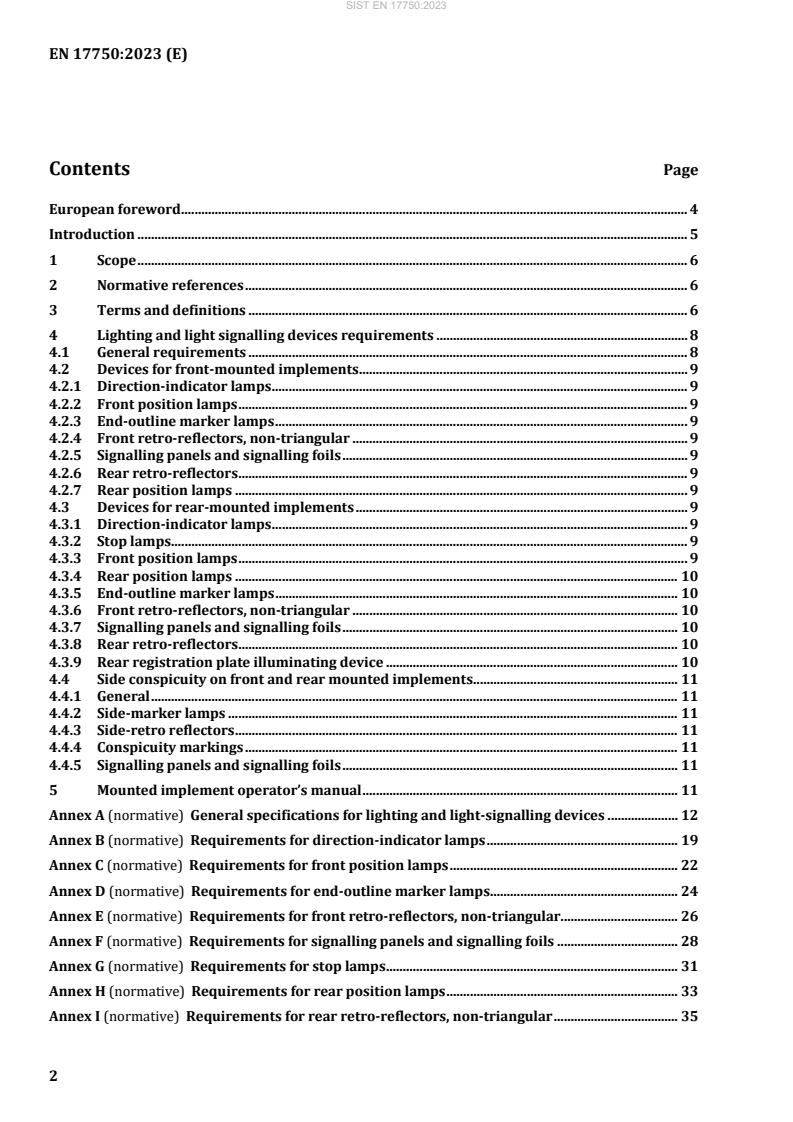
Contents Page
European foreword . 4
Introduction . 5
1 Scope . 6
2 Normative references . 6
3 Terms and definitions . 6
4 Lighting and light signalling devices requirements . 8
4.1 General requirements . 8
4.2 Devices for front-mounted implements . 9
4.2.1 Direction-indicator lamps . 9
4.2.2 Front position lamps . 9
4.2.3 End-outline marker lamps . 9
4.2.4 Front retro-reflectors, non-triangular . 9
4.2.5 Signalling panels and signalling foils . 9
4.2.6 Rear retro-reflectors . 9
4.2.7 Rear position lamps . 9
4.3 Devices for rear-mounted implements . 9
4.3.1 Direction-indicator lamps . 9
4.3.2 Stop lamps . 9
4.3.3 Front position lamps . 9
4.3.4 Rear position lamps . 10
4.3.5 End-outline marker lamps . 10
4.3.6 Front retro-reflectors, non-triangular . 10
4.3.7 Signalling panels and signalling foils . 10
4.3.8 Rear retro-reflectors . 10
4.3.9 Rear registration plate illuminating device . 10
4.4 Side conspicuity on front and rear mounted implements . 11
4.4.1 General . 11
4.4.2 Side-marker lamps . 11
4.4.3 Side-retro reflectors . 11
4.4.4 Conspicuity markings . 11
4.4.5 Signalling panels and signalling foils . 11
5 Mounted implement operator’s manual . 11
Annex A (normative) General specifications for lighting and light-signalling devices . 12
Annex B (normative) Requirements for direction-indicator lamps . 19
Annex C (normative) Requirements for front position lamps . 22
Annex D (normative) Requirements for end-outline marker lamps . 24
Annex E (normative) Requirements for front retro-reflectors, non-triangular. 26
Annex F (normative) Requirements for signalling panels and signalling foils . 28
Annex G (normative) Requirements for stop lamps . 31
Annex H (normative) Requirements for rear position lamps . 33
Annex I (normative) Requirements for rear retro-reflectors, non-triangular . 35
Annex J (normative) Requirements for rear retro-reflectors, triangular . 37
Annex K (normative) Requirements for rear registration plate illuminating device . 39
Annex L (normative) Requirements for side-marker lamps . 40
Annex M (normative) Requirements for side retro-reflectors, non-triangular . 42
Annex N (normative) Requirements for conspicuity markings . 44
Annex O (informative) A-deviations . 45
Bibliography . 47
European foreword
This document (EN 17750:2023) has been prepared by Technical Committee CEN/TC 144 “Tractors and
machinery for agriculture and forestry”, the secretariat of which is held by AFNOR.
This European Standard shall be given the status of a national standard, either by publication of an
identical text or by endorsement, at the latest by April 2024, and conflicting national standards shall be
withdrawn at the latest by April 2024.
Attention is drawn to the possibility that some of the elements of this document may be the subject of
patent rights. CEN shall not be held responsible for identifying any or all such patent rights.
Any feedback and questions on this document should be directed to the users’ national standards body.
A complete listing of these bodies can be found on the CEN website.
According to the CEN-CENELEC Internal Regulations, the national standards organisations of the
following countries are bound to implement this European Standard: Austria, Belgium, Bulgaria, Croatia,
Cyprus, Czech Republic, Denmark, Estonia, Finland, France, Germany, Greece, Hungary, Iceland, Ireland,
Italy, Latvia, Lithuania, Luxembourg, Malta, Netherlands, Norway, Poland, Portugal, Republic of North
Macedonia, Romania, Serbia, Slovakia, Slovenia, Spain, Sweden, Switzerland, Türkiye and the United
Kingdom.
Introduction
The visibility of agricultural vehicles is of great importance for road safety.
Lighting and light-signalling devices such as lights, light-signalling devices, reflectors, conspicuity
markings, signalling foils, etc. are used for this purpose. Their number and kind of installation to mounted
implements is usually regulated in the respective national road traffic regulations.
Whereas there is an EU type-approval procedure for agricultural tractors, trailers and towed
interchangeable equipment with corresponding harmonized requirements, there is no harmonized set of
regulations for mounted implements. Mounted implements are also not covered by the relevant
UN Regulation No 86 because they are not vehicles, systems, components and separate technical units
within the meaning of UN/WP.29 Resolution R.E.3.
The respective national regulations for the lighting and marking of mounted implements are very similar
within the EU Member States, but nevertheless differ slightly in detail.
For these reasons, this document is intended to provide a basis for a uniform approach to the installation
of lighting and light-signalling devices to mounted implements. It has been prepared on the basis of the
requirements of UN Regulation No 86, as these requirements cannot be applied directly to mounted
implements for formal reasons.
1 Scope
This document applies to front and rear-mounted implements on agricultural or forestry tractors, self-
propelled machines, trailers or on towed machinery.
This document specifies the requirements for lighting and light-signalling devices to be installed on the
implement for safe on-road use.
NOTE Mounted implements are considered to be interchangeable equipment and become part of the tractor,
self-propelled machine, trailer or towed machine to which they are attached.
This document describes the installation of lighting and light signalling devices on mounted implements
when the vehicle's lighting and signalling devices cannot comply with the applicable road regulation
requirements.
2 Normative references
The following documents are referred to in the text in such a way that some or all of their content
constitutes requirements of this document. For dated references, only the edition cited applies. For
undated references, the latest edition of the referenced document (including any amendments) applies.
ISO 1724:2003, Road vehicles — Connectors for the electrical connection of towing and towed vehicles —
7-pole connector type 12 N (normal) for vehicles with 12 V nominal supply voltage
ISO 1185:2003, Road vehicles — Connectors for the electrical connection of towing and towed vehicles —
7-pole connector type 24 N (normal) for vehicles with 24 V nominal supply voltage
3 Terms and definitions
For the purposes of this document, the following terms and definitions apply.
ISO and IEC maintain terminology databases for use in standardization at the following addresses:
— ISO Online browsing platform: available at https://www.iso.org/obp
— IEC Electropedia: available at https://www.electropedia.org
3.1
mounted implement
device or machine that performs a specific operation and which is normally attached to an agricultural
or forestry vehicle, and that is fully raised from the ground or that cannot articulate around a vertical axis
in relation to the vehicle
3.2
rear mounted implement
mounted implement attached to the rear of the vehicle
3.3
front mounted implement
mounted implement attached to the front of the vehicle
3.4
direction indicator
lamp used to indicate to other road-users that the driver intends to change direction to the right or to the
left
3.5
front position lamp
lamp used to indicate the presence and the width of the mounted implement when viewed from the front
3.6
end-outline marker lamp
lamp fitted near to the extreme outer edges and as close as possible to the top of the mounted implement
and intended to indicate clearly the vehicle's overall width
Note 1 to entry: For certain vehicles, this lamp is intended to complement the vehicle's position lamps and draw
special attention to its outline.
3.7
retro-reflector
device used to indicate the presence of a vehicle by reflection of light emanating from a light source
unconnected with the vehicle, the observer being situated near that source
3.8
signalling panel or signalling foil
device used to indicate to other road users the presence of a wide or long vehicle when viewed from the
front, rear or side
3.9
rear registration plate illuminating device
device for the illumination of rear registration plates by means of reflection
Note 1 to entry: The illuminating device is fitted in relation to the space to be occupied by the registration plate,
and the outlines of the area adequately illuminated.
3.10
stop lamp
lamp used to indicate to other road-users to the rear of the vehicle that the vehicle is decelerating
3.11
rear position lamp
lamp used to indicate the presence and the width of the vehicle when viewed from the rear
3.12
side-marker lamp
lamp used to indicate the presence of the vehicle when viewed from the side
3.13
lamp
device designed to illuminate the road or to emit a light signal
Note 1 to entry: Rear registration plate illuminating devices and retro-reflectors are likewise regarded as lamps.
3.14
independent lamp
device having separate apparent surface in the direction of the reference axis, separate light source, and
separate lamp body
3.15
grouped lamps
devices having separate lenses and separate light sources, but a common lamp body
3.16
combined lamps
devices having separate apparent surfaces in the direction of the reference axis, but a common light
source and a common lamp body
3.17
reciprocally incorporated lamp
device having separate light source or a single light source operating under different conditions (for
example, optical, mechanical, electrical differences), totally or partially common apparent surface in the
direction of the reference axis and a common lamp body
3.18
category
classification for lighting devices which have certain common features easy to identify in the traffic
stream
Note 1 to entry: Categories are stated in UN ECE R148, 3.2.4.
3.19
conspicuity marking
device intended to increase the conspicuity of a vehicle, when viewed from the front, side or rear, by the
reflection of light emanating from a light source not connected to the vehicle, the observer being situated
near the source
3.20
vehicle
tractor, self-propelled machine, trailer or towed machine or combination of those with implement(s)
4 Lighting and light signalling devices requirements
4.1 General requirements
4.1.1 When lighting and light signalling devices are installed on a mounted implement, they shall
comply with this document.
4.1.2 When light and light signalling devices are installed, the operator’s manual of the mounted
implement shall specify how to perform an assessment and how to equip and adjust the implement with
the lighting and light-signalling devices. See also Clause 5.
If the mounted implement is equipped with lighting and light-signalling devices, then the manufacturer
shall define a range of the height of the lower link attachment for road transport, at which the lighting
and light-signalling devices comply with this document. See also Clause 5.
4.1.3 The dimensional requirements shall be measured with the mounted implement adjusted at the
height position for road transport prescribed by the manufacturer in the operator’s manual of the
mounted implement (see Clause 5) and all components shall be in the position for road transport.
4.1.4 The appropriate general specifications of Annex A apply.
4.1.5 In order to facilitate the operations of working use, the lighting and light-signalling devices may
be pivotable or removable.
4.2 Devices for front-mounted implements
4.2.1 Direction-indicator lamps
Direction-indicator lamps shall comply with Annex B.
NOTE In the case of failure of any one of the direction-indicator lamps of mounted implements, it is not
necessary to indicate it by means of an operational tell-tale.
4.2.2 Front position lamps
Front position lamps shall comply with Annex C.
4.2.3 End-outline marker lamps
End-outline marker lamps shall comply with Annex D.
4.2.4 Front retro-reflectors, non-triangular
Non-triangular front retro-reflectors shall comply with Annex E.
The presence of front retro-reflectors is optional when signalling panels or signalling foils are provided
to indicate the presence of the implement when circulating on public road, if:
— they are installed according to 4.2.5, and
— they are positioned at minimum height lower edge 300 mm and maximum height upper edge
1 500 mm.
4.2.5 Signalling panels and signalling foils
Signalling panels and signalling foils shall comply with Annex F.
4.2.6 Rear retro-reflectors
If any, rear retro-reflectors shall comply with 4.3.8.
4.2.7 Rear position lamps
Rear position lamps shall comply with Annex H.
4.3 Devices for rear-mounted implements
4.3.1 Direction-indicator lamps
Direction-indicator lamps shall comply with Annex B.
NOTE In the case of failure of any one of the direction-indicator lamps of mounted implements, it is not
necessary to indicate it by means of an operational tell-tale.
4.3.2 Stop lamps
Stop lamps shall comply with Annex G.
4.3.3 Front position lamps
Front position lamps shall comply with Annex C.
4.3.4 Rear position lamps
Rear position lamps shall comply with Annex H.
4.3.5 End-outline marker lamps
End-outline marker lamps shall comply with Annex D.
4.3.6 Front retro-reflectors, non-triangular
Non-triangular front retro-reflectors shall comply with Annex E, except of the position in length as
specified in E.4.3.
The presence of front retro-reflectors is optional when signalling panels or signalling foils are provided
to indicate the presence of the implement when circulating on public road, if:
— they are installed according to 4.3.7, and
— they are positioned at minimum height lower edge 300 mm and maximum height upper edge
1 500 mm.
4.3.7 Signalling panels and signalling foils
Signalling panels and signalling foils shall comply with Annex F.
4.3.8 Rear retro-reflectors
4.3.8.1 General
The presence of rear retro-reflectors is optional when signalling panels or signalling foils are provided to
indicate the presence of the implement when circulating on public road, if:
— they are installed according to 4.3.7, and
— they are positioned at minimum height lower edge 300 mm and maximum height upper edge
1 500 mm.
When triangular or non-triangular rear retro-reflectors are installed, they shall comply with 4.3.8.2 or
4.3.8.3 respectively.
4.3.8.2 Non-triangular
Non-triangular rear retro-reflectors shall comply with Annex I. Non-triangular rear retro-reflectors are
accepted on all mounted implements, even when they are designed for installation onto a trailer or towed
machine. Non-triangular rear retro-reflectors are not required if triangular rear retro-reflectors (4.3.8.3)
are present.
4.3.8.3 Triangular
Triangular rear retro-reflectors shall comply with Annex J. Triangular rear retro-reflectors are accepted
on all mounted implements, even when they are designed for installation onto a tractor. Triangular rear
retro-reflectors are not required if non-triangular rear retro-reflectors (4.3.8.2) are present.
4.3.9 Rear registration plate illuminating device
If any, illuminating device shall comply with Annex K.
4.4 Side conspicuity on front and rear mounted implements
4.4.1 General
At least one of the devices specified in 4.4.2 to 4.4.5 or a combination thereof shall be installed at the sides
of the implement.
4.4.2 Side-marker lamps
Side-marker lamps shall comply with Annex L.
4.4.3 Side-retro reflectors
Side-retro reflectors shall comply with Annex M.
4.4.4 Conspicuity markings
Conspicuity markings shall comply with Annex N.
4.4.5 Signalling panels and signalling foils
Signalling panels and signalling foils shall comply with Annex F.
5 Mounted implement operator’s manual
The mounted implement operator’s manual shall contain the following information:
a) recommendation for the position (i.e. minimum and maximum heights of the lower link attachment)
at which the mounted implement shall be set for circulation on public roads (see also 4.1.2);
b) recommendation that the user assesses if lighting and light-signalling devices should be installed;
c) information on how to perform an assessment and what are the requirements (see also 4.1.2).
Annex A
(normative)
General specifications for lighting and light-signalling devices
NOTE The source of the following requirements is UN Regulation No 86, Clause 5.
A.1 The lighting and light-signalling devices shall be so fitted that under normal conditions of use, and
notwithstanding any vibration to which they may be subjected, they retain the characteristics laid down
in this document and enable the installation of lighting and light-signalling devices on the mounted
implement to comply with the requirements of this document. In particular, it shall not be possible for
the adjustment of the lamps to be inadvertently disturbed.
A.1.1 Mounted implements shall be fitted with a permanently connected socket outlet compatible with
the one of the vehicle as specified in ISO 1724:2003 or ISO 1185:2003 when it has a connection for
attaching trailed implements or mounted machines.
A.2 For all light-signalling devices, the reference axis of the lamp when fitted to the implement shall be
parallel with the bearing plane of the implement on the road; in addition it shall be perpendicular to the
median longitudinal plane of the implement in the case of side retro-reflectors and of side-marker lamps
and parallel to that plane in the case of all other signalling devices. In each direction a tolerance of ±3°
shall be allowed. In addition, any specific instructions as regards fitting laid down by the manufacturer
shall be complied with.
A.3 In the absence of specific instructions, the height and orientation of the lamps shall be verified with
the vehicle unladen and placed on a flat horizontal surface.
A.4 In the absence of specific instructions, lamps constituting a pair shall:
A.4.1 Be mounted symmetrically in relation to the median longitudinal plane;
A.4.2 Be symmetrical to one another in relation to the median longitudinal plane;
A.4.3 Satisfy the same colorimetric requirements; and
A.4.4 Have substantially identical photometric characteristics.
A.5 On implements whose external shape is asymmetrical, the requirements of A.4.1 and A.4.2 shall be
satisfied as far as possible. These requirements shall be regarded as having been met if the distance of
the two lamps from the median longitudinal plane and from the bearing plane on the ground is the same.
A.6 Grouped, combined or reciprocally incorporated lamps
A.6.1 Lamps may be grouped, combined or reciprocally incorporated with one another provided that
all requirements regarding colour, position, orientation, geometric visibility, electrical connections and
other requirements, if any, are fulfilled.
A.6.1.1 The photometric and colourimetric requirements of a lamp shall be fulfilled when all other
functions with which this lamp is grouped, combined or reciprocally incorporated are switched OFF.
However, when a front or rear position lamp is reciprocally incorporated with one or more other
function(s) which can be activated together with them, the requirements regarding colour of each of these
other functions shall be fulfilled when the reciprocally incorporated function(s) and the front or rear
position lamps are switched ON.
A.6.1.2 Stop lamps and direction-indicator lamps are not permitted to be reciprocally incorporated.
A.6.1.3 Where stop lamps and direction-indicator lamps are grouped, the following conditions shall
be met:
A.6.1.3.1 Any horizontal or vertical straight line passing through the projections of the apparent
surfaces of these functions on a plane perpendicular to the reference axis, shall not intersect more than
two borderlines separating adjacent areas of different colour;
A.6.1.3.2 Their apparent surfaces in the direction of the reference axis, based upon the areas bounded
by the outline of their light-emitting surfaces, do not overlap.
A.6.2 Where the apparent surface of a single lamp is composed of two or more distinct parts, it shall
satisfy the following requirements:
A.6.2.1 Either the total area of the projection of the distinct parts on a plane tangent to the exterior
surface of the outer lens and perpendicular to the reference axis shall occupy not less than 60 per cent of
the smallest quadrilateral circumscribing the said projection, or the distance between two
adjacent/tangential distinct parts shall not exceed 15 mm when measured perpendicularly to the
reference axis. This requirement shall not apply to a retro-reflector;
A.6.2.2 Or, in the case of interdependent lamps, the distance between adjacent apparent surfaces in
the direction of the reference axis does not exceed 75 mm when measured perpendicularly to the
reference axis.
A.7 The maximum height above the ground shall be measured from the highest point and the minimum
height from the lowest point of the apparent surface in the direction of the reference axis.
Where the (maximum and minimum) height above the ground clearly meets the requirements of this
annex, the exact edges of any surface need not be determined.
A.7.1 For the purposes of reducing the geometric visibility angles, the position of a lamp with regard to
height above the ground, shall be measured from the H plane.
A.7.2 In the case of dipped-beam headlamp, the minimum height in relation to the ground is measured
from the lowest point of the effective outlet of the optical system (e.g. reflector, lens, projection lens)
independent of its utilization.
A.7.3 The position, as regards width, shall be determined from that edge of the apparent surface in the
direction of the reference axis which is the furthest from the median longitudinal plane of the vehicle
when referred to the overall width, and from the inner edges of the apparent surface in the direction of
the reference axis when referred to the distance between lamps.
Where the position, as regards width, clearly meets the requirements of this annex, the exact edges of any
surface need not be determined.
A.8 In the absence of specific instructions, the photometric characteristics (e.g. intensity, colour,
apparent surface, etc.) of a lamp shall not be intentionally varied during the period of activation of the
lamp.
A.8.1 Direction-indicator lamps shall be flashing lamps. Amber side-marker lamps may be flashing
lamps.
A.8.2 The photometric characteristics of any lamp may vary:
a) in relation to the ambient light;
b) as a consequence of the activation of other lamps; or
c) when the lamp is being used to provide another lighting function;
provided that any variation in the photometric characteristics is in compliance with the technical
provisions for the lamp concerned.
A.9 No red light which could give rise to confusion shall be emitted from a lamp as defined in paragraph
3.13 in a forward direction and no white light which could give rise to confusion, shall be emitted from a
lamp as defined in paragraph 3.13 in a rearward direction. No account shall be taken of lighting devices
fitted for the interior lighting of the vehicle. In case of doubt, this requirement shall be verified as follows:
A.9.1 For the visibility of red light towards the front of an implement, with the exception of a red
rearmost side-marker lamp, there shall be no direct visibility of the apparent surface of a red lamp if
viewed by an observer moving within Zone 1 as specified in Figure A.1;
Key
A zone 1
Figure A.1 — Visibility of a red lamp to the front
A.9.2 For the visibility of white light towards the rear, with the exception of reversing lamps and white
side conspicuity markings fitted to the implement, there shall be no direct visibility of the apparent
surface of a white lamp if viewed by an observer moving within Zone 2 as specified in Figure A.2;
Key
A zone 2
Figure A.2 — Visibility of a white lamp to the rear
A.9.3 In their respective planes, the zones 1 and 2 explored by the eye of the observer are bounded:
A.9.3.1 In height, by two horizontal planes 1 m and 2,2 m respectively above the ground;
A.9.3.2 In width, by two vertical planes which, forming to the front and to the rear respectively an
angle of 15° outwards from the implement's median longitudinal plane, pass through the point or points
of contact of vertical planes parallel to the implement's median longitudinal plane delimiting the vehicle's
overall width; if there are several points of contact, the foremost shall correspond to the forward plane
and the rearmost to the rearward plane.
A.10 The electrical connections shall be such that the front and rear position lamps, the end-outline
marker lamps, if they exist, the side-marker lamps, if they exist, and the rear registration plate
illuminating device can only be switched ON and OFF simultaneously.
This condition does not apply:
A.10.1 When front and rear position lamps are switched ON, as well as side-marker lamps when
combined or reciprocally incorporated with said lamps, as parking lamps;
A.10.2 To front position lamps when their function is substituted under the provisions of A.11.1.
A.11 The electrical connections shall be such that the main-beam and dipped-beam headlamps and the
front fog lamps cannot be switched on unless the lamps referred to in A.10 are also switched on. This
requirement shall not apply, however, to main-beam or dipped-beam headlamps when their luminous
warnings consist of the intermittent lighting up at short intervals of the main-beam headlamp or the
intermittent lighting up at short intervals of the dipped-beam headlamp or the alternate lighting up at
short intervals of the main-beam and dipped-beam headlamps.
A.11.1 The dipped-beam headlamps and/or the main-beam headlamps and/or the front fog lamps may
substitute the function of the front position lamps, provided that:
A.11.1.1 Their electrical connections are such that in case of failure of any of these lighting devices the
front position lamps are automatically re-activated; and
A.11.1.2 The substituting lamp/function meets, for the respective position lamp, the requirements
concerning C.1 to C.6; and
A.11.1.3 Appropriate evidence demonstrating compliance with the requirements indicated in
paragraph A.11.1.2 above is provided in the test reports of the substituting lamp.
A.12 The function of the circuit-closed tell-tales may be fulfilled by operating telltales.
1)
A.13 The colours of the light emitted by the lamps are the following:
— Direction-indicator lamp: Amber
— Stop lamp: Red
— Rear registration plate illuminating device: White
— Front position lamp: White
— Rear position lamp: Red
— Side-marker lamp: Amber; however the rearmost side-marker lamp can be red if it is grouped or
combined or reciprocally incorporated with the rear position lamp, the rear end-outline marker
lamp, the rear fog lamp, the stop lamp or is grouped or has part of the light-emitting surface in
common with the rear retro-reflector.
— End-outline marker lamp: White in front, red at the rear.
— Rear retro-reflector, triangular: Red
— Rear retro-reflector, non-triangular: Red
— Front retro-reflector, non-triangular: White or colourless
— Side retro-reflector, non-triangular: Amber; however the rearmost side retroreflector can be red if it
is grouped or has part of the light-emitting surface in common with the rear position lamp, the rear
end outline marker lamp, the rear fog lamp, the stop-lamp, the red rearmost side-marker lamp or the
rear retro-reflector, non-triangular.
1)
Measurement of the chromaticity coordinates of the light emitted by the lamps is not part of this document.
— Conspicuity marking: White or yellow to the side; Red or yellow to the rear.
— Signalling panel or signalling foil: White and red
A.14 Concealable lamps
A.14.1 The concealment of lamps shall be prohibited.
A.14.2 An illuminating device in the position of use shall remain in that position if the malfunction
referred to in A.14.2.1 occurs alone or in conjunction with one of the malfunctions described in A.14.2.2.
A.14.2.1 The absence of power for manipulating the lamp;
A.14.2.2 A break, impedance, or short-circuit to earth in the electrical circuit, defects in the hydraulic
or pneumatic leads, bowden cables, solenoids or other components controlling or transmitting the energy
intended to activate the concealment device.
A.14.3 In the event of any failure affecting the operation of the concealment device(s) the lamps shall
remain in the position of use, if already in use, or shall be capable of being moved into the position of use
without the aid of tools.
A.14.4 Illuminating devices which are manipulated by power shall be brought into the position of use
and switched on by means of a single control, without excluding the possibility of moving them into the
position of use without switching them on. However, in the case of grouped- main-beam headlamps and
dipped-beam headlamps, the control referred to above is required only to activate the dipped-beam
headlamps.
A.14.5 It shall not be possible deliberately, from the driver's seat, to stop the movement of switched-on
headlamps before they reach the position of use. If there is a danger of dazzling other road users by the
movement of headlamps, they may light up only when they have reached their final position.
A.14.6 At temperatures of −30 °C to +50 °C an illuminating device which is manipulated by power shall
be capable of reaching the position of use within three seconds of initial operation of the control.
A.15 Lamps of variable position
A.15.1 The position of all lamps may be varied except at least one pair of rear reflectors provided that:
A.15.1.1 These lamps remain attached to the implement when their position is altered;
A.15.1.2 These lamps shall be capable of being locked in the position required by traffic conditions.
Locking shall be automatic;
A.15.1.3 Notwithstanding A.15.1 above, main-beam headlamps and dippedbeam headlamps may be
installed on the movable engine hood.
A.16 General provisions relating to geometric visibility
A.16.1 There shall be no obstacle on the inside of the angles of geometric visibility to the propagation of
light from any part of the apparent surface of the lamp observed from infinity. However, no account is
taken of obstacles, if they were already presented when the lamp was type-approved.
A.16.2 If measurements are taken closer to the lamp, the direction of observation shall be shifted parallel
to achieve the same accuracy.
A.16.3 If, when the lamp is installed, any part of the apparent surface of the lamp is hidden by any further
parts of the implement, proof shall be furnished that the part of the lamp not hidden by obstacles still
conforms to the photometric values prescribed for the approval of the device.
A.17 Number of lamps
The number of lamps mounted on the implement shall be equal to the number indicated in the individual
specifications of this document.
A.18 With the exception of retro-reflectors, a lamp even bearing an approval mark is deemed not to be
present when it cannot be made to operate by the sole installation of a light source and/or a fuse.
Annex B
(normative)
Requirements for direction-indicator lamps
NOTE The source of the following requirements is UN Regulation No 86, 6.5.
B.1 Presence
Mandatory if the implement obstructs the direction-indicator lamps of the vehicle. Types of indicators
fall into categories (1, 1a, 1b, 2a).
Table B.1 — List of symbols for direction-indicator lamps
Direction-indicator lamp Symbol
Front direction indicator lamp to be installed at a 1a
distance of at least 20mm from passing beam
headlamp or front fog lamp
Front direction indicator lamp to be installed at any 1b
distance from passing beam headlamp or front fog
lamp
Front direction indicator lamp to be installed at a 1
distance of at least 40 mm from passing beam
headlamp or front fog lamp
Rear direction indicator lamp (steady) 2a
Rear direction indicator lamp (variable) 2b
B.2 Number
The number of devices shall be such that they can emit signals which correspond to one of the
arrangements referred to in B.3.
Additional direction-indicator lamps optional.
B.3 Arrangement
B.3.1 The number, position and horizontal visibility of the indicator lamps shall be such that they can
give indications corresponding to the arrangements specified in B.5.
B.3.2 For front mounted implements: Two front direction-indicator lamps (category 1, 1a or 1b).
These lamps may be independent, grouped or combined.
B.3.3 For rear mounted implements: Two rear direction-indicator lamps (category 2a) with angles of
geometric visibility as specified in B.5.
B.4 Position
B.4.1 Width
The edge of the illuminating surface furthest from the median longitudinal plane of the implement shall
not be more than 400 mm from the extreme outer edge of the implement. The distance between the inner
edges of the two illuminating surfaces of a pair of lamps shall be not less than 500 mm.
Where the vertical distance between the rear direction-indicator lamp and the corresponding rear
position lamp is not more than 300 mm, the distance between the extreme outer edge of the implement
and the outer edge of the rear direction-indicator lamp shall not exceed by more than 50 mm the distance
between the extreme outer edge of the implement and the outer edge of the corresponding rear position
lamp.
For front direction-indicator lamps the illuminating surface should be not less than 40 mm from the
illuminating surface of the dipped-beam headlamps or front fog-lamps, if any.
A smaller distance is permitted if the luminous intensity in the reference axis of the direction-indicator
lamp is equal to at least 400 cd.
B.4.2 Height
Above the ground not less than 400 mm and not more than 2 500 mm and within a maximum height of
4 000 mm for optional direction-indicator lamps.
For implements with a maximum width not exceeding 1 300 mm not less than 350 mm above the ground.
B.4.3 Length
The distance between the centre of reference of illuminating surface of the category 1 indicator and the
transverse plane which marks the forward boundary of the tractor's overall length normally shall not
exceed 1 800 mm. If the structure of the tractor makes it impossible to keep to the minimum angles of
visibility, this distance may be increased to 2 600 mm.
B.5 Geometric visibility
The angles described are minimum values which may be exceeded; all the angles of visibility are
measured from the centre of the illuminating surface.
Horizontal angles: For all the arrangements the angle of visibility shall be:
— inward direction:
— front direction indicators: 10°. This value may be reduced to 3° for vehicles with an overall width
not exceeding 1 400 mm;
— rear direction indicators: 45°. This value may be reduced to 30° if the shape of the bodywork
makes it impossible to reach it.
— outward direction: 80°.
Vertical angles: 15° above and below the horizontal.
B.6 Orientation
If individual specifications for installations are
...