

EN 993-10:2020
(Main)Methods of test for dense shaped refractory products - Part 10: Determination of permanent change in dimensions on heating
General Information
- Abstract
This document specifies three methods for the determination of the permanent change in dimensions on heating of dense shaped refractory products.
NOTE The methods can be applied to materials sensitive to oxidation. However, some of these materials can be affected during the test in such a way as to make the measurement of the dimensional changes impossible to carry out to the required accuracy.
- Status
- Published
- Publication Date
- 06-Oct-2020
- Withdrawal Date
- 29-Apr-2021
- Technical Committee
- CEN/TC 187 - Refractory products and materials
- Drafting Committee
- CEN/TC 187/WG 1 - Dense shaped refractory products
- Current Stage
- 9060 - Closure of 2 Year Review Enquiry - Review Enquiry
- Start Date
- 04-Jun-2026
- Completion Date
- 04-Jun-2026



Overview
EN 993-10:2020 - Methods of test for dense shaped refractory products: Part 10 specifies procedures to determine the permanent change in dimensions on heating (linear or volumetric) of dense shaped refractory products. Published by CEN, the standard defines test-piece preparation, measuring devices, furnace and temperature controls, and three accepted measurement methods to assess dimensional stability after heating and cooling.
Key topics and technical requirements
- Scope: Applies to dense shaped refractory products (true porosity < 45 %) and provides three methods for measuring permanent dimensional change on heating; includes a note on oxidation-sensitive materials that may be altered during test.
- Test principle: Dry → measure → heat in an oxidizing atmosphere → cool → re-measure; calculate permanent change (∆L or ∆V).
- Test pieces: Cylinders (50 mm dia × 60 mm) or rectangular prisms (50 × 50 × 60 mm); tolerances ±2 mm; only one test piece near geometric centre per item; sample size and acceptance per ISO 5022.
- Measurement methods:
- Method 1: Dial gauge apparatus (accuracy 0.01 mm) with dedicated carrier for repeatable measuring points.
- Method 2: Vernier callipers (ISO 13385-1) with minimum accuracy ±0.02 mm.
- Method 3: Volume change by water displacement following EN 993-1.
- Apparatus & controls: Furnace capable of maintaining a continuously oxidizing atmosphere; minimum three thermocouples for temperature distribution; temperature/time recorder (temperature accuracy ±5 °C); drying chamber at (110 ± 5) °C.
- Procedure controls: Specified heating rate, maintenance of test temperature and soaking time, sampling of furnace atmosphere, and detailed post-test measurement protocols.
- Quality & precision: Clause 10 includes precision (repeatability/reproducibility) data from an interlaboratory study.
Applications and practical value
- Ensures consistent, reproducible assessment of thermal dimensional stability and shrinkage/ expansion of refractory bricks and shapes used in high-temperature linings.
- Useful for quality control, acceptance testing, material development, performance comparison, and supplier qualification.
- Helps predict in-service behaviour of refractories in furnaces, kilns, incinerators, steel and non-ferrous metallurgical applications where dimensional changes can affect lining integrity.
Who should use this standard
- Refractory manufacturers and production engineers
- Independent testing laboratories and quality assurance teams
- Materials scientists and R&D groups working on refractory formulations
- Specifiers, purchasers, and end-users of refractory linings and shaped products
Related standards
- EN 993-1 (bulk density, apparent/true porosity)
- ISO 13385-1 (design and metrological characteristics of callipers)
- ISO 5022 (sampling and acceptance testing)
Keywords: EN 993-10, permanent change in dimensions on heating, dense shaped refractory products, refractory testing, dimensional change, dial gauge, Vernier callipers, volume measurement, oxidizing atmosphere, CEN.
Relations
- Effective Date
- 29-May-2019
- Effective Date
- 28-Jan-2026
- Effective Date
- 28-Jan-2026
Frequently Asked Questions
EN 993-10:2020 is a standard published by the European Committee for Standardization (CEN). Its full title is "Methods of test for dense shaped refractory products - Part 10: Determination of permanent change in dimensions on heating". This standard covers: This document specifies three methods for the determination of the permanent change in dimensions on heating of dense shaped refractory products. NOTE The methods can be applied to materials sensitive to oxidation. However, some of these materials can be affected during the test in such a way as to make the measurement of the dimensional changes impossible to carry out to the required accuracy.
This document specifies three methods for the determination of the permanent change in dimensions on heating of dense shaped refractory products. NOTE The methods can be applied to materials sensitive to oxidation. However, some of these materials can be affected during the test in such a way as to make the measurement of the dimensional changes impossible to carry out to the required accuracy.
EN 993-10:2020 is classified under the following ICS (International Classification for Standards) categories: 81.080 - Refractories. The ICS classification helps identify the subject area and facilitates finding related standards.
EN 993-10:2020 has the following relationships with other standards: It is inter standard links to EN 993-10:1997, EN 16510-2-5:2025, EN ISO 22052:2020. Understanding these relationships helps ensure you are using the most current and applicable version of the standard.
EN 993-10:2020 is available in PDF format for immediate download after purchase. The document can be added to your cart and obtained through the secure checkout process. Digital delivery ensures instant access to the complete standard document.
Standards Content (Sample)
SLOVENSKI STANDARD
01-december-2020
Nadomešča:
SIST EN 993-10:1998
Metode za preskušanje gostih oblikovanih ognjevzdržnih izdelkov - 10. del:
Ugotavljanje trajnih sprememb mer pri segrevanju
Methods of test for dense shaped refractory products - Part 10: Determination of
permanent change in dimensions on heating
Prüfverfahren für dichte geformte feuerfeste Erzeugnisse - Teil 10: Bestimmung der
bleibenden Längenänderung nach Temperatureinwirkung
Méthodes d'essai pour produits réfractaires façonnés denses - Partie 10: Détermination
de la variation permanente de dimensions sous l'action de la chaleur
Ta slovenski standard je istoveten z: EN 993-10:2020
ICS:
81.080 Ognjevzdržni materiali Refractories
2003-01.Slovenski inštitut za standardizacijo. Razmnoževanje celote ali delov tega standarda ni dovoljeno.
EN 993-10
EUROPEAN STANDARD
NORME EUROPÉENNE
October 2020
EUROPÄISCHE NORM
ICS 81.080 Supersedes EN 993-10:1997
English Version
Methods of test for dense shaped refractory products -
Part 10: Determination of permanent change in
dimensions on heating
Méthodes d'essai pour produits réfractaires façonnés Prüfverfahren für dichte geformte feuerfeste
denses - Partie 10: Détermination de la variation Erzeugnisse - Teil 10: Bestimmung der bleibenden
permanente de dimensions sous l'action de la chaleur Längenänderung nach Temperatureinwirkung
This European Standard was approved by CEN on 1 September 2020.
CEN members are bound to comply with the CEN/CENELEC Internal Regulations which stipulate the conditions for giving this
European Standard the status of a national standard without any alteration. Up-to-date lists and bibliographical references
concerning such national standards may be obtained on application to the CEN-CENELEC Management Centre or to any CEN
member.
This European Standard exists in three official versions (English, French, German). A version in any other language made by
translation under the responsibility of a CEN member into its own language and notified to the CEN-CENELEC Management
Centre has the same status as the official versions.
CEN members are the national standards bodies of Austria, Belgium, Bulgaria, Croatia, Cyprus, Czech Republic, Denmark, Estonia,
Finland, France, Germany, Greece, Hungary, Iceland, Ireland, Italy, Latvia, Lithuania, Luxembourg, Malta, Netherlands, Norway,
Poland, Portugal, Republic of North Macedonia, Romania, Serbia, Slovakia, Slovenia, Spain, Sweden, Switzerland, Turkey and
United Kingdom.
EUROPEAN COMMITTEE FOR STANDARDIZATION
COMITÉ EUROPÉEN DE NORMALISATION
EUROPÄISCHES KOMITEE FÜR NORMUNG
CEN-CENELEC Management Centre: Rue de la Science 23, B-1040 Brussels
© 2020 CEN All rights of exploitation in any form and by any means reserved Ref. No. EN 993-10:2020 E
worldwide for CEN national Members.
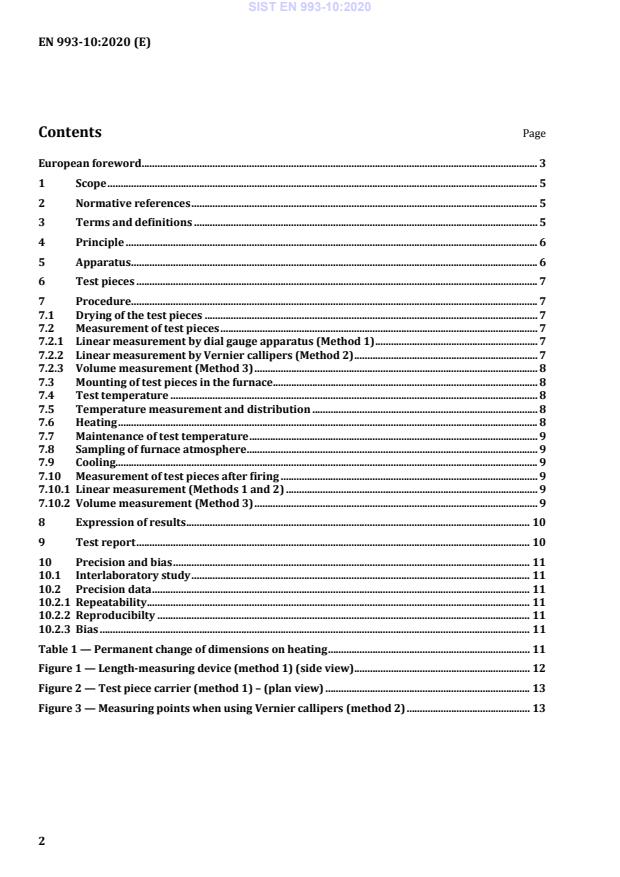
Contents Page
European foreword . 3
1 Scope . 5
2 Normative references . 5
3 Terms and definitions . 5
4 Principle . 6
5 Apparatus . 6
6 Test pieces . 7
7 Procedure. 7
7.1 Drying of the test pieces . 7
7.2 Measurement of test pieces . 7
7.2.1 Linear measurement by dial gauge apparatus (Method 1) . 7
7.2.2 Linear measurement by Vernier callipers (Method 2) . 7
7.2.3 Volume measurement (Method 3) . 8
7.3 Mounting of test pieces in the furnace . 8
7.4 Test temperature . 8
7.5 Temperature measurement and distribution . 8
7.6 Heating . 8
7.7 Maintenance of test temperature . 9
7.8 Sampling of furnace atmosphere . 9
7.9 Cooling. 9
7.10 Measurement of test pieces after firing . 9
7.10.1 Linear measurement (Methods 1 and 2) . 9
7.10.2 Volume measurement (Method 3) . 9
8 Expression of results . 10
9 Test report . 10
10 Precision and bias . 11
10.1 Interlaboratory study . 11
10.2 Precision data . 11
10.2.1 Repeatability . 11
10.2.2 Reproducibilty . 11
10.2.3 Bias . 11
Table 1 — Permanent change of dimensions on heating . 11
Figure 1 — Length-measuring device (method 1) (side view) . 12
Figure 2 — Test piece carrier (method 1) – (plan view) . 13
Figure 3 — Measuring points when using Vernier callipers (method 2) . 13
European foreword
This document (EN 993-10:2020) has been prepared by Technical Committee CEN/TC 187 “Refractory
products and materials”, the secretariat of which is held by BSI.
This European Standard shall be given the status of a national standard, either by publication of an
identical text or by endorsement, at the latest by April 2021, and conflicting national standards shall be
withdrawn at the latest by April 2021.
Attention is drawn to the possibility that some of the elements of this document may be the subject of
patent rights. CEN shall not be held responsible for identifying any or all such patent rights.
This document supersedes EN 993-10:1997.
The main change from the previous edition is the addition of precision data in clause 10 derived from a
large scale interlaboratory study completed by 10 European laboratories.
Reproducibility and repeatability data are available only for a limited number of testing methods and
materials, but may be complemented in subsequent editions.
The series of standards EN 993 'Methods of test for dense shaped refractory products' consists of 20
parts, some of which have been withdrawn and replaced by equivalent standards:
— Part 1: Determination of bulk density and porosity
— Part 2: Determination of true density
— Part 3: Test methods for carbon-containing refractories
— Part 4: Determination of permeability to gases
— Part 5: Determination of cold crushing strength
— Part 6: Determination of modulus rupture, ambient temperatures
— Part 7: Determination of modulus of rupture, elevated temperatures
— Part 8: Determination of refractoriness-under-load – withdrawn – replaced by EN ISO 1893
— Part 9: Determination of creep in compression
— Part 10: Determination of permanent change in dimensions on heating
— Part 11: Determination of resistance to thermal shock (ENV)
— Part 12: Determination of pyrometric cone equivalent
— Part 13: Specification for pyrometric cones
— Part 14: Determination of thermal conductivity (hot wire, cross-array) – withdrawn – replaced by
EN ISO 8894-1
— Part 15: Determination of thermal conductivity (hot wire, parallel)
— Part 16: Determination of resistance to acids
— Part 17: Determination of bulk density of granular material (mercury method)
— Part 18: Determination of bulk density of granular material (water method)
— Part 19: Determination of thermal expansion by a differential method
— Part 20: Determination of resistance to abrasion at ambient temperature – withdrawn – replaced by
EN ISO 16282
According to the CEN-CENELEC Internal Regulations, the national standards organisations of the
following countries are bound to implement this European Standard: Austria, Belgium, Bulgaria, Croatia,
Cyprus, Czech Republic, Denmark, Estonia, Finland, France, Germany, Greece, Hungary, Iceland, Ireland,
Italy, Latvia, Lithuania, Luxembourg, Malta, Netherlands, Norway, Poland, Portugal, Republic of North
Macedonia, Romania, Serbia, Slovakia, Slovenia, Spain, Sweden, Switzerland, Turkey and the United
Kingdom.
1 Scope
This document specifies three methods for the determination of the permanent change in dimensions on
heating of dense shaped refractory products.
NOTE The methods can be applied to materials sensitive to oxidation. However, some of these materials can
be affected during the test in such a way as to make the measurement of the dimensional changes impossible to
carry out to the required accuracy.
2 Normative references
The following documents are referred to in the text in such a way that some or all of their content
constitutes requirements of this document. For dated references, only the edition cited applies. For
undated references, the latest edition of the referenced document (including any amendments) applies.
EN 993-1, Methods of test for dense shaped refractory products - Part 1: Determination of bulk density,
apparent porosity and true porosity
ISO 13385-1, Geometrical product specifications (GPS) — Dimensional measuring equipment — Part 1:
Design and metrological characteristics of callipers
ISO 5022, Shaped refractory products — Sampling and acceptance testing
3 Terms and definitions
For the purposes of this document, the following terms and definitions apply.
ISO and IEC maintain terminological databases for use in standardization at the following addresses:
— ISO Online browsing platform: available at https://www.iso.org/obp
— IEC Electropedia: available at https://www.electropedia.org/
3.1
permanent change in dimensions on heating
expansion or contraction that remains in a shaped refractory product that is heated to a specified
temperature for a specified time and then cooled to ambient temperature
Note 1 to entry: Change is either on the basis of length (∆L) or volume (∆V).
[SOURCE: ISO 2477:2005, 3.1]
3.2
dense shaped refractory product
product with specific dimensions, having a true porosity of less than 45 % by volume, when measured in
accordance with EN 993-1
3.3
sample
representative collection of items that can be obtained by sampling in accordance with ISO 5022
3.4
item
refractory brick or shape
3.5
test piece
piece of material extracted from an item (3.4) and suitably shaped and prepared for the test
4 Principle
Test pieces in the shape of rectangular prisms or cylinders are cut from each item, then dried, and their
linear dimensions (Methods 1 and 2) or volume (Method 3) measured. The test pieces are heated in a
furnace having an oxidizing atmosphere, at a prescribed rate, to a specified temperature, which is
maintained for a specified time. After cooling to ambient temperature, the measurements on the test
pieces are repeated, and the permanent change in dimensions or volume is calculated.
5 Apparatus
5.1 Furnace, either electric or gas-fi
...