

EN 81-44:2024
(Main)Safety rules for the construction and installation of lifts - Special lifts for the transport of persons and goods - Part 44: Lifting appliances in wind turbines
- Abstract
1.1 This document specifies the safety requirements for the construction and installation of power operated lifting appliances installed permanently for indoor or outdoor service in wind turbines and intended for access to workplaces on wind turbines, including rescue and evacuation procedures. A lifting appliance serves defined landing levels and can move persons to working positions where they are carrying out work (which could be from the carrier) and has a carrier which is:
a) designed for the transportation of persons and goods;
b) guided;
c) travelling vertically or along a path within 15° maximum from the vertical;
d) supported or sustained by rack and pinion or rope traction drive;
e) travelling with a speed not more than 0,7 m/s;
f) able to operate in a temperature range between - 25 °C to + 55 °C.
1.2 This document does not cover hazards related to:
a) noise;
b) the use of the lifting appliance for erection or dismantling of the wind turbine;
c) lightning protection;
d) use in potentially explosive atmospheres;
e) electromagnetic compatibility (emission, immunity);
f) transporting of goods outside the carrier;
g) the use of combustion engines;
h) hydraulic and pneumatic drive units;
i) the use of lifting appliances in floating wind turbines;
j) use during earthquakes.
1.3 This document is not applicable to lifting appliances manufactured before the date of its publication.
- Status
- Published
- Publication Date
- 30-Jul-2024
- Technical Committee
- CEN/TC 10 - Passenger, goods and service lifts
- Drafting Committee
- CEN/TC 10/WG 11 - Lifting appliances for wind turbines
- Current Stage
- 6060 - Definitive text made available (DAV) - Publishing
- Start Date
- 31-Jul-2024
- Due Date
- 17-Jul-2021
- Completion Date
- 31-Jul-2024
- Directive
- 2006/42/EC - Directive 2006/42/EC of the European Parliament and of the Council of 17 May 2006 on machinery, and amending Directive 95/16/EC (recast)OJ Ref: 2025/1740, OJ L, OJ L, 2025/1740 OJ Date: 14-Aug-2025

Overview
EN 81-44:2024 (identical to EN 81-44:2024) specifies safety rules for the construction and permanent installation of power‑operated lifting appliances in wind turbines. It covers lifts intended to provide access to workplaces in wind turbine towers and nacelles, including provisions for rescue and evacuation. The standard applies to guided carriers transporting people and goods that travel vertically (or within 15° of vertical), are supported by rack-and‑pinion or rope traction drives, run at speeds ≤ 0.7 m/s, and are designed to operate between -25 °C and +55 °C. It is not applicable to lifting appliances manufactured before the date of publication.
Key technical topics and requirements
- Scope & exclusions: Clarifies hazards not covered (e.g., noise, lightning protection, explosive atmospheres, floating turbines, hydraulic drives, earthquakes).
- Loads and calculations: Design loads, load combinations, static and fatigue strength, suspension and rope calculations, and calculation methods.
- Liftway protection & access: Requirements for liftway enclosures, landing access and base enclosures suitable for tower environments.
- Guiding systems & carriers: Specifications for rigid guides, mast or rope guiding, carrier floors, walls, roofs, doors, trapdoors and inspection openings.
- Drive units: Requirements for traction hoist and rack‑and‑pinion drives, including redundant drive configurations.
- Control & safety devices: Travel limit switches, slack‑rope detection, overload and obstruction detection, emergency stops, interlocks and overspeed/fall‑arrest devices.
- Electrical installations: Protection from faults and external influences, wiring, safety contacts and lighting.
- Verification & testing: Detailed verification tests before first use (normative annexes cover drive, overspeed/fall arrest, landing gate tests).
- Information for use: User manuals, maintenance instructions, marking, and in‑carrier/bottom‑landing information.
- Informative guidance: Evacuation/rescue guidance, list of significant hazards and calculation guidance (informative annexes).
Practical applications
- Designing and certifying tower elevators and service lifts for onshore wind turbines.
- Specifying drive systems (rack & pinion or rope traction) and safety devices for turbine access.
- Preparing installation, commissioning and verification test plans for turbine lifts.
- Creating maintenance, rescue and evacuation procedures for wind farm operators.
- Demonstrating conformity with relevant EU requirements (see Annex ZA on Directive 2006/42/EC).
Who should use this standard
- Lift manufacturers and suppliers for wind turbines
- Wind turbine OEMs and integrators
- Installation and commissioning teams
- Safety engineers and certification bodies
- Maintenance managers and site operators
Related keywords: EN 81-44, lifts in wind turbines, wind turbine elevator safety, rack and pinion lifts, traction hoist drives, overspeed safety devices, liftway protection, lift verification tests.
Relations
- Effective Date
- 25-Aug-2026
- Effective Date
- 25-Aug-2026
- Effective Date
- 25-Aug-2026
- Effective Date
- 09-Feb-2026
- Effective Date
- 09-Feb-2026
- Effective Date
- 09-Feb-2026
- Effective Date
- 09-Feb-2026
- Effective Date
- 09-Feb-2026
- Effective Date
- 09-Feb-2026
- Effective Date
- 09-Feb-2026
- Effective Date
- 28-Jan-2026
- Effective Date
- 28-Jan-2026
- Refers
EN 13411-4:2021 - Terminations for steel wire ropes - Safety - Part 4: Metal and resin socketing - Effective Date
- 28-Jan-2026
- Effective Date
- 28-Jan-2026
- Effective Date
- 28-Jan-2026
Get Certified
Connect with accredited certification bodies for this standard

DNV
DNV is an independent assurance and risk management provider.

Lloyd's Register
Lloyd's Register is a global professional services organisation specialising in engineering and technology.

DIBt (Deutsches Institut für Bautechnik)
German Institute for Building Technology.
Sponsored listings
Frequently Asked Questions
EN 81-44:2024 is a standard published by the European Committee for Standardization (CEN). Its full title is "Safety rules for the construction and installation of lifts - Special lifts for the transport of persons and goods - Part 44: Lifting appliances in wind turbines". This standard covers: 1.1 This document specifies the safety requirements for the construction and installation of power operated lifting appliances installed permanently for indoor or outdoor service in wind turbines and intended for access to workplaces on wind turbines, including rescue and evacuation procedures. A lifting appliance serves defined landing levels and can move persons to working positions where they are carrying out work (which could be from the carrier) and has a carrier which is: a) designed for the transportation of persons and goods; b) guided; c) travelling vertically or along a path within 15° maximum from the vertical; d) supported or sustained by rack and pinion or rope traction drive; e) travelling with a speed not more than 0,7 m/s; f) able to operate in a temperature range between - 25 °C to + 55 °C. 1.2 This document does not cover hazards related to: a) noise; b) the use of the lifting appliance for erection or dismantling of the wind turbine; c) lightning protection; d) use in potentially explosive atmospheres; e) electromagnetic compatibility (emission, immunity); f) transporting of goods outside the carrier; g) the use of combustion engines; h) hydraulic and pneumatic drive units; i) the use of lifting appliances in floating wind turbines; j) use during earthquakes. 1.3 This document is not applicable to lifting appliances manufactured before the date of its publication.
1.1 This document specifies the safety requirements for the construction and installation of power operated lifting appliances installed permanently for indoor or outdoor service in wind turbines and intended for access to workplaces on wind turbines, including rescue and evacuation procedures. A lifting appliance serves defined landing levels and can move persons to working positions where they are carrying out work (which could be from the carrier) and has a carrier which is: a) designed for the transportation of persons and goods; b) guided; c) travelling vertically or along a path within 15° maximum from the vertical; d) supported or sustained by rack and pinion or rope traction drive; e) travelling with a speed not more than 0,7 m/s; f) able to operate in a temperature range between - 25 °C to + 55 °C. 1.2 This document does not cover hazards related to: a) noise; b) the use of the lifting appliance for erection or dismantling of the wind turbine; c) lightning protection; d) use in potentially explosive atmospheres; e) electromagnetic compatibility (emission, immunity); f) transporting of goods outside the carrier; g) the use of combustion engines; h) hydraulic and pneumatic drive units; i) the use of lifting appliances in floating wind turbines; j) use during earthquakes. 1.3 This document is not applicable to lifting appliances manufactured before the date of its publication.
EN 81-44:2024 is classified under the following ICS (International Classification for Standards) categories: 27.180 - Wind turbine energy systems; 91.140.90 - Lifts. Escalators. The ICS classification helps identify the subject area and facilitates finding related standards.
EN 81-44:2024 has the following relationships with other standards: It is inter standard links to ISO 6336-3:2019, ISO 6336-1:2019, ISO 6336-2:2019, EN 60204-1:2018, EN 60947-5-1:2017, ISO 6336-5:2016, EN 60529:1991, EN 60529:1991/A2:2013, EN IEC 60947-4-1:2019, EN 60529:1991/A1:2000, EN 81-20:2020, EN ISO 4264:2018, EN 13411-4:2021, EN 13411-2:2001+A1:2008, EN ISO 13854:2019. Understanding these relationships helps ensure you are using the most current and applicable version of the standard.
EN 81-44:2024 is associated with the following European legislation: EU Directives/Regulations: 2006/42/EC; Standardization Mandates: M/396. When a standard is cited in the Official Journal of the European Union, products manufactured in conformity with it benefit from a presumption of conformity with the essential requirements of the corresponding EU directive or regulation.
EN 81-44:2024 is available in PDF format for immediate download after purchase. The document can be added to your cart and obtained through the secure checkout process. Digital delivery ensures instant access to the complete standard document.
Standards Content (Sample)
SLOVENSKI STANDARD
01-marec-2025
Varnostna pravila za konstruiranje in vgradnjo dvigal (liftov) - Posebna dvigala za
prevoz oseb in blaga - 44. del: Dvigala v vetrnih turbinah
Safety rules for the construction and installation of lifts - Special lifts for the transport of
persons and goods - Part 44: Lifting appliances in wind turbines
Sicherheitsregeln für die Konstruktion und Installation von Aufzügen - Besondere
Aufzüge für den Transport von Personen und Gütern - Teil 44: Aufzüge in
Windenergieanlagen
Règles de sécurité pour la construction et l'installation des élévateurs - Applications
particulières pour les ascenseurs et les ascenseurs de charge - Partie 44 : Ascenseurs
de chantier pour éolienne
Ta slovenski standard je istoveten z: EN 81-44:2024
ICS:
27.180 Vetrne elektrarne Wind turbine energy systems
91.140.90 Dvigala. Tekoče stopnice Lifts. Escalators
2003-01.Slovenski inštitut za standardizacijo. Razmnoževanje celote ali delov tega standarda ni dovoljeno.
EN 81-44
EUROPEAN STANDARD
NORME EUROPÉENNE
July 2024
EUROPÄISCHE NORM
ICS 27.180; 91.140.90
English Version
Safety rules for the construction and installation of lifts -
Special lifts for the transport of persons and goods -
Part 44: Lifting appliances in wind turbines
Règles de sécurité pour la construction et l'installation Sicherheitsregeln für die Konstruktion und Installation
des élévateurs - Élévateurs particuliers destinés au von Aufzügen - Besondere Aufzüge für den Transport
transport des personnes et des matériaux - von Personen und Gütern - Teil 44: Aufzüge in
Partie 44 : Élévateurs pour éolienne Windenergieanlagen
This European Standard was approved by CEN on 30 June 2024.
CEN members are bound to comply with the CEN/CENELEC Internal Regulations which stipulate the conditions for giving this
European Standard the status of a national standard without any alteration. Up-to-date lists and bibliographical references
concerning such national standards may be obtained on application to the CEN-CENELEC Management Centre or to any CEN
member.
This European Standard exists in three official versions (English, French, German). A version in any other language made by
translation under the responsibility of a CEN member into its own language and notified to the CEN-CENELEC Management
Centre has the same status as the official versions.
CEN members are the national standards bodies of Austria, Belgium, Bulgaria, Croatia, Cyprus, Czech Republic, Denmark, Estonia,
Finland, France, Germany, Greece, Hungary, Iceland, Ireland, Italy, Latvia, Lithuania, Luxembourg, Malta, Netherlands, Norway,
Poland, Portugal, Republic of North Macedonia, Romania, Serbia, Slovakia, Slovenia, Spain, Sweden, Switzerland, Türkiye and
United Kingdom.
EUROPEAN COMMITTEE FOR STANDARDIZATION
COMITÉ EUROPÉEN DE NORMALISATIO N
EUROPÄISCHES KOMITEE FÜR NORMUN G
CEN-CENELEC Management Centre: Rue de la Science 23, B-1040 Brussels
© 2024 CEN All rights of exploitation in any form and by any means reserved Ref. No. EN 81-44:2024 E
worldwide for CEN national Members.
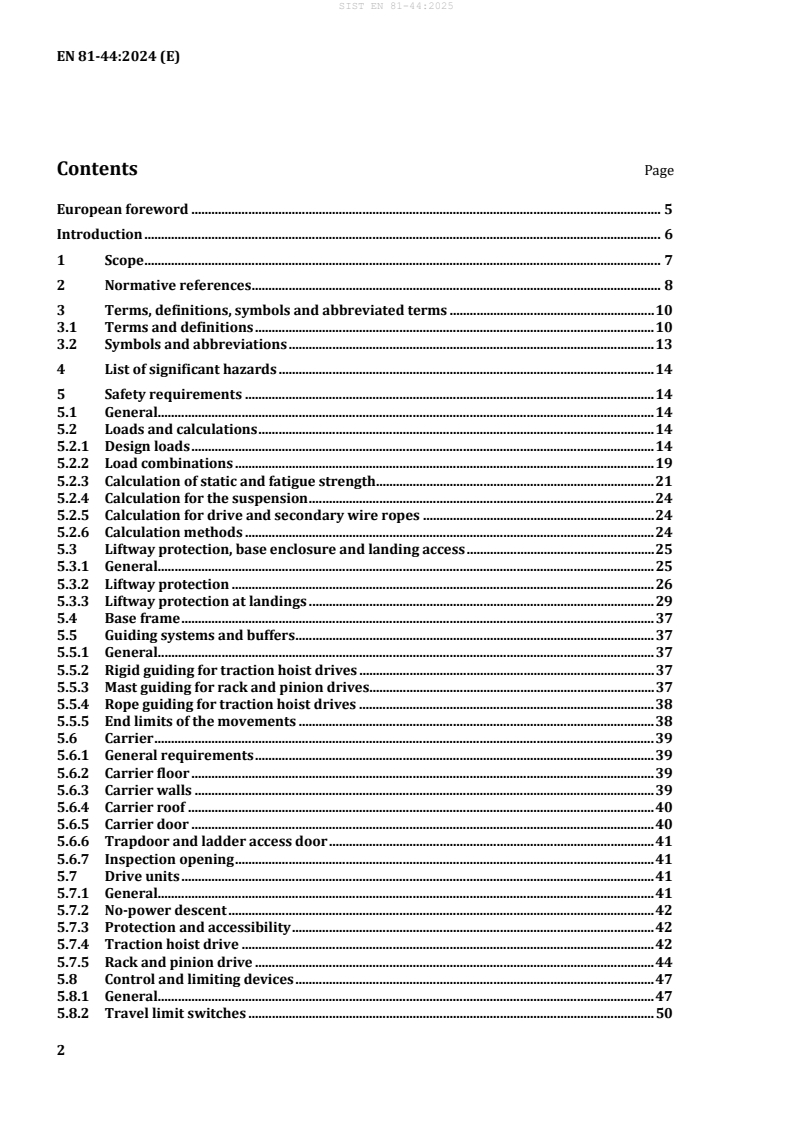
Contents Page
European foreword . 5
Introduction . 6
1 Scope . 7
2 Normative references . 8
3 Terms, definitions, symbols and abbreviated terms . 10
3.1 Terms and definitions . 10
3.2 Symbols and abbreviations . 13
4 List of significant hazards . 14
5 Safety requirements . 14
5.1 General. 14
5.2 Loads and calculations . 14
5.2.1 Design loads . 14
5.2.2 Load combinations . 19
5.2.3 Calculation of static and fatigue strength . 21
5.2.4 Calculation for the suspension . 24
5.2.5 Calculation for drive and secondary wire ropes . 24
5.2.6 Calculation methods . 24
5.3 Liftway protection, base enclosure and landing access . 25
5.3.1 General. 25
5.3.2 Liftway protection . 26
5.3.3 Liftway protection at landings . 29
5.4 Base frame . 37
5.5 Guiding systems and buffers . 37
5.5.1 General. 37
5.5.2 Rigid guiding for traction hoist drives . 37
5.5.3 Mast guiding for rack and pinion drives . 37
5.5.4 Rope guiding for traction hoist drives . 38
5.5.5 End limits of the movements . 38
5.6 Carrier . 39
5.6.1 General requirements . 39
5.6.2 Carrier floor . 39
5.6.3 Carrier walls . 39
5.6.4 Carrier roof . 40
5.6.5 Carrier door . 40
5.6.6 Trapdoor and ladder access door . 41
5.6.7 Inspection opening . 41
5.7 Drive units . 41
5.7.1 General. 41
5.7.2 No-power descent . 42
5.7.3 Protection and accessibility . 42
5.7.4 Traction hoist drive . 42
5.7.5 Rack and pinion drive . 44
5.8 Control and limiting devices . 47
5.8.1 General. 47
5.8.2 Travel limit switches . 50
5.8.3 Slack rope device . 50
5.8.4 Overload detection device . 50
5.8.5 Obstruction detection device . 51
5.8.6 Emergency stopping devices . 52
5.8.7 Interlocking devices . 52
5.8.8 Drive unit fault detection device for rack and pinion system with two redundant drive
units . 55
5.8.9 Control modes . 55
5.9 Electric installations and appliances . 56
5.9.1 General . 56
5.9.2 Protection against electric faults . 56
5.9.3 Protection against the effects of external influences . 57
5.9.4 Electric wiring . 57
5.9.5 Contactors, relay-contactors . 57
5.9.6 Electric safety devices . 57
5.9.7 Safety contacts . 58
5.9.8 Lighting . 58
5.10 Safety devices against falling of the lifting appliance . 58
5.10.1 Overspeed safety device against falling of the lifting appliance (traction hoist drive)
................................................................................................................................................................... 58
5.10.2 Fall arrest device against falling of the lifting appliance (traction hoist drive) . 59
5.10.3 Safety device against falling of the carrier (rack and pinion drive) . 60
6 Verification . 61
6.1 General . 61
6.2 Verification tests on each lifting appliance before first use . 70
7 Information for use . 71
7.1 General . 71
7.2 User’s manual . 71
7.3 Information for installation and dismantling . 72
7.4 Information for maintenance . 72
7.5 User Information available in the carrier . 73
7.6 User Information available at the bottom landing . 73
7.7 Marking . 73
7.7.1 General . 73
7.7.2 Markings on the carrier . 73
7.7.3 Markings at landings . 74
7.7.4 Mast or guide section identification label for rack and pinion drive . 74
7.7.5 Ladder guiding identification label . 74
7.7.6 Overspeed safety device and fall arrest device label . 74
7.7.7 Drive unit label . 74
7.7.8 Marking for wire ropes for traction hoist drive . 75
7.7.9 Control elements . 75
Annex A (normative) Lifting appliance verification tests . 76
A.1 Test conditions and documentation . 76
A.2 Lifting appliance verification test in as installed configuration . 77
A.3 Carrier verification test . 87
Annex B (normative) Drive unit verification tests . 89
B.1 General . 89
B.2 Traction hoist drive . 89
B.3 Rack and pinion drive (One drive system) . 91
B.4 Rack and pinion system with two redundant drive units . 94
Annex C (normative) Overspeed safety device and fall arrest device verification tests . 97
C.1 General. 97
C.2 Overspeed safety devices and fall arrest devices for traction hoist drives . 97
C.3 Overspeed safety device for rack and pinion drive . 102
Annex D (normative) Other verification tests . 104
D.1 General. 104
D.2 Landing gate and enclosure verification tests . 104
Annex E (informative) Evacuation and rescue . 105
E.1 Introduction . 105
E.2 Evacuation scenario . 105
Annex F (informative) List of significant hazards . 106
Annex G (informative) Guidance on calculation methods . 108
Annex ZA (informative) Relationship between this European Standard and the essential
requirements of Directive 2006/42/EC aimed to be covered . 109
Bibliography . 112
European foreword
This document (EN 81-44:2024) has been prepared by Technical Committee CEN/TC 10 “Lifts, escalators
and moving walks”, the secretariat of which is held by AFNOR.
This European Standard shall be given the status of a national standard, either by publication of an
identical text or by endorsement, at the latest by January 2025, and conflicting national standards shall
be withdrawn at the latest by January 2025.
Attention is drawn to the possibility that some of the elements of this document may be the subject of
patent rights. CEN shall not be held responsible for identifying any or all such patent rights.
This document is part of the EN 81 series of standards. The structure of the EN 81 series is described in
CEN/TR 81-10:2008.
This document has been prepared under a standardization request addressed to CEN by the European
Commission. The Standing Committee of the EFTA States subsequently approves these requests for its
Member States.
For the relationship with EU Legislation, see informative Annex ZA, which is an integral part of this
document.
Any feedback and questions on this document should be directed to the users’ national standards body.
A complete listing of these bodies can be found on the CEN website.
According to the CEN-CENELEC Internal Regulations, the national standards organisations of the
following countries are bound to implement this European Standard: Austria, Belgium, Bulgaria, Croatia,
Cyprus, Czech Republic, Denmark, Estonia, Finland, France, Germany, Greece, Hungary, Iceland, Ireland,
Italy, Latvia, Lithuania, Luxembourg, Malta, Netherlands, Norway, Poland, Portugal, Republic of North
Macedonia, Romania, Serbia, Slovakia, Slovenia, Spain, Sweden, Switzerland, Türkiye and the United
Kingdom.
Introduction
This document is a type-C standard as stated in EN ISO 12100:2010.
This document is of relevance, in particular, for the following stakeholder groups representing the market
players with regard to machinery safety:
— machine manufacturers (small, medium and large enterprises);
— health and safety bodies (regulators, accident prevention organizations, market surveillance etc.).
Others can be affected by the level of machinery safety achieved with the means of the document by the
above-mentioned stakeholder groups:
— machine users/employers (small, medium and large enterprises);
— machine users/employees (e.g. trade unions, organizations for people with special needs);
— service providers, e.g. for maintenance (small, medium and large enterprises);
— consumers (in case of machinery intended for use by consumers).
The above-mentioned stakeholder groups have been given the possibility to participate at the drafting
process of this document.
The machinery concerned and the extent to which hazards, hazardous situations or hazardous events are
covered are indicated in the Scope of this document.
When requirements of this type-C standard are different from those which are stated in type-A or type-B
standards, the requirements of this type-C standard take precedence over the requirements of the other
standards for machines that have been designed and built according to the requirements of this type-C
standard.
1 Scope
1.1 This document specifies the safety requirements for the construction and installation of power
operated lifting appliances installed permanently for indoor or outdoor service in wind turbines and
intended for access to workplaces on wind turbines, including rescue and evacuation procedures. A lifting
appliance serves defined landing levels and can move persons to working positions where they are
carrying out work (which could be from the carrier) and has a carrier which is:
a) designed for the transportation of persons and goods;
b) guided;
c) travelling vertically or along a path within 15° maximum from the vertical;
d) supported or sustained by rack and pinion or rope traction drive;
e) travelling with a speed not more than 0,7 m/s;
f) able to operate in a temperature range between –25 °C to + 55 °C.
1.2 This document does not cover hazards related to:
a) noise;
b) the use of the lifting appliance for erection or dismantling of the wind turbine;
c) lightning protection;
d) use in potentially explosive atmospheres;
e) electromagnetic compatibility (emission, immunity);
f) transporting of goods outside the carrier;
g) the use of combustion engines;
h) hydraulic and pneumatic drive units;
i) the use of lifting appliances in floating wind turbines;
j) use during earthquakes.
1.3 This document is not applicable to lifting appliances manufactured before the date of its
publication.
2 Normative references
The following documents are referred to in the text in such a way that some or all of their content
constitutes requirements of this document. For dated references, only the edition cited applies. For
undated references, the latest edition of the referenced document (including any amendments) applies.
EN 81-20:2020, Safety rules for the construction and installation of lifts — Lifts for the transport of persons
and goods — Part 20: Passenger and goods passenger lifts
EN 81-43:2009, Safety rules for the construction and installation of lifts — Special lifts for the transport of
persons and goods — Part 43: Lifts for cranes
EN 81-50:2020, Safety rules for the construction and installation of lifts — Examinations and tests — Part
50: Design rules, calculations, examinations and tests of lift components
EN 795:2012, Personal fall protection equipment — Anchor devices
EN 894-1:1997+A1:2008, Safety of machinery — Ergonomics requirements for the design of displays and
control actuators — Part 1: General principles for human interactions with displays and control actuators
EN 1808:2015, Safety requirements for suspended access equipment — Design calculations, stability
criteria, construction — Examinations and tests
EN 1991-1-3:2003 , Eurocode 1 — Actions on structures — Part 1-3: General actions — Snow loads
EN 10264-1:2012, Steel wire and wire products — Steel wire for ropes — Part 1: General requirements
EN 10264-2:2021, Steel wire and wire products — Steel wire for ropes — Part 2: Cold drawn non alloy steel
wire for ropes for general applications
EN 10264-3:2023, Steel wire and wire products — Steel wire for ropes — Part 3: Round and shaped non
alloyed steel wire for high duty applications
EN 10264-4:2012, Steel wire and wire products — Steel wire for ropes — Part 4: Stainless steel wire
EN 12385-1:2002+A1:2008, Steel wire ropes — Safety — Part 1: General requirements
EN 12385-2:2002+A1:2008, Steel wire ropes — Safety — Part 2: Definitions, designation and classification
EN 12385-3:2020, Steel wire ropes — Safety — Part 3: Information for use and maintenance
EN 12385-4:2002+A1:2008, Steel wire ropes — Safety — Part 4: Stranded ropes for general lifting
applications
EN 13001-2:2021, Crane safety — General design — Part 2: Load actions
EN 13411-1:2002+A1:2008, Terminations for steel wire ropes — Safety — Part 1: Thimbles for steel wire
rope slings
EN 13411-2:2001+A1:2008, Terminations for steel wire ropes — Safety — Part 2: Splicing of eyes for wire
rope slings
As impacted by EN 1991-1-3:2003/A1:2015 and EN 1991-1-3:2003/AC:2009.
EN 13411-3:2022, Terminations for steel wire ropes — Safety — Part 3: Ferrules and ferrule-securing
EN 13411-4:2021, Terminations for steel wire ropes — Safety — Part 4: Metal and resin socketing
EN 13411-5:2003+A1:2008, Terminations for steel wire ropes — Safety — Part 5: U-bolt wire rope grips
EN 13411-6:2004+A1:2008, Terminations for steel wire ropes — Safety — Part 6: Asymmetric wedge
socket
EN 13411-7:2021, Terminations for steel wire ropes — Safety — Part 7: Symmetric wedge socket
EN 60204-1:2018, Safety of machinery — Electrical equipment of machines — Part 1: General
requirements (IEC 60204-1:2016)
EN 60529:1991 , Degrees of protection provided by enclosures (IP Code) (IEC 60529:1989)
EN IEC 60947-4-1:2019 , Low-voltage switchgear and controlgear — Part 4-1: Contactors and motor-
starters — Electromechanical contactors and motor-starters (IEC 60947-4-1:2018)
EN 60947-5-1:2017 , Low-voltage switchgear and controlgear — Part 5-1: Control circuit devices and
switching elements — Electromechanical control circuit devices (IEC 60947-5-1:2016)
EN ISO 12100:2010, Safety of machinery — General principles for design — Risk assessment and risk
reduction (ISO 12100:2010)
EN ISO 13849-1:2023, Safety of machinery — Safety-related parts of control systems — Part 1: General
principles for design (ISO 13849-1:2023)
EN ISO 13850:2015, Safety of machinery — Emergency stop function — Principles for design
(ISO 13850:2015)
EN ISO 13851:2019, Safety of machinery — Two-hand control devices — Principles for design and selection
(ISO 13851:2019)
EN ISO 13854:2019, Safety of machinery — Minimum gaps to avoid crushing of parts of the human body
(ISO 13854:2017)
EN ISO 13857:2019, Safety of machinery — Safety distances to prevent hazard zones being reached by
upper and lower limbs (ISO 13857:2019)
EN ISO 14119:2013, Safety of machinery — Interlocking devices associated with guards — Principles for
design and selection (ISO 14119:2013)
EN ISO 14122-3:2016, Safety of machinery — Permanent means of access to machinery — Part 3: Stairs,
stepladders and guard-rails (ISO 14122-3:2016)
EN ISO 14122-4:2016, Safety of machinery — Permanent means of access to machinery — Part 4: Fixed
ladders (ISO 14122-4:2016)
As impacted by EN 60529:1991/AC:2016-12, EN 60529:1991/A1:2000, EN 60529:1991/A2:2013 and
EN 60529:1991/A2:2013/AC:2019-02.
As impacted by EN IEC 60947-4-1:2019/AC:2021-04 and EN IEC 60947-4-1:2019/AC:2020-05.
As impacted by EN 60947-5-1:2017/AC:2020-05.
ISO 6336-1:2019, Calculation of load capacity of spur and helical gears — Part 1: Basic principles,
introduction and general influence factors
ISO 6336-2:2019, Calculation of load capacity of spur and helical gears — Part 2: Calculation of surface
durability (pitting)
ISO 6336-3:2019, Calculation of load capacity of spur and helical gears — Part 3: Calculation of tooth
bending strength
ISO 6336-5:2016, Calculation of load capacity of spur and helical gears — Part 5: Strength and quality of
materials
3 Terms, definitions, symbols and abbreviated terms
3.1 Terms and definitions
For the purposes of this document, the terms and definitions given in EN ISO 12100:2010, EN 81-43:2009
and the following apply.
ISO and IEC maintain terminology databases for use in standardization at the following addresses:
— IEC Electropedia: available at https://www.electropedia.org/
— ISO Online browsing platform: available at https://www.iso.org/obp
3.1.1
lifting appliance
machine with a carrier which is guided and intended for transport between different levels
3.1.2
base frame
lowest framework of the rack and pinion lifting appliance upon which all other components are mounted
[SOURCE: EN 81-43:2009, definition 3.7, modified – term “rack and pinion” added, term “lift” replaced
with “lifting appliance”]
3.1.3
carrier
load carrying unit including floor, walls, doors and roof
[SOURCE: EN 81-43:2009, 3.13, definition modified]
3.1.4
interlocking device
interlock
mechanical, electrical or other type of device, the purpose of which is to prevent the operation of
hazardous machine functions under specified conditions (generally as long as a guard is not closed)
[SOURCE: EN ISO 12100:2010, 3.28.1]
3.1.5
guard locking device
device intended to lock a guard in the closed position and linked to the control system
Note 1 to entry: Interlocking device [3.1.4] with additional function of keeping the guard locked when the
hazardous machine functions are in operation.
[SOURCE: EN ISO 14119:2013, 3.4]
3.1.6
landing
level in the wind turbine intended for loading and unloading the carrier (3.1.3)
[SOURCE: EN 81-43:2009, 3.21, modified]
3.1.7
landing zone
zone, extending above and below the landing level, in which the carrier floor has to be to enable the
corresponding landing door to be unlocked
3.1.8
overspeed safety device
mechanical device for stopping and maintaining stationary the carrier in the event of over-speed
3.1.9
fall arrest device
mechanical device for stopping and maintaining stationary the carrier in the event of drive wire rope
failure
3.1.10
evacuation
specific actions required to safely release persons entrapped in the carrier without external help
3.1.11
rescue
specific actions required to safely release persons entrapped in the carrier
3.1.12
rigid guiding
guiding means where the carrier is guided by rigid rail or profile (e.g. mast guiding or ladder guiding)
3.1.13
mast guiding
structure that supports and guides the carrier
3.1.14
ladder guiding
ladder that guides the carrier and that can be used for climbing
3.1.15
obstruction detection device
protective equipment detecting obstacles during the travel of the carrier (i.e. persons or objects)
3.1.16
working load limit
WLL
maximum load that a drive unit, fall arrest device and/or an overspeed safety device is authorized to
sustain as designated by the manufacturer
3.1.17
rated load
m
H
load of persons and/or equipment that a lifting appliance has been designated to carry by the
manufacturer in normal use
3.1.18
traction hoist drive
assembly through which a wire rope is conveyed as a result of friction between the wire rope and the
traction assembly with no tail load
3.1.19
rope guiding
guiding by means of tensioned steel wire ropes that prevent the carrier from swinging and rotating while
being stationary and during travel
3.1.20
drive wire rope
active wire rope carrying the suspended load
3.1.21
secondary wire rope
wire rope not normally carrying the suspended load but rigged to work in conjunction with a fall arrest
device
3.1.22
buffer
resilient stop at the end of travel comprising a means of braking using fluids or springs (or other similar
means, e.g. rubber)
3.1.23
vision panel
transparent or perforated panel intended to provide a line of sight inside or outside the carrier
3.1.24
pit
recessed area, which is part of the liftway and has closed sides and is only accessible from above through
the liftway
3.2 Symbols and abbreviations
Symbols, Description
abbreviations
A Area of the lifting appliance on which the wind acts
ref
C Exposure coefficient related to snow loads
e
D Pulley pitch diameter
F Minimum breaking load of wire rope
min
F Wind load
w
H Pitch ratio
S Maximum tensile load in the rope
S Snow load on the carrier
c
S Characteristic value of snow load on the ground
k
Sd Shock load coefficient
St Test load
Tm Dynamic tensile force
WLL Working load limit
Z Drive rope factor
p
c Aerodynamic coefficient
a
d Rope diameter
f Limit design stress
Rd
f Limit design normal stress
Rdσ
f Limit design shear stress
Rdτ
f Ultimate strength
u
f Yield strength (= f in Eurocode 9)
y o
m Mass of unloaded carrier
c
m Mass of tools and equipment
e
m Rated load
H
m Mass of material in the lifting appliance
m
m Assumed mass of a person
p
m Mass of the power and control cables
pc
m Partial mass of the power cable based on traveling height depending on the
pce
overload system
m Mass of the drive ropes (for traction hoist drive)
R
Symbols, Description
abbreviations
m Partial mass of the drive wire rope based on traveling height depending on
Re
the overload system
m Mass of the tension weights (for traction hoist drive)
w
n Number of persons in the lifting appliance
n Number of load carrying ropes
r
q Wind pressure
v Reference storm wind speed
ref
γ Material safety factor for parts with continuous stress
f
γ Resistance coefficient
m
γ Partial safety factor for load
p
µ Impact factor
μ (0°) Snow load shape coefficient
σ Allowable stress
a
σ Calculated stress
c
σ Design normal stress
Sd
φ Dynamic factor due to buffer loads
τ Design shear stress
Sd
4 List of significant hazards
Significant hazards are listed in Annex F, Table F.1.
5 Safety requirements
5.1 General
Machinery shall comply with the safety requirements and/or protective/risk reduction measures of this
clause. In addition, the machine shall be designed according to the principles of EN ISO 12100:2010 for
relevant but not significant hazards which are not dealt with by this document.
5.2 Loads and calculations
5.2.1 Design loads
5.2.1.1 General
All suspended loads shall be taken into account (i.e. including power cables, cable trolley, ropes and
tension weights) which are subject to the component of part reviewed.
5.2.1.2 Dead weights
The following masses are part of the total dead weight and shall be taken into account in calculations
related to the lifting appliance and the lifting appliance components:
— m is mass of the unloaded carrier;
c
— masses of all additional equipment which moves together with the lifting appliance in the load
combination concerned and partial masses based on travelling height depending on the overload
system design which moves together with the lifting appliance such as:
— m is total mass of the drive wire ropes (only traction hoist drive);
R
— m is total mass of the power and control cables;
pc
— m is total mass of the tension weights (only traction hoist drive);
w
— m is partial mass of drive wire rope (only traction hoist drive) from the carrier to the
Re
suspension beam or maximum distance between landings if the lifting appliance control is
designed to stop the lifting appliance at landings during movement in case of overload;
— m is partial mass of power cables from the carrier to the top landing (trailing cable
pce
configuration) or from the carrier to the cable suspension point (travelling cable configuration).
Alternatively, the maximum distance between landings shall be used if the lifting appliance
control is designed to stop the lifting appliance at landings during movement in case of overload.
Depending on the overload system design (according to 5.8.4) and the different load combinations (see
5.2.2), the dead weights are calculated from following mass combinations:
1) Load combinations: A, B, C1, C3, C4, C5 and C6
The following masses shall be considered for overload system Type 1: m , m , m , m .
c pc Re pce
The following masses shall be considered for overload system Type 2 and Type 3: m , m , m .
c pc pce
2) Load combination: C2
The following masses shall be considered for overload system Type 1: m , m , m m , m , m .
c pc Re, pce R w
The following masses shall be considered for overload system Type 2 and Type 3: m , m , m , m , m .
c pc pce R w
5.2.1.3 Rated loads in the lifting appliance
The rated load m of the lifting appliance and the maximum number of persons (n) permitted in the lifting
H
appliance are to be stated by the lifting appliance manufacturer.
When calculating the lifting appliance and every related part, the following rated loads shall be taken into
account as a minimum:
for one person m = m + m + m (Minimum for 1 person: m = 120 kg) (1)
H p e m H
for two persons m = (2 × m ) + (2 × m ) + m (Minimum for 2 persons: m = 240 kg) (2)
H p e m H
for three or more persons m = (n × m ) + (1,5 × m ) + m (3)
H p e m
where
m is rated load;
H
m is 80 kg (mass of person);
p
m is 40 kg (mass of tools and equipment);
e
is the mass of other possible material in the lifting appliance (can be 0 kg);
m
m
n is number of persons.
The rated load is evenly distributed over the floor area of the carrier. Where the uniform distribution of
the rated load over the full area of the carrier floor is less than 4,0 kN/m then, for calculation purposes
of the floor, a minimum of 4,0 kN/m shall be placed over the whole area of the carrier floor.
5.2.1.4 Effect of friction forces
The friction forces acting on the carrier generated by guiding means and transmission chain shall be taken
into account, see Table 2.
5.2.1.5 Loads exerted by persons
5.2.1.5.1 General
When calculating the lifting appliance and every related part, the following loads, exerted by persons,
shall be taken into account.
Walls shall be capable of withstanding a load of 300 N applied normally at the least favourable point
without permanent deformation. The load shall be applied by pulling or pushing over a flat area of
100 mm × 100 mm. For elastic deformation, see 5.6.3.
Carrier doors and vision panels and their guides shall be capable of withstanding a load of 300 N applied
normally at any position without permanent deformation. The load shall be applied by pulling or pushing
over a flat area of 5 cm .
5.2.1.5.2 Individual loads (not to be combined with other loads)
The carrier floor surface shall be designed to withstand without permanent deformation a local static
load of 1,5 kN applied on the least favourable square area of 0,2 m × 0,2 m.
If the carrier roof is accessible, it shall be designed to withstand
— an evenly distributed load of at least 3,0 kN placed on the least favourable square area of 1,0 m . If
the roof area is smaller than 1,0 m , 3,0 kN shall be applied to the full roof area;
— a local static load of 1,2 kN applied on the least favourable square area of 0,2 m × 0,2 m without
permanent deformation.
The full height landing gates shall be designed to withstand, without permanent deformation and without
elastic deformation greater than 15 mm, a local static load of 300 N at the least favourable point on either
face, using a rigid square or round flat face of 5 cm .
The reduced height landing gates shall be designed to withstand, without permanent deformation, a local
static load of 1 kN vertically applied at the least favourable point along the top of the gate.
The same values for the resistance coefficient for materials as in the load combination A from Table 3
shall be used for the above-mentioned load cases in this clause.
The reduced height landing gates shall be designed to withstand horizontal loads according to
EN ISO 14122-3:2016, 8.1 and 8.2, with a minimum horizontal load of 300 N.
5.2.1.5.3 Loads caused by falling person
When calculating the structure where the anchor device is attached, a load of a falling person of 6 kN shall
be taken into account (for safety factors see Table 2).
When more than 1 anchor device is attached to the carrier, it is assumed that loads can’t occur in more
than one anchor device at the same time, so the structure shall be calculated for each anchor device
separately, not for all the anchor devices at the same time.
5.2.1.6 Wind loads for outside operating lifting appliances
5.2.1.6.1 Formulas for calculation of the wind loads
Wind loads shall be calculated according to EN 13001-2:2021.
F = q × c × A (4)
w ref
a
where
F is the wind load acting perpendicularly to the longitudinal axis of the member under
w
consideration;
q is the wind pressure: q(3) in service, q(z) out of service;
c is the aerodynamic coefficient of the member under consideration.
a
The coefficient c shall be used in combination with the characteristic area A . Values of c shall be those
a ref a
from EN 13001-2:2021, Annex A. For the carrier, it shall be assumed that the carrier walls are solid and
an aerodynamic coefficient c of 1,2 shall be applied. The factor 1,2 covers both the shape factor and the
a
shielding factor.
Wind loads are assumed to act horizontally at the centre of the area of the component parts of the lifting
appliance in any direction. The least favourable direction shall be taken into account.
The wind loads acting on a lifting appliance shall be considered to be acting on the suspension points
and/or on relevant tower interface components.
5.2.1.6.2 Lifting appliances in
...