

EN 12387:2005+A1:2009
(Main + Amendment)Footwear, leather and imitation leather goods manufacturing machines - Modular shoe repair equipment - Safety requirements
- Abstract
This document applies to the following machines including their additional equipment intended for the repair of footwear, leather and imitation leather goods as well as for the manufacture and repair of orthopaedic shoes hereafter called "Shoe Repair Machines":
a) Polishing machines;
b) Trimming machines;
c) Scouring machines;
d) Finishing machines;
e) Orthopaedic finishing machines;
f) Heel and sole press;
g) Activating unit - Adhesive;
h) Orthopaedic vacuum moulding press;
i) Orthopaedic presses;
j) Extraction equipment;
k) Powered ranging device;
l) Edge inking or staining machines;
m) Mechanism for stationary nailing and stapling tools.
These machines can be standing alone or combined in a modular system for shoe repairs or the production of orthopaedic shoes including the lasts.
1.2 This document does not apply to:
a) Sewing machines
b) Autosoling machines
c) Sole stitching machines
d) Hand operated pneumatic nail drivers or staple tackers.
1.3 This document specifies safety requirements for construction, transport, installation, setting, adjustment, programming or converting, operating, cleaning, maintenance for the machines listed in 1.1.
1.4 This document deals with all significant hazards, hazard situations and events relevant to shoe repair machines when they are used as intended and under the conditions foreseen by the manufacturer (see Clause 4). The document does not deal with hazards due to use of the machines different from the use defined in 1.1.
1.5 This document assumes the machines are:
- operated by adequately trained persons
- used with adequate workplace lighting (see EN 12464-1).
1.6 This document is not applicable to shoe repair machines which are manufactured before the date of its publication as EN.
- Status
- Published
- Publication Date
- 11-Aug-2009
- Technical Committee
- CEN/TC 201 - Leather and imitation leather goods and footwear manufacturing machinery - Safety
- Drafting Committee
- CEN/TC 201/WG 6 - Modular shoe repairing equipment
- Current Stage
- 9093 - Decision to confirm - Review Enquiry
- Start Date
- 22-Jun-2022
- Completion Date
- 07-Oct-2026
- Directive
- 2006/42/EC - Directive 2006/42/EC of the European Parliament and of the Council of 17 May 2006 on machinery, and amending Directive 95/16/EC (recast)OJ Ref: C, C 309 OJ Date: 18-Dec-2009

Overview
EN 12387:2005+A1:2009 (CEN) specifies safety requirements for modular shoe repair equipment and related machines used in the repair and manufacture of footwear, leather and imitation‑leather goods - including orthopaedic shoes and lasts. The standard covers the whole machine lifecycle: design and construction, transport, installation, setting, adjustment, programming/conversion, operation, cleaning and maintenance. It is a Type C machine-specific standard that complements general machinery safety standards and includes Amendment 1 (2009).
Scope includes (but is not limited to):
- polishing, trimming, scouring and finishing machines
- orthopaedic finishing machines, vacuum moulding and presses
- heel and sole presses, adhesive activating units
- powered ranging devices, edge inking/staining machines
- extraction equipment and mechanisms for stationary nailing/stapling
Exclusions: sewing machines, autosoling, sole‑stitching machines and hand‑operated pneumatic nail drivers/staplers. The standard assumes operation by adequately trained persons and adequate workplace lighting (see EN 12464‑1). It is not retroactive to machines built before publication.
Key Topics and Requirements
- Hazard identification: addresses significant hazards typical for shoe repair machines - mechanical (entanglement, crushing, cutting), electrical, thermal (hot surfaces), noise, dust emissions, fire/explosion, ergonomics, slips/trips and falls.
- Safety measures: requirements for guards, interlocks, safe distances, control systems, emergency stop, safe access and maintenance provisions.
- Verification and testing: procedures for verifying safety requirements and measures during design and commissioning.
- Information for use: manufacturer’s documentation, labeling, warnings, and instructions for safe operation and maintenance.
- Normative annexes: cover guard design, hold‑to‑run controls for presses, noise test code, dust extraction requirements, minimum working heights and lighting guidance for finishing machines.
Applications and Who Uses It
This standard is essential for:
- Manufacturers and designers of shoe repair and footwear production machinery - to design compliant, CE‑mark ready equipment.
- Safety engineers and compliance officers - for risk assessments and conformity checks against European directives.
- Workshop owners, orthopaedic shoe makers and installers - to understand required safeguards, installation and maintenance practices.
- Test laboratories and notified bodies - for verification and conformity assessment activities.
Practical benefits include reduced workplace accidents, improved machine ergonomics, controlled dust and noise exposure, and clearer manufacturer instructions for safe use.
Related Standards
EN 12387 references and works alongside general machinery and safety standards such as EN ISO 12100 (risk assessment / design principles), EN 12464‑1 (workplace lighting), noise and extraction standards (e.g., EN 12545), and electrical and guarding standards (e.g., EN 1088, EN 60204‑1). These should be consulted for full conformity and compliance.
Relations
- Effective Date
- 18-Jan-2023
- Effective Date
- 20-Jun-2009
- Effective Date
- 25-Aug-2026
- Effective Date
- 09-Feb-2026
- Effective Date
- 09-Feb-2026
- Effective Date
- 28-Jan-2026
- Effective Date
- 28-Jan-2026
- Effective Date
- 28-Jan-2026
- Effective Date
- 28-Jan-2026
- Effective Date
- 28-Jan-2026
- Effective Date
- 28-Jan-2026
- Effective Date
- 28-Jan-2026
- Effective Date
- 28-Jan-2026
- Effective Date
- 28-Jan-2026
- Effective Date
- 28-Jan-2026
Frequently Asked Questions
EN 12387:2005+A1:2009 is a standard published by the European Committee for Standardization (CEN). Its full title is "Footwear, leather and imitation leather goods manufacturing machines - Modular shoe repair equipment - Safety requirements". This standard covers: This document applies to the following machines including their additional equipment intended for the repair of footwear, leather and imitation leather goods as well as for the manufacture and repair of orthopaedic shoes hereafter called "Shoe Repair Machines": a) Polishing machines; b) Trimming machines; c) Scouring machines; d) Finishing machines; e) Orthopaedic finishing machines; f) Heel and sole press; g) Activating unit - Adhesive; h) Orthopaedic vacuum moulding press; i) Orthopaedic presses; j) Extraction equipment; k) Powered ranging device; l) Edge inking or staining machines; m) Mechanism for stationary nailing and stapling tools. These machines can be standing alone or combined in a modular system for shoe repairs or the production of orthopaedic shoes including the lasts. 1.2 This document does not apply to: a) Sewing machines b) Autosoling machines c) Sole stitching machines d) Hand operated pneumatic nail drivers or staple tackers. 1.3 This document specifies safety requirements for construction, transport, installation, setting, adjustment, programming or converting, operating, cleaning, maintenance for the machines listed in 1.1. 1.4 This document deals with all significant hazards, hazard situations and events relevant to shoe repair machines when they are used as intended and under the conditions foreseen by the manufacturer (see Clause 4). The document does not deal with hazards due to use of the machines different from the use defined in 1.1. 1.5 This document assumes the machines are: - operated by adequately trained persons - used with adequate workplace lighting (see EN 12464-1). 1.6 This document is not applicable to shoe repair machines which are manufactured before the date of its publication as EN.
This document applies to the following machines including their additional equipment intended for the repair of footwear, leather and imitation leather goods as well as for the manufacture and repair of orthopaedic shoes hereafter called "Shoe Repair Machines": a) Polishing machines; b) Trimming machines; c) Scouring machines; d) Finishing machines; e) Orthopaedic finishing machines; f) Heel and sole press; g) Activating unit - Adhesive; h) Orthopaedic vacuum moulding press; i) Orthopaedic presses; j) Extraction equipment; k) Powered ranging device; l) Edge inking or staining machines; m) Mechanism for stationary nailing and stapling tools. These machines can be standing alone or combined in a modular system for shoe repairs or the production of orthopaedic shoes including the lasts. 1.2 This document does not apply to: a) Sewing machines b) Autosoling machines c) Sole stitching machines d) Hand operated pneumatic nail drivers or staple tackers. 1.3 This document specifies safety requirements for construction, transport, installation, setting, adjustment, programming or converting, operating, cleaning, maintenance for the machines listed in 1.1. 1.4 This document deals with all significant hazards, hazard situations and events relevant to shoe repair machines when they are used as intended and under the conditions foreseen by the manufacturer (see Clause 4). The document does not deal with hazards due to use of the machines different from the use defined in 1.1. 1.5 This document assumes the machines are: - operated by adequately trained persons - used with adequate workplace lighting (see EN 12464-1). 1.6 This document is not applicable to shoe repair machines which are manufactured before the date of its publication as EN.
EN 12387:2005+A1:2009 is classified under the following ICS (International Classification for Standards) categories: 61.060 - Footwear. The ICS classification helps identify the subject area and facilitates finding related standards.
EN 12387:2005+A1:2009 has the following relationships with other standards: It is inter standard links to EN 12387:2005/prA1, EN 12387:2005, ISO 8598:1996, EN 60335-2-69:2003, EN 61310-1:2008, EN ISO 13850:2015, EN ISO 14119:2025, EN 1127-1:2019, EN 1837:2020, EN ISO 13732-1:2008, EN ISO 11689:1996, EN ISO 11688-2:2000, EN ISO 12100-2:2003, EN 626-1:1994, EN ISO 11688-1:2009. Understanding these relationships helps ensure you are using the most current and applicable version of the standard.
EN 12387:2005+A1:2009 is associated with the following European legislation: EU Directives/Regulations: 2006/42/EC, 98/37/EC; Standardization Mandates: M/079, M/396. When a standard is cited in the Official Journal of the European Union, products manufactured in conformity with it benefit from a presumption of conformity with the essential requirements of the corresponding EU directive or regulation.
EN 12387:2005+A1:2009 is available in PDF format for immediate download after purchase. The document can be added to your cart and obtained through the secure checkout process. Digital delivery ensures instant access to the complete standard document.
Standards Content (Sample)
2003-01.Slovenski inštitut za standardizacijo. Razmnoževanje celote ali delov tega standarda ni dovoljeno.Maschinen zur Herstellung von Schuhen, Leder- und Kunstlederwaren - Schuhreperaturmaschinen - SicherheitsanforderungenMachines pour la fabrication de chaussures et d'articles chaussants en cuir et matériaux similaires - Equipement modulaire de réparation de chaussures - Prescriptions de sécuritéFootwear, leather and imitation leather goods manufacturing machines - Modular shoe repair equipment - Safety requirements61.060ObuvalaFootwearICS:Ta slovenski standard je istoveten z:EN 12387:2005+A1:2009SIST EN 12387:2005+A1:2009en01-oktober-2009SIST EN 12387:2005+A1:2009SLOVENSKI
STANDARD
EUROPEAN STANDARD NORME EUROPÉENNE EUROPÄISCHE NORM
EN 12387:2005+A1
August 2009 ICS 61.060 Supersedes EN 12387:2005English Version
Footwear, leather and imitation leather goods manufacturing machines - Modular shoe repair equipment - Safety requirements
Machines pour la fabrication de chaussures et d'articles chaussants en cuir et matériaux similaires - Equipement modulaire de réparation de chaussures - Prescriptions de sécurité
Maschinen zur Herstellung von Schuhen, Leder- und Kunstlederwaren - Schuhreperaturmaschinen - Sicherheitsanforderungen This European Standard was approved by CEN on 10 January 2005 and includes Amendment 1 approved by CEN on 16 July 2009.
CEN members are bound to comply with the CEN/CENELEC Internal Regulations which stipulate the conditions for giving this European Standard the status of a national standard without any alteration. Up-to-date lists and bibliographical references concerning such national standards may be obtained on application to the CEN Management Centre or to any CEN member.
This European Standard exists in three official versions (English, French, German). A version in any other language made by translation under the responsibility of a CEN member into its own language and notified to the CEN Management Centre has the same status as the official versions.
CEN members are the national standards bodies of Austria, Belgium, Bulgaria, Cyprus, Czech Republic, Denmark, Estonia, Finland, France, Germany, Greece, Hungary, Iceland, Ireland, Italy, Latvia, Lithuania, Luxembourg, Malta, Netherlands, Norway, Poland, Portugal, Romania, Slovakia, Slovenia, Spain, Sweden, Switzerland and United Kingdom.
EUROPEAN COMMITTEE FOR STANDARDIZATION
COMITÉ EUROPÉEN DE NORMALISATION EUROPÄISCHES KOMITEE FÜR NORMUNG
Management Centre:
Avenue Marnix 17,
B-1000 Brussels © 2009 CEN All rights of exploitation in any form and by any means reserved worldwide for CEN national Members. Ref. No. EN 12387:2005+A1:2009: ESIST EN 12387:2005+A1:2009
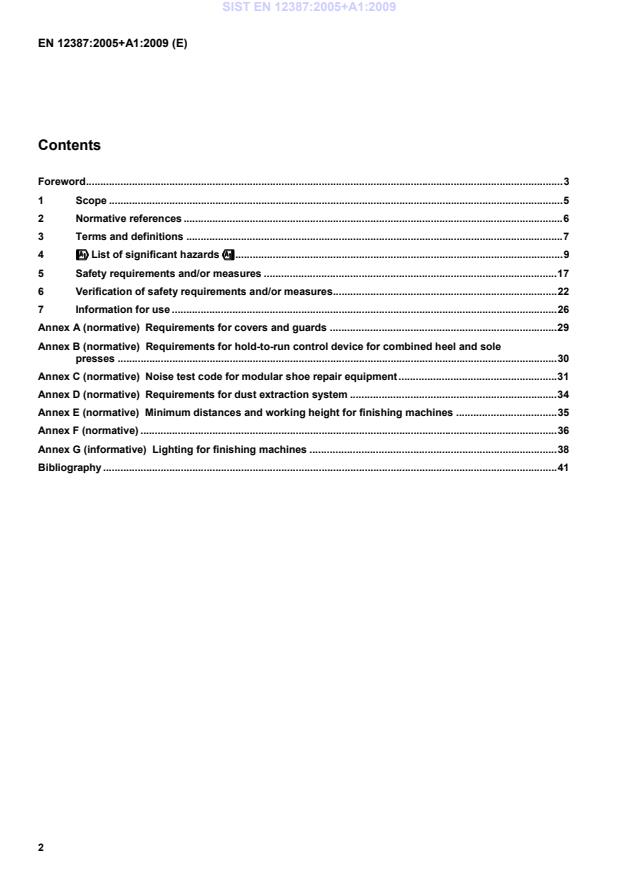
Requirements for covers and guards . 29 Annex B (normative)
Requirements for hold-to-run control device for combined heel and sole presses . 30 Annex C (normative)
Noise test code for modular shoe repair equipment . 31 Annex D (normative)
Requirements for dust extraction system . 34 Annex E (normative)
Minimum distances and working height for finishing machines . 35 Annex F (normative) . 36 Annex G (informative)
Lighting for finishing machines . 38 Bibliography . 41 SIST EN 12387:2005+A1:2009
1.4 This document deals with all significant hazards, hazard situations and events relevant to shoe repair machines when they are used as intended and under the conditions foreseen by the manufacturer (see Clause 4). The document does not deal with hazards due to use of the machines different from the use defined in 1.1. 1.5 This document assumes the machines are: operated by adequately trained persons SIST EN 12387:2005+A1:2009
NOTE Typical outlines of these machines together with significant danger areas are given in Figures 1 and 2 and Annex B.! The Figures are given for information only." 4.2 !!!!deleted text" Before using the standard it is important to carry out a risk assessment of shoe repair machines to check that its significant hazards are identified in this clause. SIST EN 12387:2005+A1:2009
4.1.1 Transmission and drive mechanisms entanglement or drawing in, trapping, friction, impact, crushing and shearing
5.2.1.1 4.1.2 Moving machinery parts, tools, work pieces drawing in and trapping, friction, impact, crushing and shearing
5.3.1.1 5.2.1.2 5.2.1.3 5.2.1.4 4.1.3 Finishing machines
4.1.3.1 Scouring section
- all abrasive tools
-
abrasive wheel:Bursting
particle ejection from tool friction, abrasion, drawing-in or entanglement, trapping Flying parts
5.3.1.2 5.3.1.3
5.3.1.4 4.1.3.2 Naumkeag section particle ejection from tool friction, abrasion, drawing-in or entanglement, trapping
5.3.1.6 Naumkeag when fitted with drill stabbing or puncture
5.3.1.5 4.1.3.3 Trimming section
Rotating tools and guides cutting, severing, drawing-in, trapping, particle ejection
5.3.1.7 Manual or power positional changing of tools entanglement, crushing, shearing
5.3.1.8 5.3.1.9 4.1.3.4 Polishing section
Rotating tools entanglement
Power or manual positional of any changing of tools crushing and shearing
5.3.1.2 SIST EN 12387:2005+A1:2009
Pressing area between pressing pad/lasting mould or work piece area between pressing pad and body of machine when returns crushing and shearing
5.3.2.1 5.3.2.2 5.3.2.3 4.1.5 Mechanism for stationary nailing and stapling tools
Accidental operation by advancing the work piece shoot in of nails and staplers 3 5.3.3 4.1.6 Powered ranging device cutting, severing, shearing 4 5.3.4 4.2 Operator's position
- protruding parts - uneven, sloping, slippery platforms - steps slips, trips and falls
5.2.1.5 4.3 Electrical hazard
5.2.2.1 Electrical contact, direct or indirectly, caused by - component failure - insulation failure - incorrect design, installation or component specification of the electrical equipment electric shock or burns
5.2.2.2 4.4 Thermal hazard
- accidental contact with hot surfaces risk of burns
5.2.3 4.5 Noise
- the action of the tool on the worked material or component - pneumatic systems - extraction equipment - motor and transmission equipment damage to hearing, physiological disorders, interference with speech-communication and acoustic signals
5.2.4 4.6 Emission of dust
The action of the tool on the materials being worked create leather, plastic or rubber dust risk of occupational disease (respiratory problems)
5.2.5
4.7 Fire and explosion hazard at finishing machines
5.3.1.10 - through material being worked (scouring) it comes to - flammable dust - through accumulation fire hazard - through whirling up the accumulation of dust explosive atmospheres (seldom and for short periods in connection with ignition source → fire and/or explosions) fire dust explosions (deflagration)
5.3.1.11 5.3.1.12 5.3.1.13 5.3.1.14 5.3.1.15 5.3.1.16 4.8 Neglect of ergonomic principles risk of occupational disease
5.3.1.17
- inadequate local lighting - accidents resulting from poor visibility
- poor operator's posture - fatigue
- poor operating conditions - psychological stress
- too small space between the tools
- risk of friction and abrasion
- unsuitable working height - musculo-skeletal damage
4.9 Functional disorders of controls and energy supply
5.2.6
- failure of control system all possible hazards generated by unexpected dangerous movements 5.2.6.1 5.2.6.2
- fault of energy supply (irregularity, failure, unexpected reconnection)
5.2.6.3
- accident operation of foot actuated controls
5.2.6.4 4.10 Fluid systems, ejection of pressure medium injury from hot oil or impact from flexible hoses
5.2.6.1 SIST EN 12387:2005+A1:2009
a) Frontal view Key 1 Power transmission (4.1.1) – Rotating shafts (4.1.2) 2 Scouring section (4.1.3.1) 3 Naumkeag (4.1.3.2) 4 Trimming section (4.1.3.3) 5 Polishing section (4.1.3.4)
b) Lateral view Key 1 Power transmission (4.1.1) – Rotating shafts (4.1.2) 2 Operator's position (4.2)
Figure 1 — Example of a finishing machine SIST EN 12387:2005+A1:2009
Key 1 Power transmission (4.1.1) 2 Pressing area (4.1.4)
Figure 2 — Example of a heel and sole press SIST EN 12387:2005+A1:2009
Figure 3 — Mechanism for stationary nailing and stapling tools
Figure 4 — Powered ranging device SIST EN 12387:2005+A1:2009
For hazards which are to be reduced by the application of a B-level standard the manufacturer shall carry out a risk assessment to establish the requirements of the B-standard to be applied. This specific risk assessment is part of the general risk assessment of the machine. 5.2 Common requirements for all shoe repair machines 5.2.1 Mechanical equipment 5.2.1.1 All transmission machinery and drive mechanisms which give rise to danger shall be enclosed by fixed enclosing guards which satisfy EN 953. 5.2.1.2 !Unless required otherwise by 5.3 hazardous movements of machinery parts, tools and work pieces shall be safeguarded by:" fixed enclosing guards which satisfy EN 953; or in case of technical impossibility fixed covers which satisfy Annex A of this document. 5.2.1.3 Safety distances and gaps shall comply with EN 294:1992, Tables 1, 3 and 4, unless specified otherwise by 5.3. !Fixing systems of fixed guards and fixed covers shall remain attached to these parts or to the machine when the parts are removed." 5.2.1.4 Safeguards at crushing, shearing, drawing-in, trapping and friction points are not required, if the maximum force of moving parts is limited to 150 N and the contact pressure is limited to 50 N/cm2. 5.2.1.5 The surface of an area where the operator is standing for recurring manual intervention shall be even and steps, slopes and protruding parts shall be avoided according to EN ISO 14122-1. 5.2.2 Electrical equipment 5.2.2.1 The electrical equipment shall be in accordance with EN 60204-1. With respect to some clauses of !EN 60204-1:2006", stated hereafter, the following shall apply: 4.3:
A.C. supplies: 4.3.2 applies without the note; 6.2: Protection in accordance with 6.2.2 or 6.2.3 and, where applicable, 6.2.4; 9.2.5.3/4: stop function and emergency stop: Category 0 or 1; SIST EN 12387:2005+A1:2009
NOTE EN ISO 11688-2 gives useful information on noise generation mechanisms in machinery. Examples for noise control measures are: a) reduction of vibrations through static and dynamic balancing of the rotating parts; b) reduction of vibrations within the machine by reducing both the mass of the moving parts and their acceleration; c) reduction of impactive over-clearance of rotational bearings by application of positive pre-loading; d) proper choice and design of energy transfer components to eliminate bouncing; e) proper choice and design of transmission components (gears, pulleys, belts, bearings etc.); f) design of the machine structure which takes account of vibration, damping and avoiding structural resonances, in particular coating of deflection rollers at scouring bands with damping rubber or felt; g) fitting pneumatic exhaust silencers. The above list is not exhaustive. Other noise control measures with the same or better efficiency can be used by a manufacturer. 5.2.4.2 Noise reduction by information If measures taken at the design stage are known to be insufficient to reduce noise emission to an acceptable level, then the manufacturer shall give information on means to reduce noise further (see 7.3). 5.2.5 Dust detrimental to health Shoe repair machines where the working process creates dust may be hazardous to health shall be fitted with an integral extraction system or with connections for an external system.
EN 626-1:1994 and Annex D of this document. 5.2.6 Control systems 5.2.6.1 Control systems shall comply with the following general requirements: electrical systems: 5.2.2 of the present document and Clause 9 of !EN 60204-1:2006"; pneumatic systems: the requirements of EN 983; for hydraulic systems: the requirements of EN 982. 5.2.6.2 !The safety related parts of the control system shall as a minimum conform to performance level "b" as defined in EN ISO 13849-1." 5.2.6.3 Means shall be provided to prevent uncontrolled starting of motors or movement of presses caused by failure or unexpected reconnection of power supply. For the pneumatic and hydraulic systems this means can be for example a pressure switch. 5.2.6.4 To avoid unintended operation foot-actuated controls, which actuate hazardous motions, control systems shall be fixed to the frame of the machine and shall be safeguarded by a bridge shaped cover which prevent unintended actuation by the operator or falling objects. 5.2.6.5 When selecting a bridge shaped cover for two or more foot-actuated controls the distance between the pedals shall be more than 150 mm or, if less, a vertical divider shall be fitted between them. 5.2.7 Pressurized fluid systems Equipment of hydraulic and pneumatic systems shall satisfy 4.10 of EN ISO 12100-2:2003, EN 982 and
EN 983. 5.2.8 Ergonomics When designing shoe repair machines basic ergonomic principles of 4.8 of EN ISO 12100-2:2003 shall be considered. 5.3 Requirements for specific shoe repair machines NOTE Following requirements apply also when the specific machine is integrated in a modular system. 5.3.1 Finishing machines for manual scouring, brushing, polishing and trimming operations 5.3.1.1 All rotating axles and shafts as well as tool shafts, nuts, bolt heads and fixing equipment, shall be safeguarded by fixed enclosing guards which satisfy EN 953. Loose rolls around axles and shafts are c
...