

EN 415-10:2014
(Main)Safety of packaging machines - Part 10: General Requirements
- Abstract
This European Standard gives general requirements for packaging machines which are defined in the scope of EN 415 1 or are in the scope of another relevant machine specific part of EN 415. When used together with a relevant machine specific part of EN 415, it gives the requirements for that specific type of machine.
This document deals with safety requirements and their verification for design, construction, installation, commissioning, operation, adjustment, maintenance and cleaning of packaging machines when used as intended and under the conditions of misuse foreseeable by a manufacturer.
The extent to which hazards, hazardous situations and events are covered is indicated in Clause 4.
The hazards on a specific machine can vary depending on its working principle; the type, size and mass of the product; the packaging material; auxiliary equipment attached to the machine and the environment in which the machine is used. If the machine presents hazards that are not dealt with in this standard, the manufacturer should assess these hazards by using the principles detailed in EN ISO 12100:2010. Such deviations or additions are outside the scope of this standard.
Exclusions
This European Standard is not applicable to the following:
- machines that were manufactured before the date of publication of this document by CEN.
This standard does not consider the following:
- the risk resulting from the use of machines in public accessed areas.
NOTE For machines used in public accessed areas different or additional requirements can apply. It is the responsibility of the manufacturer to identify such additional risks, which are outside the scope of this standard or such deviating risks which arise from this specific use, and provide suitable protective measures in accordance with EN ISO 12100.
- the use of packaging machines in potentially explosive atmospheres;
- specific health, safety or hygiene hazards associated with the products that may be handled by the machines, but does include general advice on this subject;
- hazards that may be associated with decommissioning packaging machines.
- Status
- Published
- Publication Date
- 21-Jan-2014
- Withdrawal Date
- 30-Jul-2014
- Technical Committee
- CEN/TC 146 - Packaging machines - Safety
- Current Stage
- 9092 - Decision on results of review/2YR ENQ - revise - Review Enquiry
- Start Date
- 24-Jun-2020
- Completion Date
- 21-Oct-2026
- Directive
- 2006/42/EC - Directive 2006/42/EC of the European Parliament and of the Council of 17 May 2006 on machinery, and amending Directive 95/16/EC (recast)OJ Ref: C, C 220 OJ Date: 11-Jul-2014


Overview
EN 415-10:2014 - Safety of packaging machines: Part 10: General Requirements defines the general safety requirements and verification methods for packaging machines covered by EN 415‑1 or other machine‑specific parts of EN 415. It addresses safety throughout the machine lifecycle - design, construction, installation, commissioning, operation, adjustment, maintenance and cleaning - when used as intended and under reasonably foreseeable misuse. The standard helps manufacturers and designers reduce hazards associated with packaging machinery and specifies how to verify that safety measures are effective.
Key topics and technical requirements
This part of EN 415 focuses on broad, non‑machine‑specific safety measures and verification. Major topics include:
- List of significant hazards - mechanical hazards (moving parts, slips/trips, stability, guards), pneumatic/hydraulic risks, electrical hazards, electrostatic phenomena, thermal hazards, noise and radiation.
- Hazards from products and materials - risks generated by handled products and packaging materials and general guidance to control them.
- Ergonomic and hygienic design principles - requirements to support safe operation, maintenance and cleaning.
- Control and safety functions - normal stop, operational stop, emergency stop, prevention of unexpected start, safety‑related stops, stopping times and safety control behaviour.
- Stored energy and failure modes - measures for energy sources, failures of power supplies and safety‑related control parts, and remote diagnostics/control.
- Specific elements/processes - cutting and sealing devices, film reel unwind, conveyors, handles/hand‑wheels, size/product change-over, hot‑melt equipment, modified atmosphere packaging.
- Verification - visual inspections (machine stopped and running), measurements, electrical testing and guard checks to confirm compliance.
The standard highlights that hazards vary by machine type, packaging material, product characteristics and environment. Where hazards are not addressed, manufacturers must apply the principles in EN ISO 12100:2010 for risk assessment and mitigation.
Practical applications and who uses it
SIST EN 415‑10:2014 is used by:
- Machine manufacturers and designers to build compliant, safer packaging machinery.
- Safety engineers and compliance officers to prepare technical files and CE marking evidence.
- System integrators and machine builders for applying general safety measures alongside machine‑specific EN 415 parts.
- Test laboratories and inspectors for verification and conformity assessment.
- Maintenance teams and end‑users to understand safe operation, cleaning and maintenance requirements.
This standard is applied in sectors using packaging machinery (food, pharmaceuticals, consumer goods) to reduce workplace injuries and ensure regulatory compliance.
Related standards
- EN 415 series (machine‑specific parts) - used together with Part 10 for specific packaging machine types.
- EN ISO 12100:2010 - general principles for risk assessment and risk reduction; referenced where Part 10 does not cover specific hazards.
Note: SIST EN 415‑10:2014 excludes machines manufactured before its publication date and does not cover use in public access areas, explosive atmospheres, product‑specific health hazards or decommissioning hazards; manufacturers must identify and mitigate those separately.
Relations
- Effective Date
- 25-Aug-2026
- Effective Date
- 25-Aug-2026
- Effective Date
- 21-Jul-2026
- Effective Date
- 09-Feb-2026
- Effective Date
- 09-Feb-2026
- Effective Date
- 09-Feb-2026
- Effective Date
- 09-Feb-2026
- Effective Date
- 09-Feb-2026
- Effective Date
- 09-Feb-2026
- Effective Date
- 09-Feb-2026
- Effective Date
- 09-Feb-2026
- Effective Date
- 09-Feb-2026
- Effective Date
- 09-Feb-2026
- Effective Date
- 09-Feb-2026
- Effective Date
- 09-Feb-2026
Get Certified
Connect with accredited certification bodies for this standard

BRCGS (Brand Reputation Compliance Global Standards)
Global food safety and quality standards owner.
Sponsored listings
Frequently Asked Questions
EN 415-10:2014 is a standard published by the European Committee for Standardization (CEN). Its full title is "Safety of packaging machines - Part 10: General Requirements". This standard covers: This European Standard gives general requirements for packaging machines which are defined in the scope of EN 415 1 or are in the scope of another relevant machine specific part of EN 415. When used together with a relevant machine specific part of EN 415, it gives the requirements for that specific type of machine. This document deals with safety requirements and their verification for design, construction, installation, commissioning, operation, adjustment, maintenance and cleaning of packaging machines when used as intended and under the conditions of misuse foreseeable by a manufacturer. The extent to which hazards, hazardous situations and events are covered is indicated in Clause 4. The hazards on a specific machine can vary depending on its working principle; the type, size and mass of the product; the packaging material; auxiliary equipment attached to the machine and the environment in which the machine is used. If the machine presents hazards that are not dealt with in this standard, the manufacturer should assess these hazards by using the principles detailed in EN ISO 12100:2010. Such deviations or additions are outside the scope of this standard. Exclusions This European Standard is not applicable to the following: - machines that were manufactured before the date of publication of this document by CEN. This standard does not consider the following: - the risk resulting from the use of machines in public accessed areas. NOTE For machines used in public accessed areas different or additional requirements can apply. It is the responsibility of the manufacturer to identify such additional risks, which are outside the scope of this standard or such deviating risks which arise from this specific use, and provide suitable protective measures in accordance with EN ISO 12100. - the use of packaging machines in potentially explosive atmospheres; - specific health, safety or hygiene hazards associated with the products that may be handled by the machines, but does include general advice on this subject; - hazards that may be associated with decommissioning packaging machines.
This European Standard gives general requirements for packaging machines which are defined in the scope of EN 415 1 or are in the scope of another relevant machine specific part of EN 415. When used together with a relevant machine specific part of EN 415, it gives the requirements for that specific type of machine. This document deals with safety requirements and their verification for design, construction, installation, commissioning, operation, adjustment, maintenance and cleaning of packaging machines when used as intended and under the conditions of misuse foreseeable by a manufacturer. The extent to which hazards, hazardous situations and events are covered is indicated in Clause 4. The hazards on a specific machine can vary depending on its working principle; the type, size and mass of the product; the packaging material; auxiliary equipment attached to the machine and the environment in which the machine is used. If the machine presents hazards that are not dealt with in this standard, the manufacturer should assess these hazards by using the principles detailed in EN ISO 12100:2010. Such deviations or additions are outside the scope of this standard. Exclusions This European Standard is not applicable to the following: - machines that were manufactured before the date of publication of this document by CEN. This standard does not consider the following: - the risk resulting from the use of machines in public accessed areas. NOTE For machines used in public accessed areas different or additional requirements can apply. It is the responsibility of the manufacturer to identify such additional risks, which are outside the scope of this standard or such deviating risks which arise from this specific use, and provide suitable protective measures in accordance with EN ISO 12100. - the use of packaging machines in potentially explosive atmospheres; - specific health, safety or hygiene hazards associated with the products that may be handled by the machines, but does include general advice on this subject; - hazards that may be associated with decommissioning packaging machines.
EN 415-10:2014 is classified under the following ICS (International Classification for Standards) categories: 55.200 - Packaging machinery. The ICS classification helps identify the subject area and facilitates finding related standards.
EN 415-10:2014 has the following relationships with other standards: It is inter standard links to ISO 3864-2:2004, ISO 8598:1996, EN IEC 60947-5-5:2026, EN 61800-5-2:2007, EN IEC 61496-2:2020, EN 60204-1:2006/A1:2009, EN 60529:1991/A1:2000, EN 60529:1991, ISO 3864-3:2012, EN 61496-1:2004, EN IEC 61496-3:2025, EN 61310-3:2008, EN 61496-1:2004/A1:2008, ISO 3864-1:2011, EN 60947-5-5:1997. Understanding these relationships helps ensure you are using the most current and applicable version of the standard.
EN 415-10:2014 is associated with the following European legislation: EU Directives/Regulations: 2006/42/EC; Standardization Mandates: M/396. When a standard is cited in the Official Journal of the European Union, products manufactured in conformity with it benefit from a presumption of conformity with the essential requirements of the corresponding EU directive or regulation.
EN 415-10:2014 is available in PDF format for immediate download after purchase. The document can be added to your cart and obtained through the secure checkout process. Digital delivery ensures instant access to the complete standard document.
Standards Content (Sample)
2003-01.Slovenski inštitut za standardizacijo. Razmnoževanje celote ali delov tega standarda ni dovoljeno.Pakirne naprave - Varnost pakirnih naprav - 10. del: Splošne zahteveSicherheit von Verpackungsmaschinen - Teil 10: Allgemeine AnforderungenSécurité des machines d'emballage - Partie 10: Exigences généralesSafety of packaging machines - Part 10: General Requirements55.200Pakirni strojiPackaging machineryICS:Ta slovenski standard je istoveten z:EN 415-10:2014SIST EN 415-10:2014en,fr,de01-julij-2014SIST EN 415-10:2014SLOVENSKI
STANDARD
EUROPEAN STANDARD NORME EUROPÉENNE EUROPÄISCHE NORM
EN 415-10
January 2014 ICS 55.200 English Version
Safety of packaging machines - Part 10: General Requirements Sécurité des machines d'emballage - Partie 10: Prescriptions générales
Sicherheit von Verpackungsmaschinen - Teil 10: Allgemeine Anforderungen This European Standard was approved by CEN on 12 October 2013.
CEN members are bound to comply with the CEN/CENELEC Internal Regulations which stipulate the conditions for giving this European Standard the status of a national standard without any alteration. Up-to-date lists and bibliographical references concerning such national standards may be obtained on application to the CEN-CENELEC Management Centre or to any CEN member.
This European Standard exists in three official versions (English, French, German). A version in any other language made by translation under the responsibility of a CEN member into its own language and notified to the CEN-CENELEC Management Centre has the same status as the official versions.
CEN members are the national standards bodies of Austria, Belgium, Bulgaria, Croatia, Cyprus, Czech Republic, Denmark, Estonia, Finland, Former Yugoslav Republic of Macedonia, France, Germany, Greece, Hungary, Iceland, Ireland, Italy, Latvia, Lithuania, Luxembourg, Malta, Netherlands, Norway, Poland, Portugal, Romania, Slovakia, Slovenia, Spain, Sweden, Switzerland, Turkey and United Kingdom.
EUROPEAN COMMITTEE FOR STANDARDIZATION
COMITÉ EUROPÉEN DE NORMALISATION EUROPÄISCHES KOMITEE FÜR NORMUNG
CEN-CENELEC Management Centre:
Avenue Marnix 17,
B-1000 Brussels © 2014 CEN All rights of exploitation in any form and by any means reserved worldwide for CEN national Members. Ref. No. EN 415-10:2014 ESIST EN 415-10:2014
Page
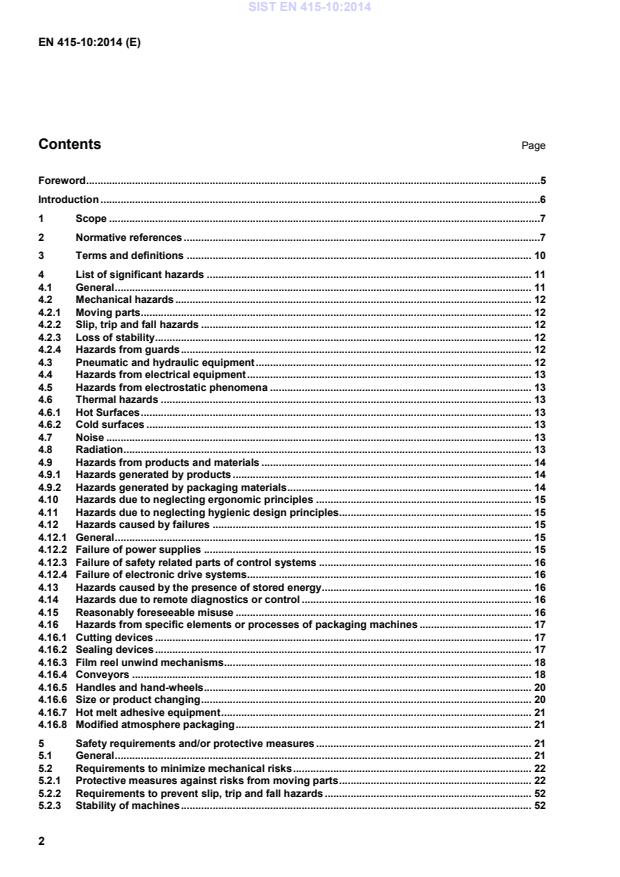
Foreword .5 Introduction .6 1 Scope .7 2 Normative references .7 3 Terms and definitions . 10 4 List of significant hazards . 11 4.1 General . 11 4.2 Mechanical hazards . 12 4.2.1 Moving parts . 12 4.2.2 Slip, trip and fall hazards . 12 4.2.3 Loss of stability . 12 4.2.4 Hazards from guards . 12 4.3 Pneumatic and hydraulic equipment . 12 4.4 Hazards from electrical equipment . 13 4.5 Hazards from electrostatic phenomena . 13 4.6 Thermal hazards . 13 4.6.1 Hot Surfaces . 13 4.6.2 Cold surfaces . 13 4.7 Noise . 13 4.8 Radiation . 13 4.9 Hazards from products and materials . 14 4.9.1 Hazards generated by products . 14 4.9.2 Hazards generated by packaging materials . 14 4.10 Hazards due to neglecting ergonomic principles . 15 4.11 Hazards due to neglecting hygienic design principles. 15 4.12 Hazards caused by failures . 15 4.12.1 General . 15 4.12.2 Failure of power supplies . 15 4.12.3 Failure of safety related parts of control systems . 16 4.12.4 Failure of electronic drive systems. 16 4.13 Hazards caused by the presence of stored energy. 16 4.14 Hazards due to remote diagnostics or control . 16 4.15 Reasonably foreseeable misuse . 16 4.16 Hazards from specific elements or processes of packaging machines . 17 4.16.1 Cutting devices . 17 4.16.2 Sealing devices . 17 4.16.3 Film reel unwind mechanisms . 18 4.16.4 Conveyors . 18 4.16.5 Handles and hand-wheels . 20 4.16.6 Size or product changing . 20 4.16.7 Hot melt adhesive equipment . 21 4.16.8 Modified atmosphere packaging . 21 5 Safety requirements and/or protective measures . 21 5.1 General . 21 5.2 Requirements to minimize mechanical risks . 22 5.2.1 Protective measures against risks from moving parts . 22 5.2.2 Requirements to prevent slip, trip and fall hazards . 52 5.2.3 Stability of machines . 52 SIST EN 415-10:2014
Evaluation of energy or force . 87 Annex B (informative)
Maximum values for inherently safe design . 88 Annex ZA (informative)
Relationship between this European Standard and the Essential
Requirements of EU Directive 2006/42/EC . 89 Bibliography . 92
EN 415-10. The requirements of the machine specific parts of EN 415 may supplement or modify the corresponding clauses of EN 415-10. The machinery concerned and the extent to which hazards, hazardous situations and events are covered are indicated in the scope of this standard. When provisions of this Type C standard are different from those, which are stated in Type A or B standards, the provisions of this Type C standard take precedence. SIST EN 415-10:2014
1) This standard is impacted by the stand-alone amendment EN 60204-1:2006/A1:2009, Safety of machinery Electrical equipment of machines Part 1: General requirements (EN 60204-1:2005/A1:2008) 2) This standard is impacted by the stand-alone amendment EN 60529:1991/A1:2000, Degrees of protection provided by enclosures (IP Code) (IEC 60529:1989/A1:1999) and EN 60529:1991/A2:2013, Degrees of protection provided by enclosures (IP Code) (IEC 60529:1989/A2:2013). SIST EN 415-10:2014
EN 60204-1:2006, EN 415-1 and the following apply. 3.1 change parts machine parts designed to handle a specific product, packaging material or pack size that are changed when the machine is set up to handle a different product, packaging material or pack size 3.2 film compensator device which maintains a constant film tension 3.3 film reel mandrel device which may be fixed to the machine or which is loose and which supports a reel of film 3.4 hot melt adhesive adhesive that is solid at room temperature and which can be applied at elevated temperature 3.5 minimum distance calculated distance between the safeguard and the hazard zone necessary to prevent a person or part of a person reaching the hazard zone before the termination of the hazardous machine function
3) This standard is impacted by the stand-alone amendment EN ISO 14122-1:2001/A1:2010, Safety of machinery Permanent means of access to machinery Part 1: Choice of fixed means of access between two levels Amendment 1 (ISO 14122-1:2001/Amd 1:2010). SIST EN 415-10:2014
The combined safety-related parts of a control system start at the point where the safety-related input signals are initiated (including, for example, the actuating cam and the roller of the position switch) and end at the output of the power control elements (including, for example, the main contacts of a contactor). Note 2 to entry:
If monitoring systems are used for diagnostics, they are also considered as SRP/CS. [SOURCE: EN ISO 13849-1:2008, 3.1.1] 3.11 strap band of material, usually made from mild steel, polypropylene or polyester, which is passed around a group of products, tensioned and then sealed to hold the products together 3.12 teleservice machine control mode where faults can be diagnosed, parameters changed and machine functions can be initiated from a remote location Note 1 to entry: Collecting data or monitoring machine parameters is not considered as teleservice. 4 List of significant hazards 4.1 General This clause lists all the significant hazards, hazardous situations and events that can be found on most packaging machines. SIST EN 415-10:2014
...