


prEN 593
(Main)Industrial valves - Metallic butterfly valves
Industrial valves - Metallic butterfly valves
This document specifies minimum requirements applicable to design, final assessment, designation, marking and documentation for butterfly valves having metallic bodies for use with all type of pipe end connections (e.g. wafer, lug, flange, butt welding) and used for isolating, regulating or control applications.
The PN and Class ranges are:
— PN 2,5; PN 6; PN 10; PN 16; PN 25; PN 40; PN 63; PN 100; PN 160;
— Class 150; Class 300; Class 600; Class 900.
The size range is:
— DN 20; DN 25; DN 32; DN 40; DN 50; DN 65; DN 80; DN 100; DN 125; DN 150; DN 200; DN 250; DN 300; DN 350; DN 400; DN 450; DN 500; DN 600; DN 700; DN 750; DN 800; DN 900; DN 1 000; DN 1 050; DN 1 100; DN 1 200; DN 1 400; DN 1 500; DN 1 600; DN 1 800; DN 2 000; DN 2 200; DN 2 400; DN 2 600; DN 2 800; DN 3 000; DN 3 200; DN 3 400; DN 3 600; DN 3 800; DN 4 000.
DN 750 and DN 1 050 are used only for Class 150 and Class 300.
Intermediate DNs are allowed upon agreement at the time of order.
Potential fields of application and their application standards that apply together with this document are listed below:
— applications with a maximum allowable pressure PS greater than 0,5 bar in accordance with the European legislation for pressure equipment, the applicable provisions of EN 16668 apply;
NOTE 1 Exclusions are given in the European legislation for pressure equipment.
— chemical applications, the applicable provisions of EN 12569 apply;
— gas distribution systems, the applicable provisions of EN 13774 apply;
— water supply application, the provisions of EN 1074-1 and EN 1074-2 apply;
— process control application, the provisions of EN 1349 and EN 60534-2-1 apply.
NOTE 2 The minimum requirements specified in Clauses 4, 5, 6, 7.1 and 8 are considered as "sound engineering practice" and are to be taken into account to ensure safe use.
NOTE 3 The range of DN, applicable to each PN, for wafer and wafer lug valve types is as given in the appropriate part of EN 1092 for Type 11 flanges for the applicable material. The range of DN, applicable to each PN, for flanged valve types is as given in the appropriate part of EN 1092 for Type 21 flanges for the applicable material.
The correspondence between DN and NPS is given for information in Annex D.
Industriearmaturen - Metallische Klappen
Robinetterie industrielle - Robinets métalliques à papillon
Industrijski ventili - Kovinske zaporne lopute
General Information
- Status
- Not Published
- Publication Date
- 08-Jul-2026
- Technical Committee
- CEN/TC 69 - Industrial valves
- Drafting Committee
- CEN/TC 69/WG 4 - Butterfly valves
- Current Stage
- 4599 - Dispatch of FV draft to CMC - Finalization for Vote
- Start Date
- 08-Jan-2026
- Due Date
- 23-Mar-2023
- Completion Date
- 08-Jan-2026
Relations
- Effective Date
- 28-Jan-2026
- Referred By
EN ISO 20109:2025 - Simultaneous interpreting - Equipment - Requirements (ISO 20109:2025) - Effective Date
- 28-Jan-2026
- Effective Date
- 18-Nov-2020
Overview
prEN 593:2025 (draft) - Industrial valves: Metallic butterfly valves - is a CEN document that defines minimum requirements for the design, final assessment, designation, marking and documentation of metallic-body butterfly valves. It covers valve types with various pipe end connections (wafer, lug, flanged, butt-weld, threaded) used for isolating, regulating or control applications across a wide size and pressure range (PN 2.5 up to PN 160 and Class 150–900; DN 20 up to DN 4000, with DN 750 and DN 1050 limited to Class 150/300). prEN 593:2025 is intended to supersede EN 593:2017 and to be used together with EN 16668:2025 where EU pressure-equipment rules apply.
Key topics and technical requirements
- Design requirements for shell, body, obturator (disc), seat seal, driving shaft, shaft seal and optional features.
- Materials and corrosion protection: minimum provisions for shell/trim materials and protective measures.
- Pressure/temperature ratings and compatibility with PN/Class ratings and DN ranges.
- Dimensions and tolerances (face-to-face, end-to-end, flanged/wafer/welding/threaded ends) aligned with EN 558 and EN 1092 series.
- Operation and functional performance: operational capability, manual or power actuators, flow characteristics.
- Manufacturing & testing: welding, NDT, heat treatment, traceability and final assessment procedures.
- Marking, designation and documentation requirements (including mandatory and supplementary marking and a valve data sheet).
- Annexes and guidance: trim material list, environmental corrosion protection, DN⇄NPS correspondence, shaft calculation example and relationship to EN 16668:2025.
Practical applications and users
prEN 593 is applicable to butterfly valves used for isolating, regulating or control duties across industrial sectors. It is most relevant to:
- Valve manufacturers for product design, testing and CE/market compliance.
- Specifiers and procurement teams creating technical requirements and purchase orders.
- EPC contractors, plant designers and asset owners in water supply, chemical processing, gas distribution/transport and process control systems.
- Inspection and conformity bodies assessing valves under the Pressure Equipment Directive (where PS > 0.5 bar).
Keywords: metallic butterfly valves, industrial valves, valve design, pressure ratings, PN/Class, DN sizes, wafer valve, lug valve, flanged valve, prEN 593.
Related standards
- EN 16668:2025 (pressure equipment requirements) - applies together with prEN 593 for PED-relevant applications
- EN 12569 (chemical), EN 13774 / EN 1594 (gas systems), EN 1074 (water supply), EN 1349 and EN 60534-2-1 (process control)
- Normative refs used: EN 19, EN 558, EN 1092 series, EN ISO 5211, EN 10269, EN ISO 10497 and related valve standards.

Get Certified
Connect with accredited certification bodies for this standard

Institut za varilstvo d.o.o. (Welding Institute)
Slovenia's leading welding institute since 1952. ISO 3834, EN 1090, pressure equipment certification, NDT personnel, welder qualification. Only IIW Au
Sponsored listings
Frequently Asked Questions
prEN 593 is a draft published by the European Committee for Standardization (CEN). Its full title is "Industrial valves - Metallic butterfly valves". This standard covers: This document specifies minimum requirements applicable to design, final assessment, designation, marking and documentation for butterfly valves having metallic bodies for use with all type of pipe end connections (e.g. wafer, lug, flange, butt welding) and used for isolating, regulating or control applications. The PN and Class ranges are: — PN 2,5; PN 6; PN 10; PN 16; PN 25; PN 40; PN 63; PN 100; PN 160; — Class 150; Class 300; Class 600; Class 900. The size range is: — DN 20; DN 25; DN 32; DN 40; DN 50; DN 65; DN 80; DN 100; DN 125; DN 150; DN 200; DN 250; DN 300; DN 350; DN 400; DN 450; DN 500; DN 600; DN 700; DN 750; DN 800; DN 900; DN 1 000; DN 1 050; DN 1 100; DN 1 200; DN 1 400; DN 1 500; DN 1 600; DN 1 800; DN 2 000; DN 2 200; DN 2 400; DN 2 600; DN 2 800; DN 3 000; DN 3 200; DN 3 400; DN 3 600; DN 3 800; DN 4 000. DN 750 and DN 1 050 are used only for Class 150 and Class 300. Intermediate DNs are allowed upon agreement at the time of order. Potential fields of application and their application standards that apply together with this document are listed below: — applications with a maximum allowable pressure PS greater than 0,5 bar in accordance with the European legislation for pressure equipment, the applicable provisions of EN 16668 apply; NOTE 1 Exclusions are given in the European legislation for pressure equipment. — chemical applications, the applicable provisions of EN 12569 apply; — gas distribution systems, the applicable provisions of EN 13774 apply; — water supply application, the provisions of EN 1074-1 and EN 1074-2 apply; — process control application, the provisions of EN 1349 and EN 60534-2-1 apply. NOTE 2 The minimum requirements specified in Clauses 4, 5, 6, 7.1 and 8 are considered as "sound engineering practice" and are to be taken into account to ensure safe use. NOTE 3 The range of DN, applicable to each PN, for wafer and wafer lug valve types is as given in the appropriate part of EN 1092 for Type 11 flanges for the applicable material. The range of DN, applicable to each PN, for flanged valve types is as given in the appropriate part of EN 1092 for Type 21 flanges for the applicable material. The correspondence between DN and NPS is given for information in Annex D.
This document specifies minimum requirements applicable to design, final assessment, designation, marking and documentation for butterfly valves having metallic bodies for use with all type of pipe end connections (e.g. wafer, lug, flange, butt welding) and used for isolating, regulating or control applications. The PN and Class ranges are: — PN 2,5; PN 6; PN 10; PN 16; PN 25; PN 40; PN 63; PN 100; PN 160; — Class 150; Class 300; Class 600; Class 900. The size range is: — DN 20; DN 25; DN 32; DN 40; DN 50; DN 65; DN 80; DN 100; DN 125; DN 150; DN 200; DN 250; DN 300; DN 350; DN 400; DN 450; DN 500; DN 600; DN 700; DN 750; DN 800; DN 900; DN 1 000; DN 1 050; DN 1 100; DN 1 200; DN 1 400; DN 1 500; DN 1 600; DN 1 800; DN 2 000; DN 2 200; DN 2 400; DN 2 600; DN 2 800; DN 3 000; DN 3 200; DN 3 400; DN 3 600; DN 3 800; DN 4 000. DN 750 and DN 1 050 are used only for Class 150 and Class 300. Intermediate DNs are allowed upon agreement at the time of order. Potential fields of application and their application standards that apply together with this document are listed below: — applications with a maximum allowable pressure PS greater than 0,5 bar in accordance with the European legislation for pressure equipment, the applicable provisions of EN 16668 apply; NOTE 1 Exclusions are given in the European legislation for pressure equipment. — chemical applications, the applicable provisions of EN 12569 apply; — gas distribution systems, the applicable provisions of EN 13774 apply; — water supply application, the provisions of EN 1074-1 and EN 1074-2 apply; — process control application, the provisions of EN 1349 and EN 60534-2-1 apply. NOTE 2 The minimum requirements specified in Clauses 4, 5, 6, 7.1 and 8 are considered as "sound engineering practice" and are to be taken into account to ensure safe use. NOTE 3 The range of DN, applicable to each PN, for wafer and wafer lug valve types is as given in the appropriate part of EN 1092 for Type 11 flanges for the applicable material. The range of DN, applicable to each PN, for flanged valve types is as given in the appropriate part of EN 1092 for Type 21 flanges for the applicable material. The correspondence between DN and NPS is given for information in Annex D.
prEN 593 is classified under the following ICS (International Classification for Standards) categories: 23.060.30 - Gate valves. The ICS classification helps identify the subject area and facilitates finding related standards.
prEN 593 has the following relationships with other standards: It is inter standard links to EN ISO 24019:2022, EN ISO 20109:2025, EN 593:2017. Understanding these relationships helps ensure you are using the most current and applicable version of the standard.
prEN 593 is associated with the following European legislation: EU Directives/Regulations: 2014/68/EU; Standardization Mandates: M/071, M/601. When a standard is cited in the Official Journal of the European Union, products manufactured in conformity with it benefit from a presumption of conformity with the essential requirements of the corresponding EU directive or regulation.
prEN 593 is available in PDF format for immediate download after purchase. The document can be added to your cart and obtained through the secure checkout process. Digital delivery ensures instant access to the complete standard document.
Standards Content (Sample)
SLOVENSKI STANDARD
01-junij-2025
Industrijski ventili - Kovinske zaporne lopute
Industrial valves - Metallic butterfly valves
Industriearmaturen - Metallische Klappen
Robinetterie industrielle - Robinets métalliques à papillon
Ta slovenski standard je istoveten z: prEN 593
ICS:
23.060.30 Zapirni ventili (zasuni) Gate valves
2003-01.Slovenski inštitut za standardizacijo. Razmnoževanje celote ali delov tega standarda ni dovoljeno.
DRAFT
EUROPEAN STANDARD
NORME EUROPÉENNE
EUROPÄISCHE NORM
June 2025
ICS Will supersede EN 593:2017
English Version
Industrial valves - Metallic butterfly valves
Robinetterie industrielle - Robinets métalliques à Industriearmaturen - Metallische Klappen
papillon
This draft European Standard is submitted to CEN members for enquiry. It has been drawn up by the Technical Committee
CEN/TC 69.
If this draft becomes a European Standard, CEN members are bound to comply with the CEN/CENELEC Internal Regulations
which stipulate the conditions for giving this European Standard the status of a national standard without any alteration.
This draft European Standard was established by CEN in three official versions (English, French, German). A version in any other
language made by translation under the responsibility of a CEN member into its own language and notified to the CEN-CENELEC
Management Centre has the same status as the official versions.
CEN members are the national standards bodies of Austria, Belgium, Bulgaria, Croatia, Cyprus, Czech Republic, Denmark, Estonia,
Finland, France, Germany, Greece, Hungary, Iceland, Ireland, Italy, Latvia, Lithuania, Luxembourg, Malta, Netherlands, Norway,
Poland, Portugal, Republic of North Macedonia, Romania, Serbia, Slovakia, Slovenia, Spain, Sweden, Switzerland, Türkiye and
United Kingdom.
Recipients of this draft are invited to submit, with their comments, notification of any relevant patent rights of which they are
aware and to provide supporting documentation.
Warning : This document is not a European Standard. It is distributed for review and comments. It is subject to change without
notice and shall not be referred to as a European Standard.
EUROPEAN COMMITTEE FOR STANDARDIZATION
COMITÉ EUROPÉEN DE NORMALISATION
EUROPÄISCHES KOMITEE FÜR NORMUNG
CEN-CENELEC Management Centre: Rue de la Science 23, B-1040 Brussels
© 2025 CEN All rights of exploitation in any form and by any means reserved Ref. No. prEN 593:2025 E
worldwide for CEN national Members.
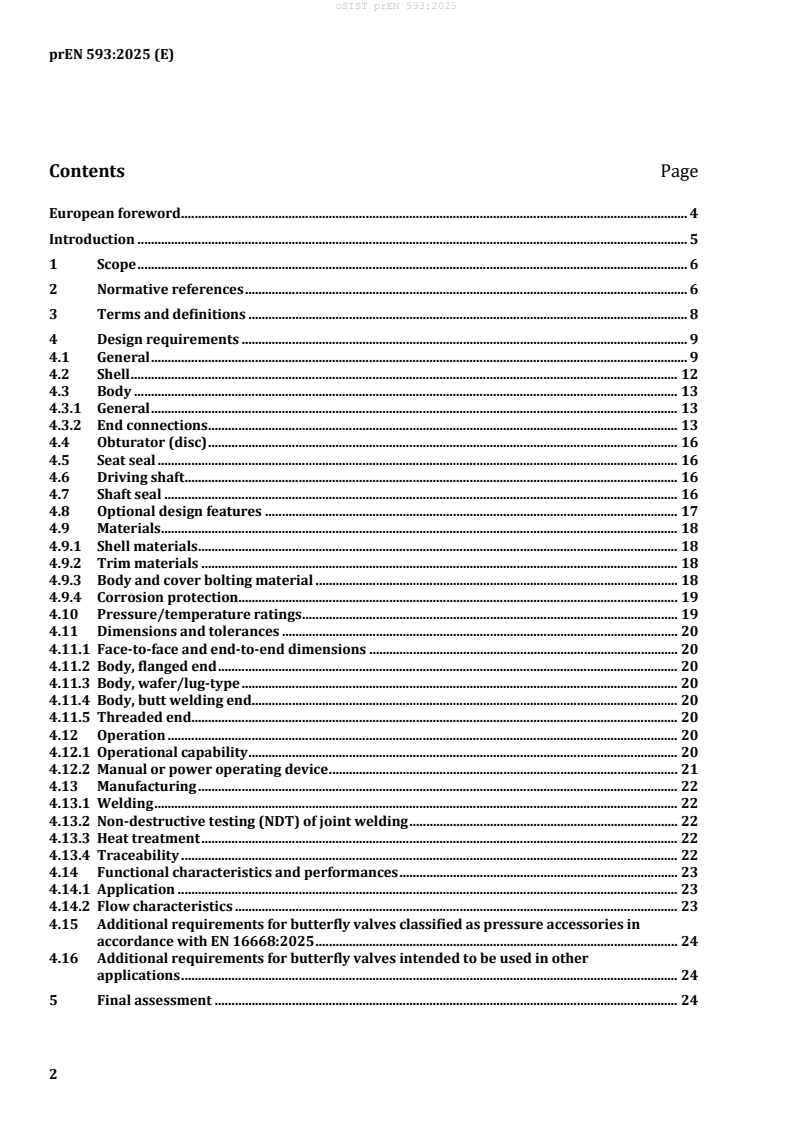
Contents Page
European foreword . 4
Introduction . 5
1 Scope . 6
2 Normative references . 6
3 Terms and definitions . 8
4 Design requirements . 9
4.1 General . 9
4.2 Shell . 12
4.3 Body . 13
4.3.1 General . 13
4.3.2 End connections . 13
4.4 Obturator (disc) . 16
4.5 Seat seal . 16
4.6 Driving shaft . 16
4.7 Shaft seal . 16
4.8 Optional design features . 17
4.9 Materials . 18
4.9.1 Shell materials . 18
4.9.2 Trim materials . 18
4.9.3 Body and cover bolting material . 18
4.9.4 Corrosion protection. 19
4.10 Pressure/temperature ratings . 19
4.11 Dimensions and tolerances . 20
4.11.1 Face-to-face and end-to-end dimensions . 20
4.11.2 Body, flanged end . 20
4.11.3 Body, wafer/lug-type . 20
4.11.4 Body, butt welding end. 20
4.11.5 Threaded end. 20
4.12 Operation . 20
4.12.1 Operational capability . 20
4.12.2 Manual or power operating device . 21
4.13 Manufacturing . 22
4.13.1 Welding . 22
4.13.2 Non-destructive testing (NDT) of joint welding . 22
4.13.3 Heat treatment . 22
4.13.4 Traceability . 22
4.14 Functional characteristics and performances . 23
4.14.1 Application . 23
4.14.2 Flow characteristics . 23
4.15 Additional requirements for butterfly valves classified as pressure accessories in
accordance with EN 16668:2025 . 24
4.16 Additional requirements for butterfly valves intended to be used in other
applications . 24
5 Final assessment . 24
6 Designation . 25
7 Marking and preparation for storage and transportation . 25
7.1 Marking . 25
7.1.1 Mandatory marking . 25
7.1.2 Supplementary marking . 26
7.2 Preparation for storage and transportation . 26
8 Documentation . 26
Annex A (informative) Valve data sheet . 27
Annex B (informative) Trim material list . 29
Annex C (informative) Environmental corrosion protection . 30
Annex D (informative) Correspondence between DN and NPS . 31
Annex E (informative) Example for valve shaft calculation . 32
E.1 General . 32
E.2 Calculation. 33
E.2.1 Shear stress . 33
E.2.2 Combined shear stress (at valve bearing) (section 2-2). 33
E.2.3 Combined tensile stress at seating due to torsion and bending (section 2-2) . 33
E.2.4 Shear stress at reduced area (sections 1-1, 3-3, 4-4) . 34
E.3 Examples of influence of flow velocity/hydrodynamic torques for shaft sizing . 34
Annex F (informative) Relationship between this document and EN 16668:2025 . 37
Annex ZA (informative) Relationship between this European Standard and the essential
requirements of Directive 2014/68/EU (Pressure Equipment Directive) aimed to be
covered . 39
Bibliography . 41
European foreword
This document (prEN 593:2025) has been prepared by Technical Committee CEN/TC 69 “Industrial
valves”, the secretariat of which is held by AFNOR.
This document is currently submitted to the CEN Enquiry.
This document will supersede EN 593:2017.
This document includes the following significant technical changes with respect to EN 593:2017:
a) inclusion of an introduction to explain the reason of this revision;
b) the inclusion of a sentence in the scope to clarify that this document applies to all industrial
applications;
c) addition of new 4.15 and 5.3 on the design requirements and final assessment for the European
legislation for pressure equipment;
d) addition of a new Clause 8 for the documentation;
e) addition of Annex F providing the relationship between the clauses/subclauses of this document and
those of EN 16668:2025;
f) update of Annex ZA.
This document has been prepared under a standardization request addressed to CEN by the European
Commission. The Standing Committee of the EFTA States subsequently approves these requests for its
Member States.
For the relationship with EU Legislation, see informative Annex ZA, which is an integral part of this
document.
Introduction
This document was revised to refer to EN 16668:2025 for those requirements related to the European
legislation for pressure equipment applicable to butterfly valves.
EN 16668:2025 was drafted to cover the requirements for the European legislation on Pressure
Equipment. Therefore, for the applications in accordance with the European legislation for pressure
equipment, EN 16668:2025 applies together with this document.
Annex F provides the relationship between the clauses/subclauses of this document and those of
EN 16668:2025.
NOTE Annex ZA of this document is identical to Annex ZA of EN 16668:2025, for those requirements
applicable to butterfly valves.
1 Scope
This document specifies minimum requirements applicable to design, final assessment, designation,
marking and documentation for butterfly valves having metallic bodies for use with all type of pipe end
connections (e.g. wafer, lug, flange, butt welding, threaded ends) and used for isolating, regulating or
controlling applications.
The PN and Class ranges are:
— PN 2,5; PN 6; PN 10; PN 16; PN 25; PN 40; PN 63; PN 100; PN 160;
— Class 150; Class 300; Class 600; Class 900.
The size range is:
— DN 20; DN 25; DN 32; DN 40; DN 50; DN 65; DN 80; DN 100; DN 125; DN 150; DN 200; DN 250;
DN 300; DN 350; DN 400; DN 450; DN 500; DN 600; DN 700; DN 750; DN 800; DN 900; DN 1 000;
DN 1 050; DN 1 100; DN 1 200; DN 1 400; DN 1 500; DN 1 600; DN 1 800; DN 2 000; DN 2 200;
DN 2 400; DN 2 600; DN 2 800; DN 3 000; DN 3 200; DN 3 400; DN 3 600; DN 3 800; DN 4 000.
DN 750 and DN 1 050 apply only for Class 150 and Class 300.
NOTE 1 Sizes are listed in Table D.1.
For applications in accordance with the European legislation for pressure equipment, EN 16668:2025
applies together with this document.
NOTE 2 Exclusions are given in the European legislation for pressure equipment.
For chemical applications, EN 12569:2020 apply together with this document.
For gas distribution systems, EN 13774:2013 apply together with this document.
For gas transport systems, EN 1594:2024 apply together with this document.
For water supply application, EN 1074-1:2000 and EN 1074-2:2000 apply together with this document.
For process control application, EN 1349:2009 and EN 60534-2-1:2011 apply together with this
document.
The correspondence between DN and NPS is given for information in Annex D.
2 Normative references
The following documents are referred to in the text in such a way that some or all of their content
constitutes requirements of this document. For dated references, only the edition cited applies. For
undated references, the latest edition of the referenced document (including any amendments) applies.
EN 19:2023, Industrial valves - Marking of metallic valves
EN 558:2022, Industrial valves — Face-to-face and centre-to-face dimensions of metal valves for use in
flanged pipe systems — PN and Class designated valves
EN 736-1:2018, Valves - Terminology - Part 1: Definition of types of valves
EN 736-2:2016, Valves - Terminology - Part 2: Definition of components of valves
EN 736-3:2008, Valves - Terminology - Part 3: Definition of terms
EN 764-1:2015+A1:2016, Pressure equipment - Part 1: Vocabulary
EN ISO 1043-1:2011, Plastics - Symbols and abbreviated terms - Part 1: Basic polymers and their special
characteristics (ISO 1043-1:2011)
EN 1074-2:2000, Valves for water supply — Fitness for purpose requirements and appropriate verification
tests — Part 2: Isolating valves
EN 1092-1:2018, Flanges and their joints - Circular flanges for pipes, valves, fittings and accessories, PN
designated - Part 1: Steel flanges
EN 1092-2:2023, Flanges and their joints - Circular flanges for pipes, valves, fittings and accessories, PN
designated - Part 2: Cast iron flanges
EN 1092-3:2003, Flanges and their joints - Circular flanges for pipes, valves, fittings and accessories, PN
designated - Part 3: Copper alloy flanges
EN 1092-4:2002, Flanges and their joints - Circular flanges for pipes, valves, fittings and accessories, PN
designated - Part 4: Aluminium alloy flanges
EN 1267:2012, Industrial valves - Test of flow resistance using water as test fluid
EN 1349:2009, Industrial process control valves
EN 1759-1:2004, Flanges and their joint - Circular flanges for pipes, valves, fittings and accessories, Class
designated - Part 1: Steel flanges, NPS 1/2 to 24
EN 1759-3:2003, Flanges and their joints - Circular flanges for pipes, valves, fittings and accessories, Class
designated - Part 3: Copper alloy flanges
EN 1759-4:2003, Flanges and their joint - Circular flanges for pipes, valves, fittings and accessories, class
designated - Part 4: Aluminium alloy flanges
EN ISO 5211:2023, Industrial valves — Part-turn actuator attachments (ISO 5211:2023)
EN 10269:2013, Steels and nickel alloys for fasteners with specified elevated and/or low temperature
properties
EN ISO 10497:2022, Testing of valves — Fire type-testing requirements (ISO 10497:2022)
EN 12266-1:2012, Industrial valves - Testing of metallic valves - Part 1: Pressure tests, test procedures and
acceptance criteria - Mandatory requirements
EN 12266-2:2012, Industrial valves - Testing of metallic valves - Part 2: Tests, test procedures and
acceptance criteria - Supplementary requirements
EN 12516-1:2014+A1:2018, Industrial valves - Shell design strength - Part 1: Tabulation method for steel
valve shells
EN 12516-2:2014+A1:2021, Industrial valves - Shell design strength - Part 2: Calculation method for steel
valve shells
EN 12516-3:2002, Valves - Shell design strength - Part 3: Experimental method
Document impacted by EN 1074-2:2000/A1:2004.
EN 12516-4:2014+A1:2018, Industrial valves - Shell design strength - Part 4: Calculation method for valve
shells manufactured in metallic materials other than steel
EN 12569:2020, Industrial valves - Valves for chemical and petrochemical process industry - Requirements
and tests
EN 12570:2000, Industrial valves — Method for sizing the operating element
EN 12627:2017, Industrial valves - Butt welding ends for steel valves
EN 12982:2009, Industrial valves - End-to-end and centre-to-end dimensions for butt welding end valves
EN 13774:2013, Valves for gas distribution systems with maximum operating pressure less than or equal to
16 bar - Performance requirements
EN 16668:2025, Industrial valves - Requirements and testing for metallic valves as pressure accessories
EN 16722:2015, Industrial valves - End-to-end and centre-to-end dimensions for valves with threaded ends
EN 60534-2-3:2016, Industrial-process control valves - Part 2-3: Flow capacity - Test procedures
EN IEC 60534-4:2022, Industrialprocess control valves – Part 4: Inspection and routine testing
ISO 1629:2025, Rubber and latices — Nomenclature
3 Terms and definitions
For the purposes of this document the terms and definitions given in EN 736-1:2018, EN 736-2:2016,
EN 736-3:2008, EN 764-1:2015+A1:2016 and the following apply.
ISO and IEC maintain terminological databases for use in standardization at the following addresses:
— ISO Online browsing platform: available at https://www.iso.org/obp
— IEC Electropedia: available at http://www.electropedia.org/
3.1
butterfly valve
valve in which the obturator rotates about an axis at right angle to the direction of flow and, in the open
position, the flow passes around the obturator, designed as double flange body, single flanged body, lug
type body, wafer type body or with butt weld ends
[SOURCE: EN 736-1:2018, 4.1.5, EN 736-2:2016, 3.1.1.4 to 3.1.1.7, 3.1.1.12]
3.2
maximum allowable pressure
PS
maximum pressure for which the pressure equipment is designed
[SOURCE: EN 764-1:2015+A1:2016, 3.2.87 – “as specified by the manufacturer” deleted.]
3.3
maximum allowable temperature
TS
max
maximum temperature for which the pressure equipment is designed
[SOURCE: EN 764-1:2015+A1:2016, 3.1.9 – “as specified by the manufacturer” deleted.]
3.4
end of line service
condition that occurs when the downstream side of the valve is opened to atmosphere
3.5
driving shaft
shaft connected to the obturator to operate the valve in the case of a multi-shaft valve
3.6
trim
functional components of a valve excluding the shell components which are in contact with the fluid
inside the valve
[SOURCE: EN 736-2:2016, 3.2]
3.7
eccentration
offset
deviation of the operating axes in respect to the reference axes of the pipe/valve
3.8
body bolting
bolting which connects the body components
4 Design requirements
4.1 General
The requirements of the design shall be agreed. For this purpose, it is recommended to use the valve data
sheet (including for service conditions) in accordance with Annex A.
The valve shall be of either concentric design (see Figure 1) or eccentric design (see Figures 2 to 4). The
offset can be single, double or triple.
A first offset is an axial offset of the shaft to the seat contact.
A second offset is an offset from the pipe centreline to the valve obturator centreline.
In the triple offset design, the seat and seal contact surface centreline is inclined in respect to the
pipe/valve centreline, whatever the form of the contact.
Figure 1 — Concentric design
Key
e eccentricity 1
Figure 2 — Single eccentric design (single offset)
Key
e1 eccentricity 1
e eccentricity 2
Figure 3 — Double eccentric design (double offset)
Key
e eccentricity 1
e eccentricity 2
e3 eccentricity 3
Figure 4 — Triple eccentric design (triple offset)
The design details are not specified in this document.
The butterfly valve can be:
— soft sealing; or
— metallic sealing.
NOTE The choice of design and material depends on the design working temperature and the physical and
chemical characteristics of the fluid.
This document does not cover the dimensioning procedures of parts, except the shell, using materials
other than those specified in EN 12516-1:2014+A1:2018, EN 12516-2:2014+A1:2021, EN 12516-3:2002
or EN 12516-4:2014+A1:2018.
The design of the parts other than the shell is determined for a differential pressure defined by the
pressure/temperature rating or for a differential pressure which shall be indicated on the valve.
In the framework of the environmental urgency and sustainability requirements, the butterfly valve shall
be designed to be easily repairable, durable, recyclable; spare parts shall be made available.
The engineering best practices are applicable (for example, number of screw threads engaged, two screw
threads overrun, …).
4.2 Shell
4.2.1 The shell is the combination of valve components comprising the pressure containing envelope,
like:
— the body and the body bolting if any,
— the retaining elements of the shaft seal ring,
— the cover and the cover bolting if any,
— if used in end of line service, the obturator (disc).
4.2.2 The shell strength shall be determined:
a) according to EN 12516-2:2014+A1:2021 for steel valves, and EN 12516-4:2014+A1:2018, 5.5.1, for
copper alloy, aluminium and cast iron valves, for the permissible membrane stress;
b) according to EN 16668:2025, 5.1.2.1.
4.2.3 For applications out of the scope of the European legislation for pressure equipment, the
following standards shall apply:
a) for steel valves designed by the tabulation method: according to EN 12516-1:2014+A1:2018;
b) for steel valves designed by calculation solely: according to EN 12516-2:2014+A1:2021;
c) for copper alloy, aluminium and cast iron valves: according to EN 12516-4:2014+A1:2018;
d) an experimental method: according to EN 12516-3:2002.
4.2.4 Other dimensioning methods (i.e. finite elements) are not specified in this document.
If the foreseeable conditions lead to the assumption that the allowable limits will be exceeded, then the
design shall take this into account.
NOTE See Annex F showing the relationship between this document and EN 16668:2025 requirements
concerning dimensioning.
4.3 Body
4.3.1 General
Flanges of double flanged valves and single flange wafer valves shall have bolt holes in accordance with
the relevant standard as specified in 4.11.2. Threaded holes can be provided where the design of the valve
precludes through flange bolting.
Flangeless wafer valves (see Figure 6) are intended for clamping between pipe flanges using through
bolting. The shape of wafer valve bodies shall be such that centring of the valves within the appropriate
flange bolt circle is ensured. Where through bolting is not practicable due to the valve design, e.g. close
to shaft passages, threaded holes can be provided for individual bolting.
Lugged or single flange wafer valves (see Figure 7) are supplied with threaded or through holes for
installation between two flanged components or at the end of a pipeline (i.e. end of line service or
downstream dismantling).
Threaded holes shall allow full thread engagement to a depth at least equal to the nominal bolt diameter
and at least 0,67 of the bolt diameter when the bolt hole is adjacent to the valve shaft.
For Class designed valves threaded body flange holes for bolts 1 inch or less in diameter shall be drilled
and tapped in accordance with UNC coarse thread series, Class 2B (see ASME B1.1:2024). For bolts 1 1/8
inches or more in diameter, such holes shall be drilled and tapped in accordance with UN 8 thread series,
Class 2B (see ASME B1.1:2024). Other threads shall be specified.
The literature shall be consulted to determine if through bolting or/and end of line assembly is possible.
Any limitation regarding end of line service condition shall be indicated.
Elastomeric or plastic linings and liners can be extended over the flange faces of the body to form a gasket
for the flange.
4.3.2 End connections
End connections shall be either one of the following.
a) Double flanged butterfly valve: butterfly valve having double flanged body ends for connection to
flanges of adjacent components by individual bolting (see Figure 5).
b) Wafer butterfly valve: butterfly valve intended for clamping between flanges of adjacent
components.
NOTE Different body shapes are possible: see Figures 6 and 7 a) to g).
c) Butt welding end butterfly valve: butterfly valve intended for butt welding into a pipeline
(see Figure 8).
d) Mechanical connection for loose flange connection: butterfly valve with one or both loose flanges for
compensation of piping alignment (see Figure 9). The loose flange shall be pullout proof.
e) Mechanical connection: butterfly valve with one or two interfaces for connection of piping
(see Figures 10 and 11). The connection shall be spigot end or socket end. Requirements and test
methods of mechanical joints are described in EN 545:2010. The connection can be pullout proof.
f) Threaded ends butterfly valve: butterfly valve intended to be threaded onto the pipeline (see
Figure 12).
Figure 5 — Double flanged body Figure 6 — Flangeless wafer body
a) Valve with central lugs b) Central single flange valve
c) Valve with lugs with internally threaded d) Single-flange valve with internally
holes threaded holes
e) Valve with lugs with drilled holes f) Single-flange valve with drilled holes
g) Valve with U-section
Figure 7 — Wafer valve bodies bolting configurations
Figure 8 — Butt welding end body
Figure 9 — Loose-flange design Figure 10 — Socket-socket Figure 11 — Spigot-socket
design design
Figure 12 — Threaded ends design
4.4 Obturator (disc)
The obturator (often named disc) can be with or without seal.
The technical documentation shall specify all necessary dimensions showing the protrusion of the
obturator in the open position beyond the faces of the valve.
4.5 Seat seal
The technical documentation shall specify whether the seat seal
— is a body liner by design, or
— is located in the body or on the obturator.
The liner/lining can have additional functions, including sealing the driving shaft and flange.
The valve documentation shall specify the seat materials and if the sealing element is replaceable or not.
4.6 Driving shaft
The external end of the driving shaft shall indicate the orientation of the obturator.
The choice of the shaft material depends on the design working temperature and the physical and
chemical characteristics of the fluid.
Valve shafts shall be sized for the maximum design torque at seating operation and at obturator position
of highest combined dynamic and bearing torques with a safety factor. The value of this safety factor
depends on the calculation method of the driving shaft. An example of calculation method is given in
Annex E.
The connection between the shaft and the obturator shall be designed to transmit the shaft torque with
the same safety factor. Higher flow velocities than defined in Table 1 can cause higher dynamic torques
(see examples in Annex E).
The outside end of the shaft shall indicate by design or marking the position of the obturator. Where
required by the design of valve, the operating instructions shall specify the method to preserve the
indication of the obturator position, during and after re-assembly of the obturator to the shaft, e.g. for
routine maintenance.
The sealing of the shaft shall remain leak tight to atmosphere when the operating device is removed.
The shaft shall be retained in the valve, so it cannot be ejected out of the body when external parts are
removed. It shall be in accordance with EN 736-3:2008.
External parts as stated in EN 736-3:2008, 3.3.7, are parts which are not included in the bare shaft valve
e.g. bracket, lever, actuator.
4.7 Shaft seal
The shaft seal tightness shall remain unchanged when the actuating device is removed.
The shaft seal is not part of the shell.
4.8 Optional design features
a) Fire type tested design: valves designated as fire type tested design shall be tested in accordance with
EN ISO 10497:2022.
If valves are required to be a fire type tested design, this requirement shall be specified (see Annex A).
b) Anti-static design: valves with anti-static design shall have electrical continuity between shaft,
obturator and body in accordance with EN 12266-2:2012.
If valves are required to be an anti-static design, this requirement shall be specified (see Annex A).
c) Valves can be designed with a blocking device of the shaft which fixes the open or close position for
maintenance purposes of the gearbox by an external blocking device. See Figure 13.
d) Valves can be designed with a blocking device which fixes the obturator in closed and tight position
independently of the function of the actuator. The blocking device acts as a safety device.
See Figure 14.
Key
1 external blocking device
Figure 13 — Blocking device of the shaft
Figure 14 — Blocking device of the obturator
4.9 Materials
4.9.1 Shell materials
4.9.1.1 Materials for the shell components shall be selected from those described in
EN 12516-1:2014+A1:2018, for steel valves, or EN 12516-4:2014+A1:2018, for copper alloy, aluminium
and cast iron valves.
NOTE See Annex F for the requirements of EN 16668:2025 for the shell materials for valves subject to the
European legislation for pressure equipment.
4.9.1.2 Other materials can be used providing that they are appropriate to the intended use.
4.9.2 Trim materials
The trim shall comprise the following:
a) obturator (disc); except in case of end of line (part of the shell in that case);
b) body or obturator seats;
b) shaft and seat seals;
c) shafts;
d) bushes;
e) shaft/obturator connecting parts;
f) seat/obturator seal clamping rings;
g) clamping ring bolting;
h) body lining/coating;
i) obturator linings/coatings.
The technical documentation shall specify the relevant materials for the trim parts.
NOTE See Annex B.
The materials of seat and seal can be elastomeric, plastic, composite, graphite, metallic or a combination
of these materials.
The technical documentation shall specify the material type of the seat or liner or seal.
4.9.3 Body and cover bolting material
Material selection for body and cover bolting shall be in accordance with EN 10269:2013.
Other bolting materials may be used providing that they are appropriate to the intended use.
EN 1515-4:2021 provides a possible selection of bolting for equipment subject to the European
legislation for pressure equipment.
NOTE See Annex F for the requirements of EN 16668:2025 for the bolting materials for valves subject to the
European legislation for pressure equipment.
4.9.4 Corrosion protection
4.9.4.1 The choice of materials and/or surface protection methods used shall be included in the
technical documentation and may be subject to agreement at the time of order.
a) External corrosion protection: valve shells shall be protected against corrosion by proper material
selection or surface treatment.
Specific surface treatment system shall be subject to agreement.
Annex C contains information on the definition of the corrosion category and information on surface
treatment prior to the application of corrosion protection.
Test assessment and test procedures are not specified in this document.
b) Internal corrosion protection: all surfaces in contact with the fluid shall be protected against
corrosion by suitable material selection or surface treatment (see Annex B) or agreed at the time of
order.
NOTE See Annex F for the requirements of EN 16668:2025 for corrosion protection for valves subject to the
European legislation for pressure equipment.
4.9.4.2 Corrosion allowance shall be considered in the calculation of the shell strength according to:
a) EN 12516-1:2014+A1:2018, 8.1;
b) EN 12516-2:2014+A1:2021, Clause 4;
c) EN 12516-4:2014+A1:2018, Clause 4.
4.10 Pressure/temperature ratings
The pressure/temperature rating shall be as specified in one of the following standards:
a) steel materials: EN 12516-1:2014+A1:2018 or EN 1092-1:2018 for the particular body/bonnet
material group;
b) cast iron materials: EN 1092-2:2023;
c) copper alloy materials: EN 1092-3:2003 for PN-designated valves; EN 1759-3:2003 for
Class-designated flanged valves;
d) aluminium alloys: EN 1092-4:2002 for PN-designated valves, EN 1759-4:2003 for Class-designated
flanged valves.
Where restrictions on pressure and/or temperature are necessary on valves by reason of valve type, trim
materials or other factors, the maximum allowable pressure and/or temperature is marked on the valve
in accordance with 7.1.2 and is added in the designation of the valve in accordance with Clause 6 i).
4.11 Dimensions and tolerances
4.11.1 Face-to-face and end-to-end dimensions
The list of DNs are given in Clause 1. Intermediate DNs are allowed upon agreement.
NOTE 1 The range of DN, applicable to each PN, for wafer and wafer lug valve types is as given in
EN 1092-1:2018, EN 1092-2:2023, EN 1092-3:2003, EN 1092-4:2002 for Type 11 flanges for the applicable
material.
NOTE 2 The range of DN, applicable to each PN, for flanged valve types is as given in EN 1092-1:2018,
EN 1092-2:2023, EN 1092-3:2003, EN 1092-4:2002 for Type 21 flanges for the applicable material.
The face-to-face dimensions and tolerances for flanged and wafer type butterfly valves shall be selected
from EN 558:2022 for PN- and Class-designated valves.
The end-to-end dimensions and tolerances for butt welding end butterfly valves shall be selected from
EN 12982:2009.
The face-to-face or end-to-end dimension for DN lower or larger than those defined in EN 558:2022 or
EN 12982:2009 shall be specified.
For spigot and mechanical joint, the end-to-end dimensions can be according to the technical
documentation.
For loose flange connection, the end-to-end dimensions can be according to EN 558:2022, series 14, but
with a higher length tolerance for pipe assembling.
4.11.2 Body, flanged end
Flanged end facing dimension shall be in accordance with:
a) EN 1092-1:2018, EN 1092-2:2023, EN 1092-3:2003 and EN 1092-4:2002 for PN-designated valves;
b) EN 1759-1:2004, EN 1759-3;2003 and EN 1759-4:2003 for Class-designated valves.
4.11.3 Body, wafer/lug-type
Lugged or single flanged body facing dimension shall be such that the body can be clamped or installed
by bolting between respectively adjacent flanges in accordance with:
a) EN 1092-1:2018, EN 1092-2:2023, EN 1092-3:2003 and EN 1092-4:2002 for PN-designated
butterfly valves;
b) EN 1759-1:2004, EN 1759-3:2003 and EN 1759-4:2003 for Class-designated butterfly valves.
4.11.4 Body, butt welding end
Butt welding end shape shall be in accordance with EN 12627:2017.
4.11.5 Threaded end
Threaded end shape shall be in accordance with EN 16722:2015.
4.12 Operation
4.12.1 Operational capability
All butterfly valves shall be capable of being operated from fully closed to fully open, and vice-versa, at a
differential pressure across the obturator equal to the maximum allowable pressure, PS at 20 °C or as
marked on the valve, taking into account the limits in flow velocity given in Table 1.
4.12.2 Manual or power operating device
4.12.2.1 Direct manual actuation
Direct manual actuation can be lever, handwheel or T-wrench.
Where a lever is used, the valve shall be open when the lever is parallel to the pipe.
When intermediate position is specified, means of securing the valve obturator in intermediate positions
shall be provided.
See 4.12.2.4.
4.12.2.2 Direct actuation by power actuator
The design of the valve shall allow, with or without an intermediate part, mounting of a part-turn actuator
complying with EN ISO 5211:2023.
NOTE 1 The part-turn actuator is suitable for operation with electric, pneumatic, hydraulic, etc. motive
energy or a combination thereof.
NOTE 2 Requirements concerning power actuator for valves are provided in EN 15714-1:2009,
EN 15714-3:2022, EN 15714-4:2009, EN 15714-5:2022, EN 15714-6:2022, EN ISO 22153:2021.
4.12.2.3 Gear actuation
The manual gear actuator shall be of self-locking movement design (in any position) and shall be provided
with stops in the two extreme travel positions.
Adjustable stop(s) shall be set and secured in a reliable way.
The gear actuator shall be fitted with a position indicator.
On request, the number of turns that are necessary to complete a full opening or closing operation shall
be supplied.
The design of the valve shall allow, with or without an intermediate part, mounting of a gear actuator
with a plate complying with EN ISO 5211:2023.
See 4.12.2.4.
NOTE Requirements concerning gearbox for valves are provided in EN ISO 22109:2020.
4.12.2.4 Sizing the operating element
For any manual operation of valves, the minimum size of the operating element shall be in accordance
with EN 12570:2000. The size of the operating element shall be selected such that the valve can be
operated:
a) when the allowable differential pressure is equal to the maximum allowable pressure, and
b) taking into account the effect of the maximum value between the medium dynamic torque due to
flow velocity and the friction torques.
When specified by the customer, it is allowed to size an actuator based on a reduced differential pressure
taking into account the effect of the medium dynamic torque.
Safety factors for operating element for specific applications are given in ISO 5115:2023.
According to 7.1, the actual differential pressure shall be marked on the valve.
4.12.2.5 Direction of operation
Manually operated valves and bare shaft valves shall normally be closed by turning the handwheel or
lever or the shaft in a clockwise direction when facing the handwheel or lever or the shaft end.
If anti-clockwise closing is required, this shall be specified and marked on the operating element.
4.12.2.6 Valve supplied bare shaft
When, on request, a butterfly valve without an operating device is supplied, the following shall be
provided:
a) the necessary torque value, based on the maximum flow velocities as specified in Table 1;
b) the maximum allowable pressure, PS at 20 °C;
c) the maximum differential pressure marked on the valve;
d) the direction of operation to close the valve;
e) the shaft end dimensions according to EN ISO 5211:2023 or other as required.
4.13 Manufacturing
4.13.1 Welding
4.13.1.1 General
The provisions concerning welding requirements
...
Questions, Comments and Discussion
Ask us and Technical Secretary will try to provide an answer. You can facilitate discussion about the standard in here.
Loading comments...