

EN 17478:2021
(Main)Transport Services - Customer communications for passenger transport services - A Universal Design approach
- Abstract
This document specifies requirements and recommendations for the planning, design, development and provision of user communications related to passenger transport so that these communications can be accessed, understood and used by the widest range of users, including persons with disabilities and older persons.
These requirements and recommendations enable an organization to extend its range of users by identifying diverse characteristics, capabilities, and preferences.
The requirements specified in this standard are applicable to but not limited to passenger transport service providers including air-, bus, rail-, and waterborne passenger transport services.
- Status
- Published
- Publication Date
- 21-Dec-2021
- Withdrawal Date
- 29-Jun-2022
- Technical Committee
- CEN/TC 320 - Transport - Logistics and services
- Drafting Committee
- CEN/TC 320 - Transport - Logistics and services
- Current Stage
- 6060 - Definitive text made available (DAV) - Publishing
- Start Date
- 22-Dec-2021
- Due Date
- 23-Jul-2021
- Completion Date
- 22-Dec-2021

Overview
EN 17478:2021 - published by CEN - defines a Universal Design approach for customer communications in passenger transport services. The standard specifies requirements and recommendations for planning, designing, developing and delivering communications so information about travel can be accessed, understood and used by the widest range of users, including persons with disabilities and older persons. It applies to passenger transport providers (air, bus, rail, waterborne) and supports inclusive, interoperable multi‑modal trip information.
Key Topics and Requirements
- Universal Design framework: adoption of the 7 Universal Design principles and associated 29 guidelines to make communications equitable, flexible and easy to use.
- Scope of communications covered: written, verbal and digital media, including signage, printed materials, web content, mobile apps, emails, electronic documents, text/instant messaging and telephone-based systems.
- Design and content rules: guidance on text clarity, dates/numbers, graphics, layout, colour/contrast, tactile markings, signage positioning and form design to improve readability and comprehension.
- Digital accessibility: web and mobile guidance (structure, navigation, forms, multimedia, time‑outs, search) and recommendations for electronic documents and social media communication.
- Verbal and auditory guidance: recommendations for personal conversations and public announcements to ensure intelligibility and usability for diverse listeners.
- User-centred planning: identification of user characteristics, capabilities and preferences, and methods for engaging experts and end users during design.
- Evaluation and monitoring: requirements for measuring, analysing and improving communication effectiveness and compliance with Universal Design objectives.
- Supporting material: informative annexes (business case, mapping tables, and detailed guidance - Annexes F, G, H cover written, verbal and digital communication).
Applications and Who Uses It
- Transport operators and service providers (airlines, rail companies, bus and ferry operators) use EN 17478 to design inclusive customer-facing information.
- Communications and UX teams implement the standard’s design, content and digital guidelines.
- Procurement officers and policy makers reference the standard when specifying accessible services or public tenders.
- Accessibility officers and compliance teams use the evaluation and monitoring sections to measure accessibility outcomes.
- Wayfinding and signage designers, contact centre managers, and app developers use the practical annex guidance for implementation.
Related Standards (if applicable)
EN 17478 complements existing accessibility and transport regulations and is commonly used alongside web and digital accessibility guidance and national transport accessibility requirements to create consistent, inclusive customer communications.
Keywords: EN 17478:2021, Universal Design, passenger transport services, customer communications, accessible communications, CEN standard, transport operators, digital accessibility.
Relations
- Effective Date
- 28-Jan-2026
Get Certified
Connect with accredited certification bodies for this standard

BSI Group
BSI (British Standards Institution) is the business standards company that helps organizations make excellence a habit.

Great Wall Tianjin Quality Assurance Center
Established 1993, first batch to receive national accreditation with IAF recognition.
Hong Kong Quality Assurance Agency (HKQAA)
Hong Kong's leading certification body.
Sponsored listings
Frequently Asked Questions
EN 17478:2021 is a standard published by the European Committee for Standardization (CEN). Its full title is "Transport Services - Customer communications for passenger transport services - A Universal Design approach". This standard covers: This document specifies requirements and recommendations for the planning, design, development and provision of user communications related to passenger transport so that these communications can be accessed, understood and used by the widest range of users, including persons with disabilities and older persons. These requirements and recommendations enable an organization to extend its range of users by identifying diverse characteristics, capabilities, and preferences. The requirements specified in this standard are applicable to but not limited to passenger transport service providers including air-, bus, rail-, and waterborne passenger transport services.
This document specifies requirements and recommendations for the planning, design, development and provision of user communications related to passenger transport so that these communications can be accessed, understood and used by the widest range of users, including persons with disabilities and older persons. These requirements and recommendations enable an organization to extend its range of users by identifying diverse characteristics, capabilities, and preferences. The requirements specified in this standard are applicable to but not limited to passenger transport service providers including air-, bus, rail-, and waterborne passenger transport services.
EN 17478:2021 is classified under the following ICS (International Classification for Standards) categories: 03.220.01 - Transport in general; 35.240.60 - IT applications in transport. The ICS classification helps identify the subject area and facilitates finding related standards.
EN 17478:2021 has the following relationships with other standards: It is inter standard links to EN 17161:2019. Understanding these relationships helps ensure you are using the most current and applicable version of the standard.
EN 17478:2021 is available in PDF format for immediate download after purchase. The document can be added to your cart and obtained through the secure checkout process. Digital delivery ensures instant access to the complete standard document.
Standards Content (Sample)
SLOVENSKI STANDARD
01-marec-2022
Transportne storitve - Strankine komunikacije pri storitvah potniškega prometa -
Pristop s splošno zasnovo
Transport Services - Customer communications for passenger transport services - A
Universal Design approach
Dienstleistungen im Transportwesen - Kundenkommunikation für Dienstleistungen im
Personenverkehr - Ein Universal Design-Ansatz
Services de transport - Communications destinées aux clients de services de transport
collectif - Une approche de conception universelle
Ta slovenski standard je istoveten z: EN 17478:2021
ICS:
03.220.01 Transport na splošno Transport in general
35.240.60 Uporabniške rešitve IT v IT applications in transport
prometu
2003-01.Slovenski inštitut za standardizacijo. Razmnoževanje celote ali delov tega standarda ni dovoljeno.
EN 17478
EUROPEAN STANDARD
NORME EUROPÉENNE
December 2021
EUROPÄISCHE NORM
ICS 03.220.01; 35.240.60
English Version
Transport Services - Customer communications for
passenger transport services - A Universal Design
approach
Services de transport - Communications destinées aux Dienstleistungen im Transportwesen -
clients de services de transport collectif - Une approche Kundenkommunikation für Dienstleistungen im
de conception universelle Personenverkehr - Ein Universal Design-Ansatz
This European Standard was approved by CEN on 3 October 2021.
CEN members are bound to comply with the CEN/CENELEC Internal Regulations which stipulate the conditions for giving this
European Standard the status of a national standard without any alteration. Up-to-date lists and bibliographical references
concerning such national standards may be obtained on application to the CEN-CENELEC Management Centre or to any CEN
member.
This European Standard exists in three official versions (English, French, German). A version in any other language made by
translation under the responsibility of a CEN member into its own language and notified to the CEN-CENELEC Management
Centre has the same status as the official versions.
CEN members are the national standards bodies of Austria, Belgium, Bulgaria, Croatia, Cyprus, Czech Republic, Denmark, Estonia,
Finland, France, Germany, Greece, Hungary, Iceland, Ireland, Italy, Latvia, Lithuania, Luxembourg, Malta, Netherlands, Norway,
Poland, Portugal, Republic of North Macedonia, Romania, Serbia, Slovakia, Slovenia, Spain, Sweden, Switzerland, Turkey and
United Kingdom.
EUROPEAN COMMITTEE FOR STANDARDIZATION
COMITÉ EUROPÉEN DE NORMALISATION
EUROPÄISCHES KOMITEE FÜR NORMUNG
CEN-CENELEC Management Centre: Rue de la Science 23, B-1040 Brussels
© 2021 CEN All rights of exploitation in any form and by any means reserved Ref. No. EN 17478:2021 E
worldwide for CEN national Members.
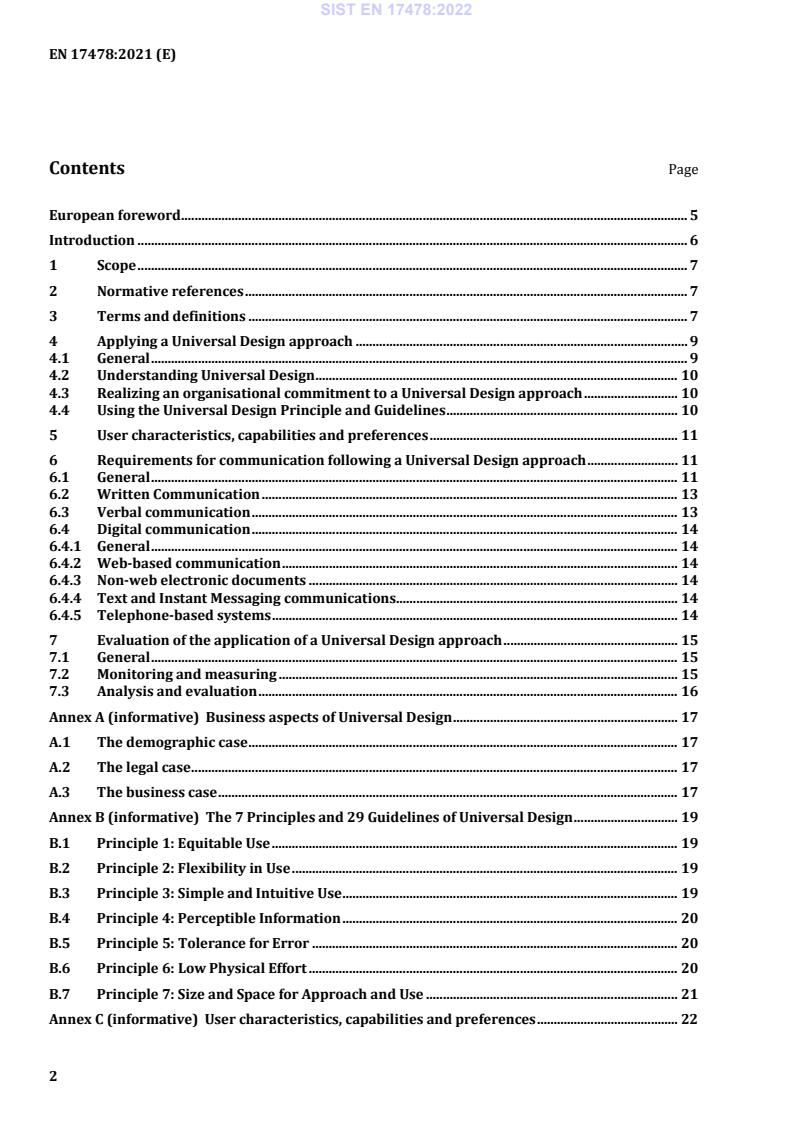
Contents Page
European foreword . 5
Introduction . 6
1 Scope . 7
2 Normative references . 7
3 Terms and definitions . 7
4 Applying a Universal Design approach . 9
4.1 General . 9
4.2 Understanding Universal Design . 10
4.3 Realizing an organisational commitment to a Universal Design approach . 10
4.4 Using the Universal Design Principle and Guidelines . 10
5 User characteristics, capabilities and preferences . 11
6 Requirements for communication following a Universal Design approach . 11
6.1 General . 11
6.2 Written Communication . 13
6.3 Verbal communication . 13
6.4 Digital communication . 14
6.4.1 General . 14
6.4.2 Web-based communication . 14
6.4.3 Non-web electronic documents . 14
6.4.4 Text and Instant Messaging communications . 14
6.4.5 Telephone-based systems . 14
7 Evaluation of the application of a Universal Design approach . 15
7.1 General . 15
7.2 Monitoring and measuring . 15
7.3 Analysis and evaluation . 16
Annex A (informative) Business aspects of Universal Design . 17
A.1 The demographic case . 17
A.2 The legal case . 17
A.3 The business case . 17
Annex B (informative) The 7 Principles and 29 Guidelines of Universal Design . 19
B.1 Principle 1: Equitable Use . 19
B.2 Principle 2: Flexibility in Use . 19
B.3 Principle 3: Simple and Intuitive Use . 19
B.4 Principle 4: Perceptible Information . 20
B.5 Principle 5: Tolerance for Error . 20
B.6 Principle 6: Low Physical Effort . 20
B.7 Principle 7: Size and Space for Approach and Use . 21
Annex C (informative) User characteristics, capabilities and preferences . 22
C.1 General . 22
C.2 Resources about user characteristics and capabilities . 22
C.3 Expert Knowledge . 23
C.4 Direct engagement with users . 23
Annex D (informative) Tables for using the Universal Design Principles and Guidelines in
passenger transport services communication design. 26
Annex E (informative) Tables mapping the Universal Design Principles and Guidelines to
the design guidance in Annexes F, G and H. 30
E.1 General . 30
E.2 Purpose and structure of the tables . 30
E.3 Content of the Tables . 31
E.4 Order of the Tables . 31
Annex F (informative) Written communication . 47
F.1 General . 47
F.2 Written communication content . 47
F.2.1 Text . 47
F.2.2 Dates, numbers and percentages . 47
F.2.3 Graphics . 48
F.3 Design, layout and formatting . 48
F.4 Paper and binding . 49
F.5 Form Design . 49
F.6 Signage Guidance . 49
F.6.1 Content . 49
F.6.2 Design . 50
F.6.3 Tactile markings . 50
F.6.4 Positioning . 50
F.6.5 Colours, images, graphs and visuals . 50
Annex G (informative) Verbal communication . 51
G.1 General . 51
G.2 Personal conversation . 51
G.3 Auditory announcements . 52
Annex H (informative) Digital communication . 53
H.1 General . 53
H.2 Websites . 53
H.2.1 General . 53
H.2.2 Writing for the web . 53
H.2.3 Design . 54
H.2.4 Links . 54
H.2.5 Structure . 54
H.2.6 Website navigation . 54
H.2.7 Online forms. 54
H.2.8 Time-out messages . 55
H.2.9 Search . 55
H.2.10 Images and multimedia . 55
H.3 Mobile web content and apps . 56
H.4 Emails and newsletters . 56
H.5 Electronic documents . 56
H.6 Telephone Based Systems . 57
H.7 Text and Instant Messaging Communication . 57
H.8 Social Media Guidance . 58
Bibliography . 59
European foreword
This document (EN 17478:2021) has been prepared by Technical Committee CEN/TC 320 “Transport -
Logistics and services”, the secretariat of which is held by NEN.
This European Standard shall be given the status of a national standard, either by publication of an
identical text or by endorsement, at the latest by June 2022, and conflicting national standards shall be
withdrawn at the latest by June 2022.
Attention is drawn to the possibility that some of the elements of this document may be the subject of
patent rights. CEN shall not be held responsible for identifying any or all such patent rights.
Any feedback and questions on this document should be directed to the users’ national standards body.
A complete listing of these bodies can be found on the CEN website.
According to the CEN-CENELEC Internal Regulations, the national standards organisations of the
following countries are bound to implement this European Standard: Austria, Belgium, Bulgaria, Croatia,
Cyprus, Czech Republic, Denmark, Estonia, Finland, France, Germany, Greece, Hungary, Iceland, Ireland,
Italy, Latvia, Lithuania, Luxembourg, Malta, Netherlands, Norway, Poland, Portugal, Republic of North
Macedonia, Romania, Serbia, Slovakia, Slovenia, Spain, Sweden, Switzerland, Turkey and the United
Kingdom.
Introduction
Transport is fundamental to our economy and society. Mobility is vital for the internal market and for the
quality of life of citizens as they enjoy their freedom to travel. One of the critical success factors for
mobility is the possibility that information relating to travel can be accessed, understood and used. This
relies on the availability of accessible and usable, adequate and interoperable multi-modal trip
information for planning and making a journey.
Ineffective user communications in many situations result in a number of users unable to travel
independently. Providing services that can be easily accessed, understood and used benefits a wide range
of users including young persons, persons with disabilities, older persons and persons who cannot read
for various reasons (for example, due to not being a user of the language used, intellectual disability, or
illiteracy) who are an important part of the users of the public transportation means. The rationale for
Universal Design is that user communications are more accessible and usable by the widest range of
users, without the need for additional adaptation or specialized design. It should be possible to use
assistive devices when needed.
Procurement and in particular public procurement can play a key role in ensuring a sustainable and
inclusive society. It is a requirement in the public procurement process to take into account accessibility
criteria for persons with disabilities or design for all users in the transport sector . Applying a Universal
Design approach can support meeting these requirements and extend the range of users and support
innovation and sustainable development.
The term ‘user’ is used throughout this document. A ‘user’, in the context of this document, is a person
who interacts with communications provided by transport services providers. It includes; a person who
avails of a transport service (a passenger or a customer); a person who will potentially avail of a transport
service; a person acting on behalf of another person who will (potentially) avail of a transport service;
and a person interacting with transport communications for other reasons (such as to determine when a
person who is availing of a transport service arrives at a station). Therefore the term ‘user’ is broader
than the term ‘customer’ – it could be any member of the public
‘User communications’ does not include communications within a transport services provider’s
organization, nor communications between transport services providers and contractors or state
agencies.
Communication, in the context of this document, includes one-way communication – (the provision of)
information.
Directive 2014/25/EU of the European Parliament and of the Council of 26 February 2014 on procurement by entities
operating in the water, energy, transport and postal services sectors and repealing Directive 2004/17/EC
1 Scope
This document specifies requirements and recommendations for the planning, design, development and
provision of user communications related to passenger transport so that these communications can be
accessed, understood and used by the widest range of users, including persons with disabilities and older
persons.
These requirements and recommendations enable an organization to extend its range of users by
identifying diverse characteristics, capabilities, and preferences.
The requirements specified in this standard are applicable to but not limited to passenger transport
service providers including air-, bus, rail-, and waterborne passenger transport services.
2 Normative references
The following documents are referred to in the text in such a way that some or all of their content
constitutes requirements of this document. For dated references, only the edition cited applies. For
undated references, the latest edition of the referenced document (including any amendments) applies.
EN 17161:2019, Design for All - Accessibility following a Design for All approach in products, goods and
services - Extending the range of users
EN 301549:2021, Accessibility requirements for ICT products and services
3 Terms and definitions
For the purposes of this document, the following terms and definitions apply.
ISO and IEC maintain terminological databases for use in standardization at the following addresses:
— ISO Online browsing platform: available at https://www.iso.org/obp
— IEC Electropedia: available at https://www.electropedia.org/
3.1
accessibility
extent to which products, systems, services, environments and facilities can be used by people from a
population with the widest range of user needs, characteristics and capabilities to achieve identified goals
in identified contexts of use
Note 1 to entry: Context of use includes direct use or use supported by assistive technologies.
[SOURCE: EN ISO 9241-112:2017, 3.15]
3.2
assistive technology
equipment, product system, hardware, software or service that is used to increase, maintain or improve
capabilities of individuals
Note 1 to entry: Assistive technology is an umbrella term that is broader than assistive products.
Note 2 to entry: Assistive technology can include assistive services, and professional services needed for
assessment, recommendation and provision.
[SOURCE: CEN-CENELEC Guide 6:2014, 2.16]
3.3
interoperable
ability of two or more systems or components to exchange information and then to be able to use the
information that has been exchanged
[SOURCE: ISO 15784-2:2015, 4.8, Modified – Note 2 to entry deleted]
3.4
organization
person or group of people that has its own functions with responsibilities, authorities and relationships
to achieve its objectives
Note 1 to entry: The concept of organization includes but is not limited to sole-trader, company, corporation,
firm, enterprise, authority, partnership, association, charity or institution, or part or combination thereof, whether
incorporated or not, public or private.
[SOURCE: ISO 9000:2015, 3.2.1]
3.5
pictogram
graphical symbol, diagram or figure with a particular meaning which directly represents or conveys its
meaning independently of language through a pictorial representation of a physical object, action or
character
Note 1 to entry: Refer to ISO 7001:2007, ISO 9186-1 and ISO 9186-2 for rules regarding graphical symbols and
frames.
[SOURCE: EN 16584-2:2017, 3.16, Note 1 to entry modified]
3.6
tactile
information that is understood through the physical sense of touch
Note 1 to entry: Tactile signs, controls, symbols, pictograms, guide path and Braille or raised characters are a
physical means by which tactile information is provided.
[SOURCE: EN 16584-2:2017, 3.26]
3.7
Universal Design
design of products, environments, programmes and services to be usable by all people, to the greatest
extent possible, without the need for adaptation or specialized design
Note 1 to entry: Universal Design does not exclude assistive devices for particular groups or persons with
disabilities where this is needed.
Note 2 to entry: Terms such as ‘Universal Design’, ‘accessible design’, ‘Design for All’, ‘barrier-free design’,
‘inclusive design’ and ‘transgenerational design’ are often used interchangeably with the same meaning.
[SOURCE: United Nations Convention on the Rights of Persons with Disabilities, Art. 2, modified —
Note 2 to entry has been added]
[SOURCE: CEN-CENELEC Guide 6:2014, 2.18]
3.8
usability
extent to which a system, product or service can be used by specified users to achieve specified goals with
effectiveness, efficiency and satisfaction in a specified context of use
[SOURCE: EN ISO 9241-11:2018, 3.1.1, modified – notes deleted]
3.9
user
person who interacts with a system, product or service
Note 1 to entry: The person who uses a service provided by a system, such as a customer in a shop or passenger
on a train, can be considered a user.
[SOURCE: ISO 27500:2016, 2.12]
3.10
written communication
communication in which messages or information is exchanged or communicated through written words,
letters, numerals, pictograms and markings
4 Applying a Universal Design approach
4.1 General
A Universal Design approach shall be applied as set out in EN 17161 to the planning, design, development
and provision of user communications so that they can be accessed, understood and used by all users to
the greatest extent possible, without the need for adaptation or specialized design.
A Universal Design approach is a process that focusses on accessibility and usability from the earliest
possible time and throughout all stages in the life of products and services, and their interoperability with
assistive technologies.
NOTE ‘Accessed, understood and used’ is about how people generally interact with a product or service: first,
they access it (approach and perceive); secondly, they understand it (comprehend and decide); and thirdly, they
use it (act or react).
In applying a Universal Design approach:
— it shall be ensured that the goal of Universal Design approach is understood;
— a commitment to a Universal Design approach shall be made and realized;
— the relevant Universal Design Principles and Guidelines shall be used in the planning, design,
development and provision of transport services user communications;
— the user’s characteristics and capabilities shall be known and considered during the planning, design,
development and provision of the user communications;
— the application of a Universal Design approach to the user communications shall be evaluated.
4.2 Understanding Universal Design
Universal Design, as applied to user communications, is to ensure a product or service can be accessed,
understood and used by all users to the greatest extent possible regardless of ambient conditions or the
user’s sensory abilities.
This can be achieved by:
— designing products and services that are easily accessed, understood and used without any
modification;
— making product and service designs adaptable to different users;
— having standardized interfaces that are compatible with assistive technologies.
4.3 Realizing an organisational commitment to a Universal Design approach
Top management shall demonstrate leadership and commitment with respect to a Universal Design
approach.
To demonstrate that leadership and commitment, top management, in relation to a Universal Design
approach, shall:
— allocate resources;
— assign responsibilities, tasks and accountabilities;
— support and monitor internal planning, design, development and provision;
— identify recruitment and training needs;
— put in place an ongoing training programme to ensure that staff are competent to meet the
requirements set out in Clause 6;
— define measurement and performance indicators;
— evaluate the effectiveness of the planning, design, development and provision activities;
— ensure that their contractors apply a Universal Design approach to the products and services
supplied to meet the requirements set out in Clause 6.
NOTE Information on the advantages of applying a Universal Design approach is provided in Annex A
(Universal Design makes good business sense).
4.4 Using the Universal Design Principle and Guidelines
Organisations shall identify the Universal Design Principles and Guidelines relevant to a design of
communications and use them as criteria in the design activities.
NOTE 1 Annex B lists the 7 Principles and 29 Guidelines of Universal Design.
All of the Universal Design Principles and guidelines can be applicable; Universal Design principles 2, 3,
4, and 5 are most relevant to designs for customer communications.
NOTE 2 Guidance on using the Universal Design Principles and Guidelines in the design and provision of
communications is provided in Annex D.
NOTE 3 Annex E contains tables that show examples of mapping of the alignment of the design guidance in
Annexes F, G and H to Universal Design Principles 2–5 and their associated Guidelines.
NOTE 4 Annex F through to Annex H provide detailed information and design guidance on Universal Design of
communications.
5 User characteristics, capabilities and preferences
In the planning, design, development and provision of communications:
— the characteristics, capabilities and preferences of the widest possible range of users shall be
determined and considered in design and development activities and included as criteria in the
procurement process;
— users with diverse characteristics and capabilities shall be involved early and throughout the design
and development process;
— relevant resources and expertise on user characteristics, capabilities and preferences shall be used
to inform design activities;
— feedback from current and potential users, including information about assistive technologies
relevant to its communications shall be used.
NOTE 1 Guidance and resources on user characteristics, capabilities and preferences are provided in Annex C
(User characteristics, capabilities and preferences).
NOTE 2 EN 17161:2019, Annex C provides information on design activities within projects.
NOTE 3 EN ISO 9241-210:2019 provides further information related to user characteristics and preferences.
In order to achieve a Universal Design approach, organisations should involve users, user representatives
and relevant experts throughout the design and development processes, such as during concept stage,
prototype evaluation, and current product or service testing.
6 Requirements for communication following a Universal Design approach
6.1 General
Transport services user communications shall be designed and provided so that they can be accessed,
understood and used by the widest range of users including persons with disabilities and older persons.
The primary means of accessing communications are visual, auditory, tactile or combinations thereof.
Transport services user communications shall be designed and provided so that they can be accessed,
understood and used through each of these three means by users of these services
All communications shall be:
— in simple and clear language;
— relevant;
— provided in a sequence that is appropriate for users with a diverse range of characteristics and
abilities;
— presented such that information provided can be accessed, understood and used by the users;
— provided to allow multiple means of information presentation and user interaction.
EXAMPLE 1 Multiple means of presentation of information on the approaching bus stop can be provided on
board a bus through the simultaneous display of text showing the approaching bus stop name and the playing of an
audio announcement of the approaching bus stop name. Multiple means of presentation allow the information to
reach users with more diverse range of characteristics and capabilities, as the communication can be accessed in
more than one way.
Notice of infrastructural outages shall be provided as soon as possible in order to minimise the impact on
users. Up-to-date communications on outages shall be available via numerous means of communication.
NOTE 1 Infrastructural outages can include elevators, travellators, electronic communication boards or
wheelchair ramps being out of operation.
User communications shall be acknowledged, and followed-up where appropriate. Responses to a user’s
communications shall be made using the same communication means used by the user, unless the user
requests otherwise. Confirmation shall also be provided to users when they make a purchase, through
communication means they have indicated appropriate.
Upon acceptance of a user’s request for assistance, the user shall be provided with confirmation that their
request has been actioned and with contact details to get further support regarding their request for
assistance. These requests for further support should be handled in real-time.
NOTE 2 Provision by a user of particular contact information does not indicate their ability to communicate by a
particular means. For example, a user may provide a telephone number, but not use it for text communications.
EXAMPLE 2 When a user requests, by post, information on the accessibility of a coach service, the user is sent
confirmation of the receipt of their request for information, by post. The user is also sent information on the
accessibility of the coach service, by post.
EXAMPLE 3 A user is sent confirmation of their online purchase of a ticket by text message where, during the
purchasing process, they have provided a phone number and indicated that they would like to receive confirmation
by text message.
The design requirements are organised in the general categories of written, verbal and digital
communication. These design requirements include requirements for ticketing, signage, symbols,
pictograms, architectural wayfinding, visual displays, real-time passenger information (RTPI), routes,
timetables and maps.
The environmental aspects where users interact with communications shall be taken into consideration.
NOTE 3 Environmental context, also referred to as ‘context of use’, includes technical, physical, social, cultural
and organizational conditions. Examples of physical conditions include lighting, positioning, ambient noise and
auditory levels.
NOTE 4 Positioning of the signage can include placement of the same signage at multiple heights.
NOTE 5 Each category of communication is supported by an annex that provides guidance to support the
requirements.
In the context of this document:
— written communication encompasses written text, document design, form design and signage;
— verbal communication encompasses telephone-, loudspeaker-, face-to-face-, text relay-and video-
communication, sign language and the ways in which the body communicates non-verbally;
— digital communication refers to all electronic communication and includes communication through
websites, mobile apps, emails, newsletters, telephone-based systems, instant messaging and social
media.
6.2 Written Communication
A Universal Design approach shall be applied to written communication for users.
Written communication encompasses written text, letters, numerals, pictograms, markings, document
design, form design and signage.
Written communication shall:
— be presented in a legible font using a high contrast with a clear layout;
— be provided to describe maps, figures and images;
— include a means to get further information or clarification.
NOTE Further design guidance and resources on the Universal Design of written communication can be found
in Annex F.
6.3 Verbal communication
In this document, verbal communication encompasses telephone-, loudspeaker-, face-to-face-, text relay-
and video-communication, sign language and the ways in which the body communicates non-verbally.
A Universal Design approach shall be applied to verbal communication for users.
In the provision of verbal communication:
— In one-to-one communication it shall be confirmed that users have understood the information
given;
— the ways in which the person communicates non-verbally shall be understood;
— awareness of communication needs of Deaf users and users that are hard of hearing shall be
implemented;
— use of a text relay service shall facilitated if it is available and its use is requested.
EXAMPLE A person communicates non-verbally through body movement, gesture, posture, appearance, eye
and physical contact, facial expression, proximity and orientation.
NOTE 1 A text relay service is a third-party system designed for use by people who are hard of hearing or deaf
as a means of communication through telephone.
NOTE 2 Further design guidance and resources on the Universal Design of verbal communication can be found
in Annex G.
6.4 Digital communication
6.4.1 General
A Universal Design approach shall be applied to digital communication with users, incorporating the
applicable requirements from 6.2 and 6.3.
Digital communication includes communication through websites, mobile apps, emails, digital
documents, telephone-based systems, instant messaging and social media.
All digital user communications shall comply with EN 301549:2021.
NOTE Further design guidance and resources on the Universal Design of digital communication can be found
in Annex H.
6.4.2 Web-based communication
Organisations’ web content shall be designed to conform to the requirements in EN 301549:2021,
Clause 9.
NOTE 1 Web content’ refers to any part of a website, including text, images, forms and multimedia, as well as any
markup code, scripts and applications. It includes web applications and mobile web applications.
NOTE 2 Conformance with Clauses 9.1 to 9.4 and the conformance requirements of EN 301549:2021, Clause 9.6
(which together comprise all of Clause 9) is equivalent to conformance with WCAG 2.1 Level AA.
NOTE 3 EN 301549 V3.2.1 is available, free of charge, at:
https://www.etsi.org/deliver/etsi_en/301500_301599/301549/03.02.01_60/en_301549v030201p.pdf.
6.4.3 Non-web electronic documents
Non-web electronic documents shall conform to the requirements in EN 301549:2021, Clause 10.
NOTE examples of non-web electronic documents are emails and movies that have an associated user agent
such as a document reader, editor or media player.
6.4.4 Text and Instant Messaging communications
Where text messaging or instant messaging is used, the message text shall meet the requirements in 6.2.
Where communications are sent to users through text or instant messaging, details shall be provided on
how the user can obtain clarifying information.
NOTE Guidance and resources for the Universal Design of digital text-based communication can be found in
Annex H.
6.4.5 Telephone-based systems
A Universal Design approach shall be applied to telephone-based systems such as Interactive Voice
Response System (IVR) or Call-Routing. Telephone based systems shall conform to the requirements in
EN 301549:2021, Clause 6.
Telephone based systems shall:
— provide at the start of the call the number of options the user will be presented with;
— where possible, limit options to those most frequently used by users, minimizing subsequent lower
levels per option;
— where a user fails to make a recognized choice from the options after these have been presented
three times, divert the user automatically to a call centre agent or provide an alternative means to
acquire the information needed;
— notify the user when they are being placed on hold and the expected holding/waiting time or their
place in the queue
— provide the user, while they are on hold, with frequent updates informing them that they are on hold
and the expected holding/waiting time or their place in the queue.
NOTE It is considered best practice to provide the user with (an) alternative option(s) to remaining on hold,
such as a call-back, each time an update is provided;
Where IVR or call-routing is provided, details of its IVR or call-routing shall be published on its website
and, where requested, in print.
7 Evaluation of the application of a Universal Design approach
7.1 General
The application of and effectiveness of a Universal Design approach shall be monitored, measured,
analysed and evaluated.
The effectiveness of the Universal Design approach shall be evaluated by determining how well transport
services user communications can be accessed, understood and used by persons with a diverse range of
characteristics, capabilities, and preferences.
7.2 Monitoring and measuring
Monitoring and measurement activities shall reflect the requirements of the passenger transport service
provider’s Universal Design approach.
The organization shall:
a) monitor and measure the applicable requirements in Clauses 4 and 6;
b) use methods for monitoring and measurement that can determine effectively whether transport
services user communications can be accessed, understood and used by persons with a diverse range
of characteristics, capabilities, and preferences’ including persons with disabilities and older
persons;
c) determine when to monitor and measure;
d) determine how to analyse results.
NOTE 1 Common methods for monitoring and measuring are electronic, postal, telephone, in-person and hybrid-
surveys.
NOTE 2 The tables in Annex E can be used as a tool for evaluating designs related to communication. They offer
a structure for evaluating the alignment of the user communications design with the design requirements in
Clause 6.
NOTE 3 The design requirements in Clause 6 and its associated Annex F, G and H provide design guidance
checklists and website links to tools that can be used to demonstrate implementation of Universal Design Principles
and Guidelines.
7.3 Analysis and evaluation
The effectiveness of the Universal Design approach with respect to 4.1 shall be analysed and evaluated.
The organization shall analyse and evaluate data and information arising from monitoring and measuring
and other relevant sources to assess the effectiveness of the Universal Design approach with respect to
4.1. Each of the different means of providing information shall be analysed and ev
...