

EN 17722:2024
(Main)Plant biostimulants - Determination of mycorrhizal fungi
General Information
- Abstract
This document specifies a horizontal method for the enumeration and genus/species determination [2], [3], [4] of mycorrhizal fungi in microbial plant biostimulants.
This document is applicable to the blends of fertilizing products where a blend is a mix of at least two of the following component EU fertilising products categories: Fertilizers, Liming Materials, Soil Improvers, Growing Media, Plant Biostimulants and where the following category Plant Biostimulants is the highest percentage in the blend by mass or volume, or in the case of liquid form by dry mass. If Plant Biostimulants is not the highest percentage in the blend, the European Standard for the highest percentage of the blend applies. In case a blend of fertilizing products is composed of components in equal quantity or in case the component EU fertilising products used for the blend have identical formulations , the user decides which standard to apply.
- Status
- Published
- Publication Date
- 26-Nov-2024
- Technical Committee
- CEN/TC 455 - Plant Biostimulants and Agricultural Micro-Organisms
- Drafting Committee
- CEN/TC 455/WG 3 - Pathogenic and non-pathogenic microorganisms
- Current Stage
- 6060 - Definitive text made available (DAV) - Publishing
- Start Date
- 27-Nov-2024
- Due Date
- 09-Apr-2024
- Completion Date
- 27-Nov-2024

Overview
EN 17722:2024 – Plant Biostimulants – Determination of Mycorrhizal Fungi is a comprehensive European Standard developed by CEN for the enumeration and genus/species determination of mycorrhizal fungi in microbial plant biostimulants. This document outlines standardized horizontal methods for analyzing mycorrhizal presence and viability in a variety of fertilizing product blends, providing critical guidance for manufacturers, laboratories, and regulatory authorities involved in the production and certification of plant biostimulants throughout Europe.
The standard is a cornerstone for compliance with Regulation (EU) 2019/1009, ensuring harmonized assessment and reliable quality in biostimulants intended for agricultural use. It applies specifically to blends where plant biostimulants constitute the highest proportion by mass or volume, supporting transparent market access and effective supply chain management in the fertilizer and plant health sectors.
Key Topics
- Sample Preparation Methods: EN 17722:2024 details procedures for preparing different types of samples, including liquids (water-based and oil-based), solid powders, granules, pellets, and substrates. Consistent sample preparation ensures accurate quantification across various product formulations.
- Mycorrhizal Enumeration Techniques:
- Spore isolation and counting for quantifying arbuscular mycorrhizal fungi.
- Clearing and staining of root specimens for observing vesicles and other intracellular structures.
- Bioassay procedures (e.g., Most Probable Number tests) for endomycorrhizal propagules.
- Plate counting methods for ectomycorrhizae and ericoid mycorrhizae.
- Viability Assessment: Methods for determining the percentage of viable mycorrhizal spores using vital stains such as MTT, ensuring that only active and effective propagules are quantified.
- Molecular Identification: Procedures for molecular characterization, including DNA extraction and PCR, for precise genus and species identification, supporting traceability and regulatory requirements.
- Guidance on Blend Categorization: Clear criteria for selecting the applicable standard based on the composition of product blends, enabling manufacturers and users to ensure regulatory compliance.
Applications
The implementation of EN 17722:2024 delivers practical advantages across multiple agricultural and industrial contexts:
- Quality Control in Biostimulant Production: Manufacturers use the standard to guarantee that products meet consistent quality benchmarks and fulfill EU market requirements.
- Third-Party Certification and Regulatory Compliance: Accredited laboratories and regulatory bodies use these methods to certify and monitor biostimulant products, supporting transparent and fair marketplace operations.
- Product Labeling and Marketing: Reliable, standardized testing of mycorrhizal content enables accurate labeling, building confidence for end users such as farmers and commercial growers.
- Agricultural Productivity: By ensuring reliable quantification and identification of mycorrhizal fungi, the standard indirectly supports higher nutrient uptake and improved crop performance linked to quality biostimulants.
- Innovation Support: EN 17722:2024 underpins research and innovation in microbial plant biostimulants, aiding the ongoing development of sustainable agricultural inputs.
Related Standards
Adherence to EN 17722:2024 may require or benefit from familiarity with related standards and reference materials, including:
- Regulation (EU) 2019/1009: Governs the marketing of EU fertilizing products.
- Other CEN Standards on Fertilizing Products: Especially those specifying methods for the main component in blends where plant biostimulants are not the dominant fraction.
- ISO and IEC Terminology Standards: For precise use of terms relating to mycorrhizal fungi and laboratory analysis.
- Prior Technical Specifications: Such as CEN/TS 17722:2022, which EN 17722:2024 supersedes with updated methodologies and definitions.
By promoting harmonized laboratory practices and ensuring reliable, reproducible results, EN 17722:2024 strengthens the integrity and sustainability of the plant biostimulant industry across Europe and beyond.
Keywords: EN 17722:2024, plant biostimulants, mycorrhizal fungi, enumeration, molecular identification, CEN standard, fertilizing products, agricultural productivity, regulatory compliance, laboratory analysis.
Relations
- Effective Date
- 15-Feb-2023
- Effective Date
- 28-Jan-2026
- Effective Date
- 28-Jan-2026
- Effective Date
- 28-Jan-2026
- Effective Date
- 28-Jan-2026
- Effective Date
- 28-Jan-2026
- Effective Date
- 28-Jan-2026
- Effective Date
- 28-Jan-2026
Get Certified
Connect with accredited certification bodies for this standard

Control Union Certifications
Global certification for agriculture and sustainability.

ECOCERT
Organic and sustainability certification.

FSC International
Forest Stewardship Council certification.
Sponsored listings
Frequently Asked Questions
EN 17722:2024 is a standard published by the European Committee for Standardization (CEN). Its full title is "Plant biostimulants - Determination of mycorrhizal fungi". This standard covers: This document specifies a horizontal method for the enumeration and genus/species determination [2], [3], [4] of mycorrhizal fungi in microbial plant biostimulants. This document is applicable to the blends of fertilizing products where a blend is a mix of at least two of the following component EU fertilising products categories: Fertilizers, Liming Materials, Soil Improvers, Growing Media, Plant Biostimulants and where the following category Plant Biostimulants is the highest percentage in the blend by mass or volume, or in the case of liquid form by dry mass. If Plant Biostimulants is not the highest percentage in the blend, the European Standard for the highest percentage of the blend applies. In case a blend of fertilizing products is composed of components in equal quantity or in case the component EU fertilising products used for the blend have identical formulations , the user decides which standard to apply.
This document specifies a horizontal method for the enumeration and genus/species determination [2], [3], [4] of mycorrhizal fungi in microbial plant biostimulants. This document is applicable to the blends of fertilizing products where a blend is a mix of at least two of the following component EU fertilising products categories: Fertilizers, Liming Materials, Soil Improvers, Growing Media, Plant Biostimulants and where the following category Plant Biostimulants is the highest percentage in the blend by mass or volume, or in the case of liquid form by dry mass. If Plant Biostimulants is not the highest percentage in the blend, the European Standard for the highest percentage of the blend applies. In case a blend of fertilizing products is composed of components in equal quantity or in case the component EU fertilising products used for the blend have identical formulations , the user decides which standard to apply.
EN 17722:2024 is classified under the following ICS (International Classification for Standards) categories: 65.080 - Fertilizers. The ICS classification helps identify the subject area and facilitates finding related standards.
EN 17722:2024 has the following relationships with other standards: It is inter standard links to CEN/TS 17722:2022, EN 12201-5:2024, EN 1555-5:2021, EN 1555-1:2025, EN 12201-1:2024, EN 1555-1:2021, EN ISO 16486-5:2021, EN ISO 16486-1:2023. Understanding these relationships helps ensure you are using the most current and applicable version of the standard.
EN 17722:2024 is associated with the following European legislation: EU Directives/Regulations: 2019/1009; Standardization Mandates: M/564, M/564 Amd 1, M/XXX. When a standard is cited in the Official Journal of the European Union, products manufactured in conformity with it benefit from a presumption of conformity with the essential requirements of the corresponding EU directive or regulation.
EN 17722:2024 is available in PDF format for immediate download after purchase. The document can be added to your cart and obtained through the secure checkout process. Digital delivery ensures instant access to the complete standard document.
Standards Content (Sample)
SLOVENSKI STANDARD
01-februar-2025
Nadomešča:
SIST-TS CEN/TS 17722:2023
Rastlinski biostimulanti - Določanje mikoriznih gliv
Plant biostimulants - Determination of mycorrhizal fungi
Pflanzen-Biostimulanzien - Bestimmung von Mykorrhizapilzen
Biostimulants des végétaux - Détermination des champignons mycorhiziens
Ta slovenski standard je istoveten z: EN 17722:2024
ICS:
65.080 Gnojila Fertilizers
2003-01.Slovenski inštitut za standardizacijo. Razmnoževanje celote ali delov tega standarda ni dovoljeno.
EN 17722
EUROPEAN STANDARD
NORME EUROPÉENNE
November 2024
EUROPÄISCHE NORM
ICS 65.080 Supersedes CEN/TS 17722:2022
English Version
Plant biostimulants - Determination of mycorrhizal fungi
Biostimulants des végétaux - Détermination des Pflanzen-Biostimulanzien - Bestimmung von
champignons mycorhiziens Mykorrhizapilzen
This European Standard was approved by CEN on 26 August 2024.
CEN members are bound to comply with the CEN/CENELEC Internal Regulations which stipulate the conditions for giving this
European Standard the status of a national standard without any alteration. Up-to-date lists and bibliographical references
concerning such national standards may be obtained on application to the CEN-CENELEC Management Centre or to any CEN
member.
This European Standard exists in three official versions (English, French, German). A version in any other language made by
translation under the responsibility of a CEN member into its own language and notified to the CEN-CENELEC Management
Centre has the same status as the official versions.
CEN members are the national standards bodies of Austria, Belgium, Bulgaria, Croatia, Cyprus, Czech Republic, Denmark, Estonia,
Finland, France, Germany, Greece, Hungary, Iceland, Ireland, Italy, Latvia, Lithuania, Luxembourg, Malta, Netherlands, Norway,
Poland, Portugal, Republic of North Macedonia, Romania, Serbia, Slovakia, Slovenia, Spain, Sweden, Switzerland, Türkiye and
United Kingdom.
EUROPEAN COMMITTEE FOR STANDARDIZATION
COMITÉ EUROPÉEN DE NORMALISATION
EUROPÄISCHES KOMITEE FÜR NORMUNG
CEN-CENELEC Management Centre: Rue de la Science 23, B-1040 Brussels
© 2024 CEN All rights of exploitation in any form and by any means reserved Ref. No. EN 17722:2024 E
worldwide for CEN national Members.
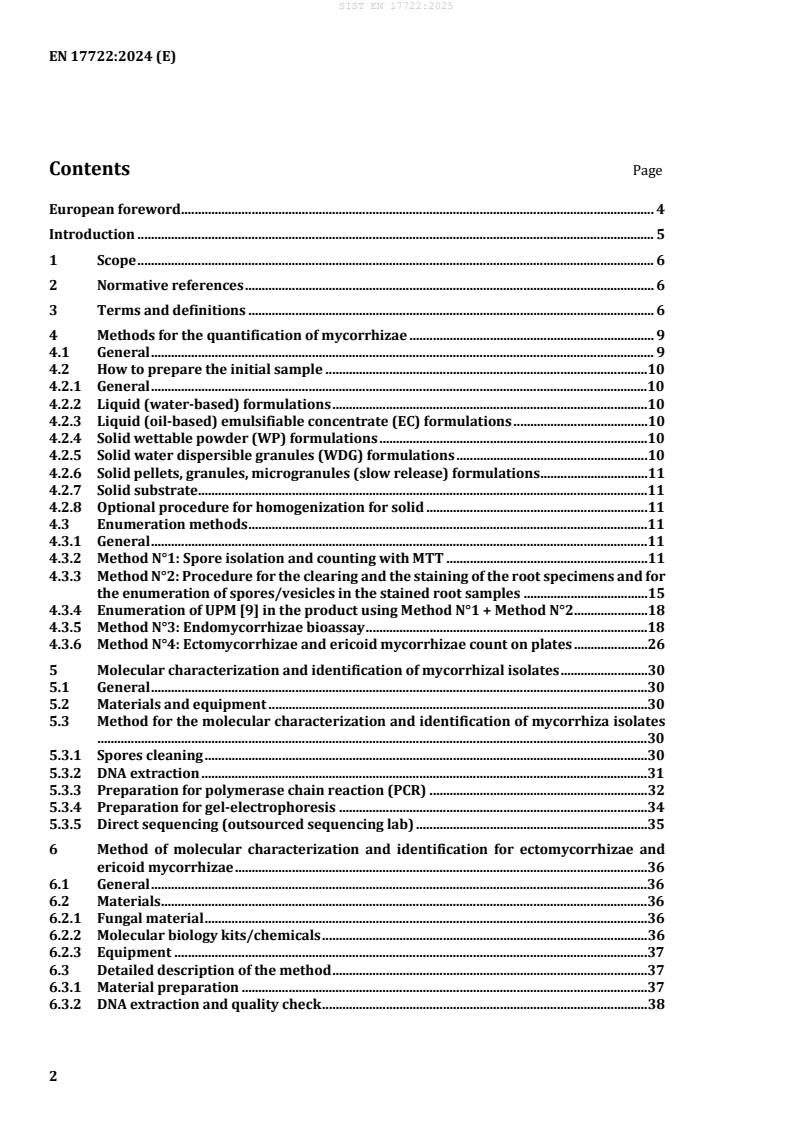
Contents Page
European foreword . 4
Introduction . 5
1 Scope . 6
2 Normative references . 6
3 Terms and definitions . 6
4 Methods for the quantification of mycorrhizae . 9
4.1 General . 9
4.2 How to prepare the initial sample .10
4.2.1 General .10
4.2.2 Liquid (water-based) formulations .10
4.2.3 Liquid (oil-based) emulsifiable concentrate (EC) formulations .10
4.2.4 Solid wettable powder (WP) formulations .10
4.2.5 Solid water dispersible granules (WDG) formulations .10
4.2.6 Solid pellets, granules, microgranules (slow release) formulations .11
4.2.7 Solid substrate .11
4.2.8 Optional procedure for homogenization for solid .11
4.3 Enumeration methods .11
4.3.1 General .11
4.3.2 Method N°1: Spore isolation and counting with MTT .11
4.3.3 Method N°2: Procedure for the clearing and the staining of the root specimens and for
the enumeration of spores/vesicles in the stained root samples .15
4.3.4 Enumeration of UPM [9] in the product using Method N°1 + Method N°2 .18
4.3.5 Method N°3: Endomycorrhizae bioassay .18
4.3.6 Method N°4: Ectomycorrhizae and ericoid mycorrhizae count on plates .26
5 Molecular characterization and identification of mycorrhizal isolates .30
5.1 General .30
5.2 Materials and equipment .30
5.3 Method for the molecular characterization and identification of mycorrhiza isolates
....................................................................................................................................................................30
5.3.1 Spores cleaning .30
5.3.2 DNA extraction .31
5.3.3 Preparation for polymerase chain reaction (PCR) .32
5.3.4 Preparation for gel-electrophoresis .34
5.3.5 Direct sequencing (outsourced sequencing lab) .35
6 Method of molecular characterization and identification for ectomycorrhizae and
ericoid mycorrhizae .36
6.1 General .36
6.2 Materials .36
6.2.1 Fungal material .36
6.2.2 Molecular biology kits/chemicals .36
6.2.3 Equipment .37
6.3 Detailed description of the method .37
6.3.1 Material preparation .37
6.3.2 DNA extraction and quality check .38
6.3.3 PCR amplification of ITS sequences . 38
6.3.4 Gel electrophoresis and PCR product visualization . 39
Annex A (informative) Repeatability and reproducibility of the method . 40
A.1 Materials used in the interlaboratory comparison study . 40
A.2 Interlaboratory comparison results . 41
Annex ZA (informative) Relationship of this European Standard and the essential
requirements of Regulation (EU) 2019/1009 making available on the market of EU
fertilising products aimed to be covered . 43
Bibliography . 44
European foreword
This document (EN 17722:2024) has been prepared by Technical Committee CEN/TC 455 “Plant
biostimulants”, the secretariat of which is held by AFNOR.
This European Standard shall be given the status of a national standard, either by publication of an
identical text or by endorsement, at the latest by May 2025, and conflicting national standards shall be
withdrawn at the latest by May 2025.
Attention is drawn to the possibility that some of the elements of this document may be the subject of
patent rights. CEN shall not be held responsible for identifying any or all such patent rights.
This document supersedes CEN/TS 17722:2022.
— the European foreword has been updated;
— the Introduction has been updated;
— the Bibliography has been re-numbered;
— Clause 4 has been reworked;
— Clause 5 has been reworked;
— Clause 6 has been reworked;
— Annex A on repeatability and reproducibility of the method has been added;
— Annex ZA has been added.
This document has been prepared under a standardization request addressed to CEN by the European
Commission. The Standing Committee of the EFTA States subsequently approves these requests for its
Member States.
For the relationship with EU Legislation, see informative Annex ZA, which is an integral part of this
document.
Any feedback and questions on this document should be directed to the users’ national standards body.
A complete listing of these bodies can be found on the CEN website.
According to the CEN-CENELEC Internal Regulations, the national standards organisations of the
following countries are bound to implement this European Standard: Austria, Belgium, Bulgaria, Croatia,
Cyprus, Czech Republic, Denmark, Estonia, Finland, France, Germany, Greece, Hungary, Iceland, Ireland,
Italy, Latvia, Lithuania, Luxembourg, Malta, Netherlands, Norway, Poland, Portugal, Republic of North
Macedonia, Romania, Serbia, Slovakia, Slovenia, Spain, Sweden, Switzerland, Türkiye and the United
Kingdom.
Introduction
The European Committee for Standardization (CEN) was requested by the European Commission (EC) to
draft European Standards or European Standardization deliverables to support the implementation of
Regulation (EU) 2019/1009 of 5 June 2019 [1] laying down rules on the making available on the market
of EU fertilising products (“FPR” or “Fertilising Products Regulation”).
This standardization request, presented as SR M/564 and relevant amendments, also contributes to the
Communication on “Innovating for Sustainable Growth: A Bio economy for Europe”. The interest in plant
biostimulants has increased significantly in Europe as a valuable tool to use in agriculture.
Standardization was identified as having an important role in order to promote the use of biostimulants.
The work of CEN/TC 455 seeks to improve the reliability of the supply chain, thereby improving the
confidence of farmers, industry, and consumers in biostimulants, and will promote and support
commercialisation of the European biostimulant industry.
WARNING — Persons using this document should be familiar with normal laboratory practice. This
document does not purport to address all of the safety problems, if any, associated with its use. It is the
responsibility of the user to establish appropriate safety and health practices and to ensure compliance
with any national regulatory conditions.
IMPORTANT — It is absolutely essential that tests conducted in accordance with this document be
carried out by suitably trained staff.
1 Scope
This document specifies a horizontal method for the enumeration and genus/species determination [2],
[3], [4] of mycorrhizal fungi in microbial plant biostimulants.
This document is applicable to the blends of fertilizing products where a blend is a mix of at least two of
the following component EU fertilising products categories: Fertilizers, Liming Materials, Soil Improvers,
Growing Media, Plant Biostimulants and where the following category Plant Biostimulants is the highest
percentage in the blend by mass or volume, or in the case of liquid form by dry mass. If Plant
Biostimulants is not the highest percentage in the blend, the European Standard for the highest
percentage of the blend applies. In case a blend of fertilizing products is composed of components in equal
quantity or in case the component EU fertilising products used for the blend have identical formulations ,
the user decides which standard to apply.
2 Normative references
There are no normative references in this document.
3 Terms and definitions
For the purposes of this document, the following terms and definitions apply.
ISO and IEC maintain terminology databases for use in standardization at the following addresses:
— ISO Online browsing platform: available at https://www.iso.org/obp
— IEC Electropedia: available at https://www.electropedia.org/
3.1
arbuscular mycorrhizal fungus
AMF
AM fungus
biotrophic microscopic fungus belonging to the Glomeromycota [5] phylum (synonymous
Glomeromycota) that establishes obligate symbiotic associations with more than 70 % of plant species
on Earth
Note 1 to entry: Arbuscular mycorrhizal fungi produce structures inside plant roots, such as vesicles and/or
endospores, but also specialized nutrient exchange structures called arbuscules.
Note 2 to entry: The hyphae do not penetrate the plant cell protoplast, but instead, they invaginate the cortical
cell membrane where they branch dichotomously to develop the arbuscule. This is meant to be the place where the
exchange of nutrients and water takes place between the plant and the fungus.
Note 3 to entry: The extraradical mycelium from arbuscular mycorrhizal fungi forms an extensive network
within the soil, which increases plant nutrient availability and uptake.
An example of such a blend is a product with 2 claimed functions consisting of a non-microbial plant biostimulant
and an organic fertiliser composed of 1kg/kg of plant biostimulant from seaweed.
3.2
ectomycorrhiza
hyphal sheath, or mantle, covering the root tip and an extracellular Hartig net of hyphae surrounding the
plant cells within the root cortex
Note 1 to entry: Beneficial symbiotic associations established by filamentous fungi belong mainly to the
Ascomycota and Basidiomycota phyla with around 5 % to 10 % of coniferous and deciduous trees.
Note 2 to entry: In some cases, the hyphae can also penetrate into the plant cells, in which case the mycorrhiza is
called an ectendomycorrhiza. Outside the root, the ectomycorrhizal extraradical mycelium forms an extensive
network within the soil, which increases plant nutrient availability and uptake. Since these fungi have septate
hyphae, hyphal fragments along with spores are considered long-term effective propagation structures.
3.3
endomycorrhiza
symbiotic association characterized by a filamentous fungal partner that colonizes the plants’ root tissues
intracellularly
EXAMPLE Four main groups of endomycorrhizal associations exist: arbuscular, ericoid, orchidoid and
sebacinoid mycorrhizae.
3.4
ericoid mycorrhizal fungus
filamentous fungus belonging to the Ascomycota phylum that establishes endomycorrhizal symbiotic
associations specifically with plants within the family Ericaceae (such as blueberry and cranberry)
Note 1 to entry: The intraradical growth phase is characterized by a dense coil of hyphae in the outermost layer
of root cells. Ericoid mycorrhizal fungi also have saprotrophic capabilities, which can enable the plant to access
nutrients in organic matter that would not yet be available to the plant.
3.5
in vivo
production performed in open area (greenhouse, tunnel, open field)
3.6
in vitro
production performed in monoxenic conditions
3.7
mycorrhiza
symbiotic relationship between a filamentous fungus and a plant
Note 1 to entry: In a mycorrhizal association, the fungus colonizes the plants’ root tissues either intracellularly
(as with endomycorrhiza) or extracellularly (as with ectomycorrhiza). This beneficial interaction brings several
advantages to the plants such as, for instance, enhanced uptake of nutrients and water.
3.8
orchidoid mycorrhizal fungus
filamentous fungus belonging to the Basidiomycota phylum that establishes endomycorrhizal symbiotic
associations specifically with plants within the family Orchidaceae
Note 1 to entry: The hyphae of orchidoid mycorrhizal fungi penetrate the root cell and form a dense coil of
hyphae, where numerous exchanges take place.
3.9
propagule
component of the fungus able to initiate a symbiosis with plant roots
3.10
sebacinoid mycorrhizal fungus
endophytic filamentous fungus belonging to the Basidiomycota phylum, more specifically the order
Sebacinales, which establishes mutualistic symbiotic relationship with a wide variety of plant hosts
EXAMPLE The model species Piriformospora spp.
Note 1 to entry: Sebacinoid mycorrhizal fungi colonize plant roots with an intracellular mycelium where nutrient
exchanges take place.
3.11
serendipita mycorrhizal fungus
Serendipitaceae (formerly Sebacinales Group B) that belongs to a taxonomically, ecologically and
physiologically diverse group in the phylum Basidiomycota (kingdom Fungus)
Note 1 to entry: While historically recognized as orchid mycorrhizae, recent phylogenetically-based studies have
demonstrated both their widespread distribution and the broad spectrum of mycorrhizae form.
Note 2 to entry: Serendipita mycorrhizal fungi are associated to all families of herbaceous angiosperms
(flowering plants) from temperate, subtropical and tropical regions.
Note 3 to entry: Serendipita mycorrhizal fungi should be considered as a previously hidden, but amenable and
effective microbial tool for enhancing plant productivity and stress tolerance.
3.12
spore
unicellular dissemination cell formed by fungi in mycorrhiza
Note 1 to entry: Their size ranges from 50 µm to 500 µm.
3.13
Unit Potential Mycorrhizal
UPM
unit of counting for mycorrhizae
where
U is unit, spore or propagule able to initiate mycorrhizae formation in a host plant’s root;
P is potential, since the development of the symbiosis depends on different factors (soil, plant,
agriculture practises, competition with other soil borne microorganisms, etc.);
M is mycorrhizal, since the inoculum is able to initiate new mycorrhizae in association with plant
roots, depending on the factors previously cited.
EXAMPLE UPM per gram (% spores, % propagules) (in vivo, in vitro).
4 Methods for the quantification of mycorrhizae
4.1 General
According to the type of mycorrhizae analysed (see Figure 1), the method to be used is listed in Table 1
to obtain the quantification in UPM.
The methods are:
Method N°1: Spore isolation and counting with MTT;
Method N°2 Procedure for the clearing and staining of the root specimens and the enumeration of
spores/vesicles in the stained root samples. Only if the root fragments extraction is feasible from the
formulation matrixes. If not possible, method N°3 shall be used;
Method N°3: Endomycorrhiza bioassay, the MPN test (Most Probable Number of mycorrhizal propagule);
Method N°4: Ectomycorrhizae and ericoid mycorrhizae count on plates.
Figure 1 — Different types of mycorrhizas and propagules
Table 1 — Methods to use for the enumeration of UPM with plant cultures and without plant
cultures
in vitro Yes NO Method N°1 Method Method
N°4 N°4
in vitro Yes Yes Method N°1 to count
spores and Method N°2
to count propagules
in vivo NO NO Method N°3
in vivo Yes NO Method N°1 Method Method
N°4 N°3
in vivo Yes Yes Method N°1 to count
spores and Method N°2
to count propagules
in vivo NO Yes Method N°2 Method Method Method
N°3 N°3 N°3
Origin of product
SPORES
Extractable
Other propagules,
roots extractable
Endo
mycorrhizae
Ectomycorrhizae
Ericoid
mycorrhizae
Orchidoid
mycorrhizae
Sebacinoid
mycorrhizae
Serendipita
mycorrhizae
Note that the operator or laboratory needs to check with the manufacturer or distributor the nature of
the sample (spore, root or mixture of both) in order to determine the most appropriate method.
4.2 How to prepare the initial sample
4.2.1 General
For solid U.P.M/ g and for liquid U.P.M / ml.
A base concentration for a product is 500 UPM/g. The whole preparation should be made according to
this.
H High = higher than 100 000 UPM/g;
M Medium = between 1 000 and 100 000 UPM/g;
L Low = below 1 000 UPM/g.
For samples with different concentrations, different amounts of sample should be taken in a
proportionate amount of tap water in order to maintain the proportion 1:10 as follows:
— for H, take 2,5 g in 22,5 ml of tap water;
— for M, take 25 g in 225 ml of tap water;
— for L, take 250 g in 2 250 ml of tap water.
A representative sample of the product shall be prepared according to the following procedure which
takes into consideration the different formulations of plant biostimulants.
4.2.2 Liquid (water-based) formulations
Dispense the quantity of sample, depending on the concentration of the product as described in 4.2.1, into
tap water maintained at room temperature in a flask and shake for 10 min or more until the distribution
is optimal, with a magnetic stirrer at half speed.
4.2.3 Liquid (oil-based) emulsifiable concentrate (EC) formulations
Dispense the quantity of sample, depending on the concentration of the product as described in 4.2.1, into
tap water maintained at room temperature in a flask and shake for 10 min or more until the distribution
is optimal, with a magnetic stirrer at half speed.
4.2.4 Solid wettable powder (WP) formulations
Dispense the quantity of sample, depending on the concentration of the product as described in 4.2.1, into
tap water maintained at room temperature in a flask and shake for 20 min or more until the distribution
is optimal, with a magnetic stirrer at half speed.
4.2.5 Solid water dispersible granules (WDG) formulations
Dispense the quantity of sample, depending on the concentration of the product as described in 4.2.1, into
tap water maintained at room temperature in a flask and shake for 40 min or more until the distribution
is optimal, with a magnetic stirrer at half speed. If required, help the dispersion of the formulations with
another apparatus such as a laboratory homogenizer after having sieved (100 mesh sieve) the particles,
and resuspend them in the same suspension [6].
2 ® ®
Stomacher and Tween 20 are examples of suitable products available commercially. This information is given
for the convenience of users of this document and does not constitute an endorsement by CEN of these products.
4.2.6 Solid pellets, granules, microgranules (slow release) formulations
Dispense the quantity of sample, depending on the concentration of the product as described in 4.2.1, into
tap water maintained at room temperature in a flask and shake for 40 min or more until the distribution
is optimal, with a magnetic stirrer at half speed. If required, help the dispersion of the formulations with ®
another apparatus such as a Stomacher after having sieved (100 mesh sieve) the particles, and
resuspend them in the same suspension [6].
4.2.7 Solid substrate
Dispense the quantity of sample, depending on the concentration of the product as described in 4.2.1, into
tap water maintained at room temperature in a flask and shake for 20 min or more until the distribution
is optimal, with a magnetic stirrer at half speed.
The time required for some analyses is too long and the cost too high. Therefore, faster and more
economical methods are proposed.
According to the diversity of the types of mycorrhizae several methods are proposed for the
quantification, depending on the origin of the products and the extraction of spores and propagules.
4.2.8 Optional procedure for homogenization for solid
Procedure option for 4.2.4; 4.2.5; 4.2.6; 4.2.7.
Dispense the quantity of sample, depending on the concentration of the product as described in 4.2.1 of
tap water maintained at room temperature in a blender for 30 s to 2 min at least 4000 rpm, until there
are not propagules present in the upper sieve. ®
If required, help the dispersion of the formulations by adding Tween 20 drops. ®
Omit the use of another apparatus such as a Stomacher after having sieved (100 mesh sieve) the
particles and resuspend them in the same suspension.
4.3 Enumeration methods
4.3.1 General
The method described in 4.3.2 is listed in Table 1.
4.3.2 Method N°1: Spore isolation and counting with MTT
4.3.2.1 Procedure for the enumeration of spores
Use the following procedure for the enumeration of spores:
— Decant the suspension through a series of sieves arranged in descending order of opening size:
250 μm, 150 μm and 25 μm. The coarse particles are collected on a coarse sieve, while spores are
captured on one or more finer sieves.
— Carefully collect the sieved contents from 25 and 150 µm sieves in jars and reconstitute the spore
suspension to a final volume of 100 ml. Transfer 1 ml of the sieved contents onto the gridded Petri
dishes/plates and observe under a stereomicroscope.
For spore count,
— initially x (g) of material are passed through three sieves and then the material is collected and
finally suspended in 100 ml;
Dehydrogenase-activated stain 3-(4,5-dimethylthiazol-2-yl)-2,5-diphenyltetrazolium bromide (MTT).
— spores are counted per ml;
— to determine the spore count in the final volume (100 ml), the spore count obtained per ml is to
be multiplied by 100.
— In case of aggregate of clay or organic material, vigorous washing with water is necessary to extract
free spores.
— Collect separately the contents of all three sieves in jars. Transfer a known volume (for example
1 ml/10 ml of the sieved contents) onto the gridded Petri dishes/plates and observe under a
stereomicroscope.
— Count the number of spores in the plate/dish. Accordingly, calculate the total number of spores in
100 ml of the suspension.
— Express the number of spores as UPM spores/ (g of the sample).
Figure 2 — Sieves
Only for solid sample:
Use the following procedure for the enumeration of spores:
— Decant the suspension through a series of sieves arranged in descending order of opening size:
250 μm, 150 μm and 25 μm. The coarse particles are collected on a coarse sieve, while spores are
captured on one or more finer sieves.
— Vigorous washing with water is necessary to free spores from aggregates of clay or organic materials.
— Collect the sieved contents in tubes and centrifuge it 960 xg for 5 min. Throw away the supernatant.
— Add 40 ml to 50 ml of a sucrose solution 1M to the sediment, centrifuge by 30 s at 960 xg. Spores are
suspended in sucrose.
— Pass the supernatant of sucrose by 25 µm sieve. Wash the content with water to remove sucrose.
— Resuspend the content of the sieve in a quantity of known water (e.g. 50 ml for low concentration
samples).
— Transfer a known volume (for example, from 1 ml to 10 ml of the sieved resuspended contents) onto
the gridded Petri dishes/plates and observe under a stereomicroscope.
— Count the number of spores per plate/dish. Accordingly, calculate the total number of spores taking
into account the volume of the total suspension and the aliquot counted.
— To determine the spore count per g of solid sample used in analyses, the count obtained in 100 ml is
divided by the initial weight (x g).
— Express the number of spores in UPM spores/(g of the sample).
4.3.2.2 Viability of spores
4.3.2.2.1 General
The spore sample shall be absolutely free of any other particles, since MTT or INT can react with these
other components.
4.3.2.2.2 Materials and equipment
The materials and equipment for spores are the following:
— MTT as a first option, INT only if MTT is not available;
— sterile distilled water;
— aluminium foil;
— Falcon tube (15 ml);
— micropipette (1 ml);
®5
— Eppendorf tubes;
— forceps;
— Petri dish;
— microscope with an external light source;
— incubator (28 °C ± 2 °C).
4.3.2.2.3 Procedure
Use the following procedure for testing the viability of the spores:
— Prepare a stock solution of 0,1 % MTT concentration in sterile distilled water and cover with
aluminium foil.
— Take the original suspension and pick about 50 to 100 spores with the micropipette.
— Keep this suspension overnight at 28 °C in the incubator before using.
INT = iodonitrotetrazolium.
5 ®
Eppendorf tube is an example of a suitable product available commercially. This information is given for the
convenience of users of this document and does not constitute an endorsement by CEN of this product. ®
— Add 500 μl of the spore suspension to an Eppendorf tube.
— Add 500 μl of the 0,1 % MTT stock solution to make a 1 ml final volume. ®
— Incubate the Eppendorf tubes in dark at 28 °C from 42 h to 48 h.
— Observe after 24 h and from 42 h to 48 h. The two incubation periods are for assurance of complete
enzymatic reduction of 3-(4,5-dimethylthiazol-2-yl)-2,5-diphenyltetrazolium bromide (MTT) to
MTT-formazan by mitochondrial succinate dehydrogenase of viable mycorrhizal spores.
— Viable spores, in absence of an external source, appear dark pink and red/purple when observed
with an external source.
— Percentage viability can be calculated as follows:
Spore viability (%) = (number of viable spores/total number of spores) × 100.
For a clearer explanation, see the following example:
— Take 25 g of the soil/sample suspended in 100 ml of sterile water.
— Obtain a homogenized suspension.
— Use the sieve as described in Figure 2.
— Collect the sieved materials contents and reconstitute the suspension to a final volume of 100 ml.
— Homogenize the suspension again and place 1 ml of the suspension in a Petri dish (in triplicates:
A, B, and C).
— Observe under the stereomicroscope and calculate the number of spores in each replicate, and
assuming the number of spores observed as follows: 10 spores (A), 15 spores (B) and 14 spores
(C).
— Calculate the average number of spores as follows: (number of spores in A+B+C)/3. In this case,
the average number of spores is 13 (this is the number of spores observed in 1 ml of the
suspension).
— Calculate the number of spores in 100 ml of the suspension as follows: average number of
spores/ml × 100. In the present case, it is 13 × 100 = 1 300 spores (this is the number of spores
present in 25 g of the sample).
— Calculate the number of spores/g as follows: total number of spores present in 100 ml of the
sample/25. In this case, it is as follows: 1 300/25 = 52 spores.
Table 2 is made in order to calculate the percentage of final viability of UPM (spore)/g.
Table 2 — Results from observation of spore after 24 h and 42 h to 48 h
Observation
Hour
24 h
SR.no Replicates A B C
1 Total no. of spores/g
2 Total no. of viable spores/g
3 Total no. of non-viable spores/g
Viability(%) = (No. of viable
spores/Total no. of spores) × 100
5 Average viability (%) after 24 h
42 h to 48 h SR.no Replicates A B C
1 Total no. of spores/g
2 Total no. of viable spores/g
3 Total no. of non-viable spores/g
Viability(%) = (No. of viable
spores/Total no. of spores) × 100
5 Average viability (%) after 24 h
Final viability Average of average viability
percentage after 24 h and after 48 h
4.3.3 Method N°2: Procedure for the clearing and the staining of the root specimens and for the
enumeration of spores/vesicles in the stained root samples
4.3.3.1 Materials and equipment
The materials and equipment for the enumeration of vesicles are:
— mycorrhizal-based product/sample;
— 25 µm to 50 µm sieve for small sized vesicles;
— 150 µm sieve for medium-sized vesicles;
— 250 µm sieve for very large vesicles;
— jars for collecting the sieving;
— stereo zoom (stereomicroscope) and simple compound microscope;
— Petri dishes (90 mm or 30 mm) for observing the material sieved under a stereomicroscope;
— micropipettes for spore picking;
— centrifuge;
— KOH solution (10 %);
— glass beaker (250 ml);
— scissors and needles;
— water bath;
— coarse sieves (250 µm, 150 µm and 25 µm) to prevent root loss during washing/changing solutions;
— plastic vials with tight-sealing lids for storage of stained samples in 50 % glycerol;
— alkaline H O (3 ml of 25 % ammonia solution + 30 ml of 10 % H O + 67 ml of distilled water);
2 2 2 2
— 1 % HCl;
— 50 % glycerol-water (volume fraction) solution for de-staining and storage of stained roots;
— lactoglycerol (876 ml of lactic acid + 64 ml of glycerol + 60 ml of distilled water);
— black ink and acetate;
— Bunsen burner/spirit lamp.
7 8
4.3.3.2 Procedure
4.3.3.2.1 Procedure on how to evaluate the number of root fragment per g of formulation
— Make 5 decimal dilutions of the sample.
— Take 3 reps of 1 ml each in a 3 cm or 9 cm diameter Petri dish.
— Count root fragment under the stereomicroscope.
— Start with the highest concentration. If the number of root fragments is too high, count the next
dilution. It is fine when about 100 roots fragments are counted in a Petri dish. Record the number of
each of the 3 counts and the dilution factor.
4.3.3.2.2 Procedure on how to evaluate the number of vesicles per root fragment
Wash the root samples thoroughly under running tap water. Place the root material into a 50 ml
thermoresistant glass pill jar and cover the root material with the 10 % of KOH solution (do not exceed
2/3 of the glass pill jar volume). Incubate then for 30 min to 60 min at 80 °C in a dry oven.
With the help of a sieve, pour off the KOH solution and rinse the roots thoroughly in a glass beaker using
at least three complete changes of tap water or until no brown colour appears in the rinse water.
If required, cover the roots with alkaline H O solution at room temperature for 10 min or until the roots
2 2
are bleached.
Rinse the roots thoroughly using at least three complete changes of tap water to remove the H O
2 2.
KOH = potassium hydroxide
For better explanation as to how the observation should be conducted, see Biermann et al., 1981. [7]
For better understanding of the staining procedure, see Vierheilig et al.,1998. [8]
Cover the roots with 1 % HCl solution and soak for 3 min to 4 min, then pour off the H O solution. Do
2 2.
not rinse after this because the samples shall be acidified for proper staining.
Incubate the roots with staining the solution (5 % black ink + 8 % acetate in osmosed water) and keep
them overnight for staining.
Place the root samples in glass Petri plates/multi well plates for de-staining. The de-staining solution
shall be 50 % lactoglycerol or this may be replaced with tap water, as an alternative, for a minimum of
2 h and up to 24 h.
Randomly select 10 root fragments and count under a microscope the total number of containing intra-
radical vesicles in each of the 10 randomly selected root fragments.
Every effort shall be made to:
— Ensure that sieved materials do not get washed away along with the water.
— Carefully isolate/recover the spores that can be trapped in the edges of the sieves, otherwise the
observations can be inaccurate.
For a clearer explanation, see the following example:
— Take 25 g of the soil/sample suspended in 100 ml of sterile water;
— Obtain a homogenized suspension;
— Use the sieve as described in Figure 2;
— Collect the sieved materials and reconstitute the suspension to a final volume of 100 ml;
— Homogenize the suspension again and take 1 ml of the suspension in a Petri dish (in triplicates: A, B,
and C);
— Observe under the stereomicroscope and calculate the number of root fragments in each replicate
and assuming the number of root fragments observed as follows: 10 root fragments (A), 15 root
fragments (B) and 14 root fragments (C);
— Calculate the average number of root fragments as follows: (number of root fragments in A+B+C)/3.
In this case, the average number of root fragments is 13 (this is the number of root fragments
observed in 1 ml of the suspension);
— Calculate the number of root fragments in 100 ml of the suspension as follows: average number of
root fragments /ml × 100. In the present case, it is 13 × 100 = 1 300 root fragments (this is the
number of root fragments present in 25 g of the sample);
— Calculate the number of UPM (spores/vesicles)/g as follows: total number of spores/vesicles present
in 1 root fragment multiplied by the number of root fragments present in 25 g of the sample. If the
average of the counts in the 10 root fragment was 8 then the final calculation is: 1300 root fragment/g
of product X 8 spores/vesicles/root fragment = 10400 UPM (spores/vesicles)/g of product.
4.3.4 Enumeration of UPM [9] in the product using Method N°1 + Method N°2
Estimate the total number of UPM/g in the product as follows: total number of UPM/g in the
product = total number of spores/g (Method 1) + total number of vesicles/g (Method 2).
Calculate the total number of UPM in the whole product as follows: total number of UPM/g in the
product × net weight (g) of the product.
Thus, the following results are obtained:
— the number of spores/g of the sample is 52 UPM example Method 1; 4.3.2.2.3;
— total number of vesicles/g in the product = 10400 UPM (spores/vesicles)/g example Method 2:
4.3.3.2.2;
— total number of UPM /g in the product = Total number of spores/g + Total number of vesicles/g
52+10400 = 10452 UPM.
4.3.5 Method N°3: Endomycorrhizae bioassay
4.3.5.1 Principle of the MPN (Most Probable Number of mycorrhizal propagules)
The Most Probable Number of mycorrhizal propagules (MPN) test is a biological test, usually carried out
in the presence of mycorrhizal host plants. It determines the mycorrhizal potential of a soil or fungal
inoculum by quantifying the number of propagules (fungal propagation units such as spores, vesicles,
sporocarp, mycorrhizal root fragments, living hyphae or auxiliary cells) in a sample. It therefore
quantifies the ability of a soil or fungal inoculum to generate mycorrhizae under predefined growth
conditions and host plants, depending on the question asked [10].
The MPN test can be strongly influenced by different parameters (host plant, plant density, substrate,
fertilization regime, light intensity, growing conditions, volume of growing pots and timing of
implementation or seasonality). Any condition that inhibits the germination of propagules and
intraradical mycorrhizae (high phosphate content, type of fertilizer, type of substrate used, use of plants
with little or medium mycorrhiza, reduced light intensity, low plant density, etc.) can influence the value
of the number of propagules calculated through the MPN test (depending on a factor of 1 to 1 000),
potentially reducing the actual number of propagules contained in the sample. The term “potential” is
therefore synonymous with “the ability to generate mycorrhizae, related to the conditions of the
implementation of the test” but also the “ability of propagules (which takes into account the number,
viability and dormant state) to generate mycorrhiza.”
When it comes to determining the closest number of propagules actually present in a sample (which can
be called the “maximum mycorrhizal potential”), it is necessary to set up conditions that promote the
germination of propagules and intraradical colonization. It is recommended to use plants highly
susceptible to mycorrhization, such as Plantago lanceolata, Trifolium pratensis or Medicago truncatula to
grow then on a chemically and biologically inert substrate (most often sterilized sand), and to apply a
fertilizer with low available phosphate (Hoagland-based solution). Plant density is also an important
factor: the denser the root system, the greater the chances of contact with a fungal propagule. On the
other hand, especially for a fungal inoculum, if one wishes to determine the mycorrhizal potential in the
frame of a specific application (which can be called mycorrhizal potential relative to a designed target),
the test should be implemented by approaching the target conditions, notably in terms of host plant,
substrate and fertilization.
The principle of the MPN test is to establish successive dilutions of the sample (see Figure 3) with a
sterilized substrate (either the same target soil or sand depending on the question asked, sterilized twice
at 120 °C for 6 h), using a fast-growing plant species (most often a herbaceous or legume plant, highly
susceptible to mycorrhization). The dilution factor, the number of successive dilutions and the number
of repetitions depend on the time available for the test, the type of sample and the desired degree of
accuracy. The dilution factor influences the accuracy of the MPN test value; the number of repetitions
influences the confident interval, as well as the standard erro
...