EN 415-1:2000+A1:2009
(Main)Packaging machines safety - Part 1: Terminology and classification of packaging machines and associated equipment
Packaging machines safety - Part 1: Terminology and classification of packaging machines and associated equipment
This European standard defines the field of packaging machines in detail in clause 3, but briefly these are:
Filling and Dosing machines
Closing machines
Labelling, decorating and coding machines
Cleaning, sterilising, cooling and drying machines
Fill and seal machines
Inspection machines
Container and component handling machines
Form, fill and seal machines
Cartoning machines
Wrapping machines
Group or transit packaging machines
Pallet or loading unit forming, dismantling and securing machines
Annex A indicates where hazards and safety requirements for these machines can be found. In most cases this will be in one of the parts of EN415, but in some cases it may be another European or ISO standard. Where no specific standard covers a particular machine Annex A will indicate the most appropriate standard which can be referred to for advice.
Sicherheit von Verpackungsmaschinen - Teil 1: Terminologie und Klassifikation von Bezeichnungen für Verpackungsmaschinen und zugehörige Ausrüstungen
Diese Europäische Norm definiert den Verpackungsmaschinenbereich detailliert im Abschnitt 3; die Hauptgruppen
sind
- Füll- und Dosiermaschinen,
- Verschließmaschinen,
- Etikettier-, Dekorier- und Codiermaschinen,
- Reinigungs-, Sterilisier-, Kühl- und Trocknungsmaschinen,
- Füll- und Verschließmaschinen,
- Inspektionsmaschinen,
- Behälter- und Komponenten-Handhabungsmaschinen,
- Form-, Füll- und Verschließmaschinen,
- Kartoniermaschinen,
- Einschlagmaschinen,
- Sammelpackmaschinen,
- Maschinen zur Herstellung, zur Auflösung und zum Sichern von Palettenladungen oder sonstigen Ladeeinheiten.
Anhang A gibt an, wo die Gefährdungen und Sicherheitsanforderungen für diese Maschinen zu finden sind. In
den meisten Fällen wird dies in einem der Teile der EN 415 geschehen, manchmal aber auch in einer
anderen Europäischen oder ISO-Norm. Existiert keine spezifische Norm für eine bestimmte Maschine, wird im
Anhang A auf diejenige Norm verwiesen, die am ehesten für eine Ratsuche herangezogen werden kann.
Sécurité des machines d'emballage - Partie 1: Terminologie et classification des machines d'emballage et de l'équipement associé
Cette norme européenne définit le champ des machines d'emballage dans l’article 3, mais brièvement ce sont :
— les remplisseuses doseuses ;
— les fermeuses ;
— les étiqueteuses, décoreuses et codeuses ;
— les laveuses, stérilisateurs, refroidisseurs et séchoirs ;
— les remplisseuses et fermeuses ;
— les machines de vérification ;
— les machines de manutention pour les contenants et de composants ;
— les fermeuses remplisseuses et scelleuses ;
— les encartonneuses ;
— les enveloppeuses ;
— les machines d’emballage de groupe ou de transit ;
— les machines à créer, à démonter ou à sécuriser des palettes ou des unités de charge.
L’annexe A indique dans quel document les phénomènes dangereux et les mesures de protection peuvent être
trouvés. Dans un grand nombre de cas ce sera une des parties de la norme EN 415, mais dans certains cas cela
pourra être une autre norme EN ou ISO. Lorsqu'une machine particulière n'est couverte par aucune norme
spécifique, l’annexe A indique la norme la plus appropriée à laquelle on peut se référer pour des conseils.
Pakirne naprave - Varnost pakirnih naprav - 1. del: Terminologija in razvrščanje pakirnih strojev ter pripadajoče opreme
General Information
- Status
- Withdrawn
- Publication Date
- 24-Feb-2009
- Withdrawal Date
- 13-Apr-2025
- Technical Committee
- CEN/TC 146 - Packaging machines - Safety
- Drafting Committee
- CEN/TC 146/WG 4 - Terminology and classification
- Current Stage
- 9960 - Withdrawal effective - Withdrawal
- Start Date
- 09-Jul-2014
- Completion Date
- 14-Apr-2025
- Directive
- 98/37/EC - Machinery
Relations
- Effective Date
- 22-Dec-2008
- Effective Date
- 08-Jun-2022
Frequently Asked Questions
EN 415-1:2000+A1:2009 is a standard published by the European Committee for Standardization (CEN). Its full title is "Packaging machines safety - Part 1: Terminology and classification of packaging machines and associated equipment". This standard covers: This European standard defines the field of packaging machines in detail in clause 3, but briefly these are: Filling and Dosing machines Closing machines Labelling, decorating and coding machines Cleaning, sterilising, cooling and drying machines Fill and seal machines Inspection machines Container and component handling machines Form, fill and seal machines Cartoning machines Wrapping machines Group or transit packaging machines Pallet or loading unit forming, dismantling and securing machines Annex A indicates where hazards and safety requirements for these machines can be found. In most cases this will be in one of the parts of EN415, but in some cases it may be another European or ISO standard. Where no specific standard covers a particular machine Annex A will indicate the most appropriate standard which can be referred to for advice.
This European standard defines the field of packaging machines in detail in clause 3, but briefly these are: Filling and Dosing machines Closing machines Labelling, decorating and coding machines Cleaning, sterilising, cooling and drying machines Fill and seal machines Inspection machines Container and component handling machines Form, fill and seal machines Cartoning machines Wrapping machines Group or transit packaging machines Pallet or loading unit forming, dismantling and securing machines Annex A indicates where hazards and safety requirements for these machines can be found. In most cases this will be in one of the parts of EN415, but in some cases it may be another European or ISO standard. Where no specific standard covers a particular machine Annex A will indicate the most appropriate standard which can be referred to for advice.
EN 415-1:2000+A1:2009 is classified under the following ICS (International Classification for Standards) categories: 01.040.55 - Packaging and distribution of goods (Vocabularies); 55.200 - Packaging machinery. The ICS classification helps identify the subject area and facilitates finding related standards.
EN 415-1:2000+A1:2009 has the following relationships with other standards: It is inter standard links to EN 415-1:2000, EN 415-1:2014. Understanding these relationships helps ensure you are using the most current and applicable version of the standard.
EN 415-1:2000+A1:2009 is associated with the following European legislation: EU Directives/Regulations: 2006/42/EC, 98/37/EC; Standardization Mandates: M/079, M/396. When a standard is cited in the Official Journal of the European Union, products manufactured in conformity with it benefit from a presumption of conformity with the essential requirements of the corresponding EU directive or regulation.
You can purchase EN 415-1:2000+A1:2009 directly from iTeh Standards. The document is available in PDF format and is delivered instantly after payment. Add the standard to your cart and complete the secure checkout process. iTeh Standards is an authorized distributor of CEN standards.
Standards Content (Sample)
2003-01.Slovenski inštitut za standardizacijo. Razmnoževanje celote ali delov tega standarda ni dovoljeno.Sicherheit von Verpackungsmaschinen - Teil 1: Terminologie und Klassifikation von Bezeichnungen für Verpackungsmaschinen und zugehörige AusrüstungenSécurité des machines d'emballage - Partie 1: Terminologie et classification des machines d'emballage et de l'équipement associéPackaging machines safety - Part 1: Terminology and classification of packaging machines and associated equipment55.200Pakirni strojiPackaging machinery01.040.55Pakiranje in distribucija blaga (Slovarji)Packaging and distribution of goods (Vocabularies)ICS:Ta slovenski standard je istoveten z:EN 415-1:2000+A1:2009SIST EN 415-1:2001+A1:2009en,fr01-april-2009SIST EN 415-1:2001+A1:2009SLOVENSKI
STANDARDSIST EN 415-1:20011DGRPHãþD
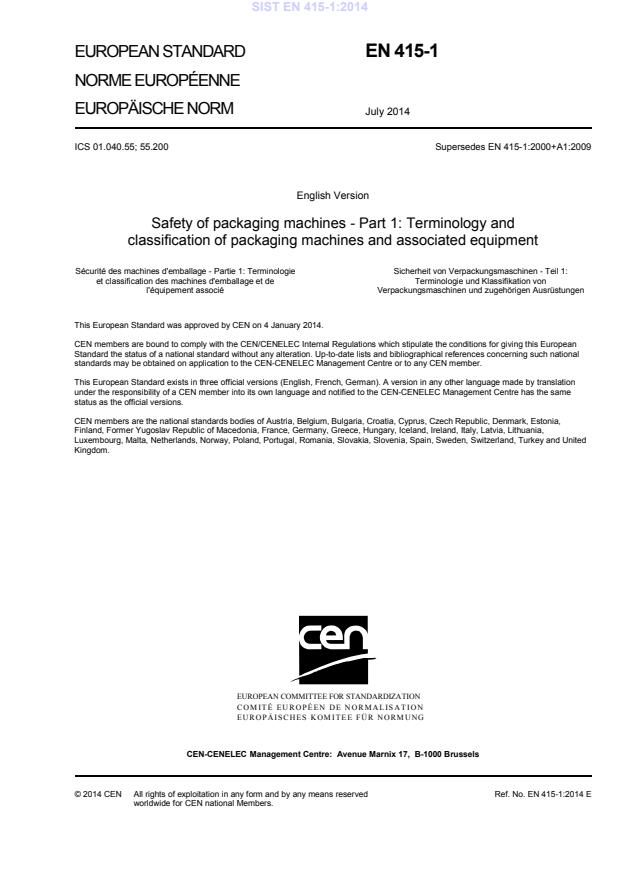
EUROPEAN STANDARD NORME EUROPÉENNE EUROPÄISCHE NORM
EN 415-1:2000+A1
February 2009 ICS 01.040.55; 55.200 Supersedes EN 415-1:2000English Version
Packaging machines safety - Part 1: Terminology and classification of packaging machines and associated equipment Sécurité des machines d'emballage - Partie 1: Terminologie et classification des machines d'emballage et de l'équipement associé
Sicherheit von Verpackungsmaschinen - Teil 1: Terminologie und Klassifikation von Bezeichnungen für Verpackungsmaschinen und zugehörige Ausrüstungen This European Standard was approved by CEN on 16 April 1999 and includes Amendment 1 approved by CEN on 5 January 2009.
CEN members are bound to comply with the CEN/CENELEC Internal Regulations which stipulate the conditions for giving this European Standard the status of a national standard without any alteration. Up-to-date lists and bibliographical references concerning such national standards may be obtained on application to the CEN Management Centre or to any CEN member.
This European Standard exists in three official versions (English, French, German). A version in any other language made by translation under the responsibility of a CEN member into its own language and notified to the CEN Management Centre has the same status as the official versions.
CEN members are the national standards bodies of Austria, Belgium, Bulgaria, Cyprus, Czech Republic, Denmark, Estonia, Finland, France, Germany, Greece, Hungary, Iceland, Ireland, Italy, Latvia, Lithuania, Luxembourg, Malta, Netherlands, Norway, Poland, Portugal, Romania, Slovakia, Slovenia, Spain, Sweden, Switzerland and United Kingdom.
EUROPEAN COMMITTEE FOR STANDARDIZATION
COMITÉ EUROPÉEN DE NORMALISATION EUROPÄISCHES KOMITEE FÜR NORMUNG
Management Centre:
Avenue Marnix 17,
B-1000 Brussels © 2009 CEN All rights of exploitation in any form and by any means reserved worldwide for CEN national Members. Ref. No. EN 415-1:2000+A1:2009: ESIST EN 415-1:2001+A1:2009
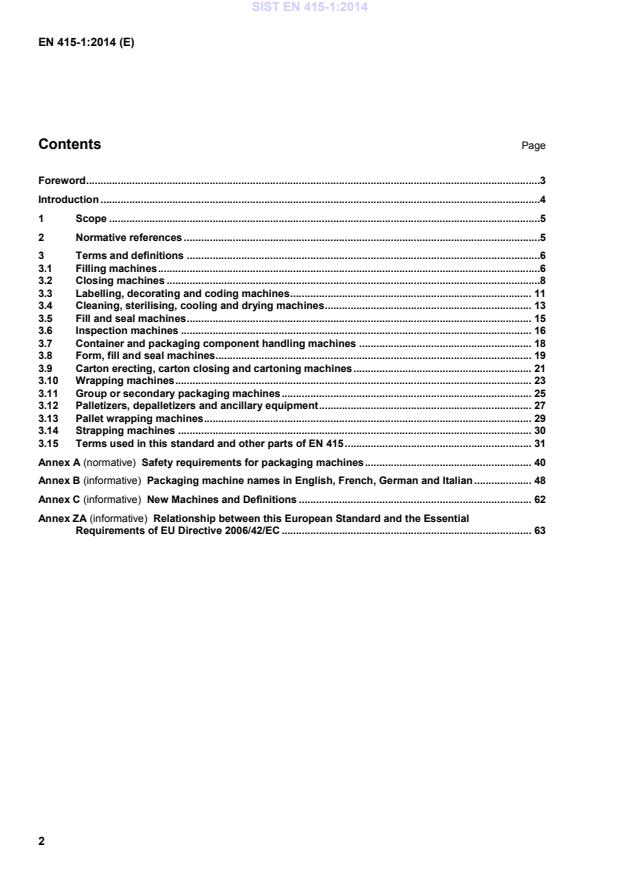
Alphabetical list of packaging machines . 31 Annex B (informative)
Packaging machines named in English, French and German . 38 Annex C (informative)
Packaging machines named in English and Italian . 47 Annex ZA (informative)
!!!!Relationship between this European Standard and the Essential Requirements of EU Directive 98/37/EC"""" . 59 Annex ZB (informative)
!!!!Relationship between this European Standard and the Essential Requirements of EU Directive 2006/42/EC"""" . 60
Part 2: Pre-formed rigid container packaging machines Part 3: Form, fill and seal machines. Part 4: Palletizers and depalletizers. Part 5: Wrapping machines. !Part 6: Pallet wrapping machines. Part 7: Group and secondary packaging machines. Part 8: Strapping machines. Part 9: Noise measurement methods for packaging machines, packaging lines and auxiliary equipment - Grade 2 and 3 accuracy." According to the CEN/CENELEC Internal Regulations, the national standards organizations of the following countries are bound to implement this European Standard: Austria, Belgium, Bulgaria, Cyprus, Czech Republic, Denmark, Estonia, Finland, France, Germany, Greece, Hungary, Iceland, Ireland, Italy, Latvia, Lithuania, Luxembourg, Malta, Netherlands, Norway, Poland, Portugal, Romania, Slovakia, Slovenia, Spain, Sweden, Switzerland and United Kingdom. SIST EN 415-1:2001+A1:2009
This has led to confusion when reporting accidents and interpreting accident and trade statistics. The purpose of this standard is to name and define each group of packaging machines uniquely.
In most cases these names will already be in common use, however in some cases the commonly used name is ambiguous, a trade name, or used to describe more than one significantly different type of machine.
In these cases a less familiar name will be defined. Designers, manufacturers, suppliers, importers, users, enforcing authorities and other interested bodies are encouraged to use this nomenclature to improve communication and to avoid confusion, particularly when reporting accidents and preparing the documentation required by EU Directives. 1 Scope This European standard defines the field of packaging machines in detail in clause 3, but briefly these are: Filling and Dosing machines Closing machines Labelling, decorating and coding machines Cleaning, sterilising, cooling and drying machines Fill and seal machines Inspection machines Container and component handling machines Form, fill and seal machines Cartoning machines Wrapping machines Group or transit packaging machines Pallet or loading unit forming, dismantling and securing machines Annex A indicates where hazards and safety requirements for these machines can be found.
In most cases this will be in one of the parts of EN415, but in some cases it may be another European or ISO standard.
Where no specific standard covers a particular machine Annex A will indicate the most appropriate standard which can be referred to for advice. SIST EN 415-1:2001+A1:2009
These normative references are cited at the appropriate places in the text and the publications are listed hereafter.
For dated references subsequent amendments to, or revisions of, any of these publications apply to this European Standard only when incorporated in it by amendment or revision.
For undated references the latest edition of the publication referred to applies. !deleted text" EN 415-2:1999, Safety of packaging machines – Part 2: Pre-formed rigid container packaging machines. EN 415-3:1999, Safety of packaging machines – Part 3: Form, fill and seal machines. EN 415-4:1997, Packaging machines safety – Part 4: Palletizers and depalletizers. !EN 415-5:2006, Packaging machines safety – Part 5: Wrapping machines. EN 415-6:2006, Packaging machines safety – Part 6: Pallet wrapping machines. EN 415-7:2006, Safety of packaging machines – Part 7: Group and secondary packaging machines."
EN 422:1995, Rubber and plastics machines – Safety - Blow moulding machines intended for the production of hollow articles - Requirements for the design and construction.
!EN ISO 12100-1:2003, Safety of machinery - Basic concepts, general principles for design – Part 1: Basic terminology, methodology (ISO 12100-1:2003). EN ISO 12100-2:2003, Safety of machinery - Basic concepts, general principles for design – Part 2: Technical principles (ISO 12100-2:2003)." ISO 10 821, Industrial sewing machines - Safety requirements for sewing machines, units and systems. 3 Definitions For the purposes of this standard the following definitions apply. 3.1 filling and dosing machines
packaging machines which measure out a product from bulk by some predetermined value, e.g. volume, level in a container, mass or count.
The terms listed below describe the method of measuring out or dosing the product.
The filling machine may comprise one or a number of dosing devices which may be arranged with or without a mechanism to control containers or packages as they are filled 3.1.1 Volumetric filling machines
3.1.1.1 volumetric cup filling machine filling machine which measures out a product, usually free-flowing solids or powder, in a cup of predetermined volume 3.1.1.2 volumetric piston filling machine filling machine which measures out a product, usually a liquid, paste or gas, using a reciprocating piston of predetermined volume SIST EN 415-1:2001+A1:2009
3.1.2.1 vacuum filling machine filling machine which fills a product, usually a liquid or powder, to a predetermined level in a rigid container, flow being initiated by applying a vacuum to the container 3.1.2.2 gravity filling machine filling machine which fills a product, usually a liquid or powder, to a predetermined level in a container, the product flowing under gravity 3.1.2.3 pressure filling machine filling machine which fills a carbonated liquid product under gravity, to a predetermined level in a rigid container, with the product under pressure 3.1.3 timed flow filling machines filling machines which measure out a product, usually a liquid or powder, by controlling the product flow duration to a predetermined value 3.1.4 Gravimetric filling machines
3.1.4.1 nett weighing machine filling machine which measures out a predetermined mass of product, usually free-flowing solids, before dispensing it as a fill 3.1.4.1.1 selective combination weighing machine nett weighing machine with multiple weighing units, which computes an appropriate combination of loads to achieve the predetermined mass and discharges them together as a fill SIST EN 415-1:2001+A1:2009
See also 3.11.3.3. 3.2.3.2 nail closing machine closing machine which closes packages, usually wooden boxes, with nails 3.2.3.3 rivet closing machine closing machine which closes packages, usually metal, with rivets 3.2.3.4 clip closing machine closing machine which closes packages, usually rigid containers, with metal clips 3.2.3.5 sewing machine closing machine which closes packages, usually paper sacks, by sewing 3.2.3.6 glue sealing machine sealing machine which seals packages, usually bags, cartons or corrugated board cases, with an adhesive.
See also 3.11.3.1 3.2.3.7 gummed tape sealing machine sealing machine which seals packages, usually corrugated board cases, with gummed tape.
See also 3.11.3.2.2 3.2.3.8 tape sealing machine sealing machine which seals packages, usually corrugated board cases, with pressure sensitive tape.
See also 3.11.3.2.1 3.2.3.9 strapping machine sealing machine which seals packages with a metal or plastic strap 3.2.3.10 twist-tie closing machine closing machine which closes packages, usually bags, by twisting a wire closure around the neck of the package 3.2.3.11 foil sealing machine packaging machine which applies a reel fed foil or plastic cover to a rigid container, which is usually plastic SIST EN 415-1:2001+A1:2009
print and apply labelling machine labelling machine on which a label is first printed and then applied to a package 3.3.2 Decorating machines 3.3.2.1 tag labelling machine packaging machine which applies a tag, usually to a rigid container, either by placing it over the neck of the container, or by fixing it to the container with glue 3.3.2.2 foiling machine packaging machine which applies a decorative foil to the neck of a closed rigid container 3.3.2.3 shrink sleeving machine packaging machine which places a tube of plain or printed thermoplastic material over the neck of a rigid container, before heat shrinking it so that it closely fits the container 3.3.2.4 capsuling machine packaging machine which applies a decorative capsule to the neck of a rigid container 3.3.2.5 stretch sleeving machine packaging machine which stretches a tube of plain or printed plastic material over the neck of a rigid container SIST EN 415-1:2001+A1:2009
However the following machines are typically supplied as combined fill and seal machines 3.5.1 Rigid container fill and close machines 3.5.1.1 ampoule/vial fill and close machine packaging machine in which glass ampoules or vials are first filled with a liquid and then fitted with a closure or fusion sealed 3.5.1.2 bottle fill and cap machine packaging machine in which bottles are first filled with a liquid and then fitted with cap or other closure SIST EN 415-1:2001+A1:2009
inspection machine which checks filled aerosol cans for leaks 3.6.2.2 cap inspection machine inspection machine which inspects filled and closed rigid containers for the presence of a cap, and rejects containers without caps 3.6.2.3 empty bottle inspection machine packaging machine which inspects empty bottles for some attribute, e.g. size, wall thickness, cleanliness, and rejects bottles which fall outside pre-set values 3.6.2.3.1 empty bottle sorting machine packaging machine which inspects empty bottles and sorts them according to size, colour or some other attribute 3.6.2.4 label inspection machine inspection machine which detects labels on packages and checks that they comply with pre-set requirements e.g. orientation, print quality, alignment 3.6.2.5 open flap detector
inspection machine which detects the presence
of an open flap on a carton or case and rejects them 3.6.2.6 seal checking machine inspection machine which tests the integrity of package seals and rejects faulty packages SIST EN 415-1:2001+A1:2009
packaging machine which accepts a bulk flow of rigid containers and reduces them to a single line of containers 3.7.1.4 rigid container orienter packaging machine which accepts a line of rigid containers with random rotary orientation, and dispenses them with the same rotary orientation 3.7.2 Dispensing machines 3.7.2.1 rigid container denester packaging machine which dispenses rigid containers, usually cups, tubs or trays, from a stack or magazine. See also 3.11.5. 3.7.2.2 leaflet feeder packaging machine or attachment which dispenses a leaflet, card or coupon from a stack or magazine 3.7.2.3 bag presenting machine packaging machine which removes a pre-made bag from a magazine and opens it ready for filling 3.7.2.3.1 sack presenting machine packaging machine which removes a pre-made sack from a magazine and opens it ready for filling 3.7.2.4 sack seal and present machine packaging machine which from a reel of tubular film, forms the base of a sack by heat sealing, separates the sack from the reel and opens it ready for filling 3.7.2.5 straw applicator packaging machine attachment which applies a pre-wrapped straw to a package 3.7.2.6 tear tape applicator packaging machine attachment which applies a strip of tear tape to film, usually on a wrapping machine SIST EN 415-1:2001+A1:2009
horizontally and a longitudinal seal formed below the pack 3.8.1.2 lower Reel Flowrapping Machine horizontally operating form, fill and
seal machine, with film reel mounted below the operating level, product placed on to the film web and a longitudinal seal formed above the pack 3.8.1.3 vertical Form, Fill and Seal Machine packaging machine which uses flexible packaging material to form a tube, which is then filled vertically
with product and sealed in a sequence of operations whilst the film is transported vertically downwards 3.8.1.3.1 vertical Form, Fill and Seal Machine for cartonboard vertically operating form fill and seal machine which uses a cartonboard laminate, which is formed, filled with product and sealed to produce a pack resembling a carton 3.8.1.4 mandrel Flexible Package Form Fill & Seal Machine packaging machine which forms packs from a reel of flexible material, on one or a number of mandrels, before filling the packs with product and sealing their tops within the machine 3.8.1.5 tubular Bag Form, Fill and Seal Machine packaging machine which forms a bag from a reel of lay flat tubular flexible packaging film.
The bag is then filled with product and sealed within the machine 3.8.1.5.1 tubular sack form, fill and seal machine packaging machine which forms a sack from a reel of lay flat tubular flexible packaging film.
The sack is then filled with product and sealed either within the machine or by separate machines SIST EN 415-1:2001+A1:2009
form, fill and seal machine. in which product is placed on a horizontal web of film before being sealed on 3 or 4 sides to an upper web of film. Machines can have one or two reels of film and can produce one or more lanes of packs 3.8.2.2 horizontal sachet form, Fill and Seal Machine horizontally form, fill and seal machine in which packs are formed, sealed on 2 or 3 sides, filled vertically with product and sealed on the remaining side whilst the film web is moved horizontally with the pack vertical 3.8.2.3 vertical Sachet Form, Fill and Seal Machine vertically operating form, fill and seal machine which uses one or two webs of film which are formed vertically, filled with product and sealed to produce a 3 or 4 side sealed sachet.
Machines can have one or two reels of film and can produce one or more lanes of packs 3.8.2.4 strip packing machine vertically operating sachet form, fill and seal machine which produces strips of individually sealed packs joined together in predetermined lengths 3.8.3 deep draw form, fill and seal machines packaging machines which use deformable or thermoformable packaging material, to form a package which is then filled and sealed in a sequence of operations to form a deep drawn pack 3.8.3.1 cold form, fill and seal machine form, fill and seal machine in which a web of deformable material is formed under pressure in a die press, before being filled vertically with product, sealed with a top film or magazine fed lid, and finally cut to produce individual packs.
Machines can produce one or more lanes of packs 3.8.3.2 thermoform, fill and seal machine form, fill and seal machine in which a web of thermoformable material is heated and formed with pressure and/or vacuum, before being filled vertically with product, sealed with a top film or magazine fed lid and finally cut to produce individual packs.
Machines can produce one or more lanes of packs and may incorporate equipment to evacuate packages before they are sealed 3.8.4 blow mould fill and seal machines packaging machines in which plastic granules are melted, extruded, blow moulded to form a container, filled with product and sealed within the machine 3.9 carton erecting, carton closing and cartoning machines packaging machines which erect, close or erect fill and close carton blanks or folded and side seam sealed cartons SIST EN 415-1:2001+A1:2009
pre-glued cartonboard skillets and secures them by engaging pre-cut tabs and slots, by applying adhesive or by applying heat to pre-coated board 3.9.2 Carton closing machines 3.9.2.1 end flap carton closing machine packaging machine which closes cartons and secures them by engaging pre-cut tabs and slots, by applying adhesive or by applying heat to pre-coated board 3.9.2.2 three flap carton closing machine packaging machine which closes 3 flap cartons and secures them with adhesive or by the application of heat to pre-coated board 3.9.3 Carton form, fill and seal machines 3.9.3.1 mandrel Carton Form, Fill and Seal Machine cartoning machine which forms cartons either from magazine fed or reel fed carton blanks, around one or a number or mandrels, before filling the cartons with product and closing them in the machine 3.9.3.2 mandrel Bag-in-Box Machine cartoning machine which forms a bag , made from a reel of flexible material
on a mandrel, around which a carton blank is formed to produce a bag-in-box package.
This package is then filled with product before first the bag and then the carton are closed 3.9.3.3 horizontal End Load Cartoner cartoning machine which erects a folded and side seam sealed carton and places it on a horizontal mechanism so that the carton can be filled with product horizontally through an end flap of the carton before being closed 3.9.3.4 vertical Cartoner cartoning machine which erects a folded and side seam sealed carton and places it on a horizontal mechanism so that the carton can be filled with product vertically through the carton top flap before being closed 3.9.3.4.1 pre-made Bag-in-Box Cartoner vertical cartoner which erects side seam sealed and folded cartons which contain a tube of flexible film.
The base of the tube is sealed before it is filled vertically with product.
After filling the top of the tube is sealed before the carton flaps are closed SIST EN 415-1:2001+A1:2009
The bag is filled vertically with product before the top of the bag is sealed and the carton flaps are closed 3.9.3.5 tray erect load and seal machine cartoning machine in which a carton tray blank is partly formed before being loaded horizontally with product.
After loading the carton tray is fully formed and sealed within the machine 3.9.3.6 top load carton form, fill and seal machine cartoning machine in which a carton blank is partly formed into an open top carton before being loaded vertically with product.
After loading the carton is fully formed and closed within the machine 3.9.3.7 wraparound cartoner cartoning machine which wraps a cartonboard blank around a product, usually with the aid of a mandrel, before closing the carton with adhesive or by tucking 3.9.3.8 wraparound sleeving machine cartoning machine which wraps a cartonboard blank around a product, or group of products, securing it by engaging pre-cut tabs and slots or by the application of adhesive 3.10 wrapping machines packaging machines which wrap a flexible packaging material e.g. paper, aluminium, plastic film, around a product or groups of products 3.10.1 Wrapping machines which partially wrap products
3.10.1.1 banding machine wrapping machine which wraps a band of material around a product or group of products and secures it with adhesive or by the application of heat 3.10.1.2 sleeve wrapping machine wrapping machine which wraps a band of thermoplastic material loosely around a product or group of products, before the pack is passed through a shrink tunnel to form a shrink-wrap pack.
The band may be formed from one or two reels of film 3.10.1.3 stretch banding machine wrapping machine which wraps a band of thermoplastic film tightly around a product or group of products 3.10.1.4 stretch film bundling machine wrapping machine which wraps a web of thermoplastic tightly around a product or group of products, in a series of turns while the product is conveyed through the machine SIST EN 415-1:2001+A1:2009
Products or groups of products are placed between the two halves of film, before the film is sealed around the product with an L shaped sealing bar, to produce a fully enclosed pack, sealed on three sides 3.10.3.7 fold over wrapping machine wrapping machine which folds a web of thermoplastic material around a rigid pack, overlapping but not sealing the edges of the film under the pack while the pack is being transported horizontally.
Transverse seals are then made in front and behind the pack before the pack is passed to a shrink tunnel where the material shrinks and the overlapped material under the pack forms a seal SIST EN 415-1:2001+A1:2009
The heating medium may be hot air, radiant heat, hot water or steam 3.10.5.2 shrink oven machine which shrinks thermoplastic film around a product or group of products, in a heated chamber 3.10.5.3 shrink frame machine which shrinks thermoplastic film around a product or group of products, as it is moved over the surface of the product 3.10.5.4 dip tank packaging machine which uses a tank of hot water to shrink thermoplastic packages by dipping them in the water 3.11 group or transit packaging machines packaging machines which group together a collation of products for transit purposes. Group packages include cases, trays, crates and cartonboard sleeves 3.11.1 Group container erecting machines 3.11.1.1 tray erecting machine packaging machine which erects trays, usually from pre-cut corrugated board blanks 3.11.1.2 case erecting machine packaging machine which erects side seamed cases, usually made from corrugated board. 3.11.1.3 division inserting machine packaging machine which assembles and places pre-cut divisions into a group package, usually a corrugated board case 3.11.2 Group container loading/unloading machines 3.11.2.1 drop packing machine packaging machine which assembles groups of products and loads them into group packages by gravity 3.11.2.2 place packing/unpacking machine packaging machine which grips groups of products and either places them vertically into or removes them from group packages SIST EN 415-1:2001+A1:2009
of the pack and securing it with adhesive 3.11.4 Group package form, fill and seal machines 3.11.4.1 plastic ringing machine packaging machine which groups rigid containers and holds them together with pre-cut plastic, supplied to the machine in reel form 3.11.4.2 wraparound tray-packing machine packaging machine which groups packages together and wraps a pre-cut tray blank around them 3.11.4.3 wraparound case-packing machine packaging machine which groups packages together and wraps a pre-cut case blank around them 3.11.4.4 end load casepacking machine packaging machine which groups packages together and loads them horizontally into side seamed cases which are closed within the machine 3.11.4.5 top load casepacking machine packaging machine which groups packages together and loads them vertically through the top of side seamed cases which are closed within the machine SIST EN 415-1:2001+A1:2009
...
기사 제목: EN 415-1:2000+A1:2009 - 포장 기계 안전 - 제1부: 포장 기계 및 관련 장치의 용어 및 분류 기사 내용: 이 유럽 표준은 세부 사항을 기준 3에서 포장 기계 분야를 정의하며 다음과 같이 간단히 설명합니다. - 충전 및 측량 기계 - 폐쇄 기계 - 라벨링, 장식 및 코딩 기계 - 청소, 멸균, 냉각 및 건조 기계 - 채운 후 밀봉 기계 - 검사 기계 - 용기 및 부품 처리 기계 - 형태, 채움 및 밀봉 기계 - 카톤 포장 기계 - 포장 기계 - 그룹 또는 이송 포장 기계 - 팔레트 또는 적재 단위 형성, 분해 및 안전 기계 부록 A에서는 이러한 기계들의 위험 및 안전 요구 사항이 어느 위치에서 찾을 수 있는지를 나타냅니다. 대부분의 경우, 이는 EN415의 한 부분 중 하나에서 찾을 수 있지만, 경우에 따라 다른 유럽 또는 ISO 표준일 수도 있습니다. 특정 기계에 대한 특정 표준이 없는 경우, 부록 A는 조언을 위해 참조될 수 있는 가장 적합한 표준을 나타낼 것입니다.
記事タイトル:EN 415-1:2000+A1:2009 - パッケージングマシンの安全 - 第1部:パッケージングマシンおよび関連機器の用語と分類 記事内容:このヨーロッパ標準は、詳細には第3節でパッケージングマシンの分野を定義していますが、以下に簡単に示します。 - 充填および計量機 - 閉鎖機 - ラベリング、装飾、コーディング機 - 清掃、滅菌、冷却、乾燥機 - 充填・封止機 - 検査機 - コンテナおよび部品処理機 - 形成、充填、封止機 - カートン詰め機 - 包装機 - グループまたは輸送包装機 - パレットまたは積載ユニットの形成、解体、固定機 付録Aでは、これらの機械の危険と安全要件がどこで見つけることができるかが示されています。ほとんどの場合、これはEN415のいずれかの部分に含まれていますが、場合によっては他のヨーロッパやISOの規格である場合もあります。特定の機械に特定の標準が存在しない場合、付録Aではアドバイスのために参照できる最適な標準が示されます。
The article discusses the European standard EN 415-1:2000+A1:2009, which focuses on the safety of packaging machines. The standard provides a classification and terminology for various types of packaging machines and their associated equipment. These machines include filling and dosing, closing, labeling and coding, cleaning and sterilizing, inspection, container handling, form-fill-seal, cartoning, wrapping, group packaging, and pallet forming machines. Annex A of the standard indicates where to find safety requirements and hazards for these machines, either within EN415 or other European or ISO standards. If there is no specific standard for a particular machine, Annex A will suggest the appropriate standard for guidance.


Questions, Comments and Discussion
Ask us and Technical Secretary will try to provide an answer. You can facilitate discussion about the standard in here.
Loading comments...