

EN 71-3:2019/prA1
(Amendment)Safety of toys - Part 3: Migration of certain elements
General Information
- Abstract
This document specifies requirements and test methods for the migration of aluminium, antimony, arsenic, barium, boron, cadmium, Chromium (III), Chromium (VI), cobalt, copper, lead, manganese, mercury, nickel, selenium, strontium, tin, organic tin and zinc from toy materials and from parts of toys.
Packaging materials are not considered to be part of the toy unless they have intended play value.
NOTE 1 See the European Commission guidance document no. 12 on the application of the Directive on the safety of toys - packaging [2].
The standard contains requirements for the migration of certain elements from the following categories of toy materials:
- Category I: Dry, brittle, powder like or pliable materials;
- Category II: Liquid or sticky materials;
- Category III: Scraped-off materials.
The requirements of this document do not apply to toys or parts of toys which, due to their accessibility, function, volume or mass, clearly exclude any hazard due to sucking, licking or swallowing or prolonged skin contact when the toy or part of toy is used as intended or in a foreseeable way, bearing in mind the behaviour of children.
NOTE 2 For the purposes of this document, for the following toys and parts of toys the likelihood of sucking, licking or swallowing toys is considered significant (see H.2 and H.3):
- All toys intended to be put in the mouth or to the mouth, cosmetics toys and writing instruments categorized as toys can be considered to be sucked, licked or swallowed;
- All the accessible parts and components of toys intended for children up to 6 years of age can be considered to come into contact with the mouth. The likelihood of mouth contact with parts of toys intended for older children is not considered significant in most cases (see H.2).
- Status
- Not Published
- Publication Date
- 09-Jan-2022
- Technical Committee
- CEN/TC 52 - Safety of toys
- Drafting Committee
- CEN/TC 52/WG 5 - Safety of toys - Chemical toys
- Current Stage
- 4097 - End of interruption of work - split/merged
- Start Date
- 06-Jan-2021
- Completion Date
- 30-Sep-2026

Overview
EN 71-3:2019/prA1 - Safety of toys - Part 3: Migration of certain elements (CEN) sets requirements and test methods to limit the migration of specific chemical elements from toy materials and toy parts. It applies to accessible materials during normal and foreseeable use and supports conformity with EU Directive 2009/48/EC on toy safety. Packaging is excluded unless it has intended play value.
Key topics and requirements
- Scope of elements: Defines migration limits for aluminium, antimony, arsenic, barium, boron, cadmium, chromium (III & VI), cobalt, copper, lead, manganese, mercury, nickel, selenium, strontium, tin, organic tin and zinc.
- Material categories: Requirements are organized by three material categories:
- Category I: dry, brittle, powder-like or pliable materials
- Category II: liquid or sticky materials
- Category III: scraped-off materials
- Migration limits: Table 2 (amended) gives specific mg/kg limits per element and material category. Notably, aluminium limits were revised by Commission Directive (EU) 2019/1922 with transitional values applicable until May 2021 and lower values thereafter.
- Exemptions: Toys or parts that, by accessibility, function, volume or mass, clearly exclude hazards from sucking, licking, swallowing or prolonged skin contact when used as intended or foreseeably, are outside the limits.
- Age-related considerations: Parts of toys intended for children up to 6 years are considered likely to come into mouth contact; mouth contact for older children is generally less likely.
- Test methods and calculations: The amendment updates test-method-related clauses (e.g., F.6.2 calculation of migration for Chromium (VI) including the revised dilution/volume formula) and prescribes migration procedures and calculation approaches.
Applications and who uses it
- Toy manufacturers and designers: to ensure material choices and product designs meet migration limits and legal requirements.
- Testing laboratories: to apply the specified migration test methods and calculation procedures for conformity testing.
- Regulatory bodies and market surveillance: for enforcement and assessment of compliance with Directive 2009/48/EC.
- Importers, distributors and retailers: to verify supplier declarations and reduce product recall risk.
- Conformity assessors and notified bodies: to support CE marking and technical documentation.
Related standards and regulatory context
- EN 71-3 is part of the EN 71 toy safety series and provides a voluntary harmonized method to demonstrate conformity with EU Directive 2009/48/EC.
- The amendment (prA1) modifies Table 2 limits, a Chromium (VI) migration calculation, Annex ZA (linking to Directive 2009/48/EC) and the bibliography (adds Commission Directive (EU) 2019/1922).
- Users should consult the Official Journal of the European Union for the current list of harmonized standards and related Commission directives.
Keywords: EN 71-3:2019/prA1, safety of toys, migration of elements, migration limits, toy materials, toy testing, Directive 2009/48/EC, CEN.
Relations
- Effective Date
- 19-Jan-2023
- Effective Date
- 11-May-2020
Frequently Asked Questions
EN 71-3:2019/prA1 is a draft published by the European Committee for Standardization (CEN). Its full title is "Safety of toys - Part 3: Migration of certain elements". This standard covers: This document specifies requirements and test methods for the migration of aluminium, antimony, arsenic, barium, boron, cadmium, Chromium (III), Chromium (VI), cobalt, copper, lead, manganese, mercury, nickel, selenium, strontium, tin, organic tin and zinc from toy materials and from parts of toys. Packaging materials are not considered to be part of the toy unless they have intended play value. NOTE 1 See the European Commission guidance document no. 12 on the application of the Directive on the safety of toys - packaging [2]. The standard contains requirements for the migration of certain elements from the following categories of toy materials: - Category I: Dry, brittle, powder like or pliable materials; - Category II: Liquid or sticky materials; - Category III: Scraped-off materials. The requirements of this document do not apply to toys or parts of toys which, due to their accessibility, function, volume or mass, clearly exclude any hazard due to sucking, licking or swallowing or prolonged skin contact when the toy or part of toy is used as intended or in a foreseeable way, bearing in mind the behaviour of children. NOTE 2 For the purposes of this document, for the following toys and parts of toys the likelihood of sucking, licking or swallowing toys is considered significant (see H.2 and H.3): - All toys intended to be put in the mouth or to the mouth, cosmetics toys and writing instruments categorized as toys can be considered to be sucked, licked or swallowed; - All the accessible parts and components of toys intended for children up to 6 years of age can be considered to come into contact with the mouth. The likelihood of mouth contact with parts of toys intended for older children is not considered significant in most cases (see H.2).
This document specifies requirements and test methods for the migration of aluminium, antimony, arsenic, barium, boron, cadmium, Chromium (III), Chromium (VI), cobalt, copper, lead, manganese, mercury, nickel, selenium, strontium, tin, organic tin and zinc from toy materials and from parts of toys. Packaging materials are not considered to be part of the toy unless they have intended play value. NOTE 1 See the European Commission guidance document no. 12 on the application of the Directive on the safety of toys - packaging [2]. The standard contains requirements for the migration of certain elements from the following categories of toy materials: - Category I: Dry, brittle, powder like or pliable materials; - Category II: Liquid or sticky materials; - Category III: Scraped-off materials. The requirements of this document do not apply to toys or parts of toys which, due to their accessibility, function, volume or mass, clearly exclude any hazard due to sucking, licking or swallowing or prolonged skin contact when the toy or part of toy is used as intended or in a foreseeable way, bearing in mind the behaviour of children. NOTE 2 For the purposes of this document, for the following toys and parts of toys the likelihood of sucking, licking or swallowing toys is considered significant (see H.2 and H.3): - All toys intended to be put in the mouth or to the mouth, cosmetics toys and writing instruments categorized as toys can be considered to be sucked, licked or swallowed; - All the accessible parts and components of toys intended for children up to 6 years of age can be considered to come into contact with the mouth. The likelihood of mouth contact with parts of toys intended for older children is not considered significant in most cases (see H.2).
EN 71-3:2019/prA1 is classified under the following ICS (International Classification for Standards) categories: 97.200.50 - Toys. The ICS classification helps identify the subject area and facilitates finding related standards.
EN 71-3:2019/prA1 has the following relationships with other standards: It is inter standard links to EN 71-3:2019+A1:2021, EN 71-3:2019. Understanding these relationships helps ensure you are using the most current and applicable version of the standard.
EN 71-3:2019/prA1 is associated with the following European legislation: EU Directives/Regulations: 2009/48/EC; Standardization Mandates: M/445. When a standard is cited in the Official Journal of the European Union, products manufactured in conformity with it benefit from a presumption of conformity with the essential requirements of the corresponding EU directive or regulation.
EN 71-3:2019/prA1 is available in PDF format for immediate download after purchase. The document can be added to your cart and obtained through the secure checkout process. Digital delivery ensures instant access to the complete standard document.
Standards Content (Sample)
SLOVENSKI STANDARD
01-september-2020
Varnost igrač - 3. del: Migracija določenih elementov - Dopolnilo A1
Safety of toys - Part 3: Migration of certain elements
Sicherheit von Spielzeug - Teil 3: Migration bestimmter Elemente
Sécurité des jouets - Partie 3: Migration de certains éléments
Ta slovenski standard je istoveten z: EN 71-3:2019/prA1
ICS:
97.200.50 Igrače Toys
2003-01.Slovenski inštitut za standardizacijo. Razmnoževanje celote ali delov tega standarda ni dovoljeno.
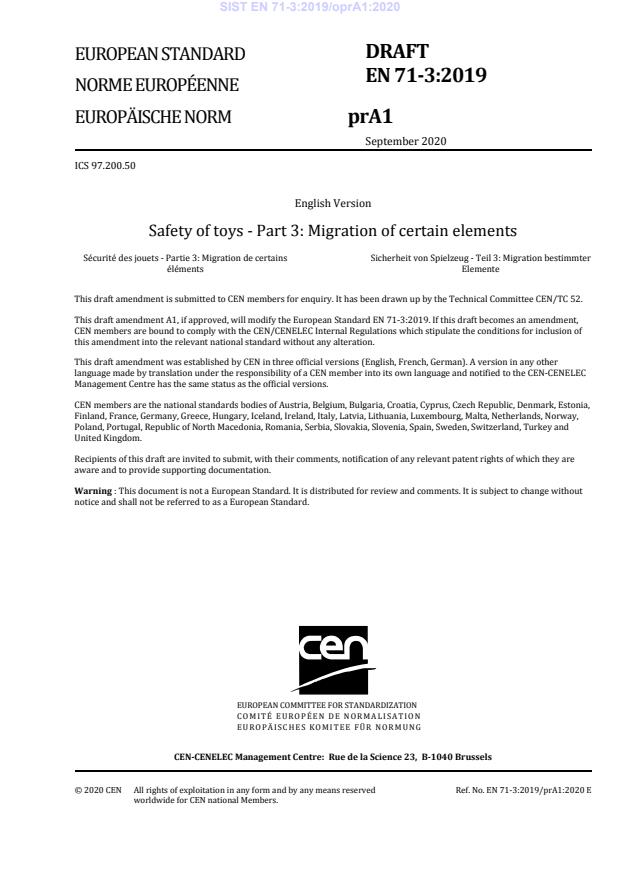
DRAFT
EUROPEAN STANDARD
EN 71-3:2019
NORME EUROPÉENNE
EUROPÄISCHE NORM
prA1
September 2020
ICS 97.200.50
English Version
Safety of toys - Part 3: Migration of certain elements
Sécurité des jouets - Partie 3: Migration de certains Sicherheit von Spielzeug - Teil 3: Migration bestimmter
éléments Elemente
This draft amendment is submitted to CEN members for enquiry. It has been drawn up by the Technical Committee CEN/TC 52.
This draft amendment A1, if approved, will modify the European Standard EN 71-3:2019. If this draft becomes an amendment,
CEN members are bound to comply with the CEN/CENELEC Internal Regulations which stipulate the conditions for inclusion of
this amendment into the relevant national standard without any alteration.
This draft amendment was established by CEN in three official versions (English, French, German). A version in any other
language made by translation under the responsibility of a CEN member into its own language and notified to the CEN-CENELEC
Management Centre has the same status as the official versions.
CEN members are the national standards bodies of Austria, Belgium, Bulgaria, Croatia, Cyprus, Czech Republic, Denmark, Estonia,
Finland, France, Germany, Greece, Hungary, Iceland, Ireland, Italy, Latvia, Lithuania, Luxembourg, Malta, Netherlands, Norway,
Poland, Portugal, Republic of North Macedonia, Romania, Serbia, Slovakia, Slovenia, Spain, Sweden, Switzerland, Turkey and
United Kingdom.
Recipients of this draft are invited to submit, with their comments, notification of any relevant patent rights of which they are
aware and to provide supporting documentation.
Warning : This document is not a European Standard. It is distributed for review and comments. It is subject to change without
notice and shall not be referred to as a European Standard.
EUROPEAN COMMITTEE FOR STANDARDIZATION
COMITÉ EUROPÉEN DE NORMALISATION
EUROPÄISCHES KOMITEE FÜR NORMUNG
CEN-CENELEC Management Centre: Rue de la Science 23, B-1040 Brussels
© 2020 CEN All rights of exploitation in any form and by any means reserved Ref. No. EN 71-3:2019/prA1:2020 E
worldwide for CEN national Members.
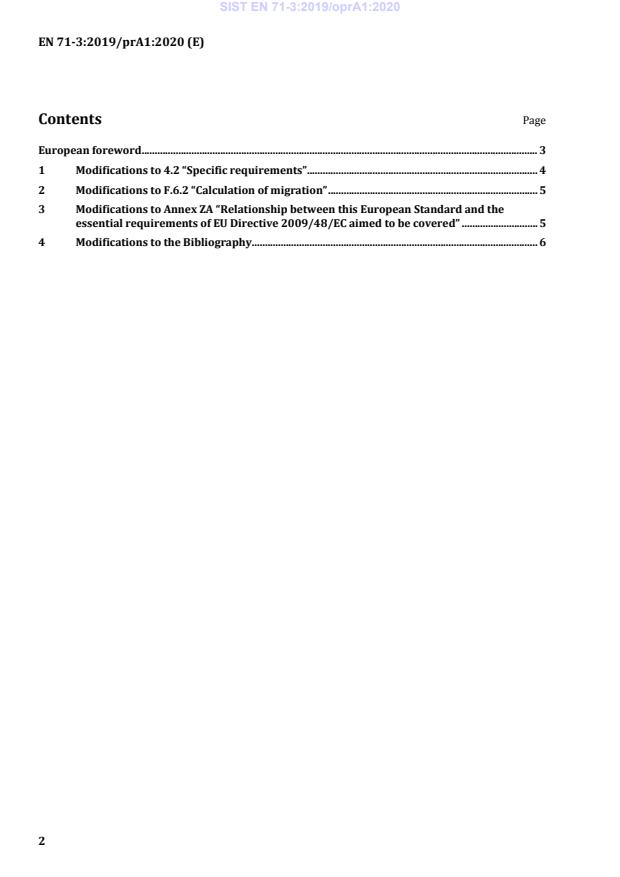
Contents Page
European foreword . 3
1 Modifications to 4.2 “Specific requirements”. 4
2 Modifications to F.6.2 “Calculation of migration” . 5
3 Modifications to Annex ZA “Relationship between this European Standard and the
essential requirements of EU Directive 2009/48/EC aimed to be covered” . 5
4 Modifications to the Bibliography . 6
European foreword
This document (EN 71-3:2019/prA1:2020) has been prepared by Technical Committee CEN/TC 52
“Safety of toys”, the secretariat of which is held by DS.
This document is currently submitted to the CEN Enquiry.
This document has been prepared under a standardization request given to CEN by the European
Commission and the European Free Trade Association, and supports essential
...