

EN 13108-1:2016
(Main)Bituminous mixtures - Material specifications - Part 1: Asphalt Concrete
- Abstract
This European Standard specifies requirements for mixtures of the mix group Asphalt Concrete for use on roads, airfields and other trafficked areas. Asphalt Concrete is used for surface courses, binder courses, regulating courses, and bases.
The mixtures of the mix group Asphalt Concrete are produced on the basis of hot bitumen. Mixtures utilizing bitumen emulsion and bituminous materials based on in situ recycling are not covered by this standard.
This European Standard includes requirements for the selection of the constituent materials. It is designed to be read in conjunction with EN 13108-20 and EN 13108-21.
- Status
- Published
- Publication Date
- 14-Jun-2016
- Withdrawal Date
- 30-Mar-2018
- Technical Committee
- CEN/TC 227 - Road materials
- Drafting Committee
- CEN/TC 227/WG 1 - Bituminous mixtures
- Current Stage
- 9093 - Decision to confirm - Review Enquiry
- Start Date
- 02-Aug-2022
- Completion Date
- 21-Oct-2026
Buy Documents






Overview
EN 13108-1:2016 - Bituminous mixtures - Material specifications - Part 1: Asphalt Concrete (CEN) specifies material and mix requirements for Asphalt Concrete used on roads, airfields and other trafficked areas. It covers hot‑bitumen produced mixtures for surface courses, binder courses, regulating courses and bases. The standard excludes mixes based on bitumen emulsion and in‑situ recycling materials. EN 13108-1 is intended to be used together with EN 13108-20 (Type Testing) and EN 13108-21 (Factory Production Control).
Key topics and technical requirements
- Constituent materials: Requirements and selection guidance for binders, aggregates (coarse, fine, all‑in), fillers, additives and reclaimed asphalt inputs.
- Binder rules: Selection and calculation methods (Annex A) for binder properties when reclaimed asphalt is incorporated.
- Mixture composition: Specification of grading, minimum binder content and composition criteria for Asphalt Concrete mix groups.
- Performance properties and tests: A menu of laboratory tests and properties covering:
- Void content and specimen preparation (gyratory compactor)
- Water sensitivity (durability)
- Abrasion by studded tyres
- Resistance to permanent deformation (wheel tracking)
- Stiffness and cyclic compression
- Fatigue and crack propagation
- Saturation Ageing Tensile Stiffness (SATS) durability index
- Low temperature behavior and fracture toughness
- Friction after polishing, coating/homogeneity, reaction to fire (where applicable)
- Airfield‑specific tests (Marshall values, resistance to fuel and de‑icing fluids)
- Quality system link: Clause on Assessment and Verification of Constancy of Performance (AVCP) aligning with Regulation (EU) No 305/2011 (CPR) and informative Annex ZA.
Applications
EN 13108-1 is used to:
- Specify material acceptance criteria for new asphalt mixes on highways, local roads, parking areas and airfields.
- Define laboratory test requirements for design verification and contract compliance.
- Guide mix designers in selecting aggregates, bitumen types and proportioning to meet performance objectives.
- Support procurement documents, technical specifications, and quality control regimes for asphalt producers and contractors.
Who uses this standard
- Highway and airport authorities, pavement designers and specifiers
- Asphalt producers and plant engineers
- Construction contractors and surfacing subcontractors
- Materials testing laboratories and certification bodies
- National standards bodies and compliance/contract managers
Related standards
- EN 13108-20 (Type Testing), EN 13108-21 (Factory Production Control)
- Other parts of EN 13108 series (e.g., Parts 2–9 for different mix types)
- EN 12697 series (test methods), EN 12591 (paving bitumens), EN 13043 (aggregates)
Relations
- Replaces
EN 13108-1:2006/AC:2008 - Bituminous mixtures - Material specifications - Part 1: Asphalt Concrete - Effective Date
- 22-Jun-2016
- Effective Date
- 25-Jul-2012
- Effective Date
- 27-May-2026
- Effective Date
- 04-Feb-2026
- Effective Date
- 28-Jan-2026
- Effective Date
- 28-Jan-2026
- Effective Date
- 28-Jan-2026
- Effective Date
- 28-Jan-2026
- Effective Date
- 28-Jan-2026
- Effective Date
- 28-Jan-2026
- Effective Date
- 28-Jan-2026
- Effective Date
- 28-Jan-2026
- Effective Date
- 28-Jan-2026
- Effective Date
- 28-Jan-2026
- Effective Date
- 28-Jan-2026
Buy Documents
Get Certified
Connect with accredited certification bodies for this standard

Zavod za gradbeništvo Slovenije (ZAG) - Inšpekcija
ZAG inspection body for construction products, structures, and materials.
Sponsored listings
Frequently Asked Questions
EN 13108-1:2016 is a standard published by the European Committee for Standardization (CEN). Its full title is "Bituminous mixtures - Material specifications - Part 1: Asphalt Concrete". This standard covers: This European Standard specifies requirements for mixtures of the mix group Asphalt Concrete for use on roads, airfields and other trafficked areas. Asphalt Concrete is used for surface courses, binder courses, regulating courses, and bases. The mixtures of the mix group Asphalt Concrete are produced on the basis of hot bitumen. Mixtures utilizing bitumen emulsion and bituminous materials based on in situ recycling are not covered by this standard. This European Standard includes requirements for the selection of the constituent materials. It is designed to be read in conjunction with EN 13108-20 and EN 13108-21.
This European Standard specifies requirements for mixtures of the mix group Asphalt Concrete for use on roads, airfields and other trafficked areas. Asphalt Concrete is used for surface courses, binder courses, regulating courses, and bases. The mixtures of the mix group Asphalt Concrete are produced on the basis of hot bitumen. Mixtures utilizing bitumen emulsion and bituminous materials based on in situ recycling are not covered by this standard. This European Standard includes requirements for the selection of the constituent materials. It is designed to be read in conjunction with EN 13108-20 and EN 13108-21.
EN 13108-1:2016 is classified under the following ICS (International Classification for Standards) categories: 93.080.20 - Road construction materials. The ICS classification helps identify the subject area and facilitates finding related standards.
EN 13108-1:2016 has the following relationships with other standards: It is inter standard links to EN 13108-1:2006/AC:2008, EN 13108-1:2006, EN 1427:2026, EN ISO 11925-2:2026, EN 13108-20:2016, EN 12697-3:2013+A1:2018, EN 1097-6:2022, EN 12697-46:2020, EN 12697-22:2020+A1:2023, EN 13108-8:2016, EN 1426:2024, EN 12697-45:2020, EN 12697-12:2018, EN 12697-16:2024, EN 12697-43:2023. Understanding these relationships helps ensure you are using the most current and applicable version of the standard.
EN 13108-1:2016 is associated with the following European legislation: EU Directives/Regulations: 305/2011, 89/106/EEC; Standardization Mandates: M/124. When a standard is cited in the Official Journal of the European Union, products manufactured in conformity with it benefit from a presumption of conformity with the essential requirements of the corresponding EU directive or regulation.
EN 13108-1:2016 is available in PDF format for immediate download after purchase. The document can be added to your cart and obtained through the secure checkout process. Digital delivery ensures instant access to the complete standard document.
Standards Content (Sample)
2003-01.Slovenski inštitut za standardizacijo. Razmnoževanje celote ali delov tega standarda ni dovoljeno.Bitumenske zmesi - Specifikacije materialov - 1. del: Bitumenski betonAsphaltmischgut - Mischgutanforderungen - Teil 1: AsphaltbetonMélanges bitumineux - Spécifications sur le matériau - Partie 1: Enrobés bitumineuxBituminous mixtures - Material specifications - Part 1: Asphalt Concrete93.080.20Materiali za gradnjo cestRoad construction materialsICS:Ta slovenski standard je istoveten z:EN 13108-1:2016SIST EN 13108-1:2016en,fr,de01-november-2016SIST EN 13108-1:2016SLOVENSKI
STANDARDSIST EN 13108-1:2006/AC:2008SIST EN 13108-1:20061DGRPHãþD
EUROPEAN STANDARD NORME EUROPÉENNE EUROPÄISCHE NORM
EN 13108-1
June
t r s x ICS
{ uä r z rä t r Supersedes EN
s u s r zæ sã t r r xEnglish Version
Bituminous mixtures æ Material specifications æ Part
sã Asphalt Concrete Mélanges bitumineux æ Spécifications pour le matériau æ Partie
sã Enrobés bitumineux
Asphaltmischgut æ Mischgutanforderungen æ Teil
sã Asphaltbeton This European Standard was approved by CEN on
t y February
t r s xä
egulations which stipulate the conditions for giving this European Standard the status of a national standard without any alterationä Upætoædate lists and bibliographical references concerning such national standards may be obtained on application to the CENæCENELEC Management Centre or to any CEN memberä
translation under the responsibility of a CEN member into its own language and notified to the CENæCENELEC Management Centre has the same status as the official versionsä
CEN members are the national standards bodies of Austriaá Belgiumá Bulgariaá Croatiaá Cyprusá Czech Republicá Denmarká Estoniaá Finlandá Former Yugoslav Republic of Macedoniaá Franceá Germanyá Greeceá Hungaryá Icelandá Irelandá Italyá Latviaá Lithuaniaá Luxembourgá Maltaá Netherlandsá Norwayá Polandá Portugalá Romaniaá Slovakiaá Sloveniaá Spainá Swedená Switzerlandá Turkey and United Kingdomä
EUROPEAN COMMITTEE FOR STANDARDIZATION COMITÉ EUROPÉEN DE NORMALISATION EUROPÄISCHES KOMITEE FÜR NORMUNG
CEN-CENELEC Management Centre:
Avenue Marnix 17,
B-1000 Brussels
t r s x CEN All rights of exploitation in any form and by any means reserved worldwide for CEN national Membersä Refä Noä EN
s u s r zæ sã t r s x ESIST EN 13108-1:2016
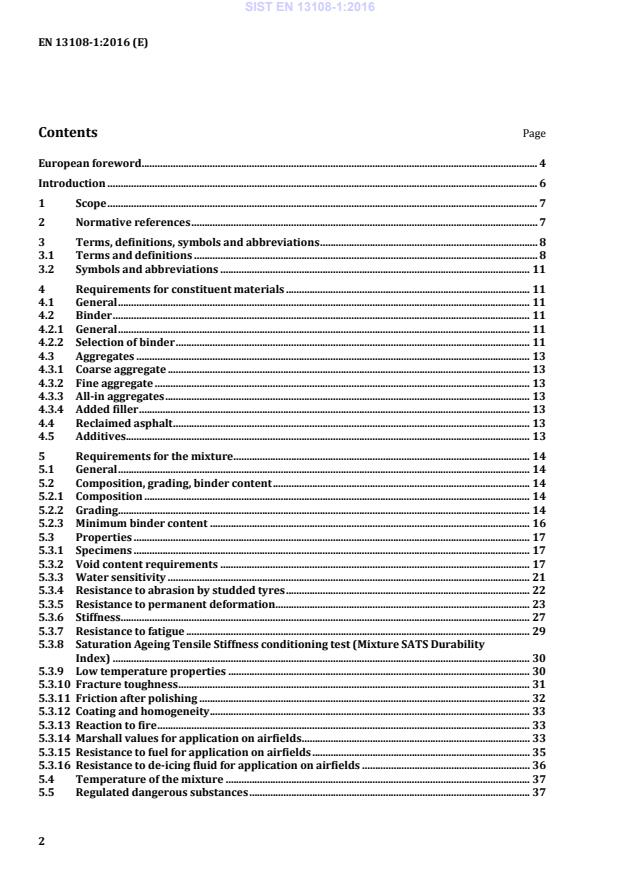
2 Contents Page European foreword . 4 Introduction . 6 1 Scope . 7 2 Normative references . 7 3 Terms, definitions, symbols and abbreviations . 8 3.1 Terms and definitions . 8 3.2 Symbols and abbreviations . 11 4 Requirements for constituent materials . 11 4.1 General . 11 4.2 Binder . 11 4.2.1 General . 11 4.2.2 Selection of binder . 11 4.3 Aggregates . 13 4.3.1 Coarse aggregate . 13 4.3.2 Fine aggregate . 13 4.3.3 All-in aggregates . 13 4.3.4 Added filler . 13 4.4 Reclaimed asphalt . 13 4.5 Additives . 13 5 Requirements for the mixture . 14 5.1 General . 14 5.2 Composition, grading, binder content . 14 5.2.1 Composition . 14 5.2.2 Grading . 14 5.2.3 Minimum binder content . 16 5.3 Properties . 17 5.3.1 Specimens . 17 5.3.2 Void content requirements . 17 5.3.3 Water sensitivity . 21 5.3.4 Resistance to abrasion by studded tyres . 22 5.3.5 Resistance to permanent deformation . 23 5.3.6 Stiffness . 27 5.3.7 Resistance to fatigue . 29 5.3.8 Saturation Ageing Tensile Stiffness conditioning test (Mixture SATS Durability Index) . 30 5.3.9 Low temperature properties . 30 5.3.10 Fracture toughness . 31 5.3.11 Friction after polishing . 32 5.3.12 Coating and homogeneity . 33 5.3.13 Reaction to fire . 33 5.3.14 Marshall values for application on airfields . 33 5.3.15 Resistance to fuel for application on airfields . 35 5.3.16 Resistance to de-icing fluid for application on airfields . 36 5.4 Temperature of the mixture . 37 5.5 Regulated dangerous substances . 37 SIST EN 13108-1:2016
Calculations of the penetration or the softening point of the binder of a mixture when reclaimed asphalt is used . 40 A.1 General . 40 A.2 Calculation of the penetration of the binder of a mixture . 40 A.3 Calculation of the softening point of the binder of a mixture . 40 Annex ZA (informative)
Relationship of this European Standard with Regulation (EU) No. 305/2011 . 42
4 European foreword This document (EN 13108-1:2016) has been prepared by Technical Committee CEN/TC 227 “Road materials”, the secretariat of which is held by DIN. This European Standard shall be given the status of a national standard, either by publication of an identical text or by endorsement, at the latest by December 2016, and conflicting national standards shall be withdrawn at the latest by March 2018. Attention is drawn to the possibility that some of the elements of this document may be the subject of patent rights. CEN [and/or CENELEC] shall not be held responsible for identifying any or all such patent rights. This document supersedes EN 13108-1:2006. This document has been prepared under a mandate given to CEN by the European Commission and the European Free Trade Association, and supports essential requirements of Regulation (EU) No 305/2011 for construction products (CPR). For relationship with Regulation (EU) No 305/2011 see informative Annex ZA which is an integral part of this document. Compared with EN 13108-1:2006, the following changes have been made: a) general, empirical and fundamental approaches have been merged into one list with different properties; b) new properties introduced (saturation tensile stiffness conditioning test, low temperature properties, fracture toughness, friction after polishing); c) additional optional sieves for the characterization of the grading; d) for several properties additional categories are introduced; e) possibility to define specific conditions in documents related to the application of the product; f) CPR reference and new Annex ZA according CPR rules. This European Standard is one of a series of standards as listed below: — EN 13108-1, Bituminous mixtures — Material specifications — Part 1: Asphalt Concrete — EN 13108-2, Bituminous mixtures — Material specifications — Part 2: Asphalt Concrete for Very Thin Layers (BBTM) — EN 13108-3, Bituminous mixtures — Material specifications — Part 3: Soft Asphalt — EN 13108-4, Bituminous mixtures — Material specifications — Part 4: Hot Rolled Asphalt — EN 13108-5, Bituminous mixtures — Material specifications — Part 5: Stone Mastic Asphalt — EN 13108-6, Bituminous mixtures — Material specifications — Part 6: Mastic Asphalt SIST EN 13108-1:2016
6 Introduction The aim of this European Standard is to enable specification of Asphalt Concrete mixtures on a performance basis. In general, however, there are currently more empirical tests available to describe the mixtures. Depending on the experience with the combination of requirements in this European standard more or less degrees of freedom for the producer may be given. This European Standard covers a large variety of materials for different applications, traffic and climate conditions. EN 13108-1 gives properties and listings of possible categories. It has to accommodate the road industry for all of Europe. For this reason the menu approach for properties has been chosen. The Tables represent categories that are required all over Europe. For this reason numerical values in Tables do not always obey statistical rules. Based on conditions of use specific properties and categories may be defined in documents related to the application of the product. The categories defined in those documents need to take into account the reproducibility of the test when this is given in the appropriate test method. Care should be taken to only select those tests which are relevant to the application of the asphalt and the use of the pavement and to avoid a combination of potentially conflicting requirements. SIST EN 13108-1:2016
8 EN 12697-34, Bituminous mixtures — Test methods for hot mix asphalt — Part 34: Marshall test EN 12697-41, Bituminous mixtures — Test methods for hot mix asphalt — Part 41: Resistance to de-icing fluids EN 12697-43, Bituminous mixtures — Test methods for hot mix asphalt — Part 43: Resistance to fuel EN 12697-44, Bituminous mixtures — Test methods for hot mix asphalt — Part 44: Crack propagation by semi-circular bending test EN 12697-45, Bituminous mixtures — Test methods for hot mix asphalt — Part 45: Saturation Ageing Tensile Stiffness (SATS) conditioning test EN 12697-46, Bituminous mixtures — Test methods for hot mix asphalt — Part 46: Low temperature cracking and properties by uniaxial tension tests EN 12697-49, Bituminous mixtures — Test methods for hot mix asphalt — Part 49: Determination of friction after polishing EN 13043, Aggregates for bituminous mixtures and surface treatments for roads, airfields and other trafficked areas EN 13108-4:2016, Bituminous mixtures — Material specifications — Part 4: Hot Rolled Asphalt EN 13108-8, Bituminous mixtures — Material specifications — Part 8: Reclaimed asphalt EN 13108-20:2016, Bituminous mixtures — Material specifications — Part 20: Type Testing EN 13108-21, Bituminous mixtures — Material specifications — Part 21: Factory Production Control EN 13501-1:2007+A1:2009, Fire classification of construction products and building elements — Part 1: Classification using data from reaction to fire tests EN 13924-1, Bitumen and bituminous binders — Specification framework for special paving grade bitumen — Part 1: Hard paving grade bitumens EN 13924-2, Bitumen and bituminous binders — Specification framework for special paving grade bitumen — Part 2: Multigrade paving grade bitumens EN 14023, Bitumen and bituminous binders — Specification framework for polymer modified bitumens EN ISO 11925-2, Reaction to fire tests — Ignitability of products subjected to direct impingement of flame — Part 2: Single-flame source test (ISO 11925-2) 3 Terms, definitions, symbols and abbreviations 3.1 Terms and definitions For the purposes of this document, the following terms and definitions apply. 3.1.1 pavement structure, composed of one or more courses, to assist the passage of traffic over terrain SIST EN 13108-1:2016
10 Note 1 to entry: A target composition is expressed in one of two ways (see 3.1.12 and 3.1.13). 3.1.12 input target composition expression of the mix formulation in terms of the constituent materials, the grading curve and the percentage of binder added to the mixture Note 1 to entry: This will usually be the result of a laboratory mix design and validation. 3.1.13 output target composition expression of the mix formulation in terms of the constituent materials and the mid-point grading and soluble binder content to be found on analysis Note 1 to entry: This will usually be the result of a production validation. 3.1.14 additive constituent material that can be added in small quantities to influence specific properties of the mixture Note 1 to entry: For example additives are used to influence the affinity of binder to aggregate, and the mechanical properties when using inorganic and organic fibres and polymers. They are also used to influence the colour of the mixture. 3.1.15 conflicting requirements combination of requirements or properties which are impracticable to fulfil in their entirety Note 1 to entry: This can occur by combining specific requirements for the composition and constituent materials together with more performance related tests. These are also relevant when two or more performance or test parameters are selected which measure similar properties using conflicting test methods resulting in a lack of clarity and consistency in the characteristics of the mixture. 3.1.16 premixed binder bitumen which is blended on the site of the asphalt mixing plant, with an additive before or during the addition of the binder to the plant mixer, which in the case of a continuous plant, will be before or during the delivery of the binder to the mixing zone of the drier drum 3.1.17 category defined level of a property of an asphalt mixture Note 1 to entry: The designation of a category is expressed with a symbol and a numerical value representing the level. EXAMPLE Bmin 4,0 means that the minimum binder content shall be 4,0 %. Note 2 to entry: Defined categories for each property are listed in EN 13108–1. 3.1.18 class range of levels defined by a minimum and a maximum value SIST EN 13108-1:2016
12 When an additive is used to lower the production temperature of the Asphalt Concrete and thereby changes relevant properties of the binder at temperatures representative for the climatic conditions in the place of use, evidence shall be provided to show what the influence of the additive is on the performance of the mix. This proof shall be based on research or evidence of satisfactory performance according to 4.1. 4.2.2.2 Surface courses with reclaimed asphalt When using more than 10 % by mass of the total mixture of reclaimed asphalt from mixtures in which only paving grade bitumen has been used and when the binder added to the mixture is a paving grade bitumen and the grade of the bitumen is selected, the following requirements may be defined in documents related to the application of the product. The penetration and/or the softening point of the binder in the resulting mixture, calculated from the penetrations and/or the softening points of the added binder and the recovered binder from the reclaimed asphalt, shall meet the penetration and/or softening point requirements of the specified grade. The calculation shall be performed according to Annex A (normative). In some cases the binder of the reclaimed asphalt can be so hardened that a very soft bitumen has to be chosen to fulfil these requirements. In such cases an alternative grade to that calculated according to Annex A (normative) may be defined. When using reclaimed asphalt from mixtures in which a modified bitumen and/or an additive has been used, and/or the mixture itself contains a modified bitumen or an additive, the amount of reclaimed asphalt may be limited in documents related to the application of the product to a maximum of 10 % by mass of the total mixture. NOTE 1 The choice for this specification depends on the choice of requirements within this European Standard. For more performance designed mixes there might be no need to apply the pen and/or softening point rule. (However, the pen or softening point rule is only valid for paving grade bitumen.) NOTE 2 When applying a recipe approach to the mixture, using too great a proportion of modified bitumen or additive could lead to an incorrect decision in respect to the addition of the new bitumen. 4.2.2.3 Regulating courses, binder courses and bases with reclaimed asphalt When using more than 20 % by mass of the total mixture of reclaimed asphalt from mixtures in which only paving grade bitumen has been used and when the binder added to the mixture is a paving grade bitumen and the grade of the bitumen is selected, the following requirements may be defined in documents related to the application of the product. The penetration and/or the softening point of the binder in the resulting mixture, calculated from the penetrations and/or the softening points of the added binder and the recovered binder from the reclaimed asphalt, shall meet the penetration and/or softening point requirements of the selected grade. The calculation shall be executed according to Annex A (normative). In some cases the binder of the recovered asphalt can be so hardened that a very soft bitumen has to be chosen to fulfil these requirements. In such cases an alternative grade to that calculated according to Annex A (normative) may be defined. When using reclaimed asphalt from mixtures in which a modified bitumen and/or an additive has been used, and/or the mixture itself contains a modified bitumen or an additive, the amount of reclaimed asphalt for regulating courses, binder courses and base courses may be limited in documents related to the application of the product to a maximum of 20 % by mass of the total mixture. NOTE 1 The choice for this specification depends on the choice of requirements within this standard. For performance designed mixes there might be no need to apply the pen and/ or softening point rule. (However, the pen or softening point rule is only valid for paving grade bitumen). SIST EN 13108-1:2016
14 5 Requirements for the mixture 5.1 General The mix formulation shall be declared in the Type Test report according to EN 13108-20, including: — the target percentages passing the specified sieves. The target grading shall be declared for the sieves as defined in 5.2.2.1 or 5.2.2.2; — the target binder content and where relevant, the binder content from reclaimed asphalt and/or binder content in natural asphalt; — and the percentage(s) of additive(s). The target binder content comprises the total of added binder (including any additives in solution in the binder), binder in reclaimed asphalt and binder in natural asphalt. At the target composition the mixture shall conform to the appropriate requirements in accordance with this European Standard. The test results in accordance with EN 13108-20:2016, 7.5, shall be made available. 5.2 Composition, grading, binder content 5.2.1 Composition The grading shall be expressed in percentages by mass of total aggregate. The binder and additive content shall be expressed in percentages by mass of the total mixture. The percentages passing the sieves, with the exception of the sieve 0,063 mm shall be expressed to 1 %. The binder content, the percentage passing sieve 0,063 mm and any additive content shall be expressed to 0,1 %. Where appropriate the additive content shall be expressed to 0,01 %. 5.2.2 Grading 5.2.2.1 General grading requirements The requirements for the overall grading limits of the target composition are given in Tables 1 and 2 for the sieves 1,4 D, D, 2 mm and 0,063 mm. The target composition shall be within these overall limits. See also 5.6 for conflicting requirements. The sieves to be used shall be either basic sieve set plus set 1 or basic sieve set plus set 2, according to EN 13043. A combination of sieve sizes from set 1 and set 2 shall not be permissible. The target grading according to 5.1 shall be declared for the sieves 1,4 D, D, 2 mm and 0,063 mm, as a minimum. In documents related to the application of the product it may be defined that the target grading shall be further declared for a maximum of three characteristic sieves between D and 2 mm and a maximum of three characteristic sieves between 2 mm and 0,063 mm. NOTE When this approach is chosen there are no further prescribed requirements for the grading on any other characteristic sieves (see also 5.6 for conflicting requirements). When required to be declared, those characteristic sieves shall be chosen from the lists identified in 5.2.2.2. SIST EN 13108-1:2016
16 given limits from Table 3. The percentage passing the sieves D, 2 mm and 0,063 mm, of the selected grading envelope shall not exceed the maximum and minimum values in Table 1 or Table 2. Table 3 — Ranges between maximum and minimum percentage values for the selected grading envelope Sieve mm Ranges for grading envelope D 10 Characteristic sieve between D and 2 10 to 30a Any additional characteristic sieves between D and 2 10 to 30a 2 5 to 25a Characteristic sieve between 2 and 0,063 4 to 25a Any additional characteristic sieves between 2 and 0,063 4 to 25a 0,063 2,0 to 12,0a a Value to be selected within the given minimum and maximum value (both included). In the case of a single point target grading meeting the requirements of Table 1 or Table 2, the use of the minimum range values in Table 3 is not required. 5.2.3 Minimum binder content The minimum binder content may be defined in documents related to the application of the product and shall be selected to the nearest 0,1 %, between values of 3,0 % and 8,0 % for a mixture in which the aggregate density is assumed to be equal to 2,65 Mg/m3. The selected minimum binder content shall be expressed as Bminx where x is the minimum binder content in %. The minimum binder content of the mixture shall be corrected by multiplying by the factor: αρ=2,650 (1) where
is the weighted mean of the particle density of the aggregates at the target grading, in megagrams per cubic metre (Mg/m3), determined according to EN 1097–6 The appropriate particle density according to EN 1097-6 shall be declared in the type test report. NOTE For normal weight aggregates with water absorption less than about 1,5 % the pre-dried particle density method as defined in EN 1097–6:2013, Annex A, is applicable for aggregates passing the 63 mm test sieve and retained on the 0,063 mm test sieve. EN 1097–6:2013, Annex G, is applicable to aggregates passing the 31,5 mm test sieve including the 0/0,063 mm size fraction. Based on experience in the place of use for certain specific aggregates with particular granulometric characteristics the corrected minimum binder content may be adjusted appropriately. The adjustment shall be defined in documents related to the application of the product. SIST EN 13108-1:2016
18 Table 4 — Void content, Vmin and/or Vmax Void content % Minimum void content % Maximum void content % Category Vmin Category Vmax 0,5 Vmin 0,5 – 1,0 Vmin 1,0 – 1,5 Vmin 1,5 – 2,0 Vmin 2,0 Vmax 2,0 2,5 Vmin 2,5 Vmax 2,5 3,0 Vmin 3,0 Vmax 3,0 3,5 Vmin 3,5 Vmax 3,5 4,0 Vmin 4,0 Vmax 4,0 4,5 Vmin 4,5 Vmax 4,5 5,0 Vmin 5,0 Vmax 5,0 5,5 Vmin 5,5 Vmax 5,5 6,0 Vmin 6,0 Vmax 6,0 6,5 – Vmax 6,5 7,0 – Vmax 7,0 8,0 – Vmax 8,0 9,0 – Vmax 9,0 10,0 – Vmax 10,0 11,0 – Vmax 11,0 12,0 – Vmax 12,0 13,0 – Vmax 13,0 14,0 – Vmax 14,0 No requirement Vmin NR Vmax NR 5.3.2.2 Voids filled with binder The percentage of voids filled with binder shall be determined according EN 12697-8 using the conditions defined in EN 13108-20:2016, D.2, based on the samples prepared and tested according to 5.3.2.1. SIST EN 13108-1:2016
20 Table 6 — Maximum voids filled with binder, VFBmax Maximum voids filled with binder % Category VFBmax 50 VFBmax 50 53 VFBmax 53 56 VFBmax 56 59 VFBmax 59 62 VFBmax 62 65 VFBmax 65 68 VFBmax 68 71 VFBmax 71 74 VFBmax 74 77 VFBmax 77 80 VFBmax 80 83 VFBmax 83 86 VFBmax 86 89 VFBmax 89 93 VFBmax 93 97 VFBmax 97 No requirement VFBmax NR 5.3.2.3 Voids in mineral aggregate The percentage of voids in mineral aggregate shall be determined according to EN 12697-8 using the conditions defined in EN 13108-20:2016, D.2, based on the samples prepared and tested according to 5.3.2.1. The range of categories of minimum percentage of voids in mineral aggregate is defined in Table 7. In documents related to the application of the product, categories for the minimum percentage of voids in mineral aggregate selected from Table 7 may be defined. SIST EN 13108-1:2016
...
SLOVENSKI SIST EN 13108-1
STANDARD
november 2016
Bitumenske zmesi – Specifikacije materialov – 1. del: Bitumenski beton
Bituminous mixtures – Material specifications – Part 1: Asphalt Concrete
Mélanges bitumineux – Spécifications sur le matériau – Partie 1: Enrobés
bitumineux
Asphaltmischgut – Mischgutanforderungen – Teil 1: Asphaltbeton
Referenčna oznaka
ICS 93.080.20 SIST EN 13108-1:2016 (sl)
Nadaljevanje na straneh II do IV in od 1 do 46
© 2018-03. Slovenski inštitut za standardizacijo. Razmnoževanje ali kopiranje celote ali delov tega standarda ni dovoljeno.
SIST EN 13108-1 : 2016
NACIONALNI UVOD
Standard SIST EN 13108-1 (sl), Bitumenske zmesi – Specifikacije materialov – 1. del: Bitumenski beton,
2016, ima status slovenskega standarda in je istoveten evropskemu standardu EN 13108-1 (en, de, fr),
Bituminous mixtures – Material specifications – Part 1: Asphalt Concrete, 2016.
Ta standard nadomešča SIST EN 13108-1:2006 in SIST EN 13108-1:2006/AC:2008.
NACIONALNI PREDGOVOR
Evropski standard EN 13108-1:2016 je pripravil tehnični odbor Evropskega komiteja za standardizacijo
CEN/TC 227 Materiali za ceste. Slovenski standard SIST EN 13108-1:2016 je prevod evropskega
standarda EN 13108-1:2016. V primeru spora glede besedila slovenskega prevoda v tem standardu je
odločilen izvirni evropski standard v angleškem jeziku. Slovensko izdajo standarda je pripravil tehnični
odbor SIST/TC CES Ceste.
Odločitev za privzem tega standarda je dne 2. septembra 2016 sprejel SIST/TC CES Ceste.
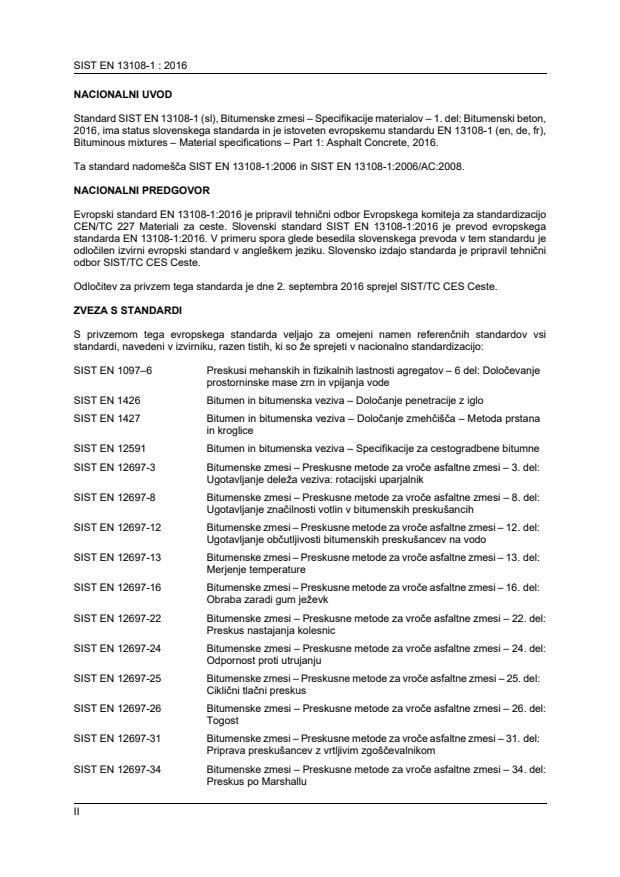
ZVEZA S STANDARDI
S privzemom tega evropskega standarda veljajo za omejeni namen referenčnih standardov vsi
standardi, navedeni v izvirniku, razen tistih, ki so že sprejeti v nacionalno standardizacijo:
SIST EN 1097–6 Preskusi mehanskih in fizikalnih lastnosti agregatov – 6 del: Določevanje
prostorninske mase zrn in vpijanja vode
SIST EN 1426 Bitumen in bitumenska veziva – Določanje penetracije z iglo
SIST EN 1427 Bitumen in bitumenska veziva – Določanje zmehčišča – Metoda prstana
in kroglice
SIST EN 12591 Bitumen in bitumenska veziva – Specifikacije za cestogradbene bitumne
SIST EN 12697-3 Bitumenske zmesi – Preskusne metode za vroče asfaltne zmesi – 3. del:
Ugotavljanje deleža veziva: rotacijski uparjalnik
SIST EN 12697-8 Bitumenske zmesi – Preskusne metode za vroče asfaltne zmesi – 8. del:
Ugotavljanje značilnosti votlin v bitumenskih preskušancih
SIST EN 12697-12 Bitumenske zmesi – Preskusne metode za vroče asfaltne zmesi – 12. del:
Ugotavljanje občutljivosti bitumenskih preskušancev na vodo
SIST EN 12697-13 Bitumenske zmesi – Preskusne metode za vroče asfaltne zmesi – 13. del:
Merjenje temperature
SIST EN 12697-16 Bitumenske zmesi – Preskusne metode za vroče asfaltne zmesi – 16. del:
Obraba zaradi gum ježevk
SIST EN 12697-22 Bitumenske zmesi – Preskusne metode za vroče asfaltne zmesi – 22. del:
Preskus nastajanja kolesnic
SIST EN 12697-24 Bitumenske zmesi – Preskusne metode za vroče asfaltne zmesi – 24. del:
Odpornost proti utrujanju
SIST EN 12697-25 Bitumenske zmesi – Preskusne metode za vroče asfaltne zmesi – 25. del:
Ciklični tlačni preskus
SIST EN 12697-26 Bitumenske zmesi – Preskusne metode za vroče asfaltne zmesi – 26. del:
Togost
SIST EN 12697-31 Bitumenske zmesi – Preskusne metode za vroče asfaltne zmesi – 31. del:
Priprava preskušancev z vrtljivim zgoščevalnikom
SIST EN 12697-34 Bitumenske zmesi – Preskusne metode za vroče asfaltne zmesi – 34. del:
Preskus po Marshallu
II
SIST EN 13108-1 : 2016
SIST EN 12697-41 Bitumenske zmesi – Preskusne metode za vroče asfaltne zmesi – 41. del:
Odpornost proti tekočinam za odtajevanje
SIST EN 12697-43 Bitumenske zmesi – Preskusne metode za vroče asfaltne zmesi – 43. del:
Odpornost proti gorivu
SIST EN 12697-44 Bitumenske zmesi – Preskusne metode za vroče asfaltne zmesi – 44. del:
Širjenje razpoke s polkrožnim upogibnim preskusom
SIST EN 12697-45 Bitumenske zmesi – Preskusne metode za vroče asfaltne zmesi – 45. del:
Preskus staranja na zasičenih asfaltnih preskušancih (preskus SATS)
SIST EN 12697-46 Bitumenske zmesi – Preskusne metode za vroče asfaltne zmesi – 46. del:
Odpornost asfaltne plasti proti razpokam pri nizkih temperaturah z
enoosnimi nateznimi preskusi
SIST EN 12697-49 Bitumenske zmesi – Preskusne metode za vroče asfaltne zmesi – 49. del:
Ugotavljanje tornih sposobnosti po poliranju
SIST EN 13043 Agregati za bitumenske zmesi in površinske prevleke za ceste, letališča
in druge prometne površine
SIST EN 13108-4:2016 Bitumenske zmesi – Specifikacije materialov – 4. del: Vroče valjani asfalt
SIST EN 13108-8 Bitumenske zmesi – Specifikacije materialov – 8. del: Ponovno uporabljen
asfalt
SIST EN 13108-20:2016 Bitumenske zmesi – Specifikacije materialov – 20. del: Preskušanje tipa
SIST EN 13108-21 Bitumenske zmesi – Specifikacije materialov – 21. del: Kontrola
proizvodnje v obratu
SIST EN 13501-1:2007+A1:2009 Požarna klasifikacija gradbenih proizvodov in elementov
stavb – 1. del: Klasifikacija po podatkih iz preskusov odziva na ogenj
SIST EN 13924-1 Bitumen in bitumenska veziva – Okvirna specifikacija za posebne
cestogradbene bitumne – 1. del: Trši cestogradbeni bitumni
SIST EN 13924-2 Bitumen in bitumenska veziva – Okvirna specifikacija za posebne
cestogradbene bitumne – 2. del: "Multigrade" cestogradbeni bitumni
SIST EN 14023 Bitumen in bitumenska veziva – Okvirna specifikacija za bitumne,
modificirane s polimeri
SIST EN ISO 11925-2 Preskusi odziva na ogenj – Sposobnost vžiga gradbenih proizvodov v
neposrednem stiku s plamenom – 2. del: Preskus z enim gorilnikom (ISO
11925-2)
OSNOVA ZA IZDAJO STANDARDA
– privzem standarda EN 13108-1:2016
PREDHODNA IZDAJA
– SIST EN 13108-1:2006 in SIST EN 13108-1:2006/AC:2008, Bitumenske zmesi – Specifikacije
materialov – 1. del: Bitumenski beton
OPOMBE
– Povsod, kjer se v besedilu standarda uporablja izraz "evropski standard", v SIST EN 13108-1:2016
to pomeni "slovenski standard".
– Uvod in nacionalni predgovor nista sestavni del standarda.
III
SIST EN 13108-1 : 2016
– Ta nacionalni dokument je istoveten EN 13108-1:2016 in je objavljen z dovoljenjem
CEN-CENELEC
Upravni center
Avenue Marnix 17
B-1000 Bruselj
This national document is identical with EN 13108-1:2016 and is published with the permission of
CEN-CENELEC
Management Centre
Avenue Marnix 17
B-1000 Brussels
IV
EVROPSKI STANDARD EN 13108-1
EUROPEAN STANDARD
NORME EUROPÉENNE
EUROPÄISCHE NORM junij 2016
ICS 91.080.40 Nadomešča EN 13108-1:2006
Slovenska izdaja
Bitumenske zmesi – Specifikacije materialov – 1. del: Bitumenski beton
Bituminous mixtures – Material Mélanges bitumineux – Asphaltmischgut –
specifications – Part 1: Asphalt Spécifications sur le matériau – Mischgutanforderungen –
Concrete Partie 1: Enrobés bitumineux Teil 1: Asphaltbeton
Ta evropski standard je CEN sprejel dne 27. februarja 2016.
Člani CEN morajo izpolnjevati notranje predpise CEN/CENELEC, s katerim je predpisano, da mora biti
ta standard brez kakršnihkoli sprememb sprejet kot nacionalni standard. Najnovejši seznami teh
nacionalnih standardov z njihovimi bibliografskimi podatki se na zahtevo lahko dobijo pri Upravnem
centru CEN-CENELEC ali kateremkoli članu CEN.
Ta evropski standard obstaja v treh izvirnih izdajah (nemški, francoski in angleški). Izdaje v drugih
jezikih, ki jih člani CEN na lastno odgovornost prevedejo in izdajo ter prijavijo pri Upravnem centru CEN-
CENELEC, veljajo kot uradne izdaje.
Člani CEN so nacionalni organi za standarde Avstrije, Belgije, Bolgarije, Cipra, Češke republike,
Danske, Estonije, Finske, Francije, Grčije, Hrvaške, Irske, Islandije, Italije, Latvije, Litve, Luksemburga,
Madžarske, Malte, Nekdanje jugoslovanske republike Makedonije, Nemčije, Nizozemske, Norveške,
Poljske, Portugalske, Romunije, Slovaške, Slovenije, Španije, Švedske, Švice, Turčije in Združenega
kraljestva.
CEN
Evropski komite za standardizacijo
European Committee for Standardization
Comité Européen de Normalisation
Europäisches Komitee für Normung
Upravni center CEN-CENELEC: Avenue Marnix 17, B-1000 Bruselj
© 2016 CEN. Lastnce avtorskih pravic so vse države članice CEN. Ref. oznaka EN 13108-1:2016 E
SIST EN 13108-1 : 2016
Predgovor k evropskemu standardu
Ta dokument (EN 13108-1:2016) je pripravil tehnični odbor CEN/TC 227 "Materiali za ceste", katerega
sekretariat vodi DIN.
Ta evropski standard mora dobiti status nacionalnega standarda bodisi z objavo istovetnega besedila
ali z razglasitvijo najpozneje decembra 2016, nasprotujoče nacionalne standarde pa je treba razveljaviti
najpozneje marca 2018.
Opozoriti je treba na možnost, da so lahko nekateri elementi tega dokumenta predmet patentnih pravic.
CEN [in/ali CENELEC] ni odgovoren za ugotavljanje posameznih ali vseh patentnih pravic.
Ta dokument nadomešča EN 13108-1:2006.
Ta dokument je bil pripravljen v okviru mandata, ki sta ga Evropska komisija in Evropsko združenje za
prosto trgovino dodelila CEN, ter podpira bistvene zahteve Uredbe (EU) št. 305/2011 o gradbenih
proizvodih (CPR).
Za zvezo z Uredbo (EU) št. 305/2011 glej informativni dodatek ZA, ki je sestavni del tega dokumenta.
V primerjavi s standardom EN 13108-1:2006 so bile vpeljane naslednje spremembe:
a) splošni, empirični in temeljni pristopi so bili dodani na isti seznam z različnimi lastnostmi;
b) uvedene so bile nove lastnosti (preskus staranja na zasičenih asfaltnih preskušancih, lastnosti pri
nizkih temperaturah lastnosti, lomna žilavost, torne sposobnosti po poliranju);
c) dodana so bila neobvezna sita za določanje zrnavosti;
d) za številne lastnosti so bile uvedene dodatne kategorije;
e) možnost opredelitve posebnih pogojev v dokumentih v zvezi z uporabo proizvoda;
f) dodana sta bila sklic na zahteve za gradbene proizvode in nov dodatek ZA, ki je skladen s temi
zahtevami.
Ta evropski standard je eden iz skupine standardov, ki so našteti spodaj:
‒ EN 13108-1, Bitumenske zmesi – Specifikacije materialov – 1. del: Bitumenski beton
‒ EN 13108-2, Bitumenske zmesi – Specifikacije materialov – 2. del: Bitumenski beton za zelo
tanke plasti (BBTM)
‒ EN 13108-3, Bitumenske zmesi – Specifikacije materialov – 3. del: Mehak asfalt
‒ EN 13108-4, Bitumenske zmesi – Specifikacije materialov – 4. del: Vroče valjani asfalt
‒ EN 13108-5, Bitumenske zmesi – Specifikacije materialov – 5. del: Drobir z bitumenskim mastiksom
‒ EN 13108-6, Bitumenske zmesi – Specifikacije materialov – 6. del: Liti asfalt
‒ EN 13108-7, Bitumenske zmesi – Specifikacije materialov – 7. del: Drenažni asfalt
‒ EN 13108-8, Bitumenske zmesi – Specifikacije materialov – 8. del: Asfaltni granulat
‒ EN 13108-9, Bitumenske zmesi – Specifikacije materialov – 9. del: Asfalt za ultra tanke plasti
(AUTL)
‒ EN 13108-20, Bitumenske zmesi – Specifikacije materialov – 20. del: Tipsko preskušanje
‒ EN 13108-21, Bitumenske zmesi – Specifikacije materialov – 21. del: Kontrola proizvodnje v obratu
SIST EN 13108-1 : 2016
Dodatek A (normativni) podrobno opisuje izračun penetracije ali točke zmehčišča v zmeseh, ki vsebujejo
asfaltni granulat, na podlagi penetracij ali točk zmehčišča dodanega veziva in ponovno pridobljenega
veziva iz asfaltnega granulata.
V skladu z notranjimi predpisi CEN/CENELEC so dolžne ta evropski standard privzeti nacionalne
organizacije za standarde naslednjih držav: Avstrije, Belgije, Bolgarije, Cipra, Češke republike, Danske,
Estonije, Finske, Francije, Grčije, Hrvaške, Irske, Islandije, Italije, Latvije, Litve, Luksemburga,
Madžarske, Malte, Nekdanje jugoslovanske republike Makedonije, Nemčije, Nizozemske, Norveške,
Poljske, Portugalske, Romunije, Slovaške, Slovenije, Španije, Švedske, Švice, Turčije in Združenega
kraljestva.
SIST EN 13108-1 : 2016
VSEBINA Stran
Predgovor k evropskemu standardu . 2
Uvod . 6
1 Področje uporabe . 7
2 Zveze s standardi . 7
3 Izrazi, definicije, simboli in okrajšave . 8
3.1 Izrazi in definicije . 8
3.2 Simboli in okrajšave . 10
4 Zahteve za sestavne materiale . 10
4.1 Splošno . 10
4.2 Vezivo . 11
4.2.1 Splošno . 11
4.2.2 Izbira veziva . 11
4.3 Agregati . 12
4.3.1 Grobi agregati . 12
4.3.2 Fini agregati . 12
4.3.3 Združene zrnavosti agregatov . 12
4.3.4 Dodano polnilo . 12
4.4 Asfaltni granulat . 13
4.5 Dodatki (aditivi) . 13
5 Zahteve za zmes . 13
5.1 Splošno . 13
5.2 Sestava, zrnavost, vsebnost veziva . 13
5.2.1 Sestava . 13
5.2.2 Zrnavost . 14
5.2.3 Najmanjša vsebnost veziva . 15
5.3 Lastnosti . 16
5.3.1 Preskušanci . 16
5.3.2 Zahteve vsebnosti votlin . 16
5.3.3 Občutljivost na vodo . 20
5.3.4 Odpornost proti obrabi z ježevkami . 21
5.3.5 Odpornost proti trajnemu preoblikovanju . 22
5.3.6 Togost . 26
5.3.7 Odpornost proti utrujanju materiala . 28
5.3.8 Preskus staranja na zasičenih asfaltnih preskušancih (indeks trajnosti zmesi SATS) .29
5.3.9 Lastnosti pri nizkih temperaturah . 29
5.3.10 Lomna žilavost . 30
5.3.11 Torne sposobnosti po poliranju . 31
5.3.12 Obvitost in homogenost . 32
5.3.13 Odziv na ogenj . 32
SIST EN 13108-1 : 2016
5.3.14 Vrednosti po Marshallu za uporabo na letališčih . 32
5.3.15 Odpornost proti gorivu za uporabo na letališčih . 34
5.3.16 Odpornost proti sredstvu za odmrzovanje za uporabo na letališčih . 35
5.4 Temperatura zmesi . 36
5.5 Zakonsko urejene nevarne snovi . 36
5.6 Nasprotujoče si zahteve . 36
6 Ocenjevanje in preverjanje nespremenljivosti lastnosti gradbenega proizvoda – AVCP . 37
7 Identifikacija . 37
Dodatek A (normativni): Izračuni penetracije ali točke zmehčišča veziva v zmesi, kadar
je uporabljen asfaltni granulat . 39
A.1 Splošno . 39
A.2 Izračun penetracije veziva v zmesi . 39
A.3 Izračun točke zmehčišča veziva v zmesi . 39
Dodatek ZA (informativni): Razmerje med tem evropskim standardom in
Uredbo (EU) št. 305/2011 . 41
ZA.1 Področje uporabe in ustrezne lastnosti. 41
ZA.2 Sistem ocenjevanja in preverjanja nespremenljivosti lastnosti gradbenega proizvoda (AVCP) . 43
ZA.3 Naloge ocenjevanja in preverjanja nespremenljivosti lastnosti gradbenega proizvoda . 44
SIST EN 13108-1 : 2016
Uvod
Cilj tega evropskega standarda je določiti zahteve za zmesi bitumenskega betona na osnovi obnašanja.
Na splošno je trenutno na voljo več empiričnih preskusov za opis zmesi. Odvisno od izkušenj z
zahtevami iz tega evropskega standarda se lahko proizvajalcu dovoli manjša ali večja stopnja
svobodnega delovanja.
Ta evropski standard obravnava zelo različne materiale za različne namene uporabe, prometne
obremenitve in podnebne razmere. Standard EN 13108-1 določa lastnosti in navaja možne kategorije.
Prilagojen mora biti cestni industriji v celotni Evropi. Iz tega razloga je bil za lastnosti izbran menijski
pristop. Preglednice predstavljajo kategorije, ki se morajo uporabljati po vsej Evropi. Iz tega razloga
številčne vrednosti v preglednicah niso vedno skladne s statističnimi pravili. Določene lastnosti in
kategorije so lahko na podlagi pogojev uporabe opredeljene v dokumentih v zvezi z uporabo proizvoda.
Kategorije, ki so opredeljene v teh dokumentih, morajo upoštevati ponovljivost preskusa, če je ta podan
v okviru ustrezne preskusne metode.
Izberejo naj se samo tisti preskusi, ki so ustrezni za uporabo asfalta in voziščne konstrukcije, in prepreči
naj se uporaba potencialno nasprotujočih si zahtev.
SIST EN 13108-1 : 2016
Bitumenske zmesi – Specifikacije materialov – 1. del: Bitumenski beton
1 Področje uporabe
Ta evropski standard določa zahteve za skupino zmesi bitumenskih betonov za uporabo na cestah,
letališčih in drugih prometnih površinah. Bitumenski beton se uporablja za obrabne plasti, vezne plasti,
izravnalne plasti in nosilne plasti.
Zmesi iz skupine bitumenskih betonov se proizvajajo na osnovi vročega bitumna. Zmesi, ki uporabljajo
bitumenske emulzije in materiale, ki temeljijo na ponovni uporabi materialov na kraju samem, niso zajete
v tem standardu.
Ta evropski standard vključuje zahteve za izbiro sestavnih materialov. Zasnovan je tako, da se uporablja
skupaj s standardoma EN 13108-20 in EN 13108-21.
2 Zveze s standardi
Za uporabo tega standarda so, delno ali v celoti, nujno potrebni spodaj navedeni referenčni dokumenti.
Pri datiranih sklicevanjih se uporablja le navedena izdaja. Pri nedatiranih sklicevanjih se uporablja
zadnja izdaja publikacije (vključno z dopolnili).
EN 1097–6 Preskusi mehanskih in fizikalnih lastnosti agregatov – 6 del: Določevanje
prostorninske mase zrn in vpijanja vode
EN 1426 Bitumen in bitumenska veziva – Določanje penetracije z iglo
EN 1427 Bitumen in bitumenska veziva – Določanje zmehčišča – Metoda prstana in
kroglice
EN 12591 Bitumen in bitumenska veziva – Specifikacije za cestogradbene bitumne
EN 12697-3 Bitumenske zmesi – Preskusne metode za vroče asfaltne zmesi – 3. del:
Ugotavljanje deleža veziva: rotacijski uparjalnik
EN 12697-8 Bitumenske zmesi – Preskusne metode za vroče asfaltne zmesi – 8. del:
Ugotavljanje značilnosti votlin v bitumenskih preskušancih
EN 12697-12 Bitumenske zmesi – Preskusne metode za vroče asfaltne zmesi – 12. del:
Ugotavljanje občutljivosti bitumenskih preskušancev na vodo
EN 12697-13 Bitumenske zmesi – Preskusne metode za vroče asfaltne zmesi – 13. del:
Merjenje temperature
EN 12697-16 Bitumenske zmesi – Preskusne metode za vroče asfaltne zmesi – 16. del:
Obraba zaradi gum ježevk
EN 12697-22 Bitumenske zmesi – Preskusne metode za vroče asfaltne zmesi – 22. del:
Preskus nastajanja kolesnic
EN 12697-24 Bitumenske zmesi – Preskusne metode za vroče asfaltne zmesi – 24. del:
Odpornost proti utrujanju
EN 12697-25 Bitumenske zmesi – Preskusne metode za vroče asfaltne zmesi – 25. del:
Ciklični tlačni preskus
EN 12697-26 Bitumenske zmesi – Preskusne metode za vroče asfaltne zmesi – 26. del:
Togost
EN 12697-31 Bitumenske zmesi – Preskusne metode za vroče asfaltne zmesi – 31. del:
Priprava preskušancev z vrtljivim zgoščevalnikom
EN 12697-34 Bitumenske zmesi – Preskusne metode za vroče asfaltne zmesi – 34. del:
Preskus po Marshallu
SIST EN 13108-1 : 2016
EN 12697-41 Bitumenske zmesi – Preskusne metode za vroče asfaltne zmesi – 41. del:
Odpornost proti tekočinam za odtajevanje
EN 12697-43 Bitumenske zmesi – Preskusne metode za vroče asfaltne zmesi – 43. del:
Odpornost proti gorivu
EN 12697-44 Bitumenske zmesi – Preskusne metode za vroče asfaltne zmesi – 44. del:
Širjenje razpoke s polkrožnim upogibnim preskusom
EN 12697-45 Bitumenske zmesi – Preskusne metode za vroče asfaltne zmesi – 45. del:
Preskus staranja na zasičenih asfaltnih preskušancih (preskus SATS)
EN 12697-46 Bitumenske zmesi – Preskusne metode za vroče asfaltne zmesi – 46. del:
Odpornost asfaltne plasti proti razpokam pri nizkih temperaturah z enoosnimi
nateznimi preskusi
EN 12697-49 Bitumenske zmesi – Preskusne metode za vroče asfaltne zmesi – 49. del:
Ugotavljanje tornih sposobnosti po poliranju
EN 13043 Agregati za bitumenske zmesi in površinske prevleke za ceste, letališča in
druge prometne površine
EN 13108-4:2016 Bitumenske zmesi – Specifikacije materialov – 4. del: Vroče valjani asfalt
EN 13108-8 Bitumenske zmesi – Specifikacije materialov – 8. del: Ponovno uporabljen
asfalt
EN 13108-20:2016 Bitumenske zmesi – Specifikacije materialov – 20. del: Preskušanje tipa
EN 13108-21 Bitumenske zmesi – Specifikacije materialov – 21. del: Kontrola proizvodnje v
obratu
EN 13501-1:2007+A1:2009 Požarna klasifikacija gradbenih proizvodov in elementov stavb –
1. del: Klasifikacija po podatkih iz preskusov odziva na ogenj
EN 13924-1 Bitumen in bitumenska veziva – Okvirna specifikacija za posebne
cestogradbene bitumne – 1. del: Trši cestogradbeni bitumni
EN 13924-2 Bitumen in bitumenska veziva – Okvirna specifikacija za posebne
cestogradbene bitumne – 2. del: "Multigrade" cestogradbeni bitumni
EN 14023 Bitumen in bitumenska veziva – Okvirna specifikacija za bitumne, modificirane
s polimeri
EN ISO 11925-2 Preskusi odziva na ogenj – Sposobnost vžiga gradbenih proizvodov v
neposrednem stiku s plamenom – 2. del: Preskus z enim gorilnikom (ISO
11925-2)
3 Izrazi, definicije, simboli in okrajšave
3.1 Izrazi in definicije
V tem dokumentu se uporabljajo naslednji izrazi in definicije.
3.1.1
voziščna konstrukcija (angl. pavement)
konstrukcija, sestavljena iz ene ali več plasti, namenjena odvijanju prometa po terenu
3.1.2
sloj (angl. layer)
element voziščne konstrukcije, vgrajen v posameznem postopku
3.1.3
plast (angl. course)
element voziščne konstrukcije iz ene asfaltne zmesi
SIST EN 13108-1 : 2016
OPOMBA 1: Plast je lahko izdelana iz enega ali več slojev.
3.1.4
obrabna plast (angl. surface course)
vrhnja plast voziščne konstrukcije, ki je v neposrednem stiku s prometom
3.1.5
vezna plast (angl. binder course)
konstrukcijska plast voziščne konstrukcije med obrabno in nosilno plastjo
3.1.6
izravnalna plast (angl. regulating course)
različno debela plast, vgrajena na obstoječo plast ali površino za zagotavljanje potrebnega profila za
naslednjo plast z enakomerno debelino
3.1.7
nosilna plast (angl. base)
glavni konstrukcijski element voziščne konstrukcije
OPOMBA 1: Nosilna plast je lahko vgrajena v eni ali več plasteh, kot zgornja plast, spodnja nosilna plast.
3.1.8
asfalt (angl. asphalt)
homogena zmes, navadno grobih in finih agregatov, polnila in bitumenskega veziva, ki se uporablja pri
gradnji voziščne konstrukcije
OPOMBA 1: Asfalt lahko vsebuje enega ali več dodatkov za izboljšanje vgradnih značilnosti, obnašanja ali videza zmesi.
3.1.9
naravni asfalt (angl. natural asphalt)
naravna zmes bitumna in mineralnih snovi v fino zrnati obliki, ki se nahaja na dobro opredeljenih
površinskih nahajališčih in ki se naknadno obdela, da se odstranijo neželene sestavine, kot so voda in
snovi rastlinskega izvora
OPOMBA 1: Naravni asfalt je opisan v standardu EN 13108-4.
3.1.10
bitumenski beton (angl. asphalt concrete)
asfaltna zmes z enakomerno ali neenakomerno porazdelitvijo agregatov v zmesi za oblikovanje trdno
vezane strukture
3.1.11
sestava zmesi (angl. mix formulation)
sestava zmesi, izražena kot ciljna sestava
OPOMBA 1: Ciljna sestava je izražena na enega od dveh načinov (glej 3.1.12 in 3.1.13).
3.1.12
vhodna ciljna sestava (angl. input target composition)
izraz za sestavo zmesi s podatki o sestavnih materialih, sejalni krivulji in deležu veziva, dodanega zmesi
OPOMBA 1: To je navadno rezultat laboratorijskega načrtovanja zmesi in validacije.
3.1.13
izhodna ciljna sestava (angl. output target composition)
izraz za sestavo zmesi s podatki o sestavnih materialih, povprečni sejalni krivulji in deležu topnega
veziva, dobljenimi z analizo v laboratoriju
OPOMBA 1: To je navadno rezultat validacije proizvodnje.
SIST EN 13108-1 : 2016
3.1.14
dodatek (angl. additive)
sestavni material, ki se lahko doda v majhnih količinah za spremembo določenih lastnosti zmesi
OPOMBA 1: Dodatki se na primer uporabljajo za spremembo sprijemljivosti med vezivom in zrni ter mehanskih lastnosti pri
uporabi anorganskih in organskih vlaken oziroma polimerov. Uporabljajo se tudi za spremembo barve zmesi.
3.1.15
nasprotujoče si zahteve (angl. conflicting requirements)
zahteve ali lastnosti, ki jih ni praktično upoštevati v celoti, ko se uporabljajo skupaj
OPOMBA 1: Do tega lahko pride, ko se uporabljajo določene zahteve za sestavo in sestavne materiale skupaj s preskusi
obnašanja. To velja tudi, ko se izbereta dva ali več preskusov obnašanja oziroma parametrov preskusov, ki merijo
sorodne lastnosti z uporabo nasprotujočih si preskusnih metod, kar posledično privede do pomanjkanja jasnosti
in doslednosti pri navajanju lastnosti zmesi.
3.1.16
predhodno zmešano vezivo (angl. premixed binder)
bitumen, ki se meša v asfaltnem obratu, kjer se dodatki dodajajo pred ali hkrati z dodajanjem veziva v
mešalnik (v stalnem obratu se to izvede pred ali hkrati z dodajanjem veziva v mešalno območje
bobnastega sušilnika)
3.1.17
kategorija (angl. category)
opredeljena raven lastnosti asfaltne zmesi
OPOMBA 1: Oznaka kategorije je izražena s simbolom in številčno vrednostjo, ki predstavljata raven.
PRIMER: B pomeni, da mora biti najmanjša vsebnost veziva 4-odstotna.
min 4,0
OPOMBA 2: Opredeljene kategorije za vsako lastnost so navedene v standardu EN 13108–1.
3.1.18
razred (angl. class)
razpon ravni, ki je določen z največjo in najmanjšo vrednostjo
3.2 Simboli in okrajšave
AC splošna oznaka za bitumenski beton
AC D oznaka za bitumenski beton, ki ji sledi oznaka D za nazivno velikost zrn agregata v zmesi
v milimetrih (mm)
PRIMER: AC 6 – bitumenski beton z nazivno velikostjo zrn agregata 6 mm.
4 Zahteve za sestavne materiale
4.1 Splošno
Uporabljati je treba samo sestavne materiale z ugotovljeno ustreznostjo. Za vse sestavne materiale je
treba navesti lastnosti, pomembne za obnašanje zmesi.
Ustreznost je treba ugotoviti na podlagi enega ali več naslednjih dokumentov:
‒ evropskega standarda,
‒ evropske tehnične ocene,
‒ specifikacij za materiale, ki temeljijo na dokazljivi zgodovini zadovoljive uporabe v asfaltu. Dokazi
morajo temeljiti na raziskavah in/ali dokazih o zadovoljivi praktični uporabi. V dokumentih v zvezi z
uporabo proizvoda so lahko opredeljene podrobnosti za oceno tega dokaza.
SIST EN 13108-1 : 2016
Obstajajo lahko tehnične omejitve glede prihodnje ponovne uporabe. Na možnosti za prihodnjo ponovno
uporabo lahko vpliva tudi sledljivost narave sestavnih materialov.
4.2 Vezivo
4.2.1 Splošno
Kot vezivo je treba uporabljati cestogradbeni bitumen, bitumen, modificiran s polimeri, trši cestogradbeni
bitumen, "multigrade" bitumen ali mešanico ene od navedenih vrst bitumnov z naravnim asfaltom.
Cestogradbeni bitumen mora biti skladen s standardom EN 12591, modificirani bitumen s standardom
EN 14023, trši cestogradbeni bitumen s standardom EN 13924-1 in "multigrade" bitumen s standardom
EN 13924-2. Če se uporablja naravni asfalt, mora biti skladen z dodatkom B standarda EN 13108-
4:2016.
Predhodno zmešana veziva, ki jih standardi EN 12591, EN 14023 oziroma EN 13924-1 in EN 13924-2
ne obravnavajo, se lahko uporabljajo, če so navedene informacije, kot navaja točka 4.1, in če je bitumen
nosilne plasti skladen s standardi EN 12591, EN 14023 ali EN 13924-1 in EN 13924-2. Uporaba teh
veziv je lahko določena v dokumentih v zvezi z uporabo proizvoda.
4.2.2 Izbira veziva
4.2.2.1 Splošno
Odvisno od pogojev uporabe so lahko tip in vrsta bitumna ter količina in kategorija naravnega asfalta
opredeljeni v dokumentih v zvezi z uporabo proizvoda.
Tip in vrsta bitumna ter količina in kategorija naravnega asfalta morajo biti navedeni v poročilu o tipskem
preskusu.
OPOMBA: Standard EN 14023 za modificirani bitumen se uporablja kot okvir za klasifikacijo in je namenjen izključno opisu
modificiranega bitumna. Specifikacije modificiranega bitumna ne temeljijo na obnašanju. Skladno s standardom
EN 13924-2 velja enako za "multigrade" bitumen.
Če se uporabi dodatek za znižanje proizvodne temperature bitumenskega betona in se s tem spremenijo
ustrezne lastnosti veziva pri temperaturah, ki so značilne za podnebne razmere na kraju uporabe, je
treba dokazati, kakšen vpliv ima dodatek na obnašanje zmesi. Dokaz mora temeljiti na raziskavah ali
dokazu o zadovoljivem obnašanju skladno s točko 4.1.
4.2.2.2 Obrabne plasti z asfaltnim granulatom
Če je v masi celotne zmesi več kot 10 % asfaltnega granulata, vzetega iz zmesi, v katerih je bil
uporabljen samo cestogradbeni bitumen, in če je kot vezivo dodana zmesi izbrana vrsta
cestogradbenega bitumna, so v dokumentih v zvezi z uporabo proizvoda lahko opredeljene naslednje
zahteve.
Penetracija in/ali točka zmehčišča veziva v dobljeni zmesi, izračunani iz penetracije in/ali točke
zmehčišča dodanega veziva in ponovno pridobljenega veziva iz asfaltnega granulata, morata
izpolnjevati zahteve za penetracijo in/ali točko zmehčišča določene vrste. Izračun je treba izvesti v
skladu z dodatkom A (normativnim). V nekaterih primerih je lahko vezivo asfaltnega granulata tako
strjeno, da je za izpolnitev zahtev treba uporabiti zelo mehak bitumen. V takih primerih se lahko opredeli
vrsta, ki je alternativna izračunani skladno z dodatkom A (normativnim).
Pri uporabi asfaltnega granulata iz zmesi, v kateri je bil uporabljen modificirani bitumen in/ali dodatek,
in/ali iz zmesi, ki sama vsebuje modificirani bitumen ali dodatek, je lahko količina asfaltnega granulata
v dokumentih v zvezi z uporabo proizvoda omejena na največ 10 % mase celotne zmesi.
OPOMBA 1: Izbira za to specifikacijo je odvisna od izbire zahtev iz tega evropskega standarda. Za zmesi, načrtovane za boljše
obnašanje, morda ni treba uporabiti pravila penetracije in/ali točke zmehčišča. (Namreč, pravilo penetracije ali
točke zmehčišča velja samo za cestogradbeni bitumen.)
SIST EN 13108-1 : 2016
OPOMBA 2: Če se zmes izdeluje po recepturi, lahko uporaba prevelikega deleža modificiranega bitumna ali dodatka vodi k
napačni odločitvi v zvezi z dodajanjem novega bitumna.
4.2.2.3 Izravnalne plasti, vezne plasti in nosilne plasti z asfaltnim granulatom
Če je v masi celotne zmesi več kot 20 % asfaltnega granulata, vzetega iz zmesi, v kateri je bil uporabljen
samo cestogradbeni bitumen, in če je kot vezivo dodana zmesi izbrana vrsta cestogradbenega bitumna,
so lahko v dokumentih v zvezi z uporabo proizvoda opredeljene naslednje zahteve.
Penetracija in/ali točka zmehčišča veziva v dobljeni zmesi, izračunani iz penetracije in/ali točke
zmehčišča dodanega veziva in ponovno pridobljenega veziva iz asfaltnega granulata, morata
izpolnjevati zahteve za penetracijo in/ali točko zmehčišča izbrane vrste. Izračun je treba izvesti v skladu
z dodatkom A (normativnim). V nekaterih primerih je lahko vezivo asfaltnega granulata tako strjeno, da
je za izpolnitev zahtev treba uporabiti zelo mehak bitumen. V takih primerih se lahko opredeli vrsta, ki
je alternativna izračunani skladno z dodatkom A (normativnim).
Pri uporabi asfaltnega granulata iz zmesi, v kateri je bil uporabljen modificirani bitumen in/ali dodatek,
in/ali iz zmesi, ki sama vsebuje modificirani bitumen ali dodatek, je količina asfaltnega granulata za
izravnalne, vezne in nosilne plasti v dokumentih v zvezi z uporabo proizvoda lahko omejena na 20 %
mase celotne zmesi.
OPOMBA 1: Izbira za to specifikacijo je odvisna od izbire zahtev iz tega standarda. Za zmesi, načrtovane za boljše obnašanje,
morda ni treba uporabiti pravila penetracije in/ali točke zmehčišča. (Namreč, pravilo penetracije ali točke
zmehčišča velja samo za cestogradbeni bitumen.)
OPOMBA 2: Če se zmes izdeluje po recepturi, lahko uporaba prevelikega deleža modificiranega bitumna ali dodatka vodi k
napačni odločitvi v zvezi z dodajanjem novega bitumna.
4.3 Agregati
4.3.1 Grobi agregati
Grobi agregati morajo ustrezati standardu EN 13043, kot je primerno za predvideno uporabo.
4.3.2 Fini agregati
Fini agregati morajo ustrezati standardu EN 13043, kot je primerno za predvideno uporabo.
4.3.3 Združene zrnavosti agregatov
Združene zrnavosti agregatov morajo ustrezati standardu EN 13043, kot je primerno za predvideno
uporabo.
4.3.4 Dodano polnilo
Dodano polnilo mora ustrezati standardu EN 13043, kot je primerno za predvideno uporabo, in lahko
vključuje materiale, kot so cement, apnenec in hidratizirano apno. Na podlagi izkušenj, pridobljenih na
kraju uporabe, sta tip in količina dodanega polnila lahko opredeljena v dokumentih v zvezi z uporabo
proizvoda.
OPOMBA: Izraz "kot je primerno za predvideno uporabo" v točkah od 4.3.1 do 4.3.4 pomeni, da je izbira zahtev in posebnih
kategorij odvisna od številnih pogojev. Ti pogoji vključujejo gostoto prometa, podnebne razmere, strukturo plasti,
v kateri bo zmes uporabljena, in ekonomsko proučitev.
SIST EN 13108-1 : 2016
4.4 Asfaltni granulat
Uporaba in količina asfaltnega granulata ter skupina zmesi in/ali plasti, iz katere je ali bo asfaltni granulat
pridobljen, so lahko opredeljene v dokumentih v zvezi z uporabo proizvoda.
Lastnosti asfaltnega granulata, navedene v skladu s standardom EN 13108-8, morajo ustrezati
zahtevam, ki se lahko izberejo, kot je primerno za predvideno uporabo.
OPOMBA: Izraz "kot je primerno za predvideno uporabo" pomeni, da je izbira zahtev in posebnih kategorij odvisna od
številnih pogojev. Ti pogoji vključujejo gostoto prometa, podnebne razmere, strukturo plasti, v kateri bo zmes
uporabljena, in ekonomsko proučitev.
Nazivna velikost zrna D agregatov v asfaltnem granulatu ne sme presegati nazivne velikosti zrna D
zmesi. Lastnosti agregatov asfaltnega granulata ali agregatov iz asfaltnega granulata z drugimi agregati
morajo izpolnjevati zahteve za agregate, ki so opredeljene v dokumentih v zvezi z uporabo zmesi.
Kadar je to zahtevano, morata biti količina asfaltnega granulata ter skupina zmesi in/ali plasti, iz katerih
je ali bo asfaltni granulat pridobljen, navedeni v poročilu o tipskem preskusu.
4.5 Dodatki (aditivi)
Narava in lastnosti vseh dodatkov morajo biti navedene in morajo biti skladne z zahtevami iz točke 4.1.
Za posebne namene in na podlagi izkušenj, pridobljenih na kraju uporabe, je količina dodatkov lahko
opredeljena v dokumentih v zvezi z uporabo proizvoda.
OPOMBA: Kemijski in organski dodatki se lahko uporabljajo na primer za zniževanje proizvodne temperature na podlagi
spreminjanja viskoznosti veziva. To lahko vpliva na druge pomembne lastnosti zmesi.
5 Zahteve za zmes
5.1 Splošno
Sestava zmesi mora biti navedena v poročilu o tipskem preskusu skladno s standardom EN 13108-20,
vključno z naslednjimi podatki:
‒ ciljni odstotek presejkov, ki gredo skozi sita določene velikosti. Ciljno zrnavost je treba navesti za
sita, kot je opredeljeno v točki 5.2.2.1 ali 5.2.2.2,
‒ ciljna vsebnost veziva, ter kjer je to ustrezno, vsebnost veziva iz asfaltnega granulata in/ali vsebnost
veziva v naravnem asfaltu,
‒ delež(-i) dodatka(-ov).
Ciljna vsebnost veziva predstavlja celotno vsebnost dodanega veziva (vključno z dodatki v raztopini v
vezivu), veziva v asfaltnem granulatu in veziva v naravnem asfaltu.
V ciljni sestavi mora zmes izpolnjevati ustrezne zahteve v skladu s tem evropskim standardom.
Rezultati preskusa morajo biti dostopni skladno s točko 7.5 standarda EN 13108-20:2016.
5.2 Sestava, zrnavost, vsebnost veziva
5.2.1 Sestava
Zrnavost mora biti izražena v masnih odstotkih celotne mase agregatov. Vsebnost veziva in dodatkov
mora biti izražena v masnih odstotkih celotne mase zmesi. Odstotki presejkov skozi sita, z izjemo sita v
velikosti 0,063 mm, morajo biti navedeni na 1 % natančno. Vsebnost veziva, odstotek presejkov skozi
sita v velikosti 0,063 mm in vsebnost vsakega dodatka morajo biti navedeni na 0,1 % natančno.
Vsebnost dodatkov mora biti izražena na 0,01 % natančno, kjer je to ustrezno.
SIST EN 13108-1 : 2016
5.2.2 Zrnavost
5.2.2.1 Splošne zahteve glede zrnavosti
Splošne zahteve za mejne vrednosti zrnavosti ciljne sestave so podane v preglednicah 1 in 2 za sita z
velikostjo odprtin 1,4 D, D, 2 mm in 0,063 mm. Zrnavost ciljne sestave mora biti znotraj teh mejnih
vrednosti. Glej tudi točko 5.6 za nasprotujoče si zahteve.
Sita, ki bodo uporabljena, morajo biti sestavljena iz osnovnega stavka sit in stavka 1 ali osnovnega
stavka sit in stavka 2 v skladu s standardom EN 13043. Kombiniranje sit iz stavkov 1 in 2 ni dovoljeno.
Ciljna zrnavost mora biti, skladno s točko 5.1, navedena za sita z velikostjo odprtin 1,4 D, D, 2 mm in
0,063 mm kot najmanjša vrednost. V dokumentih v zvezi z uporabo proizvoda se lahko opredeli, da
mora biti ciljna zrnavost dodatno navedena za največ tri značilna sita z velikostjo odprtin med D in 2 mm
in največ tri značilna sita z velikostjo odprtin med 2 mm in 0,063 mm.
OPOMBA: Če je izbran ta pristop, ni nadaljnjih predpisanih zahtev glede zrnavosti pri uporabi drugih značilnih sit (glej tudi
točko 5.6 za nasprotujoče si zahteve).
Če je ta značilna sita treba navesti, morajo biti izbrana s seznamov v točki 5.2.2.2.
Preglednica 1: Splošne zahteve glede zrnavosti ciljne sestave – osnovni stavek sit + stavek 1
D 4 5 (5,6) 8 11 (11,2) 16 22 (22,4) 32 (31,5)
Sito
Presejki v masnih odstotkih
mm
a
1,4 D 100 100 100 100 100 100 100
D 90 do 100 90 do 100 90 do 100 90 do 100 90 do 100 90 do 100 90 do 100
b b
2 50 do 85 15 do 72 10 do 72 10 do 60 10 do 50 10 do 50 10 do 65
0,063 5,0 do 17,0 2,0 do 15,0 2,0 do 13,0 2,0 do 12,0 0 do 12,0 0 do 11,0 0 do 11,0
a
Če izračunano sito 1,4 D ni točno število iz skupine osnovnega stavka in stavka 1, mora biti privzeto naslednje najbližje sito
v stavku.
b
Pri uporabi na letališčih se največji masni odstotek presejkov v velikosti 2 mm lahko poveča na 60 %.
Preglednica 2: Splošne zahteve glede zrnavosti ciljnega sestava – osnovni stavek sit + stavek 2
D 4 6 (6,3) 8 10 12 14 16
20 32(31,5)
(12,5)
Sito
Presejki v masnih odstotkih
mm
a
1,4 D 100 100 100 100 100 100 100
100 100
D 90 do 90 do 90 do 90 do 90 do 90 do 90 do 90 do 90 do 100
100 100 100 100 100 100 100 100
2 50 do 15 do 10 do 10 do 10 do 10 do 10 do 10 do
10 do 65
b b b
85 72 72 60 55 50 50 50
0,063 5,0 do 2,0 do 2,0 do 2,0 do 2,0 do 0 do 0 do 0 do 0 do 11,0
12,0
17,0 15,0 13,0 12,0 12,0 12,0 11,0
a
Če izračunano sito 1,4 D ni točno število iz skupine osnovnega stavka in stavka 1, mora biti privzeto naslednje najbližje
sito v stavku.
b
Pri uporabi na letališčih se največji masni odstotek presejkov v velikosti 2 mm lahko poveča na 60 %.
...