

CEN/TS 17889:2024
(Main)District heating pipes - Factory made flexible pipe systems - Classification, requirements and test methods for bonded or non-bonded system with thermoplastic reinforced service pipes (TRSP)
- Abstract
This document specifies classification, general requirements and test methods for flexible, factory made, buried district heating pipe systems with thermoplastic reinforced service pipes (TRSP).
The factory made bonded or non-bonded flexible pipe systems, covered by this document, consists of:
- Thermoplastic reinforced service pipe, which consists of an inner layer made of PE-Xa, a thermoplastic intermediate layer, a reinforcement layer made of para-aramid fibres, an outer thermoplastic layer and a diffusion barrier layer, all with bonded structure;
- Thermal insulation layer;
- Casing made of PE.
Depending on the temperature profile, this document is applicable to a maximum operating temperature of 115 °C and maximum operating design pressure up to 1,6 MPa.
The pipe systems are designed for a service life of at least 30 years.
This document does not apply to cover surveillance systems.
NOTE For higher temperatures or for the transport of other fluids, for example potable water, additional requirements and testing is needed. Such requirements are not specified in this document.
A guideline for testing the pipe assembly is given in Annex D.
- Status
- Published
- Publication Date
- 19-Nov-2024
- Technical Committee
- CEN/TC 107 - Pre-fabricated district heating pipe systems
- Drafting Committee
- CEN/TC 107/WG 10 - Flexible pipe systems for district heating
- Current Stage
- 6060 - Definitive text made available (DAV) - Publishing
- Start Date
- 20-Nov-2024
- Due Date
- 23-Dec-2024
- Completion Date
- 20-Nov-2024

Overview
CEN/TS 17889:2024 defines classification, requirements and test methods for factory-made, buried district heating pipes using thermoplastic reinforced service pipes (TRSP). It covers both bonded and non-bonded flexible pipe systems consisting of a PE-Xa inner layer, a thermoplastic intermediate layer, a para-aramid reinforcement layer, an outer thermoplastic layer with a diffusion barrier, thermal insulation and a PE casing. The specification applies to systems designed for a minimum 30-year service life, maximum operating temperature up to 115 °C (depending on temperature profile) and design pressures up to 1.6 MPa. Note: surveillance systems and other fluids (e.g., potable water) need additional requirements not covered here.
Key Topics and Requirements
- Classification and temperature profiles: Defines temperature profiles (TR3, TR4) with design, maximum operating and malfunction temperatures and durations; uses Miner’s Rule (EN ISO 13760) for life/pressure derivation.
- Design pressures and safety factors: Continuous operation pressures of 0.6, 0.8, 1.0, 1.2 or 1.6 MPa with specified safety factors for different temperature conditions.
- Material requirements:
- Inner layer: PE‑Xa compliant with ISO 10146; thermal stability testing per this TS.
- Intermediate and outer layers: Thermoplastic materials supporting bonded structure; thermal stability testing or Annex F method when standards are not available.
- Reinforcement: Para-aramid fibres with defined yarn grade, structure and hydrolysis resistance; minimum residual strength retention of 70% after specified aging (ASTM D7269).
- Construction: Bonded construction required between TRSP layers; splice/join procedures and testing for any reinforcement joints.
- Testing & verification:
- Long-term hydrostatic pressure (LTHP) testing and resistance to internal pressure.
- Thermal durability determination (Annex F) and guideline for pipe assembly testing (Annex D).
- Inspection, manufacturers’ quality control (MQC), type testing (TT) and process verification tests (PVT).
Applications
- Specification for design, manufacture, testing and acceptance of buried flexible district heating networks using TRSP.
- Useful for: district heating utilities, pipe and system manufacturers, consultants, designers, installation contractors, testing laboratories, and procurement/specification teams.
- Typical uses: new-build distribution mains, network extensions and replacement projects where long-term high-temperature performance and mechanical strength are required.
Who should use this standard
- Manufacturers of factory-made flexible district heating pipes (TRSP).
- Engineers and designers specifying pipe systems for urban heating.
- Test labs and certification bodies performing LTHP, thermal ageing and reinforcement tests.
- Utilities and specifiers setting procurement and quality assurance requirements.
Related Standards
- EN 15632 series (factory-made flexible pipe systems)
- EN 17248 (terms and definitions)
- EN ISO 1167, EN ISO 9080, ISO 10146, EN ISO 15875-2, ISO 2578, ISO 6259 series and ASTM D7269 (referenced test methods)
Keywords: district heating pipes, flexible pipe systems, TRSP, thermoplastic reinforced service pipes, bonded, PE‑Xa, para‑aramid, design pressure, 115 °C, 30-year service life, CEN/TS 17889.
Relations
- Refers
ISO 2578:1993 - Plastics — Determination of time-temperature limits after prolonged exposure to heat - Effective Date
- 25-Aug-2026
- Effective Date
- 25-Aug-2026
- Effective Date
- 25-Aug-2026
- Effective Date
- 09-Feb-2026
- Effective Date
- 09-Feb-2026
- Effective Date
- 28-Jan-2026
- Refers
CEN/TR 17993:2023 - Calibration and accuracy of non-catching precipitation measurement instruments - Effective Date
- 28-Jan-2026
- Effective Date
- 28-Jan-2026
- Effective Date
- 28-Jan-2026
- Effective Date
- 28-Jan-2026
- Effective Date
- 28-Jan-2026
- Effective Date
- 28-Jan-2026
- Effective Date
- 28-Jan-2026
- Effective Date
- 28-Jan-2026
- Effective Date
- 28-Jan-2026
Get Certified
Connect with accredited certification bodies for this standard

Institut za varilstvo d.o.o. (Welding Institute)
Slovenia's leading welding institute since 1952. ISO 3834, EN 1090, pressure equipment certification, NDT personnel, welder qualification. Only IIW Au
Sponsored listings
Frequently Asked Questions
CEN/TS 17889:2024 is a technical specification published by the European Committee for Standardization (CEN). Its full title is "District heating pipes - Factory made flexible pipe systems - Classification, requirements and test methods for bonded or non-bonded system with thermoplastic reinforced service pipes (TRSP)". This standard covers: This document specifies classification, general requirements and test methods for flexible, factory made, buried district heating pipe systems with thermoplastic reinforced service pipes (TRSP). The factory made bonded or non-bonded flexible pipe systems, covered by this document, consists of: - Thermoplastic reinforced service pipe, which consists of an inner layer made of PE-Xa, a thermoplastic intermediate layer, a reinforcement layer made of para-aramid fibres, an outer thermoplastic layer and a diffusion barrier layer, all with bonded structure; - Thermal insulation layer; - Casing made of PE. Depending on the temperature profile, this document is applicable to a maximum operating temperature of 115 °C and maximum operating design pressure up to 1,6 MPa. The pipe systems are designed for a service life of at least 30 years. This document does not apply to cover surveillance systems. NOTE For higher temperatures or for the transport of other fluids, for example potable water, additional requirements and testing is needed. Such requirements are not specified in this document. A guideline for testing the pipe assembly is given in Annex D.
This document specifies classification, general requirements and test methods for flexible, factory made, buried district heating pipe systems with thermoplastic reinforced service pipes (TRSP). The factory made bonded or non-bonded flexible pipe systems, covered by this document, consists of: - Thermoplastic reinforced service pipe, which consists of an inner layer made of PE-Xa, a thermoplastic intermediate layer, a reinforcement layer made of para-aramid fibres, an outer thermoplastic layer and a diffusion barrier layer, all with bonded structure; - Thermal insulation layer; - Casing made of PE. Depending on the temperature profile, this document is applicable to a maximum operating temperature of 115 °C and maximum operating design pressure up to 1,6 MPa. The pipe systems are designed for a service life of at least 30 years. This document does not apply to cover surveillance systems. NOTE For higher temperatures or for the transport of other fluids, for example potable water, additional requirements and testing is needed. Such requirements are not specified in this document. A guideline for testing the pipe assembly is given in Annex D.
CEN/TS 17889:2024 is classified under the following ICS (International Classification for Standards) categories: 23.040.07 - Pipeline and its parts for district heat; 23.040.20 - Plastics pipes. The ICS classification helps identify the subject area and facilitates finding related standards.
CEN/TS 17889:2024 has the following relationships with other standards: It is inter standard links to ISO 2578:1993, ISO 527-1:2019, ISO 6259-1:2015, ISO 527-2:2012, ISO 10146:2019, EN 17248:2019, CEN/TR 17993:2023, EN ISO 15875-2:2025, EN ISO 17892-7:2018, EN ISO 19893:2018, EN 15632-3:2022, EN ISO 9080:2012, EN ISO 1167-2:2006, EN ISO 11979-4:2000, EN ISO 3126:2005. Understanding these relationships helps ensure you are using the most current and applicable version of the standard.
CEN/TS 17889:2024 is available in PDF format for immediate download after purchase. The document can be added to your cart and obtained through the secure checkout process. Digital delivery ensures instant access to the complete standard document.
Standards Content (Sample)
SLOVENSKI STANDARD
01-januar-2025
Cevi za daljinsko ogrevanje - Tovarniško izdelani gibki cevni sistemi -
Razvrščanje, zahteve in preskusne metode za vezane ali nevezane cevne sisteme
iz ojačenih termopolimernih materialov (TRSP)
District heating pipes - Factory made flexible pipe systems - Classification, requirements
and test methods for bonded or non-bonded system with thermoplastic reinforced
service pipes (TRSP)
Fernwärmerohre - Werkmäßig gedämmte flexible Rohrsysteme - Klassifikation,
Anforderungen und Prüfungen für Verbund- und Nicht-Verbund-Rohrsysteme mit
thermoplastischen, verstärkten Mediumrohren (TRSP)
Canalisation pour le chauffage urbain - Systèmes de conduites flexibles manufacturés -
Classification, exigences et méthodes d'essai pour des systèmes bloqués ou non
bloqués de tuyaux de service renforcés en thermoplastique (TRSP)
Ta slovenski standard je istoveten z: CEN/TS 17889:2024
ICS:
23.040.07 Cevovodi za daljinsko Pipeline and its parts for
ogrevanje in njihovi deli district heat
23.040.20 Cevi iz polimernih materialov Plastics pipes
2003-01.Slovenski inštitut za standardizacijo. Razmnoževanje celote ali delov tega standarda ni dovoljeno.
CEN/TS 17889
TECHNICAL SPECIFICATION
SPÉCIFICATION TECHNIQUE
November 2024
TECHNISCHE SPEZIFIKATION
ICS 23.040.07
English Version
District heating pipes - Factory made flexible pipe systems
- Classification, requirements and test methods for bonded
or non-bonded system with thermoplastic reinforced
service pipes (TRSP)
Canalisation pour le chauffage urbain - Systèmes de Fernwärmerohre - Werkmäßig gedämmte flexible
conduites flexibles manufacturés - Classification, Rohrsysteme - Klassifikation, Anforderungen und
exigences et méthodes d'essai pour des systèmes Prüfungen für Verbund- und Nicht-Verbund-
bloqués ou non bloqués de tuyaux de service renforcés Rohrsysteme mit thermoplastischen, verstärkten
en thermoplastique (TRSP) Mediumrohren (TRSP)
This Technical Specification (CEN/TS) was approved by CEN on 6 October 2024 for provisional application.
The period of validity of this CEN/TS is limited initially to three years. After two years the members of CEN will be requested to
submit their comments, particularly on the question whether the CEN/TS can be converted into a European Standard.
CEN members are required to announce the existence of this CEN/TS in the same way as for an EN and to make the CEN/TS
available promptly at national level in an appropriate form. It is permissible to keep conflicting national standards in force (in
parallel to the CEN/TS) until the final decision about the possible conversion of the CEN/TS into an EN is reached.
CEN members are the national standards bodies of Austria, Belgium, Bulgaria, Croatia, Cyprus, Czech Republic, Denmark, Estonia,
Finland, France, Germany, Greece, Hungary, Iceland, Ireland, Italy, Latvia, Lithuania, Luxembourg, Malta, Netherlands, Norway,
Poland, Portugal, Republic of North Macedonia, Romania, Serbia, Slovakia, Slovenia, Spain, Sweden, Switzerland, Türkiye and
United Kingdom.
EUROPEAN COMMITTEE FOR STANDARDIZATION
COMITÉ EUROPÉEN DE NORMALISATION
EUROPÄISCHES KOMITEE FÜR NORMUNG
CEN-CENELEC Management Centre: Rue de la Science 23, B-1040 Brussels
© 2024 CEN All rights of exploitation in any form and by any means reserved Ref. No. CEN/TS 17889:2024 E
worldwide for CEN national Members.
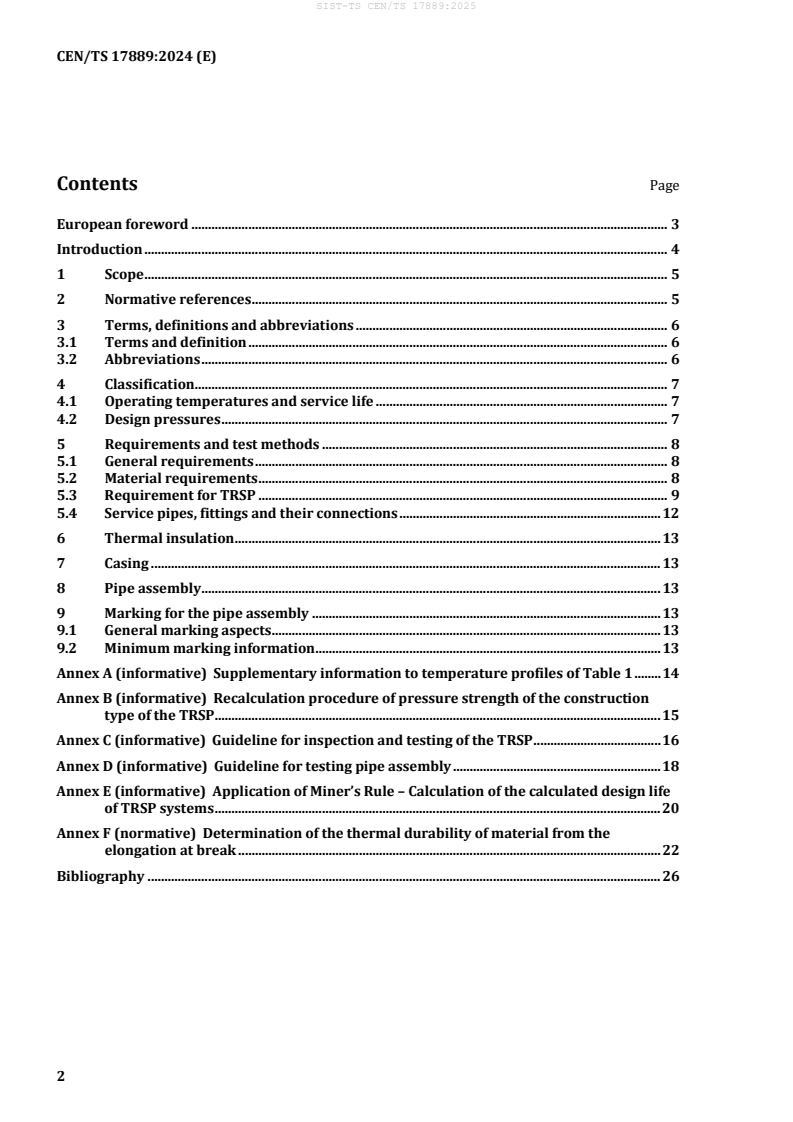
Contents Page
European foreword . 3
Introduction . 4
1 Scope . 5
2 Normative references . 5
3 Terms, definitions and abbreviations . 6
3.1 Terms and definition . 6
3.2 Abbreviations . 6
4 Classification. 7
4.1 Operating temperatures and service life . 7
4.2 Design pressures . 7
5 Requirements and test methods . 8
5.1 General requirements . 8
5.2 Material requirements . 8
5.3 Requirement for TRSP . 9
5.4 Service pipes, fittings and their connections . 12
6 Thermal insulation . 13
7 Casing . 13
8 Pipe assembly . 13
9 Marking for the pipe assembly . 13
9.1 General marking aspects . 13
9.2 Minimum marking information . 13
Annex A (informative) Supplementary information to temperature profiles of Table 1 . 14
Annex B (informative) Recalculation procedure of pressure strength of the construction
type of the TRSP . 15
Annex C (informative) Guideline for inspection and testing of the TRSP . 16
Annex D (informative) Guideline for testing pipe assembly . 18
Annex E (informative) Application of Miner’s Rule – Calculation of the calculated design life
of TRSP systems . 20
Annex F (normative) Determination of the thermal durability of material from the
elongation at break . 22
Bibliography . 26
European foreword
This document (CEN/TS 17889:2024) has been prepared by Technical Committee CEN/TC 107
Prefabricated district heating and district cooling pipe systems”, the secretariat of which is held by DS.
Attention is drawn to the possibility that some of the elements of this document may be the subject of
patent rights. CEN shall not be held responsible for identifying any or all such patent rights.
Any feedback and questions on this document should be directed to the users’ national standards body.
A complete listing of these bodies can be found on the CEN website.
According to the CEN-CENELEC Internal Regulations, the national standards organizations of the
following countries are bound to announce this Technical Specification: Austria, Belgium, Bulgaria,
Croatia, Cyprus, Czech Republic, Denmark, Estonia, Finland, France, Germany, Greece, Hungary, Iceland,
Ireland, Italy, Latvia, Lithuania, Luxembourg, Malta, Netherlands, Norway, Poland, Portugal, Republic of
North Macedonia, Romania, Serbia, Slovakia, Slovenia, Spain, Sweden, Switzerland, Türkiye and the
United Kingdom.
Introduction
District heating technology has developed rapidly since its origin and especially in recent times. Today,
there are different generations of district heating networks. The technologies of these generations are
driven by the different heat sources and operating temperatures used.
CEN/TC 107 provides a set of European Standard series for rigid and flexible piping systems in district
heating to suit all generations and requirements of district heating networks in the market.
This document ensures quality for factory made piping systems in district heating.
This document covers flexible, factory made piping systems, with thermoplastic reinforced service pipes,
for operation conditions as described in the scope of this document.
1 Scope
This document specifies classification, general requirements and test methods for flexible, factory made,
buried district heating pipe systems with thermoplastic reinforced service pipes (TRSP).
The factory made bonded or non-bonded flexible pipe systems covered by this document consist of:
— a thermoplastic reinforced service pipe, which consists of an inner layer made of PE-Xa, a
thermoplastic intermediate layer, a reinforcement layer made of para-aramid fibres, an outer
thermoplastic layer and a diffusion barrier layer, all with bonded structure;
— a thermal insulation layer;
— a casing made of PE.
Depending on the temperature profile, this document is applicable to a maximum operating temperature
of 115 °C and maximum operating design pressure up to 1,6 MPa.
The pipe systems are designed for a service life of at least 30 years.
This document does not apply to cover surveillance systems.
NOTE For higher temperatures or for the transport of other fluids, for example potable water, additional
requirements and testing is needed. Such requirements are not specified in this document.
A guideline for testing the pipe assembly is given in Annex D.
2 Normative references
The following documents are referred to in the text in such a way that some or all of their content
constitutes requirements of this document. For dated references, only the edition cited applies. For
undated references, the latest edition of the referenced document (including any amendments) applies.
EN 15632-1, District heating pipes — Factory made flexible pipe systems — Part 1: Classification, general
requirements and test methods
EN 15632-2, District heating pipes — Factory made flexible pipe systems — Part 2: Bonded system with
plastic service pipes; requirements and test methods
EN 15632-3, District heating pipes — Factory made flexible pipe systems — Part 3: Non bonded system with
plastic service pipes; requirements and test methods
EN 17248, District heating and district cooling pipe systems — Terms and definitions
EN ISO 3126, Plastics piping systems — Plastics components — Determination of dimensions (ISO 3126)
EN ISO 1167-1, Thermoplastics pipes, fittings and assemblies for the conveyance of fluids — Determination
of the resistance to internal pressure — Part 1: General method (ISO 1167-1)
EN ISO 1167-2, Thermoplastics pipes, fittings and assemblies for the conveyance of fluids — Determination
of the resistance to internal pressure — Part 2: Preparation of pipe test pieces (ISO 1167-2)
EN ISO 9080, Plastics piping and ducting systems — Determination of the long-term hydrostatic strength of
thermoplastics materials in pipe form by extrapolation (ISO 9080)
EN ISO 15875-2, Plastics piping systems for hot and cold water installations — Crosslinked polyethylene
(PE-X) — Part 2: Pipes (ISO 15875-2)
EN ISO 19893:2018, Plastics piping systems — Thermoplastics pipes and fittings for hot and cold water —
Test method for the resistance of mounted assemblies to temperature cycling (ISO 19893:2011)
ISO 527-1:2019, Plastics — Determination of tensile properties — Part 1: General principles
ISO 527-2:2012, Plastics — Determination of tensile properties — Part 2: Test conditions for moulding and
extrusion plastics
ISO 2578, Plastics — Determination of time-temperature limits after prolonged exposure to heat
ISO 6259-1:2015, Thermoplastics pipes — Determination of tensile properties — Part 1: General test
method
ISO 10146, Crosslinked polyethylene (PE-X) and crosslinked medium density polyethylene (PE-MDX) —
Effect of time and temperature on expected strength
ASTM D7269, Standard Tests Methods for Tensile Testing of Aramid Yarns
3 Terms, definitions and abbreviations
3.1 Terms and definition
For the purposes of this document, the terms and definitions given in EN 17248 apply.
ISO and IEC maintain terminology databases for use in standardization at the following addresses:
— ISO Online browsing platform: available at https://www.iso.org/obp/
— IEC Electropedia: available at https://www.electropedia.org/
3.2 Abbreviations
DN Nominal diameter of the service pipe
AI Additional inspection
LTHP Long term hydrostatic pressure
LPL 97,5 % lower prediction limit
MQC Manufacturers Quality control
PE Polyethylene
PE-Xa Peroxide cross linked polyethylene
PUR Polyurethane
PVT Process Verification Test
TRSP Thermoplastic Reinforced Service pipes
TT Manufacturers Type Test
p Design pressure in bar
D
T Design temperature
D
T Maximum design temperature
max
T Malfunction temperature
mal
Issued by: ASTM International on 2020-03-02.
4 Classification
4.1 Operating temperatures and service life
Pipe systems according to this document are designed for a service life of at least 30 years when operated
with the following temperature profiles according to temperature profile in Table 1.
Table 1 — Temperature profiles TR 3 and TR 4
TR 3
Temperature profiles (according to TR 4
EN 15632-2 and EN 15632-3)
Temperature Duration Temperature Duration
°C °C
Design temperature (T ) 80 29 years 85 29 years
D
Maximum operating temperature 90 7 760 h 100 7 760 h
(T )
max
95 1 000 h 115 1 000 h
Malfunction temperature (T ) 100 100 h 120 100 h
mal
NOTE 1 Temperature profile (TR) are defined by CEN/TC 107.
NOTE 2 For supplementary information to temperature profiles, see Annex A.
Other temperature profiles may be applied in accordance with EN ISO 13760 (Miner's Rule). Further
information is given in Annex E.
The maximum operating temperature shall not exceed the applicable temperature selected as in Table 1.
4.2 Design pressures
Pipe systems according to this document are designed for a continuous operation pressure of either
0,6 MPa, 0,8 MPa, 1,0 MPa, 1,2 MPa or 1,6 MPa.
The following minimum safety factors for design stress shall be applied, as shown in Table 2:
Table 2 — Safety factors for design stress
Temperature
Safety factor
°C
T
D
1,5
T
1,3
max
1,0
T
mal
NOTE These safety factors are identical with the safety factors given in EN 15632-2 and EN 15632-3.
The design pressure for particular temperature profiles is derived from the long-term pressure strength
(5.3.4) using Miner's rule (EN ISO 13760), taking in account the safety factors given in Table 2.
5 Requirements and test methods
5.1 General requirements
The TRSP shall be with a bonded construction between the layers.
5.2 Material requirements
5.2.1 Inner layer material
The PE-Xa inner layer shall comply with ISO 10146.
NOTE ISO 10146 defines PE-Xa up to 95 °C and 110 °C as a single reference line.
The thermal stability of the inner layer material shall be tested for the relevant temperature profile
according to the test conditions given in 5.3.5, Table 3.
5.2.2 Intermediate layer
The layer shall be a thermoplastic material. The function of this layer is to support a bonding between the
layers.
If the intermediate layer material is made of a material defined in ISO 10146 (PE-X), ISO 12230 (PB) or
ISO 24033 (PE-RT), the thermal stability shall be tested on a pipe sample made of the intermediate layer
material according to the test conditions given in 5.3.5, Table 3.
If no thermal stability test for the material according to a standard is given, alternatively the thermal
stability of the intermediate layer material shall be tested in accordance with Annex F.
5.2.3 Reinforcement
The reinforcement shall be made from para-aramid.
The pipe manufacturer shall define the reinforcement:
a) Grade of yarn:
1) Linear density [tex, g/km];
2) Twists per metre [tpm];
3) Strength at break [N];
4) Elongation at break [%].
b) Reinforcement structure:
1) Type of process (e.g. winding, braiding, weaving);
2) Angle of yarn;
3) Circumferential density of yarns [kg/m ];
4) Number of layers.
Pipe manufacturer may define different linear density and number of yarns in the dimension range.
If reinforcements do require to be joined this shall be specified, and a defined jointing procedure laid
down. Pipe samples with splice shall be tested for resistance to internal pressure over 1 000 h at the
higher T of the relevant temperature profile according to Table 3, to proof that there is no influence
max
of the splice on the pipe performance.
NOTE Para-aramid fibres are deemed to be stable to the thermal load given according to the temperature
profiles in Table 1.
For para-aramid fibre the hydrolysis resistance shall be tested.
The grade of yarn shall have a residual strength retention of at least 70 % of the nominal value (new fibre)
after exposure for 12 months at 95 °C in an atmosphere of 60 % RH, testing in accordance with
ASTM D7269.
5.2.4 Outer layer
The layer shall be a thermoplastic material. The function of this layer is to protect the reinforcement.
If the outer layer material is made of a material defined in ISO 10146 (PE-X), ISO 12230 (PB) or
ISO 24033, (PE-RT) the thermal stability shall be tested on a pipe sample made of the outer layer material
according to the test conditions given in 5.3.5, Table 3.
If no thermal stability test for the material according to a standard is given, alternatively the thermal
stability of the outer layer material shall be tested in accordance with Annex F.
5.2.5 Diffusion barrier layer
The layer shall be made from a thermoplastic material. The function of this layer is to reduce oxygen
permeation.
The thermal durability of the diffusion barrier layer material shall be tested in accordance with Annex F.
5.3 Requirement for TRSP
5.3.1 Appearance
When viewed without magnification, the internal and external surfaces of pipes shall be smooth, clean
and free from any scoring, cavities and other surface defects. The material shall contain no visible
impurities. Slight variations in colour are permitted. The ends of each pipe shall be cut cleanly and
perpendicular to the axis of the pipe.
The outer layer of the TRSP shall evenly cover the surface. Local variances of the outer layer thickness
caused by reinforcement yarns as well as a roughness caused by the reinforced layer structure on the
surface are acceptable.
5.3.2 Construction
The construction type of TRSP is a dimension range of products having the same principle design, a
winding angle of the yarn in reinforcement within ± 1°, the same grades of thermoplastics and reinforcing
materials and the number of reinforcing layers.
The manufacturer shall specify a principal construction for each construction type of TRSP in his product
range.
The principal construction of a TRSP is shown in Figure 1.
Key
1 PE-Xa inner layer
2 intermediate layer
3 reinforcement
4 outer thermoplastic layer
5 diffusion barrier layer
Figure 1 — Typical construction of a TRSP
5.3.3 Geometrical characteristics
5.3.3.1 General
Dimensions of TRSP shall be measured in accordance with EN ISO 3126.
How to measure outer diameter and wall thickness (e.g. between, on top or crossing of fibres…) shall be
specified by the manufacturer.
5.3.3.2 Dimensions of pipes
The pipe manufacturer shall give detailed information related to the geometrical characteristics for each
construction type of the TRSP, with tolerances:
— outer diameter;
— total wall thickness;
— wall thickness of inner layer.
5.3.4 Long-term pressure strength (p )
LPL
The long-term pressure strength shall be determined for each construction type of the TRSP. Hydrostatic
pressure tests according to EN ISO 1167-1 and EN ISO 1167-2 shall be performed at least on one
dimension per construction type of TRSP. The maximum test temperature shall be greater than or equal
to the highest T in the relevant temperature profile. Outside media can be water or air depending on
max
the test temperature. The test results shall be used to determine the regression line gradient and the
equation of the time-temperature dependence of LPL for LTHP using the principals and statistical
procedure described in EN ISO 9080.
The pressure strength of an already qualified TRSP with permitted changes in diameter and
reinforcement concentration can be recalculated in accordance with Annex B.
5.3.5 Mechanical and physical characteristics
The mechanical and physical characteristics are listed in Table 3.
Table 3 — Mechanical and physical characteristics
Characteristic Requirement Test method
Test pressure: p taken from the regression line (5.3.4) at
LPL
Test temperature: highest T
max
Time: 22 h
End cap: Type A) according to EN ISO 1167-1
No failure or leakage
Test pressure: p taken from the regression line (5.3.4) at
LPL
Test temperature: highest T
max
Resistance to
EN ISO 1167-1
Time: 165 h
internal
EN ISO 1167-2
End cap: Type A) according to EN ISO 1167-1
pressure
No failure or leakage
Test pressure: p taken from the regression line (5.3.4) at
LPL
Test temperature: highest T
max
Time: 1 000 h
...