

EN 13001-3-3:2014
(Main)Cranes - General design - Part 3-3: Limit states and proof of competence of wheel/rail contacts
- Abstract
This European Standard is to be used together with EN 13001 1 and EN 13001 2 and as such they specify general conditions, requirements and methods to prevent mechanical hazards of wheel/rail contacts of cranes by design and theoretical verification. This European Standard covers requirements for steel and cast iron wheels and is applicable for metallic wheel/rail contacts only.
Roller bearings are not in the scope of this European Standard.
Exceeding the limits of strength is a significant hazardous situation and hazardous event that could result in risks to persons during normal use and foreseeable misuse. Clause 5 to Clause 6 of this European Standard are necessary to reduce or eliminate the risks associated with this hazard.
This European Standard is applicable to cranes, which are manufactured after the date of approval of this European Standard by CEN, and serves as a reference base for product standards of particular crane types.
This European Standard is for design purposes only and should not be seen as a guarantee of actual performance.
EN 13001-3-3 deals only with limit state method in accordance with EN 13001-1.
- Status
- Published
- Publication Date
- 07-Oct-2014
- Technical Committee
- CEN/TC 147 - Cranes - Safety
- Drafting Committee
- CEN/TC 147/WG 2 - Design - General
- Current Stage
- 9060 - Closure of 2 Year Review Enquiry - Review Enquiry
- Start Date
- 02-Sep-2026
- Completion Date
- 02-Sep-2026
- Directive
- 2006/42/EC - Directive 2006/42/EC of the European Parliament and of the Council of 17 May 2006 on machinery, and amending Directive 95/16/EC (recast)OJ Ref: C, C 14 OJ Date: 15-Jan-2016

Overview
EN 13001-3-3:2014 - Cranes: General design - Part 3-3: Limit states and proof of competence of wheel/rail contacts is a CEN European Standard that specifies design principles and verification methods to prevent mechanical hazards arising from metallic wheel/rail contacts in cranes. It is intended to be used together with EN 13001-1 and EN 13001-2 and applies to steel and cast‑iron wheels and metallic rails (roller bearings are excluded). The standard is for design verification only (limit‑state method per EN 13001‑1) and supports conformity with essential safety requirements of the EU machinery framework.
Key Topics
- Scope and applicability: metallic wheel/rail contacts for crane travel wheels, trolley wheels, guide rollers and slewing support wheels; applicable to cranes produced after approval.
- Limit states approach: limit state verification for both static strength and fatigue strength (rolling contact fatigue, RCF).
- Contact mechanics: use of Hertz contact pressure and subsurface shear stress to assess strength and fatigue.
- Line vs point contact: classification of contact geometry (line contact, point contact) and corresponding verification rules; recognition that point contacts in practice often evolve into line contacts.
- Material and hardness considerations: requirements for wheel and rail material properties (steel, cast iron) and hardness profiling below the contact surface; Brinell hardness (HBW) and unit‑conform hardness are used in calculations.
- Design forces and factors: definition of design contact forces, limit design forces for static and fatigue checks, and additional influence factors (edge pressure, non‑uniform pressure distribution, skewing, driven wheels).
- Counting contacts and life assessment: treatment of contact force histories, number of rolling contacts, and spectrum factors for fatigue life evaluation.
- Informative annexes: guidance on typical material strength properties, hardness conversion, wear behaviour examples, and relationship to other crane standards.
Applications
- Design and verification of crane wheelsets, rails and rolling contacts during conceptual and detailed design.
- Selection of wheel and rail material combinations and surface treatments to meet fatigue and static criteria.
- Establishing inspection criteria and design life estimates for crane travelways, trolley runs and slewing supports.
- Input for product standards for specific crane types and for procurement specifications that link purchaser and designer requirements.
Who should use this standard
- Crane designers and structural/mechanical engineers
- Component manufacturers (wheels, rails)
- Safety assessors and conformity bodies
- Project purchasers and asset owners specifying crane design life and maintenance regimes
Related standards
- EN 13001-1 - General principles and requirements
- EN 13001-2 - Load actions
- EN 13001 series parts on structures, wire ropes, machinery and hooks
- EN ISO 6506-1 - Brinell hardness test
- EN ISO 12100 - Machine safety - risk assessment
- ISO 4306-1 - Cranes vocabulary
Limitations
- Applicable to metallic wheel/rail contacts only (no roller bearings).
- Intended for design verification; not a guarantee of actual field performance.
Relations
- Effective Date
- 22-Apr-2026
- Refers
ISO 12488-1:2012 - Cranes — Tolerances for wheels and travel and traversing tracks — Part 1: General - Effective Date
- 09-Feb-2026
- Effective Date
- 28-Jan-2026
- Effective Date
- 28-Jan-2026
- Effective Date
- 28-Jan-2026
- Effective Date
- 28-Jan-2026
- Effective Date
- 28-Jan-2026
- Referred By
EN 14439:2025 - Cranes - Tower cranes - Effective Date
- 28-Jan-2026
- Effective Date
- 28-Jan-2026
- Effective Date
- 28-Jan-2026
- Effective Date
- 28-Jan-2026
- Effective Date
- 28-Jan-2026
- Effective Date
- 28-Jan-2026
- Effective Date
- 28-Jan-2026
- Referred By
EN 16851:2017 - Cranes - Light crane systems - Effective Date
- 28-Jan-2026
Frequently Asked Questions
EN 13001-3-3:2014 is a standard published by the European Committee for Standardization (CEN). Its full title is "Cranes - General design - Part 3-3: Limit states and proof of competence of wheel/rail contacts". This standard covers: This European Standard is to be used together with EN 13001 1 and EN 13001 2 and as such they specify general conditions, requirements and methods to prevent mechanical hazards of wheel/rail contacts of cranes by design and theoretical verification. This European Standard covers requirements for steel and cast iron wheels and is applicable for metallic wheel/rail contacts only. Roller bearings are not in the scope of this European Standard. Exceeding the limits of strength is a significant hazardous situation and hazardous event that could result in risks to persons during normal use and foreseeable misuse. Clause 5 to Clause 6 of this European Standard are necessary to reduce or eliminate the risks associated with this hazard. This European Standard is applicable to cranes, which are manufactured after the date of approval of this European Standard by CEN, and serves as a reference base for product standards of particular crane types. This European Standard is for design purposes only and should not be seen as a guarantee of actual performance. EN 13001-3-3 deals only with limit state method in accordance with EN 13001-1.
This European Standard is to be used together with EN 13001 1 and EN 13001 2 and as such they specify general conditions, requirements and methods to prevent mechanical hazards of wheel/rail contacts of cranes by design and theoretical verification. This European Standard covers requirements for steel and cast iron wheels and is applicable for metallic wheel/rail contacts only. Roller bearings are not in the scope of this European Standard. Exceeding the limits of strength is a significant hazardous situation and hazardous event that could result in risks to persons during normal use and foreseeable misuse. Clause 5 to Clause 6 of this European Standard are necessary to reduce or eliminate the risks associated with this hazard. This European Standard is applicable to cranes, which are manufactured after the date of approval of this European Standard by CEN, and serves as a reference base for product standards of particular crane types. This European Standard is for design purposes only and should not be seen as a guarantee of actual performance. EN 13001-3-3 deals only with limit state method in accordance with EN 13001-1.
EN 13001-3-3:2014 is classified under the following ICS (International Classification for Standards) categories: 53.020.20 - Cranes. The ICS classification helps identify the subject area and facilitates finding related standards.
EN 13001-3-3:2014 has the following relationships with other standards: It is inter standard links to ISO 4306-1:2007, ISO 12488-1:2012, EN 13001-1:2015, EN ISO 12100:2010, EN ISO 6506-1:2014, EN 840-3:2012, EN 13001-2:2021, EN 14439:2025, EN 16851:2017+A1:2020, EN 14492-2:2019, EN 13852-1:2025, EN 13852-3:2021, EN 1570-2:2016, EN 15011:2020, EN 16851:2017. Understanding these relationships helps ensure you are using the most current and applicable version of the standard.
EN 13001-3-3:2014 is associated with the following European legislation: EU Directives/Regulations: 2006/42/EC; Standardization Mandates: M/396. When a standard is cited in the Official Journal of the European Union, products manufactured in conformity with it benefit from a presumption of conformity with the essential requirements of the corresponding EU directive or regulation.
EN 13001-3-3:2014 is available in PDF format for immediate download after purchase. The document can be added to your cart and obtained through the secure checkout process. Digital delivery ensures instant access to the complete standard document.
Standards Content (Sample)
2003-01.Slovenski inštitut za standardizacijo. Razmnoževanje celote ali delov tega standarda ni dovoljeno.Žerjavi - Konstrukcija, splošno - 3-3. del: Mejna stanja in dokaz varnosti stika kolo-tirnicaKrane - Konstruktion allgemein - Teil 3-3: Grenzzustände und Sicherheitsnachweis von Laufrad/Schiene-KontaktenAppareils de levage à charge suspendue - Conception générale - Partie 3-3 : Etats limites et vérification d'aptitude des contacts galet/railCranes - General design - Part 3-3: Limit states and proof of competence of wheel/rail contacts53.020.20DvigalaCranesICS:Ta slovenski standard je istoveten z:EN 13001-3-3:2014SIST EN 13001-3-3:2014en,fr,de01-december-2014SIST EN 13001-3-3:2014SLOVENSKI
STANDARD
EUROPEAN STANDARD NORME EUROPÉENNE EUROPÄISCHE NORM
EN 13001-3-3
October 2014 ICS 53.020.20 English Version
Cranes - General design - Part 3-3: Limit states and proof of competence of wheel/rail contacts
Appareils de levage à charge suspendue - Conception générale - Partie 3-3 : Etats limites et vérification d'aptitude des contacts galet/rail
Krane - Konstruktion allgemein - Teil 3-3: Grenzzustände und Sicherheitsnachweis von Laufrad/Schiene-Kontakten This European Standard was approved by CEN on 16 August 2014.
CEN members are bound to comply with the CEN/CENELEC Internal Regulations which stipulate the conditions for giving this European Standard the status of a national standard without any alteration. Up-to-date lists and bibliographical references concerning such national standards may be obtained on application to the CEN-CENELEC Management Centre or to any CEN member.
This European Standard exists in three official versions (English, French, German). A version in any other language made by translation under the responsibility of a CEN member into its own language and notified to the CEN-CENELEC Management Centre has the same status as the official versions.
CEN members are the national standards bodies of Austria, Belgium, Bulgaria, Croatia, Cyprus, Czech Republic, Denmark, Estonia, Finland, Former Yugoslav Republic of Macedonia, France, Germany, Greece, Hungary, Iceland, Ireland, Italy, Latvia, Lithuania, Luxembourg, Malta, Netherlands, Norway, Poland, Portugal, Romania, Slovakia, Slovenia, Spain, Sweden, Switzerland, Turkey and United Kingdom.
EUROPEAN COMMITTEE FOR STANDARDIZATION
COMITÉ EUROPÉEN DE NORMALISATION EUROPÄISCHES KOMITEE FÜR NORMUNG
CEN-CENELEC Management Centre:
Avenue Marnix 17,
B-1000 Brussels © 2014 CEN All rights of exploitation in any form and by any means reserved worldwide for CEN national Members. Ref. No. EN 13001-3-3:2014 ESIST EN 13001-3-3:2014
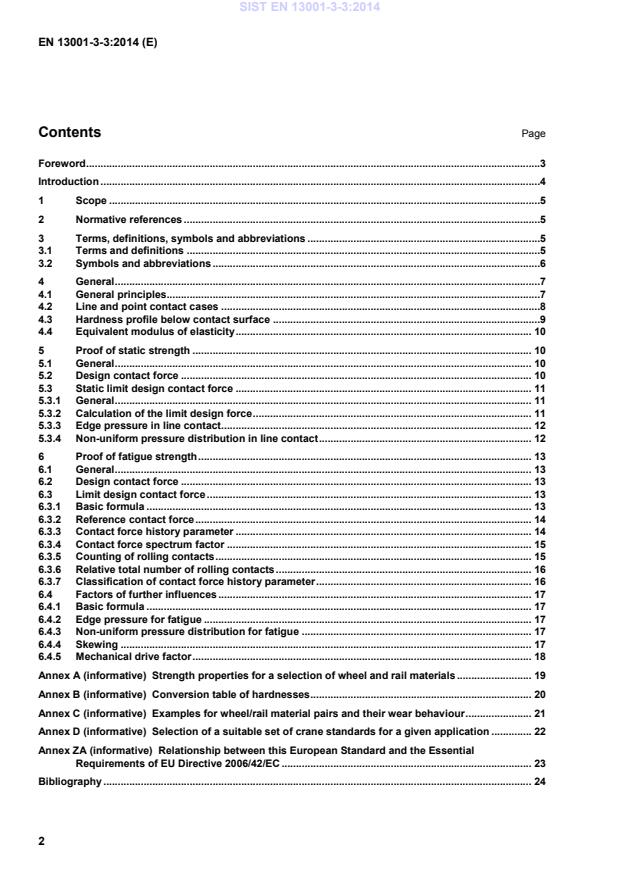
Strength properties for a selection of wheel and rail materials . 19 Annex B (informative)
Conversion table of hardnesses . 20 Annex C (informative)
Examples for wheel/rail material pairs and their wear behaviour . 21 Annex D (informative)
Selection of a suitable set of crane standards for a given application . 22 Annex ZA (informative)
Relationship between this European Standard and the Essential Requirements of EU Directive 2006/42/EC . 23 Bibliography . 24
a) Line contact b) Point contact
Point contact cases, where []wrk;min5bbr×≤ are outside the scope of this standard. In cases, where []wrk;min200bbr×[, the requirements given for line contact shall be applied. The effective contact widths (bw, br) are determined by deducting from the material width of wheel/rail the effect of corner radius equal to 2 × r3. Figure 1 — Contact cases SIST EN 13001-3-3:2014
Key z depth zml, zmp depths of maximum shear stress for line and point contact case respectively HB unit-conform hardness 1 hardness, the surface hardened zone 2 hardness, the natural hardness of the material 3 shear stress 2 due to contact force Figure 2 — Hardness and shear stress versus depth The depth of maximum shear for line contact cases shall be calculated as: ()m2wsSd0,ml10,50EbDFz×−××π××=ν (2) and for point contact cases this shall be calculated as: 3kw2msSd0,mp1210,68+−××=rDEFzν (3) where FSd0,s is the maximum, non-factored design contact force within the Load Combinations A to C in accordance with EN 13001-2; Em is the equivalent modulus of elasticity, see 4.4. SIST EN 13001-3-3:2014
...