

EN 16157-4:2021
(Main)Intelligent transport systems - DATEX II data exchange specifications for traffic management and information - Part 4: VMS publication
- Abstract
This European Standard (EN 16157 series) specifies and defines component facets supporting the exchange and shared use of data and information in the field of traffic and travel.
The component facets include the framework and context for exchanges, the modelling approach, data content, data structure and relationships.
This European Standard is applicable to:
- Traffic and travel information which is of relevance to road networks (non-urban and urban),
- Public transport information that is of direct relevance to the use of a road network (e.g. road link via train or ferry service),
- Traffic and travel information in the case of Cooperative intelligent transport systems (C-ITS).
This European Standard establishes specifications for data exchange between any two instances of the following actors:
- Traffic Information Centres (TICs),
- Traffic Control Centres (TCCs),
- Service Providers (SPs),
Use of this European Standard may be applicable for use by other actors.
This European Standard series covers, at least, the following types of informational content:
- Road traffic event information – planned and unplanned occurrences both on the road network and in the surrounding environment,
- Operator initiated actions,
- Road traffic measurement data, status data, and travel time data,
- Travel information relevant to road users, including weather and environmental information,
- Road traffic management information and instructions relating to use of the road network.
This part of the CEN/TS 16157 series specifies the informational structures, relationships, roles, attributes and associated data types required for publishing variable message sign information within the Datex II framework. This is specified in two publications, a DATEX II VMS Table Publication sub-model and a VMS Publication sub-model, which are part of the DATEX II platform independent model, but this part excludes those elements that relate to:
- location information which are specified in EN 16157-2,
- common information elements, which are specified in EN 16157-7,
- situation information which are specified in EN 16157-3.
The VMS Table Publication supports the occasional exchange of tables containing generally static reference information about deployed VMS which enable subsequent efficient references to be made to pre-defined static information relating to those VMS. The VMS Publication supports the exchange of the graphic and textual content of one or several VMS plus any status information on device configuration that aid the comprehension of the informational content. This content is potentially subject to rapid change.
These publications are not intended to support the control or configuration of VMS equipment. Each is part of the DATEX II platform independent model.
- Status
- Published
- Publication Date
- 16-Mar-2021
- Withdrawal Date
- 29-Sep-2021
- Technical Committee
- CEN/TC 278 - Road transport and traffic telematics
- Drafting Committee
- CEN/TC 278/WG 8 - Road traffic data (RTD)
- Current Stage
- 9060 - Closure of 2 Year Review Enquiry - Review Enquiry
- Start Date
- 02-Sep-2026
- Completion Date
- 02-Sep-2026



Overview
EN 16157-4:2021 is the CEN standard that defines DATEX II data exchange structures for publishing Variable Message Sign (VMS) information within traffic management and traveler information systems. Part 4 of the EN 16157 series specifies the informational structures, relationships, roles, attributes and data types used to publish both static reference information about deployed VMS (VMS Table Publication) and rapidly changing graphic/text content and device status (VMS Publication). It is part of the DATEX II platform independent model and complements other EN 16157 parts (location, common elements, situation information).
Key topics and technical requirements
- DATEX II VMS Publication models: Two complementary sub-models are defined -
- VMS Table Publication: exchange of mostly static reference tables describing deployed VMS to enable efficient referencing.
- VMS Publication: exchange of dynamic content (graphics, text) and status metadata for one or multiple VMS devices.
- Data modelling: UML-based platform independent model specifying classes, associations, attributes and data types needed to represent VMS content.
- Data dictionary and schema: normative data dictionary and referenced XML schema for encoding VMS publications (annexes include data dictionary and XML schema).
- Scope of information: aligns with EN 16157 series coverage for road traffic events, operator actions, traffic measurements, travel/weather information and traffic management instructions.
- Actors and conformance: intended for exchange between Traffic Information Centres (TICs), Traffic Control Centres (TCCs) and Service Providers (SPs); may be used by other actors.
- Exclusions: does not define location information (see EN 16157-2), common information elements (EN 16157-7) or situation models (EN 16157-3). It is explicitly not intended to support direct control/configuration of VMS hardware.
Applications and who uses it
- Traffic management authorities and control centres for publishing current VMS messages and referencing deployed sign inventories.
- Traffic Information Centres (TICs) and Service Providers delivering web, in-vehicle or third-party traffic information services using DATEX II feeds.
- System integrators and software vendors implementing DATEX II-based publishers/subscribers for VMS content and status distribution.
- C-ITS and multimodal transport applications where VMS messaging is relevant to road users or intermodal connections (ferries, trains linked to road networks).
Related standards
- EN 16157-2 - location information for DATEX II
- EN 16157-3 - situation information (events)
- EN 16157-7 - common information elements
- DATEX II platform independent model (overall framework used across the EN 16157 series)
EN 16157-4:2021 is essential for implementing standardized VMS content exchange in European traffic management ecosystems, enabling interoperable, machine-readable publication of both static VMS reference data and dynamic message content.
Relations
- Effective Date
- 24-Mar-2021
- Effective Date
- 28-Jan-2026
- Effective Date
- 28-Jan-2026
- Effective Date
- 28-Jan-2026
- Effective Date
- 28-Jan-2026
- Effective Date
- 28-Jan-2026
- Effective Date
- 28-Jan-2026
- Effective Date
- 28-Jan-2026
Get Certified
Connect with accredited certification bodies for this standard

BSI Group
BSI (British Standards Institution) is the business standards company that helps organizations make excellence a habit.

NYCE
Mexican standards and certification body.
Sponsored listings
Frequently Asked Questions
EN 16157-4:2021 is a standard published by the European Committee for Standardization (CEN). Its full title is "Intelligent transport systems - DATEX II data exchange specifications for traffic management and information - Part 4: VMS publication". This standard covers: This European Standard (EN 16157 series) specifies and defines component facets supporting the exchange and shared use of data and information in the field of traffic and travel. The component facets include the framework and context for exchanges, the modelling approach, data content, data structure and relationships. This European Standard is applicable to: - Traffic and travel information which is of relevance to road networks (non-urban and urban), - Public transport information that is of direct relevance to the use of a road network (e.g. road link via train or ferry service), - Traffic and travel information in the case of Cooperative intelligent transport systems (C-ITS). This European Standard establishes specifications for data exchange between any two instances of the following actors: - Traffic Information Centres (TICs), - Traffic Control Centres (TCCs), - Service Providers (SPs), Use of this European Standard may be applicable for use by other actors. This European Standard series covers, at least, the following types of informational content: - Road traffic event information – planned and unplanned occurrences both on the road network and in the surrounding environment, - Operator initiated actions, - Road traffic measurement data, status data, and travel time data, - Travel information relevant to road users, including weather and environmental information, - Road traffic management information and instructions relating to use of the road network. This part of the CEN/TS 16157 series specifies the informational structures, relationships, roles, attributes and associated data types required for publishing variable message sign information within the Datex II framework. This is specified in two publications, a DATEX II VMS Table Publication sub-model and a VMS Publication sub-model, which are part of the DATEX II platform independent model, but this part excludes those elements that relate to: - location information which are specified in EN 16157-2, - common information elements, which are specified in EN 16157-7, - situation information which are specified in EN 16157-3. The VMS Table Publication supports the occasional exchange of tables containing generally static reference information about deployed VMS which enable subsequent efficient references to be made to pre-defined static information relating to those VMS. The VMS Publication supports the exchange of the graphic and textual content of one or several VMS plus any status information on device configuration that aid the comprehension of the informational content. This content is potentially subject to rapid change. These publications are not intended to support the control or configuration of VMS equipment. Each is part of the DATEX II platform independent model.
This European Standard (EN 16157 series) specifies and defines component facets supporting the exchange and shared use of data and information in the field of traffic and travel. The component facets include the framework and context for exchanges, the modelling approach, data content, data structure and relationships. This European Standard is applicable to: - Traffic and travel information which is of relevance to road networks (non-urban and urban), - Public transport information that is of direct relevance to the use of a road network (e.g. road link via train or ferry service), - Traffic and travel information in the case of Cooperative intelligent transport systems (C-ITS). This European Standard establishes specifications for data exchange between any two instances of the following actors: - Traffic Information Centres (TICs), - Traffic Control Centres (TCCs), - Service Providers (SPs), Use of this European Standard may be applicable for use by other actors. This European Standard series covers, at least, the following types of informational content: - Road traffic event information – planned and unplanned occurrences both on the road network and in the surrounding environment, - Operator initiated actions, - Road traffic measurement data, status data, and travel time data, - Travel information relevant to road users, including weather and environmental information, - Road traffic management information and instructions relating to use of the road network. This part of the CEN/TS 16157 series specifies the informational structures, relationships, roles, attributes and associated data types required for publishing variable message sign information within the Datex II framework. This is specified in two publications, a DATEX II VMS Table Publication sub-model and a VMS Publication sub-model, which are part of the DATEX II platform independent model, but this part excludes those elements that relate to: - location information which are specified in EN 16157-2, - common information elements, which are specified in EN 16157-7, - situation information which are specified in EN 16157-3. The VMS Table Publication supports the occasional exchange of tables containing generally static reference information about deployed VMS which enable subsequent efficient references to be made to pre-defined static information relating to those VMS. The VMS Publication supports the exchange of the graphic and textual content of one or several VMS plus any status information on device configuration that aid the comprehension of the informational content. This content is potentially subject to rapid change. These publications are not intended to support the control or configuration of VMS equipment. Each is part of the DATEX II platform independent model.
EN 16157-4:2021 is classified under the following ICS (International Classification for Standards) categories: 35.240.60 - IT applications in transport. The ICS classification helps identify the subject area and facilitates finding related standards.
EN 16157-4:2021 has the following relationships with other standards: It is inter standard links to CEN/TS 16157-4:2014, EN 16157-1:2018, EN 16157-7:2018, EN ISO 14823:2017, EN 16157-2:2019, EN 16157-3:2018, CEN/TS 16157-11:2025, CEN/TS 17402:2020. Understanding these relationships helps ensure you are using the most current and applicable version of the standard.
EN 16157-4:2021 is associated with the following European legislation: EU Directives/Regulations: 2010/40/EU. When a standard is cited in the Official Journal of the European Union, products manufactured in conformity with it benefit from a presumption of conformity with the essential requirements of the corresponding EU directive or regulation.
EN 16157-4:2021 is available in PDF format for immediate download after purchase. The document can be added to your cart and obtained through the secure checkout process. Digital delivery ensures instant access to the complete standard document.
Standards Content (Sample)
SLOVENSKI STANDARD
01-maj-2021
Nadomešča:
SIST-TS CEN/TS 16157-4:2014
Inteligentni transportni sistemi - Specifikacije za izmenjavo podatkov DATEX II pri
upravljanju prometa in informiranju - 4. del: Objava informacij o znakih s
spremenljivim sporočilom (VMS)
Intelligent transport systems - DATEX II data exchange specifications for traffic
management and information - Part 4: VMS publication
Intelligente Transportsysteme - DATEX II Datenaustausch Spezifikationen für
Verkehrsmanagement und Verkehrsinformation - Teil 4: Veröffentlichungen Variable
Verkehrszeichen (VMS)
Ta slovenski standard je istoveten z: EN 16157-4:2021
ICS:
35.240.60 Uporabniške rešitve IT v IT applications in transport
prometu
2003-01.Slovenski inštitut za standardizacijo. Razmnoževanje celote ali delov tega standarda ni dovoljeno.
EN 16157-4
EUROPEAN STANDARD
NORME EUROPÉENNE
March 2021
EUROPÄISCHE NORM
ICS 35.240.60 Supersedes CEN/TS 16157-4:2014
English Version
Intelligent transport systems - DATEX II data exchange
specifications for traffic management and information -
Part 4: VMS publication
Intelligente Verkehrssysteme - DATEX II
Datenaustausch Spezifikation für
Verkehrsmanagement und Information - Teil 4:
Veröffentlichungen Variable Verkehrszeichen (VMS)
This European Standard was approved by CEN on 4 January 2021.
CEN members are bound to comply with the CEN/CENELEC Internal Regulations which stipulate the conditions for giving this
European Standard the status of a national standard without any alteration. Up-to-date lists and bibliographical references
concerning such national standards may be obtained on application to the CEN-CENELEC Management Centre or to any CEN
member.
This European Standard exists in three official versions (English, French, German). A version in any other language made by
translation under the responsibility of a CEN member into its own language and notified to the CEN-CENELEC Management
Centre has the same status as the official versions.
CEN members are the national standards bodies of Austria, Belgium, Bulgaria, Croatia, Cyprus, Czech Republic, Denmark, Estonia,
Finland, France, Germany, Greece, Hungary, Iceland, Ireland, Italy, Latvia, Lithuania, Luxembourg, Malta, Netherlands, Norway,
Poland, Portugal, Republic of North Macedonia, Romania, Serbia, Slovakia, Slovenia, Spain, Sweden, Switzerland, Turkey and
United Kingdom.
EUROPEAN COMMITTEE FOR STANDARDIZATION
COMITÉ EUROPÉEN DE NORMALISATION
EUROPÄISCHES KOMITEE FÜR NORMUNG
CEN-CENELEC Management Centre: Rue de la Science 23, B-1040 Brussels
© 2021 CEN All rights of exploitation in any form and by any means reserved Ref. No. EN 16157-4:2021 E
worldwide for CEN national Members.
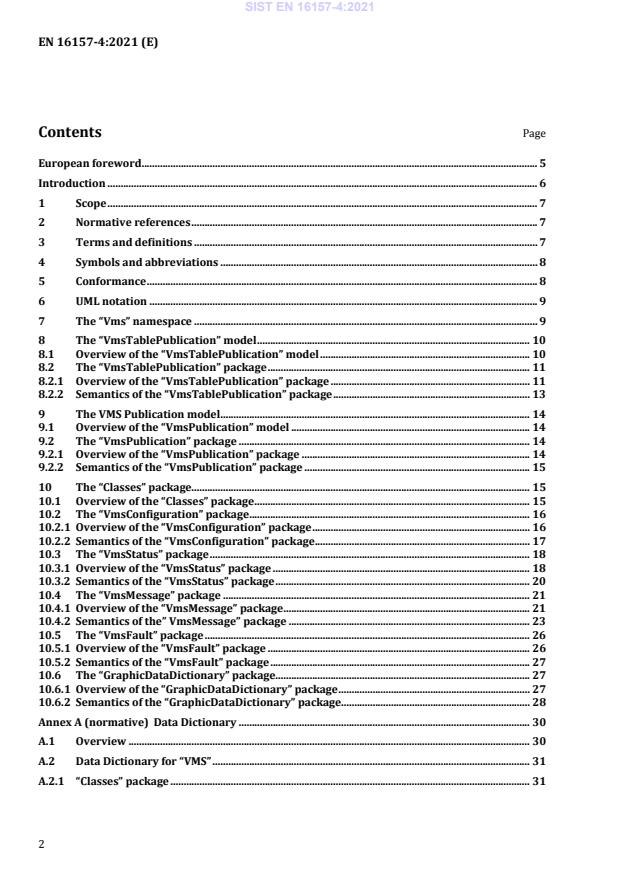
Contents Page
European foreword . 5
Introduction . 6
1 Scope . 7
2 Normative references . 7
3 Terms and definitions . 7
4 Symbols and abbreviations . 8
5 Conformance . 8
6 UML notation . 9
7 The “Vms” namespace . 9
8 The “VmsTablePublication” model . 10
8.1 Overview of the “VmsTablePublication” model . 10
8.2 The “VmsTablePublication” package . 11
8.2.1 Overview of the “VmsTablePublication” package . 11
8.2.2 Semantics of the “VmsTablePublication” package . 13
9 The VMS Publication model . 14
9.1 Overview of the “VmsPublication” model . 14
9.2 The “VmsPublication” package . 14
9.2.1 Overview of the “VmsPublication” package . 14
9.2.2 Semantics of the “VmsPublication” package . 15
10 The “Classes” package. 15
10.1 Overview of the “Classes” package . 15
10.2 The “VmsConfiguration” package . 16
10.2.1 Overview of the “VmsConfiguration” package . 16
10.2.2 Semantics of the “VmsConfiguration” package . 17
10.3 The “VmsStatus” package . 18
10.3.1 Overview of the “VmsStatus” package . 18
10.3.2 Semantics of the “VmsStatus” package . 20
10.4 The “VmsMessage” package . 21
10.4.1 Overview of the “VmsMessage” package . 21
10.4.2 Semantics of the” VmsMessage” package . 23
10.5 The “VmsFault” package . 26
10.5.1 Overview of the “VmsFault” package . 26
10.5.2 Semantics of the “VmsFault” package . 27
10.6 The “GraphicDataDictionary” package . 27
10.6.1 Overview of the “GraphicDataDictionary” package . 27
10.6.2 Semantics of the “GraphicDataDictionary” package . 28
Annex A (normative) Data Dictionary . 30
A.1 Overview . 30
A.2 Data Dictionary for “VMS” . 31
A.2.1 “Classes” package . 31
A.2.1.1 Location of “Classes” package . 31
A.2.1.2 Classes of the “Classes” package . 32
A.2.1.3 Associations of the “Classes” package . 32
A.2.1.4 Attributes of the “Classes” package . 33
A.2.2 “GraphicDataDictionary” package . 35
A.2.2.1 Location of “GraphicDataDictionary” package . 35
A.2.2.2 Classes of the “GraphicDataDictionary” package . 35
A.2.2.3 Associations of the “GraphicDataDictionary” package . 36
A.2.2.4 Attributes of the “GraphicDataDictionary” package . 36
A.2.3 “VmsConfiguration” package . 37
A.2.3.1 Location of “VmsConfiguration” package . 37
A.2.3.2 Classes of the “VmsConfiguration” package . 37
A.2.3.3 Associations of the “VmsConfiguration” package . 38
A.2.3.4 Attributes of the “VmsConfiguration” package . 38
A.2.4 “VmsFault” package . 41
A.2.4.1 Location of “VmsFault” package . 41
A.2.4.2 Classes of the “VmsFault” package . 41
A.2.4.3 Associations of the “VmsFault” package . 41
A.2.4.4 Attributes of the “VmsFault” package . 42
A.2.5 “VmsMessage” package . 42
A.2.5.1 Location of “VmsMessage” package . 42
A.2.5.2 Classes of the “VmsMessage” package . 42
A.2.5.3 Associations of the “VmsMessage” package . 43
A.2.5.4 Attributes of the “VmsMessage” package . 44
A.2.6 “VmsPublication” package. 50
A.2.6.1 Location of “VmsPublication” package . 50
A.2.6.2 Classes of the “VmsPublication” package . 50
A.2.6.3 Associations of the “VmsPublication” package . 50
A.2.6.4 Attributes of the “VmsPublication” package . 50
A.2.7 “VmsStatus” package . 50
A.2.7.1 Location of “VmsStatus” package . 50
A.2.7.2 Classes of the “VmsStatus” package . 51
A.2.7.3 Associations of the “VmsStatus” package . 51
A.2.7.4 Attributes of the “VmsStatus” package . 52
A.2.8 “VmsTablePublication” package . 53
A.2.8.1 Location of “VmsTablePublication” package . 53
A.2.8.2 Classes of the “VmsTablePublication” package . 53
A.2.8.3 Associations of the “VmsTablePublication” package . 53
A.2.8.4 Attributes of the “VmsTablePublication” package . 54
A.3 Data Dictionary of < > for “VMS” . 54
A.3.1 Introduction . 54
A.3.2 The < > “GddPictogramCategoryCode” . 54
A.4 Data Dictionary of < > for “VMS” . 54
A.4.1 Introduction . 54
A.4.2 The < > “ColourEnum” . 54
A.4.3 The < > “CompositePictogramEnum” . 54
A.4.4 The < > “DedicatedUsageEnum” . 55
A.4.5 The < > “DisplayedNumericalInformationTypeEnum” . 55
A.4.6 The < > “GddServiceCategoryEnum” . 56
A.4.7 The < > “ImageFormatEnum”. 56
A.4.8 The < > “InformationTypeEnum” . 56
A.4.9 The < > “MessageInformationTypeEnum” . 57
A.4.10 The < > “PhysicalSupportEnum” . 58
A.4.11 The < > “PictogramEnum” . 58
A.4.12 The < > “PositionXAbsoluteEnum” . 62
A.4.13 The < > “PositionXRelativeEnum” . 62
A.4.14 The < > “PositionYAbsoluteEnum”. 62
A.4.15 The < > “PositionYRelativeEnum” . 63
A.4.16 The < > “SettingReasonEnum” . 63
A.4.17 The < > “SupplementalPictogramEnum” . 64
A.4.18 The < > “UnitOfMeasureEnum” . 65
A.4.19 The < > “VmsControllerFaultEnum” . 65
A.4.20 The < > “VmsFaultEnum” . 65
A.4.21 The < > “VmsTypeEnum” . 66
A.4.22 The < > “WorkingStatusEnum” . 67
Annex B (normative) Referenced XML Schema for Vms related Publications . 68
B.1 Overview . 68
B.2 Schema . 68
Annex C (informative) Full-matrix VMS configuration . 97
C.1 Introduction . 97
C.2 Example of encoding . 97
Bibliography . 99
European foreword
This document (EN 16157-4:2021) has been prepared by Technical Committee CEN/TC 278 “Intelligent
transport systems”, the secretariat of which is held by NEN.
This European Standard shall be given the status of a national standard, either by publication of an
identical text or by endorsement, at the latest by September 2021, and conflicting national standards shall
be withdrawn at the latest by September 2021.
This document supersedes CEN/TS 16157-4:2014.
The major differences introduced in the new edition of this document are:
— renaming of some classes (e.g. currently renamed Vms, VmsController, VmsControllerStatus,
VmsStatus) to improve the understanding and the usage of the modelled information;
— merging of VMS characteristics and VMS configuration in a same model to address static and dynamic
configuration as well as VmsMessage package restructured enhancing the model flexibility for
inclusion of dynamic configured VMS, e.g. “Full-Matrix” VMS;
— Compliance to ISO 14823:2017 - Intelligent transport systems – Graphic data dictionary, for
description of Pictogram graphical information;
— correction of several bugs.
This document - EN 16157-4 - is the fourth part of a multi-part standard under the general title Intelligent
transport systems - DATEX II data exchange specifications for traffic management and information. A list of
all parts in the CEN 16157 series can be found on the CEN website.
Attention is drawn to the possibility that some of the elements of this document may be the subject of
patent rights. CEN shall not be held responsible for identifying any or all such patent rights.
According to the CEN-CENELEC Internal Regulations, the national standards organisations of the
following countries are bound to implement this European Standard: Austria, Belgium, Bulgaria, Croatia,
Cyprus, Czech Republic, Denmark, Estonia, Finland, France, Germany, Greece, Hungary, Iceland, Ireland,
Italy, Latvia, Lithuania, Luxembourg, Malta, Netherlands, Norway, Poland, Portugal, Republic of North
Macedonia, Romania, Serbia, Slovakia, Slovenia, Spain, Sweden, Switzerland, Turkey and the United
Kingdom.
Introduction
This document defines a common set of data exchange specifications to support the vision of a seamless
interoperable exchange of traffic and travel information across boundaries, including national, urban,
interurban, road administrations, infrastructure providers and service providers. Standardization in this
context is a vital constituent to ensure interoperability, reduction of risk, reduction of the cost base,
promotion of open marketplaces and many social, economic and community benefits to be gained from
more informed travellers, network managers and transport operators.
Delivering European Transport Policy in line with the White Paper issued by the European Commission
requires co-ordination of traffic management and development of seamless pan European services. With
the aim to support sustainable mobility in Europe, the European Commission has been supporting the
development of information exchange mainly between the actors of the road traffic management domain
for a number of years. In the road sector, DATEX II has been long in fruition, with the European
Commission being fundamental to its development through an initial contract and subsequent co-funding
through the Euro-Regional projects. With the standardization of DATEX II, there is a real basis for
common exchange between the actors of the traffic and travel information sector.
This document includes the framework and context for exchanges, the modelling approach, data content,
data structure and relationships. This European Standard supports a methodology that is extensible.
This document specifies the informational structures, relationships, roles, attributes and associated data
types required for publishing variable message sign information within the DATEX II framework. It
specifies the structures and definitions of information that can be exchanged to convey details of the
messages displayed on variable message signs, the current configuration, characteristics and status of the
variable message signs that are currently deployed on the road network.
This is specified in two publications, a DATEX II VMS Table Publication sub-model and a VMS Publication
sub-model, which are part of the DATEX II platform independent model, but this document excludes those
elements that relate to:
— location information which are specified in EN 16157-2
— common information elements, which are specified in EN 16157-7
— situation information which are specified in EN 16157-3.
The VMS Table Publication supports the occasional exchange of tables containing generally static
reference information about deployed VMS which enable subsequent efficient references to be made to
pre-defined static information relating to those VMS.
The VMS Publication supports the exchange of the graphic and textual content of one or several VMS plus
any status information on device configuration that aid the comprehension of the informational content.
This content is potentially subject to rapid change.
These publications are not intended to support the control or configuration of VMS equipment. Each is
part of the DATEX II platform independent model.
1 Scope
This document is the fourth part of the DATEX II European Standard which deals with the publication
sub-models within the DATEX II model that support the exchange of variable message sign information.
These publications are intended to support the exchange of status and informational content concerning
VMS from the organization controlling the VMS to other organisations providing ITS services or onward
information exchange. It is not intended to support the control or configuration of VMS equipment.
This is specified in two sub-models, a DATEX II VMS Table Publication sub-model and a DATEX II VMS
Publication sub-model.
2 Normative references
The following documents are referred to in the text in such a way that some or all of their content
constitutes requirements of this document. For dated references, only the edition cited applies. For
undated references, the latest edition of the referenced document (including any amendments) applies.
EN 16157-1:2018, Intelligent transport systems - DATEX II data exchange specifications for traffic
management and information - Part 1: Context and framework
EN 16157-2:2019, Intelligent transport systems - DATEX II data exchange specifications for traffic
management and information - Part 2: Location referencing
EN 16157-3:2018, Intelligent transport systems - DATEX II data exchange specifications for traffic
management and information - Part 3: Situation Publication
EN 16157-7:2018, Intelligent transport systems - DATEX II data exchange specifications for traffic
management and information - Part 7: Common data elements
EN ISO 14823:2017, Intelligent transport systems - Graphic data dictionary (ISO 14823:2017)
3 Terms and definitions
For the purposes of this document, the terms and definitions given in EN 16157-7:2018,
EN 16157-2:2019 and the following apply.
ISO and IEC maintain terminological databases for use in standardization at the following addresses:
— ISO Online browsing platform: available at https://www.iso.org/obp
— IEC Electropedia: available at http://www.electropedia.org
3.1
display area
physically or logically defined area of a VMS used to display a specific type of content –- instead of
representing a specific type of content
EXAMPLE A pictogram display area is used for displaying a pictogram representing a road sign.
Note 1 to entry: Such areas can be defined permanently or allocated dynamically as for full-matrix VMS.”
3.2
pictogram
representation of a graphic symbol displayed on a variable message sign by means of a matrix or LED
display panel which can display colour graphics
3.3
supplementary panel
display area used to represent additional information to a pictogram
Note 1 to entry: This area can be either physically separate or integrated with the display area used for pictograms.
Note 2 to entry: It can represent a text line, a pictogram or both.
3.4
variable message sign
VMS
variable message sign - a display panel used to display one or more messages (text, symbols, pictograms
or combinations) that can be changed or switched on or off as required
3.5
variable message sign controller
roadside controller device which can control one or more variable message signs on a single
gantry/mounting or on closely associated separate gantries/mountings
3.6
variable message sign message
message displayed on a VMS which can comprise one or more sequentially displayed text pages and/or
pictograms with supplementary details
4 Symbols and abbreviations
GDD Graphic Data Dictionary
IP Internet Protocol
LED Light Emitting Diode
UML Unified Modelling Language
URL Uniform Resource Locator
5 Conformance
This document specifies a DATEX II VMS unit table publication and a DATEX II VMS status publication,
except for elements that relate to location information which are specified in EN 16157-2, the common
elements (i.e. shared between several publications) which are defined in EN 16157-7 and through
optional elements as reference and versioned reference with EN 16157-3.
The DATEX II platform independent data model, of which these two publication sub-models are a part,
corresponds to the level A model as defined in EN 16157-1.
Conformance with this document shall require platform independent models from which platform
specific models are generated to comply with the UML modelling rules defined in EN 16157-1 and with
the following requirements of the sub-models which are expressed in this document:
— comply with all stipulated minimum and maximum multiplicity requirements for UML elements and
relationships
— comply with all definitions, types and ordering
— employ optional elements as specified
— comply with all expressed constraints.
It should be noted that conformance of a publication service with all the structural requirements stated
above does not necessarily ensure that the informational content of that service will be semantically
comprehensible.
6 UML notation
The UML notation used in this document complies with ISO/IEC 19505-1.
NOTE Some introduction guides to UML 2 are provided in the Bibliography of EN 16157-1:2018
7 The “Vms” namespace
The “Vms” namespace gathers all the packages and classes about variable message signs information.
Figure 1 pictures the different packages and classes belonging to the “Vms” namespace.
Figure 1 — The “VMS” namespace model
The “Vms” namespace shall include the following 5 packages:
— VmsTablePublication,
— VmsPublication,
— Classes,
— DataTypes,
— Enumerations.
The “Vms” package shall be immediately subordinate to the “PayloadPublication” package. It shall
comprise the packages used in the VMS table publication and VMS publication as well as the “Classes”,
“DataTypes” and “Enumerations” packages that are specific to these publications. They belong to the
“D2Namespace” namespace “Vms”.
The classes, attributes, data types and enumerations that are specific to this document are defined in the
normative Annex A.
The XML subschemas corresponding to this document is provided in the normative Annex B.
Some packages and individual classes used within the “Vms” package reside in the “D2Namespace”
namespaces “Common”, “Location”, and “SituationPublication” because they can be used in different
places within this package or by other packages. The named namespaces (D2Namespace) are a container
for a number of packages and individual reusable classes. Those packages and classes, which are
contained in the named namespaces, are identified in the following clauses. The use of these individual
classes is only described in detail if their semantics in the VMS publications is altered.
NOTE “Common” namespace classes are defined in EN 16157-7, “Location” namespace classes are defined in
EN 16157-2 and “SituationPublication” classes are defined in EN 16157-3.
Namespaces dependencies are shown in Figure 2.
NOTE Vms also has an potential indirect dependency on the Situation namespace through optional elements
of type VersionedReference where the target elements are in the Situation namespace, i.e. there could be a
dependency in implementing applications that try to access those references. This dependency is avoided if those
optional elements are not used.
Figure 2 — The “VMS” namespace dependencies
8 The “VmsTablePublication” model
8.1 Overview of the “VmsTablePublication” model
The VMS Table Publication model shall comprise a top-level package, “VmsTablePublication” which
utilizes some classes from the “Classes” package.
The “VmsTablePublication” package shall model the usually static characteristics of VMS controllers and
their controlled VMS.
Each “VmsTablePublication” class shall contain one or more “VmsControllerTable” class, each table
containing a number of “VmsController” class which relate to deployed VMS controllers. These latter
describe the deployed VMS controllers. Each “VmsController” shall contain one or more “Vms” objects,
each of which relates to a specific VMS that is controlled by the VMS controller.
Although the characteristics of “Vms” and “VmsController” objects modelled in this publication are not
updated frequently, sometimes these characteristics may change over time.
Other information updates changes may occur in the location of “VMS” objects when they are of a mobile
type or in the number of lines of text if the sign supports variable font sizes. In these cases, some of the
configuration information defined in this publication may be overridden by more up-to-date information
disseminated in a “VmsPublication”. VMS configuration information provided in a “VmsPublication” shall
always override any configuration information provided in the records of a “VmsTablePublication”.
8.2 The “VmsTablePublication” package
8.2.1 Overview of the “VmsTablePublication” package
The “VmsTablePublication” package shall comprise a sub-model for defining information describing the
static characteristics of VMS controllers and their VMS (see Figure 3).
Each publication may contain one or more tables, allowing logical partitioning of VMS static information
as deemed the most appropriate for recipients of VMS information by the supplier (e.g. by road
designation or other geographic criteria or by type of VMS equipment etc.).
The corresponding class diagram is shown in Figure 3.
Figure 3 — The “VmsTablePublication” package class model
8.2.2 Semantics of the “VmsTablePublication” package
8.2.2.1 “VmsTablePublication” package semantics - general
The “VmsTablePublication” class shall be a specific realizable class as specialization of
“PayloadPublication”. Each “VmsTablePublication” may contain a number of separate VMS controller
tables.
The information in the “VmsTablePublication” shall relate to the VMS controllers and their controlled
VMS currently deployed on the road, and shall contain the static characteristics of those devices at a
specified point in time. However, the characteristics and configuration of any VMS given in the
“VmsTablePublication” shall be overridden by any corresponding characteristics and configuration that
are given in a “VmsPublication” for the same VMS when those configuration and characteristics may be
dynamically managed.
Some of the individual classes used within the “VmsTablePublication” package, principally those for
modelling the characteristics of a VMS, also reside in the “VmsConfiguration” package which is within the
“Classes” package as they are also used in the “VmsPublication” package”.
8.2.2.2 “VmsTablePublication” Class
The “VmsTablePublication” class shall be the top-level class for containing the published VMS controller
tables.
8.2.2.3 “HeaderInformation” Class
Each instance of a “VmsTablePublication” shall have associated metadata contained in an instance of the
“HeaderInformation” class which shall be used to specify how the recipient should treat the information
contained in it. For “HeaderInformation” class refer to EN 16157-7.
8.2.2.4 “InternationalIdentifier” class
An international identifier may be associated to a VMS table to define which organization manages its
information. This class belongs to the “Common” package defined in EN 16157-7.
8.2.2.5 “VmsControllerTable” Class
An identifiable versioned instance of the “VmsControllerTable” class shall contain any logical collection
of “VmsController”. A supplier may choose to provide a textual identification for a particular
“VmsControllerTable” to clarify the logical collection of “VmsController”.
It may be possible to specify the organization which manages the table information by the
“informationManager” association to the “InternationalIdentifier” class.
8.2.2.6 “VmsController” Class
An identifiable versioned instance of the “VmsController” class shall contain the characteristics
information relating to a specific VMS controller. Each record shall have one or more indexed “Vms” sub-
records for containing the characteristics of the individual VMS that are controlled by the VMS controller.
The “vmsIndex” qualifier provides a means for a given “VmsStatus” instance (in the VMS publication) to
be referenced to the corresponding instance of the “Vms” class at the VMS controller.
8.2.2.7 “Vms” Class
An instance of the “Vms” class shall be used to provide the static characteristics of a VMS. The location of
the VMS may be defined via the composition to “vmsLocation”. Any location that is managed by the VMS
such as a car park or junction may be defined via a composition with the “VmsManagedLogicalLocation”
class.
The “Location” class shall be used to identify details of the location where a VMS is physically situated or
the location in which the VMS is logically considered to be located for its management, in case this is
different from the physical location. The “Location” class and its components are defined in EN 16157-2.
The composition “imageLink” can be defined where a URL link can provide an image of the VMS. For
“UrlLink” class refer to EN 16157-7.
The association to VmsConfiguration class allows specification of all static configuration information of
the VMS. This information can be overridden by the configuration information which may be delivered
in a VMS Status Publication through association to the same VmsConfiguration class which is described
in the dedicated package clauses of this document (ref. subclause 10.2).
9 The VMS Publication model
9.1 Overview of the “VmsPublication” model
The VMS Publication model shall comprise a top-level package, “VmsPublication” and some sub-packages
from the “Classes” package.
The “VmsPublication” package shall make use of a subordinate “VmsStatus” package and a “VmsMessage”
package that together shall model the details of the status of variable message signs and what is currently
displayed on them. The “VmsStatus” and “VmsMessage” packages shall reside in the “Classes” package of
Vms namespace.
Each “VmsPublication” instance shall contain details of the status of every deployed VMS controller
status, each of them controlling one or several VMS.
Some of the individual classes used within the “VmsPublication” package, principally those for modelling
the characteristics of a VMS, are located in the “Classes” package as they are also used in the
“VmsTablePublication” package”.
9.2 The “VmsPublication” package
9.2.1 Overview of the “VmsPublication” package
The “VmsPublication” package shall comprise the sub-model for defining a publication, which identifies
the visual and textual content displayed on individual VMS and the status, and settings of those VMS,
where each VMS is controlled by an associated VMS controller. The information shall be published in sets
where each set relates to a particular VMS controller, which can control one or more VMS. The
corresponding class diagram of the “VmsPublication” package is shown in Figure 4 .
Figure 4 — The “VmsPublication” package class model
9.2.2 Semantics of the “VmsPublication” package
9.2.2.1 “VmsPublication” package semantics - general
The “VmsPublication” class shall be a specific realizable case of a “PayloadPublication”. Each
“VmsPublication” may contain a number of separate sets of information, each relating to a set of VMS
controllers and their controlled VMS.
The information related to each VMS controllers and their controlled VMS in the “VmsPublication” class,
shall specify their status and the message or the messages that have actually been set on the VMS at a
stated time.
NOTE The information in the “VmsPublication” relates to the current state of VMS controller and relative VMS
deployed on the road, and not to any state information at the control centre, such as “pending” or “queued” or to
any prioritised lists of messages which will be displayed at some point in the future.
9.2.2.2 “VmsPublication” Class
The “VmsPublication” class shall be the top-level class for containing the published VMS information.
9.2.2.3 “HeaderInformation” Class
Each instance of a “VmsPublication” shall have associated metadata contained in an instance of the
“HeaderInformation” class which shall be used to specify how the recipient of the “VmsPublication”
should treat the information contained in it. For “HeaderInformation” class refer to EN 16157-7.
10 The “Classes” package
10.1 Overview of the “Classes” package
This package contains all the packages and classes shared among the different publications of this
document which are described in the following subclauses.
10.2 The “VmsConfiguration” package
10.2.1 Overview of the “VmsConfiguration” package
The “VmsConfiguration” package manages classes to provide information related to the VMS
configuration which includes the settings and characteristics of VMS controllers and their controlled VMS
which are deployed on the road network.
Each VMS controller controls one or more VMS which are a combination of textual, symbol or pictogram
with optional supplementary panel display areas. Classes and their associations used to define this
information are described in the “VmsConfiguration” class diagram in Figure 5.
For more details on some configuration aspects for full-matrix VMS see Annex C.
Figure 5 — The “VmsConfiguration” package class model
10.2.2 Semantics of the “VmsConfiguration” package
10.2.2.1 “VmsConfiguration” package semantics – general
The “VmsConfiguration” package shall comprise a “VmsConfiguration” class which has one or more
indexed components where each component shall model the details of an individual display area related
to all VMS component by composition to “DisplayArea” class.
A “DisplayArea” class may have an association to “Lane” to specify the lane to which the VMS is related
when the associated lane is not specified, or it is different from what specified, by the VMS physical or
managed location information. The associated lane can be defined both in VMS Table Publication when
this association is considered static information or in VMS Publication when it is considered dynamic
information.
A “DisplayArea” may be associated to one “DisplayGeometry” class which can be instantiated to define
specific geometrical information of any display areas and their position in the overall VMS geometry.
10.2.2.2 “VmsConfiguration” class
The “VmsConfiguration” class provides the current configuration and characteristics information for the
VMS which can be static or dynamically configured.
10.2.2.3 “DisplayArea” class
The “DisplayArea” class shall be used to define each individual display areas as they are configured for
the VMS. A DisplayArea can be either generic or assigned to be a display area of a fixed type (text,
pictogram or supplementary pan
...