

EN 16726:2025
(Main)Gas infrastructure - Quality of gas - Group H
- Abstract
This European standard specifies gas quality characteristics, parameters and their limits, for gases classified as group H that are to be transmitted, injected into and from storages, distributed and utilized.
NOTE For information on gas families and gas groups see EN 437.
This European standard does not cover gases conveyed on isolated networks.
For biomethane, additional requirements indicated in prEN 16723 1 apply.
- Status
- Published
- Publication Date
- 09-Sep-2025
- Technical Committee
- CEN/TC 234 - Gas infrastructure
- Drafting Committee
- CEN/TC 234/WG 11 - Gas Quality
- Current Stage
- 6060 - Definitive text made available (DAV) - Publishing
- Start Date
- 10-Sep-2025
- Due Date
- 01-Apr-2025
- Completion Date
- 10-Sep-2025
Buy Documents
EN 16726:2025 - BARVE

Overview
EN 16726:2025 - Gas infrastructure - Quality of gas - Group H is a European standard from CEN that defines gas quality characteristics, parameters and their limits for Group H gases used in transmission, storage injection/extraction, distribution and end‑use. It aims to enable free cross‑border gas flow, security of supply and safe, efficient operation of the gas value chain. The standard excludes isolated networks and refers to specific biomethane rules in EN 16723‑1.
Key topics
- Scope & applicability: Specification of gas quality parameters and limits for Group H gases (transmission/distribution/storage/exit points); does not apply to isolated networks.
- Reference conditions & units: Uses standard gas reference conditions and pressure units (EN ISO 13443).
- Gas composition limits: Parameters addressed include hydrogen admixture, oxygen, sulfur, relative density, and methane number (with calculation methods in annexes).
- Wobbe Index: Entry‑point recommendation and mandatory exit‑point Wobbe Index classification (gross WI used); includes classes, acceptable deviation, rate of change and transition measures.
- Hydrogen & biomethane: Admissible hydrogen concentrations and related informative guidance (Annex E); biomethane subject to additional requirements (EN 16723‑1).
- Sampling & measurement: Requirements and guidance on sampling, oxygen and sulfur measurement and dew point (water and hydrocarbon).
- End‑use considerations: Informative annexes on appliance compatibility, methane number, on‑site adjustment and mitigation measures for Wobbe Index changes.
- Normative references: EN ISO 14532 (vocabulary), ISO 14912 (gas analysis conversion), among others.
Applications
EN 16726:2025 is practical for organizations involved in the gas value chain:
- Gas transmission and distribution system operators (TSOs/DSOs) - for specifying allowable gas quality at entry/exit points and managing interchangeability.
- Gas producers and suppliers - to meet quality requirements for pipeline injection and cross‑border shipments.
- Storage operators - for injection and withdrawal specifications.
- Biomethane/renewable gas injectors - to align with Group H rules and EN 16723‑1.
- Appliance and engine manufacturers - to assess compatibility with Wobbe Index, methane number and composition limits.
- Test laboratories, certification bodies and regulators - for conformity assessment, sampling and enforcement.
Related standards
- EN 16723‑1 (biomethane requirements)
- EN 16726:2015+A1:2018 (previous edition - superseded)
- EN 437 (gas families/groups)
- EN ISO 13443, EN ISO 14532, ISO 14912
EN 16726:2025 is essential for harmonizing gas quality across Europe, supporting interoperability, safety and market integration while providing technical guidance on gas interchangeability, hydrogen blending and renewable gas injection.
Relations
- Effective Date
- 19-Jan-2023
- Effective Date
- 09-Feb-2026
- Effective Date
- 28-Jan-2026
- Effective Date
- 28-Jan-2026
- Effective Date
- 28-Jan-2026
- Effective Date
- 28-Jan-2026
- Effective Date
- 28-Jan-2026
Buy Documents
EN 16726:2025 - BARVE
Get Certified
Connect with accredited certification bodies for this standard

Element Materials Technology
Materials testing and product certification.

ABS Group Brazil
ABS Group certification services in Brazil.

ABS Quality Evaluations Inc.
American Bureau of Shipping quality certification.
Sponsored listings
Frequently Asked Questions
EN 16726:2025 is a standard + national annex and/or foreword published by the European Committee for Standardization (CEN). Its full title is "Gas infrastructure - Quality of gas - Group H". This standard covers: This European standard specifies gas quality characteristics, parameters and their limits, for gases classified as group H that are to be transmitted, injected into and from storages, distributed and utilized. NOTE For information on gas families and gas groups see EN 437. This European standard does not cover gases conveyed on isolated networks. For biomethane, additional requirements indicated in prEN 16723 1 apply.
This European standard specifies gas quality characteristics, parameters and their limits, for gases classified as group H that are to be transmitted, injected into and from storages, distributed and utilized. NOTE For information on gas families and gas groups see EN 437. This European standard does not cover gases conveyed on isolated networks. For biomethane, additional requirements indicated in prEN 16723 1 apply.
EN 16726:2025 is classified under the following ICS (International Classification for Standards) categories: 75.060 - Natural gas. The ICS classification helps identify the subject area and facilitates finding related standards.
EN 16726:2025 has the following relationships with other standards: It is inter standard links to EN 16726:2015+A1:2018, ISO 14912:2025, EN ISO 13443:2005, EN ISO 14532:2017, EN 17928-1:2024, EN 17928-3:2024, EN ISO 23306:2020. Understanding these relationships helps ensure you are using the most current and applicable version of the standard.
EN 16726:2025 is associated with the following European legislation: Standardization Mandates: M/400. When a standard is cited in the Official Journal of the European Union, products manufactured in conformity with it benefit from a presumption of conformity with the essential requirements of the corresponding EU directive or regulation.
EN 16726:2025 is available in PDF format for immediate download after purchase. The document can be added to your cart and obtained through the secure checkout process. Digital delivery ensures instant access to the complete standard document.
Standards Content (Sample)
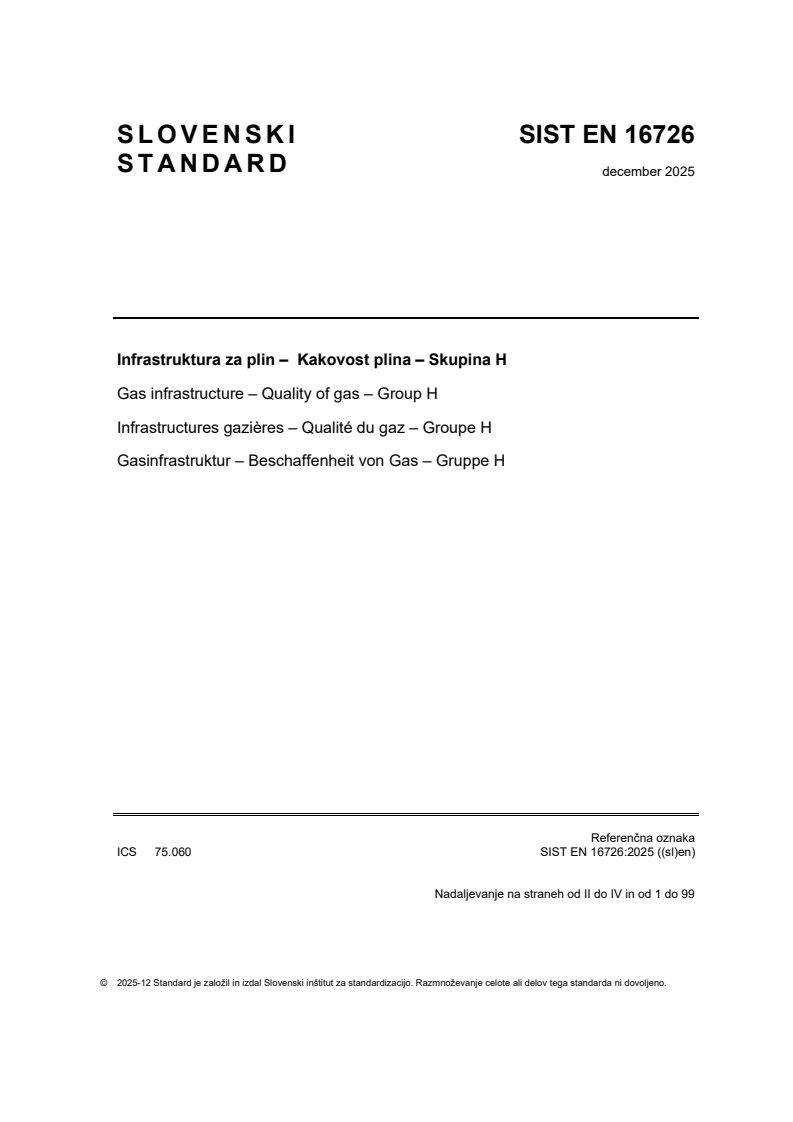
SL O V EN S K I SIST EN 16726
S T ANDAR D
december 2025
Infrastruktura za plin – Kakovost plina – Skupina H
Gas infrastructure – Quality of gas – Group H
Infrastructures gazières – Qualité du gaz – Groupe H
Gasinfrastruktur – Beschaffenheit von Gas – Gruppe H
Referenčna oznaka
ICS 75.060 SIST EN 16726:2025 ((sl)en)
Nadaljevanje na straneh od II do IV in od 1 do 99
© 2025-12 Standard je založil in izdal Slovenski inštitut za standardizacijo. Razmnoževanje celote ali delov tega standarda ni dovoljeno.
SIST EN 16726 : 2025
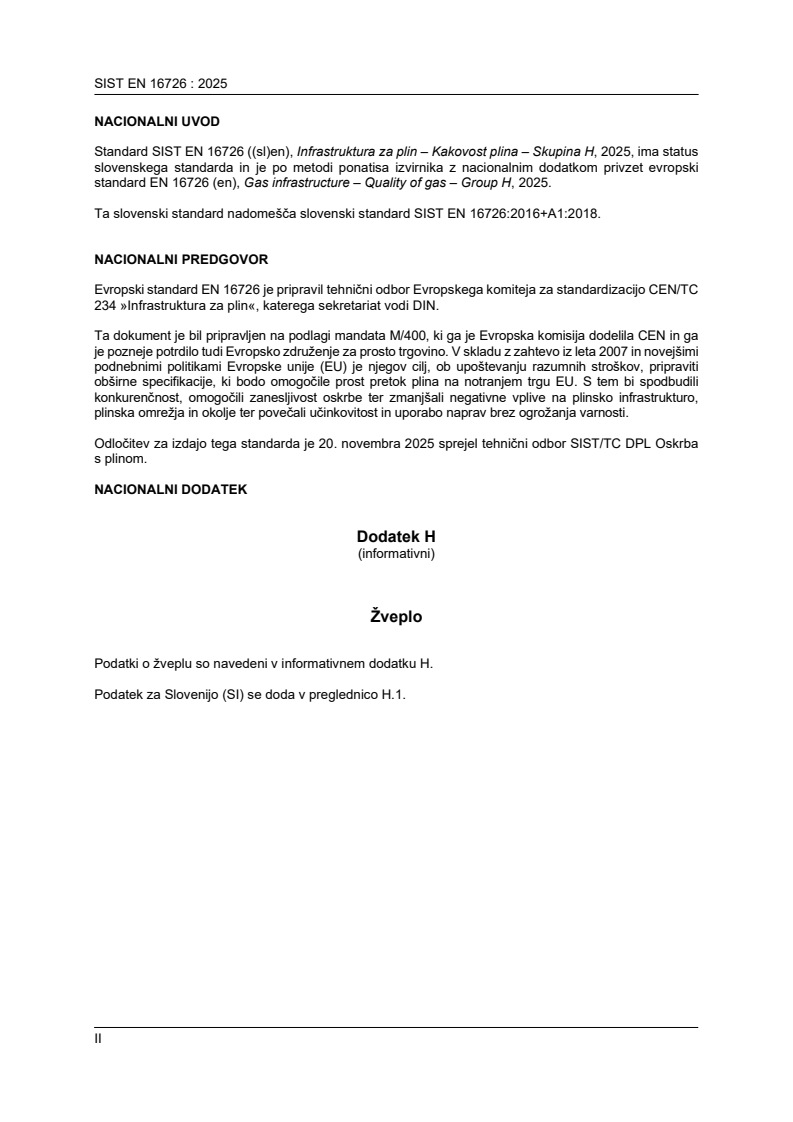
NACIONALNI UVOD
Standard SIST EN 16726 ((sl)en), Infrastruktura za plin – Kakovost plina – Skupina H, 2025, ima status
slovenskega standarda in je po metodi ponatisa izvirnika z nacionalnim dodatkom privzet evropski
standard EN 16726 (en), Gas infrastructure – Quality of gas – Group H, 2025.
Ta slovenski standard nadomešča slovenski standard SIST EN 16726:2016+A1:2018.
NACIONALNI PREDGOVOR
Evropski standard EN 16726 je pripravil tehnični odbor Evropskega komiteja za standardizacijo CEN/TC
234 »Infrastruktura za plin«, katerega sekretariat vodi DIN.
Ta dokument je bil pripravljen na podlagi mandata M/400, ki ga je Evropska komisija dodelila CEN in ga
je pozneje potrdilo tudi Evropsko združenje za prosto trgovino. V skladu z zahtevo iz leta 2007 in novejšimi
podnebnimi politikami Evropske unije (EU) je njegov cilj, ob upoštevanju razumnih stroškov, pripraviti
obširne specifikacije, ki bodo omogočile prost pretok plina na notranjem trgu EU. S tem bi spodbudili
konkurenčnost, omogočili zanesljivost oskrbe ter zmanjšali negativne vplive na plinsko infrastrukturo,
plinska omrežja in okolje ter povečali učinkovitost in uporabo naprav brez ogrožanja varnosti.
Odločitev za izdajo tega standarda je 20. novembra 2025 sprejel tehnični odbor SIST/TC DPL Oskrba
s plinom.
NACIONALNI DODATEK
Dodatek H
(informativni)
Žveplo
Podatki o žveplu so navedeni v informativnem dodatku H.
Podatek za Slovenijo (SI) se doda v preglednico H.1.
II
SIST EN 16726 : 2025
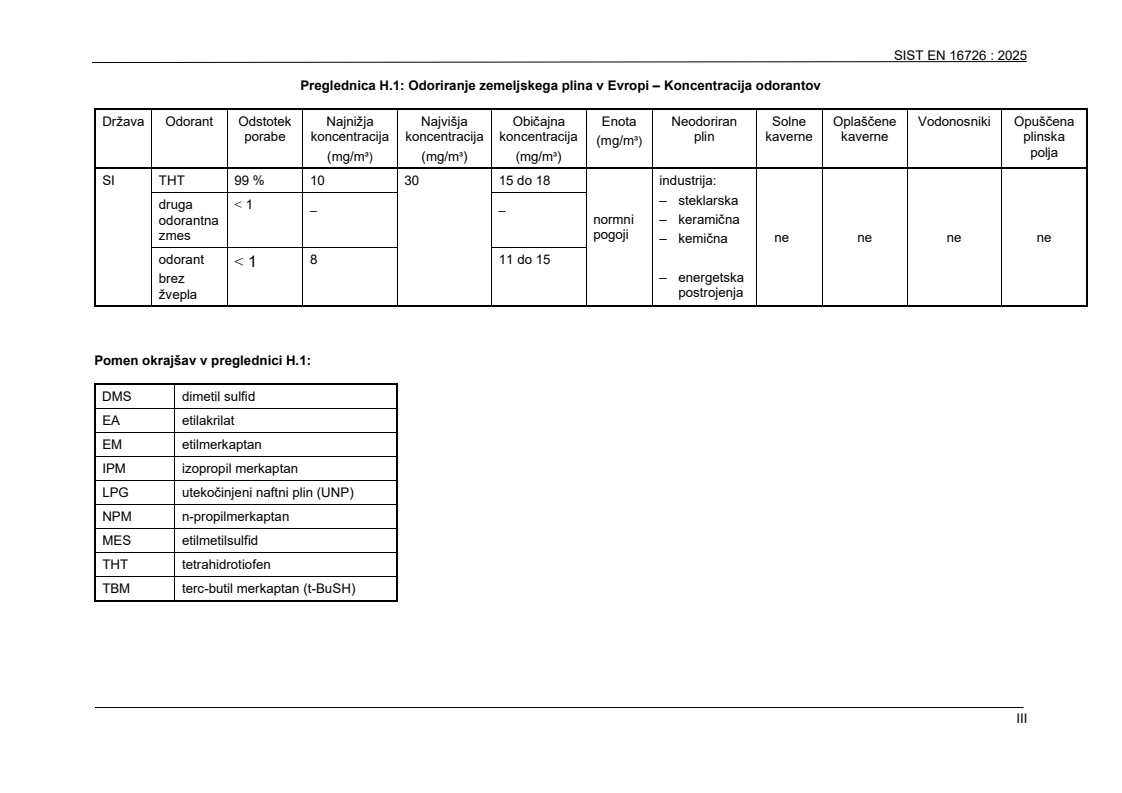
Preglednica H.1: Odoriranje zemeljskega plina v Evropi – Koncentracija odorantov
Država Odorant Odstotek Najnižja Najvišja Običajna Enota Neodoriran Solne Oplaščene Vodonosniki Opuščena
porabe koncentracija koncentracija koncentracija plin kaverne kaverne plinska
(mg/m³)
polja
(mg/m³) (mg/m³) (mg/m³)
SI THT 99 % 10 30 15 do 18 industrija:
– steklarska
druga < 1 _ _
normni – keramična
odorantna
zmes pogoji
ne ne ne ne
– kemična
odorant 8 11 do 15
< 1
– energetska
brez
postrojenja
žvepla
Pomen okrajšav v preglednici H.1:
DMS dimetil sulfid
EA etilakrilat
EM etilmerkaptan
IPM izopropil merkaptan
LPG utekočinjeni naftni plin (UNP)
NPM n-propilmerkaptan
MES etilmetilsulfid
THT tetrahidrotiofen
TBM terc-butil merkaptan (t-BuSH)
III
SIST EN 16726 : 2025
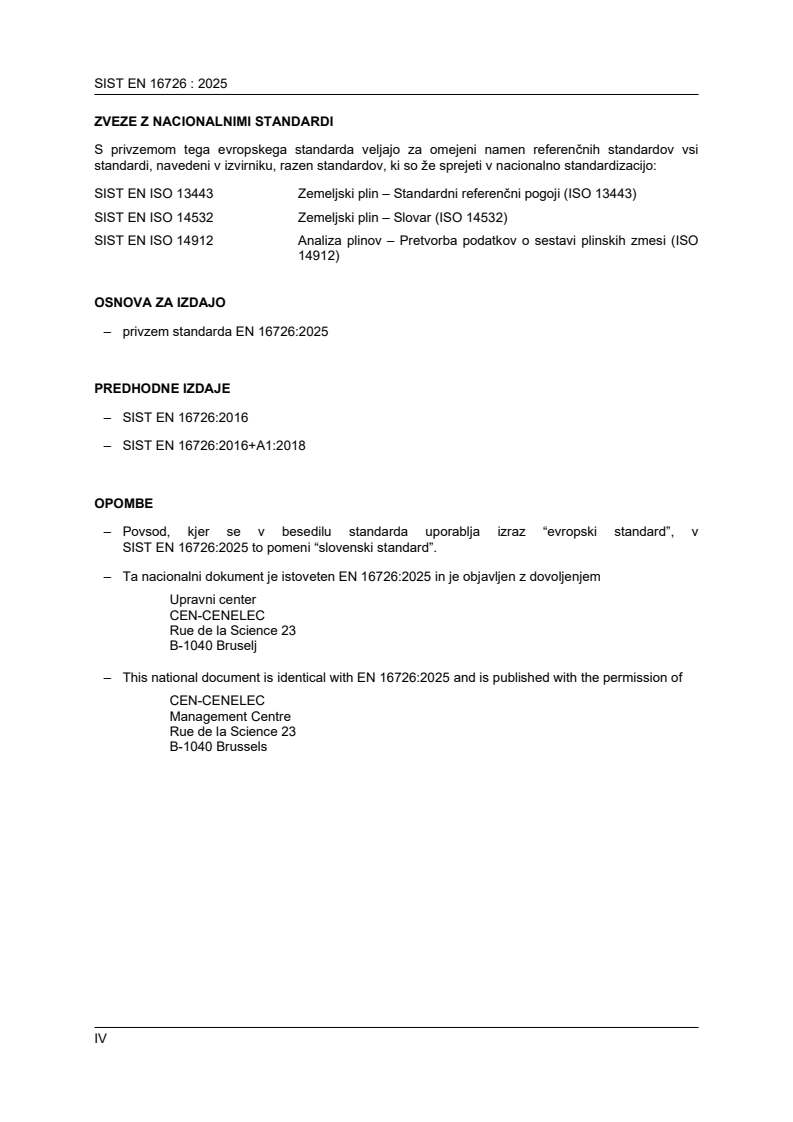
ZVEZE Z NACIONALNIMI STANDARDI
S privzemom tega evropskega standarda veljajo za omejeni namen referenčnih standardov vsi
standardi, navedeni v izvirniku, razen standardov, ki so že sprejeti v nacionalno standardizacijo:
SIST EN ISO 13443 Zemeljski plin – Standardni referenčni pogoji (ISO 13443)
SIST EN ISO 14532 Zemeljski plin – Slovar (ISO 14532)
SIST EN ISO 14912 Analiza plinov – Pretvorba podatkov o sestavi plinskih zmesi (ISO
14912)
OSNOVA ZA IZDAJO
– privzem standarda EN 16726:2025
PREDHODNE IZDAJE
– SIST EN 16726:2016
– SIST EN 16726:2016+A1:2018
OPOMBE
– Povsod, kjer se v besedilu standarda uporablja izraz “evropski standard”, v
– Ta nacionalni dokument je istoveten EN 16726:2025 in je objavljen z dovoljenjem
Upravni center
CEN-CENELEC
Rue de la Science 23
B-1040 Bruselj
– This national document is identical with EN 16726:2025 and is published with the permission of
CEN-CENELEC
Management Centre
Rue de la Science 23
B-1040 Brussels
IV
EN 16726
EUROPEAN STANDARD
NORME EUROPÉENNE
September 2025
EUROPÄISCHE NORM
ICS 75.060 Supersedes EN 16726:2015+A1:2018
English Version
Gas infrastructure - Quality of gas - Group H
Infrastructures gazières - Qualité du gaz - Groupe H Gasinfrastruktur - Beschaffenheit von Gas - Gruppe H
This European Standard was approved by CEN on 20 July 2025.
CEN members are bound to comply with the CEN/CENELEC Internal Regulations which stipulate the conditions for giving this
European Standard the status of a national standard without any alteration. Up-to-date lists and bibliographical references
concerning such national standards may be obtained on application to the CEN-CENELEC Management Centre or to any CEN
member.
This European Standard exists in three official versions (English, French, German). A version in any other language made by
translation under the responsibility of a CEN member into its own language and notified to the CEN-CENELEC Management
Centre has the same status as the official versions.
CEN members are the national standards bodies of Austria, Belgium, Bulgaria, Croatia, Cyprus, Czech Republic, Denmark, Estonia,
Finland, France, Germany, Greece, Hungary, Iceland, Ireland, Italy, Latvia, Lithuania, Luxembourg, Malta, Netherlands, Norway,
Poland, Portugal, Republic of North Macedonia, Romania, Serbia, Slovakia, Slovenia, Spain, Sweden, Switzerland, Türkiye and
United Kingdom.
EUROPEAN COMMITTEE FOR STANDARDIZATION
COMITÉ EUROPÉEN DE NORMALISATION
EUROPÄISCHES KOMITEE FÜR NORMUNG
CEN-CENELEC Management Centre: Rue de la Science 23, B-1040 Brussels
© 2025 CEN All rights of exploitation in any form and by any means reserved Ref. No. EN 16726:2025 E
worldwide for CEN national Members.
Contents Page
European foreword . 4
Introduction . 6
1 Scope . 7
2 Normative references . 7
3 Terms and definitions . 7
4 Reference conditions and pressure units . 11
5 Requirements . 11
5.1 Requirements to the gas quality . 11
5.2 Entry point Wobbe index range (recommendation) . 14
5.3 Exit point Wobbe index classification . 15
5.4 Effects of the injection of hydrogen onto gas quality . 19
5.5 Sampling . 19
Annex A (normative) Calculation of methane number of gaseous fuels for engines . 20
A.1 Introduction . 20
A.2 Calculation of methane number . 20
A.3 Example 1: 2H-gas . 21
A.4 Example 2: enriched biomethane . 27
A.5 Example 3: 2H-gas with hydrogen addition . 27
Annex B (informative) Limitations of the end-use gas applications to cope with the Wobbe
index entry range . 43
Annex C (informative) Possible mitigation measures for Wobbe index changes . 44
Annex D (informative) Considerations on on-site adjustment of combustion processes in
residential and commercial appliances . 46
D.1 General information . 46
D.2 Part 1 – Basics of combustion . 46
D.3 Part 2 – The theory behind the different types of adjustments . 48
D.4 Part 3 – On-site adjustment of the end-use applications related to the Wobbe index
exit classification . 57
Annex E (informative) National Wobbe index requirements . 61
Annex F (informative) Rate of change of the Wobbe index. 63
F.1 General. 63
F.2 Examples of nearly instantaneous changes in gas quality . 64
F.3 Impact of a changing Wobbe index on gas applications that are sensitive to Wobbe
index variations . 67
F.4 Measures to mitigate the effect of gas variations, step change and a high rate of change
................................................................................................................................................................... 68
Annex G (informative) Calorific value . 71
Annex H (informative) Sulfur . 73
Annex I (informative) Oxygen . 79
I.1 Origin of oxygen . 79
I.2 Challenges related to oxygen in natural gas grids . 79
I.3 Mitigation possibilities . 80
I.4 Oxygen measurement . 80
Annex J (informative) Water dew point and hydrocarbon dew point . 81
J.1 Water dew point . 81
Annex K (informative) Hydrogen . 82
Annex L (informative) Methane number . 85
Annex M (informative) Legal definitions which are considered useful for the topic of this
document . 87
Annex N (informative) A-deviations . 89
N.1 Denmark . 89
N.2 Estonia . 90
N.3 Hungary . 91
N.4 Ireland . 91
N.5 Italy . 92
N.6 Romania . 93
N.7 The Netherlands . 94
Bibliography . 96
European foreword
This document (EN 16726:2025) has been prepared by Technical Committee CEN/TC 234 “Gas
infrastructure”, the secretariat of which is held by DIN.
This European Standard shall be given the status of a national standard, either by publication of an
identical text or by endorsement, at the latest by March 2026, and conflicting national standards shall be
withdrawn at the latest by March 2026.
Attention is drawn to the possibility that some of the elements of this document may be the subject of
patent rights. CEN shall not be held responsible for identifying any or all such patent rights.
This document supersedes EN 16726:2015+A1:2018.
EN 16726:2024 includes the following significant technical changes with respect to
EN 16726:2015+A1:2018:
— Inclusion of Wobbe index requirements in 5.1, Table 1, Wobbe index exit classification
requirement (5.3), a Wobbe index entry recommendation (5.2) and related informative Annexes:
— Annex B – Limitations of the end-use gas applications to cope with the broad Wobbe index entry
range;
— Annex C – Possible mitigation measures for Wobbe index changes;
— Annex D – General considerations on on-site adjustment of combustion processes and
applications;
— Annex E – Current national Wobbe index requirements;
— Annex F – Rate of change of Wobbe index;
— Inclusion of the Calorific value in relationship to the Wobbe index (5.1, Table 1) and related
informative Annex G
— Revision of the minimum relative density (5.1, Table 1);
— Addition of an admissible hydrogen concentration (5.1, Table 1) and related informative Annex K;
— Revision of the admissible sulfur content (5.1, Table 1) and addition of related informative
Annex H;
— Revision of the admissible oxygen content (5.1, Table 1) and addition of related informative
Annex I;
— Revision of the admissible methane number in this standard (5.1, Table 1) in relation to the
general design of engines and addition of related informative Annex L.
This document has been prepared under a standardization request addressed to CEN by the European
Commission. The Standing Committee of the EFTA States subsequently approves these requests for its
Member States.
The need for a European Standard concerning the specification of the quality of gases of group H is
derived from the standardization request M/400 issued to CEN by the European Commission.
According to this standardization request (dated back to 2007) and the more recent EU climate policies,
the goal is to define specifications that are as wide as possible within reasonable costs. This means that
the specifications enhance the free flow of gas within the internal EU market, in order to promote
competition and security of supply minimizing the negative effects on gas infrastructure and gas
networks, efficiency and the environment and allow appliances to be used without compromising safety.
Some requirements specified in this European Standard, Clause 5, cannot be implemented by
— Denmark
— Estonia
— Hungary
— Ireland
— Italy
— Romania
— The Netherlands
due to existing conflicting national legislation. The related A-Deviations are listed in Annex.
NOTE BSI announced the notification of A-Deviations for the requirements on Wobbe index Class specified
(5.3.2), Oxygen (5.1, Table 1) and Hydrogen (5.1, Table 1) referring to Gas Safety Management Regulations, GSMR,
for the UK gas supply being enforced in UK Law.
Any feedback and questions on this document should be directed to the users’ national standards body.
A complete listing of these bodies can be found on the CEN website.
According to the CEN-CENELEC Internal Regulations, the national standards organisations of the
following countries are bound to implement this European Standard: Austria, Belgium, Bulgaria, Croatia,
Cyprus, Czech Republic, Denmark, Estonia, Finland, France, Germany, Greece, Hungary, Iceland, Ireland,
Italy, Latvia, Lithuania, Luxembourg, Malta, Netherlands, Norway, Poland, Portugal, Republic of North
Macedonia, Romania, Serbia, Slovakia, Slovenia, Spain, Sweden, Switzerland, Türkiye and the United
Kingdom.
Introduction
This document sets requirements for gas quality with the aim to allow the free flow of gas between the
CEN member states and to enable the security of supply taking into account the impact on the whole value
chain from gas production and supply to end users.
The Wobbe index and oxygen requirements in this document are based on the proposal of the CEN Sector
Forum Gas Joint Working Group Pre-normative studies of H-gas quality parameters (short: CEN SFGas
Gas Quality Study, GQS).
NOTE Responsibility issues in the context of this document are subject to European or national regulations.
This document includes requirements on Wobbe index aspects which need an appropriate
national/European framework as pre-condition for the implementation of the standard. This is expressed
in Clause 5.3.6 Implementation of Wobbe index Classification.
Furthermore, this document does not define an acceptable rate of change (RoC) of Wobbe index as pre-
normative work is needed; an informative Annex F is part of this document. A separate CEN process on
RoC is intended to start in CEN/TC 234.
1 Scope
This document specifies gas quality characteristics, parameters and their limits, for gases classified as
group H that are to be transmitted, injected into and withdrawn from storages, distributed and utilized.
NOTE For information on gas families and gas groups, see EN 437.
This document specifies a Wobbe index classification system which is applicable, if the corresponding
national/European framework is available to support it.
This document does not give any threshold for the rate of change of Wobbe index or other gas quality
parameters. Nevertheless, acknowledging the serious influence of the rate of change of Wobbe index
and/or GCV on the proper functioning of a number of end-use applications, such as gas engines and gas
turbines, the risks of the rate of change within the Wobbe index exit range is described in Annex F.
This document does not cover gases conveyed on isolated networks.
For specific requirements on the quality of biomethane and other renewable and low-carbon gases
injected into the grid, reference is made to EN 16723-1.
2 Normative references
The following documents are referred to in the text in such a way that some or all of their content
constitutes requirements of this document. For dated references, only the edition cited applies. For
undated references, the latest edition of the referenced document (including any amendments) applies.
EN ISO 13443, Natural gas - Standard reference conditions (ISO 13443)
EN ISO 14532, Natural gas - Vocabulary (ISO 14532)
ISO 14912, Gas analysis — Conversion of gas mixture composition data
3 Terms and definitions
For the purposes of this document, the terms and definitions given in EN ISO 14532 and the following
apply.
NOTE Some legal definitions which are considered useful for the topic of this document are given in Annex M
for information. Due to the normative character of this clause, they cannot be integrated here.
ISO and IEC maintain terminology databases for use in standardization at the following addresses:
— ISO Online browsing platform: available at https://www.iso.org/obp/
— IEC Electropedia: available at https://www.electropedia.org/
3.1
isolated network
network where transmission, distribution and utilization of gas are combined and which is physically
unconnected to other networks
3.2
application
installation or process that utilizes the transported and distributed gas
Note 1 to entry: Some examples of gas applications are: gas appliances (domestic or commercial), processes
(chemical or industrial), turbines, engines, burners, etc.
3.3
sensitive applications/installations
applications/installations that need intervention to maintain the proper functioning due to the sensitivity
towards one or more gas quality parameter values in the distributed gas including:
— integrity;
— safety;
— efficiency;
— emissions;
— performance (output/power)
3.4
system operator
private or public entity authorized to design, construct and/or operate and maintain a gas system
3.5
distributed gases
gases available at an exit point conveyed through the gas network
3.6
Wobbe index
W
s
ratio of the calorific value of a gas per unit volume and the square root of its relative density under the
same reference conditions
Note 1 to entry: The Wobbe index is expressed in megajoules per cubic metre (MJ/m ) of dry gas under the
reference conditions.
Note 2 to entry: The Wobbe index is said to be gross (Ws) or net (Wi) according to whether the calorific value used
is the gross or net calorific value.
Note 3 to entry: Two fuel gases with the same Wobbe index will release the same amount of heat in a combustion
system, as long as the nozzle pressure and the nozzle diameter remain constant. The gas temperature is assumed
to remain constant in this context. The Wobbe index is the primary gas interchangeability criterion for residential
and commercial appliances as well as for some large-scale combustion equipment in industry and power
generation.
[SOURCE: EN 437:2021, 3.13, modified by adding NOTE 3 to entry]
3.7
Calorific Value
Gross calorific value
GCV
value of heat that would be released in a complete combustion with oxygen of a given quantity of gas,
whereby
— the pressure p at which the reaction takes place remains constant and all combustion products
are returned to the same given temperature t of the original products;
— and all these products are in the gaseous state, with the exception of water, which condenses into
the liquid state at temperature t
Note 1 to entry: The term net calorific value (NCV) is used when water is also present in a gaseous state after
combustion. Pressure and temperature are usually related to the reference conditions (15 °C, 101,325 kPa).
3.8
entry (point)
point – except interconnection points – at which gas enters a gas distribution or gas transmission system
Note 1 to entry: Underground storages are not considered as entry points.
3.9
exit (point)
point at which gas leaves the gas transmission or gas distribution system for gas end-use
Note 1 to entry: Underground storages are not considered as exit point.
3.10
cluster of exit points
homogeneous group of exit points which are considered as one exit point for the application of the Wobbe
index classification system proposal
3.11
interconnection (point)
physical point connecting adjacent gas transmission and distribution systems and/or storage systems
3.12
range
values between maximum and minimum for a given gas quality property in absolute terms
3.13
bandwidth
difference between a maximum and a minimum of a range
3.14
rate of change
speed of change
RoC
change of the value of a gas quality property at a location per unit of time
Note 1 to entry: Nearly instantaneous change in local gas quality can be referred to as step change.
3.15
adjustment
setting a gas appliance or a gas application in such a way that the nominal operational process parameters
(e.g. firing rate, air excess ratio, required process temperatures, emission values, safety) and expected
lifetime of the system, as prescribed by the manufacturer, are met
Note 1 to entry: For residential and commercial appliances, this can be done with a reference gas like G20 (pure
methane). For industrial and power generation equipment, the adjustment is usually part of the commissioning
process and carried out with the locally available gas and the ambient conditions at the time of commissioning. This
is called on-site adjustment.
3.16
gas blending
deliberate activity of mixing two or more separate gas streams for a specific purpose where a relevant
fuel quality criterion (e.g. W or GCV) of the resulting gas blend is specified
s
Note 1 to entry: It takes place at specific locations in the network (e.g. a blending station)
3.17
mitigation measure
any measure in order to prevent or reduce significant adverse effects of gas quality changes
3.18
continuously experienced case
exit points or cluster of exit points experiencing the same Wobbe index range as they have been receiving
for an extended period of time in the past
3.19
notice period
time between the announcement of the Wobbe index change to the end-user and the moment when the
switch effectively takes place
3.20
combustion reference conditions
specified temperature T and pressure p at which a fuel is notionally burned
[SOURCE: EN ISO 14532:2017, 2.6.1.1]
3.21
metering reference conditions
specified temperature T and pressure p at which an amount of fuel to be burned is notionally determined
Note 1 to entry: There is no a priori reason for the metering reference conditions to be the same as the combustion
reference conditions.
[SOURCE: EN ISO 14532:2017, 2.6.1.2]
3.22
A-deviation
modification of, addition to or deletion from the content of an EN (and HD for CENELEC)
reflecting a national situation due to regulations the alteration of which is for the time being outside the
competence of the CEN and/or CENELEC member
Note 1 to entry: Where standards fall under EC Directives or Regulations, it is the view of the Commission of the
European Communities (OJ No C 59, 1982-03-09) that the effect of the decision of the Court of Justice in Case 815/79
Cremonini/Vrankovich (European Court Reports 1980, p. 3583) is that compliance with A-deviations is no longer
mandatory and that the free movement of products complying with such a standard should not be restricted within
the EC except under the safeguard procedure provided for in the relevant Directive or Regulation
[SOURCE: IR Part 2:2022, 2.16]
4 Reference conditions and pressure units
Unless stated otherwise, all volumes are given for the real dry gas at ISO standard reference conditions
of 15 °C (288,15 K) and 1 013,25 mbar (101,325 kPa). Unless otherwise stated, all pressures are absolute
pressures.
Whenever data on the volume, gross calorific value (GCV), energy and Wobbe index are communicated,
it shall be specified under which reference conditions these values were calculated, as these are necessary
to quantify the calorific properties (Wobbe index, Calorific Value) of a fuel.
NOTE 1 In the EU, two reference systems exist which are commonly used. EN ISO 13443 and EN ISO 14532
define the reference system with 15 °C as a combustion reference temperature and 15 °C for metering purposes
with 1 013,25 mbar as reference pressure, with energy contents given in MJ/m , whilst many other documents and
national and or European regulations use a reference system with 25 °C as a combustion reference temperature and
0 °C for volume (also with 1 013,25 mbar as reference pressure). Calorific properties, e.g. CV or Ws, can be given
as kWh/m as well.
In assessing compliance with this European Standard, parameters should be determined directly at
ISO standard reference conditions. If the properties are only available at other reference conditions and
the actual gas composition is not known then conversion to ISO standard reference conditions shall be
carried out using the procedure described in EN ISO 13443.
NOTE 2 The use of the reference condition 15 °C/15 °C as given in EN ISO 13443 is in line with the
standardization request M/400. Besides the ISO standard reference conditions, particular in gas transmission,
normal reference conditions (25 °C/0 °C) are used according to the Network Code Interoperability and Data
exchange.
5 Requirements
5.1 Requirements to the gas quality
Gas shall comply with the requirements given in Table 1.
The gas shall not contain constituents other than listed in Table 1 at levels that prevent its transportation,
storage and/or utilization without quality adjustment or treatment.
Table 1 — Requirements
Limits based on standard reference Reference
condition 15 °C/15 °C standards for
Parameter Unit
e
test methods
Min. Max.
(informative)
MJ/m
See subclauses 5.2 and 5.3 and Annex B to
Wobbe index EN ISO 6976
Annex F
kWh/m
Calorific value The calorific value results from the relationship between Wobbe
MJ/m
(informative) index and relative density, see Annex G.
Limits based on standard reference Reference
condition 15 °C/15 °C standards for
Parameter Unit
e
test methods
Min. Max.
(informative)
EN ISO 6976,
a
Relative density no unit 0,45 0,70
EN ISO 15970
b
mg/m not applicable EN ISO 19739
without odorant
For existing practices with respect to transmission of odorized gas directly between high
Total sulfur
pressure networks a maximum sulfur content of 30 mg/m shall apply.
NOTE 1 Odorization is considered as a safety issue, dealt with at national level. Some
information about sulfur odorant content is given in Annex H.
Hydrogen
sulphide +
EN ISO 6326-3,
3 b
Carbonyl mg/m not applicable 5
EN ISO 19739
sulphide
(as sulfur)
Mercaptan sulfur
EN ISO 6326-3,
3 b
without odorant mg/m not applicable 6
EN ISO 19739
(as sulfur)
Sulfur from other
components
mg/m not applicable 9
without odorant
(as sulfur)
1 % or
below 1 % to 0,01 %
EN ISO 6974-3,
No unit
or
Oxygen not applicable EN ISO 6974-6,
(as mole fraction)
below 0,01 % to 0,001 %,
EN ISO 6975
according to assessment
process (see below)
Limits based on standard reference Reference
condition 15 °C/15 °C standards for
Parameter Unit
e
test methods
Min. Max.
(informative)
In the gas infrastructure the concentration of oxygen shall be no more than 1 %. However,
if it can be demonstrated by an assessment process that a gas with oxygen content can
flow to installations with proven sensitivity to oxygen at the level:
— of below 1 % to 0,01 %, the maximum limit shall be lowered to the maximum
acceptable limit, expressed as a moving 24-h-average.
— of below 0,01 %, the maximum limit shall be limited to 0,001 % at the lowest,
expressed as a moving 24-h average. Solutions for protecting these specific
installations shall be defined in co-operation of the parties concerned, as part
of the assessment.
NOTE 1 Most applications can accept a level of 0,01 % of oxygen or higher; certain types
of underground storages are sensitive to oxygen contents higher than 0,001 %.
On a case-by-case basis, it can be required to identify the techno-economical
optimal solution enabling the level of O acceptable for the part of the gas grid
affected, e.g. from biomethane producers to installations sensitive to O2.
The assessment process for identification of installations sensitive to O2, and
evaluation of the applicable threshold and responsibilities need to be stipulated to
facilitate the application of the standard requirement on O content.
NOTE 2 Considering the expected development of biomethane production, the lower
maximum limit of 0,01 % will probably have to be reassessed upwards in the coming years.
NOTE 3 1 % is equal to 10000 ppm and 0,001 % is equal to 10 ppm.
More information on oxygen origin, challenges, mitigation measures and measurement are
given in Annex I.
EN ISO 6974
no unit
not applicable 2,5 % or 4 % (see below) parts 1 to 6,
(as mole fraction)
EN ISO 6975
The mole fraction of carbon dioxide shall be no more than 2,5 % in case of operating
Carbon dioxide
pressures higher or equal to 16 bar and up to 4 % for operating pressures below 16 bar.
However, where the gas can be demonstrated not to flow to installations sensitive to higher
levels of carbon dioxide, e.g. underground storage systems, a higher limit of up to 4 % may
be applied for pressures higher than 16 bar.
Hydrocarbon
c,d
dew point
EN ISO 23874,
at any pressure
°C not applicable −2
ISO/TR 12148
from 0,1 MPa to
8,5 MPa (85 bar)
absolute pressure
EN ISO 6327,
EN ISO 18453,
°C not applicable −8
EN ISO 10101
Water dew
parts 1 to 3
c,d
point
If the grid is at a different pressure from 7 MPa, the resulting dew point temperature shall
at 7 MPa (70 bar).
be converted to the equivalent of 7 MPa. For further information see Annex J.
NOTE 4 Water dew point at 70 bar of −8 °C is equivalent to the water concentration of
approximately 39 mg/m depending on the gas composition.
no unit
Hydrogen not applicable 2 % None
(as mole fraction)
Limits based on standard reference Reference
condition 15 °C/15 °C standards for
Parameter Unit
e
test methods
Min. Max.
(informative)
A hydrogen concentration shall be accepted up to two percent by mol across the whole
value chain.
It may deviate nationally, regionally or locally
for higher values than 2 mol/mol of hydrogen concentration provided that the
requirements of the applications sensitive to hydrogen are met
for lower values than 2 mol/mol of hydrogen concentration in case of proven sensitivity of
installations to hydrogen, e.g. some underground gas storage and some gas turbines.
For further information reference is made to 5.4 and Annex K.
70 or 65
no unit not applicable Annex A
(see below)
NOTE 5 At the time of writing this document, the vast majority of gases have a MN above
70.
Methane number
For exemptions the minimum MN of 65 applies. Some exemptions are South Arne gas, gases
from LNG terminals and possibly natural gas hydrogen blends,
This limit value of 65 does not imply that gas engines must be designed for the minimum
Methane Number (MN) of 65. They are generally designed for a minimum MN of 70 or above
(see Annexes A and L).
a
An approval of the legal weights and measurement regulation is necessary in some European countries.
b
Figures are indicated without post-comma digits due to analytical uncertainty.
c
Under given climatic conditions, a higher water dew point and hydrocarbon dew point may be accepted at
national level.
d
For further information on water dew point and hydrocarbon dew point, see Annex J.
e
Test methods other than those listed in the reference standards indicated in Table 1 may be applied, provided
their fitness for purpose can be demonstrated.
Gas quality shall not impede safety of gas appliances and operations of end users. Appropriate measures
shall be taken.
NOTE 6 Applications are sensitive towards variations of the gas quality depending on the type of application and
the degree of variation.
5.2 Entry point Wobbe index range (recommendation)
3 3
The Wobbe index entry range should be within 46,44 MJ/m and 54,00 MJ/m [15 °C/15 °C] (see
Table 2).
Table 2 —Wobbe index entry range recommendation
Limits based on standard
reference condition 15 °C/15 °C
Parameter Unit
Min. Max.
Wobbe index at
46,44 54,00
MJ/m
entry points
NOTE 1 The Wobbe index limit values at entry points need to comply with the national requirements on the
Wobbe index entry range.
NOTE 2 The Wobbe index entry range (B, 5.2) has been worked out in the CEN SFGas GQS [2][5]. It corresponds
to the Wobbe index range of the EASEE-gas CBP 2005-001/02 [1].
NOTE 3 At exit points, a Wobbe index range/variation as large as this entry range can lead to safety, emission
and performance issues in end-use applications. For further related information on the limitation of end-use
applications to the broad Wobbe index range and the on-site adjustment see Annex D. Consequently, the Wobbe
index classification at exit point applies as in 5.3.
5.3 Exit point Wobbe index classification
5.3.1 Definition of classes
The distributed gases at an exit point (or a cluster of exit points) shall be classified in classes according
to 5.3.2 and 5.3.3.
A class shall be assigned to the exit point (or to a cluster of exit points), based on the expected Wobbe
Indices at this point. Assignment is recommended to be based on both, historical data and data on future
expectations, if available.
The lower and upper limits of the Wobbe index range shall be clearly indicated. The class shall be
maintained for a maximum possible duration of time.
The Wobbe index of the distributed gas can exceed the Wobbe index limit values of the range of the class
(see 5.3.5). Time, extent, frequency and impact of exceedance of the limit values of the given class shall
be kept at a minimum.
NOTE 1 The Wobbe index limit values need to comply with the national requirements on the Wobbe index.
Awareness shall be given that the majority of nowadays applications (including residential and
commercial) are not able to accept gas with a Wobbe index varying over the whole proposed entry range
3 3 3
(46,44 MJ/m to 54,00 MJ/m ) covering a bandwidth of 7,56 MJ/m (see Annex B).
Available historical Wobbe index data shall be provided to end users requesting it.
NOTE 2 The Network Code Interoperability and data exchange (2015/703) deals with the data exchange with
end-users in Art. 17 ‘Information provision on short-term gas quality variation’.
It is recommended to consider mitigation measures. Possible mitigation measures are collected in
Annex C.
Once a Wobbe index class has been attributed to an exit point, end-users can expect the Wobbe index to
remain in the defined class range as long as they are not contacted for a class change.
NOTE 3 It is expected that the requirements for the procedures needed to specify classes and to enable an
implementation of the classification system will be dealt with in national/European legislation.
5.3.2 Class Specified
Class Specified shall be assigned to exit points (or to a cluster of exit points) for the distributed gases if
the following conditions apply:
— Wobbe index bandwidth of ≤ 3,7 MJ/m ;
3 3
— within the Wobbe index range of 46,44 MJ/m to 53,00 MJ/m [15 °C/ 15 °C at 1 013,25 mbar].
The downstream sectors and relevant end-users shall be informed about the defined classification
including:
— the lower and upper Wobbe index limit values;
3 3 3
— with a bandwidth of 3,7 MJ/m within the range of 46,44 MJ/m to 53,00 MJ/m .
Exceeding the upper and lower limits of the defined class Wobbe index values (deviations) can occur (see
5.3.5). In that case, the necessary information covered in 5.3.5 shall be communicated.
NOTE 1 For some types of end-use equipment significant technical measures (e.g. CEN Sector Forum Gas – Gas
Quality Study Report on Wobbe index 2021 [2]; German Hauptstudie Gasbeschaffenheit [3][4]) will be needed to
fulfil all safety, operational and legal requirements, even with a Wobbe index bandwidth of 3,7 MJ/m . It would be
preferable that all future end-use equipment can accept the bandwidth of 3,7 MJ/m .
5.3.3 Class Extended
Class Extended shall be assigned to exit points (or a clusters of exit points) for distributed gases which
are not covered by the Class Specified within the recommended Wobbe index entry range of 46,44 MJ/m
to 54 MJ/m (5.3) or within the national Wobbe index specification for H-gas (see Annex E).
NOTE 1 In many countries national legal Wobbe index ranges exist, which can differ from the recommended
Wobbe index entry range; in other countries generally acknowledged national standards and/or codes of practices
apply.
Allocating Class Extended to exit points (or clusters of exit points) requires
— unbiased assessment of the presence of users’ applications sensitive to Wobbe index at the
concerned exit point or cluster of exit points and,
— if any, the implementation of appropriate mitigating measures in cooperation with all parties
involved (Annex C).
If a Class Extended allocated to a specific exit point (or to a cluster of exit points) is proven by
confirmation with historical data to be a continuously experienced case (see 3.18), then no assessment
for the presence of applications sensitive to Wobbe index is needed. This can also apply for exit points
(or for a cluster of exit points) having the same application technologies as in another area with
continuously experienced gas quality variations (demonstrated by initial assessment).
Attention shall be given to required safety margins.
The lower and upper Wobbe index limit values shall be defined per exit point within the Wobbe index
entry range.
Exceeding the upper and lower limits of the defined class Wobbe index values (deviations) can occur (see
5.3.5). In that case, the necessary information covered in 5.3.5 shall be communicated.
Downstream sectors and relevant end-users shall be informed about the classification system and the
assigned class including the defined values and the necessary information covered in 5.3.5 in case of
deviation from the allocated class.
NOTE 2 A Wobbe index range – covering a bandwidth of 7,56 MJ/m – is not compatible with on-site adjustment
of end-use settings to the local gas quality (Annex D). Many applications can be adjusted, but sometimes require
additional physical changes to the equipment.
5.3.4 Examples of classes
5.3.4.1 General
Examples of classes are visualized in Figure 1; Concrete examples for Class Specified and for Class
Extended are described below.
Key
A EN 437, Test gases range for H-gas appliances (given here for reference)
B Wobbe index range recommendation at entry point (5.2)
C Upper Wobbe index limit of Class
...
SLOVENSKI STANDARD
oSIST prEN 16726:2024
01-januar-2024
Infrastruktura za plin - Kakovost plina - Skupina H
Gas infrastructure - Quality of gas - Group H
Gasinfrastruktur - Beschaffenheit von Gas - Gruppe H
Infrastructures gazières - Qualité du gaz - Groupe H
Ta slovenski standard je istoveten z: prEN 16726
ICS:
75.060 Zemeljski plin Natural gas
oSIST prEN 16726:2024 en,fr,de
2003-01.Slovenski inštitut za standardizacijo. Razmnoževanje celote ali delov tega standarda ni dovoljeno.
oSIST prEN 16726:2024
oSIST prEN 16726:2024
DRAFT
EUROPEAN STANDARD
prEN 16726
NORME EUROPÉENNE
EUROPÄISCHE NORM
December 2023
ICS 75.060 Will supersede EN 16726:2015+A1:2018
English Version
Gas infrastructure - Quality of gas - Group H
Infrastructures gazières - Qualité du gaz - Groupe H Gasinfrastruktur - Beschaffenheit von Gas - Gruppe H
This draft European Standard is submitted to CEN members for enquiry. It has been drawn up by the Technical Committee
CEN/TC 234.
If this draft becomes a European Standard, CEN members are bound to comply with the CEN/CENELEC Internal Regulations
which stipulate the conditions for giving this European Standard the status of a national standard without any alteration.
This draft European Standard was established by CEN in three official versions (English, French, German). A version in any other
language made by translation under the responsibility of a CEN member into its own language and notified to the CEN-CENELEC
Management Centre has the same status as the official versions.
CEN members are the national standards bodies of Austria, Belgium, Bulgaria, Croatia, Cyprus, Czech Republic, Denmark, Estonia,
Finland, France, Germany, Greece, Hungary, Iceland, Ireland, Italy, Latvia, Lithuania, Luxembourg, Malta, Netherlands, Norway,
Poland, Portugal, Republic of North Macedonia, Romania, Serbia, Slovakia, Slovenia, Spain, Sweden, Switzerland, Türkiye and
United Kingdom.
Recipients of this draft are invited to submit, with their comments, notification of any relevant patent rights of which they are
aware and to provide supporting documentation.
Warning : This document is not a European Standard. It is distributed for review and comments. It is subject to change without
notice and shall not be referred to as a European Standard.
EUROPEAN COMMITTEE FOR STANDARDIZATION
COMITÉ EUROPÉEN DE NORMALISATION
EUROPÄISCHES KOMITEE FÜR NORMUNG
CEN-CENELEC Management Centre: Rue de la Science 23, B-1040 Brussels
© 2023 CEN All rights of exploitation in any form and by any means reserved Ref. No. prEN 16726:2023 E
worldwide for CEN national Members.
oSIST prEN 16726:2024
prEN 16726:2023 (E)
Contents Page
European foreword . 4
Introduction . 5
1 Scope . 6
2 Normative references . 6
3 Terms and definitions . 6
4 Reference conditions and pressure units . 10
5 Requirements . 10
5.1 Requirements to the gas quality . 10
5.2 Entry point Wobbe Index range (recommendation) . 13
5.3 Exit point Wobbe Index classification . 13
5.3.1 General. 13
5.3.2 Definition of classes . 14
5.3.3 Class ‘Specified’ . 15
5.3.4 Class ‘Extended’ . 16
5.3.5 Acceptable deviation from a defined class . 17
5.3.6 Transition period for implementation of Wobbe Index classification . 18
5.4 Effects of the injection of hydrogen onto gas quality . 18
5.5 Sampling . 18
Annex A (normative) Calculation of methane number of gaseous fuels for engines . 19
A.1 Introduction . 19
A.2 Calculation of methane number . 19
A.3 Example 1: 2H-gas . 20
A.4 Example 2: enriched biomethane . 26
A.5 Example 3: 2H-gas with hydrogen addition . 27
Annex B (informative) Oxygen . 41
B.1 Origin of oxygen . 41
B.2 Challenges related to oxygen in gas . 41
B.3 Mitigation possibilities . 42
B.4 Oxygen measurement . 42
Annex C (informative) Sulfur . 43
C.1 General. 43
C.2 Total sulfur from Odorants . 43
Annex D (informative) Water dew point and hydrocarbon dew point. 47
D.1 Water dew point . 47
D.2 Hydrocarbon dew point . 47
oSIST prEN 16726:2024
prEN 16726:2023 (E)
Annex E (informative) Hydrogen . 48
Annex F (informative) Methane Number . 50
Annex G (informative) Possible mitigation measures for Wobbe Index changes . 51
Annex H (informative) Limitations of the end-use gas applications to cope with the broad
Wobbe Index entry range . 53
Annex I (informative) General considerations on adjustment and re-adjustment of
residential and commercial appliances . 54
I.1 Basics . 54
I.2 On-site adjustment today . 58
I.3 Virtual readjustment to G20 in the field . 58
I.4 Advantages and dis-advantages of “virtual adjustment” . 63
Annex J (informative) On-site adjustment of the end-use applications related to the Wobbe
Index exit proposal . 64
J.1 General . 64
J.2 Combustion . 64
J.3 Combustion settings . 65
J.4 On-site adjustment of combustion settings. 66
J.5 On-site adjustment vs. Wobbe Index classes assigned to exit points . 66
J.6 Auto-adaptive control of combustion settings . 68
Annex K (informative) Some legal definitions which are considered useful for the topic of
this document . 69
Annex L (informative) A-deviations . 71
Bibliography . 72
oSIST prEN 16726:2024
prEN 16726:2023 (E)
European foreword
This document (prEN 16726:2023) has been prepared by Technical Committee CEN/TC 234 “Gas
infrastructure”, the secretariat of which is held by DIN.
This document is currently submitted to CEN Enquiry.
This document will supersede EN 16726:2015+A1:2018.
In comparison with the previous edition, the following technical modifications have been made:
— Inclusion of a Wobbe Index requirement (5.3), i.e. Wobbe Index exit classification requirement and
a Wobbe Index entry recommendation and related informative Annexes:
o Annex H - Limitations of the end-use gas applications to cope with the broad Wobbe Index
entry range;
o Annex I - General considerations on adjustment and re-adjustment of residential and
commercial appliances;
o Annex J - Onside adjustment of end-use applications;
— Addition of an admissible hydrogen concentration (subclause 5.1, Table 1) and related informative
Annex E;
— Revision of the minimum relative density (subclause 5.1, Table 1);
— Revision of the admissible oxygen content (subclause 5.1, Table 1) and addition of related
informative Annex B;
— Revision of the admissible sulfur content (subclause 5.1, Table 1) and addition of related
informative Annex C;
— Clarification on the admissible methane number in this standard (subclause 5.1, Table 1 Note g) in
relation to the general design of engines and addition of related informative Annex F.
This document has been prepared under a standardization request addressed to CEN by the European
Commission. The Standing Committee of the EFTA States subsequently approves these requests for its
Member States.
The need for a European Standard concerning the specification of the quality of gases of group H is
derived from the standardization request M/400 issued to CEN by the European Commission.
According to this standardization request the goal is to define specifications that are as wide as possible
within reasonable costs. This means that the specifications enhance the free flow of gas within the
internal EU market, in order to promote competition and security of supply minimizing the negative
effects on gas infrastructure and gas networks, efficiency and the environment and allow appliances to
be used without compromising safety.
Some requirements specified in this European Standard, Clause 5, cannot be implemented by xyz due to
existing conflicting national legislation. The related A-Deviations are listed in Annex L (to be verified
during Public Enquiry).
oSIST prEN 16726:2024
prEN 16726:2023 (E)
Introduction
This document sets requirements for gas quality with the aim to allow the free flow of gas between the
CEN member states and to enable the security of supply taking into account the impact on the whole
value chain from gas production and supply to end uses.
The Wobbe Index requirements in this document are based on the proposal of the CEN Sector Forum
Gas Joint Working Group Pre-normative studies of H-gas quality parameters (CEN SFGas GQS).
NOTE Responsibility and liability issues in the context of this document are subject to European or national
regulations.
oSIST prEN 16726:2024
prEN 16726:2023 (E)
1 Scope
This document specifies gas quality characteristics, parameters and their limits, for gases classified as
group H that are to be transmitted, injected into and from storages, distributed and utilized.
NOTE For information on gas families and gas groups, see EN 437.
This document does not cover gases conveyed on isolated networks.
For specific requirements on biomethane, reference is made to EN 16723-1.
2 Normative references
The following documents are referred to in the text in such a way that some or all of their content
constitutes requirements of this document. For dated references, only the edition cited applies. For
undated references, the latest edition of the referenced document (including any amendments) applies.
EN ISO 13443, Natural gas — Standard reference conditions (ISO 13443)
EN ISO 14532, Natural gas — Vocabulary (ISO 14532)
ISO 14912, Gas analysis — Conversion of gas mixture composition data
3 Terms and definitions
For the purposes of this document, the terms and definitions given in EN ISO 14532 and the following
apply.
NOTE Some legal definitions which are considered useful for the topic of this document are given in Annex H
for information. Due to the normative character of this clause, they cannot be integrated here.
ISO and IEC maintain terminology databases for use in standardization at the following addresses:
— ISO Online browsing platform: available at https://www.iso.org/obp/
— IEC Electropedia: available at https://www.electropedia.org/
3.1
isolated network
network where transmission, distribution and utilization of gas are combined and which is physically
unconnected to other networks
3.2
entry (point)
point – except interconnection points – at which gas enters a gas distribution or gas transmission
system
3.3
interconnection point
physical point connecting adjacent entry-exit systems or connecting an entry-exit system with an
interconnector
oSIST prEN 16726:2024
prEN 16726:2023 (E)
3.4
maximum operating pressure
maximum pressure at which a network can be operated continuously under normal conditions
expressed as absolute pressure
Note 1 to entry: Normal conditions are: no fault in any device or stream.
[SOURCE: EN 1594:2013, 3.23, modified]
3.5
application
equipment that utilizes the transported and distributed gas
Note 1 to entry: Some examples of gas applications are: gas appliances (domestic or commercial), processes
(chemical or industrial), power plants, vehicles, greenhouses, etc.
3.6
shipper
individual or company that contracts with a gathering, transmission or distribution system for
transportation of customer-owned natural gas
[SOURCE: Enbridge Glossary of Terms, modified]
3.7
system operator
private or public organization authorized to design, construct and/or operate and maintain a system
3.8
distributed gases
gases available at an exit point conveyed through the gas network
3.9
gases from renewable sources or renewable gases
means gases from renewable non-fossil sources by fermentation, gasification and/or power-to-gas
processes
3.10
Wobbe Index
WI
ratio of the calorific value of a gas per unit volume and the square root of its relative density under the
same reference conditions; the Wobbe Index is said to be gross or net according to whether the calorific
value used is the gross or net calorific value
Note 1 to entry: Two fuel gases with the same Wobbe Index will release the same amount of heat in a combustion
system, as long as the nozzle pressure and the nozzle diameter remain constant. The gas temperature is assumed
to remain constant in this context. The Wobbe Index is the primary gas interchangeability criterion for residential
and commercial appliances as well as for some large-scale combustion equipment in industry and power
generation.
Note 2 to entry: The Gross Wobbe Index (WI calculated with GCV) is used in this document.
[SOURCE: EN 437:2018, 3.13, modified]
oSIST prEN 16726:2024
prEN 16726:2023 (E)
3.11
rate of change (RoC) = speed of change
change of the value of a gas quality property at a location per unit of time
Note 1 to entry: Nearly instantaneous change in local gas quality is often referred to as 'plug flow’.
3.12
range
values between maximum and minimum for a given gas quality property in absolute terms
3.13
bandwidth
difference between a maximum and a minimum of a range
3 3
EXAMPLE The WI range of a defined gas is between 46,44 MJ/m and 50,00 MJ/m . The bandwidth is
3,56 MJ/m .
3.14
exit (point)
point at which gas leaves the gas transmission or distribution system for end-use
Note 1 to entry: A number of connected exit points with the same class in the same topological and geographic
region are considered to be a cluster of exit point.
3.15
cluster of exit points
homogeneous group of exit points located within the vicinity of each other and which are considered as
one exit point for the application of the Wobbe Index classification system proposal
[SOURCE: Taken from Art. 3(19), TAR NC and modified]
3.16
interconnection (point)
physical point connecting adjacent gas transmission and distribution systems and/or storage systems
3.17
affected user
end-user whose installation experiences a switch of class
Note 1 to entry: Some affected users might be considered sensitive users, as well.
3.18
adjustment
setting a gas appliance or a gas application in such a way that the nominal operational process
parameters (e.g. firing rate, air excess ratio, required process temperatures, emission values) and
expected lifetime of the system, as prescribed by the manufacturer, are met
Note 1 to entry: For residential and commercial appliances, this can be done with a reference gas like G20 (pure
methane). For industrial and power generation equipment, the adjustment is usually part of the commissioning
process and carried out with the locally available gas and the ambient conditions at the time of commissioning.
This is called on-site adjustment.
oSIST prEN 16726:2024
prEN 16726:2023 (E)
3.19
gas blending
deliberate activity of mixing two or more separate gas streams for a specific purpose where a relevant
fuel quality criterion (e.g. WI or GCV) of the resulting gas blend is specified. It takes place at specific
locations in the network (e.g. a blending station)
3.20
mitigation measure
any measure in order to avoid, prevent or reduce, significant adverse effects of gas quality changes on
the end-user
3.21
cost benefit analysis
analytical tool used to appraise an investment decision in order to assess the welfare change
attributable to it and with the purpose to facilitate a more efficient allocation of resources,
demonstrating the convenience of a particular intervention rather than possible alternatives
[SOURCE: European Commission Guide to Cost-Benefit Analysis of Investment Projects]
3.22
continuous experienced case
exit points or cluster of exit points experiencing the same Wobbe Index range as they have been
receiving for an extended period of time in the past
3.23
exceptional event or force majeure
any unplanned event that is not reasonably controllable, preventable or outside the sphere of influence
of the parties and that may cause, for a limited period, capacity reductions, affecting thereby the
quantity or quality of gas, with possible consequences on interactions between the different
stakeholders of the gas value chain
3.24
notice time
time between the announcement of the Wobbe Index change to the end-user and the moment when the
switch effectively takes place
Note 1 to entry: The notice time takes into account market dynamics, technical needs and constraints.
3.25
intensity of deviation of a class
extent (in MJ/m ) of Wobbe Index value exceeding on both sides the defined Wobbe Index limits of a
class allocated to an exit point
3.26
duration of deviation of a class
accumulated time (e.g. number of days per year) during which the Wobbe Index of the distributed gases
is outside of the defined Wobbe Index range of the assigned class to an exit point/cluster of exit points
3.27
frequency of deviation of a class
number of times (e.g. per year) where the Wobbe Index of the distributed gases is outside of the defined
Wobbe Index range of the assigned class to an exit point/cluster of exit points
oSIST prEN 16726:2024
prEN 16726:2023 (E)
3.28
validity duration of a class
period of time (to be determined) during which the bandwidth and the lower and upper Wobbe Index
values [of the class] are remaining the same
3.29
combustion reference conditions
specified temperature T and pressure p at which a fuel is notionally burned
3.30
metering reference conditions
specified temperature T and pressure p at which an amount of fuel to be burned is notionally
determined
Note 1 to entry: There is no a priori reason for the metering reference conditions to be the same as the
combustion reference conditions.
[SOURCE: EN ISO 14532:2017, 2.6.1.2]
4 Reference conditions and pressure units
Unless stated otherwise, all volumes are given for the real dry gas at ISO standard reference conditions
of 15 °C (288,15 K) and 1 013,25 mbar (101,325 kPa). Unless otherwise stated, all pressures are
absolute pressures.
Whenever data on the volume, gross calorific value (GCV), energy and Wobbe Index are communicated,
it shall be specified under which reference conditions these values were calculated, as these are
necessary to quantify the calorific properties (Wobbe Index, Calorific Value) of a fuel.
NOTE 1 In the EU, two reference systems exist which are commonly used. EN ISO 13443 and EN ISO 14532
define the reference system with 15 °C as a combustion reference temperature and 15 °C for volume with
1 013,25 mbar as reference pressure, with energy contents given in MJ/m , whilst many other documents and
national and or European regulations use a reference system with 25 °C as a combustion reference temperature
and 0 °C for volume (also with 1 013,25 mbar as reference pressure). Calorific properties, e.g. CV or WI, can be
given as kWh/m as well.
In assessing compliance with this European Standard, parameters should be determined directly at
ISO standard reference conditions. If the properties are only available at other reference conditions and
the actual gas composition is not known then conversion to ISO standard reference conditions shall be
carried out using the procedure described in EN ISO 13443.
NOTE 2 Besides the ISO standard reference conditions, particular in gas transmission, normal reference
conditions (25/0 °C) are used according to the Network Code Interoperability and Data exchange. These are
indicated in Table 1 for information.
NOTE 3 The use of the reference condition 15 °C/15 °C is in line with the standardization request M/400. The
values in 25 °C/0 °C (kWh) will be indicated in this document, where considered relevant for information
(Annex C for conversion factors, based on EN ISO 13443).
5 Requirements
5.1 Requirements to the gas quality
Gas shall comply with the requirements given in Table 1 and shall be accepted for conveyance.
oSIST prEN 16726:2024
prEN 16726:2023 (E)
Table 1 — Requirements
Limits based on normal
Limits based on standard
Reference
reference condition
reference condition
standards for
25 °C/0 °C
Parameter Unit
15 °C/15 °C
test methodsf
(for information)
(informative)
Min. Max. Min. Max.
MJ/m
Wobbe index See subclauses 5.2 and 5.3 EN ISO 6976
kWh/m
EN ISO 6976,
a
Relative density no unit 0,45 0,70 0,45 0,70
EN ISO 15970
not not
3 b b
mg/m 11 11 EN ISO 19739
applicable applicable
A maximum total sulfur concentration of 20 mg/m may apply provided that sulfur
Total sulfur
components other than those mentioned in this table are experienced in the grid.
without odorant
For existing practices with respect to transmission of odorized gas between high
pressure networks higher sulfur content value up to 30 mg/m may be accepted.
NOTE Odorization is considered as a safety issue, dealt with at national level. Some
information about sulfur odorant content is given in Annex B.
Hydrogen
EN ISO 6326-1,
sulphide + not not
3 b b
mg/m 5 5 EN ISO 6326-3,
Carbonyl sulphide applicable applicable
EN ISO 19739
(as sulfur)
Mercaptan sulfur
not not EN ISO 6326-3,
3 b b
without odorant mg/m 6 6
applicable applicable EN ISO 19739
(as sulfur)
1 % or 1 % or
0,001 % for 0,001 % for EN ISO 6974-3,
not not
mol/mol sensitive sensitive EN ISO 6974-6,
applicable
applicable
users users EN ISO 6975
(see below) (see below)
In the gas infrastructure the mole fraction of oxygen shall be no more than 1 %. However,
if it can be demonstrated that a gas with oxygen content can flow to installations
sensitive to oxygen, e.g. underground gas storage, a maximum limit down to 0,001 %,
Oxygen
expressed as a moving 24 hour average, at those exit point shall be applied, unless there
is no technical need (for most applications a level of e.g. 0,01 % or higher is sufficient).
The evaluation of the applicable level shall be done by an assessment process.
If the technical need for a low oxygen limit is not confirmed within the required
assessment process, then higher oxygen concentrations can be agreed on. The evaluation
of the applicable level shall be done by a case-by-case analysis for the grid that is
influenced by the oxygen content based on concrete input e.g. from requester for gas
injection, gas infrastructure operators and relevant end-users.
NOTE 2 0,01 % is equal to 100 ppm and 0,001 % is equal to 10 ppm.
2,5 % or 2,5 % or EN ISO 6974
not not
mol/mol 4 % 4 % parts 1 to 6,
applicable
applicable
(see below) see below EN ISO 6975
Carbon dioxide
At network entry points and interconnection points the mole fraction of carbon dioxide
shall be no more than 2,5 %. However, where the gas can be demonstrated not to flow to
installations sensitive to higher levels of carbon dioxide, e.g. underground storage
systems, a higher limit of up to 4 % may be applied.
oSIST prEN 16726:2024
prEN 16726:2023 (E)
Limits based on normal
Limits based on standard
Reference
reference condition
reference condition
standards for
25 °C/0 °C
Parameter Unit
15 °C/15 °C
test methodsf
(for information)
(informative)
Min. Max. Min. Max.
Hydro carbon dew
d,e
point
not not ISO 23874,
at any pressure from
°C −2 −2
applicable applicable ISO/TR 12148
0,1 MPa to 7 MPa
(70 bar) absolute
pressure
d,e
Water dew point
at 7 MPa (70 bar) or,
EN ISO 6327,
if less than 7 MPa
not not EN ISO 18453,
(70 bar), at
°C −8 −8
applicable applicable EN ISO 10101
maximum operating
parts 1 to 3
pressure of the
system in which the
gas flows
mol% not 2 not 2 none
applicable applicable
A hydrogen concentration shall be accepted up to two percent by mole across the whole
Hydrogen
value chain. It may deviate nationally, regionally or locally for higher values of hydrogen
concentration than 2 % in the grids provided that the requirements of the sensitive users
are met (see 5.4 and Annex E)
g
(see
not
g
none
Methane number no unit normative not applicable 65
applicable
Annex A,
Annex F)
The gas shall not contain constituents other than listed in Table 1 at levels that prevent
Contaminants
its transportation, storage and/or utilization without quality adjustment or treatment.
a
An approval of the legal weights and measurement regulation is necessary in some European countries.
b
Figures are indicated without post-comma digits due to analytical uncertainty.
c
More information on oxygen origin, challenges, mitigation measures and measurement are given in Annex C.
d
Under given climatic conditions, a higher water dew point and hydrocarbon dew point may be accepted at
national level.
e
For further information on water dew point and hydrocarbon dew point, see Annex D.
f
Test methods other than those listed in the reference standards indicated in Table 1 may be applied, provided
their fitness for purpose can be demonstrated.
g
This limit value does not imply that gas engines should be designed for the minimum MN of 65. The gas
engines should be designed for the expected gas quality. They are generally designed for a minimum MN of
70 or above (see Annex F).
Gas quality shall not impede safety of gas appliances and operations of end users. Appropriate
measures shall be taken.
NOTE Applications are sensitive towards variations of the gas quality depending on the type of application
and the degree of variation.
oSIST prEN 16726:2024
prEN 16726:2023 (E)
5.2 Entry point Wobbe Index range (recommendation)
3 3
The Wobbe Index entry range should be within 46,44 MJ/m and 54,00 MJ/m [15 °C/15 °C] (see
Table 2).
Table 2 —Wobbe Index entry range
Limits based on normal
Limits based on standard
reference condition 25 °C/0 °C
reference condition 15 °C/15 °C
Parameter Unit
(for information)
Min. Max. Min. Max.
MJ/m
Wobbe index at
3 3 3 3
46,44 MJ/m 54,00 MJ/m 13,59 kWh/m 15,81 kWh/m
entry points
kWh/m
NOTE 1 This proposal corresponds to the Wobbe Index range of the EASEE-gas Common Business Practice on
Harmonization of Natural Gas Quality (CBP 2005-001/02).
NOTE 2 A Wobbe Index range as large as this entry range can lead to safety, emission and performance issues
in end-use applications. Therefore, the Wobbe Index classification at exit point applies as in 5.3.
The possible interlinkage with other gas quality parameters determining the combustion process (e.g.
methane number) shall be taken into account.
5.3 Exit point Wobbe Index classification
5.3.1 General
The distributed gases at an exit point (or a cluster of exit points) shall be classified in two categories
according to Table 3, whereas:
— the Wobbe Index of the distributed gases is within an interval of 3,7 MJ/m within the Wobbe Index
3 3
range of 46,44 MJ/m to 53,00 MJ/m (class specified) or
— any other situation of Wobbe Index bandwidth and/or of the Wobbe Index range requiring an
assessment (due diligence principle) of the presence of sensitive users downstream of the
concerned exit point and, if any, the implementation of appropriate mitigating measures (when
applicable under Class Extended). For examples on mitigation measures for Wobbe Index changes,
see Annex G.
NOTE The Wobbe Index of the distributed gas is never outside the national legal entry range.
oSIST prEN 16726:2024
prEN 16726:2023 (E)
Table 3 —Wobbe Index exit classification
Bandwidth of Wobbe Index of distributed gases at
Class Indicated Wobbe Index range
the exit point
Class Lower and upper limit values defined per The Wobbe Index of the distributed gases is
3 3
Specified exit point with an interval of ≤ 3,7 MJ/m (= 1,08 kWh/m [25 °C/0 °C at
1 013,25 mbar])
3,7 MJ/m [15 °C/15 °C at 1 013,25 mbar]
3 within the Wobbe Index range of
(= 1,08 kWh/m [25 °C/0 °C at
3 3
1 013,25 mbar]) 46,44 MJ/m to 53,00 MJ/m [15 °C/ 15 °C at
1 013,25 mbar]
based on the distributed gas, within the
3 3
Wobbe Index range. (= 13,59 kWh/ m to 15,51 kWh/m [25 °C/0 °C at
1 013,25 mbar])
The Wobbe Index of the distributed gas is never
outside the national legal entry range.
Class Lower and upper limit values defined per Any other situation of Wobbe Index bandwidth
Extended exit point, based on the distributed gas, and/or of the Wobbe Index range.
within the Wobbe Index range.
Continuous experienced situations in Class
This class requires an assessment (due Extended could be considered similar to a Class
diligence principle) of the presence of Specified (e.g. after an initial assessment)
sensitive users downstream of the concerned
The Wobbe Index of the distributed gas is never
exit point and, if any, the implementation of
outside the national legal entry range.
appropriate mitigating measures.
5.3.2 Definition of classes
5.3.2.1 General criteria for a class
A class shall be assigned to the exit point (or to a cluster of exit points), based on the forecast of local
Wobbe Indices at this point. The lower and upper limits of the Wobbe Index range shall be clearly
indicated. The class shall be maintained for a maximum possible duration of time.
The Wobbe Index of the distributed gas can exceed the Wobbe Index limit values of the range of the
class (see 5.3.4). Network operators together with the upstream parties for gas supply shall strive to
minimize the time, extent, frequency and impact of exceedance of the limit values of the given class.
NOTE 1 The Wobbe Index of the distributed gas is never outside the national legal entry range.
Network operators shall be aware that the majority of nowadays applications (including residential and
commercial) are not able to accept gas with a Wobbe Index varying over the whole proposed entry
3 3
range (46,44 to 54,00 MJ/m ) covering a bandwidth of 7,56 MJ/m (see Annex H).
NOTE 2 Gases intended for the entry into the gas transportation and distribution system can have a wider Wobbe
Index bandwidth than the stable bandwidth that the end users can accept, provided the TSO and DSO involved
take appropriate measures to ensure the conditions of a defined class with a maximum of stability.
They shall provide information on historical Wobbe Index data, including the actual highest and lowest
Wobbe Index value, together with the class range of the exit point for individual end-users’ analysis, to
those end users requesting it.
It is recommended to consider mitigation measures. Possible mitigation measures are collected in
Annex G.
NOTE 3 The type of class determines whether an assessment is required or not for the presence of sensitive
users downstream of the concerned exit point.
oSIST prEN 16726:2024
prEN 16726:2023 (E)
NOTE 4 The procedures needed to specify classes (incl. at least the switch to a new class, time scales, liabilities
and responsibilities) and to enable an implementation of the classification system are supposed to be dealt with in
national/European legislation.
5.3.3 Class ‘Specified’
Class Specified shall be allocated to exit points or cluster of exit points for which the bandwidth of the
distributed gases’ Wobbe Index range is smaller than or equal to 3,7 MJ/m . The lower and upper limit
values shall be defined per exit point or cluster of exit points with an interval of 3,7 MJ/m within the
3 3
range of 46,44 MJ/m to 53,00 MJ/m and within the Wobbe Index entry range. Deviations can occur.
The network operator shall inform the downstream sectors or relevant end-users about the
classification including the defined values and shall communicate to the end-user the necessary
information covered in 5.3.5 in case of deviation from the allocated class.
This class does not require further steps by the system operator (or another designated party) besides
the allocation of the class to the exit point.
NOTE 1 For some types of end-use equipment significant technical measures (e.g. CEN SFGas GQS SSAS;
German Hauptstudie) will be needed to fulfil all safety, operational and legal requirements without, even with a
Wobbe Index bandwidth of 3,7 MJ/m , It would be advantageous that all future end-use equipment can accept this
bandwidth.
EXAMPLE Example for Class Specified:
Potential situation:
— the actual distributed gases in exit point X have a Wobbe Index bandwidth of 2,5 MJ/m ;the gas quality data
over a certain period of time (to be determined) obtained for exit point X show Wobbe Index values
3 3 3
comprised within 49,2 MJ/m and 51,7 MJ/m (corresponding to the 2,5 MJ/m Wobbe Index bandwidth);The
Class Specified has a fixed bandwidth of 3,7 MJ/m , whereas the actual distributed gases in an exit point in a
Class Specified might have a Wobbe Index range below or equal to 3,7 MJ/m . This to ensure that the class
limits given for this exit point stay true for as long as technically possible (same class, same lower and upper
Wobbe Index values);
— according to the classification system, exit point X is in a Class Specified.
Potential information to the end-users connected to exit point X:
— classification: the customers’ gas application receives gas from an exit point in a Class Specified;
— indication of the foreseen lower Wobbe Index value of 48,0 MJ/m and the foreseen upper Wobbe Index of
3 3
, i.e. a Wobbe Index bandwidth of 3,7 MJ/m ;
51,7 MJ/m
3 3
NOTE 2 The indicated range (48,00 MJ/m and 51,70 MJ/m ) depends on the individual forecast for the
distributed gases at that specific exit point. Therefore, the range can be defined differently for another period of
time. Forecast assumptions are made based on historical data and past experience which might not reflect future
situations. The quality of the forecast cannot be guaranteed.
NOTE 3 The described example presumes that a procedure for classification and communication is set in the
European legislative framework.
oSIST prEN 16726:2024
prEN 16726:2023 (E)
5.3.4 Class ‘Extended’
Class Extended shall be allocated to exit points of distributed gases for which the bandwidth of the
3 3
Wobbe Index range exceeds 3,7 MJ/m or the upper Wobbe Index limit exceeds 53,00 MJ/m . The lower
and upper Wobbe Index limit values shall be defined per exit point within the Wobbe Index entry range.
Deviations can occur.
NOTE 1 The Wobbe Index of the distributed gas is never outside the national legal entry range.
The network operator shall inform the downstream sectors or relevant end-users about the
classification including the defined values and shall communicate to the end-user the necessary
information covered in 5.3.5 in case of deviation from the allocated class.
This class requires unbiased assessment (due diligence principle) of the presence of sensitive users at
the concerned exit point or cluster of exit points and, if any, the implementation of appropriate
mitigating measures in cooperation with all parties involved.
A Class Extended deemed to be in the situation of continuously experienced case (see 3.22) can be
considered similar to a Class Specified (see 5.3.3), after confirmation with historical data.
NOTE 2 A Wobbe Index - covering a bandwidth of 7,56 MJ/m - is not compatible with on-site adjustment of
end-use settings to the local gas quality (Annex I and Annex J). However, many applications can be adjusted, but
sometimes require additional physical changes to the equipment.
EXAMPLE Example for Class Extended
Potential situation:
— the actual distributed gases in exit point Y have a Wobbe Index bandwidth of 4,5 MJ/m ;
— the gas quality data over a certain period of time (to be determined) obtained for exit point Y show Wobbe
3 3 3
Index values comprised between 48,0 MJ/m and 52,5 MJ/m (corresponding to the 4,5 MJ/m Wobbe Index
bandwidth);
— in the classification system exit point Y is in a Class Extended.
Potential information to the end-users connected to exit point Y classification: the customers’ gas application
receives gas from an exit point in a Class Extended:
— indication of the foreseen lower Wobbe Index limit value of 48,0 MJ/m and the foreseen upper limit value of
3 3
52,5 MJ/m , i.e. a Wobbe Index bandwidth of 4,5 MJ/m ;
— indication of a warning remark if the end-use application is sensitive to Wobbe Index variations:
— the wider range might have an impact;
— an impact analysis in cooperation with the TSO/DSO will be carried out to identify which mitigation
measures, if needed, are the most reasonable. Inclusion of other parties, such as the equipment manufacturer
in the process might be needed.
A graphic visualization is given in Figure 1.
oSIST prEN 16726:2024
prEN 16726:2023 (E)
Key
A EN 437, H-gas
B Wobbe Index range at entry point proposed by CEN SFGas GQS (and as given in EASEEgas CBP)
C Exit 1 (Class Specified)
D Exit 2 (Class Specified)
E Exit 3 (Class Extended)
F Exit 4 (Class Extended)
G Exit 5 (Class Extended)
Figure 1 — Example of assigned Wobbe Index classes – specified and extended – to some exit
points
5.3.5 Acceptable deviation from a defined class
As long as end-users are not contacted by network operators, they can expect the Wobbe Index to
remain in the defined class range.
In case of deviations from the class limits, three situations can appear:
a) Short termed temporary changes (i.e. temporary Wobbe Index excursions):
Network operators shall inform downstream sectors or relevant end-users of deviations as soon as
they have information of Wobbe Index going outside of the class ranges. This change can be a
predictable or unexpected deviation for the network operator.
Network operators and end-users should cooperate to identify the appropriate mitigation
measures to limit the impact of the temporary deviation.
b) Long lasting or permanent change: (due for instance to a low-carbon gas injection facility being
installed)
Network operators shall inform downstream sectors or relevant end-users of upcoming long
lasting or permanent Wobbe Index changes and assess the adjustment of the class. If the change
leads to a class change (to specified or extended), network operators sh
...