


FprEN 12778
(Main)Cookwares - Pressure cookers for domestic use
General Information
- Abstract
This document defines terms, establishes manufacturing, safety and functional requirements and corresponding tests, and specifies data for marking, labelling and instructions for use, for pressure cookers.
This document is applicable to portable pressure cookers for domestic use, with gross volume up to 25 l, with control pressure over 4 kPa and less than 150 kPa, with either integrated or independent heating (e.g. gas burner, electrical plate, induction hobs, glass ceramic hobs).
NOTE All pressures mentioned in this text are related to atmospheric pressure.
- Status
- Not Published
- Publication Date
- 07-Mar-2027
- Technical Committee
- CEN/TC 194 - Utensils in contact with food
- Drafting Committee
- CEN/TC 194/WG 1 - Cookware
- Current Stage
- 4599 - Dispatch of FV draft to CMC - Finalization for Vote
- Completion Date
- 04-Aug-2026
Buy Documents


Overview
FprEN 12778:2025 is a European standard developed by CEN (European Committee for Standardization) that specifies requirements for domestic pressure cookers. This comprehensive document defines terminology, establishes manufacturing, safety, and functional requirements, and sets protocols for testing, marking, labelling, and user instructions for pressure cookers intended for use in private households. It applies to portable pressure cookers with a gross volume up to 25 litres and a control pressure between 4 kPa and 150 kPa, regardless of whether they use integrated or independent heat sources such as gas, electric, induction, or glass ceramic hobs. All pressure values mentioned are relative to atmospheric pressure.
Key Topics
FprEN 12778 addresses several essential aspects of pressure cookers for domestic use, including:
- Definitions and Terminology: Clear definitions to standardize technical vocabulary across manufacturers and markets.
- Material Requirements:
- Use of materials with adequate mechanical, thermal, and chemical resistance.
- Materials must not adversely affect food safety or impart unwanted flavors.
- Manufacturing Characteristics:
- Robust construction and ease of maintenance/cleaning.
- Design features to prevent user injury (e.g., absence of sharp edges).
- Safety Features:
- Mandatory inclusion of a pressure control device, pressure indicator, safety device, decompression device, and safe opening system.
- Requirements to ensure protection against overpressure, safe opening, and prevention of steam burns.
- Functional Testing:
- Prescribed tests for pressure control, safety devices, opening mechanisms, decompression devices, and resistance to deformation and destruction.
- Marking, Labelling, and Instructions:
- Clear identification of capacity, pressure ratings, and safe operation guides for consumers.
Applications
FprEN 12778 is vital for stakeholders in the cookware industry, regulators, and safety certification bodies. Its practical applications include:
- Manufacturing Compliance: Pressure cooker manufacturers can use this standard to design products that meet strict European safety and quality requirements.
- Product Testing: Laboratories and certification agencies refer to this document for standardized test methods, ensuring uniform product evaluation.
- Market Access: Compliance with FprEN 12778 is often required for market entry within the European Economic Area (EEA), supporting legal conformity and consumer confidence.
- Consumer Safety: Enhanced product labelling and detailed instructions enable end-users to handle and maintain domestic pressure cookers safely, reducing the risk of accidents in the home kitchen.
- Innovation Support: The updated provisions accommodate new designs, such as integrated electric heating, aligning with evolving consumer preferences and technological advances.
Related Standards
To ensure comprehensive safety and quality, FprEN 12778 references and complements several other international standards, including:
- EN 30-1-1: Safety for domestic gas cooking appliances.
- EN 60335-1 & EN 60335-2-15: Safety requirements for household electrical appliances and appliances for heating liquids.
- EN 12983-1: General requirements for domestic cookware used on cooktops.
- IECEE OD 5014: Instrument accuracy requirements for test and measurement devices.
Manufacturers and product certifiers should consult these related standards alongside FprEN 12778 to ensure holistic compliance for pressure cookers placed on the European and wider international markets.
By closely following FprEN 12778, pressure cooker manufacturers, importers, and retailers can ensure their products meet state-of-the-art safety, performance, and labelling requirements, ultimately protecting end-users and facilitating seamless access to the European market. This European standard is a key reference point for quality assurance and regulatory compliance in the household cookware sector.
Relations
- Effective Date
- 06-May-2026
- Effective Date
- 06-May-2026
- Effective Date
- 18-Jan-2023
Buy Documents
Frequently Asked Questions
FprEN 12778 is a draft published by the European Committee for Standardization (CEN). Its full title is "Cookwares - Pressure cookers for domestic use". This standard covers: This document defines terms, establishes manufacturing, safety and functional requirements and corresponding tests, and specifies data for marking, labelling and instructions for use, for pressure cookers. This document is applicable to portable pressure cookers for domestic use, with gross volume up to 25 l, with control pressure over 4 kPa and less than 150 kPa, with either integrated or independent heating (e.g. gas burner, electrical plate, induction hobs, glass ceramic hobs). NOTE All pressures mentioned in this text are related to atmospheric pressure.
This document defines terms, establishes manufacturing, safety and functional requirements and corresponding tests, and specifies data for marking, labelling and instructions for use, for pressure cookers. This document is applicable to portable pressure cookers for domestic use, with gross volume up to 25 l, with control pressure over 4 kPa and less than 150 kPa, with either integrated or independent heating (e.g. gas burner, electrical plate, induction hobs, glass ceramic hobs). NOTE All pressures mentioned in this text are related to atmospheric pressure.
FprEN 12778 is classified under the following ICS (International Classification for Standards) categories: 97.040.20 - Cooking ranges, working tables, ovens and similar appliances; 97.040.60 - Cookware, cutlery and flatware. The ICS classification helps identify the subject area and facilitates finding related standards.
FprEN 12778 has the following relationships with other standards: It is inter standard links to EN 12778:2002/A1:2005, EN 12778:2002/AC:2003, EN 12778:2002. Understanding these relationships helps ensure you are using the most current and applicable version of the standard.
FprEN 12778 is associated with the following European legislation: EU Directives/Regulations: 2014/68/EU; Standardization Mandates: M/071, M/601. When a standard is cited in the Official Journal of the European Union, products manufactured in conformity with it benefit from a presumption of conformity with the essential requirements of the corresponding EU directive or regulation.
FprEN 12778 is available in PDF format for immediate download after purchase. The document can be added to your cart and obtained through the secure checkout process. Digital delivery ensures instant access to the complete standard document.
Standards Content (Sample)
SLOVENSKI STANDARD
oSIST prEN 12778:2019
01-november-2019
Posoda za kuhanje - Posoda pod tlakom za domačo uporabo
Cookware - Pressure cookers for domestic use
Kochgeschirre - Dampfdruckkochtöpfe für den Hausgebrauch
Articles culinaires à usage domestique - Autocuiseurs à usage domestique
Ta slovenski standard je istoveten z: prEN 12778
ICS:
97.040.60 Kuhinjska posoda, jedilni Cookware, cutlery and
servisi in jedilni pribor flatware
oSIST prEN 12778:2019 en,fr,de
2003-01.Slovenski inštitut za standardizacijo. Razmnoževanje celote ali delov tega standarda ni dovoljeno.
oSIST prEN 12778:2019
oSIST prEN 12778:2019
DRAFT
EUROPEAN STANDARD
prEN 12778
NORME EUROPÉENNE
EUROPÄISCHE NORM
November 2019
ICS 97.040.20; 97.040.60 Will supersede EN 12778:2002
English Version
Cookware - Pressure cookers for domestic use
Articles culinaires à usage domestique - Autocuiseurs à Kochgeschirre - Dampfdruckkochtöpfe für den
usage domestique Hausgebrauch
This draft European Standard is submitted to CEN members for enquiry. It has been drawn up by the Technical Committee
CEN/TC 194.
If this draft becomes a European Standard, CEN members are bound to comply with the CEN/CENELEC Internal Regulations
which stipulate the conditions for giving this European Standard the status of a national standard without any alteration.
This draft European Standard was established by CEN in three official versions (English, French, German). A version in any other
language made by translation under the responsibility of a CEN member into its own language and notified to the CEN-CENELEC
Management Centre has the same status as the official versions.
CEN members are the national standards bodies of Austria, Belgium, Bulgaria, Croatia, Cyprus, Czech Republic, Denmark, Estonia,
Finland, France, Germany, Greece, Hungary, Iceland, Ireland, Italy, Latvia, Lithuania, Luxembourg, Malta, Netherlands, Norway,
Poland, Portugal, Republic of North Macedonia, Romania, Serbia, Slovakia, Slovenia, Spain, Sweden, Switzerland, Turkey and
United Kingdom.
Recipients of this draft are invited to submit, with their comments, notification of any relevant patent rights of which they are
aware and to provide supporting documentation.
Warning : This document is not a European Standard. It is distributed for review and comments. It is subject to change without
notice and shall not be referred to as a European Standard.
EUROPEAN COMMITTEE FOR STANDARDIZATION
COMITÉ EUROPÉEN DE NORMALISATION
EUROPÄISCHES KOMITEE FÜR NORMUNG
CEN-CENELEC Management Centre: Rue de la Science 23, B-1040 Brussels
© 2019 CEN All rights of exploitation in any form and by any means reserved Ref. No. prEN 12778:2019 E
worldwide for CEN national Members.
oSIST prEN 12778:2019
prEN 12778:2019 (E)
Contents Page
European foreword . 3
1 Scope . 4
2 Normative references . 4
3 Terms and definitions . 4
4 Requirements . 6
4.1 General . 6
4.2 Material . 7
4.3 Manufacturing characteristics . 7
4.4 Lifting grips . 8
4.5 Control and safety devices . 8
4.6 Closing of the pressure cooker . 11
4.7 Resistance to pressure . 11
5 Tests . 12
5.1 General . 12
5.2 Tests and measurements relating to materials and coatings . 12
5.3 Tests and measurements relating to manufacturing characteristics . 12
5.4 Tests and measurements relating to lifting grips . 15
5.5 Tests on control and safety devices . 17
5.6 Tests relating to opening and closing devices . 22
5.7 Tests relating to resistance to pressure. 22
6 Marking, labelling and handbook . 23
Annex ZA (informative) Relationship between this European Standard and the Essential
Requirements of Directive 2014/68/EU aimed to be covered . 26
Bibliography . 27
oSIST prEN 12778:2019
prEN 12778:2019 (E)
European foreword
This document (prEN 12778:2019) has been prepared by Technical Committee CEN/TC 194 “Utensils in
contact with food”, the secretariat of which is held by AFNOR.
This document is currently submitted to the CEN Enquiry.
This document will supersede EN 12778:2002.
This document has been prepared under a mandate given to CEN by the European Commission and the
European Free Trade Association, and supports essential requirements of EU Directive(s).
For relationship with EU Directive(s), see informative Annex ZA, which is an integral part of this
document.
Minor revision has been included to take into account the requirements specified in the Pressure
Equipment Directive 2014/68/EU.
oSIST prEN 12778:2019
prEN 12778:2019 (E)
1 Scope
This document defines terms, establishes manufacturing, safety and functional requirements and
corresponding tests, and specifies data for marking, labelling and instructions for use, for pressure
cookers.
This document is applicable to portable pressure cookers for domestic use, with gross volume up to 25 l,
with working pressure over 4 kPa and less than 150 kPa, with either integrated or independent heating.
NOTE All pressures mentioned in this text are related to atmospheric pressure.
2 Normative references
The following documents are referred to in the text in such a way that some or all of their content
constitutes requirements of this document. For dated references, only the edition cited applies. For
undated references, the latest edition of the referenced document (including any amendments) applies.
EN 30-1-1:2008+A3:2013, Domestic cooking appliances burning gas fuel — Part 1-1: Safety - General
1)
EN 60335-1:2012 , Household and similar electrical appliances — Safety — Part 1: General requirements
(IEC 60335-1:2010, modified)
2)
EN 60335-2-15:2016 , Household and similar electrical appliances — Safety — Part 2-15: Particular
requirements for appliances for heating liquids (IEC 60335-2-15:2012, modified)
EN 12983-1:2000, Cookware - Domestic cookware for use on top of a stove, cooker or hob — Part 1: General
requirements
3 Terms and definitions
For the purposes of this document, the following terms and definitions apply.
ISO and IEC maintain terminological databases for use in standardization at the following addresses:
— IEC Electropedia: available at http://www.electropedia.org/
— ISO Online browsing platform: available at https://www.iso.org/obp
3.1
pressure cooker
cookware equipped with a removable lid being able to be fitted, specifically for the purpose of allowing
cooking of foodstuffs by water and/or steam under pressure
Note 1 to entry: It can be used on a stovetop or can be equipped with an integrated heating source.
3.2
capacity
volume of water held when the pressure cooker, without the lid, is filled to the brim while standing on a
level surface
1) This document is impacted by the amendments: EN 60335-1:2012/A1:2019, EN 60335-1:2012/A2:2019,
EN 60335-1:2012/A11:2014, EN 60335-1:2012/A13:2017 and EN 60335-1:2012/A14:2019.
2) This document is impacted by the amendment EN 60335-2-15:2016/A11:2018.
oSIST prEN 12778:2019
prEN 12778:2019 (E)
3.3
gross volume
internal volume of the pressure cooker limited by the body and the lid
3.4
usable capacity
two thirds of the capacity
3.5
independent heating
heat source not constituting an integral part of the pressure cooker
3.6
integrated heating
heat source which constitutes an integral part of the pressure cooker
3.7
working pressure
actual pressure(s) at which cooking takes place
3.8
control pressure
pressure(s) declared by the manufacturer or supplier, at which the pressure control device works
3.9
maximum allowable pressure PS
maximum pressure for which the pressure cooker is designed, specified by the manufacturer
3.10
pressure control device
device which stabilises the pressure inside the pressure cooker during use
3.11
safety device
device which prevents the pressure cooker from exceeding the safety pressure
3.12
pressure indicator
visual and/or acoustic device indicating that there is a pressure inside the cooker
Note 1 to entry: It can be one of the four types specified in 4.5.3.
3.13
safe opening system
system manual or automatic intended to prevent the pressure cooker from opening when it is under
pressure
Note 1 to entry: These systems can be used independently or coupled with the decompression system.
3.13.1
manual system
system actuated manually or automatically during or after the closing operation, intended to prevent the
pressure cooker opening until the user unlocks the system with a manual action distinct from the opening
operation, or carries out an operation contained in the sequence of events normally carried out to open
oSIST prEN 12778:2019
prEN 12778:2019 (E)
the pressure cooker operation, or carries out an operation contained in the sequence of events normally
carried out to open the pressure cooker
3.13.2
automatic system
system which automatically prevents the pressure cooker from being opened if the internal pressure is
higher than a certain value
Note 1 to entry: This system is automatically unlocked, without any user's action, when the internal pressure is
equal to or below this value, and before any opening operation can be affected (see 4.5.6).
3.14
decompression device
device intended to reduce, by its own action, the internal pressure of the pressure cooker, by a substantial
emission of steam accumulated in the cooker
Note 1 to entry: There are two types of decompression device: coupled and uncoupled.
3.14.1
coupled device
decompression device, coupled to the safe opening system of the pressure cooker
Note 1 to entry: This device, as long as it is not activated, automatically prevents the opening of the pressure
cooker.
3.14.2
uncoupled device
decompression device independent of the safe opening system of the pressure cooker, activated by a
manual action, distinct from the opening operation
3.15
closed pressure cooker
pressure cooker in which an internal pressure higher than 4 kPa can be reached
3.16
opened pressure cooker
pressure cooker in which no device prevents the separation of the lid from the body
3.17
opening and closing device
all devices which affect the opening and closing of the appliance and its pressure tightness
3.18
progressive opening
system of opening where depressurisation of the pressure cooker can be controlled by the user during
the opening operation
4 Requirements
4.1 General
Test and check methods relating to each of the following paragraphs are described in the corresponding
paragraphs of Clause 5.
oSIST prEN 12778:2019
prEN 12778:2019 (E)
4.2 Material
Materials used for the construction of the pressure cooker:
— shall have mechanical characteristics suitable for its manufacture and use;
— shall have adequate chemical resistance. They shall not be damaged under the effect of water, food
and domestic cleaning products, in any way which may adversely affect the pressure cooker's
operation or safety;
— shall not be sensitive to ageing or corrosion during their expected lifetime, to any extent that may
adversely affect the pressure cooker's operation or safety.
The pressure cooker shall be made of materials of a type and purity that, under normal conditions of use,
present no toxic hazards nor in any way affect the organoleptic qualities of food prepared in it.
Coatings shall comply with the requirements of EN 12983-1:2000.
NOTE All the requirements for materials to comply with Directive 2014/68/UE are not addressed in this
document.
4.3 Manufacturing characteristics
4.3.1 The pressure cooker and its devices and accessories shall be designed and constructed so that all
they require in the way of maintenance in addition to the maintenance specified by the manufacturer or
supplier, is simple cleaning carried out without using special instruments.
Particular care shall be taken over the finish of inside surfaces so that cleaning can be carried out
thoroughly and easily.
Surfaces shall not present any defects like blisters, blowholes, or cracks which could collect dirt.
No part of the pressure cooker shall have sharp edges that could injure the user.
4.3.2 The outside base of the pressure cooker shall not become convex.
This requirement is checked:
— at room temperature (23 °C ± 5 °C);
— when hot before and after the ageing of the bottom in accordance with 5.3.2.2;
— at declared control pressures during test 5.5.2.3.
The concavity of the bottom of the pressure cooker at room temperature, before and after ageing of the
bottom as described in 5.3.2 shall be maximum 6 % of the diameter of the bottom measured at room
temperature.
The maximum 6 % concavity requirement is not applicable to pressure cookers which are exclusively for
use on exposed flame heat sources and/or exclusively for use on induction heat sources, which shall be
marked as indicated in Clause 6 nor to pressure cookers with an integrated heat system.
The diameter of the bottom of the pressure cooker shall fulfil the requirements of 6.2.3 of
EN 12983-1:2000.
4.3.3 Lids shall be easy to set and safe to use when the pressure cooker is used in accordance with the
manufacturer's instructions. The area of the pressure cooker's external closure system, or closing ring,
shall be shaped so as to prevent any jets of steam released from directly hitting the user or the handles.
oSIST prEN 12778:2019
prEN 12778:2019 (E)
4.3.4 Pressure control devices and decompression devices shall be easy to clean and they shall be
shaped so that any obstruction is clearly visible after the removal of demountable parts.
Steam exhaust devices shall be designed and positioned so as to prevent the obstruction of the steam
escape orifices, in normal cooking use.
4.3.5 Capacity, measured as described in 5.3.5, shall be claimed capacity with a tolerace of ± 5 %.
4.4 Lifting grips
4.4.1 The body and the lid of the cooker shall be equipped with secure, solid and durable lifting grips.
The body of the pressure cooker shall be equipped in such a manner that secure gripping and handling
with two hands is possible.
The lid shall have at least one lifting grip.
The lifting grips, attached to the body of the pressure cooker shall be easy to use and shall be firmly
attached so that they do not come loose. They shall not affect the stability of the pressure cooker, even
while it is empty. They shall be positioned above the centre of gravity of the pressure cooker with its lid,
when filled with water to its capacity. They shall fulfil the requirements of 7.2 to 7.6 of EN 12983-1:2000.
4.4.2 Lifting grips shall be designed in such a way that their temperature, when measured in
accordance with 5.4.2 is not higher that the following values:
— metal 55 °C;
— plastics 70 °C;
— wood 89 °C;
— ceramic 66 °C.
If the values exceed these limits, it shall be indicated in the instructions for use that protections are
required in order to ensure a safe handling of the pressure cooker.
Using a spherical probe 14 mm in diameter, it shall not be possible to touch any metal part contained
within the insulated portion of the lifting grips which exceeds 55 °C.
4.5 Control and safety devices
4.5.1 General
The pressure cooker shall be equipped with the following devices:
— a pressure control device;
— a pressure indicator;
— a safety device;
— a decompression device;
— a safe opening system.
NOTE The decompression device can be either independent or integrated in one of the other above devices.
The pressure control device shall be separate from safety device.
oSIST prEN 12778:2019
prEN 12778:2019 (E)
4.5.2 Pressure control device
4.5.2.1 When the pressure control device has been in operation, there shall be a visual and/or
acoustic signal, showing that the working pressure is reached or exceeded (type 2 indicator).
4.5.2.2 If necessary, the pressure control device shall be able to be easily disassembled for purposes
of cleaning, inspection or replacement.
If parts can be removed while the pressure cooker is under pressure, this shall not present any hazard
for the user.
If an incorrect fitting of the device is possible, so that the safety function is impaired, the pressure cooker
shall not build up a pressure higher than 4 kPa (0,04 bar).
4.5.2.3 The pressure control device shall be able to hold the pressure(s) corresponding to the
value(s) of control pressure(s) declared by the manufacturer for this device with a tolerance of ± 20 %
(with a maximum of ± 20 kPa). However, minimum and maximum pressures obtainable when the device
is in operation, shall never be less than 4 kPa (0,04 bar) or greater than 150 kPa (1,5 bar) respectively.
4.5.2.4 Weight valves shall be secured to the lid so that they cannot fall off when the pressure cooker
is upside down.
4.5.2.5 In order to avoid the obstruction of the holes by food, the steam inlet of the pressure control
device shall be designed either:
— with one circular hole without any steam inlet tube, the diameter of which is more than or equal to
3 mm or;
— with at least two holes with steam inlets in differently directed planes.
4.5.2.6 It shall not be possible for the steam released during operation of the pressure control device
to directly reach the user, in a way that could cause injury when manipulating the appliance.
4.5.3 Pressure indicator
The pressure indicator shall be visual and/or acoustic of one of the following types:
a) indicating the pressure progression from 4 kPa;
b) indicating the control pressure;
c) indicating the presence of pressure starting at a value equal to or below 4 kPa;
d) indicating the pressure progression, functionally separate from the pressure control device.
The pressure control device is also a type 2 indicator (see 4.5.2.1).
4.5.4 Safety device
4.5.4.1 General
The elastic deformation of the body or the lid of pressure cooker shall not be considered as a safely device.
The safety device shall be designed so that no direct steam jet can hit the user manipulating the appliance
or the lifting grips, nor extinguish the gas burner flame adjusted to its minimum.
The safety device can consist of gasket deformation or extrusion, if the gasket complies with the tests
according to 5.5.4.3.
oSIST prEN 12778:2019
prEN 12778:2019 (E)
Detachable parts of the safety device shall be designed in such a way that, if a wrong assembly of the
device is possible, the pressure cooker cannot reach a pressure higher than the maximum permissible
pressure PS measured when the device is normally fitted.
Whenever the pressure cooker is equipped with several safety devices, the requirement of non extinction
of the flame only applies to the first safety device which has operated.
There shall be no movement of the pressure cooker during the operation of the safety device.
A self-destructing device shall be replaceable with a new one after each operation.
The manufacture of the device shall ensure that it is not possible for the device to throw off fragments.
All the above requirements are valid only for the safety device which operated first during test 5.5.4.
4.5.4.2 Working pressure of the safety device
The working pressure of the safety device shall be greater than the highest measured control pressure
(as per 5.5.2.3) and shall not be greater than the maximum permissible pressure PS.
However, a momentary pressure surge limited to 10 % of PS is acceptable, but the pressure of the safety
declared device shall not in any case be greater than 300 kPa (3,0 bars).
4.5.5 Decompression device
The decompression device can be coupled or uncoupled with the safe opening system of the pressure
cooker.
It shall reduce the internal pressure of the pressure cooker by discharging a substantial part of the steam
accumulated in the cooker while in operation, without any hazard for the user who is actuating the device.
4.5.6 Safety at the opening
It is compulsory that the manual release of the system precedes any other operation which will allow
opening of the pressure cooker.
Pressure cookers shall fulfil the specific requirements of the opening tests in Table 1 according to the
type of pressure cooker and its equipment (e.g. decompression device, type of pressure indicator).
For pressure cookers with a non progressive opening, the internal pressure at the opening shall be less
than or equal to 4 kPa.
When the safe opening system is an automatic one, it shall prevent the pressure cooker from being
opened if the internal pressure is higher than 4 kPa.
Water projection is tolerated under the conditions defined in 5.5.6.2, but the lid shall not be projected
during the opening test.
If parts of the safe opening system which are detachable by the user, have been incorrectly fitted, safety
on opening shall be maintained, or it shall not be possible for the pressure cooker to reach a pressure
greater than 4 kPa.
oSIST prEN 12778:2019
prEN 12778:2019 (E)
Table 1 — Opening tests
a
Type of pressure cooker Tests to be done Type of opening
Decompression device Type of pressure
indicator
1,3 and 4 2
Outside Bayonets with coupled device A1 A2 Non progressive
lid
with uncoupled device A2 A2
or without device
b b
Inside or outside segments with coupled device C1 or D1 C2 or D2 Non progressive
or clamps
b
with uncoupled device C2 or D2 C2 or D2
b
or without device
Clamp and screw with coupled device E E Progressive
with uncoupled device
or without device
Inside Clamp, cam and lever or with coupled device B1 B1 Non progressive
lid knob, with or without
with uncoupled device
spring rigid lid
or without device
Clamp, cam and with or with coupled device B1 B2 Non progressive
without spring flexible lid
with uncoupled device B2 B2
or without device
Long straight handle with coupled device A2 + B1 A2 + B2 Non progressive
without clamp
with uncoupled device A2 + B2 A2 + B2 Non progressive
or without device
a
Letters from A to E indicate tests described in 5.5.6.
b
Type C when opening requires the application of a torque.
Type D when opening requires the application of a force.
4.5.7 Mechanical resistance of safe opening systems
Safe opening systems shall not undergo any deformation which adversely affects their function when
tested as described in 5.5.7.
4.6 Closing of the pressure cooker
When the pressure cooker is closed, it shall meet the requirements of 4.5.6 and 4.7, in the most
unfavourable conditions (for example, with the lid incorrectly fitted).
4.7 Resistance to pressure
4.7.1 Resistance to deformation of the body and the lid
The body and the lid of the pressure cooker shall not undergo any permanent deformation which may
impair their operation and safety under the test conditions defined in 5.7.1.
After testing, the pressure cooker shall comply with the requirements of 4.5.
oSIST prEN 12778:2019
prEN 12778:2019 (E)
A flattening out of the bottom surface is permitted in accordance with the provisions of 4.3.2.
4.7.2 Resistance to destruction of the body and the lid
When applying the pressure under the conditions specified in 5.7.2 and up to the specified pressure limit,
the pressure cooker may undergo deformation but shall not show any incipient fracture nor any crack.
All connection points between the body and the lid shall be maintained.
If there is leakage, it shall occur without fracture.
The separation of an added base which may be present to promote heat conduction and distribution is
acceptable.
Pressure cookers with integral heating device
Pressure cookers with integral heating devices shall conform to the electrical or gas safety require
...
SLOVENSKI STANDARD
01-december-2025
Posoda za kuhanje - Posoda pod tlakom za domačo uporabo
Cookware - Pressure cookers for domestic use
Kochgeschirre - Dampfdruckkochtöpfe für den Hausgebrauch
Articles culinaires à usage domestique - Autocuiseurs à usage domestique
Ta slovenski standard je istoveten z: prEN 12778
ICS:
97.040.60 Kuhinjska posoda, jedilni Cookware, cutlery and
servisi in jedilni pribor flatware
2003-01.Slovenski inštitut za standardizacijo. Razmnoževanje celote ali delov tega standarda ni dovoljeno.
DRAFT
EUROPEAN STANDARD
prEN 12778
NORME EUROPÉENNE
EUROPÄISCHE NORM
September 2025
ICS 97.040.20; 97.040.60 Will supersede EN 12778:2002
English Version
Cookwares - Pressure cookers for domestic use
Articles culinaires à usage domestique - Autocuiseurs à Kochgeschirre - Dampfdruckkochtöpfe für den
usage domestique Hausgebrauch
This draft European Standard is submitted to CEN members for second enquiry. It has been drawn up by the Technical
Committee CEN/TC 194.
If this draft becomes a European Standard, CEN members are bound to comply with the CEN/CENELEC Internal Regulations
which stipulate the conditions for giving this European Standard the status of a national standard without any alteration.
This draft European Standard was established by CEN in three official versions (English, French, German). A version in any other
language made by translation under the responsibility of a CEN member into its own language and notified to the CEN-CENELEC
Management Centre has the same status as the official versions.
CEN members are the national standards bodies of Austria, Belgium, Bulgaria, Croatia, Cyprus, Czech Republic, Denmark, Estonia,
Finland, France, Germany, Greece, Hungary, Iceland, Ireland, Italy, Latvia, Lithuania, Luxembourg, Malta, Netherlands, Norway,
Poland, Portugal, Republic of North Macedonia, Romania, Serbia, Slovakia, Slovenia, Spain, Sweden, Switzerland, Türkiye and
United Kingdom.
Recipients of this draft are invited to submit, with their comments, notification of any relevant patent rights of which they are
aware and to provide supporting documentation.
Warning : This document is not a European Standard. It is distributed for review and comments. It is subject to change without
notice and shall not be referred to as a European Standard.
EUROPEAN COMMITTEE FOR STANDARDIZATION
COMITÉ EUROPÉEN DE NORMALISATION
EUROPÄISCHES KOMITEE FÜR NORMUNG
CEN-CENELEC Management Centre: Rue de la Science 23, B-1040 Brussels
© 2025 CEN All rights of exploitation in any form and by any means reserved Ref. No. prEN 12778:2025 E
worldwide for CEN national Members.
prEN 12778:2025 (E)
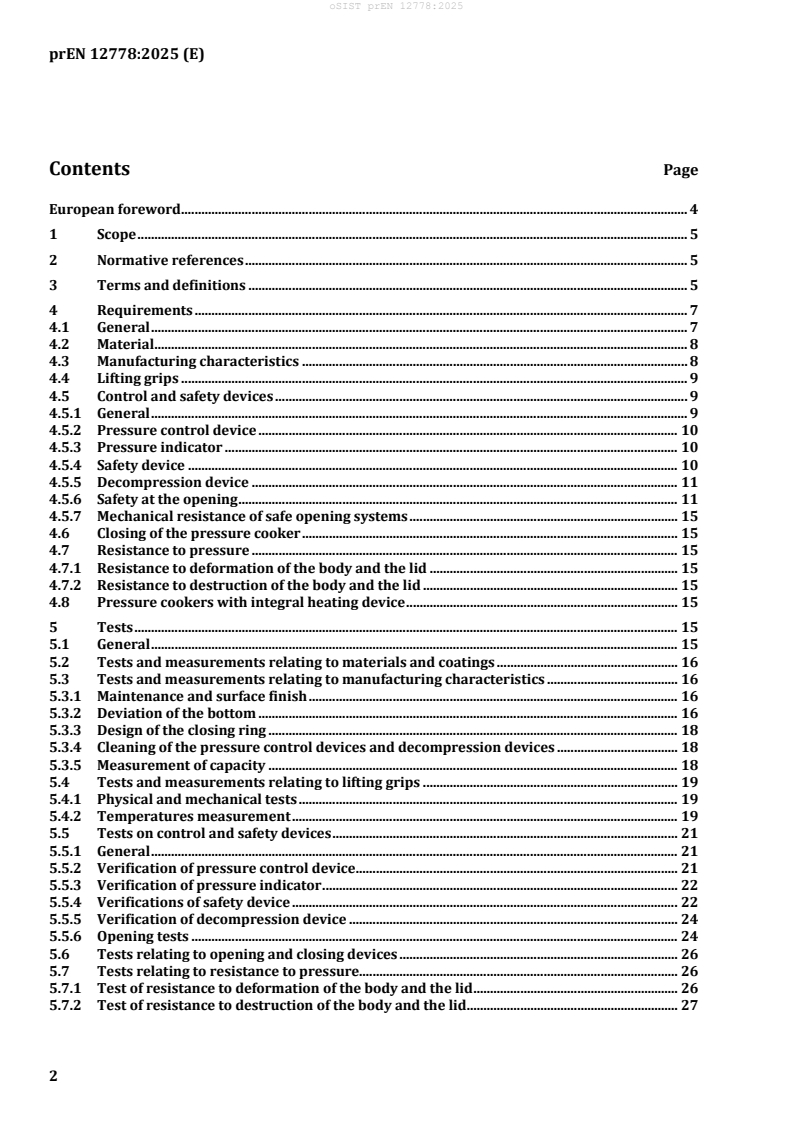
Contents Page
European foreword . 4
1 Scope . 5
2 Normative references . 5
3 Terms and definitions . 5
4 Requirements . 7
4.1 General . 7
4.2 Material . 8
4.3 Manufacturing characteristics . 8
4.4 Lifting grips . 9
4.5 Control and safety devices . 9
4.5.1 General . 9
4.5.2 Pressure control device . 10
4.5.3 Pressure indicator . 10
4.5.4 Safety device . 10
4.5.5 Decompression device . 11
4.5.6 Safety at the opening . 11
4.5.7 Mechanical resistance of safe opening systems . 15
4.6 Closing of the pressure cooker . 15
4.7 Resistance to pressure . 15
4.7.1 Resistance to deformation of the body and the lid . 15
4.7.2 Resistance to destruction of the body and the lid . 15
4.8 Pressure cookers with integral heating device . 15
5 Tests . 15
5.1 General . 15
5.2 Tests and measurements relating to materials and coatings . 16
5.3 Tests and measurements relating to manufacturing characteristics . 16
5.3.1 Maintenance and surface finish . 16
5.3.2 Deviation of the bottom . 16
5.3.3 Design of the closing ring . 18
5.3.4 Cleaning of the pressure control devices and decompression devices . 18
5.3.5 Measurement of capacity . 18
5.4 Tests and measurements relating to lifting grips . 19
5.4.1 Physical and mechanical tests . 19
5.4.2 Temperatures measurement . 19
5.5 Tests on control and safety devices . 21
5.5.1 General . 21
5.5.2 Verification of pressure control device . 21
5.5.3 Verification of pressure indicator . 22
5.5.4 Verifications of safety device . 22
5.5.5 Verification of decompression device . 24
5.5.6 Opening tests . 24
5.6 Tests relating to opening and closing devices . 26
5.7 Tests relating to resistance to pressure. 26
5.7.1 Test of resistance to deformation of the body and the lid . 26
5.7.2 Test of resistance to destruction of the body and the lid . 27
prEN 12778:2025 (E)
6 Marking, labelling and handbook . 27
Annex ZA (informative) Relationship between this European Standard and the Essential
Requirements of Directive 2014/68/EU aimed to be covered. 31
Bibliography . 32
prEN 12778:2025 (E)
European foreword
This document (prEN 12778:2025) has been prepared by Technical Committee CEN/TC 194 “Utensils in
contact with food”, the secretariat of which is held by AFNOR.
This document is currently submitted to the second CEN Enquiry.
This document will supersede EN 12778:2002 and EN 12778:2002/A1:2005.
This document has been prepared under a mandate given to CEN by the European Commission and the
European Free Trade Association and supports essential requirements of EU Directive(s).
For relationship with EU Directive(s), see informative Annex ZA, which is an integral part of this
document.
This document includes the following significant technical changes with respect to EN 12778:2002 and
EN 12778:2002/A1:2005:
— requirements for electrical integrated heating have been added;
— definitions have been updated;
— technical modifications have been made for the following subclauses: 4.3.5; 4.5.4; 4.6; 5.7;
— Annex ZA has been updated.
prEN 12778:2025 (E)
1 Scope
This document defines terms, establishes manufacturing, safety and functional requirements and
corresponding tests, and specifies data for marking, labelling and instructions for use, for pressure
cookers.
This document is applicable to portable pressure cookers for domestic use, with gross volume up to 25 l,
with control pressure over 4 kPa and less than 150 kPa, with either integrated or independent heating
(e.g. gas burner, electrical plate, induction hobs, ceramic hobs).
NOTE All pressures mentioned in this text are related to atmospheric pressure.
2 Normative references
The following documents are referred to in the text in such a way that some or all of their content
constitutes requirements of this document. For dated references, only the edition cited applies. For
undated references, the latest edition of the referenced document (including any amendments) applies.
EN 30-1-1:2021+A1:2023, Domestic cooking appliances burning gas — Part 1-1: Safety — General
1)
EN 60335-1:2012 , Household and similar electrical appliances — Safety — Part 1: General requirements
(IEC 60335-1:2010, modified)
2)
EN 60335-2-15:2016 , Household and similar electrical appliances — Safety — Part 2-15: Particular
requirements for appliances for heating liquids (IEC 60335-2-15:2012, modified)
EN 12983-1:2023, Cookware — Domestic cookware for use on top of a stove, cooker or hob — Part 1:
General requirements
IECEE OD 5014:2024, CTL Instrument Accuracy Limits
3 Terms and definitions
For the purposes of this document, the terms and definitions given in EN 12983-1:2023 and the following
apply.
ISO and IEC maintain terminology databases for use in standardization at the following addresses:
— ISO Online browsing platform: available at https://www.iso.org/obp
— IEC Electropedia: available at https://www.electropedia.org/
3.1
pressure cooker
cookware equipped with a removable lid being able to be fitted, specifically for the purpose of allowing
cooking of foodstuffs by water and/or steam under pressure
1)
This document is impacted by the amendments: EN 60335-1:2012/A1:2019, EN 60335-1:2012/A2:2019,
EN 60335-1:2012/A11:2014, EN 60335-1:2012/A13:2017, EN 60335-1:2012/A14:2019, EN 60335-
1:2012/A15:2019, and EN 60335-1:2012/A16:2023.
2)
This document is impacted by the amendment EN 60335-2-15:2016/A11:2018, EN 60335-2-15:2016/A12:2021,
EN 60335-2-15:2016/A1:2021, and EN 60335-2-15:2016/A2:2021.
prEN 12778:2025 (E)
Note 1 to entry: It can be used on a stovetop or can be equipped with an integrated heating source.
3.2
capacity
volume of water held when the pressure cooker, without the lid, is filled to the brim while standing on a
level surface
3.3
gross volume
internal volume of the pressure cooker limited by the body and the lid
3.4
usable capacity
two thirds of the capacity
3.5
independent heating
heat source not constituting an integral part of the pressure cooker
3.6
integrated heating
heat source which constitutes an integral part of the pressure cooker
3.7
working pressure
actual pressure(s) at which cooking takes place
3.8
control pressure
pressure(s) declared by the manufacturer or supplier, at which the pressure control device works
3.9
maximum allowable pressure PS
maximum pressure for which the pressure cooker is designed, specified by the manufacturer
3.10
pressure control device
device which stabilises the pressure inside the pressure cooker during use
Note 1 to entry: The pressure control can be either mechanical or electrical/electronic
3.11
safety device
device which prevents the pressure cooker from exceeding the maximum allowable pressure
3.12
pressure indicator
visual and/or acoustic device indicating that there is a pressure inside the cooker
Note 1 to entry: It can be one of the four types specified in 4.5.3.
prEN 12778:2025 (E)
3.13
prevent-opening-system
system that ensures that the overpressure is reduced to such an extent when the lid is opened that there
is no danger to the user (e.g. due to the lid being thrown off or liquid spraying out)
Note 1 to entry: Unlocking as a prerequisite for initiating the opening process can be carried out both manually
and automatically and is part of the safety opening system.
3.14
decompression device
device intended to reduce, by its own action, the internal pressure of the pressure cooker, by a substantial
emission of steam accumulated in the cooker
Note 1 to entry: There are two types of decompression device: coupled and uncoupled.
3.14.1
coupled device
decompression device, coupled to the prevent opening system of the pressure cooker
Note 1 to entry: This device, as long as it is not activated, automatically prevents the opening of the pressure
cooker.
3.14.2
uncoupled device
decompression device independent of the safe opening system of the pressure cooker, activated by a
manual action, distinct from the opening operation
3.15
opening and closing device
all devices which affect the opening and closing of the appliance and its pressure tightness
3.16
progressive opening
system of opening where depressurisation of the pressure cooker can be controlled by the user during
the opening operation
EXAMPLE Pressure cookers with clamp and screw
3.17
activation pressure
pressure at which the safety device works
4 Requirements
4.1 General
Test and check methods relating to each of the following paragraphs are described in the corresponding
subclause of Clause 5.
prEN 12778:2025 (E)
4.2 Material
Materials used for the construction of the pressure cooker:
— shall have mechanical and thermal characteristics suitable for its manufacture and intended use;
— shall have adequate chemical resistance. They shall not be damaged under the effect of water, food
and domestic cleaning products, in any way which may adversely affect the pressure cooker's
operation or safety;
— shall during intended use not be sensitive to ageing or corrosion, to any extent that may adversely
affect the pressure cooker's operation or safety.
The pressure cooker shall be made of materials of a type and purity that, under normal conditions of use,
present no toxic hazards nor in any way affect the organoleptic qualities of food prepared in it.
Coatings shall comply with the requirements of EN 12983-1:2023.
NOTE All the requirements for materials to comply with Directive 2014/68/UE are not addressed in this
document.
4.3 Manufacturing characteristics
4.3.1 The pressure cooker and its devices and accessories shall be designed and constructed so that all
they require in the way of maintenance in addition to the maintenance specified by the manufacturer or
supplier, is simple cleaning carried out without using special instruments.
Particular care shall be taken over the finish of inside surfaces so that cleaning can be carried out
thoroughly and easily.
Surfaces shall not present any defects like blisters, blowholes, or cracks which could collect dirt.
No part of the pressure cooker shall have sharp edges that could injure the user.
4.3.2 The bottom of the pressure cooker shall not become convex.
This requirement is checked:
— at room temperature (23 °C ± 5 °C);
— when hot before and after the ageing of the bottom in accordance with 5.3.2.2;
— at declared control pressures during test 5.5.2.3.
The concavity of the bottom of the pressure cooker at room temperature, before and after ageing of the
bottom as described in 5.3.2 shall be maximum 6 ‰ of the diameter of the bottom measured at room
temperature.
The maximum 6 % concavity requirement is not applicable to pressure cookers which are exclusively for
use on exposed flame heat sources and/or exclusively for use on induction heat sources, which shall be
marked as indicated in Clause 6 nor to pressure cookers with an integrated heat system.
The diameter of the bottom of the pressure cooker shall fulfil the requirements of 6.2.3 of EN 12983-
1:2023.
4.3.3 Lids shall be easy to set and safe to use when the pressure cooker is used in accordance with the
manufacturer's instructions. The area of the pressure cooker's external closure system, or closing ring,
shall be shaped so as to prevent any jets of steam released from directly hitting the user or the handles.
prEN 12778:2025 (E)
4.3.4 Pressure control devices and decompression devices shall be easy to clean and they shall be
shaped so that any obstruction is clearly visible after the removal of demountable parts.
Pressure control devices and decompression devices shall be designed and positioned so as to prevent
the obstruction of the steam escape orifices, during intended use.
4.3.5 If a capacity is claimed, the actual capacity shall not be less than the claimed capacity.
4.4 Lifting grips
4.4.1 The body and the lid of the cooker shall be equipped with secure, solid and durable lifting grips.
The body of the pressure cooker shall be equipped in such a manner that secure gripping and handling
with two hands is possible.
The lid shall have at least one lifting grip.
The lifting grips, attached to the body of the pressure cooker shall be easy to use and shall be firmly
attached so that they do not come loose. They shall not affect the stability of the pressure cooker, even
while it is empty. They shall be positioned above the centre of gravity of the pressure cooker with its lid,
when filled with water to its capacity. They shall fulfil the requirements of Clause 7 of EN 12983-1:2023.
For pressure cookers with electrical integrated heating the lifting grips shall fulfil the requirements of
Clause 11 of EN 60335-2-15:2016.
4.4.2 Lifting grips shall be designed in such a way that their temperature, when measured in
accordance with 5.4.2 is not higher than the following values:
— metal 55 °C;
— plastics/polymer/rubber 70 °C;
— wood 89 °C;
— ceramic 66 °C.
If the values exceed these limits, it shall be indicated in the instructions for use that protections are
required in order to ensure a safe handling of the pressure cooker.
Using a spherical probe 14 mm in diameter, it shall not be possible to touch any metal part contained
within the insulated portion of the lifting grips which exceeds 55 °C.
4.5 Control and safety devices
4.5.1 General
The pressure cooker shall be equipped with the following devices:
— a pressure control device;
— a pressure indicator;
— a safety device;
— a decompression device;
— a safe opening system.
NOTE The decompression device can be either independent or integrated in one of the other above devices.
prEN 12778:2025 (E)
The pressure control device shall be working independently from safety device.
4.5.2 Pressure control device
4.5.2.1 When the pressure control device has been in operation, there shall be a visual and/or
acoustic signal, showing that the working pressure is reached or exceeded (see 4.5.3).
4.5.2.2 If necessary, the pressure control device shall be able to be easily disassembled for purposes
of cleaning, inspection or replacement.
If parts can be removed while the pressure cooker is under pressure, this shall not present any hazard
for the user.
If an incorrect fitting of the device is possible, so that the safety function is impaired, the pressure cooker
shall not build up a pressure higher than 4 kPa (0,04 bar).
4.5.2.3 The pressure control device shall be able to hold the pressure(s) corresponding to the
value(s) of control pressure(s) declared by the manufacturer for this device with a tolerance of ±20 %
(with a maximum of ±20 kPa). However, minimum and maximum pressures obtainable when the device
is in operation, shall never be less than 4 kPa (0,04 bar) or greater than 150 kPa (1,5 bar) respectively.
4.5.2.4 Pressure control devices in the operating position shall be secured to the lid so that they
cannot fall off when the pressure cooker is upside down.
4.5.2.5 In order to avoid the obstruction of the holes by food, the steam inlet of the pressure control
device shall be designed either:
— with one circular hole without any steam inlet tube, the diameter of which is more than or equal to
3 mm or;
— with at least two holes with steam inlets in differently directed planes.
4.5.2.6 It shall not be possible for the steam released during operation of the pressure control device
to directly reach the user, in a way that could cause injury when manipulating the appliance.
4.5.3 Pressure indicator
The pressure indicator shall be visual and/or acoustic of one of the following types:
a) Type 1 indicating the pressure progression from 4 kPa;
b) Type 2 indicating the control pressure (with a maximum of ±20 kPa according to 4.5.2.3);
c) Type 3indicating the presence of pressure starting at a value equal to or below 4 kPa;
d) Type 4 indicating the pressure progression, functionally separate from the pressure control device
(See 4.5.2.3).
The pressure control device is also a type 2 indicator (see 4.5.2.1).
4.5.4 Safety device
4.5.4.1 General
The elastic deformation of the body or the lid of pressure cooker shall not be considered as a safety device.
The safety device shall be designed so that no direct steam jet can hit the user manipulating the appliance
or the lifting grips, nor extinguish the gas burner flame adjusted to its minimum.
prEN 12778:2025 (E)
The gasket deformation or extrusion shall be considered as a safety device when it fulfils the tests
according to 5.5.4.3 and when it is used with at least another safety device.
Detachable parts of the safety device shall be designed in such a way that, if a wrong assembly of the
device is possible, the pressure cooker cannot reach a pressure higher than the maximum allowable
pressure PS measured when the device is normally fitted.
Whenever the pressure cooker is equipped with several safety devices, the requirement of non-extinction
of the flame only applies to the first safety device which has operated.
There shall be no movement of the pressure cooker during the operation of the safety device.
A self-destructing device shall be replaceable with a new one after each operation.
The manufacturer of the device shall ensure that it is not possible for the device to throw off fragments.
All the above requirements are valid only for the safety device which operated first during test 5.5.4.
4.5.4.2 Activation pressure of the safety device
The activation pressure of the safety device shall be greater than the highest measured control pressure
(as per 5.5.2.3) and shall not be greater than the maximum allowable pressure PS.
However, a momentary (max 30 s) pressure surge limited to 10 % of PS is acceptable, but the pressure of
the safety declared device shall not in any case be greater than 300 kPa (3,0 bar).
4.5.5 Decompression device
The decompression device shall reduce the internal pressure of the pressure cooker by discharging a
substantial part of the steam accumulated in the cooker while in operation, without any hazard for the
user who is actuating the device.
4.5.6 Safety at the opening
It is compulsory that the manual release of the system precedes any other operation which will allow
opening of the pressure cooker.
For pressure cookers with a non-progressive opening, the internal pressure at the opening shall be less
than or equal to 4 kPa.
When the safe opening system is an automatic one, it shall prevent the pressure cooker from being
opened if the internal pressure is higher than 4 kPa.
Water projection is tolerated under the conditions defined in 5.5.6.2, but the lid shall not be projected
during the opening test.
If parts of the safe opening system which are detachable by the user, have been incorrectly fitted, safety
on opening shall be maintained, or it shall not be possible for the pressure cooker to reach a pressure
greater than 4 kPa.
Pressure cookers shall fulfil the specific requirements of the opening tests (summarized in Table 1)
according to the type of pressure cooker and its equipment (e.g. decompression device, type of pressure
indicator):
— Pressure cooker with non-progressive external closure of type Bayonets equipped with a
coupled decompression device and a pressure indicator of type "1,3 and 4":
For the type of pressure cooker having a non-progressive external closure, with Bayonets type
closure, a coupled decompression device, and a pressure indicator of type "1,3 and 4", test A1
shall be performed.
prEN 12778:2025 (E)
— Pressure cooker with non-progressive external closure of type Bayonets equipped with a
coupled decompression device and a pressure indicator of type "2":
For the type of pressure cooker having a non-progressive external closure, with Bayonets type
closure, a coupled decompression device, and a pressure indicator of type "2", test A2 shall be
performed.
— Pressure cooker with non-progressive external closure of type Bayonets equipped with a non-
coupled or absent decompression device and a pressure indicator of type "1,3 and 4":
For the type of pressure cooker having a non-progressive external closure, with Bayonets type
closure, a non-coupled or absent decompression device, and a pressure indicator of type "1,3
and 4", test A2 shall be performed.
— Pressure cooker with non-progressive external closure of type Bayonets equipped with a non-
coupled or absent decompression device and a pressure indicator of type "2":
For the type of pressure cooker having a non-progressive external closure, with Bayonets type
closure, a non-coupled or absent decompression device, and a pressure indicator of type "2", test
A2 shall be performed.
— Pressure cooker with non-progressive external closure of type inside/outside segments or
clamps equipped with a coupled decompression device and a pressure indicator of type "1,3
and 4":
For the type of pressure cooker having a non-progressive external closure, with inside/outside
segments or clamps type closure, a coupled decompression device, and a pressure indicator of
type "1,3 and 4", test C1 or D1 shall be performed.
— Pressure cooker with non-progressive external closure of type inside/outside segments or
clamps equipped with a coupled decompression device and a pressure indicator of type "2":
For the type of pressure cooker having a non-progressive external closure, with inside/outside
segments or clamps type closure, a coupled decompression device, and a pressure indicator of
type "2", test C2 or D2 shall be performed.
— Pressure cooker with non-progressive external closure of type inside/outside segments or
clamps equipped with a non-coupled or absent decompression device and a pressure
indicator of type "1,3 and 4":
For the type of pressure cooker having a non-progressive external closure, with inside/outside
segments or clamps type closure, a non-coupled or absent decompression device, and a
pressure indicator of type "1,3 and 4", test C2 or D2 shall be performed.
— Pressure cooker with non-progressive external closure of type inside/outside segments or
clamps equipped with a non-coupled or absent decompression device and a pressure
indicator of type "2":
For the type of pressure cooker having a non-progressive external closure, with inside/outside
segments or clamps type closure, a non-coupled or absent decompression device, and a
pressure indicator of type "2", test C2 or D2 shall be performed.
— Pressure cooker with non-progressive external closure of type clamp and screw equipped
with a coupled decompression device and a pressure indicator of type "1,3 and 4":
prEN 12778:2025 (E)
For the type of pressure cooker having a non-progressive external closure, with clamp and screw
type closure, a coupled decompression device, and a pressure indicator of type "1,3 and 4", test
E shall be performed.
— Pressure cooker with non-progressive external closure of type clamp and screw equipped
with a coupled decompression device and a pressure indicator of type "2":
For the type of pressure cooker having a non-progressive external closure, with clamp and screw
type closure, a coupled decompression device, and a pressure indicator of type "2", test E shall be
performed.
— Pressure cooker with rigid internal closure using pin, cam, or lever (with or without spring)
equipped with a coupled decompression device and a pressure indicator of type "1,3 and 4":
For the type of pressure cooker having a rigid internal closure, with pin, cam, or lever type
closure (with or without spring), a coupled decompression device, and a pressure indicator of
type "1,3 and 4", test B1 shall be performed.
— Pressure cooker with rigid internal closure using pin, cam, or lever (with or without spring)
equipped with a coupled decompression device and a pressure indicator of type "2":
For the type of pressure cooker having a rigid internal closure, with pin, cam, or lever type
closure (with or without spring), a coupled decompression device, and a pressure indicator of
type "2", test B1 shall be performed.
— Pressure cooker with rigid internal closure using pin, cam, or lever (flexible with or without
spring) equipped with a coupled decompression device and a pressure indicator of type "1,3
and 4":
For the type of pressure cooker having a rigid internal closure, with pin, cam, or lever type
closure (flexible with or without spring), a coupled decompression device, and a pressure
indicator of type "1,3 and 4", test B1 shall be performed.
— Pressure cooker with rigid internal closure using pin, cam, or lever (flexible with or without
spring) equipped with a coupled decompression device and a pressure indicator of type "2":
For the type of pressure cooker having a rigid internal closure, with pin, cam, or lever type
closure (flexible with or without spring), a coupled decompression device, and a pressure
indicator of type "2", test B2 shall be performed.
— Pressure cooker with long straight handle without clamp equipped with a coupled
decompression device and a pressure indicator of type "1,3 and 4":
For the type of pressure cooker having a long straight handle without clamp, with a coupled
decompression device, and a pressure indicator of type "1,3 and 4", test A2 + B1 shall be
performed.
— Pressure cooker with long straight handle without clamp equipped with a coupled
decompression device and a pressure indicator of type "2":
For the type of pressure cooker having a long straight handle without clamp, with a coupled
decompression device, and a pressure indicator of type "2", test A2 + B2 shall be performed.
prEN 12778:2025 (E)
— Pressure cooker with long straight handle without clamp equipped with a non-coupled
decompression device and a pressure indicator of type "1,3 and 4":
For the type of pressure cooker having a long straight handle without clamp, with a non-coupled
decompression device, and a pressure indicator of type "1,3 and 4", test A2 + B2 shall be
performed.
— Pressure cooker with long straight handle without clamp equipped with a non-coupled
decompression device and a pressure indicator of type "2":
For the type of pressure cooker having a long straight handle without clamp, with a non-coupled
decompression device, and a pressure indicator of type "2", test A2 + B2 shall be performed.
Table 1 — Opening tests
a
Type of pressure cooker Tests to be done Type of
opening
Decompression Type of pressure
device indicator
1,3 and 4 2
Outside Bayonets with coupled device A1 A2 Non progressive
lid opening
with uncoupled device A2 A2
or without device
b
Inside or outside segments with coupled device C1 or D1 C2 or D2 Non progressive
b
or clamps opening
b
with uncoupled device C2 or D2 C2 or D2
b
or without device
Clamp and screw with coupled device E E Progressive
opening
with uncoupled device
or without device
Inside Clamp, cam and lever or with coupled device B1 B1 Non progressive
lid knob, with or without opening
with uncoupled device
spring rigid lid
or without device
Clamp, cam and with or with coupled device B1 B2 Non progressive
without spring flexible lid opening
with uncoupled device B2 B2
or without device
Long straight handle with coupled device A2 + B1 A2 + B2 Non progressive
without clamp
opening
with uncoupled device A2 + B2 A2 + B2 Non progressive
or without device opening
a
Letters from A to E indicate tests described in 5.5.6.
b
Type C when opening requires the application of a torque.
Type D when opening requires the application of a force.
prEN 12778:2025 (E)
4.5.7 Mechanical resistance of safe opening systems
Safe opening systems shall not undergo any deformation which adversely affects their function when
tested as described in 5.5.7.
4.6 Closing of the pressure cooker
If the pressure cooker is not closed according to the instructions, the resulting internal pressure shall not
exceed 4 kPa.
If a higher pressure is generated, the pressure cooker shall meet the requirements of 4.5.6 and 4.7.
4.7 Resistance to pressure
4.7.1 Resistance to deformation of the body and the lid
The body and the lid of the pressure cooker shall not undergo any permanent deformation which may
impair their operation and safety under the test conditions defined in 5.7.1.
After testing, the pressure cooker shall comply with the requirements of 4.5.
A flattening out of the bottom surface is permitted in accordance with the provisions of 4.3.2.
4.7.2 Resistance to destruction of the body and the lid
When applying the pressure under the conditions specified in 5.7.2 and up to the specified pressure limit,
the pressure cooker may undergo deformation but shall not show any incipient fracture nor any crack.
All connection points between the body and the lid shall be maintained.
If there is leakage, it shall occur without fracture.
The separation of an added base which may be present to promote heat conduction and distribution is
acceptable.
4.8 Pressure cookers with integral heating device
Pressure cookers with integral heating devices shall conform to the electrical or gas safety requirements
of the followings standards:
— EN 60335-1:2012 and EN 60335-2-15:2016 for integrated electrical heating equipment;
— EN 30-1-1:2021+A1:2023 for integrated gas heating equipment.
5 Tests
5.1 General
The following tests shall be carried out on three pressure cookers for initial type testing, in the indicated
order:
1) pressure control device (5.5.2);
2) safety device (5.5.4);
3) opening test (5.5.6);
4) decompression device (5.5.5);
5) resistance to deformation (5.7.1);
prEN 12778:2025 (E)
6) resistance to destruction (5.7.2).
Carry out on the same pressure cooker, ageing of the bottom, ageing of the gasket and temperature
measurements of the lifting grips.
The pressure measuring device shall fulfil the requirements specified in IECEE OD 5014:2024.
5.2 Tests and measurements relating to materials and coatings
Tests and measurements relating to materials and coatings. Check materials and coating as specified in
EN 12983-1:2023, Clauses 4 and 8.
5.3 Tests and measurements relating to manufacturing characteristics
5.3.1 Maintenance and surface finish
Carry out a visual examination for obvious damages on safety devices.
No imperfection which can affect the safety of the user shall occur.
5.3.2 Deviation of the bottom
5.3.2.1 General
Measure the concavity of the base of the body, as described in 5.3.2.3 at room temperature, before and
after the 25 cycles described in 5.3.2.2.
Check that there is no convexity:
— when hot, before and after the 25 cycles described in 5.3.2.2, the body containing 30 mm of a suitable
oil (e.g. silicone oil) at temperature of (220 + 5) °C;
— at declared control pressures, during test 5.5.2.3.
5.3.2.2 Ageing of the bottom
Centre the empty and dry body of the pressure cooker, without the lid, over a heat source with the
characteristics specified:
— in Table 3, for pressure cookers exclusively for use on exposed flame heat sources and/or on
induction heat source;
— in Table 2, for other pressure cookers.
For pressure cookers with oval bottoms use the heat source corresponding to the smaller diameter of the
ellipse.
Heat to a temperature of (220 ± 5) °C, measured inside at the hottest point, previously situated.
Remove the body of the pressure cooker from the heat source and cool down by complete immersion in
water until its temperature reaches 15 °C to 20 °C.
Repeat this operation 25 times.
prEN 12778:2025 (E)
Table 2 — Solid plate characteristics
Declared diameter (D or D ) of the Nominal power Hotplate
kW diameter
base of the pressure cooker
mm
mm
D ≤ 175 1 145 ± 5
175 < D ≤ 215 1,5 180 ± 5
D > 215 2 220 ± 5
Table 3 — Gas burner characteristics
Declared diameter (D or D ) of the Nominal power Gas Burner
kW diameter
base of the pressure cooker
mm
mm
D ≤ 200 1,5 60 ± 5
200 < D ≤ 220 2,3 75 ± 5
D > 220 3 90 ± 5
5.3.2.3 Measurement
Carry out the measurement using an appropriate tool:
— for pressure cookers with a circular bottom: in two perpendicular diameters;
— for pressure cookers with an oval bottom: on the longest and shortest diameters of the ellipse.
Record the flatness defect at the four intersection points between these diameters and the 10 mm
diameter circle in the centre of the bottom.
Calculate the average C of the four measurements.
The concavity C shall not exceed the value stated in 4.3.2, after disregarding any machining, marking or
stamping of the bottom. See Figure 1.
prEN 12778:2025 (E)
Key
1 measuring diameter
2 outside diameter of the utensil
3 measuring zone
Figure 1 — Measurement of concavity
5.3.3 Design of the closing ring
Visually check during the operating tests specified in 5.5.1 that steam jet does not hit the user or the
handles directly.
5.3.4 Cleaning of the pressure control devices and decompression devices
Remove the demountable parts of the pressure control devices and decompression devices according to
the manufacturer's instructions and check whether a possible obstruction can be observed visually.
5.3.5 Measurement of capacity
The measured capacity is determined by the maximal quantity of water that can be contained by the body,
when placed on a flat and horizontal surface.
NOTE 0,1 % of hand wash detergent can be added to the water in order to minimize the surface tension.
prEN 12778:2025 (E)
5.4 Tests and measurements relating to lifting grips
5.4.1 Physical and mechanical tests
Lifting grips shall conform to requirements of 4.4.1, being tested as indicated in EN 12983-1:2023
(Annexes A, B, C, D and E).
5.4.2 Temperatures measurement
Determine temperature rises by means of appropriate sensors (e.g. fine-wire thermocouples) chosen and
positioned so that they have the minimum effect on the temperature of the part under test.
Fix the sensors permanently at the place marked with a point in Figure 2.
Fill the pressure cooker with water to one half of its capacity. Close the pressure cooker in accordance
with the manufacturer's instructions.
When the pressure cooker is designed to meet different control pressures, carry out the test at the highest
pressure.
Put the pressure cooker in the middle of a gas burner of a domestic hob.
Place the long handles or loop handles in a position of normal use above the cooking surface without any
part of the supporting bars acting as a screen.
The hob surroundings shall be in accordance with the following characteristics (see Figure 3):
— the hob shall be set up 75 mm far from the wall;
— the side screen shall be 500 mm from the hob and minimum high of 500 mm;
— the height from the ceiling (test room) shall be a minimum of 2,50 m;
— there shall be no mechanical air extractors.
Measure the ambient temperature at the place indicated on Figure 3, point 3. It shall be 20 °C ± 5 °C.
The gas burner shall have the following characteristics:
— domestic hob conforming to EN 30-1-1:2021+A1:2023;
— butane
...