

EN 16121:2023
(Main)Non-domestic storage furniture - Requirements for safety, strength, durability and stability
- Abstract
This document specifies requirements for the safety, strength, and durability for all types of non-domestic storage furniture.
It does not apply to domestic storage, industrial storage, kitchen, catering equipment, retail storage, and industrial storage lockers.
Requirements for strength and durability do not apply to the structure of the building for example the strength of wall hanging cabinets includes only the cabinets and the parts used for attachment. The wall and the wall attachments are not included.
The standard contains five annexes
Annex A (normative) Test methods for finger entrapment;
Annex B (normative) Requirements for schools, kindergartens and similar applications
Annex C (normative) Selecting product from a range of furniture
Annex D (informative) Guidance of test severity in relation to application
Annex E (informative) Suggested loads for tests not specified in this standard
It does not include requirements for the resistance to ageing, degradation and flammability.
- Status
- Published
- Publication Date
- 19-Dec-2023
- Technical Committee
- CEN/TC 207 - Furniture
- Drafting Committee
- CEN/TC 207/WG 5 - Contract and educational furniture
- Current Stage
- 6060 - Definitive text made available (DAV) - Publishing
- Start Date
- 20-Dec-2023
- Due Date
- 13-Mar-2023
- Completion Date
- 20-Dec-2023
Overview
EN 16121:2023 - published by CEN - specifies requirements for non-domestic storage furniture covering safety, strength, durability and stability. Applicable to items such as office and laboratory storage furniture, the standard sets out test sequences, acceptance criteria and information-for-use needed to demonstrate compliance. It supersedes earlier editions (EN 16121:2013+A1 and EN 14073-2:2004) and was approved in December 2023.
The standard does not apply to domestic storage, industrial storage, kitchen or catering equipment, retail storage, industrial lockers or the structural elements of buildings (for example wall strength and wall attachments are excluded).
Key topics and technical requirements
- Scope and exclusions - clear boundaries for non-domestic applications and what is excluded (building structure, ageing, degradation, flammability).
- Safety requirements - accessible parts, shear and compression points, hinged lids, glass components and general structural safety.
- Strength and durability - test regimes and performance expectations for long-term use of storage furniture; strength/durability tests may be carried out on a second sample while all safety tests are performed on the same unit.
- Stability - tests and criteria to prevent tipping and ensure safe use in public and workplace environments.
- Test methods & sequence - defined order of tests, tolerances and guidance on selecting worst-case units within a product range (Annex C).
- Finger entrapment and shear/compression tests - normative test methods included (Annex A).
- Special applications - additional mandatory requirements for primary schools, kindergartens and similar settings (Annex B).
- Guidance and loads - informative guidance on test severity (Annex D) and suggested test loads where not specified (Annex E).
Applications and who uses it
EN 16121:2023 is intended for:
- Furniture manufacturers and designers to develop compliant non-domestic storage products
- Test laboratories performing strength, durability and safety testing
- Specifiers, architects and procurement teams specifying storage for offices, schools, laboratories and public buildings
- Compliance officers and certification bodies assessing conformity and preparing test reports
- Facility managers selecting safe and robust storage furniture for workplaces and educational settings
Related standards
Normative references include:
- EN 16122:2012 (test methods for storage furniture)
- EN 71-1 (safety of toys - mechanical/physical properties)
- EN 12150-1, EN 12600, EN 14072 (glass in furniture/buildings)
- EN 716-2 (children’s cots - test methods)
EN 16121:2023 is a practical, regulatory-focused standard for anyone responsible for designing, testing, specifying or certifying safe, durable and stable non-domestic storage furniture.
Relations
- Effective Date
- 19-Jan-2023
- Effective Date
- 18-Jan-2023
- Effective Date
- 28-Jan-2026
- Effective Date
- 28-Jan-2026
- Effective Date
- 28-Jan-2026
- Effective Date
- 28-Jan-2026
- Effective Date
- 28-Jan-2026
- Refers
EN 716-2:2017 - Furniture - Children's cots and folding cots for domestic use - Part 2: Test methods - Effective Date
- 28-Jan-2026
- Effective Date
- 28-Jan-2026
- Effective Date
- 28-Jan-2026
- Effective Date
- 26-Feb-2025
Frequently Asked Questions
EN 16121:2023 is a standard published by the European Committee for Standardization (CEN). Its full title is "Non-domestic storage furniture - Requirements for safety, strength, durability and stability". This standard covers: This document specifies requirements for the safety, strength, and durability for all types of non-domestic storage furniture. It does not apply to domestic storage, industrial storage, kitchen, catering equipment, retail storage, and industrial storage lockers. Requirements for strength and durability do not apply to the structure of the building for example the strength of wall hanging cabinets includes only the cabinets and the parts used for attachment. The wall and the wall attachments are not included. The standard contains five annexes Annex A (normative) Test methods for finger entrapment; Annex B (normative) Requirements for schools, kindergartens and similar applications Annex C (normative) Selecting product from a range of furniture Annex D (informative) Guidance of test severity in relation to application Annex E (informative) Suggested loads for tests not specified in this standard It does not include requirements for the resistance to ageing, degradation and flammability.
This document specifies requirements for the safety, strength, and durability for all types of non-domestic storage furniture. It does not apply to domestic storage, industrial storage, kitchen, catering equipment, retail storage, and industrial storage lockers. Requirements for strength and durability do not apply to the structure of the building for example the strength of wall hanging cabinets includes only the cabinets and the parts used for attachment. The wall and the wall attachments are not included. The standard contains five annexes Annex A (normative) Test methods for finger entrapment; Annex B (normative) Requirements for schools, kindergartens and similar applications Annex C (normative) Selecting product from a range of furniture Annex D (informative) Guidance of test severity in relation to application Annex E (informative) Suggested loads for tests not specified in this standard It does not include requirements for the resistance to ageing, degradation and flammability.
EN 16121:2023 is classified under the following ICS (International Classification for Standards) categories: 97.140 - Furniture. The ICS classification helps identify the subject area and facilitates finding related standards.
EN 16121:2023 has the following relationships with other standards: It is inter standard links to EN 16121:2013+A1:2017, EN 14073-2:2004, EN 71-1:2014+A1:2018, EN 16122:2012, EN 14072:2003, EN 12600:2002, EN 12150-1:2015+A1:2019, EN 716-2:2017, EN 14470-1:2023, EN 13150:2020, EN 16121:2023/AC:2025. Understanding these relationships helps ensure you are using the most current and applicable version of the standard.
EN 16121:2023 is available in PDF format for immediate download after purchase. The document can be added to your cart and obtained through the secure checkout process. Digital delivery ensures instant access to the complete standard document.
Standards Content (Sample)
SLOVENSKI STANDARD
01-februar-2024
Nadomešča:
SIST EN 14073-2:2004
SIST EN 16121:2014+A1:2018
Shranjevalno pohištvo za javno uporabo - Zahteve za varnost, trdnost, trajnost in
stabilnost
Non-domestic storage furniture - Requirements for safety, strength, durability and
stability
Behältnismöbel für den Nicht-Wohnbereich - Anforderungen an die Sicherheit, Festigkeit,
Dauerhaltbarkeit und Standsicherheit
Meubles de rangement à usage collectif - Exigences pour la sécurité, la résistance, la
durabilité et la stabilité
Ta slovenski standard je istoveten z: EN 16121:2023
ICS:
97.140 Pohištvo Furniture
2003-01.Slovenski inštitut za standardizacijo. Razmnoževanje celote ali delov tega standarda ni dovoljeno.
EN 16121
EUROPEAN STANDARD
NORME EUROPÉENNE
December 2023
EUROPÄISCHE NORM
ICS 97.140 Supersedes EN 14073-2:2004, EN
16121:2013+A1:2017
English Version
Non-domestic storage furniture - Requirements for safety,
strength, durability and stability
Meubles de rangement à usage collectif - Exigences Behältnismöbel für den Nicht-Wohnbereich -
pour la sécurité, la résistance, la durabilité et la Anforderungen an die Sicherheit, Festigkeit,
stabilité Dauerhaltbarkeit und Standsicherheit
This European Standard was approved by CEN on 27 November 2023.
CEN members are bound to comply with the CEN/CENELEC Internal Regulations which stipulate the conditions for giving this
European Standard the status of a national standard without any alteration. Up-to-date lists and bibliographical references
concerning such national standards may be obtained on application to the CEN-CENELEC Management Centre or to any CEN
member.
This European Standard exists in three official versions (English, French, German). A version in any other language made by
translation under the responsibility of a CEN member into its own language and notified to the CEN-CENELEC Management
Centre has the same status as the official versions.
CEN members are the national standards bodies of Austria, Belgium, Bulgaria, Croatia, Cyprus, Czech Republic, Denmark, Estonia,
Finland, France, Germany, Greece, Hungary, Iceland, Ireland, Italy, Latvia, Lithuania, Luxembourg, Malta, Netherlands, Norway,
Poland, Portugal, Republic of North Macedonia, Romania, Serbia, Slovakia, Slovenia, Spain, Sweden, Switzerland, Türkiye and
United Kingdom.
EUROPEAN COMMITTEE FOR STANDARDIZATION
COMITÉ EUROPÉEN DE NORMALISATION
EUROPÄISCHES KOMITEE FÜR NORMUNG
CEN-CENELEC Management Centre: Rue de la Science 23, B-1040 Brussels
© 2023 CEN All rights of exploitation in any form and by any means reserved Ref. No. EN 16121:2023 E
worldwide for CEN national Members.
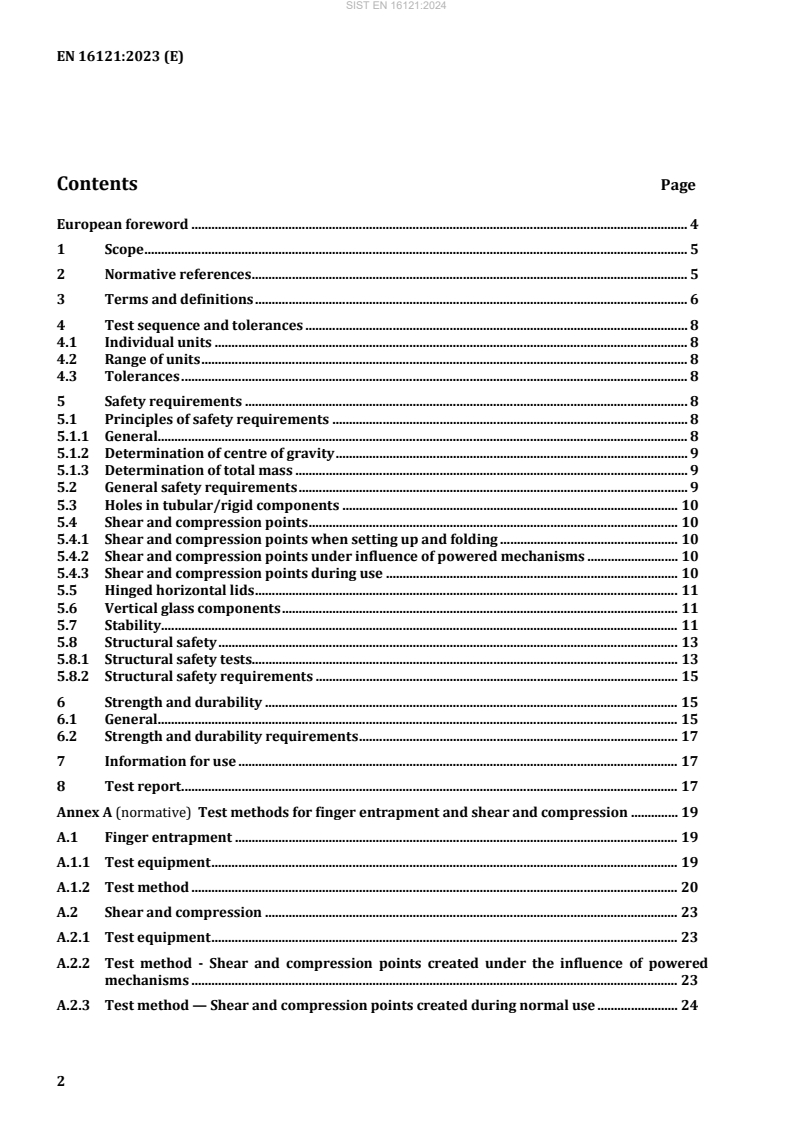
Contents Page
European foreword . 4
1 Scope . 5
2 Normative references . 5
3 Terms and definitions . 6
4 Test sequence and tolerances . 8
4.1 Individual units . 8
4.2 Range of units . 8
4.3 Tolerances . 8
5 Safety requirements . 8
5.1 Principles of safety requirements . 8
5.1.1 General. 8
5.1.2 Determination of centre of gravity . 9
5.1.3 Determination of total mass . 9
5.2 General safety requirements . 9
5.3 Holes in tubular/rigid components . 10
5.4 Shear and compression points . 10
5.4.1 Shear and compression points when setting up and folding . 10
5.4.2 Shear and compression points under influence of powered mechanisms . 10
5.4.3 Shear and compression points during use . 10
5.5 Hinged horizontal lids . 11
5.6 Vertical glass components . 11
5.7 Stability . 11
5.8 Structural safety . 13
5.8.1 Structural safety tests. 13
5.8.2 Structural safety requirements . 15
6 Strength and durability . 15
6.1 General. 15
6.2 Strength and durability requirements . 17
7 Information for use . 17
8 Test report . 17
Annex A (normative) Test methods for finger entrapment and shear and compression . 19
A.1 Finger entrapment . 19
A.1.1 Test equipment . 19
A.1.2 Test method . 20
A.2 Shear and compression . 23
A.2.1 Test equipment . 23
A.2.2 Test method - Shear and compression points created under the influence of powered
mechanisms . 23
A.2.3 Test method — Shear and compression points created during normal use . 24
Annex B (normative) Requirements for primary schools, kindergartens and similar applications
........................................................................................................................................................................... 25
B.1 General . 25
B.2 Requirements . 25
B.2.1 Shear and compression points . 25
B.2.2 Principles of safety requirements . 25
B.2.3 General safety requirements . 25
B.2.4 Glass . 25
B.2.5 Stability . 25
B.2.6 Strength and durability – drop test for trays . 25
B.3 Additional requirements for furniture for kindergartens . 26
B.3.1 Finger entrapment . 26
B.3.2 Shear and compression points under the influence of powered mechanisms . 26
B.3.3 Shear and compression points during use . 26
Annex C (normative) Selecting product from a range of furniture - Range of units . 27
Annex D (informative) Guidance of test severity in relation to application for non-domestic storage
furniture. 28
Annex E (informative) Suggested loads for tests not specified in this document . 29
E.1 Suggested loads . 29
E.1.1 General . 29
E.1.2 Stability . 29
E.1.3 Strength and durability . 29
European foreword
This document (EN 16121:2023) has been prepared by Technical Committee CEN/TC 207 “Furniture”,
the secretariat of which is held by UNI.
This European Standard shall be given the status of a national standard, either by publication of an
identical text or by endorsement, at the latest by June 2024, and conflicting national standards shall be
withdrawn at the latest by June 2024.
Attention is drawn to the possibility that some of the elements of this document may be the subject of
patent rights. CEN shall not be held responsible for identifying any or all such patent rights.
This document supersedes EN 16121:2013+A1:2017 and EN 14073-2:2004.
In comparison with the previous version EN 16121:2013+A1:2017 of edition EN 16121:2013 and of
edition EN 14073-2:2004, the following technical modifications have been made:
— update on the requirements for finger entrapment reflecting CEN/TR 17202:2018 including an
annex containing test methods;
— normative references have been updated;
— requirements for glass have been improved;
— finger entrapment/shear squeeze requirements have been corrected and made applicable to
kindergarten only;
— office and laboratory storage have been added to the list of applications;
— the fields of application in relation to the test severity were amended;
— test load added in Annex E.
Any feedback and questions on this document should be directed to the users’ national standards body.
A complete listing of these bodies can be found on the CEN website.
According to the CEN-CENELEC Internal Regulations, the national standards organisations of the
following countries are bound to implement this European Standard: Austria, Belgium, Bulgaria, Croatia,
Cyprus, Czech Republic, Denmark, Estonia, Finland, France, Germany, Greece, Hungary, Iceland, Ireland,
Italy, Latvia, Lithuania, Luxembourg, Malta, Netherlands, Norway, Poland, Portugal, Republic of North
Macedonia, Romania, Serbia, Slovakia, Slovenia, Spain, Sweden, Switzerland, Türkiye and the United
Kingdom.
1 Scope
This document specifies requirements for the safety, strength, and durability for all types of non-domestic
storage furniture including office storage furniture.
It does not apply to domestic storage, industrial storage, kitchen, catering equipment, retail storage, and
industrial storage lockers.
Requirements for strength and durability do not apply to the structure of the building for example the
strength of wall hanging cabinets includes only the cabinets and the parts used for attachment. The wall
and the wall attachments are not included.
This document contains five annexes:
— Annex A (normative) Test methods for finger entrapment and shear and compression;
— Annex B (normative) Requirements for schools, kindergartens and similar applications;
— Annex C (normative) Selecting product from a range of furniture;
— Annex D (informative) Guidance of test severity in relation to application for non-domestic storage
furniture;
— Annex E (informative) Suggested loads for tests not specified in this document.
It does not include requirements for the resistance to ageing, degradation and flammability.
2 Normative references
The following documents are referred to in the text in such a way that some or all of their content
constitutes requirements of this document. For dated references, only the edition cited applies. For
undated references, the latest edition of the referenced document (including any amendments) applies.
EN 71-1:2014+A1:2018, Safety of toys — Part 1: Mechanical and physical properties
EN 716-2:2017, Furniture — Children's cots and folding cots for domestic use — Part 2: Test methods
EN 12150-1:2015+A1:2019, Glass in building — Thermally toughened soda lime silicate safety glass — Part
1: Definition and description
EN 12600, Glass in building — Pendulum test — Impact test method and classification for flat glass
EN 14072:2003, Glass in furniture — Test methods
EN 16122:2012, Domestic and non-domestic storage furniture — Test methods for the determination of
strength, durability and stability
3 Terms and definitions
For the purposes of this document, the following terms and definitions apply.
ISO and IEC maintain terminology databases for use in standardization at the following addresses:
— ISO Online browsing platform: available at https://www.iso.org/obp/
— IEC Electropedia: available at https://www.electropedia.org/:
3.1
accessible parts
parts to which access can easily be gained by the user when in its intended configuration of use and for
which the probability of unintentional user contact is high, including any parts that are less than
1 000 mm above any surface on which a child could stand, but with the exception of doors, flaps and
extension elements including their hardware
Note 1 to entry: This includes, but is not limited to:
— the exposed edges and corners of storage units to which the user has access when the doors, drawers
and extension elements are closed,
— the corners and edges of handles.
3.2
parts accessible during setting up and folding
parts to which access can only be gained when setting up and folding the furniture
3.3
unit
complete item of furniture including the structure and all components such as drawers, doors and other
storage features
3.4
clear height
unobstructed height above the top of the bottom surface
EXAMPLE The top of the extension element bottom and the lower edge of the extension element above, or the
structure of the unit (see Figure 1).
Key
1 structure of the unit
2 clear height H
3 extension element
Figure 1 — Clear height
3.5
levelling device
adjustable device intended to keep the item of furniture perpendicular to the floor
EXAMPLE Adjustable feet or similar.
3.6
tray
storage element that is designed, under normal use, to be removed from the storage unit and used
independently
3.7
potential energy
measured in Nm and calculated by multiplication of the total mass (kg) of the unit (or the part), gravity
(m/s ) and the height (m) above the floor to the centre of gravity
Note 1 to entry: For the purpose of this document gravity can be considered to be 10 m/s .
4 Test sequence and tolerances
4.1 Individual units
When a single unit is supplied for test all the safety tests (5) shall be carried out on the same sample and
in the order in which they are listed in this document. Tests for strength and durability (6) may be carried
out on a second sample.
4.2 Range of units
For a range of units featuring similar construction and sharing hardware, or single units with features
utilizing identical hardware and fixings (e.g. a unit with different size drawers), selected tests shall be
carried out on the worst case units/components as detailed in Annex C.
The tests shall be carried out in the order in which they are listed in this document.
If one unit or component within a range of products does not satisfy the requirements of this document
then compliance for the full range cannot be claimed.
4.3 Tolerances
Unless otherwise stated, the following tolerances are applicable:
Forces: ± 5 % of the nominal force;
NOTE 1 Forces can be replaced by masses. The relationship 10N = 1 kg can be used.
Velocities: ± 5 % of the nominal velocity;
Masses: ± 1 % of the nominal mass;
Dimensions: all dimensions less than 300 mm shall have a tolerance of ± 1 mm of the nominal dimension;
all other dimensions shall have a tolerance of ± 0,5 % of the nominal dimension;
Angles: ± 2° of the nominal angle.
NOTE 2 For the purposes of uncertainty measurement, test results are not considered to be adversely affected
when the above tolerances are met.
5 Safety requirements
5.1 Principles of safety requirements
5.1.1 General
Safety requirements are based upon the knowledge that storage furniture and its parts are likely to cause
injury only when they are heavy and fall through a significant distance. This is possible if floor standing
units overbalance, wall or screen mounted units become detached, or heavy parts become detached from
units.
Therefore, the tests contained in Table 4 are only considered to affect safety when:
— the height of the centre of gravity of the unit, or any part, is > 650 mm above the floor and the total
mass is > 10 kg,
or
— when the potential energy (3.7) of the unit, or any part, is > 65 Nm and the height of the centre of
gravity of the unit, or any part, is ≤ 650 mm.
5.1.2 Determination of centre of gravity
The centre of gravity of a component or unit shall be taken as the geometric centre of that
component / unit, except in the case of extension elements, where the geometric centre of the usable
volume shall be used.
The height of the centre of gravity above the floor shall be measured for storage furniture or their
components when installed according to the manufacturer’s instructions. Levelling devices shall be set
at their middle position.
Height adjustable components shall be placed in their highest position.
All wall or top hanging units, or components thereof, are considered to have their centre of gravity more
than 650 mm above the floor.
NOTE If the extension element or tray does not have an identifiable handle, the force is applied to the upper
part of the front of this component.
5.1.3 Determination of total mass
The total mass is the mass of the component or unit plus the mass supported by it.
Unless the component is conspicuously and durably marked by the manufacturer with a maximum load,
the mass of the contents shall be determined according to Table 1, which specifies mass per unit area for
shelves and the mass per unit volume for extension elements, baskets and trays etc.
The volume of fixed baskets and trays shall be taken as the volume contained below their top edge.
The volume of extension elements shall be taken as the area of its bottom multiplied by the clear height
(3.4).
Table 1 — Load to determine total mass and load applied to all components other than those
undergoing test, excluding stability tests
Part Unit Load
1 - General 2 - Severe
Horizontal surfaces, tops, shelves, door baskets 2 1,5 1,5
kg/dm
etc.
Extension elements, trays and baskets 3 0,2 0,5
kg/dm
Suspended pocket files a 4 4
kg/dm
Clothes rails kg/dm 4 4
a
Measured perpendicular to the plane of the pocket files.
5.2 General safety requirements
The storage units shall be so designed as to minimize the risk of injury to the user.
All parts of the storage unit with which the user comes into contact, during intended use, shall be so
designed that physical injury and damage are avoided. This requirement is met when:
1. the accessible parts are rounded or chamfered, and all other edges accessible during intended use
are free from burrs and sharp edges;
2. feet of tubular components shall be capped or otherwise closed.
Movable and adjustable parts shall be designed so that injuries and inadvertent operation are avoided.
It shall not be possible for any load bearing part of the storage unit to come loose unintentionally.
All parts which are lubricated to assist sliding shall be designed to protect users from lubricant stains
when in normal use.
If it can cause injury, all roll fronts and doors sliding vertically including those constructed from hinged
elements shall not move by themselves from any position higher than 200 mm measured from the closed
position.
In order to avoid pinching points for feet, the safe height for vertically moving units shall be at least
100 mm from the floor.
Subject to the conditions contained within the general safety principles (5.1.1), all extension elements
and trays shall not become detached from the unit when subjected to one horizontal pull force of 200 N
applied to the handle of the loaded extension element/tray. The extension element/tray shall be loaded
in accordance with Table 1, unless the component is conspicuously and durably marked by the
manufacturer with a maximum load. In this case the component shall be loaded with the stated maximum
load.
5.3 Holes in tubular/rigid components
There shall be no holes in the ends of tubular components or holes in rigid components in accessible parts
between 8 mm and 18 mm, unless the depth of penetration is less than 10 mm. This requirement is
fulfilled if there is no hazard present when tested in accordance with A.1.
5.4 Shear and compression points
5.4.1 Shear and compression points when setting up and folding
Unless 5.4.2 or 5.4.3 are applicable, shear and compression points that are created only during setting up
and folding are acceptable, because the user can be assumed to be in control of his/her movements and
to be able to cease applying the force immediately upon experiencing pain.
The edges of parts moving relative to each other and creating shear and compression points shall be as
specified in 5.2.
The shear and compression points for furniture intended for use in primary schools and kindergartens
are contained in Annex B.
5.4.2 Shear and compression points under influence of powered mechanisms
With the exception of operation of doors, flaps and extension elements, there shall be no areas where the
distance between two accessible parts moving relative to each other can be less than 25 mm, and more
than 8 mm in any position during movement that could present a risk of injury to the user, created by
parts of the furniture operated by powered mechanisms, e.g. electrical motors, mechanical springs and
gas lifts.
This requirement is fulfilled if there is no hazard present when tested in accordance with A.2.
The shear and compression points for furniture intended for use in primary schools and kindergartens
are contained in Annex B.
5.4.3 Shear and compression points during use
With the exception of operation of doors, flaps and extension elements including their hardware, there
shall be no areas where the distance between two accessible parts moving relative to each other can be
less than 18 mm, and more than 8 mm in any position that could present a risk of injury to the user,
created by loads applied during normal use.
The loads defined within Table 2 are considered representative of normal use.
This requirement is fulfilled if there is no hazard present when tested in accordance with A.2.
The shear and compression points for furniture intended for use in primary schools and kindergartens
are contained in Annex B.
5.5 Hinged horizontal lids
Horizontal lids that are 1 000 mm or less from the floor and weigh 0,25 kg or more, that are hinged, shall
be provided with lid-support mechanisms to prevent sudden collapse or dropping of the lid. The lid-
support mechanism shall support the lid so that at no position in the arc of travel of the lid from within
50 mm of the fully closed position through an arc not to exceed 60° from the fully closed position shall it
drop more than 12 mm under the influence of its own mass, except in the last 50 mm of travel. The test
shall be carried out in accordance with EN 71-1:2014+A1:2018, 8.31.2.
The lid-support mechanism shall confirm to this requirement before and after being tested to the
durability of flaps test, as described in Table 5.
5.6
...