

EN 13172:2024
(Main)Thermal insulation products - Common evaluation rules
- Abstract
This document specifies common evaluation rules useful for the assessment and verification of constancy of performance of a thermal insulation product with harmonised technical specifications, product standards and any other assessment documents. Harmonised technical specifications, product standards and other assessment documents are called European product specifications in this document.
This document applies to factory made products for buildings, factory made products for building equipment and industrial installations, in situ products for buildings, in situ products for building equipment and industrial installations, to products for civil engineering applications, and to external thermal insulation composite kits.
- Status
- Published
- Publication Date
- 29-Oct-2024
- Technical Committee
- CEN/TC 88 - Thermal insulating materials and products
- Drafting Committee
- CEN/TC 88/WG 16 - Factory production control
- Current Stage
- 6060 - Definitive text made available (DAV) - Publishing
- Start Date
- 30-Oct-2024
- Due Date
- 09-Nov-2023
- Completion Date
- 30-Oct-2024

Overview
EN 13172:2024 - “Thermal insulation products - Common evaluation rules” (CEN) defines common rules for the assessment and verification of constancy of performance (AVCP) for thermal insulation products referenced by harmonised technical specifications and other European product specifications. The standard covers factory-made and in situ products for buildings, building equipment and industrial installations, civil engineering applications, and external thermal insulation composite kits (ETICS). It supports consistent application of factory production control (FPC), assessment of performance (AoP) and verification of constancy of performance (VoCP) across stakeholders.
Key Topics
- Scope and terminology: Aligns terms with the Construction Products Regulation (EU No 305/2011) and defines key abbreviations (AoP, VoCP, AVCP, FPC).
- Assessment and verification framework: Procedures for AoP and VoCP including responsibilities, documentation and inspection regimes.
- Factory production control (FPC): Requirements for organization, documentation, inspection and testing, test equipment, traceability, handling, storage and marking of products.
- Production process classification: Distinguishes continuous production lines from discontinuous/batch production units and rules for grouping products into product families.
- Testing and sampling: Guidance for product testing, sampling and record-keeping to verify declared characteristics (thermal resistance, thermal conductivity, etc.).
- Non-conformity and complaints: Criteria and procedures for managing complaints and assessing non-conformity.
- Informative annexes:
- Annex A - voluntary certification guidance (not for CE marking).
- Annex B - guidance for AVCP tasks, notified bodies and surveillance activities.
- Annex C - complaint handling and non-conformity criteria.
Applications and Who Uses It
EN 13172:2024 is intended for:
- Manufacturers of thermal insulation products (factory-made and in situ) to establish and document FPC and demonstrate constancy of performance.
- Notified bodies and certification/inspection bodies executing AVCP tasks, initial inspections, sampling, testing and ongoing surveillance.
- Testing laboratories performing AoP-related measurements and supporting compliance evidence.
- Specification writers, architects, contractors and regulators who rely on harmonised product specifications and CE-marked insulation products. Practical uses include preparing technical documentation for CE marking, designing production quality systems, conducting routine product testing, and resolving product complaints.
Related Standards
This document references and is intended to be used alongside harmonised product standards and normative test standards such as:
- EN 12664, EN 12667 and EN 12939 (thermal resistance/thermal conductivity test methods). Use EN 13172:2024 as the common evaluation rules framework when implementing or interpreting these product and test standards for thermal insulation compliance and CE marking.
Relations
- Effective Date
- 19-Jan-2023
- Effective Date
- 28-Jan-2026
- Effective Date
- 28-Jan-2026
- Effective Date
- 28-Jan-2026
- Effective Date
- 28-Jan-2026
- Effective Date
- 28-Jan-2026
- Effective Date
- 28-Jan-2026
- Effective Date
- 28-Jan-2026
- Effective Date
- 28-Jan-2026
- Effective Date
- 28-Jan-2026
- Effective Date
- 28-Jan-2026
- Effective Date
- 28-Jan-2026
- Effective Date
- 28-Jan-2026
- Effective Date
- 28-Jan-2026
- Effective Date
- 28-Jan-2026
Get Certified
Connect with accredited certification bodies for this standard

DIBt (Deutsches Institut für Bautechnik)
German Institute for Building Technology.
DIN CERTCO
DIN Group product certification.

Aboma Certification B.V.
Specialized in construction, metal, and transport sectors.
Sponsored listings
Frequently Asked Questions
EN 13172:2024 is a standard published by the European Committee for Standardization (CEN). Its full title is "Thermal insulation products - Common evaluation rules". This standard covers: This document specifies common evaluation rules useful for the assessment and verification of constancy of performance of a thermal insulation product with harmonised technical specifications, product standards and any other assessment documents. Harmonised technical specifications, product standards and other assessment documents are called European product specifications in this document. This document applies to factory made products for buildings, factory made products for building equipment and industrial installations, in situ products for buildings, in situ products for building equipment and industrial installations, to products for civil engineering applications, and to external thermal insulation composite kits.
This document specifies common evaluation rules useful for the assessment and verification of constancy of performance of a thermal insulation product with harmonised technical specifications, product standards and any other assessment documents. Harmonised technical specifications, product standards and other assessment documents are called European product specifications in this document. This document applies to factory made products for buildings, factory made products for building equipment and industrial installations, in situ products for buildings, in situ products for building equipment and industrial installations, to products for civil engineering applications, and to external thermal insulation composite kits.
EN 13172:2024 is classified under the following ICS (International Classification for Standards) categories: 91.100.60 - Thermal and sound insulating materials. The ICS classification helps identify the subject area and facilitates finding related standards.
EN 13172:2024 has the following relationships with other standards: It is inter standard links to EN 13172:2012, EN 12664:2001, EN 12667:2001, EN 12939:2000, EN 14304:2009, EN 16783:2017, EN 14306:2015, EN 14307:2009+A1:2013, EN 14303:2009+A1:2013, EN 15600-1:2010, EN 16809-1:2019, EN 14313:2009, EN 14306:2009, EN 14064-1:2018, EN 13499:2003. Understanding these relationships helps ensure you are using the most current and applicable version of the standard.
EN 13172:2024 is available in PDF format for immediate download after purchase. The document can be added to your cart and obtained through the secure checkout process. Digital delivery ensures instant access to the complete standard document.
Standards Content (Sample)
SLOVENSKI STANDARD
01-januar-2025
Nadomešča:
SIST EN 13172:2012
Toplotnoizolacijski proizvodi - Skupna pravila vrednotenja
Thermal insulation products - Common evaluation rules
Wärmedämmstoffe - Gemeinsame Bewertungsregeln
Produits isolants thermiques - Règles d’évaluation communes
Ta slovenski standard je istoveten z: EN 13172:2024
ICS:
91.100.60 Materiali za toplotno in Thermal and sound insulating
zvočno izolacijo materials
2003-01.Slovenski inštitut za standardizacijo. Razmnoževanje celote ali delov tega standarda ni dovoljeno.
EN 13172
EUROPEAN STANDARD
NORME EUROPÉENNE
October 2024
EUROPÄISCHE NORM
ICS 91.100.60 Supersedes EN 13172:2012
English Version
Thermal insulation products - Common evaluation rules
Produits isolants thermiques - Règles d'évaluation Wärmedämmstoffe - Gemeinsame Bewertungsregeln
communes
This European Standard was approved by CEN on 1 August 2024.
CEN members are bound to comply with the CEN/CENELEC Internal Regulations which stipulate the conditions for giving this
European Standard the status of a national standard without any alteration. Up-to-date lists and bibliographical references
concerning such national standards may be obtained on application to the CEN-CENELEC Management Centre or to any CEN
member.
This European Standard exists in three official versions (English, French, German). A version in any other language made by
translation under the responsibility of a CEN member into its own language and notified to the CEN-CENELEC Management
Centre has the same status as the official versions.
CEN members are the national standards bodies of Austria, Belgium, Bulgaria, Croatia, Cyprus, Czech Republic, Denmark, Estonia,
Finland, France, Germany, Greece, Hungary, Iceland, Ireland, Italy, Latvia, Lithuania, Luxembourg, Malta, Netherlands, Norway,
Poland, Portugal, Republic of North Macedonia, Romania, Serbia, Slovakia, Slovenia, Spain, Sweden, Switzerland, Türkiye and
United Kingdom.
EUROPEAN COMMITTEE FOR STANDARDIZATION
COMITÉ EUROPÉEN DE NORMALISATION
EUROPÄISCHES KOMITEE FÜR NORMUNG
CEN-CENELEC Management Centre: Rue de la Science 23, B-1040 Brussels
© 2024 CEN All rights of exploitation in any form and by any means reserved Ref. No. EN 13172:2024 E
worldwide for CEN national Members.
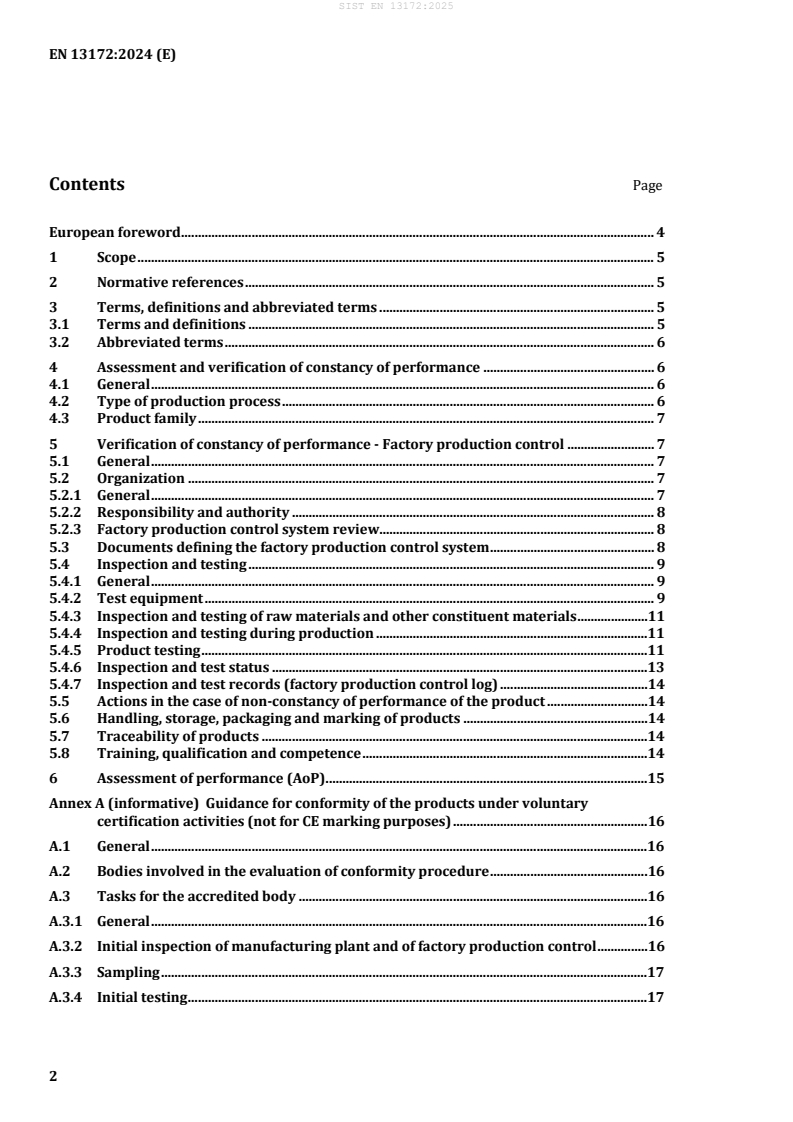
Contents Page
European foreword . 4
1 Scope . 5
2 Normative references . 5
3 Terms, definitions and abbreviated terms . 5
3.1 Terms and definitions . 5
3.2 Abbreviated terms . 6
4 Assessment and verification of constancy of performance . 6
4.1 General . 6
4.2 Type of production process . 6
4.3 Product family . 7
5 Verification of constancy of performance - Factory production control . 7
5.1 General . 7
5.2 Organization . 7
5.2.1 General . 7
5.2.2 Responsibility and authority . 8
5.2.3 Factory production control system review . 8
5.3 Documents defining the factory production control system . 8
5.4 Inspection and testing . 9
5.4.1 General . 9
5.4.2 Test equipment . 9
5.4.3 Inspection and testing of raw materials and other constituent materials .11
5.4.4 Inspection and testing during production .11
5.4.5 Product testing .11
5.4.6 Inspection and test status .13
5.4.7 Inspection and test records (factory production control log) .14
5.5 Actions in the case of non-constancy of performance of the product .14
5.6 Handling, storage, packaging and marking of products .14
5.7 Traceability of products .14
5.8 Training, qualification and competence .14
6 Assessment of performance (AoP) .15
Annex A (informative) Guidance for conformity of the products under voluntary
certification activities (not for CE marking purposes) .16
A.1 General .16
A.2 Bodies involved in the evaluation of conformity procedure .16
A.3 Tasks for the accredited body .16
A.3.1 General .16
A.3.2 Initial inspection of manufacturing plant and of factory production control .16
A.3.3 Sampling .17
A.3.4 Initial testing .17
A.3.5 Continuing surveillance . 18
A.4 Conformity mark . 22
A.4.1 General . 22
A.4.2 Issuance of certificate of conformity . 23
A.4.3 Restriction, suspension or withdrawal of certificate . 23
Annex B (informative) Guidance for common evaluation of products under AVCP system . 24
B.1 General . 24
B.2 Bodies involved in the assessment and verification of constancy of performance
(AVCP) . 24
B.3 Tasks for the notified body . 24
B.3.1 General . 24
B.3.2 Initial inspection of manufacturing plant and of factory production control . 25
B.3.3 Sampling . 25
B.3.4 Assessment of performance . 25
B.3.5 Continuing surveillance, assessment and evaluation of the factory production
control . 26
B.4 Certificate of constancy of performance . 28
B.4.1 Issuance of certificate of constancy of performance . 28
B.4.2 Restriction, suspension or withdrawal of the certificate of constancy of performance
................................................................................................................................................................... 28
Annex C (informative) Criteria for assessing non-conformity – Procedures in case of a
complaint . 29
C.1 Complaint on the product declaration . 29
C.1.1 General . 29
C.1.2 Complaint on the declared thermal resistance or thermal conductivity . 29
C.1.3 Complaint on other characteristics . 30
C.2 Complaint on a lot . 30
Bibliography . 31
European foreword
This document (EN 13172:2024) has been prepared by Technical Committee CEN/TC 88 “Thermal
insulating materials and products”, the secretariat of which is held by DIN.
This European Standard shall be given the status of a national standard, either by publication of an
identical text or by endorsement, at the latest by April 2025, and conflicting national standards shall be
withdrawn at the latest by April 2025.
Attention is drawn to the possibility that some of the elements of this document may be the subject of
patent rights. CEN shall not be held responsible for identifying any or all such patent rights.
This document supersedes EN 13172:2012.
— the adaptation of this document to the terminology used in the European Regulation (EU)
No 305/2011 (i.e. Construction Products Regulation - CPR) with AVCP system;
— the removal of references to third parties, bodies and manufacturers into clauses and annexes that
can be used in conjunction with harmonised technical specifications;
— the addition of products for civil engineering applications in the scope of this document;
— the addition of a subclause for abbreviated terms;
— the split of Clause 4 into three subclauses;
— the updates and technical adjustments of Clause 5;
— the merging of Annexes B, C and D.
This document is intended to be used as a supporting standard in conjunction with harmonised technical
specifications, product standards and any other assessment documents of thermal insulation products to
ensure common evaluation rules for all stakeholders.
This document contains three informative annexes:
— Annex A, Guidance for conformity of the products under voluntary certification activities (not for CE
marking purposes);
— Annex B, Guidance for common evaluation of the products under AVCP system;
— Annex C, Criteria for assessing non-conformity – Procedure in case of a complaint.
Any feedback and questions on this document should be directed to the users’ national standards body.
A complete listing of these bodies can be found on the CEN website.
According to the CEN-CENELEC Internal Regulations, the national standards organisations of the
following countries are bound to implement this European Standard: Austria, Belgium, Bulgaria, Croatia,
Cyprus, Czech Republic, Denmark, Estonia, Finland, France, Germany, Greece, Hungary, Iceland, Ireland,
Italy, Latvia, Lithuania, Luxembourg, Malta, Netherlands, Norway, Poland, Portugal, Republic of North
Macedonia, Romania, Serbia, Slovakia, Slovenia, Spain, Sweden, Switzerland, Türkiye and the United
Kingdom.
1 Scope
This document specifies common evaluation rules useful for the assessment and verification of constancy
of performance of a thermal insulation product with harmonised technical specifications, product
standards and any other assessment documents. Harmonised technical specifications, product standards
and other assessment documents are called European product specifications in this document.
This document applies to factory made products for buildings, factory made products for building
equipment and industrial installations, in situ products for buildings, in situ products for building
equipment and industrial installations, to products for civil engineering applications, and to external
thermal insulation composite kits.
2 Normative references
The following documents are referred to in the text in such a way that some or all of their content
constitutes requirements of this document. For dated references, only the edition cited applies. For
undated references, the latest edition of the referenced document (including any amendments) applies.
EN 12664:2001, Thermal performance of building materials and products — Determination of thermal
resistance by means of guarded hot plate and heat flow meter methods — Dry and moist products of medium
and low thermal resistance
EN 12667:2001, Thermal performance of building materials and products — Determination of thermal
resistance by means of guarded hot plate and heat flow meter methods — Products of high and medium
thermal resistance
EN 12939:2000, Thermal performance of building materials and products — Determination of thermal
resistance by means of guarded hot plate and heat flow meter methods — Thick products of high and
medium thermal resistance
3 Terms, definitions and abbreviated terms
3.1 Terms and definitions
For the purposes of this document, the following terms and definitions apply.
ISO and IEC maintain terminology databases for use in standardization at the following addresses:
— ISO Online browsing platform: available at https://www.iso.org/obp
— IEC Electropedia: available at https://www.electropedia.org/
3.1.1
product
thermal insulation product produced under conditions which are presumed uniform to a given
specification and placed on the market
3.1.2
factory production control
documented, permanent and internal control of production in a factory
3.1.3
production line
assemblage of equipment that produces products using a continuous process
3.1.4
production unit
assemblage of equipment that produces products using a discontinuous process
3.1.5
manufacturing plant
all the production equipment on the same site including all production lines and units
Note 1 to entry: The term factory also refers to the manufacturing plant.
3.1.6
assessment of performance
assessment of the performance of the product carried out on the basis of testing (including sampling),
calculation, tabulated values or descriptive documentation of the product
3.1.7
verification of constancy of performance
factory production control system, procedures, regular inspections and tests and/or assessments
ensuring that the performance in relation to the declared characteristics are maintained
3.2 Abbreviated terms
AoP is the Assessment of performance
VoCP is the Verification of Constancy of Performance
AVCP is Assessment and Verification of Constancy of Performance
FPC is Factory Production Control
4 Assessment and verification of constancy of performance
4.1 General
The assessment and verification of constancy of performance shall include all parts of the tasks given in
Clause 5 of this document.
NOTE 1 Annex A is included for the purposes of voluntary activities.
NOTE 2 Annex C is included for the purposes of describing how the case of a complaint may be handled.
NOTE 3 The Annex ZA of the relevant harmonised standard or the European Assessment Document assigns the
AVCP tasks for CE marking activities.
4.2 Type of production process
Thermal insulation can be commonly manufactured using two types of production processes:
— For continuous production processes, each production line is considered separately in terms of both
AoP and VoCP.
— For discontinuous or batch production processes, production units using the same process in one
manufacturing plant are considered together (as if one production line) in terms of both AoP and
VoCP.
4.3 Product family
Products may be grouped into families for the purposes of assessment (i.e. AoP and VoCP) subject to the
following conditions:
— They shall have the same type of production process and shall be derived from the same family of
raw material; a distinction is made between glass wool and stone wool and between foams with
different blowing agents.
— They shall differ only in aspects that do not influence the characteristics defined in the relevant
European product specification.
— They shall be covered by a single European product specification.
— Products which differ only with regard to some characteristics may be grouped together by their
common characteristics.
— Products which are identical except for the facing and for which the different facings have been
shown to have the same effect on the declared characteristics (e.g. regarding thermal characteristics,
the gas tight facings of some PU products), may be grouped.
Products with a common production specification, originating from the same type of production process
and belonging to the same family of raw material may be grouped for verification of constancy of
performance, although covered by different European product specifications (e.g. for thermal insulation
products intended for buildings, civil engineering applications and for building equipment and industrial
installations).
EXAMPLE Cellular glass in accordance with EN 13167:2012+A1:2015 and EN 14305:2015 or expanded
polystyrene in accordance with EN 13163:2012+A2:2016 and EN 14309:2015.
The characteristics outside these common families shall be tested product by product.
Products which are outside the scope of a European product specification cannot be grouped for
declaration purposes with products declared under the scope of that European product specification.
Provided that a product within the family complies with a European product specification then all
products within the same family shall be deemed to comply with the European product specification for
the characteristics concerned. If the same product fails to comply with the European product specification
then the whole family shall be assumed to have failed to comply with the European product specification.
5 Verification of constancy of performance - Factory production control
5.1 General
Factory production control shall be fulfilled for each manufacturing plant.
5.2 Organization
5.2.1 General
Factory production control shall be operated according to an FPC system that shall be established,
documented, operated and maintained to ensure that the products comply with the declared
performance.
The FPC system shall consist of procedures, regular inspections and tests and/or assessments and the
use of the results to control raw and other incoming materials or components, equipment, the production
process and the product.
5.2.2 Responsibility and authority
The responsibility, authority and the interrelationships between all persons who manage, perform, or
verify work affecting constancy of performance of the product, shall be assigned. This applies particularly
to persons who need the organisational freedom and authority to
a) initiate action to prevent the occurrence of non-constancy of performance of product;
b) identify and record any product deviations from other than declared performances (e.g. aspect,
packaging, …).
5.2.3 Factory production control system review
The factory production control system shall be reviewed at appropriate intervals to ensure its continuing
suitability, adequacy and effectiveness. Records of such reviews shall be maintained.
NOTE FPC system review is usually included as part of the management review.
5.3 Documents defining the factory production control system
Documents defining the factory production control system shall be relevant to the production and
process control used during manufacture of the product. All the elements and provisions shall be
documented in a systematic manner in the form of written policies and procedures.
Documents defining the factory production control system shall provide the following details:
a) the factory production control system aims and the organizational structure, responsibilities and
authority with regard to constancy of performance of product;
b) the procedures for specifying and verifying the raw materials and other constituent materials;
c) the production control and other techniques, processes and systematic actions that will be used;
d) the inspections and tests to be carried out before, during and after manufacture, together with their
frequency (see 5.4) and possible retest procedures (see 5.5);
e) the procedures for handling, storage, packaging, marking and labelling the product (see 5.6);
f) the procedures for affixing traceability product codes and/or markings (see 5.7);
g) the procedures for all persons to receive training in the activities affecting the constancy of
performance of the product (see 5.8).
NOTE Documents defining FPC system can be in any format and media and from any source.
Documents defining the factory production control system shall be drawn up and kept up-to-date.
5.4 Inspection and testing
5.4.1 General
All necessary facilities, equipment and persons shall be available to carry out the inspections and tests.
Inspections and tests shall be performed according to the FPC system. In case of subcontracting, these
provisions shall apply too.
Inspection and testing shall be performed by persons qualified for such tasks on the basis of documented
appropriate education, training, skills or experience.
Equipment shall be used in a manner that ensures that any measurement uncertainty is not greater than
the necessary measurement capability.
5.4.2 Test equipment
5.4.2.1 General
Tests to demonstrate constancy of performance of the finished product shall be performed using
equipment in accordance with the test methods referred to in the European product specification.
The on-going suitability of the test equipment shall be ensured.
The test equipment (including software) shall be capable of achieving the accuracy specified by the test
methods referred to in the European product specification.
5.4.2.2 Calibration
The accuracy of the test equipment shall be ensured by periodic calibration. All calibrations and
calibration checks shall be traceable to relevant internationally or, failing that, nationally recognized
reference test specimens (standards). Where no such reference test specimens exist, the basis used for
calibration shall be documented.
NOTE Calibration is the right term for the first time “calibration” and if a calibration check leads to adjustment
of the equipment. The calibration check, that is performed e.g. annually for heat flow meter (HFM) equipment (see
Table 1), is the right term to use without adjustment of the equipment. To simplify the text here the term
“calibration” is used both for calibration and calibration check.
Compliance criteria for each piece of equipment shall be defined.
The equipment shall be calibrated or verified
— before being placed into service;
— periodically respecting the minimum frequencies specified in Table 1;
— after any repair or adjustment (see 5.4.2.4);
— to verify the test results obtained before being taken out of service. If internal checks are sufficient
(e.g. for heat flow meter (HFM) equipment) then this calibration is not needed.
Equipment not listed in Table 1 shall be calibrated in accordance with the documented procedures.
The calibration results shall be assessed and the results of such assessments shall be documented. The
calibration records shall be maintained for a period of 10 years.
5.4.2.3 Internal checks of equipment
In addition to the traceable calibration, internal checks to verify the stability of the equipment shall be
carried out. Compliance criteria for results of internal checks shall be defined. Internal checks shall be
carried out at frequencies respecting the minimum frequencies given in Table 1.
Equipment not listed in Table 1 shall be checked in accordance with the documented procedures. Records
of internal checks shall be maintained for a period of 10 years.
Table 1 — Minimum frequencies of internal checks and calibrations of test equipment
Characteristics Internal checks Calibration of test equipment
a, c
Thickness
Once per month
a, c
Mass
Once per month
Prior to first use of equipment, and
Mechanical characteristics -
annual calibration checks
b
Thermal characteristics :
thereafter
c
Once per two weeks
- heat flow meter
c
- guarded hot plate Once per year
a
A lower frequency of once every 3 months may be used when stability has been verified for
a period of at least one year. If any single measurement indicates significant variation, the
frequency reverts to once a month.
b
For thermal characteristics a part of the calibration shall be to compare test results
obtained by the equipment used for the FPC with those obtained by an accredited
laboratory under EN 12664:2001, EN 12667:2001 or EN 12939:2000 on the same sample,
typically once a year. Test specimens to be used for the calibration and the annual
calibration checks shall be traceably calibrated to the reference materials IRMM 440 or
ERM-FC440 defining the European thermal conductivity level. The reference materials
IRMM 440 or ERM-FC440 can be directly used for the calibration and the annual calibration
checks. Test specimens provided by a reference material producer accredited under
EN ISO 17034:2016 can be used for the calibration and the annual calibration checks.
c
For internal checks, test specimens can be used to verify the stability of the performance of
the equipment provided that the stability of the specimens is ensured.
5.4.2.4 Defective equipment
Equipment that has been subjected to abuse or mishandling, which gives suspect results or has been
shown to be defective or outside specified limits, shall be taken out of service immediately and marked
as defective.
It shall be examined whether or not defective equipment gives cause for concern regarding the constancy
of performance of the products tested using the defective equipment. This examination shall be
documented.
In case of any doubt regarding constancy of the performance of products, 5.5 applies.
After any repair, calibration shall be repeated before the equipment is placed into use.
5.4.3 Inspection and testing of raw materials and other constituent materials
The compliance of raw materials and other constituent materials shall be ensured in accordance with the
procedures specified in the FPC system. In determining the checks, necessary consideration shall be given
to the control exercised and the documented evidence of compliance supplied with raw materials and
other constituent materials.
The incoming raw materials and other constituent materials shall be used or processed only after they
have been verified as complying with the defined specifications. Where incoming material is released for
urgent production purposes prior to verification it shall be identified and recorded in order to permit
immediate recall in the event of non-compliance.
5.4.4 Inspection and testing during production
In order to manufacture products which meet the declared performances, production process shall be
controlled and inspection and tests shall be performed as described in the FPC procedures.
All equipment used in the production process shall be regularly inspected and maintained to ensure use,
wear or failure does not cause inconsistency in the production process.
5.4.5 Product testing
5.4.5.1 General
Assessment of performance of the product carried out in accordance with Clause 6 shall be ensured prior
to placing a product on the market.
The finished products shall be tested in accordance with the relevant European product specification,
using direct and/or indirect testing, in accordance with 5.4.5.3. One test is considered as the test(s) on
one sample of the product using one or more test specimens as specified in the relevant testing standard
or European product specification.
The samples shall be drawn periodically from each production line/unit according to the test plan. The
minimum testing frequencies for the relevant characteristics for regular production conditions are
specified in the relevant European product specification. For characteristics automatically recorded
during the manufacturing process at a higher frequency than given in the relevant European product
specification, the testing frequency may be lowered.
5.4.5.2 Direct testing
Direct testing shall be applied according to the test regime specified in the relevant European product
specification.
Reduced testing frequencies for direct testing may be used for well-established production lines/units
for characteristics other than reaction to fire and thermal resistance/conductivity:
— In the case of a given characteristic where a well-controlled production process can be demonstrated,
the testing frequency may be reduced as described below following the relevant statistical rule.
— The frequency for direct testing cannot be reduced to less than 10 % of the minimum frequency given
in the relevant European product specification. In no case shall that frequency be less than once a
year.
— The risk of failure in a test shall not exceed 1,0 %. For dimensional tolerances the confidence level
shall be at least 99 %, for other characteristics the confidence level shall be at least 50 %.
Three situations arise:
I) for characteristics with declared classes – tolerance interval, T (one-sided interval for dimensional
characteristics where only a plus or a minus tolerance interval is declared and two-sided interval for e.g.
dimensional characteristics where a plus-minus tolerance interval is declared).
If the Gaussian distribution can be assumed for the test results, then Formula (1) applies.
2 2
T ≥ (k ∙ s) (1)
99/99
where
T is the tolerance interval for the test results obtained over a period not exceeding 3 years;
s is the estimate of the standard deviation of the test results obtained over a period not
exceeding 3 years;
k is a factor corresponding to the number of test results, n, available over a period not
exceeding 3 years at the reduced testing frequency.
Table 2 gives the k factors corresponding to a 99 % tolerance interval with a confidence level of 99 %
(99/99).
II) for characteristics with limit values – one-sided tolerance interval.
If the Gaussian distribution can be assumed for the test results, the Formula (2) or (3) applies.
xx−≥ k ⋅ s for minimum values (2)
D 90/50
x −≥xk ⋅ s for maximum values (3)
D 90/50
where
x
is the mean of the measured values;
x is the declared value;
D
s is the estimate of the standard deviation of the test results obtained over a period not
exceeding 3 years;
k is a factor corresponding to the number of test results, n, available over a period not
exceeding 3 years at the reduced testing frequency.
Table 2 gives the k factors corresponding to a 99 % tolerance interval with a confidence level of 50 %
(99/50).
Table 2 — k factors for estimated standard deviations
k factors
k99,99 k99,50
Number of test results n
a b c
One-sided interval Two-sided interval One-sided interval
10 5,074 5,610 2,411
20 3,832 4,175 2,366
50 3,125 3,390 2,342
100 2,850 3,098 2,334
200 2,679 2,922 2,330
NOTE 1 For other numbers of test results, see ISO 16269-6:2014, Statistical interpretation of data — Part 6:
Determination of statistical tolerance intervals and ISO 12491:1997, Statistical methods for quality control of
building materials and components.
NOTE 2 Linear interpolation is acceptable.
a
Applicable for a plus or a minus-tolerance.
b
Applicable for plus-minus-tolerances.
c
Applicable for limit values.
III) For characteristics where test results are expressed in terms of pass/fail, a binominal distribution
can be assumed. To lower the frequency, it is needed that the test shall be performed on at least 100
different samples, from different production days and 99 % shall pass.
Satisfaction of the conditions for reduced testing frequencies (I, II or III) shall be verified in the event of
failure and at least once a year.
5.4.5.3 Indirect testing
Indirect testing is a means by which a given characteristic may be assessed through tests on one or more
other characteristics, with which a correlation has been established. Indirect testing may also be used to
reduce the testing frequency of direct testing.
The correlation shall be established by suitable statistical means, e.g. regression analysis on the basis of
adequate preliminary tests for each production line/unit. It shall be re-examined at prescribed intervals
and after changes or modifications if these are likely to affect the correlation.
For each indirect testing procedure applied at the place of production the sampling plan and the
compliance criteria, for the indirect characteristic, shall be specified taking into account the relevant
correlation between the corresponding characteristics.
The use of indirect testing shall result in at least the same confidence level on the characteristic concerned
as when using the direct testing.
In case of dispute, the test method specified for the relevant characteristic in the European product
specification shall be used.
5.4.6 Inspection and test status
The constancy or non-constancy of performance of a product shall be determined by tests and inspection
which records passed, failed or due to be reclassified.
5.4.7 Inspection and test records (factory production control log)
The results of finished products inspection and testing shall be recorded in the factory production control
log. The log shall contain a record of the product identification, the date and time of manufacture and for
each characteristic the test methods, the test results, the expected level or class or the declared
performance, the inspection result and the identification of the person carrying out the inspection.
Where products do not comply with the declared performance or specification defined by the FPC system,
a note shall be made in the factory production control log of the remedial measures taken.
The factory production control log shall be kept for at least 10 years after placing the product on the
market.
5.5 Actions in the case of non-constancy of performance of the product
If the result of a test or the inspection of a product is a failure, the steps necessary to rectify the deficiency
shall be immediately taken. Products, which do not comply with the declared performance, shall be
marked accordingly. When the deficiency has been identified and rectified, the test or inspection in
question shall be repeated without delay according to the FPC procedures, to provide evidence that the
defects have been overcome.
In the event that products are dispatched before the result of the inspection is available prompt
notification shall be given to prevent any consequential damage and a record maintained of such
notification.
Products, which have not met the performance intended to be declared for a given characteristic shall be
permitted to qualify for a less stringent performance of that characteristic and shall be labelled
accordingly.
5.6 Handling, storage, packaging and marking of products
In accordance with the documents defining the FPC system (see 5.3):
a) methods of handling that prevent damage or deterioration shall be provided;
b) suitable storage areas or stock rooms to prevent damage or deterioration of the product shall be
provided;
c) the packaging, storage and the marking processes shall be controlled.
The provision of dematerialised information with the product, its packaging or its label, readable by an
electronic media (e.g. QR code) shall reflect the product placed on the market.
5.7 Traceability of products
Individual products or product batches or packages shall be identifiable and traceable back to the origin
of their production.
Written procedures ensuring that processes related to affixing traceability codes and/or markings are
inspected regularly shall be maintained.
5.8 Training, qualification and competence
Procedures for the identification of the training needs shall be established and maintained. The training
of all persons performing tasks affecting the assessment and verification of constancy of performance of
the product shall be provided.
Persons performing specific assigned tasks shall be qualified and competent on the basis of appropriate
education, training, skills or experience.
Records of training shall be kept up to date.
6 Assessment of performance (AoP)
Prior to placing a product on the market, AoP shall be carried out in order to ensure the determination of
the product performance.
Assessment previously performed in accordance with the provisions of European product specifications,
may be considered, provided that this assessment was performed to the same or a more rigorous
assessment method, under the same AVCP system on the same product or products of similar design,
construction and functionality, such that the results are applicable to the product in question.
Where kit components are used whose performance in relation to their characteristics has already been
determined on the basis of assessment methods of other harmonised technical specifications and those
components bear CE marking in accordance with those harmonised technical specifications, these
performances do not need to be re-assessed, if the intended use and the assessment methods of this
standard correspond to previously used, otherwise extra assessment shall be necessary. The
specifications of these components shall be documented.
AoP of relevant characteristics shall be repeated on changes or modifications if these are likely to affect
the declared performance of the products.
Tests shall be carried out in accordance with the European product specification, by direct testing. One
test is considered as the test of one sample of the product consisting of one or more test specimens as
specified in the relevant testing standard or European product specification.
For CE marking purposes, the AoP is specified in Annexes ZA of harmonised standards or tasks included
in European Assessment Documents.
Annex A
(informative)
Guidance for conformity of the products under voluntary certification
activities (not for CE marking purposes)
A.1 General
This annex supports the European product specifications for thermal insulation products as part of the
voluntary activities for conformity of the products.
A.2 Bodies involved in the evaluation of conformity procedure
The following external bodies may be involved in the evaluation of conformity of products with this
document:
a) product certification body: an accredited body which provides conformity certification;
b) inspection body: an accredited body which performs initial inspection and surveillance inspections
of factory production control, and which selects samples of products for testing;
c) laboratory: an accredited body which measures, examines, tests, calculates or otherwise assesses the
performance of materials or products and which calibrates equipment.
NOTE The functions of these three bodies are performed by the product certification body or by different
bodies. If different bodies are involved, the inspection body and/or the laboratory carry out their functions on behalf
of the certification body.
In this annex these bodies are referred to by the term “accredited body”.
For all certification activities, the certification body shall comply with EN ISO/IEC 17065:2012. For all
testing activities, EN ISO/IEC 17025:2017 shall be complied with.
A.3 Tasks for the accredited body
A.3.1 General
A.3 specifies the tasks for the accredited body in the evaluation of conformity procedure and also the
manufacturer's duties arising in connection with them.
If a quality management system certified to a quality management system standard, such as
EN ISO 9001:2015, is used, this certification shall be taken into account by the product certification body
for those elements that are common with this document.
A.3.2 Initial inspection of manufacturing plant and of factory production control
Initial
...