

prEN 13142
(Main)Ventilation for buildings - Components/products for residential ventilation - Required and optional performance characteristics
- Abstract
This document specifies and classifies the component/product performance characteristics, which may be necessary for the design, rating and dimensioning, placing on the market of residential ventilation products and systems to provide the predetermined performance, comfort conditions of temperature, air velocity, humidity, hygiene and sound in the occupied zone.
It defines those performance characteristics (mandatory or optional) which are determined, measured and presented according to relevant test methods. It provides a classification scheme, which leads to a full definition of product properties based on test methods described in various European Standards, and gives an overview of the test standards. Distinction between mandatory and optional requirements is left to each European and national regulation(s).
The codification part in Annex B and the classification part in Clause 8 apply to the following products:
- unidirectional mechanical supply and exhaust residential ventilation units according to EN 13141-4:2021 and EN 13141-6:2014;
- ducted mechanical bidirectional residential ventilation units according to EN 13141-7:2021;
- non-ducted mechanical bidirectional residential ventilation units according to EN 13141-8:2022.
This document does not apply to other products such as filters, fire dampers, ducts, control devices and sound attenuators, which may also be incorporated in residential ventilation.
This document specifies in Annex ZA and Annex ZB the requirements of EU 1253/2014 and EU 1254/2014 for residential ventilation units below 1 000 m3/h air volume flow.
This document does not cover requirements raised by European Directives (e.g. low voltage directive, EMC directive) and other requirements such as corrosion, reaction to fire and snow penetration.
- Status
- Not Published
- Publication Date
- 21-Nov-2027
- Technical Committee
- CEN/TC 156 - Ventilation for buildings
- Drafting Committee
- CEN/TC 156/WG 2 - Natural and mechanical powered residential ventilation
- Current Stage
- 4060 - Closure of enquiry - Enquiry
- Start Date
- 13-Aug-2026
- Due Date
- 02-Nov-2026
- Completion Date
- 13-Aug-2026

prEN 13142 is a CEN draft European Standard for ventilation for buildings, focused on components and products for residential ventilation. It specifies required and optional performance characteristics for design, rating, dimensioning and placing on the market, so manufacturers, test laboratories and specifiers can describe how a product should perform in use. The document also sets out a classification scheme and links those characteristics to test standards used across the EN 13141 series.
What does prEN 13142 specify?
prEN 13142 specifies the performance characteristics used to describe residential ventilation components, products and systems. It also shows how those characteristics are measured, classified and presented, and where the relevant test standards sit.
The scope is practical: the document is meant to support design, rating, dimensioning and market placement of residential ventilation products and systems so that they can deliver temperature, air velocity, humidity, hygiene and sound conditions in the occupied zone. The choice between mandatory and optional characteristics is left to European and national regulations.
The codification in Annex B and the classification in Clause 8 apply to these product families:
| Product family | Related test standard(s) |
|---|---|
| Unidirectional mechanical supply and exhaust residential ventilation units | EN 13141-4:2021 and EN 13141-6:2014 |
| Ducted mechanical bidirectional residential ventilation units | EN 13141-7:2021 |
| Non-ducted mechanical bidirectional residential ventilation units | EN 13141-8:2022 |
prEN 13142 does not cover other items that may be part of a residential ventilation installation, such as filters, fire dampers, ducts, control devices and sound attenuators. It also ties into EU 1253/2014 and EU 1254/2014 in Annex ZA and Annex ZB for residential ventilation units below 1 000 m3/h air volume flow.
| Annex | What it covers |
|---|---|
| Annex A | Additional list for controls declaration |
| Annex B | Additional check list for declaration and codification |
| Annex C | Schematics for classification and codification of ventilation units and relevant test standards |
| Annex D | Filter clogging compensation |
| Annex E | Calculation of an extended SEC |
| Annex F | Calculation of an extended SEC considering infiltration |
| Annex G | SEC calculation example according to EU 1253/2014 and EU 1254/2014 |
What are the key requirements of prEN 13142?
prEN 13142 organizes the requirements around performance classes, documentation and codification. The document is most useful when a buyer, designer or laboratory needs to know which measurements to request and how the results are turned into declared product data.
Performance classes and test corrections
Clause 5.1 sets the general test approach and the corrections used for temperature ratio when mixing, leakage and air flow sensitivity influence the result. In practice, this matters because thermal performance is not treated as a single raw number - the measured value may need correction before it can be declared.
Clauses 5.2 to 5.5 cover the product-specific checks for externally and internally mounted air transfer devices, exhaust and supply air terminal devices, and range hoods. The document points to aerodynamic, acoustic and air diffusion characteristics, and for range hoods it also covers grease absorption, odour extraction, electrical power input and controllability. This tells the reader which properties need evidence when comparing products for a dwelling.
Clause 5.6 is the main section for exhaust or supply unidirectional ventilation units. It addresses data input, declared data, leakage classification, air flow sensitivity, energy performance and acoustics. For a specifier, the practical value is that one unit can be compared with another using a consistent set of classes for external leakage, specific power input (SPI), electrical power input in operable and standby mode, and sound power.
Clauses 5.7 and 5.8 cover cowls, roof outlet terminals and exhaust ventilation system packages used in a single dwelling. They focus on pressure drop, free area, suction effect, acoustic characteristics and, for system packages, the combined performance of the supplied configuration. In practice, this means the complete assembly is judged as a system, not only by the performance of one component.
Clauses 5.9 and 5.10 cover ducted and non-ducted mechanical bidirectional ventilation units including heat recovery. These clauses add leakage rates, mass flow balance, filter clogging compensation, temperature ratio, humidity ratio, SPI, electrical power input in operable and standby mode, and acoustics. For bidirectional units, that is the core data set for judging heat recovery performance, fan energy use and acoustic impact.
Documentation, manual and marking
Clause 6 requires the manufacturer to provide a manual and maintenance information. The document asks for guidance on indoor and outdoor air quality, hygiene and energy impact, plus layout drawings, dimensions and weight. That matters because installers and maintenance teams need enough information to fit, clean and service the product without damaging performance.
Clause 6 also asks for cleaning and maintenance details such as access to ductwork components, filter removal, fan cleaning, protection against blockages in cowls and roof outlets, and resistance to weather for products mounted outside the building. Clause 6.3 adds practical maintenance criteria such as accessible air stream surfaces, easy filter change without tools, a maintenance manual and components that are easy to clean or replace.
Clause 7 covers marking, labelling and product information. Each product must carry identification and the relevant characteristic parameters, and the document lists additional information for each product family, such as free area, nominal air volume flow rate, pressure difference, acoustic performance, filter data, leakage class and temperature ratios. In day-to-day use, this is the data buyers and inspectors look for on the product, label or accompanying literature.
Declaration, codification and calculation annexes
Clause 8 provides a codification scheme for ducted and non-ducted mechanical bidirectional ventilation units with heat recovery. It requires declaration of all filters that are part of the unit, with filter classes given according to EN ISO 16890-1, EN ISO 16890-2, EN ISO 16890-3 and EN ISO 16890-4. Clause 8 also addresses materials through reaction to fire and hygiene and health, so the declaration is not limited to airflow and energy data.
Annex A and Annex B expand the declaration and codification work with controls, filter bypass leakage, design criteria and additional equipment. Annex C links product arrangements to the relevant test standards. Annex D gives the filter clogging compensation method, Annex E and Annex F provide extended SEC calculation approaches, and Annex G gives worked SEC examples for the EU ecodesign regulations.
What terms does prEN 13142 define?
- Bidirectional ventilation unit - a ventilation unit that moves air between indoors and outdoors and has both exhaust and supply fans.
- Unidirectional ventilation unit - a unit with fan-assisted air flow in only one direction, either supply or exhaust, with balancing air provided elsewhere.
- Ventilation system package - a compatible set of components that are tested, delivered and installed as specified to complete a residential ventilation system sold as one product.
- Specific Power Input (SPI) - the power input related to air flow, used to compare how much electrical power a unit needs for a given ventilation duty.
- Specific Energy Consumption (SEC) - the energy-use indicator used for ventilation per heated floor area in the EU ecodesign context.
- Filter compensation factor (FC) - the measure used in Annex D to show how much the air volume flow falls when the filter pressure drop is increased to represent clogging.
- Demand Controlled Ventilation (DCV) - ventilation control that varies operation from measured demand signals rather than running at a fixed setting.
Who uses prEN 13142?
prEN 13142 is used by manufacturers, test laboratories, certification bodies, specifiers, installers, quality managers and buyers of residential ventilation equipment. It is also relevant to regulators and conformity assessment teams working with EU ecodesign-related product declarations.
In practice, these users apply the document to select test methods, classify performance, prepare product documentation, compare competing units, and check that the declared characteristics match the tested product and its intended use. It is especially useful when a project needs documented performance for airflow, thermal recovery, sound, leakage, controls and maintenance access.
What changed in prEN 13142 from the previous edition?
prEN 13142 is stated to supersede EN 13142:2021.
Which standards are used with prEN 13142?
| Standard | What it contributes |
|---|---|
| EN 12792:2003 | Symbols, terminology and graphical symbols used by the document |
| EN 13141-1:2019 | Performance testing of externally and internally mounted air transfer devices |
| EN 13141-2:2010 | Performance testing of exhaust and supply air terminal devices |
| EN 13141-3:2017 | Performance testing of range hoods for residential use without fan |
| EN 13141-4:2021 | Performance testing of unidirectional ventilation units |
| EN 13141-5:2020 | Performance testing of cowls, assisted cowls and roof outlet terminal devices |
| EN 13141-6:2014 | Performance testing of exhaust ventilation system packages used in a single dwelling |
| EN 13141-7:2021 | Performance testing of ducted mechanical supply and exhaust ventilation units including heat recovery |
| EN 13141-8:2022 | Performance testing of non-ducted mechanical supply and exhaust ventilation units including heat recovery |
| EN 13141-9:2008 | Performance testing of externally mounted humidity controlled air transfer device |
| EN 13141-10:2008 | Performance testing of humidity controlled extract air terminal device |
| EN IEC 61591:2023 | Measurement methods for cooking fume extractors |
| EN ISO 16890-1:2016 to EN ISO 16890-4:2022 | Filter classification and test methods used for declared filters and filter performance |
| EN 12097 | Cleaning of ductwork components, cited in the maintenance section |
| EN 16573 | Referenced in Annex C for air-to-water heat pump related arrangements |
| EN ISO 10121-1 and EN ISO 10121-2 | Mentioned as related methods for adsorbent filters |
| EU 1253/2014 and EU 1254/2014 | Ecodesign requirements mapped in Annex ZA and Annex ZB |
What does the prEN 13142 document contain?
prEN 13142 contains tables, classification schemes, formulas and examples rather than a single pass/fail test. Clause 5 includes performance classes for leakage, temperature ratio, humidity ratio, SPI and sound power, while Clauses 6 to 8 cover manuals, marking, declaration and codification.
The annexes add the practical tools that support testing and documentation. Annex D explains how to assess filter clogging compensation, Annex E and Annex F show extended SEC calculation methods, and Annex G gives worked SEC examples for EU ecodesign use. Annex C links product arrangements to the appropriate test standards, which helps laboratories choose the right test route and helps buyers understand how a declared class was obtained.
Relations
- Effective Date
- 28-Jan-2026
- Effective Date
- 13-Mar-2024
Get Certified
Connect with accredited certification bodies for this standard

DIBt (Deutsches Institut für Bautechnik)
German Institute for Building Technology.
DIN CERTCO
DIN Group product certification.

Aboma Certification B.V.
Specialized in construction, metal, and transport sectors.
Sponsored listings
Frequently Asked Questions
prEN 13142 is a draft published by the European Committee for Standardization (CEN). Its full title is "Ventilation for buildings - Components/products for residential ventilation - Required and optional performance characteristics". This standard covers: This document specifies and classifies the component/product performance characteristics, which may be necessary for the design, rating and dimensioning, placing on the market of residential ventilation products and systems to provide the predetermined performance, comfort conditions of temperature, air velocity, humidity, hygiene and sound in the occupied zone. It defines those performance characteristics (mandatory or optional) which are determined, measured and presented according to relevant test methods. It provides a classification scheme, which leads to a full definition of product properties based on test methods described in various European Standards, and gives an overview of the test standards. Distinction between mandatory and optional requirements is left to each European and national regulation(s). The codification part in Annex B and the classification part in Clause 8 apply to the following products: - unidirectional mechanical supply and exhaust residential ventilation units according to EN 13141-4:2021 and EN 13141-6:2014; - ducted mechanical bidirectional residential ventilation units according to EN 13141-7:2021; - non-ducted mechanical bidirectional residential ventilation units according to EN 13141-8:2022. This document does not apply to other products such as filters, fire dampers, ducts, control devices and sound attenuators, which may also be incorporated in residential ventilation. This document specifies in Annex ZA and Annex ZB the requirements of EU 1253/2014 and EU 1254/2014 for residential ventilation units below 1 000 m3/h air volume flow. This document does not cover requirements raised by European Directives (e.g. low voltage directive, EMC directive) and other requirements such as corrosion, reaction to fire and snow penetration.
This document specifies and classifies the component/product performance characteristics, which may be necessary for the design, rating and dimensioning, placing on the market of residential ventilation products and systems to provide the predetermined performance, comfort conditions of temperature, air velocity, humidity, hygiene and sound in the occupied zone. It defines those performance characteristics (mandatory or optional) which are determined, measured and presented according to relevant test methods. It provides a classification scheme, which leads to a full definition of product properties based on test methods described in various European Standards, and gives an overview of the test standards. Distinction between mandatory and optional requirements is left to each European and national regulation(s). The codification part in Annex B and the classification part in Clause 8 apply to the following products: - unidirectional mechanical supply and exhaust residential ventilation units according to EN 13141-4:2021 and EN 13141-6:2014; - ducted mechanical bidirectional residential ventilation units according to EN 13141-7:2021; - non-ducted mechanical bidirectional residential ventilation units according to EN 13141-8:2022. This document does not apply to other products such as filters, fire dampers, ducts, control devices and sound attenuators, which may also be incorporated in residential ventilation. This document specifies in Annex ZA and Annex ZB the requirements of EU 1253/2014 and EU 1254/2014 for residential ventilation units below 1 000 m3/h air volume flow. This document does not cover requirements raised by European Directives (e.g. low voltage directive, EMC directive) and other requirements such as corrosion, reaction to fire and snow penetration.
prEN 13142 is classified under the following ICS (International Classification for Standards) categories: 91.140.30 - Ventilation and air-conditioning systems. The ICS classification helps identify the subject area and facilitates finding related standards.
prEN 13142 has the following relationships with other standards: It is inter standard links to EN ISO 4349:2024, EN 13142:2021. Understanding these relationships helps ensure you are using the most current and applicable version of the standard.
prEN 13142 is associated with the following European legislation: EU Directives/Regulations: 1253/2014, 1254/2014; Standardization Mandates: M/537. When a standard is cited in the Official Journal of the European Union, products manufactured in conformity with it benefit from a presumption of conformity with the essential requirements of the corresponding EU directive or regulation.
prEN 13142 is available in PDF format for immediate download after purchase. The document can be added to your cart and obtained through the secure checkout process. Digital delivery ensures instant access to the complete standard document.
Standards Content (Sample)
SLOVENSKI STANDARD
01-julij-2026
Prezračevanje stavb - Sestavni deli/izdelki za prezračevanje stanovanjskih stavb -
Zahtevane in izbirne lastnosti
Ventilation for buildings - Components/products for residential ventilation - Required and
optional performance characteristics
Lüftung von Gebäuden - Bauteile/Produkte für die Lüftung von Wohnungen - Geforderte
und frei wählbare Leistungskenngrößen
Ventilation des bâtiments - Composants/produits pour la ventilation des logements -
Caractéristiques de performances exigées et optionnelles
Ta slovenski standard je istoveten z: prEN 13142
ICS:
91.140.30 Prezračevalni in klimatski Ventilation and air-
sistemi conditioning systems
2003-01.Slovenski inštitut za standardizacijo. Razmnoževanje celote ali delov tega standarda ni dovoljeno.
DRAFT
EUROPEAN STANDARD
NORME EUROPÉENNE
EUROPÄISCHE NORM
May 2026
ICS 91.140.30 Will supersede EN 13142:2021
English Version
Ventilation for buildings - Components/products for
residential ventilation - Required and optional
performance characteristics
Ventilation des bâtiments - Composants/produits pour Lüftung von Gebäuden - Bauteile/Produkte für die
la ventilation des logements - Caractéristiques de Lüftung von Wohnungen - Geforderte und frei
performances exigées et optionnelles wählbare Leistungskenngrößen
This draft European Standard is submitted to CEN members for enquiry. It has been drawn up by the Technical Committee
CEN/TC 156.
If this draft becomes a European Standard, CEN members are bound to comply with the CEN/CENELEC Internal Regulations
which stipulate the conditions for giving this European Standard the status of a national standard without any alteration.
This draft European Standard was established by CEN in three official versions (English, French, German). A version in any other
language made by translation under the responsibility of a CEN member into its own language and notified to the CEN-CENELEC
Management Centre has the same status as the official versions.
CEN members are the national standards bodies of Austria, Belgium, Bulgaria, Croatia, Cyprus, Czech Republic, Denmark, Estonia,
Finland, France, Germany, Greece, Hungary, Iceland, Ireland, Italy, Latvia, Lithuania, Luxembourg, Malta, Netherlands, Norway,
Poland, Portugal, Republic of North Macedonia, Romania, Serbia, Slovakia, Slovenia, Spain, Sweden, Switzerland, Türkiye and
United Kingdom.
Recipients of this draft are invited to submit, with their comments, notification of any relevant patent rights of which they are
aware and to provide supporting documentation.
Warning : This document is not a European Standard. It is distributed for review and comments. It is subject to change without
notice and shall not be referred to as a European Standard.
EUROPEAN COMMITTEE FOR STANDARDIZATION
COMITÉ EUROPÉEN DE NORMALISATION
EUROPÄISCHES KOMITEE FÜR NORMUNG
CEN-CENELEC Management Centre: Rue de la Science 23, B-1040 Brussels
© 2026 CEN All rights of exploitation in any form and by any means reserved Ref. No. prEN 13142:2026 E
worldwide for CEN national Members.
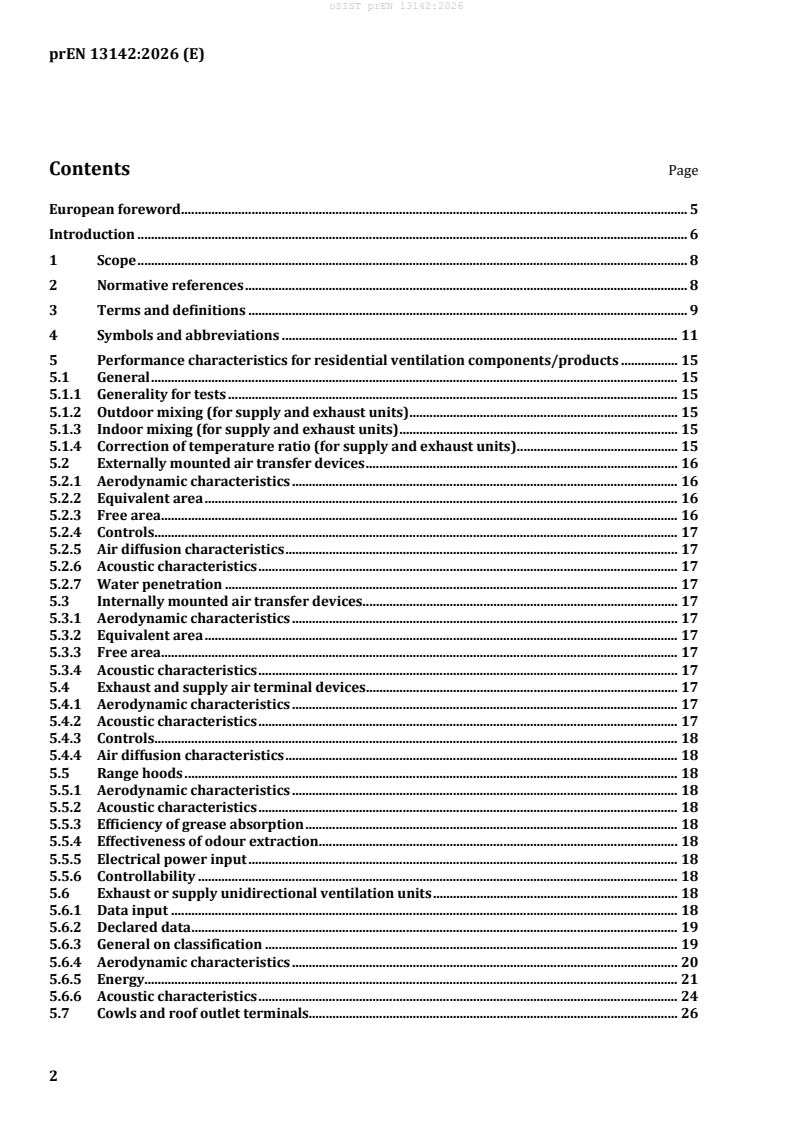
Contents Page
European foreword . 5
Introduction . 6
1 Scope . 8
2 Normative references . 8
3 Terms and definitions . 9
4 Symbols and abbreviations . 11
5 Performance characteristics for residential ventilation components/products . 15
5.1 General . 15
5.1.1 Generality for tests . 15
5.1.2 Outdoor mixing (for supply and exhaust units) . 15
5.1.3 Indoor mixing (for supply and exhaust units) . 15
5.1.4 Correction of temperature ratio (for supply and exhaust units) . 15
5.2 Externally mounted air transfer devices . 16
5.2.1 Aerodynamic characteristics . 16
5.2.2 Equivalent area . 16
5.2.3 Free area . 16
5.2.4 Controls . 17
5.2.5 Air diffusion characteristics . 17
5.2.6 Acoustic characteristics . 17
5.2.7 Water penetration . 17
5.3 Internally mounted air transfer devices . 17
5.3.1 Aerodynamic characteristics . 17
5.3.2 Equivalent area . 17
5.3.3 Free area . 17
5.3.4 Acoustic characteristics . 17
5.4 Exhaust and supply air terminal devices . 17
5.4.1 Aerodynamic characteristics . 17
5.4.2 Acoustic characteristics . 17
5.4.3 Controls . 18
5.4.4 Air diffusion characteristics . 18
5.5 Range hoods . 18
5.5.1 Aerodynamic characteristics . 18
5.5.2 Acoustic characteristics . 18
5.5.3 Efficiency of grease absorption . 18
5.5.4 Effectiveness of odour extraction . 18
5.5.5 Electrical power input . 18
5.5.6 Controllability . 18
5.6 Exhaust or supply unidirectional ventilation units . 18
5.6.1 Data input . 18
5.6.2 Declared data . 19
5.6.3 General on classification . 19
5.6.4 Aerodynamic characteristics . 20
5.6.5 Energy. 21
5.6.6 Acoustic characteristics . 24
5.7 Cowls and roof outlet terminals. 26
5.7.1 Pressure drop. 26
5.7.2 Free area . 26
5.7.3 Suction effect . 26
5.7.4 Acoustic characteristics . 27
5.8 Exhaust ventilation system packages used in a single dwelling . 27
5.8.1 General . 27
5.8.2 Aerodynamic characteristics . 27
5.8.3 Energy . 27
5.8.4 Acoustic characteristics . 28
5.9 Ducted mechanical bidirectional ventilation units (including heat recovery) . 29
5.9.1 Data input . 29
5.9.2 Declared data . 29
5.9.3 General on classification . 30
5.9.4 Aerodynamic characteristics . 30
5.9.5 Thermal characteristics . 32
5.9.6 Energy . 33
5.9.7 Acoustic characteristics . 35
5.10 Non-ducted mechanical bidirectional ventilation units (including heat recovery) . 36
5.10.1 Data input . 36
5.10.2 Declared data . 37
5.10.3 General on classification . 37
5.10.4 Aerodynamic characteristics . 37
5.10.5 Thermal characteristics . 39
5.10.6 Energy . 40
5.10.7 Acoustics characteristics . 42
6 Manual, cleaning and maintenance . 43
6.1 Manual . 43
6.2 Cleaning and maintenance . 43
6.3 Check of maintenance criteria . 44
7 Marking, labelling and product information . 44
8 Declaration and codification of mechanical bidirectional ventilation units . 46
8.1 General . 46
8.2 Filter . 46
8.3 Materials . 46
8.3.1 Reaction to fire . 46
8.3.2 Hygiene and health . 47
Annex A (normative) Additional list for controls declaration. 48
Annex B (informative) Additional check list for declaration and codification . 51
B.1 Filter bypass leakage . 51
B.2 Design criteria . 51
B.3 Controls . 52
B.4 Additional equipment . 54
Annex C (informative) Schematics for classification and codification of ventilation units
and relevant test standards . 55
Annex D (informative) Filter clogging compensation . 59
D.1 General . 59
D.2 Definition and calculation of the filter compensation factor . 59
D.3 Classification of the filter compensation factor . 60
D.4 Test method . 60
D.5 Example of test set up for bidirectional ventilation units . 60
Annex E (informative) Calculation of an extended SEC . 62
E.1 Terms and definitions for this annex . 62
E.2 Model . 62
E.2.1 General . 62
E.2.2 General total energy balance . 62
E.2.3 General electric energy balance . 62
E.2.4 Heating energy saving . 63
E.2.5 Annual electricity consumption for defrosting . 66
E.2.6 Default values for calculation and classification . 73
Annex F (informative) Calculation of an extended SEC considering infiltration . 78
F.1 General . 78
F.2 Extended SEC calculation . 78
Annex G (informative) SEC calculation example according to EU 1253/2014 and
EU 1254/2014 . 79
G.1 General . 79
G.2 Example - SEC calculations . 80
G.2.1 Example 1 - Single dwelling ducted bidirectional ventilation unit with heat
exchanger (centralized heat recovery) . 80
G.2.2 Example 2 - Single dwelling ducted bidirectional ventilation unit with heat
exchanger with local control and variable speed . 81
G.2.3 Example 3 - Single room non-ducted ventilation unit with recovery heat exchanger . 81
G.2.4 Example 4 - Single room non-ducted ventilation unit with positive input ventilation . 82
G.2.5 Example 5 – Exhaust unidirectional ventilation unit . 83
Annex H (informative) Data for calculation example of SEC . 84
Annex ZA (informative) Relationship between this European Standard and the ecodesign
requirements of Commission Regulation (EC) No 1253/2014 aimed to be covered . 85
Annex ZB (informative) Relationship between this European Standard and the energy
labelling requirements of Commission Delegated Regulation (EC) No 1254/2014
aimed to be covered . 88
Bibliography . 91
European foreword
This document (prEN 13142:2026) has been prepared by Technical Committee CEN/TC 156 “Ventilation
for buildings”, the secretariat of which is held by BSI.
This document is currently submitted to the CEN Enquiry.
This document will supersede EN 13142:2021.
In addition to a number of editorial revisions, the following main changes have been made:
— update of Annex ZA and Annex ZB;
— update of references;
— moving of the contents of Annex ZA to the new Annex H.
This document has been prepared under a standardization request addressed to CEN by the European
Commission. The Standing Committee of the EFTA States subsequently approves these requests for its
Member States.
For the relationship with EU Legislation, see informative Annex ZA and Annex ZB, which are integral
parts of this document.
Introduction
A combination of components and/or products is required to provide ventilation. These
components/products interact to achieve a renewal of the air in a dwelling.
It is important to consider each product not only individually but also as part of the whole system: for
example, from the outdoor canopy of an externally mounted air transfer device to the roof outlet terminal
at the end of an exhaust duct. To enable good design, it is essential that certain performance
characteristics for each product are available in a simple and comparable form.
This document defines a classification for balanced ventilation units which may be used for the
determination of minimum and optional product characteristics in national building regulations and
standards.
The structure of this document is based on the type of products that are given in Table 1, which specifies
the type of information for them.
Table 1 — Type of information for products
Product Declaration Classification Codification
Externally mounted air transfer devices X — —
Internally mounted air transfer devices X — —
Exhaust and supply air terminal devices X — —
Range hoods X — —
Exhaust or supply unidirectional ventilation units X X X
in residential ventilation systems
Cowls and roof outlet terminals X — —
Unidirectional exhaust ventilation system X — —
packages
Ducted mechanical bidirectional ventilation units
X X X
(including heat recovery)
Non-ducted bidirectional ventilation units
X X X
(including heat recovery)
This document is one of a series of standards on residential ventilation. It is referring to the performance
testing of the components/products for residential ventilation.
The position of this document in the field of the mechanical building services is shown in Figure 1.
Figure 1 — Position of EN 13142 in the field of the mechanical building services
EN 13142:2021 has been revised to include new requirements according to Ecodesign requirements for
ventilation units .
Ecodesign requirements for ventilation units are given in EU Commission Delegated Regulation
No EU 1253/2014 and No EU 1254/2014.
1 Scope
This document specifies and classifies the component/product performance characteristics, which may
be necessary for the design, rating and dimensioning, placing on the market of residential ventilation
products and systems to provide the predetermined performance, comfort conditions of temperature, air
velocity, humidity, hygiene and sound in the occupied zone.
It defines those performance characteristics (mandatory or optional) which are determined, measured
and presented according to relevant test methods. It provides a classification scheme, which leads to a
full definition of product properties based on test methods described in various European Standards, and
gives an overview of the test standards. Distinction between mandatory and optional requirements is left
to each European and national regulation(s).
The codification part in Annex B and the classification part in Clause 8 apply to the following products:
— unidirectional mechanical supply and exhaust residential ventilation units according to
EN 13141-4:2021 and EN 13141-6:2014;
— ducted mechanical bidirectional residential ventilation units according to EN 13141-7:2021;
— non-ducted mechanical bidirectional residential ventilation units according to EN 13141-8:2022.
This document does not apply to other products such as filters, fire dampers, ducts, control devices and
sound attenuators, which may also be incorporated in residential ventilation.
This document specifies in Annex ZA and Annex ZB the requirements of EU 1253/2014 and
EU 1254/2014 for residential ventilation units below 1 000 m /h air volume flow.
This document does not cover requirements raised by European Directives (e.g. low voltage directive,
EMC directive) and other requirements such as corrosion, reaction to fire and snow penetration.
2 Normative references
The following documents are referred to in the text in such a way that some or all of their content
constitutes requirements of this document. For dated references, only the edition cited applies. For
undated references, the latest edition of the referenced document (including any amendments) applies.
EN 12792:2003, Ventilation for buildings — Symbols, terminology and graphical symbols
EN 13141-1:2019, Ventilation for buildings — Performance testing of components/products for residential
ventilation — Part 1: Externally and internally mounted air transfer devices
EN 13141-2:2010, Ventilation for buildings — Performance testing of components/products for residential
ventilation — Part 2: Exhaust and supply air terminal devices
EN 13141-3:2017, Ventilation for buildings — Performance testing of components/products for residential
ventilation — Part 3: Range hoods for residential use without fan
EN 13141-4:2021, Ventilation for buildings — Performance testing of components/products for residential
ventilation — Part 4: Aerodynamic, electrical power and acoustic performance of unidirectional ventilation
units
EN 13141-5:2020, Ventilation for buildings — Performance testing of components/products for residential
ventilation — Part 5: Cowls, assisted cowls and roof outlet terminal devices
EN 13141-6:2014, Ventilation for buildings — Performance testing of components/products for residential
ventilation — Part 6: Exhaust ventilation system packages used in a single dwelling
EN 13141-7:2021, Ventilation for buildings — Performance testing of components/products for residential
ventilation — Part 7: Performance testing of ducted mechanical supply and exhaust ventilation units
(including heat recovery)
EN 13141-8:2022, Ventilation for buildings — Performance testing of components/products for residential
ventilation — Part 8: Performance testing of non-ducted mechanical supply and exhaust ventilation units
(including heat recovery)
EN 13141-9:2008, Ventilation for buildings — Performance testing of components/products for residential
ventilation — Part 9: Externally mounted humidity controlled air transfer device
EN 13141-10:2008, Ventilation for buildings — Performance testing of components/products for
residential ventilation — Part 10: Humidity controlled extract air terminal device
EN IEC 61591:2023, Cooking fume extractors — Methods for measuring performance (IEC 61591:2023)
EN ISO 16890-1:2016, Air filters for general ventilation — Part 1: Technical specifications, requirements
and classification system based upon particulate matter efficiency (ePM) (ISO 16890-1:2016)
EN ISO 16890-2:2022, Air filters for general ventilation — Part 2: Measurement of fractional efficiency and
air flow resistance (ISO 16890-2:2022)
EN ISO 16890-3:2024, Air filters for general ventilation — Part 3: Determination of the gravimetric
efficiency and the air flow resistance versus the mass of test dust captured (ISO 16890-3:2024)
EN ISO 16890-4:2022, Air filters for general ventilation — Part 4: Conditioning method to determine the
minimum fractional test efficiency (ISO 16890-4:2022)
3 Terms and definitions
For the purposes of this document, the terms and definitions given in EN 12792:2003 and the following
apply.
ISO and IEC maintain terminology databases for the use in standardization at the following addresses:
— IEC Electropedia: available at http://www.electropedia.org/
— ISO online browsing platform: available at http://www.iso.org/obp/
3.1
externally mounted air transfer device
device designed to allow the passage of air through the building envelope with the minimum ingress of
rain, snow, foreign bodies, etc.
[SOURCE: EN 12792:2003, definition 144]
3.2
internally mounted air transfer device
device designed to allow the passage of air between two internal spaces
[SOURCE: EN 12792:2003, definition 232]
3.3
exhaust air terminal device
device through which air leaves the treated space
3.4
supply air terminal device
device through which air enters the treated space
[SOURCE: EN 12792:2003, definition 349, modified — The second sentence has been removed.]
3.5
range hood
cooker hood
device intended to collect contaminated air from above a cooking appliance and either discharge it into
the room or remove it from the room
Note 1 to entry: It may or may not incorporate one or more of the following components:
— filter (essential when the contaminated air is discharged into the room);
— fan;
— fire damper;
— non return flow damper.
[SOURCE: EN 12792:2003, definition 85]
3.6
cowl
air terminal device with or without moving component, intended to be fitted on top of an exhaust duct,
with aim, by creating negative pressure depending on the wind speed, to avoid reverse flow and to
increase the extracted flow rate in presence of wind
[SOURCE: EN 12792:2003, 92, modified — Reformulation of the definition in a single sentence.]
3.7
roof outlet
air terminal device without moving component, intended to be fitted on top of an exhaust duct
[SOURCE: EN 13141-5:2020, definition 3.4]
3.8
ventilation system package
combination of compatible components which are tested, delivered and installed as specified, to complete
a residential ventilation system when sold as a single product
Note 1 to entry: It may exclude minor parts such as tapes, sealants and screws.
Note 2 to entry: This definition applies for single dwelling.
3.9
bidirectional ventilation unit
ventilation unit which produces an air flow between indoors and outdoors and is equipped with both
exhaust and supply fans
3.10
unidirectional ventilation unit
ventilation unit with a fan assisted air volume flow in only one direction (either supply or exhaust)
Note 1 to entry: The balancing air volume flow is provided by air transfer devices or another mechanical unit.
4 Symbols and abbreviations
For the purposes of this document, the symbols given in EN 12792:2003 and the following apply.
Symbol Designation Unit
c specific heat capacity of air at constant pressure and density kWh/(kg⋅K)
air
d thickness of the layer “i” m
i
COP coefficient of performance —
CTRL ventilation control factor —
DIS disbalance %
D + C airborne sound insulation dB
n,e,w tr
annual electricity consumption kWh/(m⋅a)
E
AEC
⋅a)
annual electricity consumption for defrosting kWh/(m
E
defr
annual electricity consumption due to internal pressure loss during kWh/(m⋅a)
E
el,preh
frost periods
EE weighted energy efficiency —
w
annual electricity consumption for an electric preheater kWh/(m⋅a)
Epreh
Epump,defr annual electricity consumption use for defroster pump kWh/(m⋅a)
annual electricity consumption use due to external pressure losses kWh/(m⋅a)
E∆p,ext,defr
of external defrosting devices
annual electricity consumption due to internal pressure loss during kWh/(m⋅a)
E∆p,int,defr
frost growing
f conversion factor between electrical and primary energy —
c
factor of the defrosting control —
f
ctrl,defr
correction value for the casing insulation —
f
insu
factor for the type of the defroster —
f
pump
factor for units conversion —
f
FC filter compensation factor —
F value of occurrence frequency for part load weighting —
i
L A-weighted sound power levels dB(A)
WA
aggregated general typology factor, incorporating factors for —
MISC
ventilation effectiveness, duct leakage and extra infiltration
pef primary energy factor —
p pressure at maximum air volume flow Pa
qvmax
p reference pressure Pa
ref
P electrical power input W
E
P electric power input at the reference volume flow W
E,ref
Symbol Designation Unit
3 a
PES primary energy saving kJ/m
P electrical power measured at q W
i vi
P maximum electrical power input W
E,max
electrical power input of the defroster pump W
P
pump
q measured air volume flow m
q mass flow rate kg/s
m
3 2
net ventilation rate demand m /(h⋅m )
q
net
3 2
q reference natural ventilation m /(h⋅m )
ref
q external leakage (ducted units only) %
ve
q air flow with an additional pressure drop of 1,5 times the initial m
vfc
pressure drop of the filter
qvi internal leakage %
3 b
q indoor/outdoor airtightness (non-ducted units only) m /s
vio
q maximum air volume flow m /s
vmax
q nominal air volume flow m /s
vn
q reference air volume flow m /s
vref
Q annual energy for defrosting kWh/(m⋅a)
defr
thermal resistance of the casing wall m⋅K/W
R
R indoor mixing %
mi
R outdoor mixing %
mr
R transfer ratio of recirculated air in the supply air stream %
s
R internal transfer ratio from extract to supply air %
s,int
R total transfer ratio in supply air %
s,tot
SPI specific power input W/(m /s)
SPI weighted specific power input part load W/(m /s)
w
ta
annual operating hours h/a
annual operating time in defrosting mode h/a
t
defr
total hours heating season h
t
h
v air flow sensitivity %
w internal leakage %
o outdoor mixing %
x
exponent that takes into account nonlinearity between thermal —
energy and electricity saving, depending on motor and drive
characteristics
x value of part load of rated air volume flow —
i
y indoor mixing %
Symbol Designation Unit
z external leakage %
annual saving in consumption of energy kWh/(m⋅a)
∆E
AHS
annual heating energy consumption for defrosting kWh/(m⋅a)
∆E
AH,defr
annual heating energy consumption for bypassing the heat recovery kWh/(m⋅a)
∆E
by
annual heating energy reduction by an earth to air heat exchanger kWh/(m⋅a)
∆E
earth
annual heating energy reduction by an electric preheater kWh/(m⋅a)
∆E
el,preh
annual heating energy consumption for increasing of the exhaust air kWh/(m⋅a)
∆E
ex
flow rate
annual heating energy consumption for preheating (by space kWh/(m⋅a)
∆E
h,preh
heating generation)
annual heating energy consumption for lowering of the supply air kWh/(m⋅a)
∆E
su
flow rate
annual heating energy reduction by ventilator heat kWh/(m⋅a)
∆E
vent
pressure loss of the external defrosting devices Pa
∆p
ext,defr
Δp pressure drop Pa
fc
average additional internal pressure due to frost growing Pa
∆p
frost
Δp initial pressure drop of the filter Pa
initial
Δp total rated pressure Pa
ref
average difference between the outdoor temperature and the K
∆T
defr
defrost mode set point during the defrosting period
average difference in indoor and outdoor temperature over a K
∆T
h
heating season, minus correction for solar and internal gains
correction for solar and internal gains °C
∆θ
g,h,avg
c
η temperature ratio %
t
η temperature ratio —
θ
η overall efficiency of the heating system —
g
average space heating efficiency —
η
h
thermal efficiency of heat recovery —
η
t
difference in thermal efficiency of heat recovery with a bypass —
∆η
t,by
compared to balanced mass flows
difference in thermal efficiency of heat recovery with an increased —
∆η
t,dec
exhaust air flow rate compared to balanced mass flows
difference in thermal efficiency of heat recovery with a lowered —
∆η
t,low
supply air flow rate compared to balanced mass flows
ventilator efficiency —
η
vent
Symbol Designation Unit
corrected temperature ratio on supply air side —
η
η temperature ratio on supply air side —
θ,su
temperature ratio on exhaust air side —
η
θ ,ex
average outdoor temperature over a heating season °C
θ
e,h,avg
average indoor temperature over a heating season °C
θ
I,avg
thermal conductivity of the material of the layer “i” W/(m⋅K)
λ
i
a 3 3
W/(m /s) or W/(m /h) can be used for measurement of primary energy saving but it shall be verified
that all parameters are consistent with the chosen unit.
b 3
l/s or m /h can be used for measurement of air flow but it shall be verified that all parameters are
consistent with the chosen unit.
c
Symbol ηt is used in EU 1253/2014 and EU 1254/2014.
For the purposes of this document, the following abbreviations apply.
AEQ Codification of Additional Equipment
CTRL Control Factor
DCV Demand Controlled Ventilation
DIS Disbalance
DIU Declared Intended Use
HRS Humidity Ratio on Supply air side
LWC Sound power level
LWD Duct connection sound power level
MFB Mass Flow Balance
POM Power input in Operable Mode
PES Primary Energy Saving
PSM Power input in Standby Mode
SEC Specific Energy Consumption
SEC* Extended Specific Energy Consumption
SPI Specific Power Input
ASI Airborne Sound Insulation
TRE Temperature Ratio on the Exhaust air side
TRS Temperature Ratio on Supply air side
5 Performance characteristics for residential ventilation components/products
5.1 General
5.1.1 Generality for tests
The results of product performance tests reflect the performance that is achieved by the product in
service. A product shall therefore be tested as a complete assembly with all necessary components that
affect performance.
Accessories are sometimes available for a product as an option. Where accessories could affect
performance, the product shall be tested both with and without those accessories.
If any insect screen, filter or similar device is intended to be fitted in the product, then it shall be in
position when the product is tested.
5.1.2 Outdoor mixing (for supply and exhaust units)
5.1.2.1 Outdoor mixing of non-ducted units
Due to the small dimensions of non-ducted units the distance between the air inlets and air outlets can
be very small and thus there is a risk of mixing exhaust air with outdoor air. This concerns also alternating
ventilation units.
The outdoor mixing shall be measured and stated in accordance with EN 13141-8:2022.
5.1.2.2 Outdoor mixing of ducted units
The outdoor mixing rate of ducted units shall not be considered. The impact depends on installation
aspects.
5.1.3 Indoor mixing (for supply and exhaust units)
5.1.3.1 Indoor mixing of non-ducted units
Due to the small dimensions of non-ducted units the distance between the air inlets and air outlets can
be very small and thus there is a risk of mixing extract air with supply air. The indoor mixing shall be
measured and stated in accordance with EN 13141-8:2022.
5.1.3.2 Indoor mixing of ducted units
The indoor mixing rate of ducted units shall not be considered. The impact depends on installation
aspects.
5.1.4 Correction of temperature ratio (for supply and exhaust units)
All the leakages, mixing and flow balance variations have an influence on the temperature ratio. Starting
from the measured air flow, q , and the temperature ratio, η , on supply air, the temperature ratio shall
v θ,su
be corrected depending on the value in % of:
— η temperature ratio on supply air side, also named η ;
θ,su t
NOTE 1 ηt is used without correction in regulations EU 1254/2014 and EU 1253/2014.
— w of the internal leakage (see Table 19 to Table 21 or Table 32 depending on design);
— o of the outdoor mixing (see Table 32);
— y of the indoor mixing (see Table 32);
— z of the external leakage (see Table 19 to Table 21 or Table 32 depending on design);
— v of the air flow sensitivity at reference air volume flow at reference pressure ± 10 Pa, the highest
value shall be taken, (for non-ducted unit according to EN 13141-8:2022 and for ducted unit
calculated from air volume flow pressure curve according to EN 13141-7:2021);
according to Table 2.
Each value of the temperature ratio shall be documented.
The Temperature Ratio on Supply air side (TRS) shall be the corrected temperature ratio η .
NOTE 2 If the impact of leakage, mixing, and air flow sensitivity is considered in EPBD calculation procedures
then η could be documented. If this impact is not considered, then η could be used.
θ,su 5
Table 2 — Temperature ratio correction at reference air volume flow
Temperature ratio correction
Measure Result Unit
Non-ducted units Ducted units
Temperature ratio on
ηθ,su — —
supply air side
Internal leakage w — η = η × (1 – 0,7 × (w – 0,03))
1 θ,su
a
Outdoor mixing o — η = η × (1 – (o-0,02)) η = η
2 1 2 1
a
Indoor mixing y — η = η × (1 – (y-0,02)) η = η
3 2 3 2
b
External leakage z — η = η
4 3
0,4
Air flow sensitivity v — η = η × (1 – (v-0,02))
5 4
a
The outdoor mixing depends on the duct system and not on the unit. There is no mixing in typical
installations.
b
The impact of external leakage
...