


EN 1789:2020/prA1
(Amendment)Medical vehicles and their equipment - Road ambulances
Medical vehicles and their equipment - Road ambulances
This European Standard specifies requirements for the design, testing, performance and equipping of road ambulances used for the transport, monitoring, treatment and care of patients. It contains requirements for the patient’s compartment in terms of the working environment, ergonomic design and the safety of the crew and patients.This European Standard does not cover the training of the staff which is the responsibility of the authority/authorities in the country where the ambulance is to be registered.
This European Standard is applicable to road ambulances capable of transporting at least one person on a stretcher and excludes the transportation of hospital beds.
This standard also specifies requirements for ambulances intended to carry transport incubator systems.
The European Standard covers the specific requirements of each type of road ambulance which are
designated according to the patient condition e.g. patient transport road ambulance types A1, A2, B and C.
This European Standard gives general requirements for medical devices carried in road ambulances and used therein and outside hospitals and clinics in situations where the ambient conditions can differ from normal indoor conditions.
Rettungsdienstfahrzeuge und deren Ausrüstung - Krankenkraftwagen
Véhicules de transport sanitaire et leurs équipements - Ambulances routières
Medicinska vozila in pripadajoča oprema - Cestna reševalna vozila - Dopolnilo A1
General Information
- Status
- Not Published
- Publication Date
- 18-Oct-2023
- Technical Committee
- CEN/TC 239 - Rescue systems
- Current Stage
- 4097 - End of interruption of work - split/merged
- Start Date
- 04-Oct-2023
- Completion Date
- 11-Feb-2026
Relations
- Effective Date
- 11-Oct-2023
- Effective Date
- 07-Sep-2022
Overview
EN 1789:2020/prA1 - Medical vehicles and their equipment - Road ambulances is a European standard from CEN that defines requirements for the design, testing, performance and equipping of road ambulances. It applies to ambulances capable of transporting at least one person on a stretcher (types A1, A2, B and C) and covers patient compartments, ergonomic design, crew and patient safety, and general requirements for medical devices used in ambulance and pre‑hospital environments. The amendment A1 adds provisions to address alternative energy vehicles (notably electric ambulances) and updates several normative references.
Key topics and technical requirements
- Scope of application
- Road ambulances for stretcher transport; excludes hospital beds and staff training (training is the responsibility of national authorities).
- Requirements for ambulances intended to carry transport incubator systems.
- Patient compartment
- Working environment and ergonomic layout to support patient monitoring, treatment and care.
- Safety features for crew and patients during transport.
- Equipment and medical devices
- General requirements for medical devices carried and used inside and outside clinical settings where ambient conditions differ from indoor conditions.
- Design, testing and performance
- Mechanical, electrical and environmental performance checks for ambulance layouts and equipment mounting.
- Updated electrical clause references to reflect ambulance electrical systems and medical electrical equipment (including EN/IEC medical electrical standards).
- Amendment A1 (notable additions)
- New normative Annex E covering electrically propelled vehicles - guidance to verify electric-chassis ambulances can meet EN 1789 requirements.
- Clarifications: “alternator” interpreted as “recharging system”; terms like “idling” and “engine running” replaced with “put vehicle in running condition” for electric vehicles.
- Warnings about electric vehicle limitations (range, charging time) and the temporary nature of these provisions while alternative-energy vehicle technology evolves.
- Updated normative references
- Several referenced standards were updated (examples include EN 16165, EN ISO 20417, EN 60601‑1‑12 and the prEN 1865 series for patient handling).
Applications and who uses this standard
- Ambulance manufacturers and vehicle bodybuilders designing or certifying road ambulances.
- Emergency Medical Services (EMS) authorities and procurement teams specifying ambulance requirements.
- Medical equipment suppliers and integrators who install supplies, gas systems and electrical medical devices in ambulances.
- Test laboratories and conformity assessors validating design, safety and performance.
- Regulators and standardization bodies aligning national vehicle approval and EMS guidance with European practice.
Practical value
- Ensures consistent safety, ergonomics and equipment performance across ambulance fleets.
- Facilitates procurement specifications and conformity assessment for both combustion and electric-chassis ambulances.
- Helps reduce operational risk by defining mounting, electrical, gas and environmental requirements for in‑vehicle medical devices.
Related standards
- EN 16165 (slip resistance), EN ISO 20417 (medical device information), EN 60601‑1‑12 (medical electrical equipment for EMS), and the prEN 1865 series (patient handling equipment). These referenced standards are updated in amendment A1.

Get Certified
Connect with accredited certification bodies for this standard

TÜV Rheinland
TÜV Rheinland is a leading international provider of technical services.

TÜV SÜD
TÜV SÜD is a trusted partner of choice for safety, security and sustainability solutions.

BSI Group
BSI (British Standards Institution) is the business standards company that helps organizations make excellence a habit.
Sponsored listings
Frequently Asked Questions
EN 1789:2020/prA1 is a draft published by the European Committee for Standardization (CEN). Its full title is "Medical vehicles and their equipment - Road ambulances". This standard covers: This European Standard specifies requirements for the design, testing, performance and equipping of road ambulances used for the transport, monitoring, treatment and care of patients. It contains requirements for the patient’s compartment in terms of the working environment, ergonomic design and the safety of the crew and patients.This European Standard does not cover the training of the staff which is the responsibility of the authority/authorities in the country where the ambulance is to be registered. This European Standard is applicable to road ambulances capable of transporting at least one person on a stretcher and excludes the transportation of hospital beds. This standard also specifies requirements for ambulances intended to carry transport incubator systems. The European Standard covers the specific requirements of each type of road ambulance which are designated according to the patient condition e.g. patient transport road ambulance types A1, A2, B and C. This European Standard gives general requirements for medical devices carried in road ambulances and used therein and outside hospitals and clinics in situations where the ambient conditions can differ from normal indoor conditions.
This European Standard specifies requirements for the design, testing, performance and equipping of road ambulances used for the transport, monitoring, treatment and care of patients. It contains requirements for the patient’s compartment in terms of the working environment, ergonomic design and the safety of the crew and patients.This European Standard does not cover the training of the staff which is the responsibility of the authority/authorities in the country where the ambulance is to be registered. This European Standard is applicable to road ambulances capable of transporting at least one person on a stretcher and excludes the transportation of hospital beds. This standard also specifies requirements for ambulances intended to carry transport incubator systems. The European Standard covers the specific requirements of each type of road ambulance which are designated according to the patient condition e.g. patient transport road ambulance types A1, A2, B and C. This European Standard gives general requirements for medical devices carried in road ambulances and used therein and outside hospitals and clinics in situations where the ambient conditions can differ from normal indoor conditions.
EN 1789:2020/prA1 is classified under the following ICS (International Classification for Standards) categories: 11.160 - First aid; 43.160 - Special purpose vehicles. The ICS classification helps identify the subject area and facilitates finding related standards.
EN 1789:2020/prA1 has the following relationships with other standards: It is inter standard links to EN 1789:2020+A1:2023, EN 1789:2020. Understanding these relationships helps ensure you are using the most current and applicable version of the standard.
EN 1789:2020/prA1 is available in PDF format for immediate download after purchase. The document can be added to your cart and obtained through the secure checkout process. Digital delivery ensures instant access to the complete standard document.
Standards Content (Sample)
SLOVENSKI STANDARD
01-marec-2023
Medicinska vozila in pripadajoča oprema - Cestna reševalna vozila - Dopolnilo A1
Medical vehicles and their equipment - Road ambulances
Rettungsdienstfahrzeuge und deren Ausrüstung - Krankenkraftwagen
Véhicules de transport sanitaire et leurs équipements - Ambulances routières
Ta slovenski standard je istoveten z: EN 1789:2020/prA1
ICS:
11.160 Prva pomoč First aid
43.160 Vozila za posebne namene Special purpose vehicles
2003-01.Slovenski inštitut za standardizacijo. Razmnoževanje celote ali delov tega standarda ni dovoljeno.
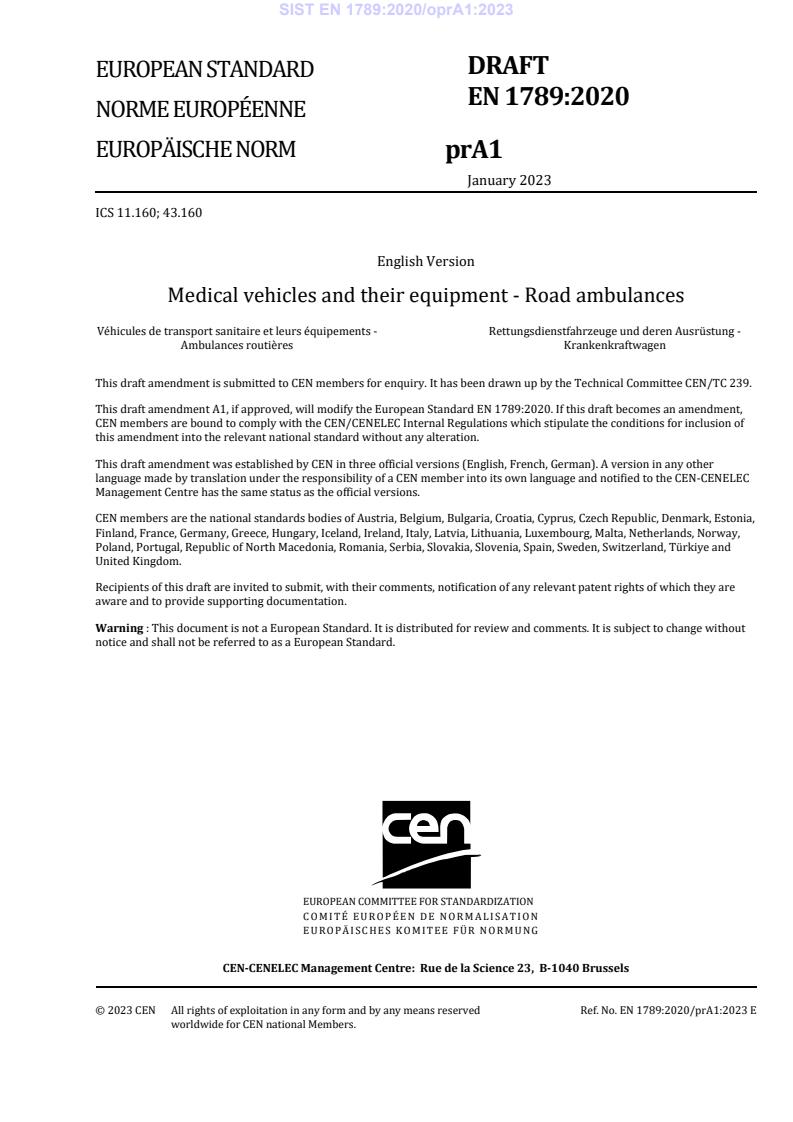
DRAFT
EUROPEAN STANDARD
EN 1789:2020
NORME EUROPÉENNE
EUROPÄISCHE NORM
prA1
January 2023
ICS 11.160; 43.160
English Version
Medical vehicles and their equipment - Road ambulances
Véhicules de transport sanitaire et leurs équipements - Rettungsdienstfahrzeuge und deren Ausrüstung -
Ambulances routières Krankenkraftwagen
This draft amendment is submitted to CEN members for enquiry. It has been drawn up by the Technical Committee CEN/TC 239.
This draft amendment A1, if approved, will modify the European Standard EN 1789:2020. If this draft becomes an amendment,
CEN members are bound to comply with the CEN/CENELEC Internal Regulations which stipulate the conditions for inclusion of
this amendment into the relevant national standard without any alteration.
This draft amendment was established by CEN in three official versions (English, French, German). A version in any other
language made by translation under the responsibility of a CEN member into its own language and notified to the CEN-CENELEC
Management Centre has the same status as the official versions.
CEN members are the national standards bodies of Austria, Belgium, Bulgaria, Croatia, Cyprus, Czech Republic, Denmark, Estonia,
Finland, France, Germany, Greece, Hungary, Iceland, Ireland, Italy, Latvia, Lithuania, Luxembourg, Malta, Netherlands, Norway,
Poland, Portugal, Republic of North Macedonia, Romania, Serbia, Slovakia, Slovenia, Spain, Sweden, Switzerland, Türkiye and
United Kingdom.
Recipients of this draft are invited to submit, with their comments, notification of any relevant patent rights of which they are
aware and to provide supporting documentation.
Warning : This document is not a European Standard. It is distributed for review and comments. It is subject to change without
notice and shall not be referred to as a European Standard.
EUROPEAN COMMITTEE FOR STANDARDIZATION
COMITÉ EUROPÉEN DE NORMALISATION
EUROPÄISCHES KOMITEE FÜR NORMUNG
CEN-CENELEC Management Centre: Rue de la Science 23, B-1040 Brussels
© 2023 CEN All rights of exploitation in any form and by any means reserved Ref. No. EN 1789:2020/prA1:2023 E
worldwide for CEN national Members.
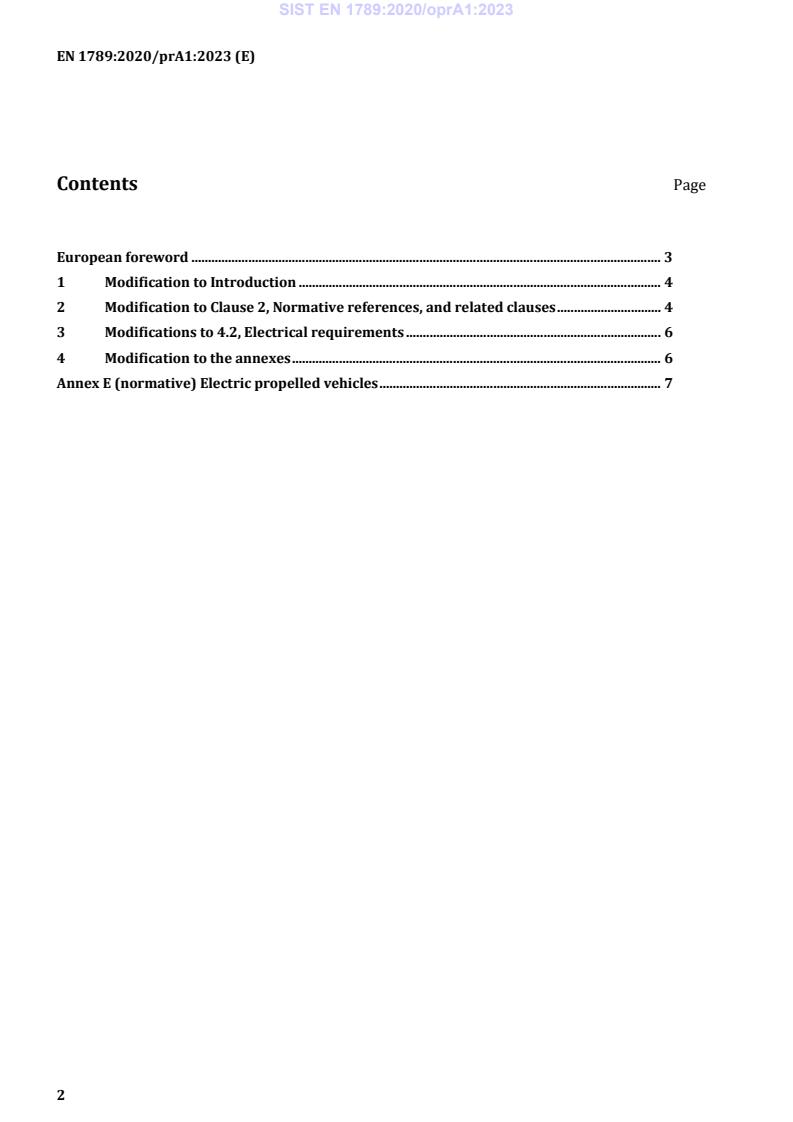
Contents Page
European foreword . 3
1 Modification to Introduction . 4
2 Modification to Clause 2, Normative references, and related clauses . 4
3 Modifications to 4.2, Electrical requirements . 6
4 Modification to the annexes . 6
Annex E (normative) Electric propelled vehicles . 7
European foreword
This document (EN 1789:2020/prA1:2023) has been prepared by Technical Committee CEN/TC 239
“Rescue systems”, the secretariat of which is held by DIN.
This document is currently submitted to the CEN Enquiry.
Compared to EN 1789:2020 the following main technical changes were made:
a) addition to introduction to explain purpose of Amendment A1;
b) normative references up-dated;
c) new normative Annex E added to cover alternative energies.
1 Modification to Introduction
Delete the following since this paragraph only applied to the Version published in 2020:
CEN/TC 239 has agreed to a transition period of a maximum of 18 months in order to accommodate the
different organisational structures that are necessary for the transport of patients are responsible for
providing sufficient time for the technical implementation. At the date of publication of EN 1789, the
presumption of conformity of the superseded standard has not yet been established in the Official Journal
of the European Union. Users of the standard are invited to check the date in the Official Journal of the
European Union against the transition period established by CEN/TC 239.
Add the following as last paragraph:
The energy sources for motor vehicles are in turmoil due to environmental fight against global climate
warming. Alternative energies are becoming more regular in motor vehicles and electric vehicles are
already common by most vehicle manufacturers.
In all standardization criteria, combustion engine characteristics have guided the requirements.
Therefore, the most obvious ambulance standard requirements (EN 1789) need adjustments introduced
by an Amendment to allow verification of electric engine ambulances as compliant to this document.
2 Modification to Clause 2, Normative references, and related clauses
Update the following references in Clause 2 and their related clauses:
“CEN/TS 16165:2016, Determination of slip resistance of pedestrian surfaces - Methods of evaluation”
by
“EN 16165:2021, Determination of slip resistance of pedestrian surfaces - Methods of evaluation”
“DIN 51130:2014, Testing of floor coverings - Determination of the anti-slip property - Workrooms and
fields of activities with slip danger - Walking method - Ramp test”
by
“EN 16165:2021, Determination of slip resistance of pedestrian surfaces - Methods of evaluation”
“EN 455-1:2020, Medical gloves for single use - Part 1: Requirements and testing for freedom from holes”
by
“EN 455-1:2020+A1:2022, Medical gloves for single use - Part 1: Requirements and testing for freedom
from h
...
Questions, Comments and Discussion
Ask us and Technical Secretary will try to provide an answer. You can facilitate discussion about the standard in here.
Loading comments...