EN 863:1995
(Main)Protective clothing - Mechanical properties - Test method: Puncture resistance
Protective clothing - Mechanical properties - Test method: Puncture resistance
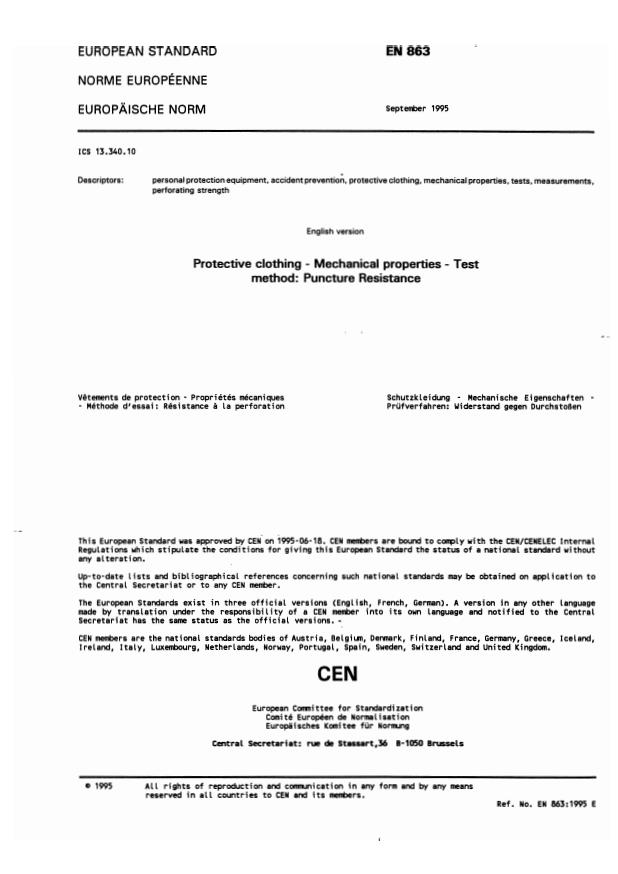
This European Standard specifies a test method for measuring the puncture resistance of protective clothing or materials used for these products. The puncture resistance is expressed as the maximum force required to push a spike with a specified speed through the test specimens.
Schutzkleidung - Mechanische Eigenschaften - Prüfverfahren: Widerstand gegen Durchstoßen
Diese Europäische Norm legt ein Prüfverfahren fest, das für die Bestimmung der Durchstoßfestigkeit von Schutzkleidung oder der entsprechenden Materialien anwendbar ist. Die Durchstoßfestigkeit wird bestimmt durch die maximale Kraft, die notwendig ist, um eine Nadel mit einer bestimmten Geschwindigkeit durch die Prüflinge zu stoßen.
Vêtements de protection - Propriétés mécaniques - Méthode d'essai: Résistance à la perforation
Cette norme européenne spécifie une méthode d'essai pour la mesure de la résistance à la perforation des vêtements de protection ou des matériaux utilisés pour ces produits. La résistance à la perforation est exprimée par la force maximale nécessaire pour perforer l'éprouvette par un poinçon a une vitesse spécifiée.
Varovalna obleka - Mehanske lastnosti - Preskusna metoda: odpornost proti prebadanju
General Information
- Status
- Published
- Publication Date
- 19-Sep-1995
- Withdrawal Date
- 30-Mar-1996
- Technical Committee
- CEN/TC 162 - Protective clothing including hand and arm protection and lifejackets
- Drafting Committee
- CEN/TC 162/WG 5 - Resistance to mechanical impact of protective clothing
- Current Stage
- 9060 - Closure of 2 Year Review Enquiry - Review Enquiry
- Start Date
- 04-Jun-2022
- Completion Date
- 04-Jun-2022
Overview
EN 863:1995 is a CEN (European Committee for Standardization) test method that defines how to measure the puncture resistance of protective clothing and the materials used to make these garments. The standard expresses puncture resistance as the maximum force required to push a prescribed spike through a test specimen at a specified speed. EN 863 provides a repeatable laboratory procedure to assess mechanical resistance to puncture and to support material selection, quality control, and regulatory compliance for personal protective equipment (PPE).
Key topics and requirements
- Scope: Applies to protective clothing and constituent materials intended to resist puncture.
- Measurement parameter: Puncture resistance reported as the maximum force (peak load) to penetrate the specimen.
- Test principle: A defined spike is driven through the specimen at a specified speed under controlled conditions; force vs. displacement is recorded.
- Specimen types: Can be applied to finished garments or material samples cut from protective clothing.
- Repeatability and comparability: Standardized apparatus, test speed and procedures ensure results are comparable between laboratories and manufacturers.
- Documentation: Test reports should state specimen preparation, test conditions and the measured maximum force.
(EN 863:1995 text provides the general method; consult the full standard for detailed apparatus, sample dimensions and procedural steps.)
Practical applications
Who uses EN 863 and why:
- PPE manufacturers: To evaluate materials and garment designs for puncture resistance during product development and production control.
- Test laboratories and certification bodies: For standardized testing to support CE marking and product conformity assessments.
- Safety engineers and procurement teams: To compare materials and specify minimum puncture-resistance requirements for workplace PPE.
- Regulators and occupational health professionals: To inform guidance on protective clothing performance for medical, industrial, forestry, law enforcement and similar hazards.
Benefits:
- Enables objective comparison of fabrics, laminates and assemblies.
- Supports risk-based selection of protective clothing.
- Helps detect manufacturing defects or material degradation affecting puncture performance.
Related standards
- Other EN standards addressing protective clothing mechanical properties (abrasion, tearing and burst resistance).
- Standards covering protective gloves (e.g., mechanical resistance testing) and broader PPE conformity standards.
Keywords: EN 863, puncture resistance test, protective clothing, CEN standard, PPE testing, mechanical properties, puncture test, protective materials.
Frequently Asked Questions
EN 863:1995 is a standard published by the European Committee for Standardization (CEN). Its full title is "Protective clothing - Mechanical properties - Test method: Puncture resistance". This standard covers: This European Standard specifies a test method for measuring the puncture resistance of protective clothing or materials used for these products. The puncture resistance is expressed as the maximum force required to push a spike with a specified speed through the test specimens.
This European Standard specifies a test method for measuring the puncture resistance of protective clothing or materials used for these products. The puncture resistance is expressed as the maximum force required to push a spike with a specified speed through the test specimens.
EN 863:1995 is classified under the following ICS (International Classification for Standards) categories: 13.340.10 - Protective clothing. The ICS classification helps identify the subject area and facilitates finding related standards.
EN 863:1995 is associated with the following European legislation: EU Directives/Regulations: 2016/425, 89/686/EEC; Standardization Mandates: M/BC/CEN/90/2. When a standard is cited in the Official Journal of the European Union, products manufactured in conformity with it benefit from a presumption of conformity with the essential requirements of the corresponding EU directive or regulation.
You can purchase EN 863:1995 directly from iTeh Standards. The document is available in PDF format and is delivered instantly after payment. Add the standard to your cart and complete the secure checkout process. iTeh Standards is an authorized distributor of CEN standards.
Standards Content (Sample)
SLOVENSKI STANDARD
01-december-1996
Varovalna obleka - Mehanske lastnosti - Preskusna metoda: odpornost proti
prebadanju
Protective clothing - Mechanical properties - Test method: Puncture resistance
Schutzkleidung - Mechanische Eigenschaften - Prüfverfahren: Widerstand gegen
Durchstoßen
Vetements de protection - Propriétés
...
SIST EN 863:1996 표준은 보호복 및 이러한 제품에 사용되는 소재의 천공 저항을 측정하기 위해 설계된 시험 방법을 명시하고 있습니다. 이 표준은 천공 저항을 측정하는 데 있어 특정 속도로 시험 샘플을 관통해야 하는 스파이크를 밀어내는 데 필요한 최대 힘으로 표현됩니다. 이 표준의 강점 중 하나는 일관된 시험 방법을 제공함으로써 다양한 제품 간의 비교를 가능하게 한다는 점입니다. 이러한 비교 가능성은 제조사와 사용자 간의 신뢰를 쌓는 데 중요한 역할을 합니다. 또한, EN 863:1995는 유럽 전역에서 보호복의 품질 및 안전성을 보장하기 위해 반드시 따라야 할 기준으로, 이로 인해 사용자들이 보다 안전한 제품을 선택할 수 있도록 돕습니다. SIST EN 863:1996의 범위는 특히 산업계에서 직면할 수 있는 다양한 위험 요소에 대응하는 데 적합합니다. 특정 환경에서 사용되는 보호복에 대한 명확한 기준을 제공함으로써, 이 표준은 공급업체와 최종 사용자가 보다 안전하고 신뢰할 수 있는 소재를 선택할 수 있도록 지원합니다. 이러한 점에서, EN 863:1995는 보호복의 기계적 성질을 평가하는 데 있어 매우 적절하고도 필수적인 기준이라 할 수 있습니다. 결론적으로, EN 863:1995 표준은 보호복의 천공 저항성을 측정하기 위한 정확하고 신뢰할 수 있는 시험 방법을 제공하며, 이는 산업 안전성을 높이는 데 중요한 역할을 합니다.
SIST EN 863:1996は、保護衣料の機械的特性に関する欧州標準であり、特に穿刺抵抗に焦点を当てたテスト方法を定義しています。この標準は、保護衣料やそのために使用される材料の穿刺抵抗を測定するための手法を明確に規定しており、その重要性は多岐にわたります。 この標準の強みとして、試験方法が具体的に示されている点が挙げられます。試験においては、指定された速度でスパイクを試験片に押し込む際に必要な最大力を測定し、それによって材料の穿刺抵抗を定量的に評価することが可能です。この明確な手法により、異なる材料や製品間での評価が容易になり、保護衣料の選定や説明に関して重要な基準として機能します。 さらに、SIST EN 863:1996は、産業界における安全性の向上にも寄与しています。衣料品や防護具が直面する潜在的な危険から使用者を守るために、確実な穿刺抵抗の基準が求められています。この標準は、新しい材料や設計の開発を促進し、保護衣料の安全性を高めるための指針を提供します。 また、EN 863:1995は、国際的な基準との整合性が取れている点も大きな特徴です。欧州での標準化だけでなく、他国での標準や規制との互換性を考慮することで、世界中での保護衣料の信頼性向上に寄与しています。このような国際的な視点は、グローバルな市場における製品の競争力を保つ上でも非常に重要です。 このように、SIST EN 863:1996は保護衣料の穿刺抵抗に関する標準として、測定手法の明確さ、産業界への実用性、国際的な整合性を兼ね備えており、その relevancy は非常に高いと言えます。
La norme EN 863:1995, intitulée "Vêtements de protection - Propriétés mécaniques - Méthode d'essai : Résistance à la perforation", est un document essentiel pour l'évaluation des performances des vêtements de protection. Son ample champ d'application précise clairement la méthode d'essai à utiliser pour mesurer la résistance à la perforation des vêtements de protection ou des matériaux qui les composent. Cela en fait un outil incontournable pour les producteurs de vêtements de protection cherchant à garantir la sécurité et l'efficacité de leurs produits. L'un des principaux atouts de la norme EN 863:1995 réside dans sa méthodologie rigoureuse. L'évaluation de la résistance à la perforation est exprimée par la force maximale nécessaire pour enfoncer un objet pointu à une vitesse spécifiée à travers les échantillons testés. Cette approche quantitative offre aux fabricants une compréhension précise du niveau de protection fourni par leurs produits, ce qui est crucial dans le cadre de la conformité aux exigences de sécurité européenne. En ce qui concerne sa pertinence, la norme se démarque par son adaptation aux besoins actuels de l'industrie des vêtements de protection. Dans un contexte où la sécurité des travailleurs est primordiale, la norme EN 863:1995 assure que les matériaux utilisés répondent à des critères de performance bien définis, permettant ainsi de minimiser les risques de blessures dues à la perforation. Cela est particulièrement crucial dans des secteurs tels que la construction, la manutention de matériaux dangereux ou d'autres environnements à hauts risques. En résumé, la norme SIST EN 863:1996 est d'une grande valeur pour tous les acteurs de l'industrie de la protection, garantissant un haut niveau de sécurité grâce à une évaluation systématique de la résistance à la perforation. Sa rigueur méthodologique et sa pertinence font d'elle une référence incontournable pour l'amélioration continue des produits destinés à la protection individuelle.
The standard EN 863:1995 is a critical document that outlines the test method for assessing the puncture resistance of protective clothing and the materials used in these protective products. Its scope is explicitly defined, focusing on providing a reliable means to measure the mechanical properties of fabrics, specifically concerning their ability to withstand puncturing forces. By specifying a method where a spike is propelled at a set speed into test specimens, this standard ensures consistency and reliability in the evaluation of protective clothing. One of the primary strengths of EN 863:1995 lies in its rigorous approach to quantifying puncture resistance, which is essential for manufacturers and users of protective clothing. The standard not only establishes a clear protocol for testing but also provides a framework that can be universally applied across different types of protective garments, thereby facilitating comparative testing and certification processes. This is particularly important in sectors where safety is paramount, such as industrial work settings, medical environments, and outdoor activities. Furthermore, the relevance of this standard cannot be overstated in the context of enhancing safety and compliance in protective clothing. As regulations and safety requirements evolve, standards like EN 863:1995 play a pivotal role in ensuring that products meet high-performance criteria before reaching the market. The focus on puncture resistance as a key mechanical property means that protective clothing can be evaluated and assured against specific hazards, thus safeguarding users against potential injuries. In summary, EN 863:1995 is a vital standard that not only sets a benchmark for the puncture resistance of protective clothing but also upholds the integrity and quality of safety garments needed in various industries. Its detailed methodology and emphasis on mechanical properties make it an indispensable reference for manufacturers and quality assurance professionals.
Die Norm EN 863:1995 legt einen Prüfmethodenstandard zur Bestimmung der Durchstichfestigkeit von Schutzkleidung und den für diese Produkte verwendeten Materialien fest. Der Umfang dieser Norm ist entscheidend, da sie eine konsistente und zuverlässige Messung der mechanischen Eigenschaften von Schutzkleidung gewährleistet. Ein herausragendes Merkmal der Norm ist die spezifische Angabe der Prüfparameter, insbesondere der maximalen Kraft, die erforderlich ist, um einen Spike mit einer festgelegten Geschwindigkeit durch die Prüfmuster zu drücken. Diese klare Definition der Prüfmethoden ermöglicht es Herstellern, die Durchstichfestigkeit ihrer Produkte präzise zu bewerten und zu vergleichen, was für den Marktzugang und die Produktsicherheit von großer Bedeutung ist. Die Relevanz der EN 863:1995 ist insbesondere in Hochrisikobereichen, wie in der Bau- oder Fertigungsindustrie, von Bedeutung, in denen Schutzkleidung entscheidend ist, um Verletzungen zu verhindern. Die Norm trägt dazu bei, das Vertrauen der Verbraucher in die Schutzkleidung zu stärken, indem sie eine einheitliche Grundlage für die Qualitätsbewertung bietet. Die Anwendung dieser Norm ermöglicht es den Herstellern, qualitativ hochwertige Produkte zu entwickeln, die den Sicherheitsanforderungen entsprechen und somit den Schutz der Anwender in gefährlichen Umgebungen erhöhen. Durch die standardisierte Prüfung der Durchstichfestigkeit leistet die EN 863:1995 einen bedeutenden Beitrag zur Verbesserung der Sicherheit und der Performance von Schutzkleidung auf dem europäischen Markt.


Questions, Comments and Discussion
Ask us and Technical Secretary will try to provide an answer. You can facilitate discussion about the standard in here.
Loading comments...