

EN 16853:2026
(Main)Conservation of cultural heritage - Conservation process - Decision making, planning, implementation and documentation
- Abstract
This document specifies the process of decision-making, planning, implementing and documenting the conservation of tangible cultural heritage. It applies to material expressions of tangible cultural heritage such as individual objects, collections, the built environment, historic sites, archaeological sites and cultural landscapes.
This document concerns the documentation gathered during a conservation process and focuses on concepts to support the sector in working towards interoperability, whilst not specifying methods, systems or conventions.
NOTE This document does not cover how to identify cultural heritage nor who or what competences are required to undertake decisions or other parts of the process.
- Status
- Published
- Publication Date
- 10-Mar-2026
- Technical Committee
- CEN/TC 346 - Conservation of cultural property
- Drafting Committee
- CEN/TC 346/WG 11 - Conservation process
- Current Stage
- 6060 - Definitive text made available (DAV) - Publishing
- Start Date
- 11-Mar-2026
- Due Date
- 13-Mar-2026
- Completion Date
- 11-Mar-2026

Overview
EN 16853:2026 - Conservation of cultural heritage – Conservation process – Decision making, planning, implementation and documentation is a European Standard developed by the CEN Technical Committee for Conservation of Cultural Heritage. This standard defines a comprehensive, step-by-step process for the management of conservation projects focusing on tangible cultural heritage. It provides guidance for decision making, planning, implementing, and, crucially, documenting interventions for cultural heritage assets, including individual objects, collections, buildings, historic sites, archaeological sites, and cultural landscapes.
By establishing concepts that promote interoperability and structured documentation, EN 16853:2026 aims to ensure best practices in professional conservation work, support effective communication among stakeholders, and facilitate the retention and transmission of knowledge for future generations. While it does not specify particular methods or competence requirements, it emphasizes ethical and transparent documentation as a core part of sustainable heritage conservation.
Key Topics
EN 16853:2026 covers all key stages in the conservation process for tangible cultural heritage, with specific attention to documentation and decision making:
- Documentation and Communication: Outlines the types and purposes of conservation documentation, including legal, technical, financial, and historical records. Stresses the need for documentation at every project stage and the use of accessible, interoperable formats.
- Establishing the Conservation Project: Details how to determine project aims, identify stakeholders, assign responsibilities, and assess resources and constraints.
- Investigation and Diagnosis: Guides the assessment of the object’s condition, significance, history, and environment, using qualitative and quantitative investigation.
- Risk Assessment and Management: Requires ongoing identification, evaluation, and mitigation of risks to objects, people, and the environment throughout the project.
- Evaluation and Selection of Conservation Options: Supports the selection of appropriate conservation measures, taking into account ethics, impact, resource needs, and compliance with relevant standards.
- Conservation Planning: Stipulates creation of a conservation plan outlining objectives, resources, procedures, quality control, and communication strategies.
- Implementation and Quality Management: Ensures actions are undertaken following agreed standards and ethical codes, with continuous quality review.
- Completion, Ongoing Evaluation, and Monitoring: Specifies the requirements for final documentation, assessment of outcomes, and arrangements for ongoing care and re-evaluation.
- Principles of Documentation (Annex A): Establishes principles for detail, use, ethics, accessibility, authorship, observation, timeliness, and use of authority files.
Applications
EN 16853:2026 is applicable to a wide range of conservation contexts:
- Museums and Galleries: Supporting best-practice documentation and planning for conservation and restoration of individual artefacts or entire collections.
- Heritage Sites and Built Environment: Facilitating systematic conservation of historic buildings, archaeological sites, and cultural landscapes by multiple stakeholders.
- Archives and Libraries: Improving interoperability and clarity in recording and sharing conservation processes and outcomes.
- Public and Private Sector Projects: Providing a recognized basis for conservation tendering, project planning, and contract management.
- Heritage Professionals and Institutions: Establishing common documentation frameworks that enhance communication, research, and training.
By applying the standard, organizations and professionals can ensure that conservation processes are well-documented, ethically managed, and aligned with current international best practices.
Related Standards
EN 16853:2026 cross-references multiple related European and international standards for conservation of cultural heritage, including:
- EN 16095:2012 – Condition recording for movable cultural heritage
- EN 16096:2012 – Condition survey and report of built cultural heritage
- EN 17429:2020 – Procurement of conservation services and works
- EN 15898:2019 – Terminology for conservation standards
Adherence to these related standards ensures an integrated and consistent approach to the conservation and preservation of tangible cultural heritage throughout Europe and beyond.
Keywords: conservation of cultural heritage, heritage documentation, conservation planning, heritage risk management, cultural asset restoration, heritage project management, EN 16853:2026, tangible heritage conservation, European conservation standard, interoperability in heritage documentation.
Relations
- Effective Date
- 20-Dec-2023
- Effective Date
- 25-Mar-2026
- Effective Date
- 25-Mar-2026
- Refers
EN 17429:2020 - Conservation of cultural heritage - Procurement of conservation services and works - Effective Date
- 25-Mar-2026
- Effective Date
- 18-Mar-2026
Frequently Asked Questions
EN 16853:2026 is a standard published by the European Committee for Standardization (CEN). Its full title is "Conservation of cultural heritage - Conservation process - Decision making, planning, implementation and documentation". This standard covers: This document specifies the process of decision-making, planning, implementing and documenting the conservation of tangible cultural heritage. It applies to material expressions of tangible cultural heritage such as individual objects, collections, the built environment, historic sites, archaeological sites and cultural landscapes. This document concerns the documentation gathered during a conservation process and focuses on concepts to support the sector in working towards interoperability, whilst not specifying methods, systems or conventions. NOTE This document does not cover how to identify cultural heritage nor who or what competences are required to undertake decisions or other parts of the process.
This document specifies the process of decision-making, planning, implementing and documenting the conservation of tangible cultural heritage. It applies to material expressions of tangible cultural heritage such as individual objects, collections, the built environment, historic sites, archaeological sites and cultural landscapes. This document concerns the documentation gathered during a conservation process and focuses on concepts to support the sector in working towards interoperability, whilst not specifying methods, systems or conventions. NOTE This document does not cover how to identify cultural heritage nor who or what competences are required to undertake decisions or other parts of the process.
EN 16853:2026 is classified under the following ICS (International Classification for Standards) categories: 97.195 - Items of art and handicrafts. Cultural property and heritage. The ICS classification helps identify the subject area and facilitates finding related standards.
EN 16853:2026 has the following relationships with other standards: It is inter standard links to EN 16853:2017, EN 16096:2012, EN 16095:2012, EN 17429:2020, EN 17820:2023. Understanding these relationships helps ensure you are using the most current and applicable version of the standard.
EN 16853:2026 is available in PDF format for immediate download after purchase. The document can be added to your cart and obtained through the secure checkout process. Digital delivery ensures instant access to the complete standard document.
Standards Content (Sample)
SLOVENSKI STANDARD
01-maj-2026
Ohranjanje kulturne dediščine - Konservatorski postopki - Sprejemanje odločitev,
načrtovanje, izvedba in dokumentacija
Conservation of cultural heritage - Conservation process - Decision making, planning,
implementation and documentation
Erhaltung des kulturellen Erbes - Erhaltungsprozess - Entscheidungsprozesse, Planung,
Umsetzung und Dokumentation
Conservation du patrimoine culturel - Processus de conservation - Prise de décisions,
programmation et mise en œuvre
Ta slovenski standard je istoveten z: EN 16853:2026
ICS:
97.195 Umetniški in obrtniški izdelki. Items of art and handicrafts.
Kulturne dobrine in kulturna Cultural property and
dediščina heritage
2003-01.Slovenski inštitut za standardizacijo. Razmnoževanje celote ali delov tega standarda ni dovoljeno.
EN 16853
EUROPEAN STANDARD
NORME EUROPÉENNE
March 2026
EUROPÄISCHE NORM
ICS 97.195 Supersedes EN 16853:2017
English Version
Conservation of cultural heritage - Conservation process -
Decision making, planning, implementation and
documentation
Conservation du patrimoine culturel - Processus de Erhaltung des kulturellen Erbes - Erhaltungsprozess -
conservation - Prise de décisions, programmation, mise Entscheidungsprozesse, Planung, Umsetzung und
en œuvre et documentation Dokumentation
This European Standard was approved by CEN on 19 January 2026.
CEN members are bound to comply with the CEN/CENELEC Internal Regulations which stipulate the conditions for giving this
European Standard the status of a national standard without any alteration. Up-to-date lists and bibliographical references
concerning such national standards may be obtained on application to the CEN-CENELEC Management Centre or to any CEN
member.
This European Standard exists in three official versions (English, French, German). A version in any other language made by
translation under the responsibility of a CEN member into its own language and notified to the CEN-CENELEC Management
Centre has the same status as the official versions.
CEN members are the national standards bodies of Austria, Belgium, Bulgaria, Croatia, Cyprus, Czech Republic, Denmark, Estonia,
Finland, France, Germany, Greece, Hungary, Iceland, Ireland, Italy, Latvia, Lithuania, Luxembourg, Malta, Netherlands, Norway,
Poland, Portugal, Republic of North Macedonia, Romania, Serbia, Slovakia, Slovenia, Spain, Sweden, Switzerland, Türkiye and
United Kingdom.
EUROPEAN COMMITTEE FOR STANDARDIZATION
COMITÉ EUROPÉEN DE NORMALISATION
EUROPÄISCHES KOMITEE FÜR NORMUNG
CEN-CENELEC Management Centre: Rue de la Science 23, B-1040 Brussels
© 2026 CEN All rights of exploitation in any form and by any means reserved Ref. No. EN 16853:2026 E
worldwide for CEN national Members.
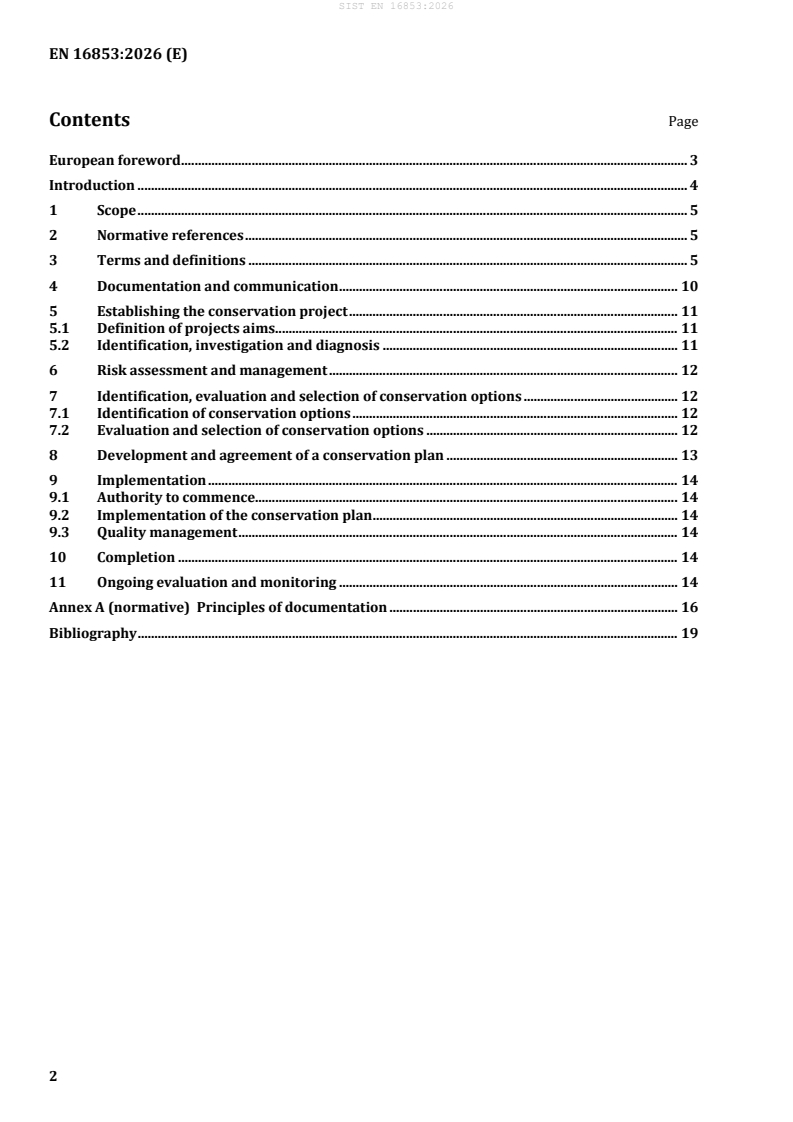
Contents Page
European foreword . 3
Introduction . 4
1 Scope . 5
2 Normative references . 5
3 Terms and definitions . 5
4 Documentation and communication . 10
5 Establishing the conservation project . 11
5.1 Definition of projects aims. 11
5.2 Identification, investigation and diagnosis . 11
6 Risk assessment and management . 12
7 Identification, evaluation and selection of conservation options . 12
7.1 Identification of conservation options . 12
7.2 Evaluation and selection of conservation options . 12
8 Development and agreement of a conservation plan . 13
9 Implementation . 14
9.1 Authority to commence . 14
9.2 Implementation of the conservation plan . 14
9.3 Quality management . 14
10 Completion . 14
11 Ongoing evaluation and monitoring . 14
Annex A (normative) Principles of documentation . 16
Bibliography . 19
European foreword
This document (EN 16853:2026) has been prepared by Technical Committee CEN/TC 346 “Conservation
of Cultural Heritage”, the secretariat of which is held by UNI.
This European Standard shall be given the status of a national standard, either by publication of an
identical text or by endorsement, at the latest by September 2026, and conflicting national standards shall
be withdrawn at the latest by September 2026.
Attention is drawn to the possibility that some of the elements of this document may be the subject of
patent rights. CEN shall not be held responsible for identifying any or all such patent rights.
This document supersedes EN 16853:2017.
This document includes the following significant technical changes with respect to EN 16853:2017:
a) the mandatory Annex A “Principles of documentation” has been included;
b) Clause 4 “Overview” has been removed;
c) Clause 11 “Ongoing evaluation and monitoring” has been added.
Any feedback and questions on this document should be directed to the users’ national standards body.
A complete listing of these bodies can be found on the CEN website.
According to the CEN-CENELEC Internal Regulations, the national standards organisations of the
following countries are bound to implement this European Standard: Austria, Belgium, Bulgaria, Croatia,
Cyprus, Czech Republic, Denmark, Estonia, Finland, France, Germany, Greece, Hungary, Iceland, Ireland,
Italy, Latvia, Lithuania, Luxembourg, Malta, Netherlands, Norway, Poland, Portugal, Republic of North
Macedonia, Romania, Serbia, Slovakia, Slovenia, Spain, Sweden, Switzerland, Türkiye and the United
Kingdom.
Introduction
Cultural heritage is of significance and value to present and future generations. Conservation is a central
consideration when it comes to retaining, protecting and sharing that significance and offers a rare and
privileged opportunity to understand, enhance, and protect cultural heritage. It follows that decisions to
embark on conservation are of concern to society and should be made in a responsible and informed
manner.
Conservation often involves different participants and may require dialogue with stakeholders. It is an
inter-disciplinary practice involving a range of professionals with historic, scientific, technical and other
competences. How conservation is achieved and the manner in which it is thought about, planned and
carried out is of concern to not only conservation practitioners but also to allied professionals and to
owners and custodians and is the subject of this document.
Conservation professionals seek to understand the object and how it has attained its present condition.
They use knowledge of the object, its past and present use and diagnosis to decide what, if any, action is
needed to secure its future use and enjoyment. Conservation of tangible cultural heritage respects its
intangible aspects and may comprise some or all of preventive, remedial or restoration work.
The objective of conservation is to manage change in a way that sustains the significance of cultural
heritage. Conservation is more complex than just a mechanistic series of actions with a beginning, middle
and end. Successful conservation results in the delivery of identified objectives. It usually involves the
following components: documentation, definition of scope, information gathering, risk evaluation,
formulation of conservation options, and the development and implementation of a conservation plan.
Although conservation can be understood as an ongoing process, continuing into the future, a specific
intervention or project can be completed by the delivery and evaluation of an agreed set of outcomes
including recommendations. Ultimately the emphasis on each component will depend on the
circumstances in which conservation is undertaken.
This document sets out good practice for the conceptual and practical elements of conservation. It is a
tool that can stand alone or support national regulations, always in compliance with them, and applies to
all types of objects, whether protected by legislation or not. It can be applied to public and private
tendering, and to procedures in institutions. It also provides the principles that all documentation
practice in conservation should rest upon regardless on whether the methods used employ digital or
analogue tools. Aligning documentation practice with these principles will make documentation more
interoperable and accessible. This document addresses ethical requirements to make knowledge about
cultural heritage available. It enables stakeholders to understand the value and maximize the use of
conservation records.
1 Scope
This document specifies the process of decision-making, planning, implementing and documenting the
conservation of tangible cultural heritage. It applies to material expressions of tangible cultural heritage
such as individual objects, collections, the built environment, historic sites, archaeological sites and
cultural landscapes.
This document concerns the documentation gathered during a conservation process and focuses on
concepts to support the sector in working towards interoperability, whilst not specifying methods,
systems or conventions.
NOTE This document does not cover how to identify cultural heritage nor who or what competences are
required to undertake decisions or other parts of the process.
2 Normative references
The following documents are referred to in the text in such a way that some or all of their content
constitutes requirements of this document. For dated references, only the edition cited applies. For
undated references, the latest edition of the referenced document (including any amendments) applies.
EN 16095:2012, Conservation of cultural property — Condition recording for movable cultural heritage
EN 16096:2012, Conservation of cultural property — Condition survey and report of built cultural heritage
EN 17429:2020, Conservation of cultural heritage — Procurement of conservation services and works
3 Terms and definitions
For the purposes of this document, the following terms and definitions apply.
ISO and IEC maintain terminology databases for use in standardization at the following addresses:
— ISO Online browsing platform: available at https://www.iso.org/obp
— IEC Electropedia: available at https://www.electropedia.org/
3.1
cultural heritage
tangible and intangible entities of significance to present and future generations
[SOURCE: EN 15898:2019, 3.1.1]
3.2
significance
combination of all the values assigned to an object, ensemble or collection
[SOURCE: EN 15898:2019, 3.1.7]
3.3
value
aspect of importance that individuals, communities or society assign(s) to an object, ensemble or
collection in a particular context
Note 1 to entry: Values can be of different types, for example: artistic, symbolic, historical, social, economic,
scientific, educational, technological, functional, etc.
Note 2 to entry: The assigned value can change according to circumstance, e.g. how the judgement is made, the
context and the moment in time. Value should always be indicated by its qualifying type.
[SOURCE: EN 15898:2019, 3.1.6]
3.4
object
single manifestation of tangible cultural heritage
Note 1 to entry: The term “object” is used in this document for cultural heritage, both immovable and movable. In
specific professional contexts, other terms are used: e.g. “artefact”, “cultural property”, “item”, “site”, “building”,
“monument”, “specimen”, “structure”, “cultural landscape”, “document”.
[SOURCE: EN 15898:2019, 3.1.3]
3.5
conservation
conservation-restoration
measures and actions aimed at safeguarding cultural heritage while respecting its significance, including
its accessibility to present and future generations
[SOURCE: EN 15898:2019, 3.3.1— modified; Note 1, 2 and 3 to entry have been removed.]
3.6
documentation
recorded information created, collected, held and maintained for the purpose of present and future
conservation and for reference
EXAMPLE X-radiographs, drawings, photographs, written reports, computer files, photogrammetry, laser-
scanning, etc.
Note 1 to entry: This term can also refer to the process itself.
Note 2 to entry: Documentation of all stages of conservation is an essential part of the overall process of
conservation planning.
[SOURCE: EN 15898:2019, 3.6.8]
3.7
conservation planning
conservation-restoration planning management tool for the development and coordination of
conservation measures and actions
Note 1 to entry: An outcome of conservation planning may be a ‘Conservation Plan’.
[SOURCE: EN 15898:2019, 3.6.2]
3.8
treatment
direct intervention to achieve stated conservation aims
Note 1 to entry: The least invasive treatment consistent with achieving the stated conservation aims is often
referred to as minimum intervention.
[SOURCE: EN 15898:2019, 3.5.1]
3.9
condition report
record of condition for a specific purpose, dated and authored
Note 1 to entry: A condition report normally results from a condition survey.
[SOURCE: EN 15898:2019, 3.6.5]
3.10
investigation
obtaining and gathering the information necessary for a conservation decision-making process
Note 1 to entry: This should include both qualitative and quantitative information.
Note 2 to entry: Investigation is frequently invasive, entailing opening up floors or roofs, the making of holes for
fibre-optics, taking samples, etc., and may be locally destructive, as is archaeological excavation. Non-invasive
methods include inspection, photogrammetry, remote sensing, the study of documentary and/or oral sources, etc.
[SOURCE: EN 15898:2019, 3.6.3]
3.11
diagnosis
process of identifying the present condition of an object and determining the nature and causes of any
change, as well as the likely consequences
Note 1 to entry: Diagnosis is based on observation, investigation, historical analysis, etc.
[SOURCE: EN 15898:2019, 3.6.6]
3.12
deterioration
unintentional alteration that reduces significance or stability
Note 1 to entry: This term can also refer to the process itself.
Note 2 to entry: Degradation is gradual deterioration.
Note 3 to entry: The term “decay” is sometimes used as a synonym.
[SOURCE: EN 15898:2019, 3.2.8]
3.13
condition
physical state of an object at a particular time
[SOURCE: EN 15898:2019, 3.2.1]
3.14
alteration
change in condition, beneficial or not, intentional or not
[SOURCE: EN 15898:2019, 3.2.4]
3.15
preventive conservation
measures and actions aimed at avoiding or minimizing future damage, deterioration, loss and
consequently, any invasive intervention
Note 1 to entry: In the field of movable heritage, “preventive conservation” is generally indirect; namely, these
measures and actions are carried out within the immediate environment of the object.
Note 2 to entry: Strategies combining preventive actions and measures are outlined in a conservation plan.
[SOURCE: EN 15898:2019, 3.3.8]
3.16
remedial conservation
actions applied directly to an object to arrest or slow deterioration and/or to limit damage
[SOURCE: EN 15898:2019, 3.3.9]
3.17
restoration
actions applied to a stable or stabilized object aimed at facilitating its appreciation, understanding and/or
use, while respecting and/or revealing its significance and the materials and techniques used
Note 1 to entry: In some professional communities, especially in the field of immovable cultural heritage, the
term restoration traditionally covers the whole field of conservation.
Note 2 to entry: Remedial conservation is often carried out at the same time as restoration.
[SOURCE: EN 15898:2019, 3.3.10]
3.18
collection
group of objects having shared or combined significance
Note 1 to entry: The term “collection” is mainly used within “movable cultural heritage”. In the context of
immovable cultural heritage other terms are used: e.g. historic ensemble, historic site, conservation area, historic
garden.
[SOURCE: EN 15898:2019, 3.1.5]
3.19
environment
surroundings of an object, some aspects of which may affect its condition
Note 1 to entry: Such aspects could be of human, physical, chemical, biological, geological or climatic origin.
[SOURCE: EN 15898:2019, 3.2.2]
3.20
condition survey
condition assessment
planned and methodical assessment of the condition of an object or a collection
[SOURCE: EN 15898:2019, 3.6.4]
3.21
agent
individual person or group who has the potential to perform intentional actions of kinds for which
someone may be held responsible
[SOURCE: ISO 21127:2023, 9, E39 Actor]
3.22
authority file
list or file of headings to be used in an index, e.g. forms of proper names, subject headings
Note 1 to entry: Such pre-established lists are used in particular to coordinate the indexing of collections.
Note 2 to entry: It refers to index of terms, names, classes and other items used in records, in the format preferred
by the authority to allow consistent use and information retrieval.
[SOURCE: ISO 999:1996, 3.1 — modified; Note 2 to entry has been added.]
3.23
local authority file
authority file which is used within an organisation or project
3.24
available record
record which is retained and retrievable
3.25
accessible record
record which are available and easy to find and use by a range of agents
3.26
shared authority file
authority file which has been made accessible for use by multiple organisations and projects
3.27
proprietary format
file format whose encoding is privately owned and controlled and it is often not possible to decode
without purchased software
3.28
open format
file format whose encoding is controlled by a community and published freely to allow decoding also with
open-source software
3.29
instrument
tool used to facilitate analytical work and observation
3.30
record
retrievable part of documentation treated as a unit in a system
3.31
structured record
record which is produced using a pre-defined format and its contents can be systematically retrieved
3.32
free-text record
record which is produced using natural language
3.33
record
process of producing documentation and records
4 Documentation and communication
Documentation of cultural heritage is an ongoing activity. All conservation projects shall be documented.
This documentation comprises more than information about the intervention carried out.
Documentation of plans, decisions, measures and actions is essential. A systematic framework or
structure for data shall be established, within which all information about the process shall be recorded.
The condition recording elements of this documentation shall conform to EN 16095:2012 or
EN 16096:2012. Principles of documentation shall comply with Annex A of this document.
Responsibility for documentation, its form and content and internal communication between parties
shall be established at the start of the process.
The extent of conservation project documentation will be determined by the context of the project. In the
course of a project different types of documents arise:
a) legal, e.g. relating to ownership, provenance and Health and Safety regulations;
b) financial and administrative, e.g. budgets, insurance;
c) contractual, e.g. tendering, completion documents;
d) historical, e.g. previous archival records;
e) technical, e.g. object and condition information, results of investigation and diagnosis, actions and
treatments, records of meetings, recommendations for future management, further analysis.
Wherever these documents are created they shall be compiled as a record of the conservation process.
Documentation shall include the stages and critical elements of a plan of work and arguments for taking
decisions.
Documentary records should be of a level of detail and clarity appropriate to their intended use and in a
form that permits them to be retained for future reference. Documentation about the cultural heritage
shall include relevant graphical information.
Conservation projects can be of interest to a wider audience. Conservation professionals and
commissioners shall agree the extent of any wider communication. Communication during and after the
intervention is an important opportunity to raise awareness amongst the public for a better sharing of
the objectives and ethics of conservation. Where circumstances permit, consideration should be given to
publication and dissemination of projects. Furthermore, some questions arising from interventions may
lead to the establishment of a research programme. This shall take account of any confidentiality
requirements or copyright (for example of the use of personal information or images).
5 Establishing the conservation project
...