

EN 10272:2016
(Main)Stainless steel bars for pressure purposes
- Abstract
This document specifies the technical delivery conditions for hot and cold formed stainless steel bars for the construction of pressure equipment supplied in accordance with one of the process routes and surface finishes listed in Table 5.
The general technical delivery conditions in EN 10021 also apply.
NOTE Once this European Standard is published in the EU Official Journal (OJEU) under Directive 97/23/EC, presumption of conformity to the Essential Safety Requirements (ESRs) of Directive 97/23/EC is limited to technical data of materials in this European Standard and does not presume adequacy of the material to a specific item of equipment. Consequently, the assessment of the technical data stated in this material standard against the design requirements of this specific item of equipment to verify that the ESRs of Directive 97/23/EC are satisfied, needs to be done.
- Status
- Published
- Publication Date
- 12-Jul-2016
- Withdrawal Date
- 30-Jan-2017
- Technical Committee
- ECISS/TC 107 - Steels for pressure purposes
- Drafting Committee
- ECISS/TC 107 - Steels for pressure purposes
- Current Stage
- 9093 - Decision to confirm - Review Enquiry
- Start Date
- 13-Jun-2022
- Completion Date
- 07-Oct-2026


Overview
EN 10272:2016 - Stainless steel bars for pressure purposes (CEN) specifies the technical delivery conditions for hot- and cold-formed stainless steel bars and rods intended for the construction of pressure equipment. It covers delivery in accordance with the process routes and surface finishes listed in the standard (Table 6) and is used alongside the general delivery conditions in EN 10021. The document also defines purchaser information, classification, inspection, testing and marking requirements relevant to pressure‑purpose stainless steel bars.
Key topics and technical requirements
- Scope and product forms: Hot and cold formed stainless steel bars and rods for pressure equipment.
- Classification: Steels are classified by microstructure - ferritic, martensitic, austenitic, and austenitic‑ferritic (duplex) - referenced to EN 10088‑1.
- Delivery conditions: Specifies required information at order (quantity, shape, dimensions, steel name/number, delivery condition, process route/surface finish, inspection certificate).
- Process routes & surface finish: Products are supplied according to agreed process routes and surface finishes (see Table 6 of EN 10272).
- Testing & inspection:
- Chemical analysis and product analysis verification.
- Mechanical testing (tensile tests at room and elevated temperatures; Charpy impact tests where applicable).
- Corrosion resistance checks (e.g., intergranular corrosion tests) and non‑destructive testing for internal soundness (ultrasonic testing referenced).
- Hardness testing and verification options.
- Inspection documents per EN 10204 (e.g., 3.1 certificates).
- Purchaser options: Buyers can specify steelmaking process, tighter carbon/sulfur limits, additional impact or elevated‑temperature tensile verification, special surface quality, marking.
- Regulatory note: When used under the EU Pressure Equipment Directive (2014/68/EU), the standard provides presumption of conformity limited to material technical data; designers must still verify material adequacy for specific equipment.
Applications
- Manufacture and supply of bars and rods used in pressure vessels, boilers, piping spools, heat exchangers and other pressure equipment where stainless steel is required for strength and corrosion resistance.
- Specification reference in procurement, quality control, fabrication and inspection processes for pressure‑purpose components.
Who uses this standard
- Material purchasers and specifiers in oil & gas, petrochemical, power generation and chemical industries
- Steel manufacturers and mill test laboratories
- Pressure equipment designers, fabricators, inspectors and certification bodies
Related standards (selection)
- EN 10021 (general delivery conditions)
- EN 10088‑1 (list/classification of stainless steels)
- EN 10204 (inspection documents)
- EN 10058/59/60/61 (dimensional standards for bars)
- EN ISO 6892‑1 / EN ISO 148‑1 (tensile and Charpy test methods)
- EN 10308 (ultrasonic testing of bars)
Keywords: EN 10272:2016, stainless steel bars, pressure purposes, pressure equipment, CEN, delivery conditions, process routes, EN 10021.
Relations
- Effective Date
- 08-Jun-2022
- Effective Date
- 09-Feb-2026
- Effective Date
- 28-Jan-2026
- Effective Date
- 28-Jan-2026
- Effective Date
- 28-Jan-2026
- Effective Date
- 28-Jan-2026
- Effective Date
- 28-Jan-2026
- Effective Date
- 28-Jan-2026
- Effective Date
- 28-Jan-2026
- Effective Date
- 28-Jan-2026
- Effective Date
- 28-Jan-2026
- Effective Date
- 28-Jan-2026
- Effective Date
- 28-Jan-2026
- Effective Date
- 28-Jan-2026
- Effective Date
- 28-Jan-2026
Get Certified
Connect with accredited certification bodies for this standard

Element Materials Technology
Materials testing and product certification.

Inštitut za kovinske materiale in tehnologije
Institute of Metals and Technology. Materials testing, metallurgical analysis, NDT.
Sponsored listings
Frequently Asked Questions
EN 10272:2016 is a standard published by the European Committee for Standardization (CEN). Its full title is "Stainless steel bars for pressure purposes". This standard covers: This document specifies the technical delivery conditions for hot and cold formed stainless steel bars for the construction of pressure equipment supplied in accordance with one of the process routes and surface finishes listed in Table 5. The general technical delivery conditions in EN 10021 also apply. NOTE Once this European Standard is published in the EU Official Journal (OJEU) under Directive 97/23/EC, presumption of conformity to the Essential Safety Requirements (ESRs) of Directive 97/23/EC is limited to technical data of materials in this European Standard and does not presume adequacy of the material to a specific item of equipment. Consequently, the assessment of the technical data stated in this material standard against the design requirements of this specific item of equipment to verify that the ESRs of Directive 97/23/EC are satisfied, needs to be done.
This document specifies the technical delivery conditions for hot and cold formed stainless steel bars for the construction of pressure equipment supplied in accordance with one of the process routes and surface finishes listed in Table 5. The general technical delivery conditions in EN 10021 also apply. NOTE Once this European Standard is published in the EU Official Journal (OJEU) under Directive 97/23/EC, presumption of conformity to the Essential Safety Requirements (ESRs) of Directive 97/23/EC is limited to technical data of materials in this European Standard and does not presume adequacy of the material to a specific item of equipment. Consequently, the assessment of the technical data stated in this material standard against the design requirements of this specific item of equipment to verify that the ESRs of Directive 97/23/EC are satisfied, needs to be done.
EN 10272:2016 is classified under the following ICS (International Classification for Standards) categories: 77.040.01 - Testing of metals in general; 77.140.30 - Steels for pressure purposes; 77.140.60 - Steel bars and rods. The ICS classification helps identify the subject area and facilitates finding related standards.
EN 10272:2016 has the following relationships with other standards: It is inter standard links to EN 10272:2007, ISO 286-1:2010, EN ISO 3651-2:1998, EN ISO 6892-2:2011, EN 10058:2018, EN 10088-1:2014, EN 10060:2003, EN 10308:2001, EN 10052:1993, EN 10020:2000, EN 10204:2004, EN 10168:2004, EN 10079:2007, EN 10021:2006, EN ISO 148-1:2010. Understanding these relationships helps ensure you are using the most current and applicable version of the standard.
EN 10272:2016 is associated with the following European legislation: EU Directives/Regulations: 2014/68/EU, 97/23/EC; Standardization Mandates: M/071. When a standard is cited in the Official Journal of the European Union, products manufactured in conformity with it benefit from a presumption of conformity with the essential requirements of the corresponding EU directive or regulation.
EN 10272:2016 is available in PDF format for immediate download after purchase. The document can be added to your cart and obtained through the secure checkout process. Digital delivery ensures instant access to the complete standard document.
Standards Content (Sample)
2003-01.Slovenski inštitut za standardizacijo. Razmnoževanje celote ali delov tega standarda ni dovoljeno.Stäbe aus nichtrostendem Stahl für DruckbehälterBarres en acier inoxydable pour appareils à pressionStainless steel bars for pressure purposes77.140.60Jeklene palice in drogoviSteel bars and rods77.140.30Jekla za uporabo pod tlakomSteels for pressure purposes77.140.20Visokokakovostna jeklaStainless steelsICS:Ta slovenski standard je istoveten z:EN 10272:2016SIST EN 10272:2016en,fr,de01-oktober-2016SIST EN 10272:2016SLOVENSKI
STANDARDSIST EN 10272:20071DGRPHãþD
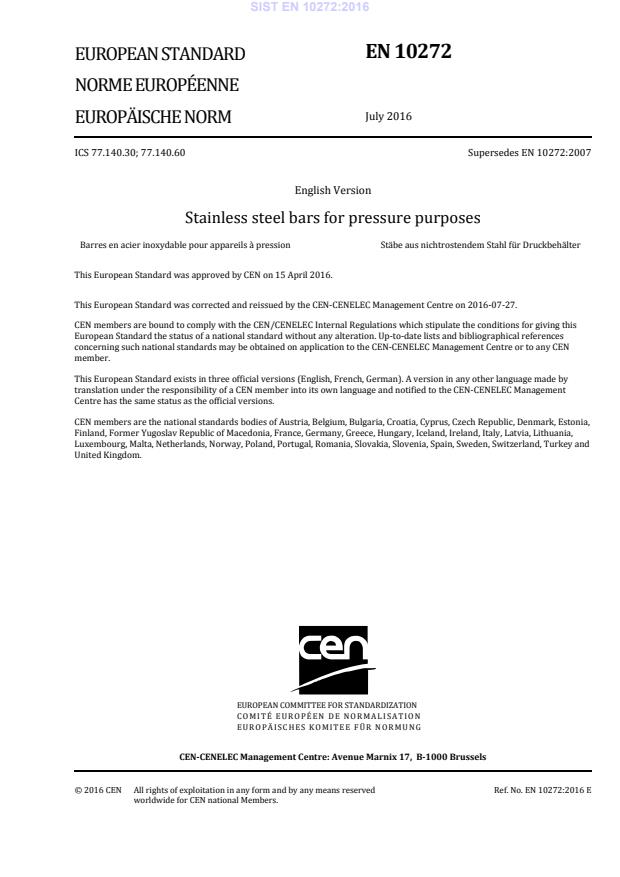
EUROPEAN STANDARD NORME EUROPÉENNE EUROPÄISCHE NORM
EN 10272
July 2016 ICS 77.140.30; 77.140.60 Supersedes EN 10272:2007
English Version
Stainless steel bars for pressure purposes
Barres en acier inoxydable pour appareils à pression
Stäbe aus nichtrostendem Stahl für Druckbehälter This European Standard was approved by CEN on 15 April 2016.
This European Standard was corrected and reissued by the CEN-CENELEC Management Centre on 2016-07-27.
CEN members are bound to comply with the CEN/CENELEC Internal Regulations which stipulate the conditions for giving this European Standard the status of a national standard without any alteration. Up-to-date lists and bibliographical references concerning such national standards may be obtained on application to the CEN-CENELEC Management Centre or to any CEN member.
This European Standard exists in three official versions (English, French, German). A version in any other language made by translation under the responsibility of a CEN member into its own language and notified to the CEN-CENELEC Management Centre has the same status as the official versions.
CEN members are the national standards bodies of Austria, Belgium, Bulgaria, Croatia, Cyprus, Czech Republic, Denmark, Estonia, Finland, Former Yugoslav Republic of Macedonia, France, Germany, Greece, Hungary, Iceland, Ireland, Italy, Latvia, Lithuania, Luxembourg, Malta, Netherlands, Norway, Poland, Portugal, Romania, Slovakia, Slovenia, Spain, Sweden, Switzerland, Turkey and United Kingdom.
EUROPEAN COMMITTEE FOR STANDARDIZATION
COMITÉ EUROPÉEN DE NORMALISATION
EUROPÄISCHES KOMITEE FÜR NORMUNG
CEN-CENELEC Management Centre: Avenue Marnix 17,
B-1000 Brussels © 2016 CEN All rights of exploitation in any form and by any means reserved worldwide for CEN national Members. Ref. No. EN 10272:2016 E SIST EN 10272:2016
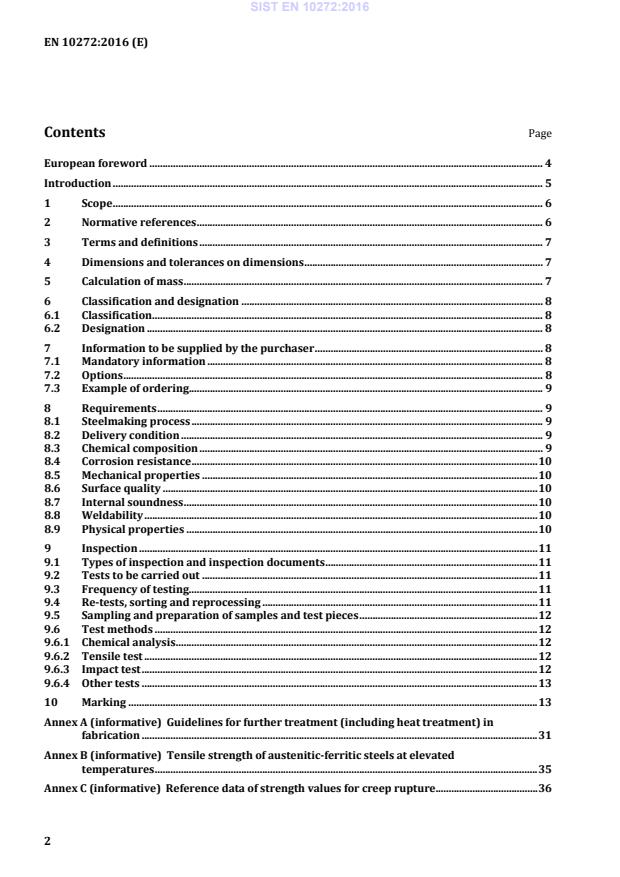
Guidelines for further treatment (including heat treatment) in fabrication . 31 Annex B (informative)
Tensile strength of austenitic-ferritic steels at elevated temperatures . 35 Annex C (informative)
Reference data of strength values for creep rupture. 36 SIST EN 10272:2016
Significant changes to the previous version EN 10272:2007 . 37 Annex ZA (informative)
Relationship between this European Standard and the Essential Requirements of Directive 2014/68/EU . 38 Bibliography . 39
Outokumpu OYJ FI – 02200 Espoo, Finland for steel grades 1.4162 and 1.4662 Attention is drawn to the possibility that some of the elements of this document may be the subject of patent rights other than those identified above. CEN shall not be held responsible for identifying any or all such patent rights. CEN and CENELEC maintain online lists of patents relevant to their standards. Users are encouraged to consult the lists for the most up to date information concerning patents (ftp://ftp.cencenelec.eu/EN/IPR/Patents/IPRdeclaration.pdf).
Chemical analysis Unless otherwise agreed at the time of enquiry and order, the choice of a suitable physical or chemical analytical method for the product analysis shall be at the discretion of the manufacturer. In cases of dispute, the analysis shall be carried out by a laboratory approved by both parties. In this case, the analysis method to be used shall be agreed taking into account the relevant existing European Standards. The list of available documents is given in CEN/TR 10261. 9.6.2
Tensile test 9.6.2.1 The tensile test at room temperature shall be carried out as specified in EN ISO 6892-1:2009, generally using a proportional test piece of gauge length L0 = 5,65 oS (S0 = cross-sectional area of the test piece). The tensile strength, elongation after fracture and 0,2 % proof strength shall be determined and for austenitic steels additionally the 1,0 % proof strength. 9.6.2.2 The tensile test at elevated temperatures if agreed shall be carried as specified in EN ISO 6892-2:2011. If the tensile test at elevated temperatures is specified, the 0,2 %-proof strength shall be verified for ferritic and martensitic steels. For austenitic-ferritic steels, the 0,2 %-proof strength and the tensile strength shall be determined. In case of austenitic steels, the 0,2 %-proof strength, the 1,0 %-proof strength and the tensile strength shall be determined. Unless a test temperature for which values are specified has been agreed at the time of enquiry and order, the test shall be carried out 300 °C except for austenitic-ferritic steels for which the test shall be carried out at 250 °C. 9.6.3
Impact test The impact test shall be carried out in accordance with EN ISO 148-1:2010 at 20 °C (unless otherwise agreed), on V-notched test pieces and by using a 2 mm striker (KV2). The average values of a set of three test pieces shall be equal to or greater than the specified value. One individual value may be below the specified value, provided that it is not less than 70 % of that value. If the above conditions are not satisfied then an additional set of three test pieces may be taken at the discretion of the manufacturer from the same sample and tested. To consider the test unit as conforming, after testing the second set, the following conditions shall be satisfied simultaneously: — average value of six test pieces shall be equal to or greater than the specified value; — not more than two of six individual values may be lower than the specified value; SIST EN 10272:2016
10 mm Nominal diameter / Nominal thickness (mm) No test required d < 12 b < 6 Standard test pieces or test pieces with reduced widths at the discretion of the manufacturer.
The largest width possible has to be chosen. 12
d < 15 6
b < 12 Standard 10 mm x 10 mm test pieces d
15 b
12 Where test pieces with reduced width are used (see Table 1), the minimum impact energy values given shall be reduced in proportion to the cross-sectional area of the test piece. 9.6.4
Other tests 9.6.4.1 If a test on the resistance to intergranular corrosion has been agreed, this shall be carried out in accordance with EN ISO 3651-2. 9.6.4.2 If a Brinell hardness test has been agreed, this shall be carried out in accordance with
EN ISO 6506-1. 9.6.4.3 Dimensions and dimensional tolerances of the products shall be tested in accordance with the requirements of the relevant dimensional standards, where available. 9.6.4.4 The surface condition of the products shall be checked for conformity with 8.6 by visual examination without optical aids or, at the discretion of the manufacturer, by an approved automated process. 9.6.4.5 If an ultrasonic test has been agreed for verification of internal soundness, the requirements of EN 10308 shall apply. 10 Marking 10.1 The products or the bundle or boxes shall be marked in a suitable way such that it is possible to determine the cast, the steel grade and the origin of the delivery (see Table 15). 10.2 Special marking may be agreed at the time of enquiry and order. SIST EN 10272:2016
25
c Impacta
c a For products of a circular cross-section, the axis of the notch is approximately parallel to the diameter; for products with a rectangular cross-section, the axis of the notch is perpendicular to the greatest rolled surface. b Test pieces of product may alternatively be tested un-machined, in accordance with EN ISO 377. c Value of 12,5 mm is valid only if a
25 mm, otherwise the value shall be at least a/2. Figure 1 — Position of test pieces for steel bars
160 mm diameter or thickness (longitudinal test pieces) The samples shall be protected by a thermal buffer that means they shall be taken at least at a distance of one radius far from the end of a bar. SIST EN 10272:2016
Key tr transverse Figure 2 — Position of test pieces for steel bars > 160 mm diameter or thickness (transverse test pieces) The axis of the notch on the impact test pieces shall be radial in the case of round steel bars, and perpendicular to the nearest rolled surface for rectangular bars. The location of the axis of the test piece shall be d/6 or a/6 but max. 50 mm from the surface.
max. max. max. max.
Ferritic stainless steel X2CrNi12 1.4003
0,030 1,00 1,50 0,040 0,015c 10,5 to 12,5 – 0,30 to 1,00
0,030 Martensitic stainless steels X12Cr13 1.4006 0,08 to 0,15b 1,00 1,50 0,040 0,015c 11,5 to 13,5 –
0,75 – X17CrNi16–2 1.4057 0,12 to 0,22b 1,00 1,50 0,040 0,015c 15,0 to 17,0 – 1,50 to 2,50 – X3CrNiMo13–4 1.4313
0,05 0,70 1,50 0,040 0,015 12,0 to 14,0 0,30 to 0,70 3,5 to 4,5
0,020 X4CrNiMo16–5-1 1.4418
0,06 0,70 1,50 0,040 0,015c 15,0 to 17,0 0,80 to 1,50 4,0 to 6,0
0,020 a Elements not quoted in this table shall not be intentionally added to the steel without the agreement of the purchaser except for finishing the cast.
All appropriate precautions shall be taken to avoid the addition of such elements from scrap and other materials used in production which would
impair mechanical properties and the suitability of the steel. b Tighter carbon ranges may be agreed at the time of enquiry and order. c Particular ranges of sulfur content may provide improvement of particular properties. For machinability, a controlled sulfur content of 0,015 % to
0,030 % is recommended and may be agreed. For weldability, a controlled sulfur content of 0,008 % to 0,030 % is recommended and may be agreed. SIST EN 10272:2016
Si
Mn max. P max. S max. N Cr Cu Mo Nb Ni Ti X5CrNi18–10 1.4301
0,07
1,00 2,00 0,045 0,015b
0,10 17,5 to 19,5 – – – 8,0 to 10,5 – X2CrNi19–11 1.4306
0,03
1,00 2,00 0,045 0,015b
0,10 18,0 to 20,0 – – – 10,0 to 12,0 – X2CrNi18–9 1.4307
0,03
1,00 2,00 0,045 0,015b
0,10 17,5 to 19,5 – – – 8,0 to 10,5 – X2CrNiN18–10 1.4311
0,03
1,00 2,00 0,045 0,015b 0,12 to 0,22 17,5 to 19,5 – – – 8,5 to 11,5 – X1CrNiSi18–15–4 1.4361
0,015 3,7 to 4,5 2,00 0,025 0,010
0,10 16,5 to 18,5 –
0,20 – 14,0 to 16,0 – X5CrNiMo17–12–2 1.4401
0,07
1,00 2,00 0,045 0,015b
0,10 16,5 to 18,5 – 2,00 to 2,50 – 10,0 to 13,0 – X2CrNiMo17–12–2 1.4404
0,03
1,00 2,00 0,045 0,015b
0,10 16,5 to 18,5 – 2,00 to 2,50 – 10,0 to 13,0 – X2CrNiMoN17–11–2 1.4406
0,03
1,00 2,00 0,045 0,015b 0,12 to 0,22 16,5 to 18,5 – 2,00 to 2,50 – 10,0 to 12,5 – X2CrNiMoN17–13–3 1.4429
0,03
1,00 2,00 0,045 0,015 0,12 to 0,22 16,5 to 18,5 – 2,50 to 3,00 – 11,0 to 14,0 – X2CrNiMo17–12–3 1.4432
0,03
1,00 2,00 0,045 0,015b
0,10 16,5 to 18,5 – 2,50 to 3,00 – 10,5 to 13,0 – X2CrNiMo18–14–3 1.4435
0,03
1,00 2,00 0,045 0,015b
0,10 17,0 to 19,0 – 2,50 to 3,00 – 12,5 to 15,0 – X3CrNiMo17–13–3 1.4436
0,05
1,00 2,00 0,045 0,015b
0,10 16,5 to 18,5 – 2,50 to 3,00 – 10,5 to 13,0 – X2CrNiMoN17–13–5 1.4439
0,03
1,00 2,00 0,045 0,015 0,12 to 0,22 16,5 to 18,5 – 4,0 to 5,0 – 12,5 to 14,5 – X1NiCrMoCuN25–20–7 1.4529
0,02
0,5 1,00 0,030 0,010 0,15 to 0,25 19,0 to 21,0 0,50 to 1,50 6,0 to 7,0 – 24,0 to 26,0 – X1NiCrMoCu25–20–5 1.4539
0,02
0,7 2,00 0,030 0,010
0,15 19,0 to 21,0 1,20 to 2,00 4,0 to 5,0 – 24,0 to 26,0 – X6CrNiTi18–10 1.4541
0,08
1,00 2,00 0,045 0,015b – 17,0 to 19,0 – – – 9,0 to 12,0 5 x C to 0,70 X1CrNiMoCuN20–18–7 1.4547
0,02
0,70 1,00 0,030 0,010 0,18 to 0,25 19,5 to 20,5 0,50 to 1,00 6,0 to 7,0 – 17,5 to 18,5 – X6CrNiNb18–10 1.4550
0,08
1,00 2,00 0,045 0,015 – 17,0 to 19,0 – – 10 x C to 1,00 9,0 to 12,0 – X1NiCrMoCu31–27–4 1.4563
0,02
0,70 2,00 0,030 0,010
0,10 26,0 to 28,0 0,70 to 1,50 3,0 to 4,0 – 30,0 to 32,0 – X6CrNiMoTi17–12–2 1.4571
0,08
1,00 2,00 0,045 0,015b – 16,5 to 18,5 – 2,00 to 2,50 – 10,5 to 13,5 5 x C to 0,70 X6CrNiMoNb17–12–2 1.4580
0,08
1,00 2,00 0,045 0,015 – 16,5 to 18,5 – 2,00 to 2,50 10 x C to 1,00 10,5 to 13,5 – X6CrNi25–20 1.4951 0,04 to 0,08
0,70 2,00 0,035 0,015
0,10 24,0 to 26,0 – – – 19,0 to 22,0 – a Elements not quoted in this table shall not be intentionally added to the steel without the agreement of the purchaser except for finishing the cast. All appropriate precautions shall be taken to avoid the addition of such elements from scrap and other materials used in production which would impair mechanical properties and the suitability of the steel. b Particular ranges of sulfur content may provide improvement of particular properties. For machinability, a controlled sulfur content of 0,015 % to 0,030 % is recommended and may be
agreed. For weldability, a controlled sulfur content of 0,008 % to 0,030 % is recommended and may be agreed. SIST EN 10272:2016
2,00 0,035 0,015 0,05 to 0,20 22,0 to 24,0 0,10 to 0,60 0,10 to 0,60 3,5 to 5,5 – X2CrNiMoN25–7-4 1.4410 0,030 1,00
2,00 0,035 0,015 0,24 to 0,35 24,0 to 26,0 – 3,0 to 4,5 6,0 to 8,0 – X2CrNiMoN22–5-3 1.4462 0,030 1,00
2,00 0,035 0,015 0,10 to 0,22 21,0 to 23,0 – 2,50 to 3,5 4,5 to 6,5 – X2CrMnNiMoN21–5-3 1.4482 0,030 1,00 4,0 to 6,0 0,035 0,030 0,05 to 0,20 19,5 to 21,5
1,0 0,10 to 0,60 1,50 to 3,50 – X2CrNiMoCuWN25–7-4 1.4501 0,030 1,00
1,00 0,035 0,015 0,20 to 0,30 24,0 to 26,0 0,50 to 1,00 3,0 to 4,0 6,0 to 8,0 0,50 to 1,00 X2CrNiMoCuN25–6-3 1.4507 0,030 0,70
2,00 0,035 0,015 0,20 to 0,30 24,0 to 26,0 1,00 to 2,50 3,0 to 4,0 6,0 to 8,0 – X2CrNiMnMoCuN24–4-3–2b 1.4662 0,030 0,70 2,50 to 4,0 0,035 0,005 0,20 to 0,30 23,0 to 25,0 0,10 to 0,80 1,00 to 2,00 3,0 to 4,5 – a Elements not quoted in this table shall not be intentionally added to the steel without the agreement of the purchaser except for finishing the cast. All appropriate precautions
shall be taken to avoid the addition of such elements from scrap and other materials used in production which would impair mechanical properties and the suitability of the
steel. b Patented steel.
Tables 2 to 4 for the cast analysis Element Specified limits, cast analysis % by mass Permissible tolerancea % by mass Carbon
0,030 + 0,005 > 0,030
0,22 ±0,01 Silicon
1,00 + 0,05 > 1,00
3,00 ±0,10 > 3,00
4,50 ±0,15 Manganese > 1,00 > 2,00
1,00
2,00
6,00 + 0,03 ±0,04 ±0, 10 Phosphorus
0,045 + 0,005 Sulfur
0,015 + 0,003 > 0,015
0,030 ±0,005 Nitrogen
0,11 ±0,01
0,11
0,35 ±0,02 Chromium
10,5
15,0 ±0,15 > 15,0
20,0 ±0,20 > 20,0
28,0 ±0,25 Copper
1,00 ±0,07 > 1,00
2,50 ±0,10 Molybdenum
0,60 ±0,03 > 0,60
1,75 ±0,05 > 1,75
7,0 ±0,10 Niobium
1,00 ±0,05 Nickel
1,00 ±0,03 > 1,00
5,0 ±0,07 > 5,0
10,0 ±0,10 > 10,0
20,0 ±0,15 > 20,0
32,0 ±0,20 Titanium
0,70 ±0,05 Tungsten
1,00 ±0,05 a If several product analyses are carried out on one cast, and the content of an individual element determined lies outside the permissible range of the chemical composition specified for the cast analysis, then it is only allowed to exceed the permissible maximum value or to fall short of the permissible minimum value, but not both for one cast. SIST EN 10272:2016
Abbreviationb Type of process route Surface finish Notes e Hot formed 1U Hot formed, not heat treated, not de-scaled Covered with scale (spot ground if necessary) Suitable for products to be further hot formed. For semi-finished products, ground on all-sides can be specified. 1C Hot formed, heat treated c, not de-scaled Covered with scale (spot ground if necessary) Suitable for products to be further processed. For semi-finished products, ground on all-sides can be specified. 1E Hot formed, heat treated c, mechanically de-scaled Largely free of scale (but some black spots may remain) The type of mechanical de-scaling, e.g. grinding, peeling or shot blasting, is left to the manufacturer’s discretion unless otherwise agreed. Suitable for products to be further processed. 1D Hot formed, heat treated c, pickled Free of scale Tolerance
IT 14 f, g 1X Hot formed, heat treated c, rough machined (peeled or rough turned) Metallically clean Tolerance
IT 12 f, g Cold processed 2H Heat treated c, mechanically or chemically descaled, cold processedd Smooth and bright. Substantially smoother than finishes 1E, 1D or 1X On products formed by cold drawing with-out subsequent heat treatment, the tensile strength is substantially increased, particularly on austenitic structure, depending on the degree of forming. Tolerance IT 9 to IT 11 f, g 2D Cold processed d, heat treated c, pickled (skin-passed) Smoother than finishes 1E or 1D Finish for good ductility 2B Heat treated c, machined (peeled), mechanically smoothed Smoother and brighter than finishes 1E, 1D or 1X Pre-finish for close ISO-tolerances. Tolerance IT 9 to IT 11 f, g Special finishing processes 1G or 2G Centreless ground Uniform finish. Type and degree of grinding to be agreed Surface roughness can be specified. Finish for close ISO-tolerances. Normally obtained from material in finishes 1E, 1D, 2H or 2B. Tolerance
IT 8 f, g 1P or 2P Polished Smoother and brighter than finish 1G or 2G. Type and degree of polishing to be agreed Surface roughness can be specified. Finish for close ISO-tolerances. Normally obtained from material in finishes 1E, 1D, 2H, 2B, 1G or 2G. Tolerance
IT 11 f, g a Not all process routes and surface finishes are available for all steels. b First digit, 1 hot formed, 2 cold processed. c On ferritic, austenitic and austenitic-ferritic grades, the heat treatment may be omitted if the conditions for hot forming and
subsequent cooling are such that the requirements for the mechanical properties of the product and the resistance to intergranular corrosion are obtained. d The type of cold processing, e.g. cold drawing, turning, or centreless grinding, is left to the manufacturer’s discretion, provided
that the requirements concerning tolerances on dimensions and surface roughness are respected. e The notes contain information concerning tolerances for bright bars; special agreements are necessary if such information should become obligatory. The given standard tolerance grades IT are taken from ISO 286-1. f For information. g Specific tolerance within the ranges shall be agreed upon at the time of enquiry and order. SIST EN 10272:2016
HBW max. Rp0,2 MPa min. Rm MPa A % min. at 20 °C at –20 °C
(long.) (tr.) (long.) (tr.) (long.) (tr.) Ferritic stainless steel X2CrNi12 1.4003
100 + A 200c 260 450 to
600c 20d – 60 – – – Martensitic stainless steels X12Cr13 1.4006
160 + QT650 – 450 650 to 850 15 – 27 – – – X17CrNi16–2 1.4057
60 + QT800 – 600 800 to 1050 14 – 27 – – – 60 < (d or b)
160 14 27
60 + QT900 – 700 900 to 1050 14 – 27 – – – 60 < (d or b)
160 14 27 X3CrNiMo13–4 1.4313
160 + QT650 – 520 700 to 800 15 – 70 – 40 – 160 < (d or b)
250 – 14 – 50 – –
160 + QT780 – 620 780 to 980 15 – 70 – – – 160 < (d or b)
250 – 14 – 50 – –
160 + QT900 – 800 900 to
1 100 14 – 50 – – – 160 < (d or b)
250 – 14 – 40 – – X4CrNiMo16–5-1 1.4418
160 + QT760 – 550 760 to 960 16 – 90 – 40 – 160 < (d or b)
250 – 14 – 70 – –
160 + QT900 – 700 900 to 1100 16 – 80 – – – 160 < (d or b)
250 – 14 – 60 – – a +A = annealed; +QT = quenched and tempered. b Only for guidance. c HBWmax-values may be raised by 60 units or Rm,max values may be raised by 150 MPa for bars of
35 mm. d The minimum elongation value may be lowered to 14 % for bars of
35 mm thickness having a final cold deformation. e Those grades may also be available as bright bars.
J min. Resistance to intergranular
corrosiond
HBW Rp0,2 Rp1,0 Rmc Ac Steel name Steel number mm max. MPa min. MPa % min. at 20 °C at –196 °C in the delivery condition in the sensitized conditione, f
(long.) (tr.) (long.) (tr.)
X5CrNi18–10 1.4301
160 215 190 225 500 to 700 45 – 100 – 60 yesf nog 160 < (d or b)
400 – 35 – 60 X2CrNi19–11 1.4306
160 215 180 215 460 to 680 45 – 100 – 60 yes yes 160 < (d or b)
400 – 35 – 60 X2CrNi18–9 1.4307
160 215 175 210 500 to 700 45 – 100 – 60 yes yes 160 < (d or b)
400 – 35 – 60 X2CrNiN18–10 1.4311
160 230 270 305 550 to 760 40 – 100 – 60 yes yes 160 < (d or b)
400 – 30 – 60 X1CrNiSi18–15–4 1.4361
160 230 210 240 530 to 730 40 – 100 – – yes yes 160 < (d or b)
400 – 30 – 60 – X5CrNiMo17–12–2 1.4401
160 215 200
...