

EN 13141-8:2022
(Main)Ventilation for buildings - Performance testing of components/products for residential ventilation - Part 8: Performance testing of non-ducted mechanical supply and exhaust ventilation units (including heat recovery)
- Abstract
This document specifies the laboratory test methods and test requirements for the testing of aerodynamic, thermal, acoustic and the electrical performance characteristics of non-ducted mechanical supply and exhaust residential ventilation units used in single dwellings.
The purpose of this document is not to consider the quality of ventilation but to test the performance of the equipment.
This document is applicable to ventilation units, the latter:
a) containing either:
- fans for mechanical supply and exhaust;
- air filters;
- air-to-air heat exchanger for heat and possibly humidity recovery;
- control system;
- inlet and outlet grilles; or
- alternating heat exchangers which provide separate supply and exhaust air flows;
b) provided either:
- in one assembly; or
- in more than one assembly, the separate assemblies of which are designed to be used together.
This document does not deal with ducted units which are covered by EN 13141-7 or units with heat pumps.
Safety requirements are given in EN 60335-2-40 and EN 60335-2-80.
- Status
- Published
- Publication Date
- 06-Sep-2022
- Technical Committee
- CEN/TC 156 - Ventilation for buildings
- Drafting Committee
- CEN/TC 156/WG 2 - Natural and mechanical powered residential ventilation
- Current Stage
- 6060 - Definitive text made available (DAV) - Publishing
- Start Date
- 07-Sep-2022
- Due Date
- 03-Oct-2020
- Completion Date
- 07-Sep-2022
Buy Documents




Overview
EN 13141-8:2022 - "Ventilation for buildings - Performance testing of components/products for residential ventilation - Part 8" - defines laboratory test methods and requirements for the performance testing of non-ducted mechanical supply and exhaust residential ventilation units, including units with air-to-air heat recovery. The standard focuses on measuring equipment performance (aerodynamic, thermal, acoustic and electrical) for units used in single dwellings (and units ventilating more than one room). It does not assess indoor air quality or cover ducted units (see EN 13141-7) or units with heat pumps.
Key topics and technical requirements
- Scope of tested units: units containing fans (supply and/or exhaust), filters, air-to-air heat exchangers (heat and possible humidity recovery), control systems, inlet/outlet grilles, or alternating heat exchangers; single or multi‑assembly units designed to operate together.
- Performance domains:
- Aerodynamic: leakage, internal/external airtightness, filter bypass, air flow measurement, air transfer and indoor mixing, air flow sensitivity.
- Thermal: heat recovery performance, standardized and cold‑climate test conditions, temperature and humidity measurement, calculation of temperature ratios.
- Electrical: effective power input and electrical performance under defined operating points.
- Acoustic: radiated sound power and airborne sound insulation using reverberant, anechoic or free‑field methods.
- Classification: results include classifications (e.g., leakage classes, air flow sensitivity, indoor/outdoor airtightness).
- Test documentation: standardized test reports, product specification outputs and additional performance data requirements.
- Normative references and safety: safety requirements referenced from EN 60335-2-40 and EN 60335-2-80; cross‑references to other parts of EN 13141 and EN 13142 for terminology and performance parameters.
- Annexes: include test layouts and detailed leakage/indoor mixing test methods.
Applications and who uses it
- Manufacturers: validate product performance, support technical datasheets and claims for non‑ducted decentralised ventilation units and heat‑recovery devices.
- Independent test laboratories: perform accredited laboratory testing for certification and regulatory compliance.
- Certification bodies and regulators: assess conformity and prepare product classifications for market entry.
- HVAC designers, specifiers and installers: compare units by standardized performance metrics to select appropriate equipment for residential projects.
- Researchers and consultants: evaluate aerodynamic, thermal and acoustic behavior under repeatable laboratory conditions.
Related standards
- EN 13141-7 - performance testing of ducted residential ventilation units
- EN 13142 - performance characteristics and definitions for residential ventilation components
- EN 60335-2-40, EN 60335-2-80 - electrical safety requirements for ventilation appliances
- EN 12792 - symbols, terminology and graphic conventions for ventilation
Keywords: EN 13141-8:2022, non-ducted mechanical ventilation, residential ventilation standard, performance testing, heat recovery ventilation, aerodynamic testing, thermal performance, acoustic testing, HVAC certification.
Relations
- Effective Date
- 14-Sep-2022
- Effective Date
- 25-Aug-2026
- Effective Date
- 25-Aug-2026
- Effective Date
- 25-Aug-2026
- Effective Date
- 28-Jan-2026
- Effective Date
- 28-Jan-2026
- Effective Date
- 28-Jan-2026
- Effective Date
- 28-Jan-2026
- Effective Date
- 28-Jan-2026
- Effective Date
- 28-Jan-2026
- Effective Date
- 28-Jan-2026
- Effective Date
- 28-Jan-2026
- Effective Date
- 28-Jan-2026
- Effective Date
- 28-Jan-2026
- Effective Date
- 28-Jan-2026
Buy Documents
Get Certified
Connect with accredited certification bodies for this standard

DIBt (Deutsches Institut für Bautechnik)
German Institute for Building Technology.
DIN CERTCO
DIN Group product certification.

Aboma Certification B.V.
Specialized in construction, metal, and transport sectors.
Sponsored listings
Frequently Asked Questions
EN 13141-8:2022 is a standard published by the European Committee for Standardization (CEN). Its full title is "Ventilation for buildings - Performance testing of components/products for residential ventilation - Part 8: Performance testing of non-ducted mechanical supply and exhaust ventilation units (including heat recovery)". This standard covers: This document specifies the laboratory test methods and test requirements for the testing of aerodynamic, thermal, acoustic and the electrical performance characteristics of non-ducted mechanical supply and exhaust residential ventilation units used in single dwellings. The purpose of this document is not to consider the quality of ventilation but to test the performance of the equipment. This document is applicable to ventilation units, the latter: a) containing either: - fans for mechanical supply and exhaust; - air filters; - air-to-air heat exchanger for heat and possibly humidity recovery; - control system; - inlet and outlet grilles; or - alternating heat exchangers which provide separate supply and exhaust air flows; b) provided either: - in one assembly; or - in more than one assembly, the separate assemblies of which are designed to be used together. This document does not deal with ducted units which are covered by EN 13141-7 or units with heat pumps. Safety requirements are given in EN 60335-2-40 and EN 60335-2-80.
This document specifies the laboratory test methods and test requirements for the testing of aerodynamic, thermal, acoustic and the electrical performance characteristics of non-ducted mechanical supply and exhaust residential ventilation units used in single dwellings. The purpose of this document is not to consider the quality of ventilation but to test the performance of the equipment. This document is applicable to ventilation units, the latter: a) containing either: - fans for mechanical supply and exhaust; - air filters; - air-to-air heat exchanger for heat and possibly humidity recovery; - control system; - inlet and outlet grilles; or - alternating heat exchangers which provide separate supply and exhaust air flows; b) provided either: - in one assembly; or - in more than one assembly, the separate assemblies of which are designed to be used together. This document does not deal with ducted units which are covered by EN 13141-7 or units with heat pumps. Safety requirements are given in EN 60335-2-40 and EN 60335-2-80.
EN 13141-8:2022 is classified under the following ICS (International Classification for Standards) categories: 91.140.30 - Ventilation and air-conditioning systems. The ICS classification helps identify the subject area and facilitates finding related standards.
EN 13141-8:2022 has the following relationships with other standards: It is inter standard links to EN 13141-8:2014, ISO 13347-2:2004, ISO 13347-4:2004, ISO 13347-3:2004, EN ISO 10140-5:2021, EN 12792:2003, EN ISO 10140-2:2021, EN ISO 16890-1:2016, EN ISO/IEC 17025:2017, EN ISO 717-1:2020, EN ISO 5801:2017, EN ISO 16890-3:2024, EN 15895:2011, EN ISO 16890-4:2022, EN ISO 16890-2:2022. Understanding these relationships helps ensure you are using the most current and applicable version of the standard.
EN 13141-8:2022 is available in PDF format for immediate download after purchase. The document can be added to your cart and obtained through the secure checkout process. Digital delivery ensures instant access to the complete standard document.
Standards Content (Sample)
SLOVENSKI STANDARD
01-november-2022
Nadomešča:
SIST EN 13141-8:2014
Prezračevanje stavb - Preskušanje lastnosti sestavnih delov/izdelkov za
prezračevanje stanovanjskih stavb - 8. del: Preskušanje lastnosti mehanskih
brezkanalnih dovodnih in odvodnih prezračevalnih enot (vključno z enotami za
vračanje toplote)
Ventilation for buildings - Performance testing of components/products for residential
ventilation - Part 8: Performance testing of non-ducted mechanical supply and exhaust
ventilation units (including heat recovery)
Lüftung von Gebäuden - Leistungsprüfung von Bauteilen/Produkten für die Lüftung von
Wohnungen - Teil 8: Leistungsprüfung von mechanischen Zuluft‐ und Ablufteinheiten
ohne Luftführung (einschließlich Wärmerückgewinnung)
Ventilation des bâtiments - Essais de performance des composants/produits pour la
ventilation des logements - Partie 8 : Essais de performance des unités de ventilation
double flux décentralisées (y compris la récupération de chaleur)
Ta slovenski standard je istoveten z: EN 13141-8:2022
ICS:
91.140.30 Prezračevalni in klimatski Ventilation and air-
sistemi conditioning systems
2003-01.Slovenski inštitut za standardizacijo. Razmnoževanje celote ali delov tega standarda ni dovoljeno.
EN 13141-8
EUROPEAN STANDARD
NORME EUROPÉENNE
September 2022
EUROPÄISCHE NORM
ICS 91.140.30 Supersedes EN 13141-8:2014
English Version
Ventilation for buildings - Performance testing of
components/products for residential ventilation - Part 8:
Performance testing of non-ducted mechanical supply and
exhaust ventilation units (including heat recovery)
Ventilation des bâtiments - Essais de performance des Lüftung von Gebäuden - Leistungsprüfungen von
composants/produits pour la ventilation des Bauteilen/Produkten für die Lüftung von Wohnungen -
logements - Partie 8 : Essais de performance des unités Teil 8: Leistungsprüfung von mechanischen Zuluft- und
de ventilation double flux décentralisées (y compris la Ablufteinheiten ohne Luftführung (einschließlich
récupération de chaleur) Wärmerückgewinnung)
This European Standard was approved by CEN on 10 January 2022.
CEN members are bound to comply with the CEN/CENELEC Internal Regulations which stipulate the conditions for giving this
European Standard the status of a national standard without any alteration. Up-to-date lists and bibliographical references
concerning such national standards may be obtained on application to the CEN-CENELEC Management Centre or to any CEN
member.
This European Standard exists in three official versions (English, French, German). A version in any other language made by
translation under the responsibility of a CEN member into its own language and notified to the CEN-CENELEC Management
Centre has the same status as the official versions.
CEN members are the national standards bodies of Austria, Belgium, Bulgaria, Croatia, Cyprus, Czech Republic, Denmark, Estonia,
Finland, France, Germany, Greece, Hungary, Iceland, Ireland, Italy, Latvia, Lithuania, Luxembourg, Malta, Netherlands, Norway,
Poland, Portugal, Republic of North Macedonia, Romania, Serbia, Slovakia, Slovenia, Spain, Sweden, Switzerland, Türkiye and
United Kingdom.
EUROPEAN COMMITTEE FOR STANDARDIZATION
COMITÉ EUROPÉEN DE NORMALISATION
EUROPÄISCHES KOMITEE FÜR NORMUNG
CEN-CENELEC Management Centre: Rue de la Science 23, B-1040 Brussels
© 2022 CEN All rights of exploitation in any form and by any means reserved Ref. No. EN 13141-8:2022 E
worldwide for CEN national Members.
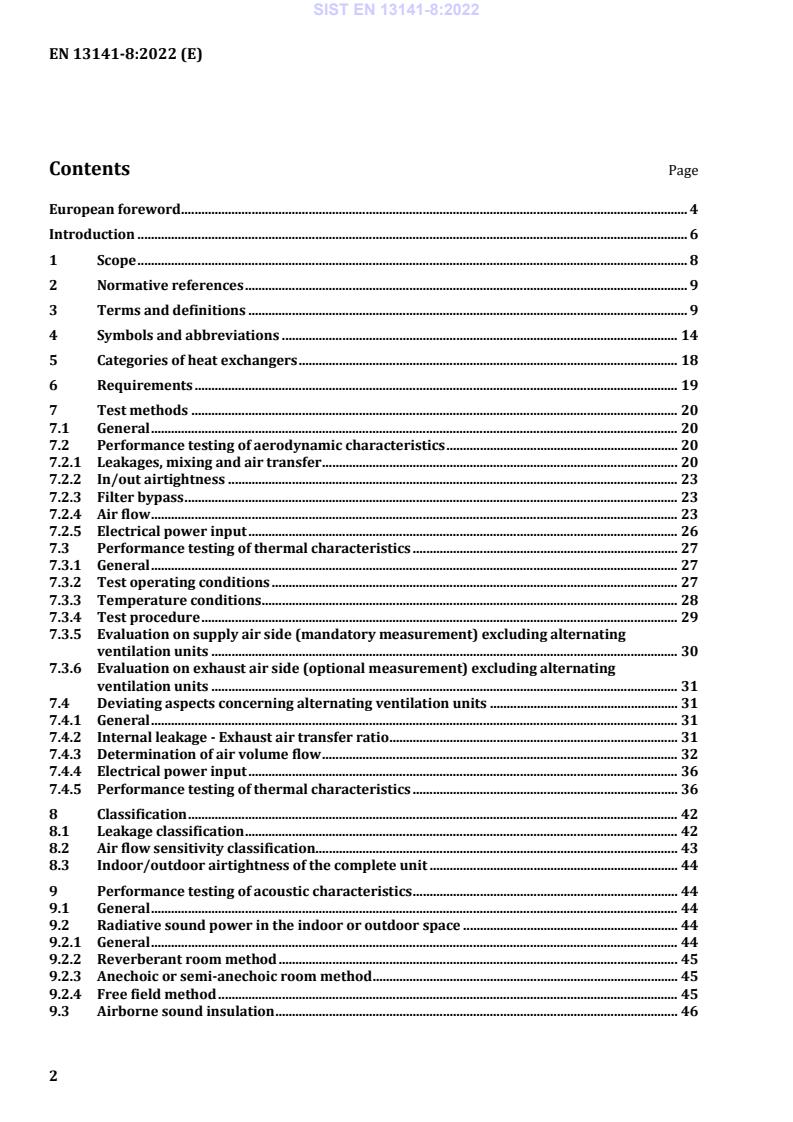
Contents Page
European foreword . 4
Introduction . 6
1 Scope . 8
2 Normative references . 9
3 Terms and definitions . 9
4 Symbols and abbreviations . 14
5 Categories of heat exchangers . 18
6 Requirements . 19
7 Test methods . 20
7.1 General . 20
7.2 Performance testing of aerodynamic characteristics . 20
7.2.1 Leakages, mixing and air transfer . 20
7.2.2 In/out airtightness . 23
7.2.3 Filter bypass . 23
7.2.4 Air flow . 23
7.2.5 Electrical power input . 26
7.3 Performance testing of thermal characteristics . 27
7.3.1 General . 27
7.3.2 Test operating conditions . 27
7.3.3 Temperature conditions . 28
7.3.4 Test procedure . 29
7.3.5 Evaluation on supply air side (mandatory measurement) excluding alternating
ventilation units . 30
7.3.6 Evaluation on exhaust air side (optional measurement) excluding alternating
ventilation units . 31
7.4 Deviating aspects concerning alternating ventilation units . 31
7.4.1 General . 31
7.4.2 Internal leakage - Exhaust air transfer ratio . 31
7.4.3 Determination of air volume flow . 32
7.4.4 Electrical power input . 36
7.4.5 Performance testing of thermal characteristics . 36
8 Classification . 42
8.1 Leakage classification . 42
8.2 Air flow sensitivity classification. 43
8.3 Indoor/outdoor airtightness of the complete unit . 44
9 Performance testing of acoustic characteristics . 44
9.1 General . 44
9.2 Radiative sound power in the indoor or outdoor space . 44
9.2.1 General . 44
9.2.2 Reverberant room method . 45
9.2.3 Anechoic or semi-anechoic room method . 45
9.2.4 Free field method . 45
9.3 Airborne sound insulation . 46
10 Test results . 47
10.1 Test report . 47
10.2 Product specifications. 47
10.3 Additional information related to the performance of the product . 47
10.4 Leakages . 47
10.5 Filter bypass . 48
10.6 Air flow . 49
10.7 Effective power input . 49
10.8 Temperature and humidity ratios . 50
10.9 Acoustic characteristics . 50
Annex A (normative) Test layouts . 52
Annex B (normative) Pressure leakage test method . 55
B.1 General . 55
B.2 External leakage test . 55
B.3 Internal leakage test . 56
Annex C (normative) Indoor mixing . 57
C.1 General . 57
C.2 Determination of indoor mixing - First test . 57
C.3 Determination of indoor mixing - Second test . 57
C.4 Indoor mixing calculation . 57
Bibliography . 58
European foreword
This document (EN 13141-8:2022) has been prepared by Technical Committee CEN/TC 156 “Ventilation
for buildings”, the secretariat of which is held by BSI.
This European Standard shall be given the status of a national standard, either by publication of an
identical text or by endorsement, at the latest by March 2023, and conflicting national standards shall be
withdrawn at the latest by March 2023.
Attention is drawn to the possibility that some of the elements of this document may be the subject of
patent rights. CEN shall not be held responsible for identifying any or all such patent rights.
This document supersedes EN 13141-8:2014.
In addition to a number of editorial revisions, the following main changes have been made with respect
to EN 13141-8:2014:
— scope has been changed, and concerns now also non-ducted units which ventilate more than one
single room;
— terms and definitions as well as symbols and abbreviations have been updated in accordance with
the parameters used in the document;
— new categories of heat exchanger have been added;
— designations in 7.2.1.4 and the Formulae (1) to (4) have been changed;
— reference of the internal and external leakage rates has been changes to the reference air volume
flow;
— extrapolation of the leakage rates has been added;
— 7.2.1.3.2 concerning exhaust air transfer ratio has been added;
— 7.2.4 concerning air flow measurement has been revised;
— requirements to convert the measured values to standard conditions have been added in 7.2.4 and
7.3.2;
— 7.3.3 has been divided into two separate subclauses 7.3.3.1 for standard tests and 7.3.3.2 for cold
climate tests;
— formulae to calculate the temperature ratios have been changed;
— wet bulb temperature for the cold climate test has been changed;
— the order of the specific test for alternating units including storage heat exchanges has been changed;
— deviating aspects for alternating units to determine the air flow correction, thermal performance and
the exhaust air transfer ratio have been revised;
— Table 10 concerning the temperature conditions for the cooling performance test has been moved in
EN 13142.
A list of all parts in the EN 13141 series, published under the general title Ventilation for buildings —
Performance testing of components/products for residential ventilation can be found on the CEN website.
Any feedback and questions on this document should be directed to the users’ national standards body.
A complete listing of these bodies can be found on the CEN website.
According to the CEN-CENELEC Internal Regulations, the national standards organisations of the
following countries are bound to implement this European Standard: Austria, Belgium, Bulgaria, Croatia,
Cyprus, Czech Republic, Denmark, Estonia, Finland, France, Germany, Greece, Hungary, Iceland, Ireland,
Italy, Latvia, Lithuania, Luxembourg, Malta, Netherlands, Norway, Poland, Portugal, Republic of North
Macedonia, Romania, Serbia, Slovakia, Slovenia, Spain, Sweden, Switzerland, Türkiye and the United
Kingdom.
Introduction
This document specifies methods for the performance testing of components used in residential
ventilation systems to establish the performance characteristics as identified in EN 13142.
This document incorporates many references to other European and International Standards, especially
on characteristics other than the aerodynamic characteristics, for instance on acoustic characteristics.
In most cases some additional tests or some additional conditions are given for the specific use in
residential ventilation systems.
This document can be used for the following applications:
— laboratory testing;
— attestation purposes.
The position of this document in the field of standards for the mechanical building services is shown
in Figure 1.
Figure 1 — Position of EN 13141-8 in the field of the mechanical building services
1 Scope
This document specifies the laboratory test methods and test requirements for the testing of
aerodynamic, thermal, acoustic and the electrical performance characteristics of non-ducted mechanical
supply and exhaust residential ventilation units used in single dwellings.
The purpose of this document is not to consider the quality of ventilation but to test the performance of
the equipment.
This document is applicable to ventilation units, the latter:
a) containing either:
— fans for mechanical supply and exhaust;
— air filters;
— air-to-air heat exchanger for heat and possibly humidity recovery;
— control system;
— inlet and outlet grilles; or
— alternating heat exchangers which provide separate supply and exhaust air flows;
b) provided either:
— in one assembly; or
— in more than one assembly, the separate assemblies of which are designed to be used together.
This document does not deal with ducted units which are covered by EN 13141-7 or units with heat
pumps.
Safety requirements are given in EN 60335-2-40 and EN 60335-2-80.
2 Normative references
The following documents are referred to in the text in such a way that some or all of their content
constitutes requirements of this document. For dated references, only the edition cited applies. For
undated references, the latest edition of the referenced document (including any amendments) applies.
EN 12792:2003, Ventilation for buildings - Symbols, terminology and graphical symbols
EN ISO 717-1, Acoustics - Rating of sound insulation in buildings and of building elements — Part 1:
Airborne sound insulation (ISO 717-1)
EN ISO 5801, Fans - Performance testing using standardized airways (ISO 5801)
EN ISO 10140-1, Acoustics - Laboratory measurement of sound insulation of building elements — Part 1:
Application rules for specific products (ISO 10140-1)
EN ISO 10140-2, Acoustics - Laboratory measurement of sound insulation of building elements — Part 2:
Measurement of airborne sound insulation (ISO 10140-2)
EN ISO 10140-4, Acoustics - Laboratory measurement of sound insulation of building elements — Part 4:
Measurement procedures and requirements (ISO 10140-4)
EN ISO 10140-5, Acoustics - Laboratory measurement of sound insulation of building elements — Part 5:
Requirements for test facilities and equipment (ISO 10140-5)
EN ISO 16890 (all parts), Air filters for general ventilation (ISO 16890 (all parts))
ISO 13347-2, Industrial fans - Determination of fan sound power levels under standardized laboratory
conditions - Part 2: Reverberant room method
ISO 13347-3, Industrial fans - Determination of fan sound power levels under standardized laboratory
conditions - Part 3: Enveloping surface methods
ISO 13347-4, Industrial fans - Determination of fan sound power levels under standardized laboratory
conditions - Part 4: Sound intensity method
EN ISO/IEC 17025:2017, General requirements for the competence of testing and calibration laboratories
(ISO/IEC 17025:2017)
3 Terms and definitions
For the purposes of this document, the terms and definitions given in EN 12792:2003 and the following
apply.
ISO and IEC maintain terminological databases for the use in standardization at the following addresses:
— ISO Online browsing platform: available at https://www.iso.org/obp
— IEC Electropedia: available at https://www.electropedia.org/
3.1
external leakage
q
ve
leakage to or from the air flowing inside the casing of the ventilation unit to or from the surrounding air
[SOURCE: EN 13141-4:2021, 3.11]
3.2
internal leakage
q
vi
leakage inside the unit between the exhaust and the supply air flows
[SOURCE: EN 13141-7:2021, 3.2]
3.3
filter bypass leakage
air bypass around filter cells
[SOURCE: EN 13141-7:2021, 3.4]
3.4
indoor/outdoor airtightness
q
vio
maximum air volume flow between the indoor and the outdoor environments at static pressure
difference of –20 Pa and +20 Pa when the fans are “OFF” and all shutters are closed
Note 1 to entry: Indoor/outdoor airtightness is not the external leakage.
[SOURCE: EN 13141-4:2021, 3.13, modified – Removal of “through a non-ducted ventilation unit”,
“corresponding to the setting” and “additional”, adding of “between the indoor and the outdoor
environments”]
3.5
exhaust air transfer ratio
R
s
mass transfer of the discharged air to a zone from extract to supply that is actually recirculated air from
the same zone, due to internal leakage and external casing leakage
3.6
outdoor mixing
R
me
mixing of the two air flows external to the equipment under test between discharge and intake ports at
outdoor terminal points caused by short circuiting
3.7
indoor mixing
R
mi
mixing of the two air flows external to the equipment under test between discharge and intake ports at
indoor terminal points caused by short circuiting
3.8
declared maximum air volume flow
q
vmax,d
declared maximum air volume flow of the unit at 0 Pa static pressure difference, between indoor and
outdoor
[SOURCE: EN 13141-4:2021, 3.6, modified – “at 0 Pa static pressure difference, between indoor and
outdoor” has been added]
3.9
maximum air volume flow
q
vmax
air volume flow corresponding to the maximum achievable fan curve setting of the unit at 0 Pa static
pressure difference between indoor and outdoor, either declared or measured
Note 1 to entry: If the supply and exhaust air volume flows are different, then the maximum air volume flow is
equal to the smaller of the two air volume flows.
[SOURCE: EN 13141-4:2021, 3.7, modified – Note 1 to entry has been replaced by “If the supply and
exhaust air volume flows are different, then the maximum air volume flow is equal to the smaller of the
two air volume flows.”]
3.10
declared minimum air volume flow
q
vmin,d
minimum air volume flow of the unit declared at 0 Pa static pressure difference between indoor and
outdoor
Note 1 to entry: If the supply and exhaust air volume flows are different, then the minimum air volume flow is
equal to the higher of the two air volume flows.
[SOURCE: EN 13141-7:2021, 3.8, modified – “at the reference pressure declared” has been replaced by
“at 0 Pa static pressure difference between indoor and outdoor”]
3.11
reference air volume flow
q
vref
air volume flow at 70 % of the maximum air volume flow
Note 1 to entry: If the air volume flow at 70 % of the maximum air volume flow cannot be adjusted on the product
itself, the closest value above is selected.
[SOURCE: EN 13141-4:2021, 3.8, modified – Note 1 to entry “To determine reference air volume flow, see
5.2.3.4, Table 6.” has been replaced by the one above]
3.12
unit static pressure
p
us
pressure increase induced by the ventilation unit given as difference between the static pressure at the
unit outlet and the total pressure at the unit inlet
Note 1 to entry: The parameter p for a ventilation unit is defined as the parameter p described in
us fs
EN ISO 5801 for a stand alone fan.
[SOURCE: EN 13141-4:2021, 3.2]
3.13
external static pressure difference
p
s,ext
pressure increase induced by the ventilation unit given as difference between the static pressures at the
unit outlet and the unit inlet
Note 1 to entry: The external static pressure difference, p , is used to determine the maximum air volume
s,ext
flow, the reference air volume flow and the minimum air volume flow.
[SOURCE: EN 13141-4:2021, 3.3, modified – “and the minimum air volume flow” has been added in Note 1
to entry]
3.14
air flow sensitivity
v
maximum relative deviation of the maximum air volume flow q due to a static pressure difference of
vmax
+20 Pa and – 20Pa
Note 1 to entry: Unbalanced (unequal) supply and exhaust air streams influence the thermal efficiency of the
ventilation unit and its air exchange capacity.
[SOURCE: EN 13141-4:2021, 3.12, modified – “of a non-ducted ventilation unit” has been removed from
the definition, Note 1 to entry has been added]
3.15
temperature ratio
η
θ
temperature difference between inlet and outlet of one of the air flows divided by the temperature
difference between the inlets of both air flows
[SOURCE: EN 13141-7:2021, 3.15]
3.16
humidity ratio
η
x
difference of vapour mixing ratio between inlet and outlet of one of the air flows divided by the difference
of vapour mixing ratio between the inlets of both air flows
[SOURCE: EN 13141-7:2021, 3.16]
3.17
electrical power input
P
E
average overall electrical power input to the equipment within a defined interval of time for standard air
conditions obtained from:
— the power input of the fans;
— controller(s), compressor(s), safety devices of the equipment(s) excluding additional electrical
heating devices not used for defrosting
Note 1 to entry: Electrical power consumption includes the consumption of the heating device for defrosting
during the cold climate test.
[SOURCE: EN 13141-4:2021, 3.15, modified – Note 1 to entry has been added]
3.18
maximum electrical power input
P
E,max
electrical power input at maximum air volume flow, q
vmax
[SOURCE: EN 13141-4:2021, 3.17, modified – “, and its corresponding pressure, p ” has been
qvmax
removed]
3.19
electrical power input at the reference air volume flow
P
E,ref
electrical power input at reference air volume flow q
vref
[SOURCE: EN 13141-4:2021, 3.16, modified – “, and reference pressure, p ” has been removed]
ref
3.20
supply air transfer ratio
R
e
mass fraction of the discharged air to a zone from outdoor to exhaust that is actually recirculated air from
the same zone, due to internal leakage, external casing leakage and short circuiting
3.21
alternating ventilation unit
pair of mechanical ventilation devices using storage heat exchangers operating in opposite, synchronized
periodically changing air flow direction incorporated in common or two separate casing(s)
3.22
alternating mode
operating mode in which a ventilation unit periodically changes from exhausting air to supplying air and
vice versa
3.23
ventilation mode
constant operating mode where the alternating devices are running in an opposite direction with no heat
recovery
3.24
indoor side
supply and extract air side of the ventilation devices
3.25
cycle time
duration of a cycle in which each path of the alternating device performs one complete supply and exhaust
phase
4 Symbols and abbreviations
For the purposes of this document, the symbols and abbreviations given in EN 12792 and in Table 1
apply.
Table 1 — Symbols
Symbol Designation Unit
c
concentration of tracer gas ppm
absolute deviation of maximum air volume flow due to over —
dq
v,over
pressure of 20 Pa
absolute deviation of maximum air volume flow due to under —
dq
v,under
pressure of 20 Pa
d/λ thermal resistance K/W
airborne sound insulation in third octave bands dB
D
n,e
global airborne sound insulation index dB
D
n,e,w
quotient reduction factor —
f
red
sound power level in third octave band dB
L
W
A-weighted sound power level dB
L
WA
n
-1
fan speed
min
-1
fan speed in ventilation mode
n min
vent
electrical power input W
P
E
electrical power input at the reference air volume flow W
P
E,ref
maximum electrical power input W
P
E,max
electrical power input under test conditions measured at the W
P
E,Te
density ρ
Te
W
P electrical power input at the maximum air flow, q
vmax
el,max
Symbol Designation Unit
electrical power input at the reference air volume flow W
P
el,ref
W
electrical power input at the maximum air flow, q in
P
el,max,vent vmax
ventilation mode
electrical power input at the reference air volume flow in W
P
el,ref,vent
ventilation mode
static pressure Pa
p
s
external static pressure difference Pa
p
s,ext
external static pressure difference under test conditions Pa
p
s,ext,T
e
measured at the density ρ
Te
maximum static pressure Pa
p
s,max
maximum static pressure for each device and each direction Pa
p
s,vent,D1/,2 ex/su
unit static pressure Pa
p
us
unit static pressure under test conditions measured at the Pa
p
us,Te
density
ρ
Te
-1 b
air mass flow
kg ⋅ s
q
m
-1 b
unit mass air flow
q kg ⋅ s
m,max,vent
-1 b
purge mass air flow
q kg ⋅ s
mp
-1 b
purge mass air flow on the indoor side
kg ⋅ s
q
mp,I
-1 b
purge mass air flow on the outdoor side
kg ⋅ s
q
mp,O
-1 b
mean extract mass air flow rate of the device in alternating
kg ⋅ s
q
m,ex,alt
mode
-1 b
to be set air mass flow
kg ⋅ s
q
m,set
-1 b
mean supply mass air flow rate of the device in alternating
q kg ⋅ s
m,su,alt
mode
3 -1 a
air volume flow
q m ⋅ s
v
3 -1 a
air volume flow for alternating ventilation unit
q m ⋅ s
v,alt
3 -1 a
external leakage air volume flow
m ⋅ s
q
ve
3 -1 a
mean extract air volume flow in alternating mode
q m ⋅ s
v,ex,alt
3 -1 a
extract air flow in ventilation mode of device x
m ⋅ s
q
v,ex,Di
3 -1 a
mean extract air volume flow in ventilation mode
m ⋅ s
q
v,ex,vent
Symbol Designation Unit
3 -1 a
internal leakage air volume flow
m ⋅ s
q
vi
3 -1 a
flow rate at intermediate fan speed setting
q m ⋅ s
vin
3 -1 a
indoor/outdoor airtightness
q m ⋅ s
vio
3 -1 a
maximum air volume flow
q m ⋅ s
vmax
3 -1 a
declared maximum air volume flow
q m ⋅ s
vmax,d
3 -1 a
minimum air volume flow
q m ⋅ s
vmin
3 -1 a
declared minimum air volume flow
q m ⋅ s
vmin,d
3 -1 a
purge air volume flow
m ⋅ s
q
v,p
3 -1 a
reference air volume flow
q m ⋅ s
vref
3 -1 a
m ⋅ s
q air volume flow q at a density of 1,2 kg/m
v,set ve,set
3 -1 a
mean supply air volume flow in alternating mode
q m ⋅ s
v,su,alt
3 -1 a
supply air flow in ventilation mode of device x
q m ⋅ s
v,su,Di
3 -1 a
mean supply air volume flow in ventilation mode
m ⋅ s
q
v,su,vent
3 -1 a
air volume flow in ventilation mode
m ⋅ s
q
v,vent
supply air transfer ratio %
R
e
%
R
outdoor mixing
me
%
R
indoor mixing
mi
%
R
exhaust air transfer ratio
s
time of an operating cycle for alternating ventilation units s
t
cycle
v
air flow sensitivity %
air volume content of device
V m
a
volume of the casing
V m
c
θ
air temperature °C
purge air temperature on the indoor side °C
θ
I1
purge air temperature on the outdoor side °C
θ
O1
wet bulb temperature °C
θ
w
wet bulb temperature on the indoor side °C
θ
wI1
Symbol Designation Unit
wet bulb temperature on the outdoor side °C
θ
wO2
x
vapour mixing ratio kg water/kg dry
air
extract air (ETA) (see Figure 2) —
exhaust air (EHA) (see Figure 2) —
outdoor air (ODA) (see Figure 2) —
supply air (SUP) (see Figure 2) —
humidity ratio of the unit on exhaust air side —
η
x,ex
humidity ratio of the unit on supply air side —
η
x,su
temperature ratio of the unit on exhaust air side —
η
θ ,ex
Symbol Designation Unit
temperature ratio of the unit on supply air side —
η
θ ,su
3 3
ρ density of 1,2 kg/m corresponding to the air under standard kg/m
st
conditions (20 °C and 101 325 Pa)
density of the ambient air at the test enclosure
kg/m
ρ
Te
a 3
l/s or m /h can be used for measurement of air flow but it shall be verified that all parameters are consistent
with the chosen unit.
b -1 -1
kg ⋅ h or g ⋅ s can be used for measurement of air flow but it shall be verified that all parameters are
consistent with the chosen unit.
For the purposes of this document, the following abbreviations apply.
POM Power input in Operable Mode
PSM Power input in Standby Mode
5 Categories of heat exchangers
Categories of heat exchangers are given in Table 2.
Table 2 — Categories of heat exchangers
Category Definition
HRC1 Recuperative heat exchangers (e.g. air-to-air plate or tube heat exchanger)
HRC1a Recuperative heat exchangers of the category 1a are designed to transfer sensible
thermal energy from one air stream to another without moving parts. Heat transfer
surfaces are in form of plates or tubes. This heat exchanger can have parallel flow,
cross flow or counter flow construction or a combination of these.
HRC1x Recuperative heat exchangers of the category 1x are designed to transfer total
thermal energy including vapour diffusion from one air stream to another without
moving parts. Heat transfer surfaces are in form of plates or tubes. This heat
exchanger can have parallel flow, cross flow or counter flow construction or a
combination of these.
HRC3 Regenerative heat exchangers
HRC3a Regenerative heat exchangers with moving masses e.g. rotary
HRC3b Regenerative heat exchangers with stationary masses and changing of flow direction
6 Requirements
In addition, to assess correctly the thermal performance, aerodynamic characteristics, including all
leakages, shall be tested before or together with any thermal characteristics testing (see 7.3 or 7.4.5).
Aerodynamic characteristics (see 7.2) shall include three characteristics listed below:
— external leakage;
— internal leakage or exhaust air transfer ratio;
— air flow.
Other characteristics such as filter bypass leakage are optional.
The tests for thermal performances shall not be made because of measurement uncertainty when
leakages according to 7.2.1 are too high. Units with heat recovery category HRC3b shall fulfil U1 or U2
leakage class, all other units shall have the leakage class specified in Table 3.
Table 3 — Classification requirements for thermal performance
Fan position Required leakage class to
allow measurements
Exhaust fan upstream and supply fan downstream of the heat exchanger U1
Supply fan upstream and exhaust fan downstream of the heat exchanger U1, U2
Other fan positions U1, U2, U3
The following points shall be declared:
— maximum air volume flow;
— minimum air volume flow;
— category of heat exchanger;
— filter classes supply and exhaust air;
— presence, type of by-pass and its control;
— minimum outdoor operation temperature;
— frost protection function(s) and control (for cold climate test);
— minimum distance between the inlets and outlets for alternating units in two separate casings;
— maximum and minimum length of the wall duct;
— possibility of balancing the air volume flows;
— nominal revolutions of the heat recovery wheel;
— control parameter and sensors;
— type of fan and speed control;
— indented use;
— possible mounting positions.
7 Test methods
7.1 General
Tests shall be conducted with a unit containing all components (including wall ducts and grilles, controls)
as supplied for intended use, and installed according to the product's instructions. If the wall ducts are
available in variable length the test shall be performed with the closest length to 500 mm.
The air mass flow rates and shall be measured in steady-state conditions at the same time.
q q
m11 m22
For tests on alternating ventilation units, the deviating aspects in 7.4 shall be considered.
If internal and external leakage class U2 or better is reached, it can be assumed that qq= and
m11 m12
qq= .
m21 m22
The tests shall be conducted at the primary voltage of 230 V. This voltage shall be maintained throughout
the testing to ± 1 %. Where a product requires a voltage regulation device (transformer), this device shall
also be supplied or clearly specified. The power consumption of this device shall be taken into account.
7.2 Performance testing of aerodynamic characteristics
7.2.1 Leakages, mixing and air transfer
7.2.1.1 General
Methods for rating leakages, mixing and air transfer depending on the category of heat exchanger are
summarized in Table 4.
Table 4 — Methods for classification of leakage classes
Category of heat exchanger
Test method
Classification
subclause
HRC1a HRC1x HRC3a HRC3b
External leakage 7.2.1.2 X X X X
7.2.1.3.1 X X — —
Internal leakage 7.2.1.3.2 — — X —
7.4.2 — — — X
Outdoor mixing X X X X
7.2.1.4
Indoor mixing X X X X
Indoor/outdoor airtightness 7.2.2 X X X X
There are four classes of leakage depending on the ratios between both leakage air flows and reference
air volume flow.
7.2.1.2 External leakage
The external leakage shall be measured according to Annex B. During the tests, the fans of the unit under
test shall be switched off.
The external leakage air volume flow, q , at over and under-pressure of 50 Pa shall be reported as such
ve
and also compared to the reference air volume flow of the unit as a percentage. The leakage at 250 Pa is
calculated according to Formula (1) (see EN 15727:2010, Table 3).
0,65
q q ⋅ (1)
ve,250 ve,50
The measured leakage flow shall be divided by the reference air flow to get the percentage.
7.2.1.3 Internal leakage
7.2.1.3.1 Pressure test
Internal leakage of category HRC1 heat exchangers shall be measured by means of pressurization test
and the test shall be conducted as follows: during pressurization test, as defined in Annex B, the fan shall
be off and the difference between the two air flows shall be fixed at 20 Pa.
The leakage at 100 Pa is calculated according to Formula (2) (see EN 15727:2010, Table 3).
0,65
qq ⋅ (2)
vi,100 vi,20
The measured leakage flow shall be divided by the reference air flow to get the percentage.
7.2.1.3.2 Exhaust air transfer ratio
The exhaust air transfer ratio measured by the tracer gas method applies to classify the internal leakages
of category HRC3a heat exchanger units. The test as described below shall be done without applying any
pressure drop on the system. The test shall be done using the test setups given in Annex A.
Test for tracer gas method:
— The fans shall be on and working at reference air volume flow.
— The tracer gas should be introduced into the indoor extract duct as close as possible to the grille, if
this is not possible, a short length of duct (less than 150 mm) of the same cross section as the grille
should be fastened to the grille and the tracer gas introduced into the ductwork.
— The tracer gas concentration should be measured at the line of the grilles. If this is impossible short
pieces of ductwork of the same cross section as the grille should be applied and measurement made
within the ductwork.
— To measure internal leakage a deflector is introduced between the outdoor grilles and sealed to
ensure that exhaust gas cannot be mixed back into the intake port. The deflector should be applied
between the exhaust and outdoor air intake ports. It should be fixed to the outside of the grille and
extend to at least 300 mm in each direction. Tracer gas is introduced into the extract port and the
concentration is measured in both the exhaust and supply ports.
— The exhaust air transfer ratio of the supply flow, is then the ratio of the two concentrations, as defined
in 7.2.1.4.
NOTE The exhaust air transfer ratio of category HRC3b heat exchanger units is described in 7.4.2.
=
=
7.2.1.4 Air transfer and mixing
Due to the small dimensions of a single room unit or pair of mechanical ventilation devices the distance
between the air inlets and outlets can be very small and thus there is a great risk of mixing fresh outdoor
air with used indoor air.
a) exhaust air transfer b) exhaust air transfer + outdoor mixing
c) supply air transfer d) supply air transfer + indoor mixing
Key
21 outdoor air 5 deflector
11 extract air 6 tracer gas introduction
22 supply air 7 tracer gas measurement
12 exhaust air
Figure 2 — Schematic test configurations for internal leakages and mixing
When the deflector is removed the concentration of the tracer gas at the indoor supply grille is now the
sum of the internal air transfer and the mixing between discharge and intake grilles, expressed as a
percentage of the supply flow. The use of the deflector is described in Annex C. The mixing is therefore
calculated as the difference between the percentages measured during this test and the internal leakage.
A separate mixing measurement is made at both the indoor and outdoor grille locations, the
measurement with the highest percentage figure is used for the certification. The method is described in
Annex C (normative).
NOTE The duration of the test is limited such that any influence of the contamination/saturation of the test
room from the gas is reduced to a minimum.
The test for alternating ventilation units shall be done in ventilation mode and alternating ventilation
units shall be installed with the minimum distance declared between inlet and outlet.
The exhaust air transfer ratio and mixing are calculated using Formula (3) to Formula (6) where terms a,
b, c and d refer to subfigures a, b, c and d of Figure 2.
Exhaust air transfer ratio is given by Formula (3).
CC−
22 21
R ⋅ 100% (3)
s1
C − C
12 21
a
=
Outdoor mixing is given by Formula (4).
CC− CC−
22 21 22 21
R= −⋅ 100% (4)
me
C − C C − C
12 21 12 21
b a
Supply air transfer ratio is given by Formula (5).
C − C
12 11
R ⋅ 100% (5)
e
CC−
22 11
c
Indoor mixing is given by Formula (6).
C − C C − C
...
SLOVENSKI STANDARD
oSIST prEN 13141-8:2021
01-januar-2021
Prezračevanje stavb - Preskušanje lastnosti sestavnih delov/izdelkov za
prezračevanje stanovanjskih stavb - 8. del: Preskušanje lastnosti mehanskih
brezkanalnih dovodnih in odvodnih prezračevalnih enot (vključno z enotami za
vračanje toplote)
Ventilation for buildings - Performance testing of components/products for residential
ventilation - Part 8: Performance testing of non-ducted mechanical supply and exhaust
ventilation units (including heat recovery)
Lüftung von Gebäuden - Leistungsprüfung von Bauteilen/Produkten für die Lüftung von
Wohnungen - Teil 8: Leistungsprüfung von mechanischen Zuluft‐ und Ablufteinheiten
ohne Luftführung (einschließlich Wärmerückgewinnung)
Ventilation des bâtiments - Essais de performance des composants/produits pour la
ventilation des logements - Partie 8 : Essais de performance des unités de ventilation
double flux décentralisées (y compris la récupération de chaleur)
Ta slovenski standard je istoveten z: prEN 13141-8
ICS:
91.140.30 Prezračevalni in klimatski Ventilation and air-
sistemi conditioning systems
oSIST prEN 13141-8:2021 en,fr,de
2003-01.Slovenski inštitut za standardizacijo. Razmnoževanje celote ali delov tega standarda ni dovoljeno.
oSIST prEN 13141-8:2021
oSIST prEN 13141-8:2021
DRAFT
EUROPEAN STANDARD
prEN 13141-8
NORME EUROPÉENNE
EUROPÄISCHE NORM
January 2021
ICS 91.140.30 Will supersede EN 13141-8:2014
English Version
Ventilation for buildings - Performance testing of
components/products for residential ventilation - Part 8:
Performance testing of non-ducted mechanical supply and
exhaust ventilation units (including heat recovery)
Ventilation des bâtiments - Essais de performance des Lüftung von Gebäuden - Leistungsprüfung von
composants/produits pour la ventilation des Bauteilen/Produkten für die Lüftung von Wohnungen -
logements - Partie 8 : Essais de performance des unités Teil 8: Leistungsprüfung von mechanischen Zuluft- und
de ventilation double flux décentralisées (y compris la Ablufteinheiten ohne Kanalanschluss (einschließlich
récupération de chaleur) Wärmerückgewinnung)
This draft European Standard is submitted to CEN members for second enquiry. It has been drawn up by the Technical
Committee CEN/TC 156.
If this draft becomes a European Standard, CEN members are bound to comply with the CEN/CENELEC Internal Regulations
which stipulate the conditions for giving this European Standard the status of a national standard without any alteration.
This draft European Standard was established by CEN in three official versions (English, French, German). A version in any other
language made by translation under the responsibility of a CEN member into its own language and notified to the CEN-CENELEC
Management Centre has the same status as the official versions.
CEN members are the national standards bodies of Austria, Belgium, Bulgaria, Croatia, Cyprus, Czech Republic, Denmark, Estonia,
Finland, France, Germany, Greece, Hungary, Iceland, Ireland, Italy, Latvia, Lithuania, Luxembourg, Malta, Netherlands, Norway,
Poland, Portugal, Republic of North Macedonia, Romania, Serbia, Slovakia, Slovenia, Spain, Sweden, Switzerland, Turkey and
United Kingdom.
Recipients of this draft are invited to submit, with their comments, notification of any relevant patent rights of which they are
aware and to provide supporting documentation.
Warning : This document is not a European Standard. It is distributed for review and comments. It is subject to change without
notice and shall not be referred to as a European Standard.
EUROPEAN COMMITTEE FOR STANDARDIZATION
COMITÉ EUROPÉEN DE NORMALISATION
EUROPÄISCHES KOMITEE FÜR NORMUNG
CEN-CENELEC Management Centre: Rue de la Science 23, B-1040 Brussels
© 2021 CEN All rights of exploitation in any form and by any means reserved Ref. No. prEN 13141-8:2021 E
worldwide for CEN national Members.
oSIST prEN 13141-8:2021
prEN 13141-8:2021 (E)
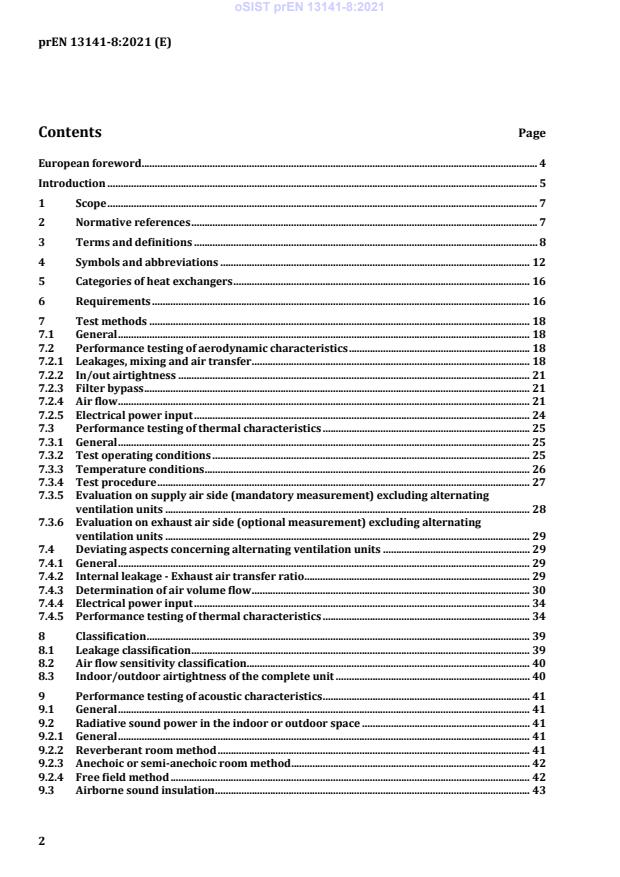
Contents Page
European foreword . 4
Introduction . 5
1 Scope . 7
2 Normative references . 7
3 Terms and definitions . 8
4 Symbols and abbreviations . 12
5 Categories of heat exchangers . 16
6 Requirements . 16
7 Test methods . 18
7.1 General . 18
7.2 Performance testing of aerodynamic characteristics . 18
7.2.1 Leakages, mixing and air transfer . 18
7.2.2 In/out airtightness . 21
7.2.3 Filter bypass . 21
7.2.4 Air flow . 21
7.2.5 Electrical power input . 24
7.3 Performance testing of thermal characteristics . 25
7.3.1 General . 25
7.3.2 Test operating conditions . 25
7.3.3 Temperature conditions . 26
7.3.4 Test procedure . 27
7.3.5 Evaluation on supply air side (mandatory measurement) excluding alternating
ventilation units . 28
7.3.6 Evaluation on exhaust air side (optional measurement) excluding alternating
ventilation units . 29
7.4 Deviating aspects concerning alternating ventilation units . 29
7.4.1 General . 29
7.4.2 Internal leakage - Exhaust air transfer ratio . 29
7.4.3 Determination of air volume flow . 30
7.4.4 Electrical power input . 34
7.4.5 Performance testing of thermal characteristics . 34
8 Classification . 39
8.1 Leakage classification . 39
8.2 Air flow sensitivity classification. 40
8.3 Indoor/outdoor airtightness of the complete unit . 40
9 Performance testing of acoustic characteristics . 41
9.1 General . 41
9.2 Radiative sound power in the indoor or outdoor space . 41
9.2.1 General . 41
9.2.2 Reverberant room method . 41
9.2.3 Anechoic or semi-anechoic room method . 42
9.2.4 Free field method . 42
9.3 Airborne sound insulation . 43
oSIST prEN 13141-8:2021
prEN 13141-8:2021 (E)
10 Test results . 43
10.1 Test report . 43
10.2 Product specifications. 44
10.3 Additional information related to the performance of the product . 44
10.4 Leakages . 44
10.5 Air flow . 45
10.6 Effective power input . 45
10.7 Temperature and humidity ratios . 46
10.8 Acoustic characteristics . 46
11 Cleaning and maintenance . 47
Annex A (normative) Test layouts . 48
Annex B (normative) Pressure leakage test method . 51
B.1 External leakage test . 51
B.2 Internal leakage test . 52
Annex C (normative) Indoor mixing . 53
C.1 General . 53
C.2 Determination of indoor mixing - First test . 53
C.3 Determination of indoor mixing - Second test . 53
C.4 Indoor mixing calculation . 53
Bibliography . 54
oSIST prEN 13141-8:2021
prEN 13141-8:2021 (E)
European foreword
This document (prEN 13141-8:2021) has been prepared by Technical Committee CEN/TC 156
“Ventilation for buildings”, the secretariat of which is held by BSI.
This document is currently submitted to the second CEN Enquiry.
This document will supersede EN 13141-8:2014.
In addition to a number of editorial revisions, the following main changes have been made with respect
to EN 13141-8:2014:
— scope has been changed, and concerns now non-ducted units which ventilate more than one single
room;
— terms and definitions as well as symbols and abbreviations have been updated in accordance with
the parameters used in the document;
— new categories of heat exchanger have been added;
— designations in 7.2.1.4 and the Formulae (1) to (4) have been changed;
— reference of the internal and external leakage rates has been changes to the reference air volume
flow;
— extrapolation of the leakage rates has been added;
— 7.2.1.3.2 concerning exhaust air transfer ratio has been added;
— 7.2.4 concerning air flow measurement has been revised;
— requirements to convert the measured values to standard conditions have been added in 7.2.4 and
7.3.2;
— 7.3.3 has been divided into two separate subclauses 7.3.3.1 for standard tests and 7.3.3.2 for cold
climate tests;
— formulae to calculate the temperature ratios have been changed;
— wet bulb temperature for the cold climate test has been changed;
— the order of the specific test for alternating units including storage heat exchanges has been changed;
— deviating aspects for alternating units to determine the air flow correction, thermal performance and
the exhaust air transfer ratio have been revised;
— Table 10 concerning the temperature conditions for the cooling performance test has been moved in
prEN 13142.
A list of all parts in the EN 13141 series, published under the general title Ventilation for buildings —
Performance testing of components/products for residential ventilation can be found on the CEN website.
oSIST prEN 13141-8:2021
prEN 13141-8:2021 (E)
Introduction
This document specifies methods for the performance testing of components used in residential
ventilation systems to establish the performance characteristics as identified in prEN 13142.
This document incorporates many references to other European and International Standards, especially
on characteristics other than the aerodynamic characteristics, for instance on acoustic characteristics.
In most cases some additional tests or some additional conditions are given for the specific use in
residential ventilation systems.
This document can be used for the following applications:
— laboratory testing;
— attestation purposes.
The position of this document in the field of standards for the mechanical building services is shown
in Figure 1.
oSIST prEN 13141-8:2021
prEN 13141-8:2021 (E)
Figure 1 — Position of EN 13141-8 in the field of the mechanical building services
oSIST prEN 13141-8:2021
prEN 13141-8:2021 (E)
1 Scope
This document specifies the laboratory test methods and test requirements for the testing of
aerodynamic, thermal, acoustic and the electrical performance characteristics of non-ducted mechanical
supply and exhaust residential ventilation units used in single dwellings.
The purpose of this document is not to consider the quality of ventilation but to test the performance of
the equipment.
In general, a ventilation unit contains:
— fans for mechanical supply and exhaust;
— air filters;
— air-to-air heat exchanger for heat and possibly humidity recovery;
— control system;
— inlet and outlet grilles.
Such equipment can be provided in more than one assembly, the separate assemblies of which are
designed to be used together.
Such equipment can contain alternating heat exchangers which provide separate supply and exhaust air
flows.
In certain cases, i.e. alternating ventilation unit, it may be declared that the equipment can be installed in
such a way that it serves more than one room. For the purpose of this document, these products are
assessed in a single room.
This document does not deal with ducted units which are covered by prEN 13141-7 or units with heat
pumps.
Safety requirements are given in EN 60335-2-40 and EN 60335-2-80.
2 Normative references
The following documents are referred to in the text in such a way that some or all of their content
constitutes requirements of this document. For dated references, only the edition cited applies. For
undated references, the latest edition of the referenced document (including any amendments) applies.
EN 12792:2003, Ventilation for buildings — Symbols, terminology and graphical symbols
EN ISO 717-1, Acoustics — Rating of sound insulation in buildings and of building elements — Part 1:
Airborne sound insulation (ISO 717-1)
EN ISO 5801, Fans — Performance testing using standardized airways (ISO 5801)
EN ISO 10140-1, Acoustics — Laboratory measurement of sound insulation of building elements — Part 1:
Application rules for specific products (ISO 10140-1)
EN ISO 10140-2, Acoustics — Laboratory measurement of sound insulation of building elements — Part 2:
Measurement of airborne sound insulation (ISO 10140-2)
EN ISO 10140-4, Acoustics — Laboratory measurement of sound insulation of building elements — Part 4:
Measurement procedures and requirements (ISO 10140-4)
oSIST prEN 13141-8:2021
prEN 13141-8:2021 (E)
EN ISO 10140-5, Acoustics — Laboratory measurement of sound insulation of building elements — Part 5:
Requirements for test facilities and equipment (ISO 10140-5)
EN ISO 16890 (all parts), Air filters for general ventilation (ISO 16890 (all parts))
ISO 13347-2, Industrial fans — Determination of fan sound power levels under standardized laboratory
conditions — Part 2: Reverberant room method
ISO 13347-3, Industrial fans — Determination of fan sound power levels under standardized laboratory
conditions — Part 3: Enveloping surface methods
ISO 13347-4, Industrial fans — Determination of fan sound power levels under standardized laboratory
conditions — Part 4: Sound intensity method
3 Terms and definitions
For the purposes of this document, the terms and definitions given in EN 12792:2003 and the following
apply.
ISO and IEC maintain terminological databases for the use in standardization at the following addresses:
— IEC Electropedia: available at http://www.electropedia.org/
— ISO Online browsing platform: available at https://www.iso.org/obp
3.1
external leakage
q
ve
leakage to or from the air flowing inside the casing of the ventilation unit to or from the surrounding air
[SOURCE: prEN 13141-4:2018, 3.11]
3.2
internal leakage
q
vi
leakage inside the unit between the exhaust and the supply air flows
[SOURCE: prEN 13141-7:2018, 3.2]
3.3
filter bypass leakage
air bypass around filter cells
[SOURCE: prEN 13141-7:2018, 3.4]
3.4
indoor/outdoor airtightness
q
vio
maximum air volume flow at static pressure difference of – 20 Pa and + 20 Pa corresponding to the
setting when the fans are “OFF” and all additional shutters are closed
Note 1 to entry: Indoor/outdoor airtightness is not the external leakage.
[SOURCE: prEN 13141-4:2018, 3.13, modified – Removal of “through a non-ducted ventilation unit”]
oSIST prEN 13141-8:2021
prEN 13141-8:2021 (E)
3.5
exhaust air transfer ratio
R
s
mass transfer of the discharged air to a zone (in Figure 2, a): from key 11 (extract) to key 22 (supply))
that is actually recirculated air from the same zone, due to internal leakage and external casing leakage
Note 1 to entry: The exhaust air transfer ratio, R , is used for units equipped witch category IIa heat exchanger.
s
3.6
outdoor mixing
R
me
mixing of the two air flows external to the equipment under test between discharge and intake ports at
outdoor terminal points caused by short circuiting
3.7
indoor mixing
R
mi
mixing of the two air flows external to the equipment under test between discharge and intake ports at
indoor terminal points caused by short circuiting
3.8
declared maximum air volume flow
q
vmax,d
declared maximum air volume flow of the unit at 0 Pa static pressure difference, between indoor and
outdoor
[SOURCE: prEN 13141-4:2018, 3.6, modified – “at 0 Pa static pressure difference, between indoor and
outdoor” has been added]
3.9
maximum air volume flow
q
vmax
air volume flow corresponding to the maximum achievable fan curve setting of the unit at 0 Pa static
pressure difference between indoor and outdoor, either declared or measured
Note 1 to entry: If the supply and exhaust air volume flows are different, then the maximum air volume flow is
equal to the smaller of the two air volume flows.
[SOURCE: prEN 13141-4:2018, 3.7, modified – Note 1 to entry has been removed and Note 2 to entry
became Note 1 to entry, “at the pressure p ” has been replaced by “at 0 Pa static pressure difference
qvmax
between indoor and outdoor”]
3.10
declared minimum air volume flow
q
vmin,d
minimum air volume flow of the unit declared at 0 Pa static pressure difference between indoor and
outdoor
Note 1 to entry: If the supply and exhaust air volume flows are different, then the minimum air volume flow is
equal to the higher of the two air volume flows.
oSIST prEN 13141-8:2021
prEN 13141-8:2021 (E)
[SOURCE: prEN 13141-7:2018, 3.8, modified – “at the reference pressure declared” has been replaced by
“at 0 Pa static pressure difference between indoor and outdoor”]
3.11
reference air volume flow
q
vref
air volume flow at 70 % of the maximum air volume flow
Note 1 to entry: If the air volume flow at 70 % of the maximum air volume flow cannot be adjusted on the product
itself, the closest value above is selected.
[SOURCE: prEN 13141-4:2018, 3.8, modified – Note 1 to entry "To determine reference air volume flow,
see 5.2.3.4, Table 6." has been replaced by the one above]
3.12
unit static pressure
p
us
pressure increase induced by the ventilation unit given as difference between the static pressure at the
unit outlet and the total pressure at the unit inlet
Note 1 to entry: The parameter p for a ventilation unit is defined as the parameter p described in
us fs
EN ISO 5801 for a stand alone fan.
[SOURCE: prEN 13141-4:2018, 3.2]
3.13
external static pressure difference
p
s,ext
pressure increase induced by the ventilation unit given as difference between the static pressures at the
unit outlet and the unit inlet
Note 1 to entry: The external static pressure difference is used to determine the maximum air volume flow, the
reference air volume flow and the minimum air volume flow.
[SOURCE: prEN 13141-4:2018, 3.2, modified – “and the minimum air volume flow” has been added in
Note 1 to entry]
3.14
air flow sensitivity
v
maximum relative deviation of the maximum air volume flow q due to a static pressure difference of
vmax
+ 20 Pa and – 20 Pa
Note 1 to entry: Unbalanced (unequal) supply and exhaust air streams influence the thermal efficiency of the
ventilation unit and its air exchange capacity.
[SOURCE: prEN 13141-4:2018, 3.2, modified – “of a non-ducted ventilation unit” has been removed from
the definition, Note 1 to entry has been added]
oSIST prEN 13141-8:2021
prEN 13141-8:2021 (E)
3.15
temperature ratio
η
θ
temperature difference between inlet and outlet of one of the air flows divided by the temperature
difference between the inlets of both air flows
[SOURCE: prEN 13141-7:2018, 3.15]
3.16
humidity ratio
η
x
difference of vapour mixing ratio between inlet and outlet of one of the air flows divided by the difference
of vapour mixing ratio between the inlets of both air flows
[SOURCE: prEN 13141-7:2018, 3.16]
3.17
electrical power input
P
E
average overall electrical power input to the equipment within a defined interval of time for standard air
conditions obtained from:
— the power input of the fans;
— controller(s), compressor(s), safety devices of the equipment(s) excluding additional electrical
heating devices not used for defrosting
Note 1 to entry: Electrical power consumption includes the consumption of the heating device for defrosting
during the cold climate test.
[SOURCE: prEN 13141-4:2018, 3.15, modified – Note 1 to entry has been added]
3.18
maximum electrical power input
P
E,max
electrical power input at maximum air volume flow, q
vmax
[SOURCE: prEN 13141-4:2018, 3.17, modified – “, and its corresponding pressure, p ” has been
qvmax
removed]
3.19
electrical power input at the reference air volume flow
P
E,ref
electrical power input at reference air volume flow q
vref
[SOURCE: prEN 13141-4:2018, 3.16, modified – “, and reference pressure, p ” has been removed]
ref
oSIST prEN 13141-8:2021
prEN 13141-8:2021 (E)
3.20
exhaust air transfer ratio
R
s 1;2
( )
mass fraction of the discharged air to a zone (see Figure 2: from key 11 (extract) to key 22 (supply)) that
is actually recirculated air from the same zone, due to internal leakage, external casing leakage, short
circuiting and carry back
Note 1 to entry: The exhaust air transfer ratio, R , is used for units equipped witch category IIb heat
s 1;2
( )
exchanger according to Table 2.
3.21
supply air transfer ratio
R
e
mass fraction of the discharged air to a zone (see Figure 2: from key 21 (outdoor) to key 12 (exhaust))
that is actually recirculated air from the same zone, due to internal leakage, external casing leakage and
short circuiting
3.22
alternating ventilation unit
pair of mechanical ventilation devices using storage heat exchangers operating in opposite, synchronized
periodically changing air flow direction incorporated in common or two separate casing(s)
3.23
alternating mode
operating mode in which a ventilation unit periodically changes from exhausting air to supplying air and
vice versa
3.24
ventilation mode
constant operating mode where the alternating devices are running in an opposite direction with no heat
recovery
3.25
indoor side
supply and extract air side of the ventilation devices
3.26
air path
path of a ventilation device with equal flow direction and amount
3.27
cycle time
duration of a cycle in which the alternating device changes its direction and return back to the original
direction
4 Symbols and abbreviations
For the purposes of this document, the symbols and abbreviations given in EN 12792 and in Table 1
apply.
oSIST prEN 13141-8:2021
prEN 13141-8:2021 (E)
Table 1 — Symbols
Symbol Designation Unit
c
concentration of tracer gas ppm
absolute deviation of maximum air volume flow due to over —
dq
v,over
pressure of 20 Pa
absolute deviation of maximum air volume flow due to under —
dq
v,under
pressure of 20 Pa
thermal resistance K/W
d /
airborne sound insulation in third octave bands dB
D
n,e
global airborne sound insulation index dB
D
n,e,w
quotient reduction factor —
f
red
sound power level in third octave band dB
L
W
A-weighted sound power level dB
L
WA
n
fan speed -1
min
fan speed in ventilation mode -1
n
min
vent
electrical power input W
P
E
electrical power input at the reference air volume flow W
P
E,ref
maximum electrical power input W
P
E,max
electrical power input under test conditions measured at the W
P
E,Te
density ρ
Te
W
P electrical power input at the maximum air flow, q
el,max vmax
electrical power input at the reference air volume flow W
P
el,ref
W
P
electrical power input at the maximum air flow, q in
el,max,vent
vmax
ventilation mode
electrical power input at the reference air volume flow in W
P
el,ref,vent
ventilation mode
static pressure Pa
p
s
external static pressure difference Pa
p
s,ext
external static pressure difference under test conditions Pa
p
s,ext,T
e
measured at the density ρ
Te
maximum static pressure Pa
p
s,max
maximum static pressure for each devise and each direction Pa
p
s,vent,D1/2,ex/su
oSIST prEN 13141-8:2021
prEN 13141-8:2021 (E)
Symbol Designation Unit
unit static pressure Pa
p
us
unit static pressure under test conditions measured at the Pa
p
us,Te
density ρ
Te
air mass flow -1 b
q
kg ⋅ s
m
unit mass air flow -1 b
q
kg ⋅ s
m,max,vent
purge mass air flow -1 b
q
kg ⋅ s
mp
purge mass air flow on the indoor side -1 b
q
kg ⋅ s
mp,I
purge mass air flow on the outdoor side -1 b
q
kg ⋅ s
mp,O
mean extract mass air flow rate of the device in alternating mode -1 b
q
kg ⋅ s
m,ex,alt
to be set air mass flow -1 b
q
kg ⋅ s
m,set
mean supply mass air flow rate of the device in alternating mode -1 b
q
kg ⋅ s
m,su,alt
air volume flow 3 -1 a
q
m ⋅ s
v
air volume flow for alternating ventilation unit 3 -1 a
q
m ⋅ s
v,alt
external leakage air volume flow 3 -1 a
q
m ⋅ s
ve
mean extract air volume flow in alternating mode
q
v,ex,alt
extract air flow in ventilation mode of device x 3 -1 a
q
m ⋅ s
v,ex,Di
mean extract air volume flow in ventilation mode 3 -1 a
q
m ⋅ s
v,ex,vent
internal leakage air volume flow 3 -1 a
q
m ⋅ s
vi
flow rate at intermediate fan speed setting 3 -1 a
q
m ⋅ s
vin
indoor/outdoor airtightness 3 -1 a
q
m ⋅ s
vio
maximum air volume flow 3 -1 a
q
m ⋅ s
vmax
declared maximum air volume flow 3 -1 a
q
m ⋅ s
vmax,d
minimum air volume flow 3 -1 a
q
m ⋅ s
vmin
declared minimum air volume flow 3 -1 a
q
m ⋅ s
vmin,d
purge air volume flow 3 -1 a
q
m ⋅ s
v,purge
reference air volume flow 3 -1 a
q
m ⋅ s
vref
3 -1 a
q air volume flow q at a density of 1,2 kg/m
m ⋅ s
v,set ve,set
oSIST prEN 13141-8:2021
prEN 13141-8:2021 (E)
Symbol Designation Unit
mean supply air volume flow in alternating mode 3 -1 a
q
m ⋅ s
v,su,alt
supply air flow in ventilation mode of device x 3 -1 a
q
m ⋅ s
v,su,Di
mean supply air volume flow in ventilation mode 3 -1 a
q
m ⋅ s
v,su,vent
air volume flow in ventilation mode 3 -1 a
q
m ⋅ s
v,vent
supply air transfer ratio %
R
e
%
R
outdoor mixing
me
%
R
indoor mixing
mi
%
R
exhaust air transfer ratio (for units with cat. IIa heat exchangers)
s
%
R
exhaust air transfer ratio (for units with cat. IIb heat exchangers)
s 1;2
( )
time of an operating cycle for alternating ventilation units s
t
cycle
v
air flow sensitivity %
air volume content of device l
V
a
volume of the casing l
V
c
θ air temperature °C
purge air temperature on the indoor side °C
θ
I1
purge air temperature on the outdoor side °C
θ
O1
wet bulb temperature °C
θ
w
wet bulb temperature on the indoor side °C
θ
wI1
wet bulb temperature on the outdoor side °C
θ
wO2
x
vapour mixing ratio kg water/kg dry air
extract air (ETA) (see Figure 2) —
12 exhaust air (EHA)(see Figure 2) —
21 outdoor air (ODA) (see Figure 2) —
supply air (SUP)(see Figure 2) —
humidity ratio of the unit on exhaust air side —
η
x,ex
humidity ratio of the unit on supply air side —
η
x,su
temperature ratio of the unit on exhaust air side —
η
θ ,ex
temperature ratio of the unit on supply air side —
η
θ ,su
oSIST prEN 13141-8:2021
prEN 13141-8:2021 (E)
Symbol Designation Unit
3 3
ρ
density of 1,2 kg/m corresponding to the air under standard kg/m
st
conditions (20 °C and 101 325 Pa)
density of the ambient air at the test enclosure 3
ρ
kg/m
Te
a 3
l/s or m /h can be used for measurement of air flow but it shall be verified that all parameters are consistent
with the chosen unit.
b -1 -1
kg h or g.s can be used for measurement of air flow but it shall be verified that all parameters are consistent
with the chosen unit.
For the purposes of this document, the following abbreviations apply.
POM Power input in Operable Mode
PSM Power input in Standby Mode
5 Categories of heat exchangers
Categories of heat exchangers are given in Table 2.
Table 2 — Categories of heat exchangers
Category Definition
I Recuperative heat exchangers (e.g. air-to-air plate or tube heat exchanger)
Ia Recuperative heat exchangers of the category Ia are designed to transfer sensible
thermal energy from one air stream to another without moving parts. Heat transfer
surfaces are in form of plates or tubes. This heat exchanger can have parallel flow,
cross flow or counter flow construction or a combination of these.
Ib Recuperative heat exchangers of the category Ib are designed to transfer total
thermal energy including vapour diffusion from one air stream to another without
moving parts. Heat transfer surfaces are in form of plates or tubes. This heat
exchanger can have parallel flow, cross flow or counter flow construction or a
combination of these.
II Regenerative heat exchangers
IIa Regenerative heat exchangers with moving masses e.g. rotary
IIb Regenerative heat exchangers with stationary masses and changing of flow direction
6 Requirements
In addition, to assess correctly the thermal performance, aerodynamic characteristics, including all
leakages, shall be tested before or together with any thermal characteristics testing (see 7.3 or 7.4.5).
Aerodynamic characteristics (see 7.2) shall include three characteristics listed below:
— external leakage;
oSIST prEN 13141-8:2021
prEN 13141-8:2021 (E)
— internal leakage or exhaust air transfer ratio;
— air flow.
Other characteristics such as filter bypass leakage are optional.
The tests for thermal performances shall not be made because of measurement uncertainty when
leakages according to 7.2.1 are too high. Units with heat recovery category 2b shall fulfil U1 or U2 leakage
class, all other units shall have the leakage class specified in Table 3.
Table 3 — Classification requirements for thermal performance
Fan position Required leakage class to
allow measurements
Exhaust fan upstream and supply fan downstream of the heat exchanger U1
Supply fan upstream and exhaust fan downstream of the heat exchanger U1, U2
Other fan positions U1, U2, U3
The following points shall be declared:
— mandatory points:
— maximum air volume flow;
— minimum air volume flow;
— category of heat exchanger;
— filter classes supply and exhaust air;
— presence, type of by-pass and its control;
— minimum outdoor operation temperature;
— frost protection function(s) and control (for cold climate test);
— minimum distance between the inlets and outlets for alternating units in two separate casings;
— maximum and minimum length of the wall duct;
— informative points:
— possibility of balancing the air volume flows;
— nominal revolutions of the heat recovery wheel;
— control parameter and sensors;
— type of fan and speed control;
— indented use;
oSIST prEN 13141-8:2021
prEN 13141-8:2021 (E)
— possible mounting positions.
7 Test methods
7.1 General
Tests shall be conducted with a unit containing all components (including wall ducts and grilles, controls)
as supplied for intended use, and installed according to the product's instructions. If the wall ducts are
available in variable length the test shall be performed with the closest length to 500 mm.
The air mass flow rates q and q shall be measured in steady-state conditions at the same time.
m11 m22
For tests on alternating ventilation units, the deviating aspects in 7.4 shall be considered.
If internal and external leakage class U2 or better is reached, it can be assumed that qq= and
m11 m12
qq= .
m21 m22
The tests shall be conducted at the primary voltage of 230 V. This voltage shall be maintained throughout
the testing to ± 1 %. Where a product requires a voltage regulation device (transformer), this device shall
also be supplied or clearly specified. The power consumption of this device shall be taken into account.
7.2 Performance testing of aerodynamic characteristics
7.2.1 Leakages, mixing and air transfer
7.2.1.1 General
Methods for rating leakages, mixing and air transfer depending on the category of heat exchanger are
summarized in Table 4.
Table 4 — Methods for classification of leakage classes
Category of heat exchanger
Test method
Classification
subclause
Ia Ib IIa IIb
External leakage 7.2.1.2 X X X X
7.2.1.3.1 X X — —
Internal leakage 7.2.1.3.2 — — X —
7.4.2 — — — X
Outdoor mixing X X X X
7.2.1.4
Indoor mixing X X X X
Indoor/outdoor airtightness 7.2.2 X X X X
There are four classes of leakage depending on the ratios between both leakage air flows and reference
air volume flow.
oSIST prEN 13141-8:2021
prEN 13141-8:2021 (E)
7.2.1.2 External leakage
The external leakage shall be measured according to Annex B. During the tests, the fans of the unit under
test shall be switched off.
The external leakage air volume flow, q , at over and under-pressure of 50 Pa shall be reported as such
ve
and also compared to the reference air volume flow of the unit as a percentage. The leakage at 250 Pa is
calculated according to Formula (1) (see EN 15727:2010, Table 3).
0,65
250
q q⋅ (1)
ve,250 ve,50
The measured leakage flow shall be divided by the reference air flow to get the percentage.
7.2.1.3 Internal leakage
7.2.1.3.1 Pressure test
Internal leakage of category I heat exchangers shall be measured by means of pressurization test and the
test shall be conducted as follows: during pressurization test, as defined in Annex B, the fan shall be off
and the difference between the two air flows shall be fixed at 20 Pa.
The leakage at 100 Pa is calculated according to Formula (2) (see EN 15727:2010, Table 3).
0,65
qq⋅ (2)
vi,100 vi,20
The measured leakage flow shall be divided by the reference air flow to get the percentage.
7.2.1.3.2 Exhaust air transfer ratio
The exhaust air transfer ratio measured by the tracer gas method applies to classify the internal leakages
of category IIa heat exchanger units. The test as described below shall be done without applying any
pressure drop on the system. The test shall be done using the test setups given in Annex A.
Test for tracer gas method:
— The fans shall be on and working at reference air volume flow.
— The tracer gas should be introduced into the indoor extract duct as close as possible to the grille, if
this is not possible, a short length of duct (less than 150 mm) of the same cross section as the grille
should be fastened to the grille and the tracer gas introduced into the ductwork.
— The tracer gas concentration should be measured at the line of the grilles. If this is impossible short
pieces of ductwork of the same cross section as the grille should be applied and measurement made
within the ductwork.
— To measure internal leakage a deflector is introduced between the outdoor grilles and sealed to
ensure that exhaust gas cannot be mixed back into the intake port. The deflector should be applied
between the exhaust and outdoor air intake ports. It should be fixed to the outside of the grille and
extend to at least 300 mm in each direction. Tracer gas is introduced into the extract port and the
concentration is measured in both the exhaust and supply ports.
— The exhaust air transfer ratio of the supply flow, is then the ratio of the two concentrations, as defined
in 7.2.1.4.
NOTE The exhaust air transfer ratio of category IIb heat exchanger units is described in 7.4.2.
=
=
oSIST prEN 13141-8:2021
prEN 13141-8:2021 (E)
7.2.1.4 Air transfer and mixing
Due to the small dimensions of a single room unit or pair of mechanical ventilation devices the distance
between the air inlets and outlets can be very small and thus there is a great risk of mixing fresh outdoor
air with used indoor air.
a) exhaust air transfer b) exhaust air transfer + outdoor mixing
c) supply air transfer d) supply air transfer + indoor mixing
Key
21 outdoor air 5 deflector
11 extract air 6 tracer gas introduction
22 supply air 7 tracer gas measurement
12 exhaust air
Figure 2 — Test configurations for internal leakages and mixing
When the deflector is removed the concentration of the tracer gas at the indoor supply grille is now the
sum of the internal air transfer and the mixing between discharge and intake grilles, expressed as a
percentage of the supply flow. The use of the deflector is described in Annex C. The mixing is therefore
calculated as the difference between the percentages measured during this test and the internal leakage.
A separate mixing measurement is made at both the indoor and outdoor grille locations, the
measurement with the highest percentage figure is used for the certification. The method is described in
Annex C (normative).
NOTE The duration of the test is limited such that any influence of the contamination/saturation of the test
room from the gas is reduced to a minimum.
The test for alternating ventilation units shall be done in ventilation mode and alternating ventilation
units shall be installed with the minimum distance declared between inlet and outlet.
The exhaust air transfer ratio and mixing are calculated using Formula (3) to Formula (6) where terms a,
b, c and d refer to subfigures a, b, c and d of Figure 2.
Exhaust air transfer ratio is given by Formula (3).
CC−
22 21
R ⋅100% (3)
s1
CC−
12 21
a
=
oSIST prEN 13141-8:2021
prEN 13141-8:2021 (E)
Outdoor mixing is given by Formula (4).
CC−−CC
22 21 22 21
R= − ⋅100% (4)
me
CC−−CC
12 21 12 21
ba
Supply air transfer ratio is given by Formula (5).
CC−
12 21
R ⋅100% (5)
e
CC−
22 21
c
Indoor mixing is given by Formula (6).
CC− CC−
12 21 12 21
R= − ⋅100% (6)
mi
CC− CC−
22 21 22 21
dc
7.2.2 In/out airtightness
The test shall be performed with fans switched off.
If the unit is equipped with a manual or automatic shutter, the measurement of the airtightness shall be
made with closed shutters.
The difference of
...