

EN 13954:2005+A1:2010
(Main)Food processing machinery - Bread slicers - Safety and hygiene requirements
- Abstract
1.1 This European Standard specifies safety and hygiene requirements for the design and manufacture of bread slicing machines of type 1 and 2 as defined in Clause 3.
The intended use of these machines is to cut baked bread into slices.
This European Standard deals with all significant hazards, hazardous situations and events relevant to bread slicers machines, when they are used as intended and under conditions of misuse which are reasonably foreseeable by the manufacturer (see Clause 4).
This European Standard covers requirements for the safe operation of the machine including: loading, cutting, unloading, cleaning, crumb removal and maintenance.
These machines can be manually or automatically operated.
1.2 The following machines are excluded from the scope of this document:
- experimental and testing machines under development by the manufacturer;
- frame cutter machines with multiple blades moving horizontally;
- domestic appliances and machines intended for use by the general public;
- machines with horizontal circular cutting systems;
- rectangular cutting machines for cutting or sawing of panel size products into small pieces.
The significant hazards covered by this document are described in Clause 4.
1.3 In drafting this European Standard, it has been assumed that the bread slicers falling within the scope are operated only by trained personnel and that the machines are not intended to be cleaned with water jet.
1.4 This European Standard is not applicable to bread slicing machines which are manufactured before the date of publication of this European Standard.
- Status
- Published
- Publication Date
- 02-Mar-2010
- Withdrawal Date
- 29-Sep-2010
- Technical Committee
- CEN/TC 153 - Food processing machinery - Safety and hygiene specifications
- Drafting Committee
- CEN/TC 153/WG 1 - Bakery equipment
- Current Stage
- 6060 - Definitive text made available (DAV) - Publishing
- Start Date
- 03-Mar-2010
- Completion Date
- 03-Mar-2010
- Directive
- 2006/42/EC - Directive 2006/42/EC of the European Parliament and of the Council of 17 May 2006 on machinery, and amending Directive 95/16/EC (recast)OJ Ref: C, C 136 OJ Date: 26-May-2010

Overview
EN 13954:2005+A1:2010 (CEN) - "Food processing machinery - Bread slicers - Safety and hygiene requirements" defines safety and hygiene requirements for commercial bread-slicing machines of type 1 (frame cutters with multiple vertical blades) and type 2 (machines with rotary crescent or circular blades). The standard addresses all significant hazards reasonably foreseeable by the manufacturer during intended use and foreseeable misuse, and covers machine lifecycle tasks such as loading, cutting, unloading, cleaning, crumb removal and maintenance. It assumes operation by trained personnel and excludes household appliances, experimental machines, certain horizontal blade designs and machines intended to be cleaned with water jets.
Key Topics
- Scope and machine types: Clarifies inclusion (type 1 & 2) and explicit exclusions (domestic, experimental, horizontal multi-blade frame cutters, horizontal circular cutting systems, large panel saws).
- Hazard identification: Mechanical (cutting, shearing, crushing, entanglement, drawing-in, loss of stability), electrical, hygiene, ergonomic, cleaning/handling, and noise risks.
- Protective measures: Requirements for guards, interlocks, safe access, stable design, and hygienic construction to prevent contamination and enable safe maintenance and cleaning.
- Hygiene and cleanability: Design principles to ensure surfaces, crumb removal and disassembly support sanitary processing (Annex B: principles of cleanability).
- Control systems & electrical safety: Compliance expectations referencing electrical equipment and safety-related control parts.
- Verification & testing: Procedures for verification of safety and hygiene measures, including noise test code (Annex A).
- Information for use: Required instruction handbook content and machine marking for safe operation, maintenance and user training.
- Assumptions & limitations: Machines are not intended for water-jet cleaning and are operated by trained personnel; the standard does not apply retroactively to pre-publication equipment.
Applications / Who Uses This Standard
- Manufacturers and machine designers - to design and certify bread slicers that meet EU safety and hygiene expectations.
- Food processing plant engineers and safety managers - for procurement specs, risk assessments and safe operation procedures.
- Compliance officers and notified bodies - for conformity assessment and documentation required under relevant EU directives.
- Maintenance teams and trainers - to develop safe maintenance, cleaning and operator training materials.
Practical uses include specifying guards and interlocks, designing hygienic surfaces, preparing instruction manuals, setting maintenance/cleaning regimes, and performing noise and safety verification.
Related Standards
EN 13954 complements and references other standards such as EN 14655 (type 3 crescent blade machines), EN 1672‑2 (hygiene for food machinery), EN ISO 12100 (risk assessment/design principles), EN 60204‑1 (electrical equipment), EN ISO 13849‑1 (safety-related control systems) and relevant acoustics standards for noise measurement.
Relations
- Merged From
EN 13954:2005 - Food processing machinery - Bread slicers - Safety and hygiene requirements - Effective Date
- 19-Jan-2023
- Effective Date
- 25-Aug-2026
- Effective Date
- 09-Feb-2026
- Effective Date
- 09-Feb-2026
- Effective Date
- 09-Feb-2026
- Effective Date
- 28-Jan-2026
- Effective Date
- 28-Jan-2026
- Effective Date
- 28-Jan-2026
- Effective Date
- 28-Jan-2026
- Effective Date
- 28-Jan-2026
- Effective Date
- 28-Jan-2026
- Effective Date
- 28-Jan-2026
- Effective Date
- 28-Jan-2026
- Effective Date
- 28-Jan-2026
- Effective Date
- 28-Jan-2026
Get Certified
Connect with accredited certification bodies for this standard

BSI Group
BSI (British Standards Institution) is the business standards company that helps organizations make excellence a habit.

Bureau Veritas
Bureau Veritas is a world leader in laboratory testing, inspection and certification services.

DNV
DNV is an independent assurance and risk management provider.
Sponsored listings
Frequently Asked Questions
EN 13954:2005+A1:2010 is a standard published by the European Committee for Standardization (CEN). Its full title is "Food processing machinery - Bread slicers - Safety and hygiene requirements". This standard covers: 1.1 This European Standard specifies safety and hygiene requirements for the design and manufacture of bread slicing machines of type 1 and 2 as defined in Clause 3. The intended use of these machines is to cut baked bread into slices. This European Standard deals with all significant hazards, hazardous situations and events relevant to bread slicers machines, when they are used as intended and under conditions of misuse which are reasonably foreseeable by the manufacturer (see Clause 4). This European Standard covers requirements for the safe operation of the machine including: loading, cutting, unloading, cleaning, crumb removal and maintenance. These machines can be manually or automatically operated. 1.2 The following machines are excluded from the scope of this document: - experimental and testing machines under development by the manufacturer; - frame cutter machines with multiple blades moving horizontally; - domestic appliances and machines intended for use by the general public; - machines with horizontal circular cutting systems; - rectangular cutting machines for cutting or sawing of panel size products into small pieces. The significant hazards covered by this document are described in Clause 4. 1.3 In drafting this European Standard, it has been assumed that the bread slicers falling within the scope are operated only by trained personnel and that the machines are not intended to be cleaned with water jet. 1.4 This European Standard is not applicable to bread slicing machines which are manufactured before the date of publication of this European Standard.
1.1 This European Standard specifies safety and hygiene requirements for the design and manufacture of bread slicing machines of type 1 and 2 as defined in Clause 3. The intended use of these machines is to cut baked bread into slices. This European Standard deals with all significant hazards, hazardous situations and events relevant to bread slicers machines, when they are used as intended and under conditions of misuse which are reasonably foreseeable by the manufacturer (see Clause 4). This European Standard covers requirements for the safe operation of the machine including: loading, cutting, unloading, cleaning, crumb removal and maintenance. These machines can be manually or automatically operated. 1.2 The following machines are excluded from the scope of this document: - experimental and testing machines under development by the manufacturer; - frame cutter machines with multiple blades moving horizontally; - domestic appliances and machines intended for use by the general public; - machines with horizontal circular cutting systems; - rectangular cutting machines for cutting or sawing of panel size products into small pieces. The significant hazards covered by this document are described in Clause 4. 1.3 In drafting this European Standard, it has been assumed that the bread slicers falling within the scope are operated only by trained personnel and that the machines are not intended to be cleaned with water jet. 1.4 This European Standard is not applicable to bread slicing machines which are manufactured before the date of publication of this European Standard.
EN 13954:2005+A1:2010 is classified under the following ICS (International Classification for Standards) categories: 67.260 - Plants and equipment for the food industry. The ICS classification helps identify the subject area and facilitates finding related standards.
EN 13954:2005+A1:2010 has the following relationships with other standards: It is inter standard links to EN 13954:2005, ISO 8598:1996, EN 61496-1:2004, EN 60529:1991, EN 61310-1:2008, EN ISO 13857:2008, EN ISO 4871:1996, EN 1088:1995, EN ISO 12001:1996, EN 614-1:2006, EN ISO 13849-1:2008, EN ISO 3744:1995, EN ISO 4287:1998, EN ISO 12100-1:2003, EN ISO 11201:1995. Understanding these relationships helps ensure you are using the most current and applicable version of the standard.
EN 13954:2005+A1:2010 is associated with the following European legislation: EU Directives/Regulations: 2006/42/EC, 98/37/EC; Standardization Mandates: M/079, M/396. When a standard is cited in the Official Journal of the European Union, products manufactured in conformity with it benefit from a presumption of conformity with the essential requirements of the corresponding EU directive or regulation.
EN 13954:2005+A1:2010 is available in PDF format for immediate download after purchase. The document can be added to your cart and obtained through the secure checkout process. Digital delivery ensures instant access to the complete standard document.
Standards Content (Sample)
2003-01.Slovenski inštitut za standardizacijo. Razmnoževanje celote ali delov tega standarda ni dovoljeno.Nahrungsmittelmaschinen - Brotschneidemaschinen - Sicherheits- und HygieneanforderungenMachines pour les produits alimentaires - Machines à couper le pain - Prescriptions relatives à la sécurité et à l'hygièneFood processing machinery - Bread slicers - Safety and hygiene requirements67.260Tovarne in oprema za živilsko industrijoPlants and equipment for the food industryICS:Ta slovenski standard je istoveten z:EN 13954:2005+A1:2010SIST EN 13954:2006+A1:2010en,fr01-junij-2010SIST EN 13954:2006+A1:2010SLOVENSKI
STANDARDSIST EN 13954:20061DGRPHãþD
EUROPEAN STANDARD NORME EUROPÉENNE EUROPÄISCHE NORM
EN 13954:2005+A1
March 2010 ICS 67.260 Supersedes EN 13954:2005English Version
Food processing machinery - Bread slicers - Safety and hygiene requirements
Machines pour les produits alimentaires - Machines à couper le pain - Prescriptions relatives à la sécurité et à l'hygiène
Nahrungsmittelmaschinen - Brotschneidemaschinen - Sicherheits- und Hygieneanforderungen This European Standard was approved by CEN on 8 August 2005 and includes Amendment 1 approved by CEN on 17 January 2010.
CEN members are bound to comply with the CEN/CENELEC Internal Regulations which stipulate the conditions for giving this European Standard the status of a national standard without any alteration. Up-to-date lists and bibliographical references concerning such national standards may be obtained on application to the CEN Management Centre or to any CEN member.
This European Standard exists in three official versions (English, French, German). A version in any other language made by translation under the responsibility of a CEN member into its own language and notified to the CEN Management Centre has the same status as the official versions.
CEN members are the national standards bodies of Austria, Belgium, Bulgaria, Croatia, Cyprus, Czech Republic, Denmark, Estonia, Finland, France, Germany, Greece, Hungary, Iceland, Ireland, Italy, Latvia, Lithuania, Luxembourg, Malta, Netherlands, Norway, Poland, Portugal, Romania, Slovakia, Slovenia, Spain, Sweden, Switzerland and United Kingdom.
EUROPEAN COMMITTEE FOR STANDARDIZATION
COMITÉ EUROPÉEN DE NORMALISATION EUROPÄISCHES KOMITEE FÜR NORMUNG
Management Centre:
Avenue Marnix 17,
B-1000 Brussels © 2010 CEN All rights of exploitation in any form and by any means reserved worldwide for CEN national Members. Ref. No. EN 13954:2005+A1:2010: ESIST EN 13954:2006+A1:2010
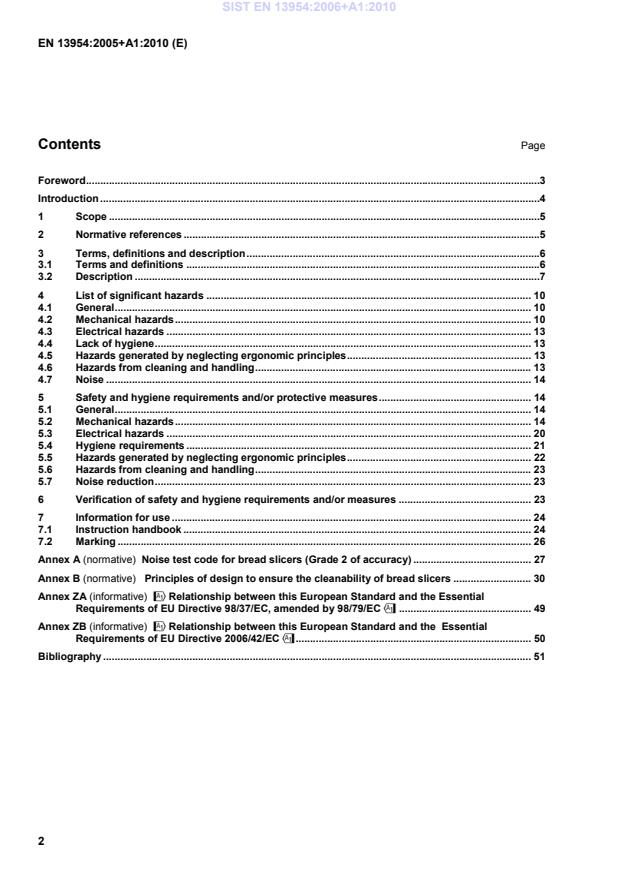
Noise test code for bread slicers (Grade 2 of accuracy) . 27Annex B (normative)
Principles of design to ensure the cleanability of bread slicers . 30Annex ZA (informative)
!Relationship between this European Standard and the Essential Requirements of EU Directive 98/37/EC, amended by 98/79/EC" . 49Annex ZB (informative)
!Relationship between this European Standard and the
Essential Requirements of EU Directive 2006/42/EC" . 50Bibliography . 51 SIST EN 13954:2006+A1:2010
Figure 1.1 — type 1a Figure 1.2 —type 1b
Figure 1.3 — type 1c Key 1 crumb tray; 2 discharge area or device; 3 cutting device: multiple blades which have reciprocating motion; 4 infeed area or device; 5 feed device (e.g. pusher, special conveyor belt), which pushes and guides the loaf of bread for the cutting action; 6 drive mechanisms; 7 electrical controls.
Figure 1 — Example of a bread slicer of type 1 According to the way the bread is brought to the slicing tool, the following distinctions are made: SIST EN 13954:2006+A1:2010
Key 1 feed device in a feed trough; 2 blade housing; 3 rotary (sickle) crescent or circular blade; 4 discharge trough; 5 crumb tray
Figure 2 — Bread slicing machine of type 2 with discharge trough The machine housing holds associated drives, electrical and/or hydraulic and pneumatic components, depending on the machine type. Type 2 bread slicing machines in the scope of this document may be equipped with an in-feed conveyor belt, a discharge conveyor belt, and SIST EN 13954:2006+A1:2010
Hazards of cutting. Zone 2: Access to cutting side of blades through discharge area.
Hazards of cutting. Zone 3: Access to cutting side of blades and to other moving parts of the machine through the crumb tray opening, when it is removed.
Hazards of shearing, drawing in, cutting. Zone 4: Access to all moving parts (e.g. drive mechanisms) through other sides of the machine.
Hazards of shearing, drawing in. SIST EN 13954:2006+A1:2010
Figure 3.a Figure 3.b
Figure 3.c Key 1 Zone 1 2 Zone 2 3 Zone 3 4 Zone 4 Figure 3 — Danger zones of
bread slicers of type 1 4.2.2 The significant mechanical hazards for type 2 machines are listed below: crushing hazard; shearing hazard; severing hazard; entanglement hazard; cutting hazard; drawing-in hazard; SIST EN 13954:2006+A1:2010
Crushing or shearing and cutting or severing hazard to fingers or hand. Zone 2: Rotating blade in cutting area, access from feed trough.
Entanglement, cutting or severing hazard to fingers or hand. Zone 3: Rotating blade in cutting area, access via discharge trough.
Entanglement, cutting or severing hazard to fingers or hand. Zone 4: Rotating blade in the blade housing.
Cutting or severing hazard to fingers or hand.
Breakage of blade or detachment of blade mounting.
Hazard caused by ejected parts. Zone 5: Rotating blade, access via the crumb tray.
Entanglement, cutting or severing hazard to fingers or hand. Zone 6: Drive mechanisms of blade and feed device/ bread holder.
Crushing, shearing or drawing-in hazard to fingers or hand. Zone 7: Outlet conveyor belt.
Entanglement, drawing-in or crushing hazard to fingers or hand. Zone 8: Unintentional or intentional closing of machine parts.
Crushing hazard to fingers or hand. SIST EN 13954:2006+A1:2010
Key 1 Zone 1 2 Zone 2 3 Zone 3 4 Zone 4 5 Zone 5 6 Zone 6 7 Zone 7 8 Zone 8 Figure 4 — Danger zones on a bread slicing machine of type 2 with discharge trough and outlet conveyor belt
4.3 Electrical hazards Hazard of electric shock from direct or indirect contact with live components. Hazard of external influences on electrical equipment (e.g. cleaning with water and dust generated by slicing the bread). 4.4 Lack of hygiene Lack of hygiene can create a risk to human health and unacceptable alteration of foodstuff e.g. contamination by microbial growth or foreign materials. 4.5 Hazards generated by neglecting ergonomic principles Risk of injury or chronic damage to the body resulting from harmful body postures during operation, cleaning and maintenance. 4.6 Hazards from cleaning and handling Cutting while cleaning, whereas the blades are stopped. Cutting while removing the blade assembly. SIST EN 13954:2006+A1:2010
Key 1 cutting side of slicing blades 2 frame d distance from edge of frame to slicing blades Figure 5 — Minimum distance The operating lever shall command the start function of the blades. If the lever is released the machine shall stop and the lever shall return to the rest position ("hold-to-run"). The design of the bread pusher and the comb shall prevent access to the blades at the end of the pusher’s movement. On machines where the frame supporting the blades moves relative to the machine frame, the crushing hazard between the blade frame and the machine frame shall be avoided. To achieve this, the maximum clearance between the blade frame and the machine frame, where accessible, shall be less than 4 mm. 5.2.1.2.2 Type 1b machines (automatic) The slicing blades and in-feed device shall be protected by one of the following methods: an interlocking guard, which prevents access to the cutting side of the blades and the infeed device; or a control guard, complying with 5.4.9 of EN 953:1997, which when closed prevents access to the cutting side of the blades and the infeed device and initiates the operation of the blades and the in-feed device; or !an active opto-electronic protective device (AOPD) of type 2 in accordance with EN 61496-1:2004, while the related part of the control system shall meet a performance level d and category 3 in accordance with EN ISO 13849-1:2008." In all cases, the dimensions of any openings in the guard shall be in accordance with Table 4 of
!EN ISO 13857:2008". Opening of the guard or actuation of the active opto-electronic protective device shall cause the machine to stop in the shortest possible time, but in no case exceed 1 s. 5.2.1.2.3 Type 1c machines (automatic with continuous feeding) The slicing blades and in-feed device shall be protected by an interlocking guard. The safety distance from the edge of the bread in-feed opening to the nearest danger zone shall be greater than or equal to 850 mm. The height of the opening of the tunnel shall be limited to 200 mm. SIST EN 13954:2006+A1:2010
" Figure 6 — Example of warning signs 5.2.1.5 Zone 4: Drive mechanisms Access to drive mechanisms shall be prevented. This can be achieved by housing them within the machine frame. Any opening in the machine frame shall have a fixed or interlocking guard. SIST EN 13954:2006+A1:2010
EN ISO 13849-1:2008." Under normal stopping conditions, the blade shall come to a standstill in such a position that the cutting edge of the blade does not protrude into the cutting area. 5.2.2.1.2 Specific requirements for interlocking devices without guard locking, associated with guards preventing from access to the blade This solution shall only be used if after activation of the device the blade stops within the shortest stopping time from the following: 0,5 s, or a half rotation for a rotating blade/a half cycle of oscillating blades. If necessary for achieving these objectives a braking device shall be provided. Otherwise the interlocking device shall be with guard locking in accordance with 5.2.2.1.3. The interlocking device shall be activated after opening of the guard by more than 10 mm. The specified stopping time shall also be achieved after actuation of the emergency stop, or in the event of a power failure. Instruction for use shall recommend regular inspection and maintenance, and define the elements to be check in order to maintain operating effectiveness of the braking device. 5.2.2.1.3 Specific requirements for interlocking devices with guard locking, associated with guards preventing from access to the blade !The safety related parts of the monitoring system shall meet at least a performance level c and at least category 1 in accordance with EN ISO 13849-1:2008." The locking shall be effective even in the event of a power failure. 5.2.2.2 Zone 1: Movement of the feed device in feed trough Unless hazards can be eliminated by design in accordance with 4.2 of EN ISO 12100-2:2003 access shall be prevented by the use of a control guard according to 5.4.9 of EN 953:1997. 5.2.2.3 Zone 2: Rotating blade in cutting area, access from feed trough As far as this hazard is not dealt with by the safety measures for zone 1, access into the danger zones in the cutting area shall be prevented: either by an interlocking guard with guard locking over the feed trough according to 3.25.5 of EN ISO 12100-1:2003 (see 5.2.2.1.3) SIST EN 13954:2006+A1:2010
!EN ISO 13857:2008" (see Figure 7). If the opening of the feed trough or the space released by the pusher is larger than 120 mm (see Table 4 of !EN ISO 13857:2008"), the length of the infeed trough shall be at least 1 200 mm.
Key L1 ≥ 850 mm or 1 200 mm (see 5.2.2.3) L2 ≥ 1 200 mm (see 5.2.2.4) when the feed trough or discharge trough are open faced where L1 = Distance from the edge of the guard (cover) on the infeed side and the blade L2 = Distance from the edge of the guard (cover) on the outlet side and the blade Figure 7 — Safety measures on type 2 bread slicing machines 5.2.2.4 Zone 3: Rotating blade in cutting area, access via discharge through Access shall be prevented by the use of: either an interlocking guard with guard locking (cover) according to 3.25.5 of EN ISO 12100-1:2003 (see 5.2.2.1.3) or by an interlocking guard without guard locking (see 5.2.2.1.2). The discharge trough shall be guarded or the aperture on the discharge side shall be designed according to Table 4 of !EN ISO 13857:2008". If the opening of the discharge trough is larger than 120 mm (see Table 4 of !EN ISO 13857:2008"), the length L2 of the discharge trough shall be at least 1 200 mm (see Figure 7). With a distance to the blade plane greater than or equal to 1 200 mm and an aperture less than or equal to 120 mm, the trough end may be open. The movable guard may be designed as a control guard according to 5.4.9 of EN 953:1997. 5.2.2.5 Zone 4: Rotating blade in the blade housing Rotating blade SIST EN 13954:2006+A1:2010
EN 60204-1:2006"); the whole machine housing shall have a minimum degree of protection IP23 according to
EN 60529:1991. 5.4 Hygiene requirements 5.4.1 General Bread slicers shall be designed and manufactured in accordance with EN 1672-2 and Annex B of this document. The three different areas shown in the examples of Figure 8 are defined in EN 1672-2. The precise boundary between the zones depends on the detailed design of the machine but in general they are at least as follows: SIST EN 13954:2006+A1:2010
food area
splash area
non food area Figure 8 — Hygiene areas 5.5 Hazards generated by neglecting ergonomic principles Harmful body postures during maintenance and cleaning as well as when filling and emptying the machine shall be avoided. SIST EN 13954:2006+A1:2010
5.2.1.4 By visual inspection and measurement of the dimensions 5.2.1.5 By visual inspection 5.2.2.1 By design verification, visual inspection, measurement of the dimensions and functional test 5.2.2.2 By design verification, visual inspection, measurement of the dimensions and functional test 5.2.2.3 By design verification, visual inspection, measurement of the dimensions and functional test 5.2.2.4 By design verification, visual inspection, measurement of the dimensions and functional test 5.2.2.5 By design verification, visual inspection, measurement of the dimensions and functional test 5.2.2.6 By measurement of the dimensions and functional test 5.2.2.7 By visual inspection and functional test 5.2.2.8 By visual inspection and measurement of the dimensions 5.2.2.9 By visual inspection and functional test 5.2.2.10 By visual inspection and functional test 5.2.3 By tilting test at 10° for free standing machines and verification of the instruction handbook !5.3 By design verification, visual inspection and by testing in accordance with Clause 18 of EN 60204-1:2006 Visual inspection and functional test of emergency stop control, if existing Visual inspection and functional test of normal stop control" 5.4 In accordance with Clause 6 of EN 1672-2:2005 5.5 By measurement of the forces, by inspection of the visibility of the indicators, buttons etc. 5.6 Visual inspection 5.7 By measurement according to Annex A. 7 Information for use 7.1 Instruction handbook The manufacturer shall provide an instruction handbook in accordance with 6.5 of EN ISO 12100-2:2003. In particular, the instruction handbook shall provide: the provisions for handling, transportation, storage, installation, starting up; information on residual risks, and recommended personal protective equipment (PPE) including an instruction, that cut resistant gloves shall be worn when changing the cutting tools and when carrying out any work in the vicinity of the cutting tools; the provisions for cleaning: the cleaning products to be used, the recommended implements, the procedures and frequency, any necessary warning (for example, cleaning shall be done once the machine is stopped, using a brush, a plastic scraper, a duster, a vacuum cleaner, …, metallic implements are not recommended); the capacity of the machine; the value of forces at the fixing points if the machine is fixed; SIST EN 13954:2006+A1:2010
...