

prEN 15383
(Main)Plastics piping systems for drainage and sewerage - Glass-reinforced thermosetting plastics (GRP) based on polyester resin (UP) - Manholes and inspection chambers
- Abstract
This document applies to:
a) manholes, when made from glass-reinforced thermosetting plastics (GRP) based on polyester resin (UP);
b) inspection chambers, when made from glass-reinforced thermosetting plastics (GRP) based on polyester resin (UP) which are intended to be used with inverts which are at a depth not exceeding 2 m.
These products are intended to be used within a drain or sewer system operating without pressure or occasionally at a head of pressure up to 1 bar.
It applies to products, and their joints, intended for use in buried installations and to be installed by open-trench techniques.
The units have a circular shape with nominal sizes as specified in EN ISO 23856.
The intended use of these products is to provide access to, buried drain or sewer systems for the conveyance of waste water at temperatures up to 50 °C, without pressure or occasionally at a head of pressure up to 1 bar, outside buildings and installed in areas subjected to vehicle and/or pedestrian traffic.
It specifies definitions including symbols, requirements and characteristics of manholes, inspection chambers, joints, materials, test methods and marking.
NOTE It is the responsibility of the purchaser or specifier to make the appropriate selections, taking into account their particular requirements and any relevant national regulations and installation practices or codes.
- Status
- Not Published
- Publication Date
- 25-May-2027
- Technical Committee
- CEN/TC 155 - Plastics piping systems and ducting systems
- Current Stage
- 4060 - Closure of enquiry - Enquiry
- Start Date
- 05-Mar-2026
- Completion Date
- 05-Mar-2026

Overview
prEN 15383 specifies requirements for manholes and inspection chambers manufactured from glass‑reinforced thermosetting plastics (GRP) based on unsaturated polyester resin (UP) for drainage and sewerage systems. It covers circular GRP‑UP shaft and chamber units intended for buried, open‑trench installations used outside buildings for the conveyance of wastewater at temperatures up to 50 °C, operating without pressure or occasionally subject to a head of pressure up to 1 bar.
Key scope points:
- Manholes (internal diameter ≥ 800 mm) for personnel access.
- Inspection chambers (internal diameter 200–800 mm) with invert depth ≤ 2 m.
- Units sized per EN ISO 23856 and suitable for areas with vehicle and/or pedestrian traffic.
- Defines requirements for materials, joints, mechanical and geometrical characteristics, test methods, marking and ancillary products.
Key topics and technical requirements
- Materials and construction: GRP based on polyester resin (UP), with specified material properties and manufacturing controls for buried use.
- Geometrical characteristics: External/internal diameter, wall thickness, opening sizes and dimensional tolerances (referencing EN ISO 23856 and EN ISO 3126).
- Mechanical properties: Longitudinal compressive strength and compressive load requirements; specific test procedures (e.g., EN ISO 604; prism test-piece method in Annex A).
- Joints and leak‑tightness: Requirements for flexible and rigid joints, joint performance and leak‑tightness testing (see EN 1119, ISO 8533).
- Service conditions: Designed for wastewater up to 50 °C, no internal pressure or occasional short-term pressure up to 1 bar.
- Ancillary components: Covers, steps/ladders, cover slabs and precast concrete interfaces; tests for steps/ladder resistance (EN 13101, EN 14396, Annex B).
- Marking, dangerous substances and conformity: Minimum marking, declarations on dangerous substances and guidance on conformity assessment and manufacturer installation recommendations.
- Purchaser/specifier responsibility: selection must account for national regulations and installation practices.
Applications and users
This standard is essential for:
- Manufacturers of GRP-UP manholes and inspection chambers
- Civil and sewerage engineers specifying buried drainage components
- Contractors performing open‑trench installation of sewer access structures
- Authorities and asset owners requiring standardized products for vehicular/pedestrian areas
Practical applications include access points for maintenance, inspection and cleaning of non‑pressurised or intermittently pressurised sewer and drainage networks.
Related standards
Relevant references and complementary standards include:
- EN ISO 23856 (GRP systems - sizing)
- EN 124-1 (gully/manhole tops)
- EN 1119 (GRP joint leak tests)
- EN 13101, EN 14396 (steps, ladders)
- EN ISO 604, EN ISO 3126, ISO 8533
Keywords: prEN 15383, EN 15383, GRP manholes, GRP inspection chambers, GRP‑UP, plastics piping systems, drainage and sewerage, leak‑tightness, buried manholes.
Relations
- Effective Date
- 28-Feb-2024
Get Certified
Connect with accredited certification bodies for this standard

Zavod za gradbeništvo Slovenije (ZAG) - Inšpekcija
ZAG inspection body for construction products, structures, and materials.
Sponsored listings
Frequently Asked Questions
prEN 15383 is a draft published by the European Committee for Standardization (CEN). Its full title is "Plastics piping systems for drainage and sewerage - Glass-reinforced thermosetting plastics (GRP) based on polyester resin (UP) - Manholes and inspection chambers". This standard covers: This document applies to: a) manholes, when made from glass-reinforced thermosetting plastics (GRP) based on polyester resin (UP); b) inspection chambers, when made from glass-reinforced thermosetting plastics (GRP) based on polyester resin (UP) which are intended to be used with inverts which are at a depth not exceeding 2 m. These products are intended to be used within a drain or sewer system operating without pressure or occasionally at a head of pressure up to 1 bar. It applies to products, and their joints, intended for use in buried installations and to be installed by open-trench techniques. The units have a circular shape with nominal sizes as specified in EN ISO 23856. The intended use of these products is to provide access to, buried drain or sewer systems for the conveyance of waste water at temperatures up to 50 °C, without pressure or occasionally at a head of pressure up to 1 bar, outside buildings and installed in areas subjected to vehicle and/or pedestrian traffic. It specifies definitions including symbols, requirements and characteristics of manholes, inspection chambers, joints, materials, test methods and marking. NOTE It is the responsibility of the purchaser or specifier to make the appropriate selections, taking into account their particular requirements and any relevant national regulations and installation practices or codes.
This document applies to: a) manholes, when made from glass-reinforced thermosetting plastics (GRP) based on polyester resin (UP); b) inspection chambers, when made from glass-reinforced thermosetting plastics (GRP) based on polyester resin (UP) which are intended to be used with inverts which are at a depth not exceeding 2 m. These products are intended to be used within a drain or sewer system operating without pressure or occasionally at a head of pressure up to 1 bar. It applies to products, and their joints, intended for use in buried installations and to be installed by open-trench techniques. The units have a circular shape with nominal sizes as specified in EN ISO 23856. The intended use of these products is to provide access to, buried drain or sewer systems for the conveyance of waste water at temperatures up to 50 °C, without pressure or occasionally at a head of pressure up to 1 bar, outside buildings and installed in areas subjected to vehicle and/or pedestrian traffic. It specifies definitions including symbols, requirements and characteristics of manholes, inspection chambers, joints, materials, test methods and marking. NOTE It is the responsibility of the purchaser or specifier to make the appropriate selections, taking into account their particular requirements and any relevant national regulations and installation practices or codes.
prEN 15383 is classified under the following ICS (International Classification for Standards) categories: 93.030 - External sewage systems. The ICS classification helps identify the subject area and facilitates finding related standards.
prEN 15383 has the following relationships with other standards: It is inter standard links to EN 15383:2012+A1:2013. Understanding these relationships helps ensure you are using the most current and applicable version of the standard.
prEN 15383 is available in PDF format for immediate download after purchase. The document can be added to your cart and obtained through the secure checkout process. Digital delivery ensures instant access to the complete standard document.
Standards Content (Sample)
SLOVENSKI STANDARD
01-marec-2025
Cevni sistemi iz polimernih materialov za odpadno vodo - S steklenimi vlakni
ojačeni duromerni materiali (GRP), ki temeljijo na nenasičeni poliestrski smoli (UP)
- Vstopni in revizijski jaški
Plastics piping systems for drainage and sewerage - Glass-reinforced thermosetting
plastics (GRP) based on polyester resin (UP) - Manholes and inspection chambers
Kunststoff-Rohrleitungssysteme für Entwässerung und Kanalisation -
Glasfaserverstärkte duroplastische Kunststoffe (GFK) auf Basis von Polyesterharz (UP) -
Schächte und Kontrollschächte
Systèmes de canalisations en plastique pour les branchements et collecteurs
d'assainissement - Plastiques thermodurcissables renforcés de verre (PRV) à base de
résine de polyester (UP) - Regards et boîtes de branchement et d'inspection
Ta slovenski standard je istoveten z: prEN 15383
ICS:
23.040.05 Cevovodi za zunanje Pipeline and its parts for
sisteme za odpadno vodo in external sewage systems
njihovi deli
83.120 Ojačani polimeri Reinforced plastics
93.030 Zunanji sistemi za odpadno External sewage systems
vodo
2003-01.Slovenski inštitut za standardizacijo. Razmnoževanje celote ali delov tega standarda ni dovoljeno.
DRAFT
EUROPEAN STANDARD
NORME EUROPÉENNE
EUROPÄISCHE NORM
January 2025
ICS 93.030 Will supersede EN 15383:2012+A1:2013
English Version
Plastics piping systems for drainage and sewerage - Glass-
reinforced thermosetting plastics (GRP) based on
polyester resin (UP) - Manholes and inspection chambers
Systèmes de canalisations en plastique pour les Kunststoff-Rohrleitungssysteme für Entwässerung und
branchements et collecteurs d'assainissement - Kanalisation - Glasfaserverstärkte duroplastische
Plastiques thermodurcissables renforcés de verre Kunststoffe (GFK) auf Basis von Polyesterharz (UP) -
(PRV) à base de résine de polyester (UP) - Regards et Schächte und Kontrollschächte
boîtes de branchement et d'inspection
This draft European Standard is submitted to CEN members for enquiry. It has been drawn up by the Technical Committee
CEN/TC 155.
If this draft becomes a European Standard, CEN members are bound to comply with the CEN/CENELEC Internal Regulations
which stipulate the conditions for giving this European Standard the status of a national standard without any alteration.
This draft European Standard was established by CEN in three official versions (English, French, German). A version in any other
language made by translation under the responsibility of a CEN member into its own language and notified to the CEN-CENELEC
Management Centre has the same status as the official versions.
CEN members are the national standards bodies of Austria, Belgium, Bulgaria, Croatia, Cyprus, Czech Republic, Denmark, Estonia,
Finland, France, Germany, Greece, Hungary, Iceland, Ireland, Italy, Latvia, Lithuania, Luxembourg, Malta, Netherlands, Norway,
Poland, Portugal, Republic of North Macedonia, Romania, Serbia, Slovakia, Slovenia, Spain, Sweden, Switzerland, Türkiye and
United Kingdom.
Recipients of this draft are invited to submit, with their comments, notification of any relevant patent rights of which they are
aware and to provide supporting documentation.
Warning : This document is not a European Standard. It is distributed for review and comments. It is subject to change without
notice and shall not be referred to as a European Standard.
EUROPEAN COMMITTEE FOR STANDARDIZATION
COMITÉ EUROPÉEN DE NORMALISATION
EUROPÄISCHES KOMITEE FÜR NORMUNG
CEN-CENELEC Management Centre: Rue de la Science 23, B-1040 Brussels
© 2025 CEN All rights of exploitation in any form and by any means reserved Ref. No. prEN 15383:2025 E
worldwide for CEN national Members.
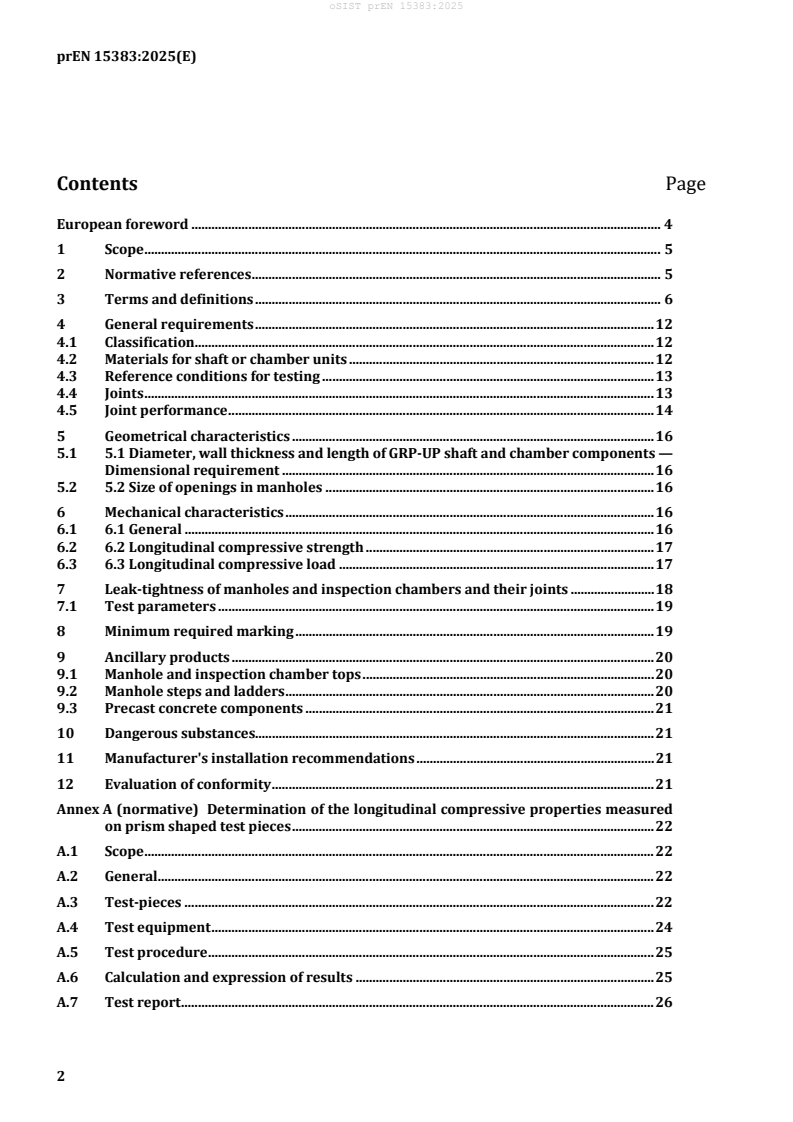
Contents Page
European foreword . 4
1 Scope . 5
2 Normative references . 5
3 Terms and definitions . 6
4 General requirements . 12
4.1 Classification. 12
4.2 Materials for shaft or chamber units . 12
4.3 Reference conditions for testing . 13
4.4 Joints . 13
4.5 Joint performance . 14
5 Geometrical characteristics . 16
5.1 5.1 Diameter, wall thickness and length of GRP-UP shaft and chamber components —
Dimensional requirement . 16
5.2 5.2 Size of openings in manholes . 16
6 Mechanical characteristics . 16
6.1 6.1 General . 16
6.2 6.2 Longitudinal compressive strength . 17
6.3 6.3 Longitudinal compressive load . 17
7 Leak-tightness of manholes and inspection chambers and their joints . 18
7.1 Test parameters . 19
8 Minimum required marking . 19
9 Ancillary products . 20
9.1 Manhole and inspection chamber tops . 20
9.2 Manhole steps and ladders . 20
9.3 Precast concrete components . 21
10 Dangerous substances. 21
11 Manufacturer's installation recommendations . 21
12 Evaluation of conformity . 21
Annex A (normative) Determination of the longitudinal compressive properties measured
on prism shaped test pieces . 22
A.1 Scope . 22
A.2 General. 22
A.3 Test-pieces . 22
A.4 Test equipment . 24
A.5 Test procedure . 25
A.6 Calculation and expression of results . 25
A.7 Test report . 26
Annex B (normative) Determination of the resistance of installed steps to vertical or
horizontal loading . 27
B.1 Scope . 27
B.2 Principle . 27
B.3 Apparatus . 27
B.4 Preparation . 27
B.5 Procedure . 27
B.6 Test report . 28
European foreword
This document (prEN 15383:2025) has been prepared by Technical Committee CEN/TC 155 “Plastics
piping systems and ducting systems”, the secretariat of which is held by NEN.
This document is currently submitted to the CEN Enquiry.
This document will supersede EN 15383:2012+A1:2013.
EN 15383:2012+A1:2013:
— References to EN 14364 have been replaced with references to EN ISO 23856;
— Specifying concrete in slabs have been removed.
1 Scope
This document applies to
a) manholes, when made from glass-reinforced thermosetting plastics (GRP) based on polyester resin
(UP);
b) inspection chambers, when made from glass-reinforced thermosetting plastics (GRP) based on
polyester resin (UP) which are intended to be used with inverts which are at a depth not exceeding
2 m.
These products are intended to be used within a drain or sewer system operating without pressure or
occasionally at a head of pressure up to 1 bar.
It applies to products, and their joints, intended for use in buried installations and to be installed by open-
trench techniques.
The units have a circular shape with nominal sizes as specified in EN ISO 23856.
The intended use of these products is to provide access to, buried drain or sewer systems for the
conveyance of waste water at temperatures up to 50 °C, without pressure or occasionally at a head of
pressure up to 1 bar, outside buildings and installed in areas subjected to vehicle and/or pedestrian
traffic.
It specifies definitions including symbols, requirements and characteristics of manholes, inspection
chambers, joints, materials, test methods and marking.
NOTE It is the responsibility of the purchaser or specifier to make the appropriate selections, taking into
account their particular requirements and any relevant national regulations and installation practices or codes.
2 Normative references
The following documents are referred to in the text in such a way that some or all of their content
constitutes requirements of this document. For dated references, only the edition cited applies. For
undated references, the latest edition of the referenced document (including any amendments) applies.
EN 124-1, Gully tops and manhole tops for vehicular and pedestrian areas — Part 1: Definitions,
classification, general principles of design, performance requirements and test methods
EN 476, General requirements for components used in drains and sewers
EN 681-1, Elastomeric seals — Materials requirements for pipe joint seals used in water and drainage
applications — Part 1: Vulcanized rubber
EN 1119, Plastics piping systems — Joints for glass-reinforced thermosetting plastics (GRP) pipes and
fittings — Test methods for leaktightness and resistance to damage of non-thrust resistant flexible joints
with elastomeric sealing elements
EN 1917, Concrete manholes and inspection chambers, unreinforced, steel fibre and reinforced
EN 13101, Steps for underground man entry chambers — Requirements, marking, testing and evaluation
of conformity
EN ISO 23856, Plastics piping systems for pressure and non-pressure water supply, drainage or sewerage
— Glass-reinforced thermosetting plastics (GRP) systems based on unsaturated polyester (UP) resin
EN 14396, Fixed ladders for manholes
CEN/TS 14632, Plastics piping systems for drainage, sewerage and water supply, pressure and non-pressure
— Glass-reinforced thermosetting plastics (GRP) based on unsaturated polyester resin (UP) — Guidance for
the assessment of conformity
EN ISO 604:2003, Plastics — Determination of compressive properties (ISO 604:2002)
EN ISO 3126, Plastics piping systems — Plastics components — Determination of dimensions (ISO 3126)
ISO 2602, Statistical interpretation of test results — Estimation of the mean — Confidence interval
ISO 8533, Plastics piping systems for pressure and non-pressure drainage and sewerage — Glass-reinforced
thermosetting plastics (GRP) systems based on unsaturated polyester (UP) resin — Test methods to prove
the design of cemented or wrapped joints
3 Terms and definitions
For the purposes of this document, the terms and definitions given in EN ISO 23856 and the following
apply.
ISO and IEC maintain terminology databases for use in standardization at the following addresses:
— ISO Online browsing platform: available at https://www.iso.org/obp/
— IEC Electropedia: available at https://www.electropedia.org/
3.1
adjusting unit
component of a manhole used above the cover slab to adjust the height of the structure and accommodate
a cover and frame (see Figure 2)
3.2
base unit
vertical component with integral base, with or without benching (see Figure 2), incorporating
appropriate flexible joints to provide watertight connections to pipelines with or without integral
connecting pipe(s) or adaptors
3.3
chamber unit
vertical component of uniform cross-section (see Figure 2)
Note 1 to entry: It is classified by its nominal size and its internal height. Chamber units may incorporate flexible
joints providing watertight connections to a pipeline.
3.4
connecting pipe
short pipe having plain, socket or spigot ends which provides a connection between a pipeline and a
manhole
3.5
cover slab
horizontal unit, forming the roof of a chamber or shaft, which incorporates an opening for access and
above which adjusting unit(s) and/or a cover and frame are intended to fit (see Figure 2)
Note 1 to entry: Typically, a cover slab is made of reinforced precast concrete.
3.6
external diameter
d
e
mean external diameter of the shaft or chamber unit at any cross section except the joint
Note 1 to entry: External diameter is expressed in millimetres (mm).
3.7
inspection chamber
drainage or sewerage fitting used to connect drainage or sewerage installations and/or to change the
direction of drainage or sewerage runs, which terminates at ground level with a riser shaft having an
internal diameter not less than 200 mm and not more than 800 mm diameter (see Figure 2)
Note 1 to entry: The termination at ground level permits the introduction of cleaning, inspection and test equipment
and the removal of debris but does not provide access for personnel.
3.8
internal diameter
d
i
external diameter of a unit minus twice its wall thickness
Note 1 to entry: Internal diameter is calculated using Formula (1) and expressed in millimetres:
d = d − 2e (1)
i e
where
de is the external diameter of the unit, expressed in millimetres (mm);
e is the wall thickness of the unit, expressed in millimetres (mm).
3.9
manhole
chamber, with a removable cover, constructed on a drain or sewer to permit entry by personnel (having
an internal diameter not less than 800 mm) (see Figure 2)
Note 1 to entry: The termination at ground level permits the introduction of cleaning, inspection and test equipment
and the removal of debris as well as providing access for personnel.
Note 2 to entry: Manhole components are subject to national safety regulations and/or local provisions regarding
man-entry limitations. The installer should check for compliance prior to installation.
3.10
normal service conditions
conveyance of wastewater, at temperature up to 50 °C, without pressure
3.11
reducing slab
horizontal transition unit, forming the roof of a chamber, which incorporates an opening for access from
the shaft to the chamber and above which shaft units are intended to fit (see Figure 2)
3.12
shaft unit
vertical component of uniform cross-section (see Figure 2)
Note 1 to entry: When incorporated in a manhole together with chamber units shaft units have a smaller nominal
size than the chamber units.
Note 2 to entry: Shaft units are classified by their nominal size and internal height (see Figure 2).
3.13
flexible joint
joint which allows relative movement between the components being joined
EXAMPLE: Socket-and-spigot joint with an elastomeric sealing element (including double socket designs).
3.14
rigid joint
joint which does not allow relative movement between the components being joined
EXAMPLE: Wrapped or cemented joint.
3.15
minimum specific initial longitudinal compressive stress at break
σ
b,s,min
manufacturers declared minimum value for the specific initial longitudinal compressive stress at break
of the unit
Note 1 to entry: Minimum specific initial longitudinal compressive stress at break is expressed in megapascals
(MPa).
3.16
initial longitudinal compressive stress at break (determined using prism test pieces)
σ
s,b,u
compressive stress at break of the test piece during a short-term compression test
Note 1 to entry: Initial longitudinal compressive stress at break (determined using prism test pieces) is expressed
in megapascals (MPa).
3.17
ultimate longitudinal load
F
ult
calculated value of the concentric longitudinal load that the manhole or inspection chamber ring
withstands just before break
Note 1 to entry: Ultimate longitudinal load is expressed in kilonewtons (kN).
3.18
longitudinal compressive (material) safety coefficient
ν
safety factor applied to the ultimate longitudinal load to determine the theoretical design load F
d,calc
(see 3.20)
3.19
design load
F
d
manufacturer's declared value of the longitudinal compressive load that a manhole or inspection
chamber ring can withstand during operation, taking into account the material safety coefficient, ν (see
3.18)
Note 1 to entry: Design load is expressed in kilonewtons (kN) and is calculated using the following formula:
F = F x ν
d ult
3.20
theoretical design load
F
d, calc
calculated value of the maximum concentric longitudinal compressive load that a manhole or inspection
chamber ring can be expected to withstand during operation, taking into account the material safety
coefficient, ν (see 3.18)
Note 1 to entry: Theoretical design load is expressed in kilonewtons (kN).
3.21
permissible eccentric force on the manhole or inspection chamber unit
F
perm,p
calculated value of the permissible eccentric longitudinal load that the manhole or inspection chamber
ring can withstand in operation, taking into account the material safety coefficient, ν (see 3.18)
Note 1 to entry: Permissible eccentric force on the manhole or inspection chamber unit is expressed in kilonewtons
(kN).
3.22
minimum cross-sectional area at the spigot
A
s
minimum pipe cross section of the spigot (see Figure 1) in square millimetres (mm )
Note 1 to entry: Minimum cross-sectional area at the spigot is expressed in square millimetres (mm ).
Note 2 to entry: Minimum cross-sectional area at the spigot is calculated using Formula (2):
A = π [(0,5j ) – (0,5d ) ] (2)
s e i
where
j is outside diameter of the joint, in millimetres (mm);
e
d is internal diameter of shaft or chamber unit, in
i
millimetres (mm).
Key
d outside diameter of unit (see 3.6)
e
j joint outside diameter
e
d internal diameter of unit (see 3.8)
i
(A) minimum unit cross-sectional area at spigot, A (see 3.22)
s
Figure 1 — Areas and diameters referred to in this document
Key
(a) section through deep chamber manhole
(b) section through a size reduction using a taper unit
(c) section through a size reduction using a reducing slab
1 adjusting unit (see 3.1)
2 GRP chamber unit
3 ladder
4 GRP riser shaft
5 cover slab
6 seal or joint
7 taper unit
8 reducing slab
9 GRP base unit
10 benching
Figure 2 — Typical types of units used in manholes and inspection chambers
4 General requirements
4.1 Classification
4.1.1 Categories
Shaft and chamber units shall be made from units complying with EN ISO 23856.
Shaft and chamber units shall be classified according to nominal size (DN) and internal height. In addition,
shaft and chamber units shall include nominal stiffness (SN) in their classification.
4.1.2 Nominal stiffness
The nominal stiffness, SN, shall conform to one of those given in Table 1 (see Footnotes a and b).
Where special applications require the use of units having a higher nominal stiffness than those given in
Table 1 the unit shall be marked “SN N”, where N is the number equal to the unit's nominal stiffness.
Table 1 — Nominal stiffnesses SN
a b
Nominal stiffnesses SN
SN 1 250
SN 2 500
SN 5 000
SN 10 000
a
These nominal stiffnesses correspond to the values specified EN ISO 23856 for the minimum initial specific
).
ring stiffness, in newtons per square metre (N/m
b
Shaft or chamber units of nominal stiffness less than SN 1250 are not intended for laying directly in the ground.
4.2 Materials for shaft or chamber units
4.2.1 General
Shaft and chamber units shall be made from units complying with EN ISO 23856 and be constructed using
chopped and/or continuous glass filaments, strands or rovings, mats or fabric synthetic veils, and
polyester resin with or without fillers and, if applicable, additives necessary to impart specific properties
to the resin. The shaft or chamber unit may also incorporate aggregates, and, if required, a thermoplastics
liner.
4.2.2 Elastomers
Each elastomeric material(s) of the sealing component (if used) shall conform to the applicable
requirements of EN 681-1.
4.2.3 Metals
Where exposed metal components are used in the shaft or chamber units, there shall not be evidence of
corrosion of the components after the metal component has been immersed in an aqueous sodium
chloride solution, 30 g/l, for seven days at (23 ± 2) °C.
4.3 Reference conditions for testing
4.3.1 Temperature
The mechanical, physical and chemical properties specified in all clauses of this document shall, unless
otherwise specified, be determined at (23 ± 5) °C. To establish re-rating factors for all long-term
properties to be used in design for service temperatures over 35 °C and up to and including 50 °C type
tests shall, unless otherwise specified, be carried out at least at the maximum service temperature
(50 ± 5) °C.
The joint tests described in 4.5 shall be performed at a temperature of (23 ± 15) °C.
4.3.2 Properties of water for testing
The water used for the tests referred to in this document shall be tap water having a pH of (7 ± 2).
4.3.3 Loading conditions
Unless otherwise specified, the mechanical, physical and chemical properties specified in EN ISO 23856
and clauses of this document shall be determined using circumferential and/or longitudinal loading
conditions, as applicable.
4.3.4 Preconditioning
Unless otherwise specified, in case of dispute store the test piece(s) in air at the test temperature specified
in 4.3.1 for at least 24 h prior to testing.
4.3.5 Measurement of dimensions
In case of dispute the dimensions of GRP-UP components shall be determined at the temperature
specified in 4.3.1. Measurements shall be made in accordance with EN ISO 3126 or otherwise using any
method of sufficient accuracy to determine conformity or otherwise to the applicable limits. Routine
measurements shall be determined at the prevailing temperature or, if the manufacturer prefers, at the
temperature specified in 4.3.1.
4.4 Joints
4.4.1 Types of joint
A joint shall be classified as either flexible (see 3.13) or rigid (see 3.14).
4.4.2 Length and diameter of joint
If requested, the manufacturer shall declare the length and the maximum external diameter of the
assembled joint used between manhole components.
4.4.3 Flexibility of the jointing system
Neither flexible nor rigid joints are required to have any specified amount of flexibility but both are
required to be watertight in service.
4.4.4 Sealing ring
If used the sealing ring shall not have any detrimental effect on the properties of the components with
which it is used and shall not cause the test assembly to fail the performance requirements of 4.5.
4.4.5 Adhesives
Adhesives, if required, shall be specified by the manufacturer of the joint. Adhesives shall not have any
detrimental effects on the components with which it is used and shall not cause the test assembly to fail
the performance requirements of 4.5.
4.5 Joint performance
4.5.1 Performance requirements
Flexible and rigid joints, when tested using procedures detailed in either EN 1119 or ISO 8533, as
applicable and using test pieces complying with 4.5.3, shall show conformity with the requirements that
they remain watertight and free from signs of damage when subject to each of the characteristics of the
test (see Table 2).
Joints for shaft and chamber units are not to be subject to bending tests as they are not applicable to
manhole elements.
Table 2 — Summary of joint tests and performance requirements for flexible and rigid joints
Characteristic Requirements Test parameters Test
method
Parameter Value
Initial leak- No le
...