

EN 16104:2012
(Main)Food data - Structure and interchange format
- Abstract
This European Standard specifies requirements on the structure and semantics of food datasets and of interchange of food data for various applications.
Food data refers to information on various food properties and includes various steps in the generation and publication of such data, e.g. sampling, analysis, food description, food property and value description.
The standard regards food data as datasets covering:
- identification, description and classification of foods including food ingredients,
- qualitative and quantitative food properties that can be measured, calculated or estimated,
- data quality values and other metadata,
- specifications of methods used for obtaining these values,
- references to sources for the information reported.
This standard includes requirements on:
- semantics and data structure for food data,
- content of referenced controlled vocabularies,
- XML encoding for interchange of food data.
This standard does not include:
- food description methods,
- quality assessment methods,
- content of controlled vocabularies, for example controlled vocabularies for nutrients,
- database implementation.
- Status
- Published
- Publication Date
- 18-Dec-2012
- Withdrawal Date
- 29-Jun-2013
- Technical Committee
- CEN/TC 387 - Project Committee - Food composition data
- Drafting Committee
- CEN/TC 387 - Project Committee - Food composition data
- Current Stage
- 9093 - Decision to confirm - Review Enquiry
- Start Date
- 23-Feb-2022
- Completion Date
- 21-Oct-2026


Overview
EN 16104:2012 (CEN) - "Food data - Structure and interchange format" defines a common model, semantics and an XML interchange format for food data and food datasets. The standard specifies how to represent identification, description and classification of foods (including ingredients), quantitative and qualitative food properties, metadata on data quality, methods and bibliographic references. EN 16104 supports consistent food data exchange across databases, systems and organizations.
Key topics and technical requirements
- Data structure and semantics: a formal class model for food data (e.g., Food, Ingredient, Property, Measure, Method, Sample, Recipe, Reference, Vocabulary), including UML-based class descriptions and aggregation rules.
- Controlled vocabularies: requirements for referenced vocabularies (food descriptors, units of measure, property codes, allergens, methods, places, languages) to ensure unambiguous meaning.
- XML encoding and schema: an XML schema and encoding rules for data instances, including identifiers, typed values (numeric, text, date/time), lists of valid values and decimal/date encodings (see Annex C).
- Metadata and provenance: mandatory support for data quality values, method specifications, performance and bibliographic source references.
- Identifiers and references: rules for identity, referencing data instances and the sequential order of XML elements to support robust data interchange.
- Scope exclusions: the standard does not define sampling or analytical methods themselves, content of specific controlled vocabularies (e.g., exact nutrient lists), quality assessment methods or database implementations.
Applications and users
EN 16104 is practical for any organization that generates, manages or exchanges structured food information:
- Food manufacturers, distributors and retailers - product specification, labelling and ecommerce data exchange.
- Food analysis laboratories - standardized reporting of analytical results, methods and uncertainties.
- Authorities and regulators - harmonised submission of food composition and safety data.
- Researchers, nutritionists and dietitians - consistent datasets for dietary assessment and research.
- Software developers and database providers - implement XML schemas and APIs for interoperability between food composition databases, LIMS, ERP and food service systems.
Related standards
- Works alongside domain standards and initiatives such as EuroFIR outputs, GS1 data standards and EFSA sample description guidelines. It complements but does not replace laboratory or method standards.
EN 16104 enables interoperable, machine-readable food data interchange, improving data quality, traceability and reuse across the food value chain. Keywords: EN 16104, food data, food data interchange, XML encoding, controlled vocabularies, food datasets, data structure, CEN.
Get Certified
Connect with accredited certification bodies for this standard

BSI Group
BSI (British Standards Institution) is the business standards company that helps organizations make excellence a habit.

Bureau Veritas
Bureau Veritas is a world leader in laboratory testing, inspection and certification services.

DNV
DNV is an independent assurance and risk management provider.
Sponsored listings
Frequently Asked Questions
EN 16104:2012 is a standard published by the European Committee for Standardization (CEN). Its full title is "Food data - Structure and interchange format". This standard covers: This European Standard specifies requirements on the structure and semantics of food datasets and of interchange of food data for various applications. Food data refers to information on various food properties and includes various steps in the generation and publication of such data, e.g. sampling, analysis, food description, food property and value description. The standard regards food data as datasets covering: - identification, description and classification of foods including food ingredients, - qualitative and quantitative food properties that can be measured, calculated or estimated, - data quality values and other metadata, - specifications of methods used for obtaining these values, - references to sources for the information reported. This standard includes requirements on: - semantics and data structure for food data, - content of referenced controlled vocabularies, - XML encoding for interchange of food data. This standard does not include: - food description methods, - quality assessment methods, - content of controlled vocabularies, for example controlled vocabularies for nutrients, - database implementation.
This European Standard specifies requirements on the structure and semantics of food datasets and of interchange of food data for various applications. Food data refers to information on various food properties and includes various steps in the generation and publication of such data, e.g. sampling, analysis, food description, food property and value description. The standard regards food data as datasets covering: - identification, description and classification of foods including food ingredients, - qualitative and quantitative food properties that can be measured, calculated or estimated, - data quality values and other metadata, - specifications of methods used for obtaining these values, - references to sources for the information reported. This standard includes requirements on: - semantics and data structure for food data, - content of referenced controlled vocabularies, - XML encoding for interchange of food data. This standard does not include: - food description methods, - quality assessment methods, - content of controlled vocabularies, for example controlled vocabularies for nutrients, - database implementation.
EN 16104:2012 is classified under the following ICS (International Classification for Standards) categories: 35.240.60 - IT applications in transport; 35.240.63 - IT applications in trade; 67.040 - Food products in general. The ICS classification helps identify the subject area and facilitates finding related standards.
EN 16104:2012 is available in PDF format for immediate download after purchase. The document can be added to your cart and obtained through the secure checkout process. Digital delivery ensures instant access to the complete standard document.
Standards Content (Sample)
2003-01.Slovenski inštitut za standardizacijo. Razmnoževanje celote ali delov tega standarda ni dovoljeno.Podatki o živilu - Struktura in format za izmenjevanjeLebensmitteldaten - Struktur und AustauschformatDonnées sur les aliments - Structure et format d'échangeFood data - Structure and interchange format67.040Živilski proizvodi na splošnoFood products in general35.240.68Uporabniške rešitve IT v kmetijstvuIT applications in agriculture35.240.63Uporabniške rešitve IT v trgoviniIT applications in tradeICS:Ta slovenski standard je istoveten z:EN 16104:2012SIST EN 16104:2013en,fr,de01-marec-2013SIST EN 16104:2013SLOVENSKI
STANDARD
EUROPEAN STANDARD NORME EUROPÉENNE EUROPÄISCHE NORM
EN 16104
December 2012 ICS 35.240.60; 67.040 English Version
Food data - Structure and interchange format
Données sur les aliments - Structure et format d'échange
Lebensmitteldaten - Struktur und Austauschformat This European Standard was approved by CEN on 3 November 2012.
CEN members are bound to comply with the CEN/CENELEC Internal Regulations which stipulate the conditions for giving this European Standard the status of a national standard without any alteration. Up-to-date lists and bibliographical references concerning such national standards may be obtained on application to the CEN-CENELEC Management Centre or to any CEN member.
This European Standard exists in three official versions (English, French, German). A version in any other language made by translation under the responsibility of a CEN member into its own language and notified to the CEN-CENELEC Management Centre has the same status as the official versions.
CEN members are the national standards bodies of Austria, Belgium, Bulgaria, Croatia, Cyprus, Czech Republic, Denmark, Estonia, Finland, Former Yugoslav Republic of Macedonia, France, Germany, Greece, Hungary, Iceland, Ireland, Italy, Latvia, Lithuania, Luxembourg, Malta, Netherlands, Norway, Poland, Portugal, Romania, Slovakia, Slovenia, Spain, Sweden, Switzerland, Turkey and United Kingdom.
EUROPEAN COMMITTEE FOR STANDARDIZATION
COMITÉ EUROPÉEN DE NORMALISATION EUROPÄISCHES KOMITEE FÜR NORMUNG
Management Centre:
Avenue Marnix 17,
B-1000 Brussels © 2012 CEN All rights of exploitation in any form and by any means reserved worldwide for CEN national Members. Ref. No. EN 16104:2012: ESIST EN 16104:2013
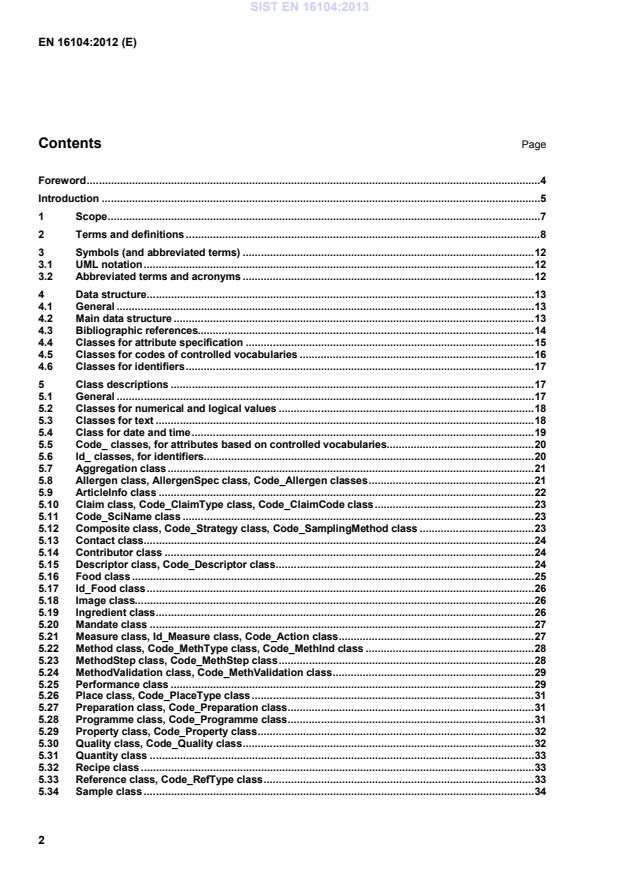
Data encoding . 36 6.1 General . 36 6.2 Data instances with identity . 36 6.3 Sequential order of XML elements . 37 6.4 References to data instances . 37 6.5 Data instances of class attributes . 37 6.6 XML schema datatypes . 38 6.7 Encoding of Decimal datatype class . 38 6.8 Encoding of Date datatype class . 38 6.9 Encoding of MultiText datatype class . 38 6.10 Encoding of Vocabulary class . 39 6.11 Encoding of Code_ classes . 39 6.12 Encoding of list of valid values . 39 6.13 Encoding of identifiers . 41 Annex A (informative)
UML notation . 43 Annex B (informative)
Examples of data instances . 44 B.1 Overview . 44 B.2 Agreements between actors . 44 B.3 Data instances and dataset . 48 B.4 Food description and food property measures . 48 B.5 Aggregation of food property measures . 52 B.6 Food composite and food samples . 54 B.7 Food recipes . 57 B.8 Food article with article information . 60 Annex C (informative)
XML schema and example of XML encoding . 63 C.1 General . 63 C.2 XML schema . 63 C.3 XML document example . 64 Annex D (informative)
Examples of controlled vocabularies . 66 D.1 General . 66 D.2 Background . 66 D.3 Food description . 66 D.4 Food classification . 67 D.5 Food property description . 68 D.6 Analytical methods . 68 D.7 Geographic places and languages . 69 D.8 Units of measure . 69 D.9 Other controlled vocabularies . 70 Bibliography . 71 SIST EN 16104:2013
Foreword This document (EN 16104:2012) has been prepared by Technical Committee CEN/TC 387 “Food data”, the secretariat of which is held by SIS. This European Standard shall be given the status of a national standard, either by publication of an identical text or by endorsement, at the latest by June 2013, and conflicting national standards shall be withdrawn at the latest by June 2013. Attention is drawn to the possibility that some of the elements of this document may be the subject of patent rights. CEN [and/or CENELEC] shall not be held responsible for identifying any or all such patent rights. According to the CEN/CENELEC Internal Regulations, the national standards organisations of the following countries are bound to implement this European Standard: Austria, Belgium, Bulgaria, Croatia, Cyprus, Czech Republic, Denmark, Estonia, Finland, Former Yugoslav Republic of Macedonia, France, Germany, Greece, Hungary, Iceland, Ireland, Italy, Latvia, Lithuania, Luxembourg, Malta, Netherlands, Norway, Poland, Portugal, Romania, Slovakia, Slovenia, Spain, Sweden, Switzerland, Turkey and the United Kingdom. SIST EN 16104:2013
This standard uses food properties as a general term when describing food constituents such as nutrients, heavy metals, micro-organisms, but also when describing various physico-chemical properties of foods.
Food data address description and identification of foods and their food properties. They are needed and used for many purposes, e.g. labelling, product development, dietary treatment, nutritional treatment, consumer information, and research. Thus, there are many types of parties that need to generate, compile, interchange, or access detailed information about foods. These include:
Food manufacturers Food analysis laboratories Authorities Researchers Resellers Retailers Nutritionists/dieticians Food distributors Consumers Restaurants/food service operators Software developers The ability and need to manage food information vary between these parties. There are multiple instances of all parties mentioned, which means that the information is interchanged in a large number of relations between parties. For example, a food manufacturer may have the need to communicate food information with multiple resellers, multiple retailers, multiple distributors and multiple authorities in multiple countries, and so on.
Currently, there are differences among member states and parties in the way food data are expressed with respect e.g. food description, definition of nutrients and other food properties, and methods used to generate compositional values. A common European Standard, established within the CEN framework, is a key tool enabling unambiguous identification and description of food data and its quality in e.g. databases, for dissemination and interchange.
Several European and international initiatives have focused on improving and harmonising food data description and interchange. This standard is based on two initiatives: the EuroFIR project [11] (an EC Network of Excellence funded by the 6th Framework Programme for Research and technological Development) 2005-2010 and Food and Beverage Extension to the GS1 GDSN Trade Item standard [14].
The main aim of the standard is to provide a framework that facilitates and enables generation, compilation, dissemination and interchange of food data that are comparable and unambiguous with respect to the identity of foods, the description of foods and food property measures including their quality. The standard is structured to be robust and flexible enough to incorporate future extensions with respect to various types of data. This standard will make it possible for any party in a community to send understandable food data to any other receiving party in that community. However, this standard does not include all definitions that are required. For example, the set of food properties that can be used, such as contents of various nutrients and heavy metals, is not included in the standard. These and all other so called controlled vocabularies will be agreed upon within the community. An annex of the standard provides examples of required controlled vocabularies. The reasons for not including the controlled vocabularies are: Most controlled vocabularies, for example with new food properties, will be constantly updated. Communities around the world are maintaining and using their own controlled vocabularies. The exchange of food data among different parties requires an agreement on not only what data to exchange but also on the encoding of the data. This standard includes data encoding rules based on XML which today is the most recognised general technique for data encoding.
Figure 1 illustrates a case where food data is exchanged between databases of partners (1) in some kind of community. They want to use this standard to set up a mutual agreement (2). Apart from selecting the standard (3), such an agreement will contain selections of controlled vocabularies and restrictions on data. Most of the data specified in the standard require a controlled vocabulary to be specified (5). Such controlled vocabularies are maintained by various organisations. An agreement will select the controlled vocabularies to use. Restrictions on data will be defined (4). For example, an agreement may state that a scientific name has to be provided for all foods, despite the fact that it is not required in the standard. In addition, an agreement may specify requirements on what food properties are to be exchanged or what language to use.
Figure 1 — Agreement for food data exchange (A) that are based on this standard (S) will also specify a set of controlled vocabularies (V). SIST EN 16104:2013
data quality values and other metadata, specifications of methods used for obtaining these values, references to sources for the information reported. This standard includes requirements on: semantics and data structure for food data, content of referenced controlled vocabularies, XML encoding for interchange of food data. This standard does not include: food description methods, quality assessment methods, content of controlled vocabularies, for example controlled vocabularies for nutrients, database implementation. SIST EN 16104:2013
characteristics of a class described by the values it can have Note 1 to entry: This term refers to ISO/IEC 19501:2005 (Unified Modelling Language) [1]. 2.3 class definition of data for description of a certain concept
Note 1 to entry: Classes as described in ISO/IEC 19501:2005 (Unified Modelling Language) [1] may also describe operations and methods. That possibility is not used in this standard. Note 2 to entry: A class is used as a specification of a data instance. For example a data instance of an employee may be specified by a class that specifies two attributes: the name and the salary of the employee. Note 3 to entry: A class can be used by other classes to specify an attribute. For example, a class for dates may be used to specify a delivery date in one class and a birthday in another class.
EXAMPLE 1 A class that defines a data structure with a code representing a language and a text. EXAMPLE 2 A class that defines a set of codes for representation of languages. EXAMPLE 3 A class that defines a text as a sequence of characters. 2.4 class diagram schema of associations between classes Note 1 to entry: This term refers to ISO/IEC 19501:2005 (Unified Modelling Language) [1]. 2.5 controlled vocabulary carefully selected set of terms such that each concept from the domain of discourse is described using only one term in the set and each term in the set describes only one concept 2.6 data instance set of data that is specified by a class
2.7 datatype class class for specification of attributes SIST EN 16104:2013
Note 1 to entry: A food article often includes a final preparation instruction that tells how to prepare it before you can eat it.
2.9 food substance intended for human consumption
Note 1 to entry: The term food generally refers to substances intended for human consumption, normally with exceptions for e.g. medicines, feed, cosmetics, tobacco, and includes raw or processed food products and substances used in the manufacture. The exact definition, however, may vary depending on legislation and cultural differences.
Note 2 to entry: Codex definition of food: “Food” means any substance, whether processed, semi-processed or raw, which is intended for human consumption, and includes drinks, chewing gum and any substance which has been used in the manufacture, preparation or treatment of “food” but does not include cosmetics or tobacco or substances used only as drugs (CODEX STAN 1-1985 [20]). Note 3 to entry: EC definition of food: Food means “Any substance or product, whether processed, partially processed or unprocessed, intended to be, or reasonably expected to be ingested by humans. 'Food' includes drink, chewing gum and any substance, including water, intentionally incorporated into the food during its manufacture, preparation or treatment. It includes water after the point of compliance as defined in Article 6 of Directive 98/83/EC and without prejudice to the requirements of Directives 80/778/EEC and 98/83/EC. ‘Food’ shall not include: (a) feed; (b) live animals unless they are prepared for placing on the market for human consumption; (c) plants prior to harvesting; (d) medicinal products within the meaning of Council Directives 65/65/EEC (1) and 92/73/EEC (2); (e) cosmetics within the meaning of Council Directive 76/768/EEC (3); (f) tobacco and tobacco products within the meaning of Council Directive 89/622/EEC (4); (g) narcotic or psychotropic substances within the meaning of the United Nations Single Convention on Narcotic Drugs, 1961, and the United Nations Convention on Psychotropic Substances, 1971; (h) residues and contaminants. (Regulation (EC) No 178/2002). 2.10 food article real food product distributed in a specific packing EXAMPLE 1 Canned tomato soup of a certain brand and type. EXAMPLE 2 Corn flakes package of a certain brand and intended for a specific market. EXAMPLE 3 Apples labelled with the apple variety and name of the producer. 2.11 food data data identifying and describing properties of foods 2.12 food dataset identified, structured collection of records of food data that can be stored or exchanged
2.13 food description system
method for systematic description of food as a combination of characteristics Note 1 to entry: A food description system may include procedures for capturing and retrieval of information about the food.
Note 2 to entry: A food description system defines a set of aspects to be described and a set of food descriptors for each aspect.
EXAMPLE 2 According to Codex Alimentarius “Ingredient” means any substance, including a food additive, used in the manufacture or preparation of a food and present in the final product although possibly in a modified form.
2.16 food ingredient list list describing the absolute or relative quantity or the ranking of food ingredients in a food 2.17 food label information information written on the package of a food article
2.18 food property qualitative or quantitative characteristic for a food that can be measured, calculated or estimated Note 1 to entry: Content of vitamins, minerals, allergens and micro-organisms as well as physico-chemical properties such as pH and specific gravity are examples of food properties. Note 2 to entry: Sets of food properties are defined and maintained by organisations such as EuroFIR [11], INFOODS [19], and CODEX [16] . EXAMPLE Content of vitamin C; content of calcium; pH; viscosity; retention factor of vitamin C after boiling. 2.19 food property measure value and unit of measure that quantifies or specifies a food property Note 1 to entry: A food property measure may include statistical properties of the value. 2.20 food recipe instructions on how to produce or prepare a food from a set of food ingredients
2.21 food sample
portion of a food that is assumed to represent the food
Note 1 to entry: UPAC [21] definition: portion of material selected from a larger quantity of material. 2.22 food sampling
procedure for the selection, withdrawal, preservation, transportation and preparation of the portions to be removed from a population as samples
Note 1 to entry: This standard handles food yield factors as food properties. 2.24 generic food
abstraction of a food based on several occurrences of foods Note 1 to entry: The description of a generic food is typically based on several occurrences, e.g. several food articles.
EXAMPLE 1 The food properties of a generic food "apple" may be based on samples of apples of different varieties and origin. EXAMPLE 2 The food properties of a generic food "pasta" may be based on samples of pasta of different types and brands. 2.25 health claim any representation that states, suggests or implies that a relationship exists between a food category, a food or one of its constituents and health Note 1 to entry:
The definition of health claim may differ somewhat between different legislation: EC 1924/2006 [24]: any claim that states suggests or implies that a relationship exists between a food category, a food or one of its constituents and health CAC/GL 23-1997 [22]: Health claim means any representation that states, suggests, or implies that a relationship exists between a food or a constituent of that food and health. Health claims include Nutrient function claims; Other function claims; Reduction of disease risk claims. 2.26 multi-ingredient food food that is made from at least two food ingredients
2.27 nutrient claim any representation which states, suggests or implies that a food has particular nutritional properties Note 1 to entry: The definition of nutrient claim may differ somewhat between different legislation: EC 1924/2006 [24]: any claim which states suggests or implies that a food has particular beneficial nutritional properties. CAC/GL 23-1997 [22]: Nutrition claim means any representation which states, suggests or implies that a food has particular nutritional properties including but not limited to the energy value and to the content of protein, fat and carbohydrates, as well as the content of vitamins and minerals. The following do not constitute nutrition claims: (a) the mention of substances in the set of ingredients; (b) the mention of nutrients as a mandatory part of nutrition labelling; (c) quantitative or qualitative declaration of certain nutrients or ingredients on the label if required by national legislation. 2.28 primary food sample
portion of a food initially collected from a food
Note 1 to entry: Other definitions: IUPAC [21]: The collection of one or more increments or units initially taken from a population. The portions may be either combined (composited or bulked sample) or kept separate (gross sample). If combined and mixed to homogeneity, it is a blended bulk sample. CAC/GL 50-2004 [23]: A primary sample is the ‘portion of product’ collected from a lot during the first stage of the sampling process, and will normally be in the form of an item (if collected from a lot of prepacked products) or of an increment (if collected from a bulk lot). 2.29 real food product
food that is produced harvested or gathered in a certain way independent of package type
Note 1 to entry: A real food product may be produced using a recipe. SIST EN 16104:2013
EXAMPLE 2 The retention factor of fat after frying.
2.31 XML attribute name-value pair within an XML element start tag EXAMPLE The value-pair currency="USD" is an attribute in the following XML element: 12.50 2.32 XML element XML data encoding structure that is delimited by a start tag and an end tag EXAMPLE
John Smith
4711 Note 1 to entry: In the example above there are three XML elements: employee, name and salary. is a start tag and is an end tag of the name element. 3 Symbols (and abbreviated terms) 3.1 UML notation This standard uses graphical UML notation in Clause 5 and in Annex B. For a complete description of the UML notation, refer to ISO/IEC 19501:2005, Information technology -- Open Distributed Processing -- Unified Modeling Language (UML) Version 1.4.2 [1]. For an informative explanation of the UML notation, refer to Annex A. 3.2 Abbreviated terms and acronyms URI
Uniform Resource Identifier
NOTE A URI consists of a string of characters used to identify or name a resource on the Internet. There are two types: URL (Uniform Resource Locator) which is a resources web address and URN (Uniform Resource Name) which is only a unique name of the resource. UML
Unified Modelling Language XML
Extensible Markup Language SIST EN 16104:2013
Classes with bold border lines are those that will specify data instances that have an identifier. These data instances can be referred to by other data instances and will be encoded in a special way, as described in Clause 7.
The notation of class diagrams is described in Annex A. NOTE All names of classes, attributes and association roles are symbolic names to be maintained unchanged if this standard is translated. 4.2 Main data structure
The class diagram in Figure 2 specifies the main data structure of a food dataset.
NOTE Annex B provides data instance examples and an informal explanation of the class diagram. Table 1 lists the classes covered by Figure 2 with a reference to the description of each class. Table 1 — Classes in Figure 2 Class Clause
Aggregation 5.7 ArticleInfo 5.9 Composite 5.12 Contributor 5.14 Food 5.16 Ingredient 5.19 Measure 5.21 Method 5.22 MethodStep 5.23 Property 5.29 Recipe 5.32 Sample 5.34 Source 5.35
Figure 2 — Main data structure 4.3 Bibliographic references
The class diagram in Figure 3 shows the Reference class and the classes that have associations with it.
NOTE These associations are put in a separate class diagram to make the drawing of associations more clear. Table 2 lists the classes covered by Figure 3 with a reference to the description of each class. SIST EN 16104:2013
Figure 3 — Associations to the Reference class 4.4 Classes for attribute specification The class diagram in Figure 4 describes datatype classes, that are classes used for specifying attributes. Table 3 lists the classes covered by Figure 4 with a reference to the description of each class. Classes for terms (see 5.5) and identifiers (see 5.6) are not shown in the diagram. NOTE 1 These classes are put in a separate class diagram to make the drawing more clear. NOTE 2 In a dataset, data instances of these classes will become parts of the data instances that are referring to them. Annex B contains many such examples, for example Figure B.5 where each Property data instance is part of a Measure data instance.
Class Clause Allergen 5.8
MultiText 5.3 AllergenSpec 5.8
Performance 5.25 Boolean 5.2
Place 5.26 Claim 5.10
Preparation 5.27 Contact 5.13
Programme 5.28 Date 5.4
Quality 5.30 Decimal 5.2
Quantity 5.31 Descriptor 5.15
UoM 5.38 Image 5.18
Text 5.3 Integer 5.2
TypedDate 5.36 LangText 5.3
TypedValue 5.37 MethodValidation 5.24
Figure 4 — Classes for attribute specification 4.5 Classes for codes of controlled vocabularies Some attributes can be assigned codes that are defined as a term of a controlled vocabulary. When a code is assigned to such an attribute, the controlled vocabulary shall also be referred to by its identifier. A food dataset shall specify the controlled vocabularies that data in the food dataset are referring. The Vocabulary class, described in 5.39, shall be used for specification of controlled vocabularies.
EXAMPLE Code_ValueType, Code_SamplingMethod and Code_Property are examples of such classes. NOTE 1 The Code_classes are not shown in the class diagrams. NOTE 2 Annex D contains a list of controlled vocabularies.
4.6 Classes for identifiers An identifier is a string of characters that is unique within a certain identifier system.
Identifiers are treated similar to codes. Each type of identifier is a specific data type class with a name beginning with Id_.
The Vocabulary class, described in 5.39, shall be used for specification of identifier systems.
EXAMPLE Id_Food and Id_Measure are examples of such classes. NOTE 1 These classes are not shown in the class diagrams. NOTE 2 This standard does not define any controlled vocabularies.
NOTE 3 This standard does not specify any methods for defining, publishing or accessing a controlled vocabulary. Annex D contains a list of controlled vocabularies. 5 Class descriptions 5.1 General Clause 5 describes all classes. For most classes, attributes and association roles are described in a separate table with the columns described in Table 4.
Table 4 — Columns of tables for class description Header Explanation Name Name of the attribute or the role name of an associated class. Role names are written in italics.
Class Name of the class to be used for the attribute or the name of the associated class.
If a data instance of an associated class shall be referred to by its identifier, the class name is written in bold.
Conditions Restrictions on number of occurrences in a dataset: Mandatory – there shall be one and only one occurrence Optional – there shall be no more than one occurrence Mandatory, repeatable – there shall be at least one occurrence Optional, repeatable – no restrictions Conditional – a more complex condition that is explained in the Semantics column
In addition to this information, a condition below the table may state special constraints. Semantics Meaning, description and further explanations of the attribute or association.
Table 5 lists datatype classes for numerical and logical values. A decimal number shall be stored and interchanged in a way that makes it possible to find out the number of significant digits. NOTE 1 The XML encoding of a decimal number is described in Clause 6. NOTE 2 See also TypedValue class (5.37) for a more general handling of values.
Table 5 — Classes for numerical and logical values Class Short description Example Decimal decimal number with a certain number of significant digits
17, 3,45, 0,072 Integer integer number 1 066 Boolean true or false True
NOTE 3 In this document, decimal numbers in the text and tables use a comma as a decimal separator according to ISO Directives Part 2 [7]. However, in XML encoding, a point is used for decimal separator. This is according to the W3C specification XML Schema Part 2: Datatypes [8]. Therefore, XML examples use a point for decimal separator. 5.3 Classes for text The Text datatype class specifies a string of at least one character. The Text datatype class shall be used for texts that are language independent. The Text datatype class is also used by the LangText datatype class.
EXAMPLE Identifiers are language independent texts. The LangText datatype class, described in Table 6, shall be used to hold text in one specified language and is used by the MultiText datatype class only. For multi-lingual texts the MultiText datatype class, described in Table 7, shall be used.
Table 6 — LangText class attributes
Name Class
Condition Semantics text Text
Mandatory String of characters forming a text in the language specified by the language attribute.
lang ISOlang Mandatory A two-letter code according to ISO 639-1 [2] indicating the language, optionally followed by e dash and a two-letter country code according to ISO 3166-1 [3]. SIST EN 16104:2013
Table 7 — MultiText class attributes
Name Class
Condition Semantics langText LangText
Mandatory, repeatable
Text in different languages. One data instance of MultiText may only contain one text string in each language.
NOTE The possibilities of handling several languages may affect the selection of character encoding. It is essential that the encoding supports all the characters that may occur.
ISO 639-1 [2] lists codes for languages but does not differentiate between national variants, e.g. British and American English have the same code. Since the name for the same food may differ between language variants, it is recommended that codes for languages be combined with the country code, listed in ISO 3166-1 [3]. See also 6.9. EXAMPLE "en" for English, "pt" for Portuguese, "en-CA" for Canadian English, "pt-BR" for Brazilian Portuguese. 5.4 Class for date and time
The Date class, described in Table 8, shall be used to represent points of time and periods of time. The use of attributes is dependent on what is to be expressed; see
...