

prEN 13954-2
(Main)Food processing machinery - Bread slicers - Part 2: Safety and hygiene requirements for self-service bread slicers
- Abstract
This European Standard specifies safety and hygiene requirements for the design and manufacture of selfservice bread slicing machines.
The intended use of these machines is to cut baked bakery (e.g. bread) and dry pastry products into slices. This standard covers the intended use of the machines by trained personnel as well as by untrained and uninstructed persons (e.g. customers in the selfservice
area). The intended use for untrained and uninstructed person is only the slicing. All other operations (e.g. maintenance, cleaning) are only intended for trained and instructed personnel. This European Standard deals with all significant hazards, hazardous situations and events relevant to bread slicers machines, when they are used as intended and under conditions of misuse which are
reasonably foreseeable by the manufacturer.
This European Standard covers requirements for the safe operation of the machine including: loading, cutting, unloading, cleaning, crumb removal and maintenance.
The following machines are excluded from the scope of this document:
- experimental and testing machines under development by the manufacturer;
- domestic appliances falling under Low Voltage Directive 2014/35/EU;
- rectangular cutting machines for cutting or sawing of panel size products into small pieces;
- baguette slicers according to EN 14655;
- bread slicers according to EN 139541.
- Status
- Not Published
- Publication Date
- 22-Oct-2023
- Technical Committee
- CEN/TC 153 - Food processing machinery - Safety and hygiene specifications
- Drafting Committee
- CEN/TC 153/WG 1 - Bakery equipment
- Current Stage
- 4060 - Closure of enquiry - Enquiry
- Start Date
- 19-Jan-2023
- Due Date
- 03-Jan-2022
- Completion Date
- 19-Jan-2023

Overview
prEN 13954-2:2022 - published by CEN - defines safety and hygiene requirements for self-service bread slicers used in food processing machinery. The standard covers machines intended to cut baked bakery and dry pastry products into slices and applies to both Type 1 (frame cutter with multiple blades) and Type 2 (rotary/crescent or circular blade) self-service machines. It addresses use by trained personnel and by untrained/uninstructed persons (customers) where the intended action is limited to slicing; cleaning and maintenance remain for trained staff. prEN 13954-2 is a type-C standard (per EN ISO 12100) and deals with hazards reasonably foreseeable by the manufacturer.
Key topics and technical requirements
- Scope of operation: requirements for loading, cutting, unloading, cleaning, crumb removal and maintenance.
- Machine types: specific provisions for Type 1 (frame cutter) and Type 2 (rotary/circular blade) self-service slicers.
- Mechanical hazards: guarding, blade access, feeding and ejection mechanisms, pinch points and safe design for customer use.
- Electrical safety: protection against electric shock, motor enclosures, electromagnetic phenomena considerations, emergency stop and electrical requirements for Type 2 machines.
- Hygiene and cleanability: materials of construction, surface finish, design for easy cleaning, separation of food, splash and non-food areas; Annex C gives principles of cleanability.
- Ergonomics and noise: design to reduce ergonomic risks and noise emissions (Annex B provides a noise test code).
- Verification & documentation: testing, verification of safety and hygiene measures, instruction handbook, marking and short customer instructions for self-service operation.
- Hazard listing: Annex A lists significant hazards relevant to slicers.
Practical applications - who uses this standard
- Manufacturers and designers of bread slicers to ensure safe, hygienic product design and compliance with EU requirements.
- Retailers, bakeries and food-service operators deploying self-service slicers to understand operational limits, cleaning regimes and required information for customers.
- Safety engineers and compliance officers assessing machine risk, preparing instructions for use, verifying guarding and sanitation.
- Test labs and certification bodies performing verification, noise testing and cleanability assessments.
Related standards
- EN 1672-2 (food machinery - hygiene and cleanability concepts)
- EN 614-1 (ergonomic design principles)
- EN 14655 (baguette slicers - excluded scope)
- EN 13954-1 (other bread slicer provisions - referenced/excluded)
Keywords: prEN 13954-2, bread slicers, self-service bread slicers, safety and hygiene requirements, food processing machinery, cleanability, Type 1, Type 2, machine safety, CEN.
Get Certified
Connect with accredited certification bodies for this standard

BSI Group
BSI (British Standards Institution) is the business standards company that helps organizations make excellence a habit.

Bureau Veritas
Bureau Veritas is a world leader in laboratory testing, inspection and certification services.

DNV
DNV is an independent assurance and risk management provider.
Sponsored listings
Frequently Asked Questions
prEN 13954-2 is a draft published by the European Committee for Standardization (CEN). Its full title is "Food processing machinery - Bread slicers - Part 2: Safety and hygiene requirements for self-service bread slicers". This standard covers: This European Standard specifies safety and hygiene requirements for the design and manufacture of selfservice bread slicing machines. The intended use of these machines is to cut baked bakery (e.g. bread) and dry pastry products into slices. This standard covers the intended use of the machines by trained personnel as well as by untrained and uninstructed persons (e.g. customers in the selfservice area). The intended use for untrained and uninstructed person is only the slicing. All other operations (e.g. maintenance, cleaning) are only intended for trained and instructed personnel. This European Standard deals with all significant hazards, hazardous situations and events relevant to bread slicers machines, when they are used as intended and under conditions of misuse which are reasonably foreseeable by the manufacturer. This European Standard covers requirements for the safe operation of the machine including: loading, cutting, unloading, cleaning, crumb removal and maintenance. The following machines are excluded from the scope of this document: - experimental and testing machines under development by the manufacturer; - domestic appliances falling under Low Voltage Directive 2014/35/EU; - rectangular cutting machines for cutting or sawing of panel size products into small pieces; - baguette slicers according to EN 14655; - bread slicers according to EN 139541.
This European Standard specifies safety and hygiene requirements for the design and manufacture of selfservice bread slicing machines. The intended use of these machines is to cut baked bakery (e.g. bread) and dry pastry products into slices. This standard covers the intended use of the machines by trained personnel as well as by untrained and uninstructed persons (e.g. customers in the selfservice area). The intended use for untrained and uninstructed person is only the slicing. All other operations (e.g. maintenance, cleaning) are only intended for trained and instructed personnel. This European Standard deals with all significant hazards, hazardous situations and events relevant to bread slicers machines, when they are used as intended and under conditions of misuse which are reasonably foreseeable by the manufacturer. This European Standard covers requirements for the safe operation of the machine including: loading, cutting, unloading, cleaning, crumb removal and maintenance. The following machines are excluded from the scope of this document: - experimental and testing machines under development by the manufacturer; - domestic appliances falling under Low Voltage Directive 2014/35/EU; - rectangular cutting machines for cutting or sawing of panel size products into small pieces; - baguette slicers according to EN 14655; - bread slicers according to EN 139541.
prEN 13954-2 is classified under the following ICS (International Classification for Standards) categories: 67.260 - Plants and equipment for the food industry. The ICS classification helps identify the subject area and facilitates finding related standards.
prEN 13954-2 is associated with the following European legislation: EU Directives/Regulations: 2006/42/EC, 2023/1230; Standardization Mandates: M/396, M/605. When a standard is cited in the Official Journal of the European Union, products manufactured in conformity with it benefit from a presumption of conformity with the essential requirements of the corresponding EU directive or regulation.
prEN 13954-2 is available in PDF format for immediate download after purchase. The document can be added to your cart and obtained through the secure checkout process. Digital delivery ensures instant access to the complete standard document.
Standards Content (Sample)
SLOVENSKI STANDARD
01-december-2022
Stroji za predelavo hrane - Rezalniki kruha - 2. del: Varnostne in higienske zahteve
za samopostrežne kruhoreznice
Food processing machinery - Bread slicers - Part 2: Safety and hygiene requirements for
self-service bread slicers
Nahrungsmittelmaschinen - Brotschneidemaschinen - Teil 2: Sicherheits- und
Hygieneanforderungen für Selbstbedienungs-Brotschneidemaschinen
Machines pour les produits alimentaires - Trancheuses à pain - Partie 2: Prescriptions
relatives à la sécurité et à l'hygiène des trancheurs de pain en libre service
Ta slovenski standard je istoveten z: prEN 13954-2
ICS:
67.260 Tovarne in oprema za živilsko Plants and equipment for the
industrijo food industry
2003-01.Slovenski inštitut za standardizacijo. Razmnoževanje celote ali delov tega standarda ni dovoljeno.
DRAFT
EUROPEAN STANDARD
NORME EUROPÉENNE
EUROPÄISCHE NORM
October 2022
ICS 67.260
English Version
Food processing machinery - Bread slicers - Part 2: Safety
and hygiene requirements for self-service bread slicers
Machines pour les produits alimentaires - Trancheuses Nahrungsmittelmaschinen - Brotschneidemaschinen -
à pain - Partie 2: Prescriptions relatives à la sécurité et Teil 2: Sicherheits- und Hygieneanforderungen für
à l'hygiène des trancheurs de pain en libre service Selbstbedienungs-Brotschneidemaschinen
This draft European Standard is submitted to CEN members for enquiry. It has been drawn up by the Technical Committee
CEN/TC 153.
If this draft becomes a European Standard, CEN members are bound to comply with the CEN/CENELEC Internal Regulations
which stipulate the conditions for giving this European Standard the status of a national standard without any alteration.
This draft European Standard was established by CEN in three official versions (English, French, German). A version in any other
language made by translation under the responsibility of a CEN member into its own language and notified to the CEN-CENELEC
Management Centre has the same status as the official versions.
CEN members are the national standards bodies of Austria, Belgium, Bulgaria, Croatia, Cyprus, Czech Republic, Denmark, Estonia,
Finland, France, Germany, Greece, Hungary, Iceland, Ireland, Italy, Latvia, Lithuania, Luxembourg, Malta, Netherlands, Norway,
Poland, Portugal, Republic of North Macedonia, Romania, Serbia, Slovakia, Slovenia, Spain, Sweden, Switzerland, Türkiye and
United Kingdom.
Recipients of this draft are invited to submit, with their comments, notification of any relevant patent rights of which they are
aware and to provide supporting documentation.
Warning : This document is not a European Standard. It is distributed for review and comments. It is subject to change without
notice and shall not be referred to as a European Standard.
EUROPEAN COMMITTEE FOR STANDARDIZATION
COMITÉ EUROPÉEN DE NORMALISATION
EUROPÄISCHES KOMITEE FÜR NORMUNG
CEN-CENELEC Management Centre: Rue de la Science 23, B-1040 Brussels
© 2022 CEN All rights of exploitation in any form and by any means reserved Ref. No. prEN 13954-2:2022 E
worldwide for CEN national Members.
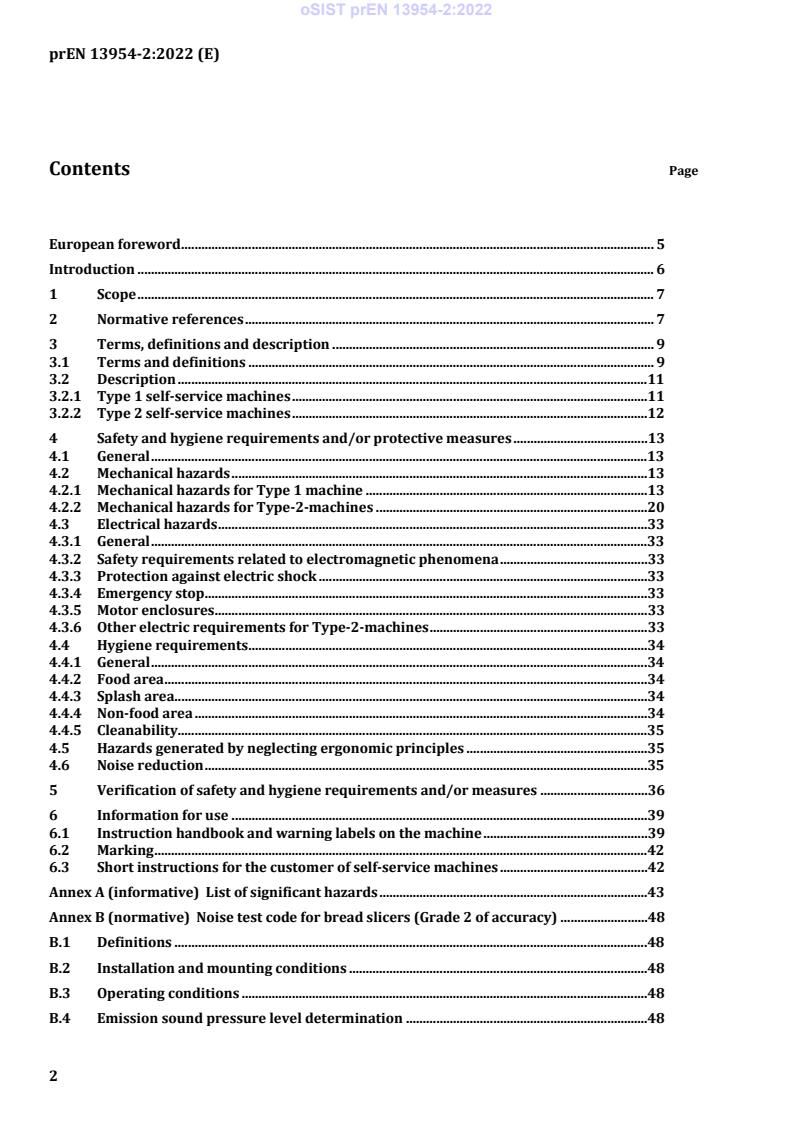
Contents Page
European foreword . 5
Introduction . 6
1 Scope . 7
2 Normative references . 7
3 Terms, definitions and description . 9
3.1 Terms and definitions . 9
3.2 Description .11
3.2.1 Type 1 self-service machines .11
3.2.2 Type 2 self-service machines .12
4 Safety and hygiene requirements and/or protective measures .13
4.1 General .13
4.2 Mechanical hazards .13
4.2.1 Mechanical hazards for Type 1 machine .13
4.2.2 Mechanical hazards for Type-2-machines .20
4.3 Electrical hazards .33
4.3.1 General .33
4.3.2 Safety requirements related to electromagnetic phenomena .33
4.3.3 Protection against electric shock .33
4.3.4 Emergency stop .33
4.3.5 Motor enclosures .33
4.3.6 Other electric requirements for Type-2-machines .33
4.4 Hygiene requirements .34
4.4.1 General .34
4.4.2 Food area .34
4.4.3 Splash area.34
4.4.4 Non-food area .34
4.4.5 Cleanability .35
4.5 Hazards generated by neglecting ergonomic principles .35
4.6 Noise reduction .35
5 Verification of safety and hygiene requirements and/or measures .36
6 Information for use .39
6.1 Instruction handbook and warning labels on the machine .39
6.2 Marking .42
6.3 Short instructions for the customer of self-service machines .42
Annex A (informative) List of significant hazards .43
Annex B (normative) Noise test code for bread slicers (Grade 2 of accuracy) .48
B.1 Definitions .48
B.2 Installation and mounting conditions .48
B.3 Operating conditions .48
B.4 Emission sound pressure level determination .48
B.5 Sound power level determination . 49
B.6 Measurement uncertainties . 49
B.7 Information to be recorded . 49
B.8 Information to be reported . 49
B.9 Declaration and verification of noise emission values . 49
Annex C (normative) Principles of design to ensure the cleanability of bread slicers . 51
C.1 Terms and definitions . 51
C.2 Materials of construction . 51
C.2.1 Type of materials . 51
C.2.2 Surface conditions . 51
C.3 Design . 52
C.3.1 Connections of internal surfaces . 52
C.3.1.1 General . 52
C.3.1.2 Connections of internal surfaces for food area . 53
C.3.1.3 Connections of internal surfaces for splash area . 55
C.3.1.4 Connections of internal surfaces for non-food area. 56
C.3.2 Surface assemblies and overlaps . 56
C.3.2.1 General . 56
C.3.2.2 Surface assemblies and overlaps for food area . 57
C.3.2.2.1 Surface assembly . 57
C.3.2.2.2 Surface overlapping. 57
C.3.2.3 Surface assemblies and overlaps for splash area: . 59
C.3.2.4 Surface assemblies and overlaps for non-food area . 61
C.3.3 Fasteners . 61
C.3.3.1 Fasteners for food area . 61
C.3.3.1.1 Spot-facing . 61
C.3.3.1.2 Pin-drive systems . 61
C.3.3.2 Fasteners for splash area . 61
C.3.3.3 Fasteners for non-food area . 62
C.3.4 Feet, support and bases for cleaning the machines underneath . 62
C.3.4.1 Table-top machines . 62
C.3.4.2 Machines on the floor . 65
C.3.4.2.1 Fixed machines with or without a base . 65
C.3.4.2.2 Mobile machines . 66
C.3.5 Ventilation openings . 67
C.3.5.1 Ventilation openings for non-food area . 67
C.3.5.2 Ventilation openings for splash area .67
C.3.6 Hinges .67
C.3.7 Control panel .68
C.3.7.1 Control panel in the non-food area .68
C.3.7.2 Control panel in the splash area .68
Annex ZA (informative) Relationship between this European Standard and the Essential
Requirements of Directive 2006/42/EC aimed to be covered .70
Bibliography .72
European foreword
This document (prEN 13954-2:2022) has been prepared by Technical Committee CEN/TC 153 “Machin-
ery intended for use with foodstuffs and feed”, the secretariat of which is held by DIN.
This document is currently submitted to CEN enquiry.
This document has been prepared under a Standardization Request given to CEN by the European Com-
mission and the European Free Trade Association, and supports essential requirements of EU Di-
rective(s) / Regulation(s).
For relationship with EU Directive(s) / Regulation(s), see informative Annex ZA, which is an integral part
of this document.
Introduction
There are various types of bread slicing machines for self-service. They are divided mainly into the fol-
lowing types:
— Type 1: Frame cutter machines with multiple blades moving simultaneously and manual loading;
— Type 2: Machines with rotary crescent (sickle) or circular blade fixed to a shaft with oscillating or
rotating movement and manual loading;
This European Standard is a type-C-standard as stated in EN ISO 12100:2010.
The machinery concerned and the extent to which hazards, hazardous situations and events are covered
are indicated in the scope of this European Standard.
When provisions of this type-C-standard are different from those that are stated in type-A- or -B-stand-
ards, the provisions of this type-C-standard take precedence over the provisions of the other standards,
for machines that have been designed and built according to the provisions of this type-C-standard.
1 Scope
1.1 This document covers requirements for the safe and hygienic operation of self-service bread slicing
machines of Type 1 and Type 2 including: loading, cutting, unloading, cleaning, crumb removal and
maintenance.
The intended use of these machines is to cut baked bakery products (e.g. bread) and dry pastry products
into slices. This document covers the intended use of the machines by trained personnel as well as by
untrained and uninstructed persons (e.g. customers in the self-service area). The intended use for un-
trained and uninstructed person is only the slicing. All other operations (e.g. maintenance, cleaning) are
only intended for trained and instructed personnel.
This document deals with all significant hazards, hazardous situations and events relevant to bread slic-
ers machines, when they are used as intended and under conditions of misuse which are reasonably fore-
seeable by the manufacturer (see Clause 4).
1.2 The following machines are excluded from the scope of this document:
— experimental and testing machines under development by the manufacturer;
— domestic appliances falling under Low Voltage Directive 2014/35/EU;
— rectangular cutting machines for cutting or sawing of panel size products into small pieces;
— baguette slicers according to EN 14655;
— bread slicers according to EN 13954.
1.3 This document is not applicable to bread slicing machines which are manufactured before the date
of publication of this document.
1.4 The following hazards are not covered by this document:
— hazards due to packaging, handling or transport;
— hazards arising from electromagnetic compatibility issues;
— hazards due to dismantling and disassembling.
The significant hazards covered by this document are described in Annex A.
2 Normative references
The following documents are referred to in the text in such a way that some or all of their content consti-
tutes requirements of this document. For dated references, only the edition cited applies. For undated
references, the latest edition of the referenced document (including any amendments) applies.
EN 614-1:2006+A1:2009, Safety of machinery - Ergonomic design principles - Part 1: Terminology and gen-
eral principles
EN 1672-2:2020, Food processing machinery - Basic concepts - Part 2: Hygiene and cleanability require-
ments
EN 60204-1:2018, Safety of machinery - Electrical equipment of machines - Part 1: General requirements
(IEC 60204-1:2016, modified)
EN 60529:1991, Degrees of protection provided by enclosures (IP Code) IEC 60529:1989)
EN ISO 3744:2010, Acoustics - Determination of sound power levels and sound energy levels of noise sources
using sound pressure - Engineering methods for an essentially free field over a reflecting plane (ISO
3744:2010)
EN ISO 4871:2009, Acoustics - Declaration and verification of noise emission values of machinery and equip-
ment (ISO 4871:1996)
EN ISO 7010:2020, Graphical symbols - Safety colours and safety signs - Registered safety signs (ISO
7010:2019, Corrected version 2020-06)
EN ISO 11688-1:2009, Acoustics - Recommended practice for the design of low-noise machinery and equip-
ment - Part 1: Planning (ISO/TR 11688-1:1995)
EN ISO 11201:2010, Acoustics - Noise emitted by machinery and equipment - Determination of emission
sound pressure levels at a work station and at other specified positions in an essentially free field over a
reflecting plane with negligible environmental corrections (ISO 11201:2010)
EN ISO 12001:2009, Acoustics - Noise emitted by machinery and equipment - Rules for the drafting and
presentation of a noise test code (ISO 12001:1996)
EN ISO 12100:2010, Safety of machinery - General principles for design - Risk assessment and risk reduction
(ISO 12100:2010)
EN ISO 13849-1:2015, Safety of machinery - Safety-related parts of control systems - Part 1: General prin-
ciples for design (ISO 13849-1:2015)
EN ISO 13854:2019, Safety of machinery - Minimum gaps to avoid crushing of parts of the human body (ISO
13854:2017)
EN ISO 13855:2010, Safety of machinery - Positioning of safeguards with respect to the approach speeds of
parts of the human body (ISO 13855:2010)
EN ISO 13857:2019, Safety of machinery - Safety distances to prevent hazard zones being reached by upper
and lower limbs (ISO 13857:2019)
EN ISO 14119:2013, Safety of machinery - Interlocking devices associated with guards - Principles for de-
sign and selection (ISO 14119:2013)
EN ISO 14120:2015, Safety of machinery - Guards - General requirements for the design and construction
of fixed and movable guards (ISO 14120:2015)
EN ISO 21469:2006, Safety of machinery - Lubricants with incidental product contact - Hygiene require-
ments (ISO 21469:2006)
EN ISO 21920-2:2022, Geometrical product specifications (GPS) - Surface texture: Profile - Part 2: Terms,
definitions and surface texture parameters (ISO 21920-2:2021, Corrected version 2022-06)
As impacted by EN 60529:1991/A1:2000, EN 60529:1991/A2:2013, EN 60529:1991/AC:2016 and
EN 60529:1991/AC:2019.
3 Terms, definitions and description
3.1 Terms and definitions
For the purposes of this document, the terms and definitions given in EN ISO 12100:2010 and the follow-
ing apply.
ISO and IEC maintain terminology databases for use in standardization at the following addresses:
— ISO Online browsing platform: available at https://www.iso.org/obp
— IEC Electropedia: available at https://www.electropedia.org
3.1.1
bread
baked bakery and dry pastry products
3.1.2
self-service bread slicers
bread slicers that are made available for untrained persons in points of sale (e.g. supermarkets) to slice
baked bakery (e.g. bread) and dry pastry products. Operating of the machine is done by customers with-
out surveillance by the personnel of the store
3.1.3
type 1 self-service bread slicers
frame cutter machines with reciprocating multiple blades moving simultaneously and manual loading
3.1.4
type 2 self-service bread slicers
machines with rotary crescent (sickle) or circular blade fixed to a shaft with oscillating or rotating move-
ment and usually manual loading
3.1.5
frame
support that carries the set(s) of blades in Type 1 bread slicers. During cutting the whole frame oscillates
3.1.6
crumb tray
container that collects the crumb of the bread produced by slicing
3.1.7
pusher
device used to move the bread or to move the blade to generate the adjusted slice thickness
3.1.8
holder/gripper
device used to hold the bread in position
Note 1 to entry: May be combined with the pusher.
3.1.9
bagging tray
support for bread used to hold the bread in position while the bread is put in a bag
3.1.10
stopping time
time interval between the actuation of the sensing function and the termination of the hazardous machine
function
[SOURCE: EN ISO 13855:2010, 3.1.2, modified]
3.2 Description
3.2.1 Type 1 self-service machines
Type 1 bread slicers usually consist of a machine frame supporting the following main elements (see
example in Figure 1).
Key
1 crumb tray
2 discharge area or device
3 frame/s with multiple blades (3a: blunt side of the blades seen from discharge area; 3b: sharp side of the
blades seen from infeed area)
4 infeed area or device
5 pusher, which moves and guides the loaf of bread for the cutting action
6 drive mechanisms (behind cover)
7 operating panel
8 hold-down device (for the bread)
9 bagging tray (optional)
Figure 1 — Example of Type 1 bread slicer
The bread is moved by a power-operated pusher. All slices of the bread are cut at the same time. The
pusher is automatically returned to the feeding position.
3.2.2 Type 2 self-service machines
A type 2 self-service bread slicing machine consists of a machine frame supporting the following main
elements (see examples in Figure 2).
Key
1 pusher and/or holder(gripper)
2 infeed area
3 (cutting gap of) rotary (sickle) crescent or circular blade
4 discharge area
5 crumb tray
6 operating panel
7 bagging tray (optional)
NOTE Infeed and discharge area can be the same
Figure 2 — Examples of Type 2 bread slicer
Either the blade is moved or the bread is moved to cut the bread. The bread is cut sequentially slice by
slice.
4 Safety and hygiene requirements and/or protective measures
4.1 General
Machinery shall comply with the safety and hygiene requirements and/or protective measures of this
clause.
In addition, the machine shall be designed according to the principles of EN ISO 12100:2010 for relevant
but not significant hazards, which are not dealt with by this document.
When fixed guards, or parts of the machine acting as such, are not permanently fixed e.g. by welding, their
fixing systems shall remain attached to the guards or to the machinery when the guards are removed. An
exception may be made for parts that are necessary for the function of the machine.
Information about residual risks concerning allergens shall be given in the instruction handbook (see
6.1 cm c)).
Warnings for trained and instructed personnel concerning cleaning and maintenance after cutting of pro-
hibited products shall be provided with the instructions (see 6.1 y))
4.2 Mechanical hazards
4.2.1 Mechanical hazards for Type 1 machine
4.2.1.1 General
4.2.1.1.1 General requirements
Openings in guards shall comply with EN ISO 13857:2019.
Interlocking devices shall comply with EN ISO 14119:2013, Clause 7, and EN ISO 14120:2015.
Information for trained operator’s personnel concerning regular visual control shall be provided with the
instructions (see 6.1 s)).
Guards shall be so constructed that either the possibility to apply mechanical forces (pull -, push -, torsion
force) is prevented or does not lead to a gap that allows to reach the danger zone.
If a closed guard is able to be gripped so that a force of 150 N can be applied, this shall be tested by ap-
plying this force at the most unfavourable point and in each direction.
Fasteners of guards within the customer's field of vision shall be secured against loosening by simple
means.
Warnings for trained and instructed personnel concerning cleaning and maintenance and concerning the
storage of tools shall be provided with the instructions (see 6.1 u))
The manufacturer shall clarify in the instructions which work is to be performed by the trained and in-
structed personnel and which by the service technician (see 6.1 v)).
The pusher and other machine parts – except those parts that are sharp for functional reasons – shall be
designed without sharp edges to avoid bump injuries.
Unless specified otherwise in specific clauses, the parts of the control system associated with interlocking
shall meet at least a performance level “c” according to EN ISO 13849-1:2015.
If the interlock is implemented in performance level “c”, the electronic control unit shall also perform the
following plausibility check:
— Before each new cutting cycle of the machine, the guard above the infeed or discharge area shall have
been opened and closed at least once.
If a mechanical or electronic brake is used, the failure of the brake shall be detected and shall block the
restart. The plausibility check and the blocking of the restart shall meet at least a performance level “a”
according to EN ISO 13849-1:2015.
NOTE If the brake is realized by a frequency converter the requirement is fulfilled due to the strong process
failure detection.
The interlocking guards may be designed as an interlocking guard with a start function.
4.2.1.1.2 Specific requirements for interlocking devices without guard locking
The machine controls shall ensure that hazardous functions stop before dangerous movements can be
reached after an interlocked guard has been opened.
For interlocking guards the following requirement shall apply:
The interlocking device shall be activated at the latest after opening of the guard by more than 8 mm. At
this moment, the safety distance shall be at least 100 mm.
4.2.1.1.3 Specific requirements for interlocking devices with guard locking
If one of the requirements of 4.2.1.1.2 is not fulfilled, the interlocking guard shall be with guard locking.
In this case the interlocking guards with guard locking shall meet the following requirements:
— the guard locking shall not be released until the hazardous movements have come to a safe standstill.
The safe standstill can be achieved, for example, by using one of the following methods:
— Solution via time relay, whereby opening of the guard locking at least after 1,1 times the maxi-
mum stopping time of the mechanics (without felts and measured on a machine after 100’000
cycles) is considered sufficient to evaluate the remaining residual risk as acceptable.
— Solution via standstill detection, whereby this safety function shall meet at least a performance
level = “a” according to EN ISO 13849-1:2015.
— all hazardous movements shall only be possible if all guards are closed, interlocked and locked.
— the guard locking shall be in accordance with EN ISO 14119:2013, 5.7. The monitoring of the guard
locking shall meet at least a performance level “a” according to EN ISO 13849-1:2015.
— the stability of the guard locking shall be constructed in such way that it withstands the foreseeable
forces in use
4.2.1.2 Hazard zone I: Access to the cutting side of the blades
4.2.1.2.1 Access to the still-standing blades through the infeed area
Key
1 Infeed area
2 Discharge area
3 Hold-down device
a Machine front to infeed opening
b Depth of infeed opening
c Infeed opening to upper edge of hold-down device
d ≤ 8 mm (space under hold-down device with access to the cutting side of the blades
e height of the discharge opening
h height of the infeed opening
Figure 3 — Distances in an exemplary Type 1 machine
Access to the blades through the infeed area shall be prevented by:
— The height h of the infeed opening shall be at least 1000 mm. For table-top machines, the instruction
handbook shall require the appropriate minimum table or support height (see 6.1 bb)).
and by one of the following measures:
— a guard that prevents unintentional access to the still standing blades.
The risk is considered to be sufficiently reduced if the exposed part of the blades is d ≤ 10 mm before
the bread is placed into the machine. This requirement shall also be met when a force of ≥ 5 N is
applied to the guard at any point and in direction for straight-line access to the blades.
NOTE: The hold-down device can be used as guard.
or
— a fixed guard with an opening to place the bread (e.g. realized by a hood), which allows access only
from the front (see Figure 4), whereby reaching the still standing blade is prevented by at least dou-
ble reaching around an obstacle
and
with a distance g ≥ 230 mm from the access opening to the next cutting edge of one of the blades (for
access to the moving blade see chapter 4.2.1.2.2).
The operating instructions shall specify requirements for the installation (see 6.1).
Key
1 hood
g infeed opening to accessible blade
Figure 4 – Solution with hood
4.2.1.2.2 Access to the moving blades through the infeed area
Access to the moving blades through the infeed area shall be prevented by one of the following measures:
— an interlocking guard (see 4.2.1.1.2) with the following requirements:
The dangerous movements shall stop within a stopping time of ≤ 0,3 s;
NOTE The after-run time of a well-run-in machine without braking components such as oiling felts is decisive.
— a fixed distance guard complying with EN ISO 13857:2019 or a fixed guard according to 4.2.1.2.1 in
combination with an interlocking guard;
— an interlocking guard with guard locking (see 4.2.1.1.3).
In all cases, the dimensions of any openings shall be in accordance with EN ISO 13857:2019, Table 5,
while the guard is closed.
4.2.1.2.3 Access to the still-standing blades through the discharge area
— The gap between the blades and the blades and other parts of the machine shall be ≤ 18 mm at any
point of the blade. The depth of the blades shall be ≥ 6 mm and the cutting side of all blades shall be
in the same plane.
— Access shall be limited by the following dimensions:
— It shall not be possible to access the blade through any opening below a height of e = 900 mm
from the floor (see Figure 3).
— The shortest distance between any opening of the machine and the cutting side of the blades
shall be f ≥ 230 mm.
— The cumulative dimension to access the cutting side of the blades starting from the floor shall be
S ≥ 1300 mm, where S = e + f (see Figures 3 and 5).
— At the end of the slicing cycle the pusher shall be in a position where access to the cutting side of the
blades is prevented like shown in Figure 5. The detection of this position is not required. The height
of the protected area that prevents access to the cutting side of the still-standing blades shall be
g ≥ 100 mm measured from the bottom of the discharge area (see Figure 5)
— A warning concerning the risk of cutting shall be provided with the instructions (see 6.1 w)), and a
warning label W022 according to EN ISO 7010:2020 shall be placed on the machine. The label shall
be visible while the guard is opened.
Key
1 discharge area
2 pusher
g height to which the blades are protected by the pusher
f distance between front edge and blade
Figure 5 — By the pusher-protected zone at the discharge area
4.2.1.2.4 Access to the moving blades through the discharge area
The crushing hazard between the blade frame and the machine frame shall be avoided. To achieve this,
the maximum clearance between the blade frame and the machine frame, where accessible, shall be less
than 4 mm, or the clearance between the blade frame and the machine frame shall be in accordance with
EN ISO 13854:2019.
Access to the moving blades through the discharge area shall be prevented by one of the following
measures:
— an interlocking guard (see 4.2.1.1.2) with the following requirements:
The dangerous movements shall stop within a stopping time of ≤ 1 s. The specified stopping time
shall also be achieved after actuation of the emergency stop if existent;
NOTE The after-run time of a well-run-in machine without braking components such as oiling felts is decisive.
— an interlocking guard with guard locking (see 4.2.1.1.3).
The interlocking device shall be actuated after opening the guard by ≤ 10 mm.
As an alternative, the access to the cutting side of the blade can be prevented by measures according to
EN ISO 13857:2019. Table 5.
4.2.1.2.5 Access to the cutting side of the blades through the crumb tray/ crumb tray opening and
through other areas of the machine
Access shall be prevented by all the following requirements:
— The safety guard that gives access through these openings shall only be openable by means of tools,
e.g. a special sash lock that is different from other sash locks used at the machine or another kind of
lockable access.
— The dimensions of remaining gaps shall comply with EN ISO 13857:2019, Table 5, for the closed state
of the guard.
— For the opened state of the guard access to the blades shall be prevented by dimensions complying
with EN ISO 13857:2019, Table 4.
— If the opened state of the guard does not comply with EN ISO 13857:2019, Table 4, the safety guard
that gives access through the crumb tray shall be interlocked.
— Warnings for trained personnel concerning cleaning and maintenance shall be provided with the in-
structions (see 6.1 u)).
4.2.1.3 Hazard zone II: Access between the pusher and the blade frame or fixed parts
The movement of the pusher shall be limited to ≤ 0,5 m/s.
The interlocking of the guards shall also effect on the pusher.
The stopping time of the pusher shall be ≤ 0,3 s or the interlocked guard shall be with guard locking.
4.2.1.4 Hazard zone III: Access between the moving blade frame and fixed parts
4.2.1.4.1 Access between the moving blade frame and fixed parts through the infeed area
The hazard is prevented by measures for access to the moving blade, see 4.2.1.2.2.
4.2.1.4.2 Access between the moving blade frame and fixed parts through the discharge area
The hazard is prevented by measures for access to the moving blade, see 4.2.1.2.4.
4.2.1.4.3 Access between the moving blade frame and fixed parts through the crumb tray/ crumb
tray opening
The hazard is prevented by measures for access to the moving blade, see 4.2.1.2.5.
4.2.1.4.4 Access between the moving blade frame and fixed parts through other areas of the
machine
The requirements of 4.2.1.2.5 shall be fulfilled.
4.2.1.5 Hazard zone IV: Access to other moving parts of the machine (e.g. chains, belts, pulley)
The requirements of 4.2.1.2.5 shall be fulfilled.
4.2.1.6 Hazard zone V: Unintentional or intentional closing of doors and covers
If the movement of a guard might cause a hazard, a safe end position using e.g. a spring or a counterweight
shall be provided which, when open, ensures that the hood or cover swings back to a position beyond top
dead centre or to another inherently safe position.
The contact energies on affected parts of the body shall be reduced to a safe level. It is assumed that only
fingers and hands are affected.
Sufficient risk reduction can be assumed if all the following requirements are met:
— kinetic contact energy in the worst case ≤ 4 J;
— a contact pressure of ≤ 50 N/cm ;
— avoidance of shearing points, sharp edges, and tips;
— the protective hoods or covers shall be provided with a grab handle if not motor-driven.
4.2.1.7 Hazard zone VI: Impact and cuts through the bagging tray (bagging sheet, bread rail), bag
dispenser or other protruding machine parts
The bagging tray (bagging sheet, bread rail), bag dispenser or other protruding parts of the machine shall
be so designed as to prevent injury by impact and/or cutting.
The instructions shall provide information concerning the installation of the machine (see 6.1 z) and 6.1
aa)).
4.2.1.8 Loss of stability
Machines shall be designed not to tilt and fall and shall comply with all the following requirements as far
as applicable:
— For machines designed to be fixed to the floor, the instruction handbook shall indicate the values of
forces at the fixing points and the dimensions of the fixing elements.
— Machines not fixed to the building equipped with castors shall have at least two castors (or sets of
castors) fitted with a locking device.
— Machines not fixed to the building shall not tilt and fall when inclined by 10° from the horizontal
plane in the most unfavourable direction. Machines with castors shall be arranged in a position which
entails the condition of lowest stability (minimum distance between the points of contact of the
wheels with the supporting plane), and the wheels shall be blocked.
4.2.2 Mechanical hazards for Type-2-machines
4.2.2.1 General
4.2.2.1.1 General requirements
Guards shall comply with EN ISO 13857:2019. When closed, gaps and holes shall have the dimensions
according to EN ISO 13857:2019, Table 5.
Interlocking devices shall comply with EN ISO 14119:2013, Clause 7, and EN ISO 14120:2015. Warnings
for trained and instructed personnel concerning regular visual control shall be provided with the instruc-
tions (see 6.1 s)).
Guards shall be so constructed that either the possibility to apply mechanical forces (pull -, push -, torsion
force) is prevented or does not lead to a gap that allows to reach the danger zone. If a closed guard is easy
to grip it shall be tested by applying a force of 150 N at the most unfavourable spot and in each direction.
Fasteners of guards within the customer's field of vision shall be secured against loosening by simple
means, e.g. by gluing them in.
Warnings for trained and instructed personnel concerning cleaning and maintenance and concerning the
storage of tools shall be provided with the instructions (see 6.1 u))
The manufacturer shall clarify in the instructions which work is to be performed by the trained and in-
structed personnel and which by the service technician (see 6.1 v)).
The pusher and other machine parts, except those parts that are sharp for functional reasons, shall be
designed without sharp edges to avoid bump injuries.
Unless specified otherwise in specific clauses, the parts of the control system associated with interlocking
shall fulfil all the following requirements:
— The electronic control unit shall perform the following plausibility check:
Before each new cutting cycle of the machine, the guard above the infeed or discharge area shall have
been opened and closed at least once.
— The loss of any safety function (e.g. safety-related stop function initiated by safeguard) shall be de-
tected and lead to a stop and prevent the restart of the machine.
— If a mechanical or electronic brake is used, the failure of the brake shall be detected and shall block
the restart. The detection and the blocking of the restart shall meet at least a performance level “a”
according to EN ISO 13849-1:2015.
NOTE This function can be realized by simple electronics.
— The interlocking guards may be designed as an interlocking guard with a start function.
In the case of damage that could lead to personal injury or contamination of the food, the machine shall
be blocked for use by the personnel.
Unless specified otherwise in specific clauses, the parts of the control system associated with interlocking
shall meet at least a performance level = “c” according to EN ISO 13849-1:2015.
4.2.2.1.2 Specific requirements for interlocking devices without guard locking
The machine contro
...