

EN 16230-1:2013+A1:2014
(Main + Amendment)Leisure karts - Part 1: Safety requirements and test methods for karts
- Abstract
This European Standard is applicable for karts, according to 3.1, that are not intended to be used on public roads.
This European Standard applies to:
- leisure karts only;
- karts propelled by a combustion engine, including LPG combustion engines;
- karts used on indoor and outdoor tracks, permanent or temporary;
- karts used on supervised tracks designed for leisure karting, with a sealed ground (such as asphalt, concrete, ice or snow).
This European Standard does not apply to:
- karts used for competition organised by and under the responsibility of the CIK-FIA and/or ASN, ensuring through the granting of licenses by an ASN or one of its affiliated members as defined in the International Sporting code, compliance with the safety, sporting, disciplinary and technical rules of the CIAK-FIA and/ or ASN;
- karts designed exclusively for competition and toys;
- cross country karts;
- karts with two or more seats;
- karts used on tracks not mentioned above (such as mud, earth);
- karts used in amusement parks.
The requirements related to the hazards of electrical propulsion are not covered in this European Standard.
The requirements related to whole-body vibration are not covered in this European Standard.
This European Standard specifies appropriate measures to eliminate or reduce the risks arising from significant hazards, hazardous situations and events (see Clause 6) during operation and maintenance of the karts, when carried out as intended by the manufacturer.
Safety in karting activities is dependent on a correct interaction between leisure karts and the track equipment and facilities. General recommendations for tracks to be used for leisure karting are included in this part of the standard.
This document is not applicable to karts that are manufactured before the date of publication of this European Standard by CEN.
NOTE Specific requirements for tracks design and operation will be included in a future Part 2 of this standard.
- Status
- Published
- Publication Date
- 16-Dec-2014
- Withdrawal Date
- 29-Jun-2015
- Technical Committee
- CEN/TC 354 - Ride-on, motorized vehicles intended for the transportation of persons and goods and not intended for use on public roads - Safety requirements
- Drafting Committee
- CEN/TC 354/WG 3 - Go-karts
- Current Stage
- 9092 - Decision on results of review/2YR ENQ - revise - Review Enquiry
- Start Date
- 20-Dec-2023
- Completion Date
- 07-Oct-2026
- Directive
- 2006/42/EC - Directive 2006/42/EC of the European Parliament and of the Council of 17 May 2006 on machinery, and amending Directive 95/16/EC (recast)OJ Ref: C, C 14 OJ Date: 15-Jan-2016

Overview
EN 16230-1:2013+A1:2014 - published by CEN - is the European standard that sets safety requirements and test methods for leisure karts (karts not intended for use on public roads). It applies to combustion‑engine karts (including LPG) used on supervised indoor and outdoor sealed tracks (asphalt, concrete, ice, snow). The standard defines the scope, significant hazards, protective measures, verification tests and information for use, and includes annexes with test protocols (crash, brake, noise, vibration and protection-system measurement methods).
Key Topics
- Scope & exclusions: Applies only to leisure karts; excludes competition karts (CIK‑FIA/ASN), toys, cross‑country, multi‑seat karts, amusement‑park karts, electrified propulsion hazards and whole‑body vibration requirements.
- Classification: Defines kart types (e.g., A1, A2, B, C1, C2) and manufacturer design parameters such as reference driver size, weight ranges, maximum speeds and engine power guidance.
- Mechanical safety: Requirements for all‑around protection (to prevent wheel‑to‑kart contact and launching), seat and restraint considerations, steering, stub axle integrity, sharp‑edge protection and rotating‑part guards.
- Brake and steering performance: Test methods and performance criteria for braking systems and brake controls, including normative test protocols.
- Fuel and LPG systems: Safety rules for fuel tanks/lines and specific requirements for LPG karts to reduce fire/explosion risk during operation and after impacts.
- Noise & vibration: Noise emission testing (referencing EN ISO 3744/11201/4871) and informative vibration test methods; whole‑body vibration effects are not covered.
- Electrical & thermal hazards: Rules for starter/auxiliary battery systems (electrolyte, charging) and protection against hot surfaces.
- Information for use: Marking, warnings, and operator information, plus track recommendations (recognizing track and kart interaction is key to safety).
Applications
Who uses EN 16230-1:
- Kart manufacturers and designers - to design and certify leisure karts that meet European safety requirements.
- Test laboratories and certification bodies - to perform crash, brake, noise and protection‑system tests described in the annexes.
- Track operators and leisure operators - to inform procurement, fleet selection, maintenance and operational safety rules.
- Regulators and safety engineers - for conformity assessment, risk assessments and aligning equipment with EU directives (see Annex ZA). Practical uses include design verification, pre‑market testing, drafting user manuals, maintenance procedures and supplier specifications.
Related Standards
Normative references include EN ISO 12100 (machine safety principles), EN ISO 3744/11201/4871 (acoustics), ISO 48 (material hardness) and other referenced methods. Part 2 of EN 16230 (tracks) is planned to address specific track‑design and operational requirements.
Relations
- Merged From
EN 16230-1:2013/FprA1 - Leisure karts - Part 1: Safety requirements and test methods for karts - Effective Date
- 18-Jan-2023
- Effective Date
- 29-Oct-2014
- Effective Date
- 25-Aug-2026
- Effective Date
- 09-Feb-2026
- Effective Date
- 09-Feb-2026
- Effective Date
- 28-Jan-2026
- Effective Date
- 28-Jan-2026
- Effective Date
- 28-Jan-2026
- Effective Date
- 28-Jan-2026
- Effective Date
- 28-Jan-2026
- Effective Date
- 28-Jan-2026
- Effective Date
- 28-Jan-2026
- Effective Date
- 28-Jan-2026
- Effective Date
- 17-Jul-2024
Get Certified
Connect with accredited certification bodies for this standard

TÜV Rheinland
TÜV Rheinland is a leading international provider of technical services.

TÜV SÜD
TÜV SÜD is a trusted partner of choice for safety, security and sustainability solutions.

DEKRA Certification Inc.
DEKRA US certification services.
Sponsored listings
Frequently Asked Questions
EN 16230-1:2013+A1:2014 is a standard published by the European Committee for Standardization (CEN). Its full title is "Leisure karts - Part 1: Safety requirements and test methods for karts". This standard covers: This European Standard is applicable for karts, according to 3.1, that are not intended to be used on public roads. This European Standard applies to: - leisure karts only; - karts propelled by a combustion engine, including LPG combustion engines; - karts used on indoor and outdoor tracks, permanent or temporary; - karts used on supervised tracks designed for leisure karting, with a sealed ground (such as asphalt, concrete, ice or snow). This European Standard does not apply to: - karts used for competition organised by and under the responsibility of the CIK-FIA and/or ASN, ensuring through the granting of licenses by an ASN or one of its affiliated members as defined in the International Sporting code, compliance with the safety, sporting, disciplinary and technical rules of the CIAK-FIA and/ or ASN; - karts designed exclusively for competition and toys; - cross country karts; - karts with two or more seats; - karts used on tracks not mentioned above (such as mud, earth); - karts used in amusement parks. The requirements related to the hazards of electrical propulsion are not covered in this European Standard. The requirements related to whole-body vibration are not covered in this European Standard. This European Standard specifies appropriate measures to eliminate or reduce the risks arising from significant hazards, hazardous situations and events (see Clause 6) during operation and maintenance of the karts, when carried out as intended by the manufacturer. Safety in karting activities is dependent on a correct interaction between leisure karts and the track equipment and facilities. General recommendations for tracks to be used for leisure karting are included in this part of the standard. This document is not applicable to karts that are manufactured before the date of publication of this European Standard by CEN. NOTE Specific requirements for tracks design and operation will be included in a future Part 2 of this standard.
This European Standard is applicable for karts, according to 3.1, that are not intended to be used on public roads. This European Standard applies to: - leisure karts only; - karts propelled by a combustion engine, including LPG combustion engines; - karts used on indoor and outdoor tracks, permanent or temporary; - karts used on supervised tracks designed for leisure karting, with a sealed ground (such as asphalt, concrete, ice or snow). This European Standard does not apply to: - karts used for competition organised by and under the responsibility of the CIK-FIA and/or ASN, ensuring through the granting of licenses by an ASN or one of its affiliated members as defined in the International Sporting code, compliance with the safety, sporting, disciplinary and technical rules of the CIAK-FIA and/ or ASN; - karts designed exclusively for competition and toys; - cross country karts; - karts with two or more seats; - karts used on tracks not mentioned above (such as mud, earth); - karts used in amusement parks. The requirements related to the hazards of electrical propulsion are not covered in this European Standard. The requirements related to whole-body vibration are not covered in this European Standard. This European Standard specifies appropriate measures to eliminate or reduce the risks arising from significant hazards, hazardous situations and events (see Clause 6) during operation and maintenance of the karts, when carried out as intended by the manufacturer. Safety in karting activities is dependent on a correct interaction between leisure karts and the track equipment and facilities. General recommendations for tracks to be used for leisure karting are included in this part of the standard. This document is not applicable to karts that are manufactured before the date of publication of this European Standard by CEN. NOTE Specific requirements for tracks design and operation will be included in a future Part 2 of this standard.
EN 16230-1:2013+A1:2014 is classified under the following ICS (International Classification for Standards) categories: 43.100 - Passenger cars. Caravans and light trailers. The ICS classification helps identify the subject area and facilitates finding related standards.
EN 16230-1:2013+A1:2014 has the following relationships with other standards: It is inter standard links to EN 16230-1:2013/FprA1, EN 16230-1:2013, ISO 3864-2:2004, ISO 48:2010, ISO 3864-1:2011, EN ISO 4871:2009, EN ISO 3744:2010, CR 1030-1:1995, EN ISO 11201:2010, EN ISO 12100-1:2003, EN 4614:2009, EN ISO 12100:2010, EN 16230-2:2016, prEN 16230-1. Understanding these relationships helps ensure you are using the most current and applicable version of the standard.
EN 16230-1:2013+A1:2014 is associated with the following European legislation: EU Directives/Regulations: 2006/42/EC; Standardization Mandates: M/396. When a standard is cited in the Official Journal of the European Union, products manufactured in conformity with it benefit from a presumption of conformity with the essential requirements of the corresponding EU directive or regulation.
EN 16230-1:2013+A1:2014 is available in PDF format for immediate download after purchase. The document can be added to your cart and obtained through the secure checkout process. Digital delivery ensures instant access to the complete standard document.
Standards Content (Sample)
2003-01.Slovenski inštitut za standardizacijo. Razmnoževanje celote ali delov tega standarda ni dovoljeno.Freizeitkarts - Teil 1: Sicherheitstechnische Anforderungen und Prüfverfahren für KartsKarts de loisir - Partie 1: Exigences de sécurité et méthodes d'essais relatives aux kartsLeisure karts - Part 1: Safety requirements and test methods for karts97.220.01Sports equipment and facilities in general43.100Osebni avtomobili. Bivalne prikolice in lahke prikolicePassenger cars. Caravans and light trailersICS:Ta slovenski standard je istoveten z:EN 16230-1:2013+A1:2014SIST EN 16230-1:2014+A1:2015en,fr,de01-februar-2015SIST EN 16230-1:2014+A1:2015SLOVENSKI
STANDARD
EUROPEAN STANDARD NORME EUROPÉENNE EUROPÄISCHE NORM
EN 16230-1:2013+A1
December 2014 ICS 43.100 Supersedes EN 16230-1:2013English Version
Leisure karts - Part 1: Safety requirements and test methods for karts
Karts de loisir - Partie 1: Exigences de sécurité et méthodes d'essais relatives aux karts
Freizeitkarts - Teil 1: Sicherheitstechnische Anforderungen und Prüfverfahren für Karts This European Standard was approved by CEN on 17 November 2012 and includes Amendment 1 approved by CEN on 18 November 2014.
CEN members are bound to comply with the CEN/CENELEC Internal Regulations which stipulate the conditions for giving this European Standard the status of a national standard without any alteration. Up-to-date lists and bibliographical references concerning such national standards may be obtained on application to the CEN-CENELEC Management Centre or to any CEN member.
This European Standard exists in three official versions (English, French, German). A version in any other language made by translation under the responsibility of a CEN member into its own language and notified to the CEN-CENELEC Management Centre has the same status as the official versions.
CEN members are the national standards bodies of Austria, Belgium, Bulgaria, Croatia, Cyprus, Czech Republic, Denmark, Estonia, Finland, Former Yugoslav Republic of Macedonia, France, Germany, Greece, Hungary, Iceland, Ireland, Italy, Latvia, Lithuania, Luxembourg, Malta, Netherlands, Norway, Poland, Portugal, Romania, Slovakia, Slovenia, Spain, Sweden, Switzerland, Turkey and United Kingdom.
EUROPEAN COMMITTEE FOR STANDARDIZATION
COMITÉ EUROPÉEN DE NORMALISATION EUROPÄISCHES KOMITEE FÜR NORMUNG
CEN-CENELEC Management Centre:
Avenue Marnix 17,
B-1000 Brussels © 2014 CEN All rights of exploitation in any form and by any means reserved worldwide for CEN national Members. Ref. No. EN 16230-1:2013+A1:2014 ESIST EN 16230-1:2014+A1:2015
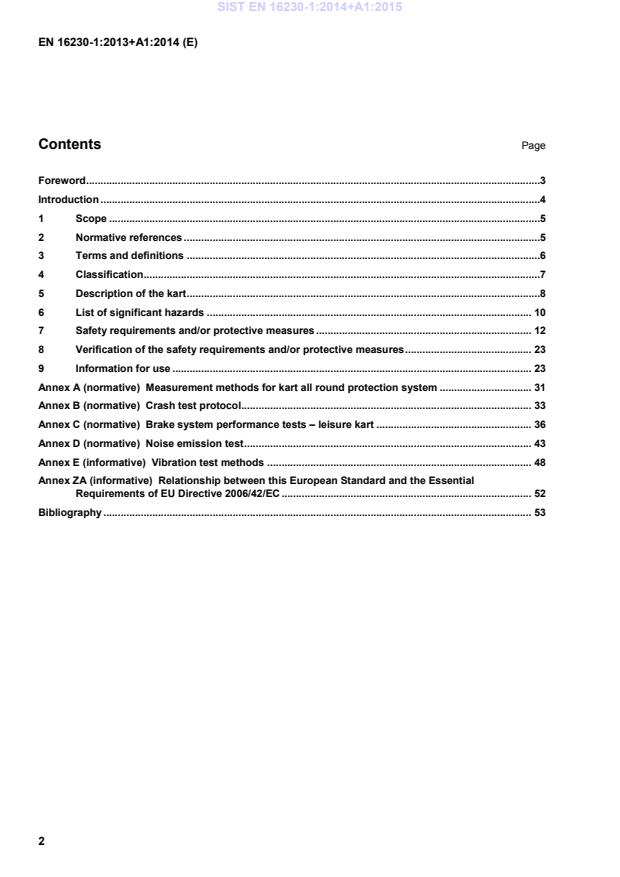
Measurement methods for kart all round protection system . 31 Annex B (normative)
Crash test protocol. 33 Annex C (normative)
Brake system performance tests – leisure kart . 36 Annex D (normative)
Noise emission test . 43 Annex E (informative)
Vibration test methods . 48 Annex ZA (informative)
Relationship between this European Standard and the Essential Requirements of EU Directive 2006/42/EC . 52 Bibliography . 53
1) In preparation. SIST EN 16230-1:2014+A1:2015
Kart type A1 (babyf) 30 30 1 150 (- 100 / + 100)b 22 (- 5 / + 10)b 3,5 - Kart type A2 (mini) 45 65 1 350 (- 150 / + 150)b 32 (- 10 / + 18)b 5,15 5th percentile female Kart type B (adult) 70 80 1 700 (- 250 / + 250)b 78 (- 38 / + 23c)b 10,3 95th percentile male Kart type C1 (adult) 70 90 1 700 (- 250 / + 250)b 78 (- 38 / + 23c)b 16,9 95th percentile male Kart type C2 (adult) 70 110 1 700 (- 250 / + 250)b 78 (- 38 / + 23c)b 22,1 95th percentile male a Engineering design values; it is assumed that karts are used in conjunction with a track designed for their maximum speed. In some countries, specific regulations may apply regarding age, speed limitation, intended use or dedicated areas. b Range specified according to the relevant 50th percentile dummy. c Upper tolerance specified according to the 95th percentile male dummy. d Measured according to a generally acknowledged standardised method, e.g. ISO 15550, SAE J1349. e Hybrid III type dummies used for the crash test as described in B.3. f smallest category of a kart. " NOTE See also Table 6 in 9.2.2.3. 5 Description of the kart The main components of the karts are described in Figure 1. SIST EN 16230-1:2014+A1:2015
Key 1 all around protection 2 stub axle 3 track rods 4 steering wheel 5 rear train 6 seat 7 wheel 8 steering axle 9 energy absorption device Figure 1 — Names of the components of the kart SIST EN 16230-1:2014+A1:2015
6.1.1 Protection of the kart Wheel to wheel, or plastic/metal to wheel contact leading to a “launching” type of roll over 7.4.1 Kart protection
Karts “climbing” one on the other 7.4.1 Kart protection
Crash situations leading to high forces on the driver 7.4.1 Kart protection 6.1.2 Seat Falling on the side under centrifugal forces 7.4.2 Seat Non efficient braking due to bad position of the driver Lack of control due to bad driving position Falling aside under lateral crash 6.1.3 Brake system mechanical Brake system hydraulic Crash situation resulting from a failure of brake systems 7.4.3 Brake system performance 7.5.1 Brake system controls 6.1.4 Steering system Crash situation resulting from a failure of steering system
Steering wheel Projection of the driver against the steering wheel, resulting from a frontal crash 7.5.2 Steering wheel 6.1.5 Stub axle Crash situation resulting from a failure of a stub axle 7.6 Protection against break up during operation – stub axle 6.1.6 Sharp edges (whole kart) Injuries due to sharp edges under: — normal situations — crash situations 7.7 Protection against sharp and edges angles 6.1.7 Rotating elements Rear axle Transmission Brake disk Hair entanglement in moving parts, especially in rear axle 7.8 Protection against rotating parts Loose (floating) clothes entanglement in rotating parts
Risk of inadvertent contact of the body of the driver (e.g. hand) with rotating parts 9.4 Signs (pictogram), written warnings SIST EN 16230-1:2014+A1:2015
Starter batteries and/or 2nd systems (not propulsion), if any Fire caused by short circuits 7.18 Starter batteries and 2nd systems (not propulsion) Electrical risks of the power source (charger) 7.18 Starter batteries and 2nd systems (not propulsion) 6.3 Thermal hazard
All high temperature components Burns due to inadvertent contacts with hot parts 7.9 Protection against hot surfaces 6.4 Noise
Whole kart Risk for the driver, due to close source of noise 7.15 Noise Risk for other persons than the driver due to fleet of karts 7.15 Noise 6.5 Vibrations hazards
Whole kart Risk for the driver, due to sources of vibration 7.16 Vibrations hazards 6.6 Material / substance hazards
7.3 Materials and products 6.6.1 Fuel system Fuel tank Fuel line Fire or explosion due to damage on fuel system after impacts 7.14.1 Fuel tank Fire or explosion due to filling 7.14.2 Fuel lines 6.6.2 LPG system LPG tank LPG line Fire or explosion due to filling 7.13 Specific requirements for LPG karts Fire or explosion due to damage on fuel system after impacts 7.13 Specific requirements for LPG karts 6.6.3 Starter batteries and/or 2nd systems (not propulsion), if any Electrolyte of batteries spilled or projected due to battery failure 7.18 Starter batteries and batteries for second systems (not propulsion) 6.6.4 Indoor facilities. Requirements on karts is an open question Risk for the driver when exposed to gas emissions , in particular to carbon monoxide 7.17 Gas emission Risk for the other persons than driver when exposed to gas emissions, in particular to carbon monoxide 7.17 Gas emission 6.7 Ergonomics hazards
6.7.1 Pedals means of adjustment Loss of control due to bad ergonomics leading to crash 7.10 Protection against incorrect action on control SIST EN 16230-1:2014+A1:2015
Maximum Total length Maximum Total width Minimum Wheel base Minimum Rear wheel tracka to wheel base ratiob Minimum Front wheel tracka to wheel base ratioc
L/mm B/mm A/mm
Kart Type A1 1 700 1 300 700 1 0,8 Kart Type A2 2 000 1 400 800 1 0,8 Others (B, C1, C2) 2 200 1 500 900 1 0,8 a The measurement of the track is taken from centre of the wheel to centre of the wheel. b The minimum rear wheel track dimension is the actual wheelbase multiplied by the minimum rear wheel track to wheel base ratio. c The minimum front wheel track dimension is the actual wheel base multiplied by the minimum front wheel track to wheel base ratio. 7.3 Materials and products No part or system shall contain asbestos or other materials endangering persons’ safety or health. SIST EN 16230-1:2014+A1:2015
Key 1 all around protection (see Table 4) 2 upper edge of the all around protection (see Table 4) 3 bottom edge of the all around protection (see Table 4) a bottom edge height of the all around protection b upper edge height of the all around protection c depth of the all around protection
Figure 2 — Dimensions of the all around protection The dimensions a, b and c of the all-around protection shall be in accordance with the values given at Table 4 at all positions around the kart. Compliance with Table 4 shall be verified, as a minimum, by the measurement of the dimensions a, b and c at the 12 positions defined in Figure 4. NOTE Table 4 can only be applied directly to all-around protection having a flat vertical contact surface. See 7.4.1.2 for other contact surfaces. SIST EN 16230-1:2014+A1:2015
Key a
bottom edge of the all-around protection (see Table 4) b
upper edge height of the all-around protection (see Table 4) c
depth of the all-around protection (see Table 4) 1
vertical component of the tool 2
upper measuring arm 3
bottom measuring arm Figure 3 — Tool for measuring the all-around protection" The dimensions a, b and c of the all-around protection shall be in accordance with the values given in Table 4 at all positions around the kart. Compliance with Table 4 shall be verified, as a minimum, by measurement of the dimensions a, b and c at the 12 positions defined in Figure 4. Table 4 — All around protection values Dimensions in mm
Kart with plastic all around protection Kart with metallic protection
Minimum Maximum Minimum Maximum bottom edge (key a in Figure 2) 35 80 60 80 upper edge (key b in Figure 2) 125 350 - 350 depth of the all around protection (key c in Figure 2) 80 - 80 140 SIST EN 16230-1:2014+A1:2015
Key a) Point 1: middle of the protection, front b) Point 2 and 12 front of the protection, facing axle pins. c) Points 3 and 11: middle of front wheels d) Points 5 and 9; middle rear wheels e) Points 4 and 10: at equal distance between points 3 and 5, respectively 9 and 11 f) Points 6 and 8: rear of the protection, facing rear bearings g) Point 7: middle of the protection, rear Figure 4 — Selected points for measurement of all-around protection - Contact between two karts SIST EN 16230-1:2014+A1:2015
Figure 5 — Steering wheel The distance between the steering wheel and any other part of the kart in any direction shall be at least 50 mm. If a dashboard is fitted, then, it shall not have sharp edges and shall not influence safety. 7.6 Protection against break up during operation – Stub axle The stub axle pin shall be constructed with a non brittle material. Should the stub axle pin be constructed with steel, the elongation of the material shall be at least 8 %. 7.7 Protection against sharp edges and angles The kart shall be designed so that inadvertent contact with sharp edges or angles is avoided under normal conditions of use. 7.8 Protection against rotating parts Rotating parts shall be covered (e.g. by guards) to prevent entanglement of hair, scarf, loose clothes around them. Rotating parts shall be covered (e.g. by guards) to prevent inadvertent contact of parts of the human body (e.g. hands) with them. The rear axle cover shall cover at least half the width of each tyre. The user's manual shall instruct that driving with long hair, loose clothing, scarf, etc. is forbidden and that this information should be conveyed through the driver's briefing. 7.9 Protection against hot surfaces Hot surfaces of the kart (temperature above 58 °C) shall be protected to prevent inadvertent contact with the body of the driver. An uncovered radiator of karts types C1 and C2 is allowed, provided that the driver is equipped with suitable appropriate protective equipment (e.g. a one piece driving suit, gloves) in accordance with 9.2.2.5. SIST EN 16230-1:2014+A1:2015
Fuel system (petrol) The fuel system shall be fitted in the area protected by the all round protection and shall enable an unhindered filling with an appropriate device e.g. funnel. The fuel tank shall either be fitted with a pressure venting device discharging to a safe area or shall have an overflow containment system e.g. an overflow tank. The fuel tank capacity shall not exceed 12 l. Instruction for the safe refueling of hot engines shall be given in warnings in the user's manual. 7.14.2 Fuel lines The fuel hoses shall be made with materials the thermal, mechanical and chemical behaviour of which continue to be appropriate under their intended conditions of use. Fuel lines shall be laid so that: — they do not go under the chassis; — they cannot be damaged by stepping in or out of the kart; — they are not exposed to excessive temperatures. 7.15 Noise The karts shall be designed so that hazards by emissions from airborne noise are reduced. The noise emission values of the kart shall be measured according to Annex D (noise emission). The corresponding results shall be indicated in the instruction handbook (see D.10) and in documents for sales providing performance data of the kart. 7.16 Vibrations hazards Hand-transmitted vibration emission by the karts shall be minimised as far as possible by design of the kart following the principles defined in CR 1030-1. NOTE Vibration is dependent on both on the kart and track conditions/surface. Among the important aspects to be considered during design is the balancing of the moving parts of the engine over the range of engine speed from idling to the maximum achievable in use. The efficiency of the design measures regarding vibration emitted by the kart may be assessed by comparing the vibration emission of the kart, e.g. when tested in accordance with Annex E with other karts of the same family and of similar size and power. 7.17 Exhaust emissions The user maintenance guide shall warn operators about the hazard due to gas emission, especially for karts used on indoor tracks. SIST EN 16230-1:2014+A1:2015
Specific requirements for LPG karts Visual examination by a leak testing device
7.14.1 Fuel tank Visual inspection for leaks and damage 7.14.2 Fuel lines Visual inspection for leaks and damage 7.15 Noise In accordance with Annex D (Noise emission test) 7.16 Vibration hazards In accordance with Annex E (Vibration test method) 7.17 Gas emission
N/A certified by engine manufacturer 9 Information for use 9.1 General The kart shall be delivered with information to enable proper use and maintenance. This information shall at least include: — a user manual; SIST EN 16230-1:2014+A1:2015
...