

EN ISO 13585:2024
(Main)Brazing - Qualification testing of brazers and brazing operators (ISO 13585:2021)
- Abstract
This document specifies requirements for qualification testing of brazers and brazing operators for metallic materials.
This document gives general provisions on quality requirements for brazing (see Annex A).
This document applies to the following brazing processes according to ISO 857-2 and ISO 4063:2009 with local and global heating:
— 911 Infrared brazing;
— 912 Flame brazing, torch brazing;
— 913 Laser beam brazing;
— 914 Electron beam brazing;
— 916 Induction brazing;
— 918 Resistance brazing;
— 919 Diffusion brazing;
— 921 Furnace brazing;
— 922 Vacuum brazing;
— 923 Dip-bath brazing;
— 924 Salt-bath brazing;
— 925 Flux bath brazing;
— 926 Immersion brazing;
— 972 Arc weld brazing.
This document is not applicable to personnel operating brazing equipment who do not have any direct influence on the quality of the brazed joint, for example, personnel performing exclusively loading/unloading the brazing unit or just initiating the brazing cycle in automatic brazing.
The principles of this document can be applied to other brazing processes and brazing of materials not listed.
This document does not apply to brazing for aerospace applications covered by ISO 11745.
- Status
- Published
- Publication Date
- 23-Jul-2024
- Technical Committee
- CEN/TC 121 - Welding
- Drafting Committee
- CEN/TC 121/SC 4 - Quality management in the field of welding
- Current Stage
- 6060 - Definitive text made available (DAV) - Publishing
- Start Date
- 24-Jul-2024
- Due Date
- 17-Jan-2025
- Completion Date
- 24-Jul-2024
Overview
EN ISO 13585:2024 - "Brazing - Qualification testing of brazers and brazing operators (ISO 13585:2021)" - specifies requirements for qualification testing of brazers and brazing operators working with metallic materials. Published by CEN and aligned with ISO 13585:2021, the standard defines essential variables, test methods, certificate requirements and quality provisions (see Annex A) for a wide range of brazing processes using local and global heating.
This standard is intended to ensure consistent competence and repeatable brazed joint quality across industries and is not applicable to personnel with no direct influence on joint quality (e.g., loading/unloading equipment) or to aerospace brazing covered by ISO 11745.
Key Topics and Requirements
- Scope of qualification: Defines the range and limits of qualification - product type, joint type, parent material groups, filler metals and application, dimensions, filler flow direction, and equipment type.
- Covered brazing processes (per ISO 857-2 / ISO 4063):
- 911 Infrared brazing
- 912 Flame/torch brazing
- 913 Laser beam brazing
- 914 Electron beam brazing
- 916 Induction brazing
- 918 Resistance brazing
- 919 Diffusion brazing
- 921 Furnace brazing
- 922 Vacuum brazing
- 923 Dip-bath brazing
- 924 Salt-bath brazing
- 925 Flux bath brazing
- 926 Immersion brazing
- 972 Arc weld brazing
- Examination and testing: Specifies supervision, brazing conditions, test-piece design, and assessment methods including visual testing, non-destructive testing (NDT) and destructive testing. Extent of testing, additional examinations, re-tests and acceptance requirements are detailed (without prescribing specific numeric acceptance criteria in the standard text extract).
- Certification and validity: Requirements for issuing qualification certificates, their designation, initial qualification, prolongation and period of validity are included.
- Quality provisions: Informative Annex A outlines general quality requirements for brazing processes and outcomes.
Applications and Who Uses It
EN ISO 13585:2024 is used by:
- Brazers and brazing operators seeking formal qualification and certificates
- Welding engineers and quality managers establishing brazing qualification schemes
- Training organizations and examination bodies conducting brazing tests
- Manufacturers of pressure equipment and assemblies where brazed joints must meet regulatory or customer requirements
- Certification bodies and third-party examiners assessing competence for pressure equipment categories (see Annex ZA / relationship with PED 2014/68/EU)
Practical uses include qualifying personnel for specific brazing processes, defining the scope of allowable work (materials, joints, filler metals), and demonstrating competence to customers or regulatory bodies.
Related Standards
- ISO 857-2, ISO 4063 (process nomenclature)
- ISO 17672 (filler metals), ISO 17779 (procedure specification/qualification)
- ISO 18279 (imperfections), EN 12797 (destructive tests), EN 12799 (NDT)
- Note: Aerospace brazing is covered separately by ISO 11745 (excluded here).
Keywords: EN ISO 13585:2024, brazing qualification, brazers, brazing operators, brazing processes, qualification testing, brazing certificate, pressure equipment, PED.
Relations
- Replaces
EN ISO 13585:2012 - Brazing - Qualification test of brazers and brazing operators (ISO 13585:2012) - Effective Date
- 28-Jan-2023
- Effective Date
- 20-May-2026
- Effective Date
- 20-May-2026
- Effective Date
- 20-May-2026
- Refers
ISO 4063:2009 - Welding and allied processes — Nomenclature of processes and reference numbers - Effective Date
- 20-May-2026
- Effective Date
- 20-May-2026
- Effective Date
- 09-Feb-2026
- Refers
EN ISO 8537:2016 - Sterile single-use syringes, with or without needle, for insulin (ISO 8537:2016) - Effective Date
- 28-Jan-2026
- Effective Date
- 28-Jan-2026
- Effective Date
- 28-Jan-2026
- Effective Date
- 28-Jan-2026
- Effective Date
- 28-Jan-2026
- Effective Date
- 20-May-2026
- Effective Date
- 28-Jan-2026
- Referred By
EN 13134:2000 - Brazing - Procedure approval - Effective Date
- 28-Jan-2026
Get Certified
Connect with accredited certification bodies for this standard

DVS-ZERT GmbH
German welding certification society.
CARES (UK Certification Authority for Reinforcing Steels)
UK certification for reinforcing steels and construction.
EWF/IIW (European/International Welding Federation)
International welding personnel certification.
Sponsored listings
Frequently Asked Questions
EN ISO 13585:2024 is a standard published by the European Committee for Standardization (CEN). Its full title is "Brazing - Qualification testing of brazers and brazing operators (ISO 13585:2021)". This standard covers: This document specifies requirements for qualification testing of brazers and brazing operators for metallic materials. This document gives general provisions on quality requirements for brazing (see Annex A). This document applies to the following brazing processes according to ISO 857-2 and ISO 4063:2009 with local and global heating: — 911 Infrared brazing; — 912 Flame brazing, torch brazing; — 913 Laser beam brazing; — 914 Electron beam brazing; — 916 Induction brazing; — 918 Resistance brazing; — 919 Diffusion brazing; — 921 Furnace brazing; — 922 Vacuum brazing; — 923 Dip-bath brazing; — 924 Salt-bath brazing; — 925 Flux bath brazing; — 926 Immersion brazing; — 972 Arc weld brazing. This document is not applicable to personnel operating brazing equipment who do not have any direct influence on the quality of the brazed joint, for example, personnel performing exclusively loading/unloading the brazing unit or just initiating the brazing cycle in automatic brazing. The principles of this document can be applied to other brazing processes and brazing of materials not listed. This document does not apply to brazing for aerospace applications covered by ISO 11745.
This document specifies requirements for qualification testing of brazers and brazing operators for metallic materials. This document gives general provisions on quality requirements for brazing (see Annex A). This document applies to the following brazing processes according to ISO 857-2 and ISO 4063:2009 with local and global heating: — 911 Infrared brazing; — 912 Flame brazing, torch brazing; — 913 Laser beam brazing; — 914 Electron beam brazing; — 916 Induction brazing; — 918 Resistance brazing; — 919 Diffusion brazing; — 921 Furnace brazing; — 922 Vacuum brazing; — 923 Dip-bath brazing; — 924 Salt-bath brazing; — 925 Flux bath brazing; — 926 Immersion brazing; — 972 Arc weld brazing. This document is not applicable to personnel operating brazing equipment who do not have any direct influence on the quality of the brazed joint, for example, personnel performing exclusively loading/unloading the brazing unit or just initiating the brazing cycle in automatic brazing. The principles of this document can be applied to other brazing processes and brazing of materials not listed. This document does not apply to brazing for aerospace applications covered by ISO 11745.
EN ISO 13585:2024 is classified under the following ICS (International Classification for Standards) categories: 25.160.01 - Welding, brazing and soldering in general. The ICS classification helps identify the subject area and facilitates finding related standards.
EN ISO 13585:2024 has the following relationships with other standards: It is inter standard links to EN ISO 13585:2012, ISO 18279:2003, ISO 857-2:2005, ISO 17672:2016, ISO 4063:2009, ISO 17779:2021, ISO/TR 25901-1:2016, EN ISO 8537:2016, EN 12799:2000, CEN/TR 18290-1:2026, EN ISO 11111-6:2005/A1:2009, EN 12797:2000, EN 13807:2026, EN ISO 14065:2021, EN 13134:2000. Understanding these relationships helps ensure you are using the most current and applicable version of the standard.
EN ISO 13585:2024 is associated with the following European legislation: EU Directives/Regulations: 2014/68/EU; Standardization Mandates: M/071, M/601. When a standard is cited in the Official Journal of the European Union, products manufactured in conformity with it benefit from a presumption of conformity with the essential requirements of the corresponding EU directive or regulation.
EN ISO 13585:2024 is available in PDF format for immediate download after purchase. The document can be added to your cart and obtained through the secure checkout process. Digital delivery ensures instant access to the complete standard document.
Standards Content (Sample)
SLOVENSKI STANDARD
01-oktober-2024
Nadomešča:
SIST EN ISO 13585:2012
Trdo spajkanje - Preskušanje za kvalifikacijo spajkalcev in operaterjev (ISO
13585:2021)
Brazing - Qualification testing of brazers and brazing operators (ISO 13585:2021)
Hartlöten - Prüfung von Hartlötern und Bedienern von Hartlöteinrichtungen (ISO
13585:2021)
Brasage fort - Essais de qualification des braseurs et des opérateurs braseurs en
brasage fort (ISO 13585:2021)
Ta slovenski standard je istoveten z: EN ISO 13585:2024
ICS:
03.100.30 Vodenje ljudi Management of human
resources
25.160.50 Trdo in mehko lotanje Brazing and soldering
2003-01.Slovenski inštitut za standardizacijo. Razmnoževanje celote ali delov tega standarda ni dovoljeno.
EN ISO 13585
EUROPEAN STANDARD
NORME EUROPÉENNE
July 2024
EUROPÄISCHE NORM
ICS 25.160.01 Supersedes EN ISO 13585:2012
English Version
Brazing - Qualification testing of brazers and brazing
operators (ISO 13585:2021)
Brasage fort - Essais de qualification des braseurs et Hartlöten - Prüfung von Hartlötern und Bedienern von
des opérateurs braseurs en brasage fort (ISO Hartlöteinrichtungen (ISO 13585:2021)
13585:2021)
This European Standard was approved by CEN on 9 March 2024.
CEN members are bound to comply with the CEN/CENELEC Internal Regulations which stipulate the conditions for giving this
European Standard the status of a national standard without any alteration. Up-to-date lists and bibliographical references
concerning such national standards may be obtained on application to the CEN-CENELEC Management Centre or to any CEN
member.
This European Standard exists in three official versions (English, French, German). A version in any other language made by
translation under the responsibility of a CEN member into its own language and notified to the CEN-CENELEC Management
Centre has the same status as the official versions.
CEN members are the national standards bodies of Austria, Belgium, Bulgaria, Croatia, Cyprus, Czech Republic, Denmark, Estonia,
Finland, France, Germany, Greece, Hungary, Iceland, Ireland, Italy, Latvia, Lithuania, Luxembourg, Malta, Netherlands, Norway,
Poland, Portugal, Republic of North Macedonia, Romania, Serbia, Slovakia, Slovenia, Spain, Sweden, Switzerland, Türkiye and
United Kingdom.
EUROPEAN COMMITTEE FOR STANDARDIZATION
COMITÉ EUROPÉEN DE NORMALISATION
EUROPÄISCHES KOMITEE FÜR NORMUNG
CEN-CENELEC Management Centre: Rue de la Science 23, B-1040 Brussels
© 2024 CEN All rights of exploitation in any form and by any means reserved Ref. No. EN ISO 13585:2024 E
worldwide for CEN national Members.
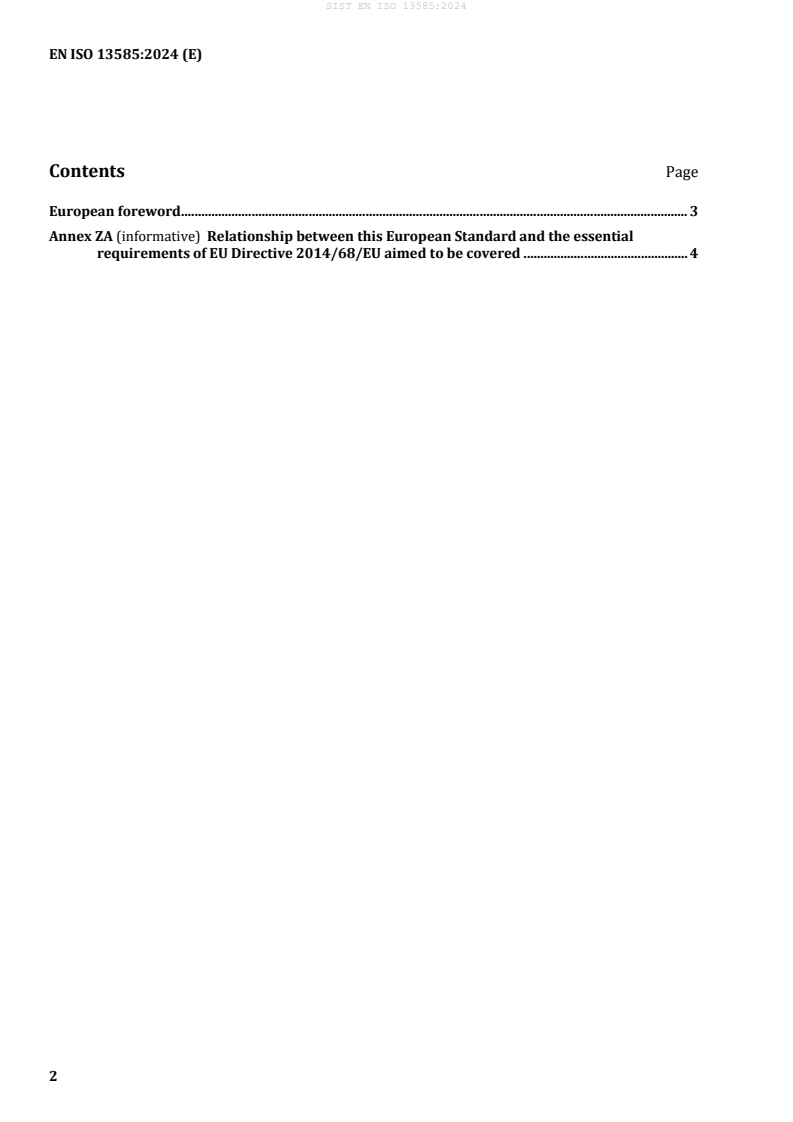
Contents Page
European foreword . 3
Annex ZA (informative) Relationship between this European Standard and the essential
requirements of EU Directive 2014/68/EU aimed to be covered . 4
European foreword
The text of ISO 13585:2021 has been prepared by Technical Committee ISO/TC 44 "Welding and allied
processes” of the International Organization for Standardization (ISO) and has been taken over as
of which is held by AFNOR.
This European Standard shall be given the status of a national standard, either by publication of an
identical text or by endorsement, at the latest by January 2025, and conflicting national standards shall
be withdrawn at the latest by January 2025.
Attention is drawn to the possibility that some of the elements of this document may be the subject of
patent rights. CEN shall not be held responsible for identifying any or all such patent rights.
This document supersedes EN ISO 13585:2012.
This document has been prepared under a standardization request addressed to CEN by the European
Commission. The Standing Committee of the EFTA States subsequently approves these requests for its
Member States.
For the relationship with EU Legislation, see informative Annex ZA, which is an integral part of this
document.
Any feedback and questions on this document should be directed to the users’ national standards body.
A complete listing of these bodies can be found on the CEN website.
According to the CEN-CENELEC Internal Regulations, the national standards organizations of the
following countries are bound to implement this European Standard: Austria, Belgium, Bulgaria,
Croatia, Cyprus, Czech Republic, Denmark, Estonia, Finland, France, Germany, Greece, Hungary, Iceland,
Ireland, Italy, Latvia, Lithuania, Luxembourg, Malta, Netherlands, Norway, Poland, Portugal, Republic of
North Macedonia, Romania, Serbia, Slovakia, Slovenia, Spain, Sweden, Switzerland, Türkiye and the
United Kingdom.
Endorsement notice
The text of ISO 13585:2021 has been approved by CEN as EN ISO 13585:2024 without any modification.
Annex ZA
(informative)
Relationship between this European Standard and the essential
requirements of EU Directive 2014/68/EU aimed to be covered
This European Standard has been prepared under a Commission’s standardization request
M/601“Mandate to CEN for standardization in the field of Pressure equipment” to provide one
voluntary means of conforming to essential requirements of Directive 2014/68/EU “Pressure
equipment”.
Once this standard is cited in the Official Journal of the European Union under that Directive
2014/68/EU compliance with the normative clauses of this standard given in Table ZA.1 and
application of the edition of the normatively referenced standards as given in Table ZA.2 confers, within
the limits of the scope of this standard, a presumption of conformity with the corresponding essential
requirements of that Directive 2014/68/EU, and associated EFTA regulations.
Table ZA.1 — Correspondence between this European Standard and
Annex I of the Directive 2014/68/EU (PED)
Essential Requirements of Clause(s)/sub-clause(s) Remarks/Notes
Directive 2014/68/EU of this EN
3.1.2, paragraphs 3, 4 and 5 5(without 5.3.4, 3rd paragraph), Permanent joining. For pressure
6, 7, 8, 9, 10, Annex E2 resistant components of pressure
equipment in the categories II, III
and IV the examiner/examining
body is a competent third party.
Table ZA.2 — Applicable Standards to confer presumption of conformity as described in this
Annex ZA
Column 1 Column 2 Column 3 Column 4
Reference in International
Title Corresponding European
Clause 2 Standard Edition
Standard Edition
ISO 857-2 ISO 857-2:2005 Welding and allied processes None
— Vocabulary — Part 2:
For applicable standard edition
Soldering and brazing
see Column 2
processes and related terms
ISO 4063:2009 ISO 4063:2009 Welding and allied processes EN ISO 4063:2010
— Nomenclature of
processes and reference
numbers
ISO 17672 ISO 17672:2016 Brazing — Filler metals EN ISO 17672:2016
ISO 17779 ISO 17779:2021 Brazing — Specification and None
qualification of brazing
For applicable standard edition
procedures for metallic
see Column 2
materials
ISO 18279:2003 ISO 18279:2003 Brazing — Imperfections in EN ISO 18279:2003
brazed joints
ISO/TR 25901-1 ISO/TR 25901- Welding and allied processes None
1:2016 — Vocabulary — Part 1:
For applicable standard edition
General terms
see Column 2
EN 12797 None Brazing — Destructive tests EN 12797:2000
of brazed joints
EN 12797:2000/A1:2003
EN 12799 None Brazing — Non-destructive EN 12799:2000
examination of brazed joints
EN 12799:2000/A1:2003
The documents listed in the Column 1 of Table ZA.2, in whole or in part, are normatively referenced in
this document, i.e. are indispensable for its application. The achievement of the presumption of
conformity is subject to the application of the edition of Standards as listed in Column 4 or, if no
European Standard Edition exists, the International Standard Edition given in Column 2 of Table ZA.2.
WARNING 1 — Presumption of conformity stays valid only as long as a reference to this European
Standard is maintained in the list published in the Official Journal of the European Union. Users of this
standard should consult frequently the latest list published in the Official Journal of the European
Union.
WARNING 2 — Other Union legislation may be applicable to the products falling within the scope of
this standard.
INTERNATIONAL ISO
STANDARD 13585
Second edition
2021-12
Brazing — Qualification testing of
brazers and brazing operators
Brasage fort — Essais de qualification des braseurs et des opérateurs
braseurs en brasage fort
Reference number
ISO 13585:2021(E)
ISO 13585:2021(E)
© ISO 2021
All rights reserved. Unless otherwise specified, or required in the context of its implementation, no part of this publication may
be reproduced or utilized otherwise in any form or by any means, electronic or mechanical, including photocopying, or posting on
the internet or an intranet, without prior written permission. Permission can be requested from either ISO at the address below
or ISO’s member body in the country of the requester.
ISO copyright office
CP 401 • Ch. de Blandonnet 8
CH-1214 Vernier, Geneva
Phone: +41 22 749 01 11
Email: copyright@iso.org
Website: www.iso.org
Published in Switzerland
ii
ISO 13585:2021(E)
Contents Page
Foreword .iv
1 Scope . 1
2 Normative references . 1
3 Terms and definitions . 2
4 Symbols and abbreviated terms.3
5 Essential variables and range of qualification . 4
5.1 General . 4
5.2 Brazing process. 5
5.3 Brazer qualification . 5
5.3.1 Product type . 5
5.3.2 Type of joint . 5
5.3.3 Parent material group(s) . 5
5.3.4 Filler metals and brazing filler application . 6
5.3.5 Dimensions . 6
5.3.6 Filler metal flow direction . 7
5.4 Brazing operator qualification . 7
5.4.1 Type of equipment . . 7
5.4.2 Filler metals and brazing filler application . 7
6 Examination and testing . 7
6.1 Supervision . 7
6.2 Brazing conditions . 8
6.3 Test piece . 8
6.4 Assessment of work pieces . 8
6.5 Extent of testing . 8
6.6 Visual testing . 8
6.7 Non-destructive testing . 9
6.8 Destructive testing . 9
6.9 Additional examination and testing . 9
7 Acceptance requirements for test pieces . 9
8 Re-tests. 9
9 Period of validity .10
9.1 Initial qualification . 10
9.2 Prolongation . 10
10 Certificate .10
11 Designation .11
Annex A (informative) Quality requirements for brazing .12
Annex B (informative) Brazer qualification test certificate .13
Annex C (informative) Brazing operator qualification test certificate .15
Annex D (informative) Other non-essential variables .16
Annex E (normative) Material grouping system .17
Annex F (informative) Examples of test pieces.19
Bibliography .21
iii
ISO 13585:2021(E)
Foreword
ISO (the International Organization for Standardization) is a worldwide federation of national standards
bodies (ISO member bodies). The work of preparing International Standards is normally carried out
through ISO technical committees. Each member body interested in a subject for which a technical
committee has been established has the right to be represented on that committee. International
organizations, governmental and non-governmental, in liaison with ISO, also take part in the work.
ISO collaborates closely with the International Electrotechnical Commission (IEC) on all matters of
electrotechnical standardization.
The procedures used to develop this document and those intended for its further maintenance are
described in the ISO/IEC Directives, Part 1. In particular, the different approval criteria needed for the
different types of ISO documents should be noted. This document was drafted in accordance with the
editorial rules of the ISO/IEC Directives, Part 2 (see www.iso.org/directives).
Attention is drawn to the possibility that some of the elements of this document may be the subject of
patent rights. ISO shall not be held responsible for identifying any or all such patent rights. Details of
any patent rights identified during the development of the document will be in the Introduction and/or
on the ISO list of patent declarations received (see www.iso.org/patents).
Any trade name used in this document is information given for the convenience of users and does not
constitute an endorsement.
For an explanation of the voluntary nature of standards, the meaning of ISO specific terms and
expressions related to conformity assessment, as well as information about ISO's adherence to
the World Trade Organization (WTO) principles in the Technical Barriers to Trade (TBT) see
www.iso.org/iso/foreword.html.
This document was prepared by Technical Committee ISO/TC 44, Welding and allied processes
Subcommittee SC 11, Qualification requirements for welding and allied processes personnel.
This second edition cancels and replaces the first edition (ISO 13585:2012), which has been technically
revised.
The main changes compared to the previous edition are as follows:
— brazing processes, in accordance with ISO 4063:2009, covered by this document, have been moved
to the scope;
— Clause 3 has been updated and additional terms have been defined;
— additional symbols and abbreviated terms have been added to Clause 4;
— Clause 5 has been significantly revised and updated including clarifications on brazing operator
qualification;
— material grouping has been moved to new Annex E;
— Clause 6 has been updated to refer to ISO or technically equivalent standards;
— the period of validity and prolongation of qualifications has been revised to 5 years in Clause 9.
Any feedback or questions on this document should be directed to the user’s national standards body. A
complete listing of these bodies can be found at www.iso.org/members.html.
Official interpretations of ISO/TC 44 documents, where they exist, are available from this page:
https://committee.iso.org/sites/tc44/home/interpretation.html.
iv
INTERNATIONAL STANDARD ISO 13585:2021(E)
Brazing — Qualification testing of brazers and brazing
operators
1 Scope
This document specifies requirements for qualification testing of brazers and brazing operators for
metallic materials.
This document gives general provisions on quality requirements for brazing (see Annex A).
This document applies to the following brazing processes according to ISO 857-2 and ISO 4063:2009
with local and global heating:
— 911 Infrared brazing;
— 912 Flame brazing, torch brazing;
— 913 Laser beam brazing;
— 914 Electron beam brazing;
— 916 Induction brazing;
— 918 Resistance brazing;
— 919 Diffusion brazing;
— 921 Furnace brazing;
— 922 Vacuum brazing;
— 923 Dip-bath brazing;
— 924 Salt-bath brazing;
— 925 Flux bath brazing;
— 926 Immersion brazing;
— 972 Arc weld brazing.
This document is not applicable to personnel operating brazing equipment who do not have any direct
influence on the quality of the brazed joint, for example, personnel performing exclusively loading/
unloading the brazing unit or just initiating the brazing cycle in automatic brazing.
The principles of this document can be applied to other brazing processes and brazing of materials not
listed.
This document does not apply to brazing for aerospace applications covered by ISO 11745.
2 Normative references
The following documents are referred to in the text in such a way that some or all of their content
constitutes requirements of this document. For dated references, only the edition cited applies. For
undated references, the latest edition of the referenced document (including any amendments) applies.
ISO 857-2, Welding and allied processes — Vocabulary — Part 2: Soldering and brazing processes and
related terms
ISO 13585:2021(E)
ISO 4063:2009, Welding and allied processes — Nomenclature of processes and reference numbers
ISO 17672, Brazing — Filler metals
ISO 17779, Brazing — Specification and qualification of brazing procedures for metallic materials
ISO 18279:2003, Brazing — Imperfections in brazed joints
ISO/TR 25901-1, Welding and allied processes — Vocabulary — Part 1: General terms
EN 12797, Brazing — Destructive tests of brazed joints
EN 12799, Brazing — Non-destructive examination of brazed joints
3 Terms and definitions
For the purposes of this document, the terms and definitions given in ISO 857-2, ISO/TR 25901-1 and
the following apply.
ISO and IEC maintain terminology databases for use in standardization at the following addresses:
— ISO Online browsing platform: available at https:// www .iso .org/ obp
— IEC Electropedia: available at https:// www .electropedia .org/
3.1
brazing
joining process using filler metal (3.12) with a liquidus temperature above 450 °C
[SOURCE: ISO 857-2:2005, 3.1.2.]
3.2
brazer
person who holds and manipulates the device for heating the brazing area by hand
Note 1 to entry: The brazer verifies compliance with the pBPS or BPS prior to and during brazing.
3.3
brazing operator
person who controls or adjusts brazing parameters for mechanized brazing (3.5) or sets up brazing
parameters for automatic brazing (3.6)
Note 1 to entry: The brazing operator verifies compliance with the pBPS or BPS prior to and during the brazing
cycle.
3.4
manual brazing
brazing (3.1) where the required brazing conditions are maintained by hand
3.5
mechanized brazing
brazing (3.1) where the required brazing conditions are maintained by mechanical or electronic means
but can be manually varied during the process
3.6
automatic brazing
brazing (3.1) in which all operations are performed without brazing operator (3.3) intervention during
the process
Note 1 to entry: Manual adjustment of brazing variables by the brazing operator during brazing is not possible.
ISO 13585:2021(E)
3.7
brazing procedure specification
BPS
document that has been qualified and provides the required variables of the brazing procedure to
ensure repeatability during production brazing
3.8
preliminary brazing procedure specification
pBPS
document containing the required variables of the brazing procedure which is not yet qualified
3.9
manufacturer
workshop or site (or both) which is (are) under the same technical and quality management
3.10
examiner
person who has been appointed to verify compliance with the applicable standard
Note 1 to entry: In certain cases, an external independent
...