

EN 415-6:2013
(Main)Safety of packaging machines - Part 6: Pallet wrapping machines
- Abstract
This European Standard applies to the following groups of machines:
- pallet banding machines;
- stretch film pallet wrapping machines;
- stretch film hood application machines;
- mobile stretch film wrapping machines;
- semi automatic self driving stretch film wrapping machines;
- shrink film pallet wrapping machines;
- shrink film hood application machines;
- film removing machines;
- shrinking systems;
- sleeve wrapping machines for product greater than 400 mm in one direction;
- product centralising machines.
The individual machines are described in 3.2.
This standard deals with safety requirements for machine design, construction, installation, commissioning, operation, adjustment, maintenance and cleaning of pallet wrapping machines.
The extents to which hazards, hazardous situations and events are covered are indicated in Clause 4.
Exclusions
This European Standard is not applicable to the following machines:
machines that were manufactured before the date of publication of this document by CEN;
- pallet strapping machines and destrapping machines. These machines are within the scope of
EN 415-8;
- conveying systems that connect packaging machines with each other, but includes conveying systems that are part of the machines.
This standard does not consider the following hazards:
- the use of pallet wrapping machines in potentially explosive atmospheres;
- the health, safety or hygiene hazards associated with the products that may be handled by the machines, but does include general advice on this subject;
- hazards that may be associated with electromagnetic emissions from pallet wrapping machines;
- hazards that may be associated with decommissioning pallet wrapping machines.
- Status
- Published
- Publication Date
- 21-May-2013
- Technical Committee
- CEN/TC 146 - Packaging machines - Safety
- Drafting Committee
- CEN/TC 146/WG 6 - Unit load securing machines
- Current Stage
- 9060 - Closure of 2 Year Review Enquiry - Review Enquiry
- Start Date
- 02-Dec-2024
- Completion Date
- 02-Dec-2024
- Directive
- 2006/42/EC - Directive 2006/42/EC of the European Parliament and of the Council of 17 May 2006 on machinery, and amending Directive 95/16/EC (recast)OJ Ref: C, C 348 OJ Date: 28-Nov-2013

Overview
EN 415-6:2013 (EN 415-6) is the European type C standard that specifies safety requirements for pallet wrapping machines. It covers the design, construction, installation, commissioning, operation, adjustment, maintenance and cleaning of a broad range of pallet wrapping equipment including stretch-film, shrink-film and banding systems, hood applicators, mobile and self‑driving wrappers, sleeve wrappers (>400 mm), film‑removing machines, shrinking systems and product centralising machines.
The standard identifies hazards (Clause 4), defines machine types (Clause 3.2) and sets out detailed safety requirements (Clause 5), verification procedures (Clause 6) and information for use (Clause 7). It also contains normative and informative annexes on noise testing, safeguarding large apertures, ESPE muting and the relationship to EU Directive 2006/42/EC.
Key topics and technical requirements
- Scope of machines covered: pallet banding, stretch‑film pallet wrapping, hood application, mobile and semi‑automatic self‑driving wrappers, shrink systems, sleeve wrappers and product centralising machines.
- Hazard identification: crushing, drawing‑in, entanglement, hot surfaces (shrinking), film roll handling, and other machine‑specific risks are listed and addressed.
- Safety measures (Clause 5): requirements for guards, emergency stops, protective devices (e.g., ESPE), safe access for maintenance, electrical and thermal safety for shrinking ovens, and measures for cleaning and washdown environments.
- Verification (Clause 6): visual and measurement checks with machine stopped and running, and verification procedures for required safeguards.
- Information for use (Clause 7): marking, signals, warning signs and instruction handbook content.
- Annexes: noise test code (Annex A), safeguarding large apertures and ESPE guidance (Annex B/C), and compliance mapping to the Machinery Directive (Annex ZA).
Note: the standard excludes machines manufactured before its publication date, pallet strapping/destrapping (EN 415‑8), conveying systems not integral to the machine, explosive atmospheres and certain EM or decommissioning hazards.
Practical applications - who uses this standard
- Machine manufacturers and designers - to design compliant, safe pallet wrapping machines.
- Safety engineers and CE compliance teams - for risk assessment and to demonstrate conformity with the Machinery Directive (see Annex ZA).
- Integrators and plant engineers - when installing, commissioning and validating safety measures on packaging lines.
- Maintenance teams and operators - for safe adjustment, cleaning and maintenance procedures.
- Testing laboratories and notified bodies - to verify conformity and perform inspections specified in Clause 6.
Related standards
- EN 415 series (Parts 1, 2, 3, 4, 5, 7, 8, 9)
- Normative references cited in EN 415‑6 include EN 415‑1, EN 415‑9, EN 349, EN 574, EN 953, EN 619 and EN 626‑1/2 - useful for complementary machine safety, guarding and ergonomic requirements.
Keywords: EN 415-6:2013, pallet wrapping machines, safety requirements, packaging machines standard, stretch film, shrink film, EN 415-6.
Relations
- Effective Date
- 29-May-2013
- Effective Date
- 25-Aug-2026
- Effective Date
- 09-Feb-2026
- Effective Date
- 09-Feb-2026
- Effective Date
- 09-Feb-2026
- Effective Date
- 09-Feb-2026
- Effective Date
- 09-Feb-2026
- Effective Date
- 09-Feb-2026
- Effective Date
- 09-Feb-2026
- Effective Date
- 09-Feb-2026
- Effective Date
- 09-Feb-2026
- Effective Date
- 28-Jan-2026
- Effective Date
- 28-Jan-2026
- Effective Date
- 28-Jan-2026
- Effective Date
- 28-Jan-2026
Get Certified
Connect with accredited certification bodies for this standard

BRCGS (Brand Reputation Compliance Global Standards)
Global food safety and quality standards owner.
Sponsored listings
Frequently Asked Questions
EN 415-6:2013 is a standard published by the European Committee for Standardization (CEN). Its full title is "Safety of packaging machines - Part 6: Pallet wrapping machines". This standard covers: This European Standard applies to the following groups of machines: - pallet banding machines; - stretch film pallet wrapping machines; - stretch film hood application machines; - mobile stretch film wrapping machines; - semi automatic self driving stretch film wrapping machines; - shrink film pallet wrapping machines; - shrink film hood application machines; - film removing machines; - shrinking systems; - sleeve wrapping machines for product greater than 400 mm in one direction; - product centralising machines. The individual machines are described in 3.2. This standard deals with safety requirements for machine design, construction, installation, commissioning, operation, adjustment, maintenance and cleaning of pallet wrapping machines. The extents to which hazards, hazardous situations and events are covered are indicated in Clause 4. Exclusions This European Standard is not applicable to the following machines: machines that were manufactured before the date of publication of this document by CEN; - pallet strapping machines and destrapping machines. These machines are within the scope of EN 415-8; - conveying systems that connect packaging machines with each other, but includes conveying systems that are part of the machines. This standard does not consider the following hazards: - the use of pallet wrapping machines in potentially explosive atmospheres; - the health, safety or hygiene hazards associated with the products that may be handled by the machines, but does include general advice on this subject; - hazards that may be associated with electromagnetic emissions from pallet wrapping machines; - hazards that may be associated with decommissioning pallet wrapping machines.
This European Standard applies to the following groups of machines: - pallet banding machines; - stretch film pallet wrapping machines; - stretch film hood application machines; - mobile stretch film wrapping machines; - semi automatic self driving stretch film wrapping machines; - shrink film pallet wrapping machines; - shrink film hood application machines; - film removing machines; - shrinking systems; - sleeve wrapping machines for product greater than 400 mm in one direction; - product centralising machines. The individual machines are described in 3.2. This standard deals with safety requirements for machine design, construction, installation, commissioning, operation, adjustment, maintenance and cleaning of pallet wrapping machines. The extents to which hazards, hazardous situations and events are covered are indicated in Clause 4. Exclusions This European Standard is not applicable to the following machines: machines that were manufactured before the date of publication of this document by CEN; - pallet strapping machines and destrapping machines. These machines are within the scope of EN 415-8; - conveying systems that connect packaging machines with each other, but includes conveying systems that are part of the machines. This standard does not consider the following hazards: - the use of pallet wrapping machines in potentially explosive atmospheres; - the health, safety or hygiene hazards associated with the products that may be handled by the machines, but does include general advice on this subject; - hazards that may be associated with electromagnetic emissions from pallet wrapping machines; - hazards that may be associated with decommissioning pallet wrapping machines.
EN 415-6:2013 is classified under the following ICS (International Classification for Standards) categories: 55.200 - Packaging machinery. The ICS classification helps identify the subject area and facilitates finding related standards.
EN 415-6:2013 has the following relationships with other standards: It is inter standard links to EN 415-6:2006+A1:2009, ISO 8598:1996, ISO 7000:2012, EN 61310-3:2008, EN 61496-3:2001, EN 61310-1:2008, EN 61508-2:2010, EN 61508-3:2010, EN 61496-1:2004, EN 62061:2005, EN 61508-1:2010, EN ISO 14122-3:2016, EN 415-1:2000+A1:2009, EN 1088:1995+A2:2008, EN 415-9:2009. Understanding these relationships helps ensure you are using the most current and applicable version of the standard.
EN 415-6:2013 is associated with the following European legislation: EU Directives/Regulations: 2006/42/EC; Standardization Mandates: M/396. When a standard is cited in the Official Journal of the European Union, products manufactured in conformity with it benefit from a presumption of conformity with the essential requirements of the corresponding EU directive or regulation.
EN 415-6:2013 is available in PDF format for immediate download after purchase. The document can be added to your cart and obtained through the secure checkout process. Digital delivery ensures instant access to the complete standard document.
Standards Content (Sample)
2003-01.Slovenski inštitut za standardizacijo. Razmnoževanje celote ali delov tega standarda ni dovoljeno.Pakirne naprave - Varnost pakirnih naprav - 6. del: Stroji za ovijanje paletSicherheit von Verpackungsmaschinen - Teil 6: PaletteneinschlagmaschinenSécurité des machines d'emballage - Partie 6 : Machines d'emballage de palettesSafety of packaging machines - Part 6: Pallet wrapping machines55.200Pakirni strojiPackaging machineryICS:Ta slovenski standard je istoveten z:EN 415-6:2013SIST EN 415-6:2013en,fr,de01-junij-2013SIST EN 415-6:2013SLOVENSKI
STANDARDSIST EN 415-6:2007+A1:20101DGRPHãþD
EUROPEAN STANDARD NORME EUROPÉENNE EUROPÄISCHE NORM
EN 415-6
May 2013 ICS 55.200 Supersedes EN 415-6:2006+A1:2009English Version
Safety of packaging machines - Part 6: Pallet wrapping machines
Sécurité des machines d'emballage - Partie 6 : Machines d'emballage de palettes
Sicherheit von Verpackungsmaschinen - Teil 6: Paletteneinschlagmaschinen This European Standard was approved by CEN on 28 March 2013.
CEN members are bound to comply with the CEN/CENELEC Internal Regulations which stipulate the conditions for giving this European Standard the status of a national standard without any alteration. Up-to-date lists and bibliographical references concerning such national standards may be obtained on application to the CEN-CENELEC Management Centre or to any CEN member.
This European Standard exists in three official versions (English, French, German). A version in any other language made by translation under the responsibility of a CEN member into its own language and notified to the CEN-CENELEC Management Centre has the same status as the official versions.
CEN members are the national standards bodies of Austria, Belgium, Bulgaria, Croatia, Cyprus, Czech Republic, Denmark, Estonia, Finland, Former Yugoslav Republic of Macedonia, France, Germany, Greece, Hungary, Iceland, Ireland, Italy, Latvia, Lithuania, Luxembourg, Malta, Netherlands, Norway, Poland, Portugal, Romania, Slovakia, Slovenia, Spain, Sweden, Switzerland, Turkey and United Kingdom.
EUROPEAN COMMITTEE FOR STANDARDIZATION
COMITÉ EUROPÉEN DE NORMALISATION EUROPÄISCHES KOMITEE FÜR NORMUNG
Management Centre:
Avenue Marnix 17,
B-1000 Brussels © 2013 CEN All rights of exploitation in any form and by any means reserved worldwide for CEN national Members. Ref. No. EN 415-6:2013: ESIST EN 415-6:2013
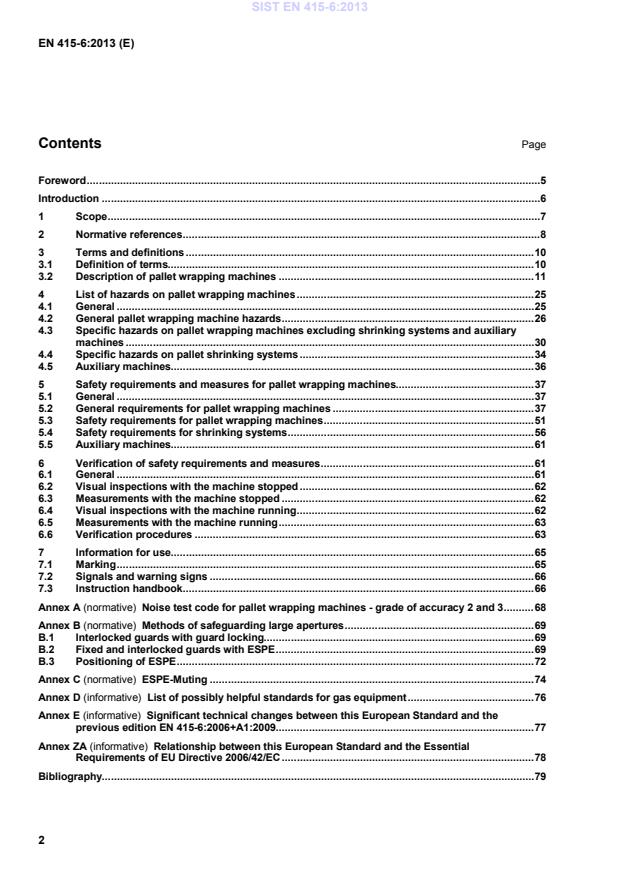
Noise test code for pallet wrapping machines - grade of accuracy 2 and 3 . 68 Annex B (normative)
Methods of safeguarding large apertures . 69 B.1 Interlocked guards with guard locking. 69 B.2 Fixed and interlocked guards with ESPE . 69 B.3 Positioning of ESPE . 72 Annex C (normative)
ESPE-Muting . 74 Annex D (informative)
List of possibly helpful standards for gas equipment . 76 Annex E (informative)
Significant technical changes between this European Standard and the previous edition EN 415-6:2006+A1:2009. 77 Annex ZA (informative)
Relationship between this European Standard and the Essential Requirements of EU Directive 2006/42/EC . 78 Bibliography. 79
When provisions of this type C standard are different from those, which are stated in type A or B standards, the provisions of this type C standard take precedence. SIST EN 415-6:2013
1 Scope This European Standard applies to the following groups of machines: pallet banding machines; stretch film pallet wrapping machines; stretch film hood application machines; mobile stretch film wrapping machines; semi automatic self driving stretch film wrapping machines; shrink film pallet wrapping machines; shrink film hood application machines; film removing machines; shrinking systems; sleeve wrapping machines for product greater than 400 mm in one direction; product centralising machines. The individual machines are described in 3.2.
This standard deals with safety requirements for machine design, construction, installation, commissioning, operation, adjustment, maintenance and cleaning of pallet wrapping machines. The extents to which hazards, hazardous situations and events are covered are indicated in Clause 4. Exclusions This European Standard is not applicable to the following machines: machines that were manufactured before the date of publication of this document by CEN; pallet strapping machines and destrapping machines. These machines are within the scope of EN 415-8; conveying systems that connect packaging machines with each other, but includes conveying systems that are part of the machines. This standard does not consider the following hazards: the use of pallet wrapping machines in potentially explosive atmospheres; the health, safety or hygiene hazards associated with the products that may be handled by the machines, but does include general advice on this subject; hazards that may be associated with electromagnetic emissions from pallet wrapping machines;
hazards that may be associated with decommissioning pallet wrapping machines. SIST EN 415-6:2013
EN 614-1, Safety of machinery — Ergonomic design principles — Part 1: Terminology and general principles EN 614-2, Safety of machinery — Ergonomic design principles — Part 2: Interactions between the design of machinery and work tasks EN 619, Continuous handling equipment and systems — Safety and EMC requirements for equipment for mechanical handling of unit loads EN 626-1, Safety of machinery — Reduction of risks to health from hazardous substances emitted by machinery — Part 1: Principles and specifications for machinery manufacturers EN 626-2, Safety of machinery — Reduction of risk to health from hazardous substances emitted by machinery — Part 2: Methodology leading to verification procedures EN 894-1, Safety of machinery — Ergonomics requirements for the design of displays and control actuators — Part 1: General principles for human interactions with displays and control actuators EN 894-2, Safety of machinery — Ergonomics requirements for the design of displays and control actuators — Part 2: Displays EN 894-3, Safety of machinery — Ergonomics requirements for the design of displays and control actuators — Part 3: Control actuators EN 953:1997+A1:2009, Safety of machinery — Guards — General requirements for the design and construction of fixed and movable guards EN 1005-3, Safety of machinery — Human physical performance — Part 3: Recommended force limits for machinery operation EN 1037, Safety of machinery — Prevention of unexpected start-up EN 1088:1995+A2:2008, Safety of machinery — Interlocking devices associated with guards — Principles for design and selection EN 1672-2:2005+A1:2009, Food processing machinery — Basic concepts — Part 2: Hygiene requirements EN 1760-1, Safety of machinery — Pressure sensitive protective devices — Part 1: General principles for the design and testing of pressure sensitive mats and pressure sensitive floors SIST EN 415-6:2013
EN 61310-1:2008, Safety of machinery — Indication, marking and actuation — Part 1: Requirements for visual, acoustic and tactile signals (IEC 61310-1:2007) EN 61310-3, Safety of machinery — Indication, marking and actuation — Part 3: Requirements for the location and operation of actuators (IEC 61310-3) EN 61496-1:2004, Safety of machinery — Electro-sensitive protective equipment — Part 1: General requirements and tests (IEC 61496-1:2004, modified) EN 61496-3, Safety of machinery — Electro-sensitive protective equipment — Part 3: Particular requirements for Active Opto-electronic Protective Devices responsive to Diffuse Reflection (AOPDDR)
EN 61508-1, Functional safety of electrical/electronic/programmable electronic safety-related systems —
Part 1: General requirements (IEC 61508-1) EN 61508-2, Functional safety of electrical/electronic/programmable electronic safety-related systems —
Part 2: Requirements for electrical/electronic/programmable electronic safety-related systems (IEC 61508-2) EN 61508-3, Functional safety of electrical/electronic/programmable electronic safety-related systems —
Part 3: Software requirements
EN 62061:2005, Safety of machinery — Functional safety of safety-related electrical, electronic and programmable electronic control systems (IEC 62061:2005) EN ISO 4413:2010, Hydraulic fluid power — General rules and safety requirements for systems and their components (ISO 4413:2010) EN ISO 4414:2010, Pneumatic fluid power — General rules and safety requirements for systems and their components (ISO 4414:2010) EN ISO 12100:2010, Safety of machinery — General principles for design — Risk assessment and risk reduction (ISO 12100:2010) EN ISO 13732-1 Ergonomics of the thermal environment – Methods for the assessment of human responses to contact with surfaces – Part 1: Hot surfaces (ISO 13732-1) EN ISO 13849-1:2008, Safety of machinery — Safety-related parts of control systems — Part 1: General principles for design (ISO 13849-1:2006) EN ISO 13850, Safety of machinery — Emergency stop — Principles for design (ISO 13850) EN ISO 13855, Safety of machinery — Positioning of safeguards with respect to the approach speeds of parts of the human body (ISO 13855) EN ISO 13857:2008, Safety of machinery – Safety distances to prevent hazard zones being reached by upper and lower limbs (ISO 13857:2008) EN ISO 14122-1:2001, Safety of machinery — Permanent means of access to machinery — Part 1: Choice of fixed means of access between two levels (ISO 14122-1:2001)
3.1 Definition of terms 3.1.1 product article or articles, with or without pallet, that are handled in the pallet wrapping machine 3.1.2 pack assembly of product and packaging materials produced by a pallet wrapping machine 3.1.3 packaging material material used to secure a product, e.g. stretch film 3.1.4 flexible packaging material relatively thin paper, plastic film or flexible laminate 3.1.5 stretch film flexible elastic plastic film which can be pulled tightly around a product to form an envelope. It may stick to itself on contact or require heat sealing 3.1.6 stretch wrapping wrapping process in which the stretch film is stretched and wrapped around the product and sealed under tension 3.1.7 thermoplastic film, shrink film plastic film which shrinks when heated 3.1.8 film reel, packaging material reel continuous sheet of paper, plastic film, metal foil or flexible laminate wound on a cylindrical core 3.1.9 film clamp device to hold the film at the product for the first wrap. Also called film fixture SIST EN 415-6:2013
3.2.2 Spiral stretch wrapping machines 3.2.2.1 General The stretching method uses film webs that are wound around product according to a given winding pattern (e.g. single or cross bracing). The number of the bottom windings or bottom edge windings or the degree of overlapping of the film webs can be variably adjusted. Stretch film wrapping machines wind a stretch film spirally around product, thus resulting in an envelope with horizontal and vertical tension forces. Pallet stretch wrapping machines include: Automatic stretch film wrapping machines: The machine is loaded and unloaded automatically by a conveyor. The application of the stretch film, stretching and cutting of the stretch film are done automatically. Semiautomatic stretch film wrapping machines: One or more of the following are done manually: loading or unloading of the machine, application or cutting of the stretch film. The wrapping movement is done automatically. Manual stretch film wrapping machines: Like semiautomatic stretch film wrapping machines, but additionally the movement of the lifting mechanism is done manually. The following types of stretch film wrapping machines exist. 3.2.2.2 Rotary table machine Product, which is positioned on a table that rotates, is wrapped. When used, vertically moveable film carriage and pre-stretching device are fitted to a column. The functional principle of a rotary table machine is shown in Figure 1. On manual rotary machine the vertical movement of the film carriage is done by an operator (see Figure 2). An example of a fully automatic rotary table machine is shown in Figure 3. The principle components are rotating table and film reel.
Optional assemblies: conveyors, film clamp, film knife, film sealing device, hold-down plate, pre-stretching unit on the film reel assembly, top sheet feeder. SIST EN 415-6:2013
Figure 1 — Principle of rotary table machine Figure 2 — Manual rotary table machine
Key 1 hold down plate
2 pre-stretching device
3 film reel
4 film fixture system
5 conveyor 6 rotary table
7 film cutting device Figure 3 — Automatic rotary table machine 3.2.2.3 Rotary arm machine Machine which wraps product in film or net, from a reel on an arm which rotates around the stationary product (see Figure 4 and Figure 5). The principle components are: rotating arm, film reel assembly and lifting mechanism which moves the arm up and down. SIST EN 415-6:2013
Key 1 rotary arm
2 product
3 film
4 conveying device Figure 4 — Semiautomatic rotary arm machine SIST EN 415-6:2013
Key 1 vertical slide device
2 pre-stretching device
3 film reel assembly
4 film fixture system
5 conveying device
6 rotary arm
7 top sheet feeder Figure 5 — Fully automatic rotary arm machine
3.2.2.4 Ring machine In a ring machine a film carriage guided on a ring moves circularly around the stationary product (see Figure 6). Some examples have a tilting ring to apply a diagonal wrap. The principle components are: rotating mechanism on a ring, film reel assembly and lifting mechanism which moves the ring up and down. Optional assemblies: conveyors, film clamp, film knife, film sealing device, hold-down plate, pre-stretching unit on the film reel assembly, top sheet feeder. SIST EN 415-6:2013
Figure 6 — Ring machine – Principle of operation
3.2.2.5 Semi automatic self driving pallet stretch wrapping machines Semi automatic self driving pallet stretch wrapping machines apply a stretch film by the whole machine driving around the product (see Figure 7). The machine is guided around the product by a contact wheel which is mounted on a moveable lever. The principle components are the contact wheel and the film reel assembly.
Key 1 contact wheel 2 film reel assembly Figure 7 — Semi automatic self driving pallet stretch wrapping machine 3.2.2.6 Mobile pallet stretch wrapping machines Mobile stretching machines (see Figure 8) are moved to the pallet manually, usually assisted by a motor drive. Usually the pallet is lifted by a lifting mechanism and so fixed on the stretch wrapping machine. The machine wraps a product in film or net, from a reel on an arm which rotates around the stationary product (rotary arm machine). The principle components are: pallet support, rotary arm and film reel assembly. SIST EN 415-6:2013
Figure 8 — Mobile pallet stretch wrapping machine 3.2.3 Curtain stretching machine A conveyor transports the product into a film curtain that is stretched and subsequently welded on the rear side. Working principle is the so-called passage method according to which the product in the machine bumps against the film web rolling off two rollers and drags this along. In this manner, the stretch film envelopes the advancing product. After this a closing and cutting tool tightens up and separates the film (see Figure 9). The principle components are: conveyor, film reel assembly, sealing and cutting mechanism. Optional assemblies: Top sheet assembly.
Figure 9 — Curtain stretching machine – Principle of operation 3.2.4 Hood stretching machines Hood stretching machines apply a stretch film hood which is prefabricated or taken from a film tube roll to a product by stretching it and pulling it over the product. When a film tube is used, the required length of the hood is pulled off the reel then sealed and cut off. Hood stretching can be either semiautomatic or fully automatic. In case of semiautomatic hood stretching, the essential automatic operations are only gathering and stretching. The hood is loaded manually. Prefabricated hoods or hoods on reels with perforated separation seam are used. A hood stretching machine and the stretching procedure is shown in Figure 10. SIST EN 415-6:2013
Figure 10 — Hood stretching machine
Fully automatic machines use reels of square tubes with gussets or of flat tubes. The film web to be uncoiled is guided via deviation or dancer rolls into the head of the machine operating according to the vertical principle.
Mechanically, pneumatically or vacuum driven opening devices open the tube to a rectangular format and put it into the gathering device. Similar to the case with the semiautomatic version this device consists of SIST EN 415-6:2013
3.2.5 Shrink film pallet wrapping machines 3.2.5.1 General When using the shrinking method, the product is first wrapped with thermoplastic film. Subsequently, the thermoplastic film is shrunk under the effect of heat around the pack. See 3.2.6 for descriptions of shrinking systems. 3.2.5.2 Banding, curtain and sleeve wrapping machines A conveyor transports product into a curtain of thermoplastic or non elastic film that is welded on the rear side. Working principle is the so-called passage method according to which, the product in the machine bumps against the film web rolling off two rollers and drags this along. In this manner, the film wraps the advancing product. Working principle see Figure 9. Differentiation is made between horizontal and vertical machines. In the horizontal machine the film reels are arranged in vertical position next to the product conveying system. In the vertical machine one film reel is positioned above and another one below the conveying system. The principle components are: conveyor, film reel assembly, film closing/fixing mechanism, cutting mechanism. Optional assemblies: Top sheet assembly, sealing mechanism. 3.2.5.3 Spiral pallet wrapping machines A spiral pallet wrapping machine processes a shrink film that is wound spirally around product and product carrier in the same way as by a pallet stretching machine, but without sufficient tension to stretch the film. This method allows packaging of product which varies in height or base, using one machine and one film width. See Figure 11. The principle components are: rotating table, film reel assembly and lifting mechanism which moves the film reel assembly vertically thus producing a spiral wrap. Optional assemblies: conveyors, film clamp, film knife, film sealing device, hold-down plate, pre-stretching unit on the film reel assembly, top sheet feeder.
Key 1 hold down plate
2 film reel assembly 3 rotary table
4 product Figure 11 — Spiral pallet wrapping machine 3.2.5.4 Hood application machines 3.2.5.4.1 General Hood application machines generally use a square profile tube with gussets. The machine detects the height of the product and forms the hood length accordingly. There are two principle operating types between two versions: vertical hood and parachute hood application, which are described below. 3.2.5.4.2 Vertical hood application machine The film hood is formed above the product and put on vertically, i.e. opening, welding and cutting device are located above the product (see Figure 12). Opening of the hood is usually assisted by a blower. After the hood has been put on, the product is fed to a shrinking device. The principle components are: tube film reel assembly, tube opening mechanism, tube placement mechanism, tube cutting device, hood application mechanism Optional assemblies: conveyors, edge protection feeding device, blower. SIST EN 415-6:2013
Key 1 product
2 conveyor
3 film reels (two formats) Figure 12 — Vertical hood application machine 3.2.5.4.3 Parachute hood application machine In the case of parachute hood application machines, the assembling unit is located at floor level, at the side of the application machine. The film is withdrawn from the assembling unit, the hood welded and cut off. The so assembled hood is turned and put on the product standing next to the assembling unit (see Figure 13). The principle components are: Film reels Film transport mechanism Turning arm Assembling unit (sealing and opening unit) Conveyor
Key 1 film assembling unit
2 film reels (2No)
3 conveyor
4 product
5 turning arm Figure 13 — Parachute hood application machine SIST EN 415-6:2013
Shrinking hoods are rectangular containers with open bottom that are guided over a product enveloped with a thermoplastic film. They exist both with central heating device and continuously arranged heating elements.
In both cases the product is fed either manually or by a conveyor. The principle components are: frame or hood with a source of heat, lifting mechanism which moves the hood or frame up and down, heating system. Optional assemblies: conveyors.
Key 1 shrinking frame
2 moving frame mechanism
3 moving drive Figure 14 — Shrinking frame 3.2.6.2 Shrinking oven A shrinking oven is a heated space in which the thermoplastic film put around a product is shrunk. Shrinking ovens are available as chamber ovens (see Figure 15) or as continuous ovens (see Figure 16) as well. They can use direct gas heating, indirect oil heating or also be fitted with electrical heater coils. The principle components are: conveyors, source of heat, automatic doors. Optional assemblies: fans. SIST EN 415-6:2013
Key 1 fan circulating air 2 electric heating unit 3 bogie drive unit 4 bottom shrink device 5 automatic doors 6 conveyor A side view B plan view C end view TR product transport direction
Figure 15 — Chamber shrinking oven with electric heating device SIST EN 415-6:2013
Key 1 infeed conveyor 2 product position in oven 3 product position after shrink cycle 4 discharge conveyor 5 bottom shrink device 6 heating element 7 shrinking zone 8 automatic doors A side view B plan view C end view TR product transport direction
Figure 16 — Continuous shrinking oven using thermal combustion heating 3.2.6.3 Shrinking column Shrinking columns are devices in which a thermoplastic film is shrunk around product using heating devices that are positioned in usually one or two vertical columns at the side of a rotating table which can be part of a conveyor. Shrinking columns exist as rotating shrinking column with stationary product or as stationary shrinking column with rotating product. The heating device can be heated electrically or by means of gas. The principle components are: source of heat, turn table. Optional assemblies: conveyors. SIST EN 415-6:2013
Key 1 product 2 roller conveyor with turntable 3 column 4 heating elements Figure 17 — Shrinking column using thermal combustion 3.2.7 Auxiliary machines 3.2.7.1 Top sheet feeder To place the top sheet, one film sheet is put on top of product. The top sheet is pulled off a reel, cut off, drawn over product or put on it. Subsequently, the top sheet hanging down on the sides is enveloped using the spiral film winding method.
Differentiation is made between the following working methods: When working according to the passage principle, the top sheet feeder uncoils the top sheet from the roll while product is passing. Subsequently, the top sheet is cut off.
When working according to the tensioning principle, the top sheet is uncoiled from the reel, then pulled over the top of the stationary product, cut off and put down.
The principle components are: film reel assembly or top sheet magazine, application mechanism, gripping mechanism. Optional assemblies: film clamp, film cutting device. 3.2.7.2 Product centralising machines Product centralising machines push the product, usually placed on a pallet, in the correct position by pressing with two lateral metal plates. The machine usually is loaded automatically by a pallet conveyor. The principle components are: pushing plates, conveyor. SIST EN 415-6:2013
Key 1 pushing plates 2 roller conveyor 3 product Figure 18 — Product centralizing machine 3.2.7.3 Film removing machines Film removing machines remove the film from palletised or unpalletised product. Usually the film is cut vertically by a cutting device and then removed by low pressure. Mostly a product centralising assembly is used to hold the product. The machine is usually loaded automatically by a pallet conveyor which usually comprises an integrated lifting platform. The principle components are: cutting device, film removing assembly, film repository, conveyor with lifting platform. 4 List of hazards on pallet wrapping machines
4.1 General This clause lists all the significant hazards, hazardous situations and events that can be found on typical pallet wrapping machines including integrated transport, feed and discharge devices.
Before using this standard, the manufacturer shall establish that the hazards on his machine correspond to the hazards described in this standard. If the manufacturer identifies hazards that are not listed in this clause, he shall assess these hazards by using the principles detailed in EN ISO 12100. The hazards on a specific machine can vary depending on its working principle; the type, size and mass of the product; the packaging material; auxiliary equipment attached to the machine and the environment in which the machine is used.
The hazards which occur on most pallet wrapping machines are listed in 4.2 and the hazards which are specific to particular types of pallet wrapping machines are listed in 4.3 to 4.5. SIST EN 415-6:2013
Pneumatic and hydraulic equipment presents crushing, shearing, ejection of parts and injection of fluids hazards. Stored energy in pneumatic or hydraulic systems may cause mechanisms to move unexpectedly even when power supplies are disconnected. In addition hydraulic oil and pneumatic lubricating oil present a potential fire hazard and can contaminate agri-foodstuffs. 4.2.1.3 Slip, trip and fall hazards Slip accidents can occur if liquids or solids from the machine e.g. lubricants, packaging materials or the product, spill onto traffic routes, work stations or means of access around the machine. Trip accidents may occur if parts of the machine protrude beyond the machine frame at low level, or if cables and pipes associated with the machine are incorrectly installed. Falls may occur if people climb or stand on parts of the machine above floor level, e.g. for magazine loading, size changing, maintenance or cleaning. 4.2.1.4 Loss of stability If pallet wrapping machines become unstable and move unexpectedly or fall over they can cause crushing and impact injuries. Loss of stability can occur in the following circumstances: a) while the machine is in operation for example: if components are unbalanced; if the centre of gravity of the machine is high relative to its base area; if someone stands on the machine; b) while the machine is being moved, for example: if the manufacturers lifting instructions are not followed; on machines fitted with wheels if the machine is moved on a slope or uneven surface. 4.2.1.5 Hazards from moveable guards Movable guards may present crushing, shearing and impact hazards when they open or close if they have a high mass or move under gravity. If excessive effort is necessary to operate the guard or it is located in an unfavourable
...