

EN 14135:2025
(Main)Covering - Determination of fire protection ability
- Abstract
This document is applicable to all coverings, including but not limited to renderings, boards with and without air gaps and installed with various support systems. This document specifies a method for determining the ability of a covering to protect underlying materials against damage during a specified fire exposure.
The document is not used for the evaluation of fire resistance classifications (e.g. EI, EW, E) or reaction to fire classifications (specified in EN 13501-1).
The fire protection ability is influenced by the presence of combustible materials in the cavity behind the covering. The applicability of the results is limited according to the quantity and position of such combustible materials within that cavity.
NOTE The amount of combustible materials permissible in the cavity is generally laid down in national regulations.
- Status
- Published
- Publication Date
- 23-Sep-2025
- Technical Committee
- CEN/TC 127 - Fire safety in buildings
- Drafting Committee
- CEN/TC 127/WG 1 - Structural and separating elements
- Current Stage
- 6060 - Definitive text made available (DAV) - Publishing
- Start Date
- 24-Sep-2025
- Due Date
- 16-Dec-2024
- Completion Date
- 24-Sep-2025

Overview
EN 14135:2025 - Covering: Determination of fire protection ability is a CEN European Standard that defines a laboratory method to assess a covering’s ability to protect underlying materials (substrates) against ignition, charring and other heat damage during a specified fire exposure. Approved in 2025, this document supersedes EN 14135:2004 and is intended for all types of coverings (e.g., renderings, boards, single- and multi-layer systems, with or without air gaps and various support systems). It is explicitly not a method for assigning fire resistance (EI, EW, E) or reaction-to-fire classifications (EN 13501‑1).
Key topics and technical requirements
- Scope and purpose: Defines the test objective - to determine the fire protection ability (K) of coverings protecting an underlying substrate.
- Test set-up and equipment: Specifies general test apparatus including furnace, supporting construction, thermocouples and instrumentation required for temperature and pressure measurements.
- Test specimen requirements: Covers specimen size, design details (joints, integrated installations), mounting and fixation, and substrate types (particleboard, EPS/XPS, low-density and special substrates).
- Test conditions and procedure: Refers to general requirements in EN 1363‑1 and details conditioning, application of instrumentation, measurements during the test, observations, and safe termination.
- Evaluation methods: Includes at least two options - Option 1 (temperature-evaluated covering) and Option 2 (temperature and visually evaluated covering) - and updated criteria for calculating fire protection ability K. A vertical test and an additional evaluation method were added in the 2025 revision.
- Performance criteria and reporting: Defines pass/fail criteria, observation protocols, post-test examination (charring, burning, melting, shrinkage, collapse), and required content of the test report.
- Field of direct application: Limits on applicability depending on substrate, fixation, covering thickness, air gaps, orientation, size, perforations and joints; influence of combustible materials in cavities is emphasised and may be limited by national rules.
Applications and target users
EN 14135:2025 is used by:
- Test laboratories performing fire tests on façades, ceilings and wall linings
- Manufacturers and product developers of coverings, boards, render systems and façade assemblies
- Fire safety engineers and consultants evaluating protective performance of coverings
- Building authorities, specifiers and compliance bodies interpreting test results for national regulations
Practical uses include product development, comparative testing of coverings, documentation of protective performance for project specifications and regulatory submissions.
Related standards
- EN 1363‑1 - Fire resistance tests: general requirements (used in conjunction with EN 14135)
- EN 13501‑1 - Reaction to fire classification (EN 14135 is not a classification method)
- EN ISO 13943 - Fire safety vocabulary
- Product standards referenced for substrates (EN 312, EN 13163, EN 13164)
Keywords: EN 14135:2025, covering, fire protection ability, fire testing, substrate protection, covering fire test, CEN standard.
Relations
- Effective Date
- 28-Jan-2023
- Effective Date
- 22-Jul-2026
- Effective Date
- 09-Feb-2026
- Effective Date
- 28-Jan-2026
- Effective Date
- 28-Jan-2026
- Effective Date
- 28-Jan-2026
- Effective Date
- 28-Jan-2026
- Effective Date
- 28-Jan-2026
- Effective Date
- 28-Jan-2026
- Effective Date
- 28-Jan-2026
- Effective Date
- 28-Jan-2026
- Effective Date
- 28-Jan-2026
Get Certified
Connect with accredited certification bodies for this standard

CIS Institut d.o.o.
Personal Protective Equipment (PPE) certification body. Notified Body NB-2890 for EU Regulation 2016/425 PPE.

Kiwa BDA Testing
Building and construction product certification.
Kmetijski inštitut Slovenije
Agricultural Institute of Slovenia. Soil testing, plant health, agricultural product analysis.
Sponsored listings
Frequently Asked Questions
EN 14135:2025 is a standard published by the European Committee for Standardization (CEN). Its full title is "Covering - Determination of fire protection ability". This standard covers: This document is applicable to all coverings, including but not limited to renderings, boards with and without air gaps and installed with various support systems. This document specifies a method for determining the ability of a covering to protect underlying materials against damage during a specified fire exposure. The document is not used for the evaluation of fire resistance classifications (e.g. EI, EW, E) or reaction to fire classifications (specified in EN 13501-1). The fire protection ability is influenced by the presence of combustible materials in the cavity behind the covering. The applicability of the results is limited according to the quantity and position of such combustible materials within that cavity. NOTE The amount of combustible materials permissible in the cavity is generally laid down in national regulations.
This document is applicable to all coverings, including but not limited to renderings, boards with and without air gaps and installed with various support systems. This document specifies a method for determining the ability of a covering to protect underlying materials against damage during a specified fire exposure. The document is not used for the evaluation of fire resistance classifications (e.g. EI, EW, E) or reaction to fire classifications (specified in EN 13501-1). The fire protection ability is influenced by the presence of combustible materials in the cavity behind the covering. The applicability of the results is limited according to the quantity and position of such combustible materials within that cavity. NOTE The amount of combustible materials permissible in the cavity is generally laid down in national regulations.
EN 14135:2025 is classified under the following ICS (International Classification for Standards) categories: 13.220.50 - Fire-resistance of building materials and elements. The ICS classification helps identify the subject area and facilitates finding related standards.
EN 14135:2025 has the following relationships with other standards: It is inter standard links to EN 14135:2004, EN 312:2010, EN 60584-1:2013, EN 13163:2012+A2:2016, EN 1363-1:2020, EN 13164:2012+A1:2015, EN ISO 13943:2023, EN 13501-2:2023, EN 13501-2:2007+A1:2009, EN 14509:2013, EN 14509:2006, EN 13501-2:2016. Understanding these relationships helps ensure you are using the most current and applicable version of the standard.
EN 14135:2025 is associated with the following European legislation: EU Directives/Regulations: 305/2011; Standardization Mandates: M/117. When a standard is cited in the Official Journal of the European Union, products manufactured in conformity with it benefit from a presumption of conformity with the essential requirements of the corresponding EU directive or regulation.
EN 14135:2025 is available in PDF format for immediate download after purchase. The document can be added to your cart and obtained through the secure checkout process. Digital delivery ensures instant access to the complete standard document.
Standards Content (Sample)
SLOVENSKI STANDARD
01-december-2025
Nadomešča:
SIST EN 14135:2004
Prevleke - Ugotavljanje zmožnosti za požarno zaščito
Covering - Determination of fire protection ability
Brandschutzbekleidungen - Bestimmung der Brandschutzwirkung
Revêtements - Détermination de la capacité de protection contre l'incendie
Ta slovenski standard je istoveten z: EN 14135:2025
ICS:
13.220.50 Požarna odpornost Fire-resistance of building
gradbenih materialov in materials and elements
elementov
91.060.99 Drugi stavbni elementi Other elements of buildings
2003-01.Slovenski inštitut za standardizacijo. Razmnoževanje celote ali delov tega standarda ni dovoljeno.
EN 14135
EUROPEAN STANDARD
NORME EUROPÉENNE
September 2025
EUROPÄISCHE NORM
ICS 13.220.50 Supersedes EN 14135:2004
English Version
Covering - Determination of fire protection ability
Revêtements - Détermination de la capacité de Brandschutzbekleidungen - Bestimmung der
protection contre l'incendie Brandschutzwirkung
This European Standard was approved by CEN on 25 August 2025.
CEN members are bound to comply with the CEN/CENELEC Internal Regulations which stipulate the conditions for giving this
European Standard the status of a national standard without any alteration. Up-to-date lists and bibliographical references
concerning such national standards may be obtained on application to the CEN-CENELEC Management Centre or to any CEN
member.
This European Standard exists in three official versions (English, French, German). A version in any other language made by
translation under the responsibility of a CEN member into its own language and notified to the CEN-CENELEC Management
Centre has the same status as the official versions.
CEN members are the national standards bodies of Austria, Belgium, Bulgaria, Croatia, Cyprus, Czech Republic, Denmark, Estonia,
Finland, France, Germany, Greece, Hungary, Iceland, Ireland, Italy, Latvia, Lithuania, Luxembourg, Malta, Netherlands, Norway,
Poland, Portugal, Republic of North Macedonia, Romania, Serbia, Slovakia, Slovenia, Spain, Sweden, Switzerland, Türkiye and
United Kingdom.
EUROPEAN COMMITTEE FOR STANDARDIZATION
COMITÉ EUROPÉEN DE NORMALISATION
EUROPÄISCHES KOMITEE FÜR NORMUNG
CEN-CENELEC Management Centre: Rue de la Science 23, B-1040 Brussels
© 2025 CEN All rights of exploitation in any form and by any means reserved Ref. No. EN 14135:2025 E
worldwide for CEN national Members.
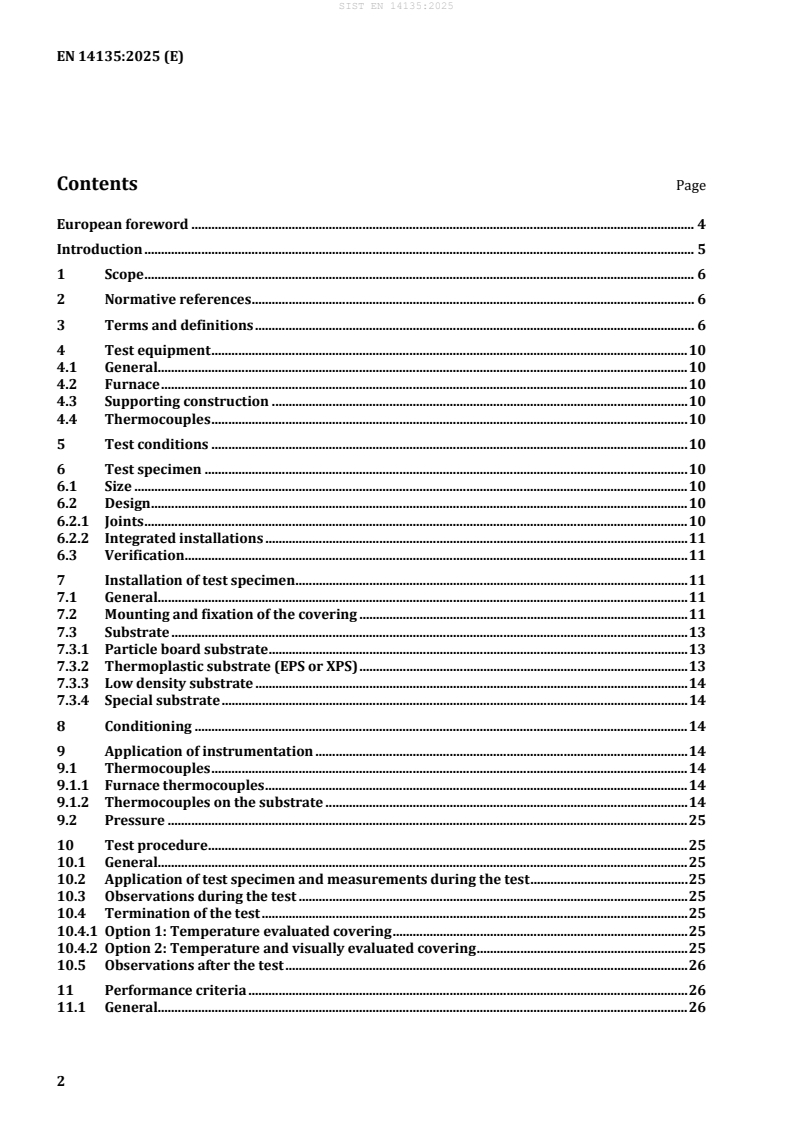
Contents Page
European foreword . 4
Introduction . 5
1 Scope . 6
2 Normative references . 6
3 Terms and definitions . 6
4 Test equipment . 10
4.1 General. 10
4.2 Furnace . 10
4.3 Supporting construction . 10
4.4 Thermocouples . 10
5 Test conditions . 10
6 Test specimen . 10
6.1 Size . 10
6.2 Design . 10
6.2.1 Joints . 10
6.2.2 Integrated installations . 11
6.3 Verification . 11
7 Installation of test specimen . 11
7.1 General. 11
7.2 Mounting and fixation of the covering . 11
7.3 Substrate . 13
7.3.1 Particle board substrate . 13
7.3.2 Thermoplastic substrate (EPS or XPS) . 13
7.3.3 Low density substrate . 14
7.3.4 Special substrate . 14
8 Conditioning . 14
9 Application of instrumentation . 14
9.1 Thermocouples . 14
9.1.1 Furnace thermocouples . 14
9.1.2 Thermocouples on the substrate . 14
9.2 Pressure . 25
10 Test procedure . 25
10.1 General. 25
10.2 Application of test specimen and measurements during the test . 25
10.3 Observations during the test . 25
10.4 Termination of the test . 25
10.4.1 Option 1: Temperature evaluated covering . 25
10.4.2 Option 2: Temperature and visually evaluated covering . 25
10.5 Observations after the test . 26
11 Performance criteria . 26
11.1 General. 26
11.2 Option 1: Temperature evaluated covering . 26
11.3 Option 2: Temperature and visually evaluated covering. 26
12 Test report . 27
13 Field of direct application of test results . 27
13.1 General . 27
13.2 Substrate . 27
13.3 Fixation . 28
13.4 Thickness of the covering . 30
13.5 Air gap . 30
13.6 Orientation . 30
13.7 Size . 31
13.8 Perforations . 31
13.9 Joints. 31
Bibliography . 32
European foreword
This document (EN 14135:2025) has been prepared by Technical Committee CEN/TC 127 “Fire safety in
buildings”, the secretariat of which is held by BSI.
This European Standard shall be given the status of a national standard, either by publication of an
identical text or by endorsement, at the latest by March 2026, and conflicting national standards shall be
withdrawn at the latest by March 2026.
Attention is drawn to the possibility that some of the elements of this document may be the subject of
patent rights. CEN shall not be held responsible for identifying any or all such patent rights.
This document supersedes EN 14135:2004.
— the criteria for K , an additional evaluation method and a vertical test has been included.
This document is used in conjunction with EN 1363-1.
This document has been prepared under a standardization request addressed to CEN by the European
Commission. The Standing Committee of the EFTA States subsequently approves these requests for its
Member States.
Any feedback and questions on this document should be directed to the users’ national standards body.
A complete listing of these bodies can be found on the CEN website.
According to the CEN-CENELEC Internal Regulations, the national standards organisations of the
following countries are bound to implement this European Standard: Austria, Belgium, Bulgaria, Croatia,
Cyprus, Czech Republic, Denmark, Estonia, Finland, France, Germany, Greece, Hungary, Iceland, Ireland,
Italy, Latvia, Lithuania, Luxembourg, Malta, Netherlands, Norway, Poland, Portugal, Republic of North
Macedonia, Romania, Serbia, Slovakia, Slovenia, Spain, Sweden, Switzerland, Türkiye and the United
Kingdom.
Introduction
This document has been prepared to provide a method of test for assessing a coverings ability to protect
underlying materials against fire.
Fire protection ability K is the ability of a wall or ceiling covering, to provide for the material behind the
covering, protection against ignition, charring and other damage for a specified period of time. EN 13501-
2 describes and define the difference between K and K .
1 2
WARNING — The attention of all persons concerned with managing and carrying out this test is drawn
to the fact that fire testing can be hazardous and that there is a possibility that toxic and/or harmful
smoke and gases can be involved during the test. Operational hazards can also arise during the testing of
specimens and the disposal of test residues.
An assessment of all potential hazards and risks to health should be made and safety precautions should
be identified and provided. Written safety instructions should be issued. Appropriate training should be
given to relevant personnel. Laboratory personnel should ensure that they follow written safety
instructions at all times.
1 Scope
This document is applicable to all coverings, including but not limited to renderings, boards with and
without air gaps and installed with various support systems. This document specifies a method for
determining the ability of a covering to protect underlying materials against damage during a specified
fire exposure.
The document is not used for the evaluation of fire resistance classifications (e.g. EI, EW, E) or reaction
to fire classifications (specified in EN 13501-1).
The fire protection ability is influenced by the presence of combustible materials in the cavity behind the
covering. The applicability of the results is limited according to the quantity and position of such
combustible materials within that cavity.
NOTE The amount of combustible materials permissible in the cavity is generally laid down in national
regulations.
2 Normative references
The following documents are referred to in the text in such a way that some or all of their content
constitutes requirements of this document. For dated references, only the edition cited applies. For
undated references, the latest edition of the referenced document (including any amendments) applies.
EN 1363-1, Fire resistance tests - Part 1: General requirements
EN ISO 13943, Fire safety - Vocabulary (ISO 13943)
EN 312, Particleboards - Specification
EN 13163, Thermal insulation products for buildings – Factory made expanded polystyrene (EPS) products
– Specification
EN 13164, Thermal insulation products for buildings – Factory made extruded polystyrene foam (XPS)
products – Specification
EN 60584-1, Thermocouples - Part 1: EMF specifications and tolerances
3 Terms and definitions
For the purposes of this document, the terms and definitions given in EN 1363-1 and EN ISO 13943 and
the following apply.
ISO and IEC maintain terminology databases for use in standardization at the following addresses:
— IEC Electropedia: available at https://www.electropedia.org/
— ISO Online browsing platform: available at https://www.iso.org/obp
3.1
covering
test specimen
material(s) or product(s), including installation method, which is intended to protect an underlying
substrate against damage behind the covering, during a specified fire exposure
Note 1 to entry: A covering could be single layer or multilayer, with or without an air gap, see Figure 1.
b) Multilayer covering c) Multilayer covering
a) Single layer covering
with 2 layers with 3 layers
d) Single layer covering e) Multilayer covering f) Multilayer covering
with a substructure and an with 2 layers with a with 3 layers with a
air gap substructure and an air gap substructure and an air gap
Key
A substrate
B single layer covering
C multilayer covering
D air gap
E substructure
Figure 1 — Covering examples
3.2
substrate
underlying material which is used behind a covering which needs protection against ignition, charring
and other damage
Note 1 to entry: For multi-layered products, the inner layer can function as substrate, see Figure 1.
3.3
damaged substrate
substrate which has been burnt or charred
Note 1 to entry: Discoloration and soot deposits are not regarded as damage.
3.4
burnt substrate
substrate which has been destroyed by combustion or pyrolysis
Note 1 to entry: The substrate is considered to be burnt if the surface is scratched with a hard material e.g. a metal
key and the surface is decomposed.
3.5
charred substrate
substrate which has formed carbonaceous residue resulting from pyrolysis or combustion
Note 1 to entry: The substrate is considered to have charred if the surface is scratched with a hard material e.g. a
metal key and the surface is decomposed.
3.6
discoloured substrate
substrate which has changed colour but not burned or charred
3.7
shrunken substrate
substrate which has decreased in dimensions
3.8
melted substrate
substrate which has changed state due to the influence of heat
3.9
directly fixed covering
covering directly fixed to the substrate without a separate substructure
3.10
covering with an air gap
covering fixed to the substrate with a separate substructure (e.g. battens), generating an air gap or a
covering with a separate system (e.g. grid) for holding the covering (e.g. suspended ceilings)
3.11
collapse
deterioration of the covering or part of the covering exposing the substrate directly to the fire
Note 1 to entry: A collapse has not occurred when the outer layers of a multilayer covering breaks or falls down.
3.12
supporting construction
construction that may be required for the testing of some building elements into which the test specimen
is assembled as described in EN 1363-1
3.13
integrated installation
element, that is installed within the covering, which have different thermal insulation properties than the
covering
Note 1 to entry: The integrated installations are within the covering. Integrated installation can pass through the
covering, see Figure 2.
Note 2 to entry: Examples include lamps, fire alarms, speakers, sprinklers, ventilation outlet.
a) Single layer covering with an integrate b) Multilayer covering with 2 layers and an
installation integrate installation
c) Single layer covering with an integrate d) Single layer covering with a non-integrated
installation and an air gap installation and an air gap
Key
A substrate
B single layer covering
C multilayer covering
D air gap
E substructure
F integrated installation
G non-integrated installation
Figure 2 — Examples of integrated installation and non-integrated installations within the
covering
3.14
non-integrated installation
element that is installed between the covering and substrate, e.g. cables, pipes, ventilation ducts in the
cavity between the substrate and the covering, not passing through the covering
Note 1 to entry: See Figure 2.
3.15
substructure
product (e.g. battens or metal components) to which the covering is fixed
3.16
cavity
concealed volume(s) in the air gap
Note 1 to entry: Cavity can be with or without material.
3.17
air gap
space between the covering and the substrate
3.18
non-loadbearing floor application
element protecting the underlying construction in case of fire from above
4 Test equipment
4.1 General
The furnace and test equipment shall be as specified in EN 1363-1.
4.2 Furnace
Horizontal or vertical furnace, capable of subjecting the test specimen to the heating and pressure
conditions specified in EN 1363-1.
4.3 Supporting construction
Supporting construction is a stiff frame to which the substrate is attached. The stiff frame consists e.g. of
rafters to which a particleboard of minimum 10 mm is applied. If particleboard is used as substrate a
19 mm thick particleboard, as specified in 7.3.1, can be used as both supporting construction and
substrate. The stiff frame shall be stable enough to prevent damage of the test specimen due to movement
after the fire exposure.
4.4 Thermocouples
The thermocouples shall be made as disc thermocouples. In order to provide a good thermal contact, type
K thermocouple wire, as defined in EN 60584-1, 0,5 mm in diameter (with tolerances as defined in
EN 60584-1) shall be soldered to a 0,2 mm thick by 12 mm diameter copper disc. It is also permitted to
use thermocouples whose wires have been twisted together and then soldered to the copper disc. An
insulation pad as described in EN 1363-1 shall not be used.
5 Test conditions
The heating and pressure conditions and the furnace atmosphere shall conform to those given in
EN 1363-1.
6 Test specimen
6.1 Size
A horizontal test specimen shall be rectangular with minimum dimensions of 2,4 m by 2,5 m (exposed
area), not including the 100 mm boundary zone if applicable, see Figure 3 a) and b).
A vertical test specimen shall have the minimum dimension of 2,8 m x 2,8 m. See Figure 3 c) and d).
6.2 Design
6.2.1 Joints
If the covering includes joints, these joints shall be part of the test specimen. This means that longitudinal
and transversal joints shall be tested if used in practice.
If cross joints and T joints are used in practice these shall be included in the test specimen. If performance
criteria for option 1 are chosen, a minimum of 4 joints in total shall be included in the test specimen, see
Figure 4. For vertical test specimens, at least one joint shall be located within 500 ± 150 mm of the top of
the test specimen, see Figure 4 b).
6.2.2 I
...