


FprEN 1127-1
(Main)Explosive atmospheres - Explosion prevention and protection - Part 1: Basic concepts, methodology and design
General Information
- Abstract
This document specifies methods for the identification and assessment of hazardous situations leading to explosion and the design and construction measures appropriate for the required safety. This is achieved by:
— risk assessment;
— risk reduction.
The safety of equipment, protective systems and components can be achieved by eliminating hazards and/or limiting the risk, i.e. by steps (figure below from ISO EN 12100):
a) appropriate design (without using safeguarding) – Step 1;
b) safeguarding – Step 2;
c) information for use – Step 3;
d) any other preventive measures.
In this standard the measures in accordance with
a) (prevention) and
b) (protection) against explosions are dealt with in Clause 6.
The measures according to
c) against explosions are dealt with in Clause 7.
Measures in accordance with d) are not specified in this standard.
Refer to EN ISO 12100:2010 for complementary preventive and protective measures
Inherently safe design measures are the first and most important step in the risk reduction process. This is because protective measures inherent to the characteristics of the product or system are likely to remain effective, whereas experience has shown that even well-designed guards and protective devices can fail or be violated, and information for use might not be followed.
Guards and protective devices shall be used whenever an inherently safe design measure does not reasonably make it possible either to remove hazards or to sufficiently reduce risks. Complementary protective measures involving additional equipment (e.g. emergency stop equipment) might have to be implemented.
The end user has a role to play in the risk reduction procedure by complying with the information provided by the designer/supplier. However, information for use shall not be a substitute for the correct application of inherently safe design measures, guards or complementary protective measures.
The preventive and protective measures described in this document will not provide the required level of safety unless the equipment, protective systems and components are operated within their intended use and are installed and maintained according to the relevant codes of practice or requirements.
This document specifies general design and construction methods to help designers and manufacturers in achieving explosion safety in the design of equipment, protective systems and components.
This document is applicable to any equipment, protective systems and components intended to be used in potentially explosive atmospheres, under atmospheric conditions. These atmospheres can arise from flammable/combustible substances processed, used or released by the equipment, protective systems and components or from materials in the vicinity of the equipment, protective systems and components and/or from the materials of construction of the equipment, protective systems and components.
This document is applicable to equipment, protective systems and components at all stages of its use.
This document is only applicable to equipment group II which is intended for use in other places than underground parts of mines and those parts of surface installations of such mines endangered by firedamp and/or combustible dust.
- Status
- Not Published
- Publication Date
- 12-Nov-2026
- Technical Committee
- CEN/TC 305 - Potentially explosive atmospheres - Explosion prevention and protection
- Drafting Committee
- CEN/TC 305/WG 4 - Terminology and Methodology
- Current Stage
- 4599 - Dispatch of FV draft to CMC - Finalization for Vote
- Start Date
- 15-May-2026
- Due Date
- 09-May-2025
- Completion Date
- 15-May-2026

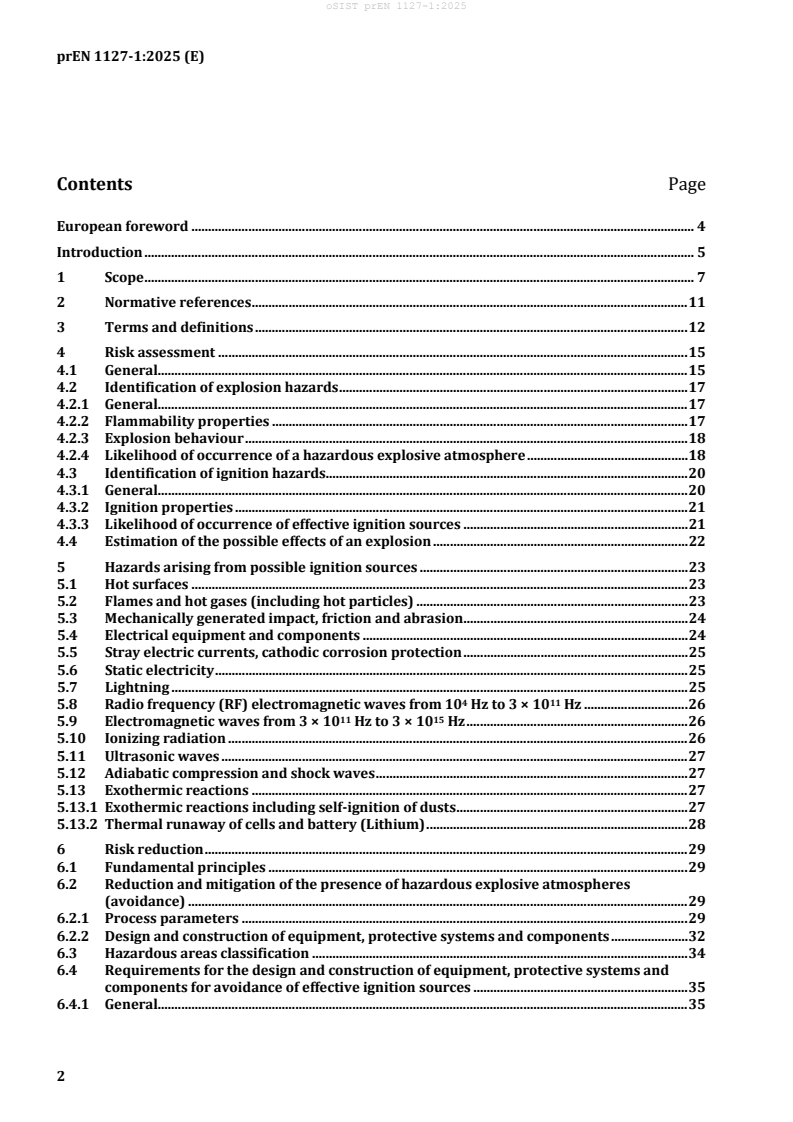
Overview
FprEN 1127-1: Explosive Atmospheres - Explosion Prevention and Protection - Part 1: Basic Concepts, Methodology and Design is a European draft standard developed by CEN/TC 305. This standard outlines comprehensive methods for identifying and assessing hazardous situations that could lead to explosions in potentially explosive atmospheres, and prescribes design and construction measures to ensure required safety through risk assessment and risk reduction.
FprEN 1127-1 applies to equipment, protective systems, and components intended for use in explosive atmospheres above ground (not in underground mining environments). The standard is crucial for designers, manufacturers, and users responsible for explosion safety, supporting compliance with European Union Directives such as ATEX (2014/34/EU) and relevant safety regulations.
Key Topics
- Hazard Identification and Risk Assessment: The standard requires thorough evaluation of equipment, protective systems, and the interactions with flammable materials. Identification of explosion and ignition hazards, and estimation of the likelihood and potential effects of explosions, are central themes.
- Risk Reduction Measures: Emphasis is placed on following a hierarchy for explosion safety:
- Inherently safe design (eliminating hazards by design)
- Safeguarding and protection systems
- Providing information for use
- Other preventive measures (not covered by this standard)
- Design and Construction: Guidelines are provided for designing equipment and systems to avoid or mitigate ignition sources such as hot surfaces, flames, mechanical sparks, electrical faults, static electricity, lightning, radio frequency, and chemical reactions.
- Operational Use and Maintenance: Proper installation, intended use, and regular maintenance, as well as user compliance with provided instructions, are critical to maintaining explosion protection.
- Classification and Documentation: Emphasis on hazardous area classification and the need for documentation of risk assessment, protective measures, and user information.
Applications
FprEN 1127-1 is applicable to a broad range of industries and environments where explosive atmospheres may occur due to flammable gases, vapors, mists, or dusts. Practical application areas include:
- Chemical, Oil & Gas, and Petrochemical Industries: For equipment in refineries, gas terminals, chemical plants, and storage facilities.
- Process and Manufacturing Plants: Such as pharmaceutical, grain handling, food processing, woodworking, and painting industries where combustible dusts or vapors can form.
- Energy Sector: Including hydrogen, ammonia, and methane facilities, as well as HVAC systems using flammable refrigerants.
- Public Utilities and Infrastructure: Gas pipelines, filling stations, and distribution grids.
- Other Industrial Environments: Metalworking (handling aluminum dusts), paper, and textiles manufacturing.
By following this standard, organizations can ensure a systematic approach to explosion risk management from equipment design to daily operation, reducing workplace accidents and ensuring regulatory compliance.
Related Standards
FprEN 1127-1 references a number of related standards and documents for complementary safety measures and terminology, including:
- EN ISO 12100:2010: Safety of machinery - General principles for design - Risk assessment and risk reduction.
- EN 13237:2024: Terms and definitions for equipment and protective systems in potentially explosive atmospheres.
- EN IEC 60079 Series: Explosive atmospheres - General requirements, electrical equipment design, installation, inspection, and maintenance.
- EN 15198:2007: Risk assessment of non-electrical equipment for use in explosive atmospheres.
- EN ISO 80079-36:2016: Non-electrical equipment for explosive atmospheres - Basic requirements.
- ISO Guide 51:2014: Guidelines for including safety aspects in standards.
By adhering to FprEN 1127-1 and these related standards, organizations can adopt best practices in explosion prevention and protection, ensuring safer workplaces in hazardous environments and supporting conformity with essential EU safety requirements.
Relations
- Effective Date
- 09-Aug-2023
Get Certified
Connect with accredited certification bodies for this standard

CIS Institut d.o.o.
Personal Protective Equipment (PPE) certification body. Notified Body NB-2890 for EU Regulation 2016/425 PPE.

Kiwa BDA Testing
Building and construction product certification.
Kmetijski inštitut Slovenije
Agricultural Institute of Slovenia. Soil testing, plant health, agricultural product analysis.
Sponsored listings
Frequently Asked Questions
FprEN 1127-1 is a draft published by the European Committee for Standardization (CEN). Its full title is "Explosive atmospheres - Explosion prevention and protection - Part 1: Basic concepts, methodology and design". This standard covers: This document specifies methods for the identification and assessment of hazardous situations leading to explosion and the design and construction measures appropriate for the required safety. This is achieved by: — risk assessment; — risk reduction. The safety of equipment, protective systems and components can be achieved by eliminating hazards and/or limiting the risk, i.e. by steps (figure below from ISO EN 12100): a) appropriate design (without using safeguarding) – Step 1; b) safeguarding – Step 2; c) information for use – Step 3; d) any other preventive measures. In this standard the measures in accordance with a) (prevention) and b) (protection) against explosions are dealt with in Clause 6. The measures according to c) against explosions are dealt with in Clause 7. Measures in accordance with d) are not specified in this standard. Refer to EN ISO 12100:2010 for complementary preventive and protective measures Inherently safe design measures are the first and most important step in the risk reduction process. This is because protective measures inherent to the characteristics of the product or system are likely to remain effective, whereas experience has shown that even well-designed guards and protective devices can fail or be violated, and information for use might not be followed. Guards and protective devices shall be used whenever an inherently safe design measure does not reasonably make it possible either to remove hazards or to sufficiently reduce risks. Complementary protective measures involving additional equipment (e.g. emergency stop equipment) might have to be implemented. The end user has a role to play in the risk reduction procedure by complying with the information provided by the designer/supplier. However, information for use shall not be a substitute for the correct application of inherently safe design measures, guards or complementary protective measures. The preventive and protective measures described in this document will not provide the required level of safety unless the equipment, protective systems and components are operated within their intended use and are installed and maintained according to the relevant codes of practice or requirements. This document specifies general design and construction methods to help designers and manufacturers in achieving explosion safety in the design of equipment, protective systems and components. This document is applicable to any equipment, protective systems and components intended to be used in potentially explosive atmospheres, under atmospheric conditions. These atmospheres can arise from flammable/combustible substances processed, used or released by the equipment, protective systems and components or from materials in the vicinity of the equipment, protective systems and components and/or from the materials of construction of the equipment, protective systems and components. This document is applicable to equipment, protective systems and components at all stages of its use. This document is only applicable to equipment group II which is intended for use in other places than underground parts of mines and those parts of surface installations of such mines endangered by firedamp and/or combustible dust.
This document specifies methods for the identification and assessment of hazardous situations leading to explosion and the design and construction measures appropriate for the required safety. This is achieved by: — risk assessment; — risk reduction. The safety of equipment, protective systems and components can be achieved by eliminating hazards and/or limiting the risk, i.e. by steps (figure below from ISO EN 12100): a) appropriate design (without using safeguarding) – Step 1; b) safeguarding – Step 2; c) information for use – Step 3; d) any other preventive measures. In this standard the measures in accordance with a) (prevention) and b) (protection) against explosions are dealt with in Clause 6. The measures according to c) against explosions are dealt with in Clause 7. Measures in accordance with d) are not specified in this standard. Refer to EN ISO 12100:2010 for complementary preventive and protective measures Inherently safe design measures are the first and most important step in the risk reduction process. This is because protective measures inherent to the characteristics of the product or system are likely to remain effective, whereas experience has shown that even well-designed guards and protective devices can fail or be violated, and information for use might not be followed. Guards and protective devices shall be used whenever an inherently safe design measure does not reasonably make it possible either to remove hazards or to sufficiently reduce risks. Complementary protective measures involving additional equipment (e.g. emergency stop equipment) might have to be implemented. The end user has a role to play in the risk reduction procedure by complying with the information provided by the designer/supplier. However, information for use shall not be a substitute for the correct application of inherently safe design measures, guards or complementary protective measures. The preventive and protective measures described in this document will not provide the required level of safety unless the equipment, protective systems and components are operated within their intended use and are installed and maintained according to the relevant codes of practice or requirements. This document specifies general design and construction methods to help designers and manufacturers in achieving explosion safety in the design of equipment, protective systems and components. This document is applicable to any equipment, protective systems and components intended to be used in potentially explosive atmospheres, under atmospheric conditions. These atmospheres can arise from flammable/combustible substances processed, used or released by the equipment, protective systems and components or from materials in the vicinity of the equipment, protective systems and components and/or from the materials of construction of the equipment, protective systems and components. This document is applicable to equipment, protective systems and components at all stages of its use. This document is only applicable to equipment group II which is intended for use in other places than underground parts of mines and those parts of surface installations of such mines endangered by firedamp and/or combustible dust.
FprEN 1127-1 is classified under the following ICS (International Classification for Standards) categories: 13.230 - Explosion protection. The ICS classification helps identify the subject area and facilitates finding related standards.
FprEN 1127-1 has the following relationships with other standards: It is inter standard links to EN 1127-1:2019. Understanding these relationships helps ensure you are using the most current and applicable version of the standard.
FprEN 1127-1 is associated with the following European legislation: EU Directives/Regulations: 2006/42/EC, 2014/34/EU, 2023/1230; Standardization Mandates: M/396, M/596, M/605, M/BC/CEN/92/46. When a standard is cited in the Official Journal of the European Union, products manufactured in conformity with it benefit from a presumption of conformity with the essential requirements of the corresponding EU directive or regulation.
FprEN 1127-1 is available in PDF format for immediate download after purchase. The document can be added to your cart and obtained through the secure checkout process. Digital delivery ensures instant access to the complete standard document.
Standards Content (Sample)
SLOVENSKI STANDARD
01-september-2025
Eksplozivne atmosfere - Protieksplozijska zaščita - 1. del: Osnovni pojmi,
metodologija in zasnova
Explosive atmospheres - Explosion prevention and protection - Part 1: Basic concepts,
methodology and design
Explosionsfähige Atmosphären - Explosionsschutz - Teil 1: Grundlegende Konzepte,
Methodik und konstruktive Auslegung
Atmosphères explosives - Prévention de l'explosion et protection contre l'explosion -
Partie 1 : Notions fondamentales, méthodologie et conception constructive
Ta slovenski standard je istoveten z: prEN 1127-1
ICS:
13.230 Varstvo pred eksplozijo Explosion protection
2003-01.Slovenski inštitut za standardizacijo. Razmnoževanje celote ali delov tega standarda ni dovoljeno.
DRAFT
EUROPEAN STANDARD
prEN 1127-1
NORME EUROPÉENNE
EUROPÄISCHE NORM
July 2025
ICS 13.230 Will supersede EN 1127-1:2019
English Version
Explosive atmospheres - Explosion prevention and
protection - Part 1: Basic concepts, methodology and
design
Atmosphères explosives - Prévention de l'explosion et Explosionsfähige Atmosphären - Explosionsschutz -
protection contre l'explosion - Partie 1 : Notions Teil 1: Grundlegende Konzepte, Methodik und
fondamentales, méthodologie et conception konstruktive Auslegung
constructive
This draft European Standard is submitted to CEN members for enquiry. It has been drawn up by the Technical Committee
CEN/TC 305.
If this draft becomes a European Standard, CEN members are bound to comply with the CEN/CENELEC Internal Regulations
which stipulate the conditions for giving this European Standard the status of a national standard without any alteration.
This draft European Standard was established by CEN in three official versions (English, French, German). A version in any other
language made by translation under the responsibility of a CEN member into its own language and notified to the CEN-CENELEC
Management Centre has the same status as the official versions.
CEN members are the national standards bodies of Austria, Belgium, Bulgaria, Croatia, Cyprus, Czech Republic, Denmark, Estonia,
Finland, France, Germany, Greece, Hungary, Iceland, Ireland, Italy, Latvia, Lithuania, Luxembourg, Malta, Netherlands, Norway,
Poland, Portugal, Republic of North Macedonia, Romania, Serbia, Slovakia, Slovenia, Spain, Sweden, Switzerland, Türkiye and
United Kingdom.
Recipients of this draft are invited to submit, with their comments, notification of any relevant patent rights of which they are
aware and to provide supporting documentation.
Warning : This document is not a European Standard. It is distributed for review and comments. It is subject to change without
notice and shall not be referred to as a European Standard.
EUROPEAN COMMITTEE FOR STANDARDIZATION
COMITÉ EUROPÉEN DE NORMALISATION
EUROPÄISCHES KOMITEE FÜR NORMUNG
CEN-CENELEC Management Centre: Rue de la Science 23, B-1040 Brussels
© 2025 CEN All rights of exploitation in any form and by any means reserved Ref. No. prEN 1127-1:2025 E
worldwide for CEN national Members.
prEN 1127-1:2025 (E)
Contents Page
European foreword . 4
Introduction . 5
1 Scope . 7
2 Normative references . 11
3 Terms and definitions . 12
4 Risk assessment . 15
4.1 General. 15
4.2 Identification of explosion hazards . 17
4.2.1 General. 17
4.2.2 Flammability properties . 17
4.2.3 Explosion behaviour . 18
4.2.4 Likelihood of occurrence of a hazardous explosive atmosphere . 18
4.3 Identification of ignition hazards. 20
4.3.1 General. 20
4.3.2 Ignition properties . 21
4.3.3 Likelihood of occurrence of effective ignition sources . 21
4.4 Estimation of the possible effects of an explosion . 22
5 Hazards arising from possible ignition sources . 23
5.1 Hot surfaces . 23
5.2 Flames and hot gases (including hot particles) . 23
5.3 Mechanically generated impact, friction and abrasion . 24
5.4 Electrical equipment and components . 24
5.5 Stray electric currents, cathodic corrosion protection . 25
5.6 Static electricity . 25
5.7 Lightning . 25
4 11
5.8 Radio frequency (RF) electromagnetic waves from 10 Hz to 3 × 10 Hz . 26
11 15
5.9 Electromagnetic waves from 3 × 10 Hz to 3 × 10 Hz . 26
5.10 Ionizing radiation . 26
5.11 Ultrasonic waves . 27
5.12 Adiabatic compression and shock waves . 27
5.13 Exothermic reactions . 27
5.13.1 Exothermic reactions including self-ignition of dusts . 27
5.13.2 Thermal runaway of cells and battery (Lithium) . 28
6 Risk reduction . 29
6.1 Fundamental principles . 29
6.2 Reduction and mitigation of the presence of hazardous explosive atmospheres
(avoidance) . 29
6.2.1 Process parameters . 29
6.2.2 Design and construction of equipment, protective systems and components . 32
6.3 Hazardous areas classification . 34
6.4 Requirements for the design and construction of equipment, protective systems and
components for avoidance of effective ignition sources . 35
6.4.1 General. 35
prEN 1127-1:2025 (E)
6.4.2 Hot surfaces . 37
6.4.3 Flames and hot gases . 38
6.4.4 Mechanically generated impact, friction and grinding . 38
6.4.5 Electrical equipment . 39
6.4.6 Stray electric currents and cathodic corrosion protection . 40
6.4.7 Static electricity . 41
6.4.8 Lightning . 41
4 11
6.4.9 Radio frequency (RF) electromagnetic waves from 10 Hz to 3 × 10 Hz . 42
11 15
6.4.10 Electromagnetic waves from 3 × 10 Hz to 3 × 10 Hz . 43
6.4.11 Ionizing radiation . 43
6.4.12 Ultrasonic waves . 44
6.4.13 Adiabatic compression and shock waves . 45
6.4.14 Exothermic reactions, including self-ignition of dusts . 46
6.5 Requirements for the design and construction of equipment, protective systems and
components to reduce the explosion effects . 46
6.6 Provisions for emergency measures . 47
6.7 Principles of measuring and control systems for explosion prevention and
protection . 47
7 Information for use . 48
7.1 General . 48
7.2 Information for commissioning, maintenance and repair to prevent explosion . 50
7.3 Qualifications and training . 50
Annex A (informative) Information for the use of tools in potentially explosive
atmospheres . 51
Annex B (informative) Tightness of equipment . 52
B.1 General . 52
B.2 Normal tightness . 52
B.3 Enhanced tightness . 53
Annex C (normative) Verification procedure for the threshold limit of ultrasound in liquids . 54
Annex D (informative) Significant technical changes between this document and the
previous edition of this document . 56
Annex ZA (informative) Relationship between this European Standard and the essential
requirements of EU Directive 2014/34/EU aimed to be covered . 59
Annex ZB (informative) Relationship between this European Standard and the essential
requirements of EU Regulation 2023/1230 aimed to be covered . 62
Bibliography . 65
prEN 1127-1:2025 (E)
European foreword
This document (prEN 1127-1:2025) has been prepared by Technical Committee CEN/TC 305 “Potentially
explosive atmospheres — Explosion prevention and protection”, the secretariat of which is held by DIN.
This document is currently submitted to the Enquiry.
This document will supersede EN 1127-1:2019.
Annex D provides details of significant technical changes between this document and the previous edition
EN 1127-1:2019.
This document has been prepared under a standardization request addressed to CEN by the European
Commission. The Standing Committee of the EFTA States subsequently approves these requests for its
Member States.
For the relationship with EU Legislation, see informative Annex ZA and ZB, which are integral parts of
this document.
prEN 1127-1:2025 (E)
Introduction
CEN and CENELEC are producing a set of standards to assist designers, manufacturers and other
interested bodies to interpret the essential safety requirements in order to achieve conformity with
European Legislation. Within this series of standards CEN has undertaken to draw up a standard to give
guidance in the field of explosion prevention and protection, as hazards from explosions are intended to
be considered in accordance with EN ISO 12100:2010.
In accordance with EN ISO 12100:2010, it is a type B standard dealing with the particular safety aspects
of the explosion hazards (due explosive atmosphere) of equipment and protective system, as for the
ISO Guide 78:2012, Safety of machinery — Rules for drafting and presentation of safety standards.
This document describes the basic concepts and methodology of explosion prevention and protection.
CEN/TC 305 has a mandate in this area to produce B-type, and C-type standards, which will allow
verification of conformity with the essential safety requirements.
Explosions can occur from:
a) materials processed or used by the equipment, protective systems and components;
b) materials released by the equipment, protective systems and components;
c) materials in the vicinity of the equipment, protective systems and components;
d) materials of construction of the equipment, protective systems and components.
Since safety depends not only on equipment, protective systems and components but also on the material
being handled and its use, this document includes aspects related to the intended use and foreseeable
misuse, i.e. the manufacturer should consider in which way and for which purpose the equipment,
protective systems and components will be used and take this into account during its design and
construction. This is the only way hazards inherent in equipment, protective systems and components
can be reduced.
NOTE This standard can also serve as a guide for users of equipment, protective systems and components when
assessing the risk of explosion in the workplace (Directive 1999/92/EC) and selecting the appropriate equipment,
protective systems and components.
Such workplace and areas or processes can include (but are not limited to)
— filling stations or petrol stations, dispensers (gasoline, diesel, CNG, LPG, Hydrogen and the like)
— oil refineries and processing plants
— chemical and pharmaceutical processing plants
— renewable energy sources with low carbon fuels industries such those using as hydrogen, ammonia
(NH ) or methanol (CH OH),
3 3
— painting industries, paper and textiles, surface coating industries
— medical device using ethers,
— gas pipelines and distribution grid, gas infrastructure, gas metering, gas blending
— heat exchanger and flammable refrigerants, mechanical refrigerating systems used for cooling and
heating (as HVAC)
prEN 1127-1:2025 (E)
— grain handling and storage
— woodworking areas
— sugar refineries and food industries
— metal surface grinding, especially aluminium dusts and particles
prEN 1127-1:2025 (E)
1 Scope
This document specifies methods for the identification and assessment of hazardous situations leading
to explosion and the design and construction measures appropriate for the required safety. This is
achieved by:
— risk assessment;
— risk reduction.
The iterative process of risk assessment and risk reduction is described in Figure 1.
prEN 1127-1:2025 (E)
Figure 1 — Iterative process of risk assessment and risk reduction
prEN 1127-1:2025 (E)
The safety of equipment, protective systems and components can be achieved by eliminating hazards
and/or limiting the risk, i.e. by steps (Figure 2 below derived from EN ISO 12100 describes the process
of Risk Assessment Process and risk reduction to describe the combination of efforts at design and use
phase):
a) appropriate design (without using safeguarding or protective device) — Step 1;
b) safeguarding or protections — Step 2;
c) information for use — Step 3;
d) any other preventive measures.
In this document the measures in accordance with
1) (prevention) and
2) (protection) against explosions are dealt with in Clause 6.
3) The measures according to c) against explosions are dealt with in Clause 7.
4) Measures in accordance with d) are not specified in this document.
Refer to EN ISO 12100:2010 for complementary preventive and protective measures.
prEN 1127-1:2025 (E)
Figure 2 — Risk reduction: combination of efforts at design and use (workplace)
The preventive and protective measures described in this document will not provide the required level
of safety unless the equipment, protective systems and components are operated within their intended
use and are installed and maintained according to the relevant codes of practice or requirements.
This document specifies general design and construction methods to help designers and manufacturers
in achieving explosion safety in the design of equipment, protective systems and components.
This document is applicable to any equipment, protective systems and components intended to be used
in potentially explosive atmospheres, under atmospheric conditions. These atmospheres can arise from
flammable/combustible substances processed, used or released by the equipment, protective systems
and components or from materials in the vicinity of the equipment, protective systems and components
and/or from the materials of construction of the equipment, protective systems and components.
prEN 1127-1:2025 (E)
This document is applicable to equipment, protective systems and components at all stages of its use.
This document is only applicable to equipment group II which is intended for use in other places than
underground parts of mines and those parts of surface installations of such mines endangered by
firedamp and/or combustible dust.
This document is not applicable to the design and construction of systems containing desired, controlled
combustion processes, unless they can act as ignition sources in potentially explosive atmospheres.
2 Normative references
The following documents are referred to in the text in such a way that some or all of their content
constitutes requirements of this document. For dated references, only the edition cited applies. For
undated references, the latest edition of the referenced document (including any amendments) applies.
EN 13237:2024, Potentially explosive atmospheres - Terms and definitions for equipment and protective
systems intended for use in potentially explosive atmospheres
EN 15198:2007, Methodology for the risk assessment of non-electrical equipment and components for
intended use in potentially explosive atmospheres
EN IEC 60079-0:2018, Explosive atmospheres - Part 0: Equipment - General requirements
EN IEC 60079-14:2024, Explosive atmospheres - Part 14: Electrical installation design, selection and
installation of equipment, including initial inspection
EN IEC 60079-17:2024, Explosive atmospheres - Part 17: Electrical installations inspection and
maintenance
EN 60079-29-1:2016, Explosive atmospheres - Part 29-1: Gas detectors - Performance requirements of
detectors for flammable gases
EN 60079-29-2:2015, Explosive atmospheres - Part 29-2: Gas detectors - Selection, installation, use and
maintenance of detectors for flammable gases and oxygen
EN 60079-29-3:2014, Explosive atmospheres - Part 29-3: Gas detectors - Guidance on functional safety of
fixed gas detection systems
EN 60079-29-4:2010, Explosive atmospheres - Part 29-4: Gas detectors - Performance requirements of open
path detectors for flammable gases
EN ISO 12100:2010, Safety of machinery - General principles for design - Risk assessment and risk reduction
(ISO 12100:2010)
EN ISO 80079-36:2016, Explosive atmospheres - Part 36: Non-electrical equipment for explosive
atmospheres - Basic method and requirements (ISO 80079-36:2016)
ISO Guide 51:2014, Safety aspects — Guidelines for their inclusion in standards (supersede the CEN/CLC
Guide 9)
ISO 26142:2010, Hydrogen detection apparatus — Stationary applications
prEN 1127-1:2025 (E)
3 Terms and definitions
For the purposes of this document, the terms and definitions given in EN 13237:2024 and the following
apply.
ISO and IEC maintain terminology databases for use in standardization at the following addresses:
— ISO Online browsing platform: available at https://www.iso.org/obp/
— IEC Electropedia: available at https://www.electropedia.org/
3.1
normal tightness
absence of leakage when any of the tightness tests or tightness monitoring appropriate for the application
does not reveal any hazardous leaks during normal operation
3.2
enhanced tightness
absence of leakage when due to the design and measures of maintenance any of the tightness tests or
tightness monitoring appropriate for the application does not reveal any hazardous leaks during normal
operations and expected malfunctions
3.3
non-electrical equipment
equipment that can achieve its intended function mechanically
Note 1 to entry: The prime mover for this equipment can be powered by any kind of energy, including electrical
(for example a complete package of Compressor including electrical motors, hydrokinetic and pneumatic power,
sensors, transmitter, mechanical gears and basement or container).
[SOURCE: ATEX 2014/34/EU Directive art. 13 1.(b) (ii) so called “other equipment”]
3.4
equipment
machines, equipment, apparatus, fixed or mobile devices, control components and instrumentation
thereof and detection or prevention systems which, separately or jointly in assembly, are intended for
the generation, transfer, storage, measurement, control and conversion of energy and/or the processing
of material and which are capable of causing an explosion through their own potential sources of ignition
[SOURCE: ATEX 2014/34/EU Directive art. 2(1)]
3.5
harm
physical injury or damage to health
[SOURCE: ISO Guide 51, EN ISO 12100]
prEN 1127-1:2025 (E)
3.6
hazard
potential source of harm
Note 1 to entry: The term “hazard” can be qualified in order to define its origin or the nature of the potential
harm; ignition hazard or source of ignition hazards due to the nature of the potential harm (explosion).
Note 2 to entry: The hazard envisaged by this definition depends on the frequency and duration of occurrence of
a hazardous explosive atmosphere during the intended use of the equipment.
[SOURCE: ISO Guide 51]
3.7
ignition hazard
occurrence of a potential ignition source that is capable of igniting an explosive atmosphere
[SOURCE: EN 15198:2007, 3.1]
3.8
hazardous event
event that can cause harm (the ignition of explosive atmosphere)
[SOURCE: ISO/IEC Guide 51]
3.9
hazardous situation
circumstance in which a person is exposed to at least one hazard
Note 1 to entry: The exposure can result in harm immediately or over a period of time.
[SOURCE: ISO/IEC Guide 51]
3.10
explosive atmosphere
mixture with air, under atmospheric conditions, of flammable substances in the form of gases, vapours,
mists or dusts in which, after ignition has occurred, combustion spreads to the entire unburned mixture
[SOURCE: EN 13237:2024, A.1]
3.11
risk
combination of the probability of occurrence of harm and the severity of that harm
[SOURCE: ISO/IEC Guide 51]
3.12
residual risk
risk remaining after protective measures have been implemented
Note 1 to entry: This document distinguishes the residual risk after protective measures have been implemented
by the designer, so called inherently safe design measures; the residual risk remaining after all protective measures
have been implemented by the user.
[SOURCE: ISO/IEC Guide 51]
prEN 1127-1:2025 (E)
3.13
risk estimation
defining likely severity of harm and probability of its occurrence
[SOURCE: ISO/IEC Guide 51]
3.14
risk analysis
combination of the specification of the limits of the Equipment, hazard identification and risk estimation
[SOURCE: ISO/IEC Guide 51]
3.15
risk evaluation
judgment, on the basis of risk analysis, of whether the risk reduction objectives have been achieved
[SOURCE: ISO/IEC Guide 51]
3.16
risk assessment
overall process comprising a risk analysis and a risk evaluation
[SOURCE: ISO/IEC Guide 51]
3.17
adequate risk reduction
risk reduction that is at least in accordance with legal requirements, taking into consideration the current
state of the art
[SOURCE: ISO/IEC Guide 51]
3.18
protective measure
measure intended to achieve risk reduction, implemented
— by the designer (inherently safe design, protective system, safeguarding and complementary
protective measures, information for use) and/or
— by the user (organization: safe working procedures, supervision, permit-to-work systems; provision
and
use of additional safeguards; use of personal protective equipment; training)
[SOURCE: ISO/IEC Guide 51]
3.19
inherently safe design measure
protective measure which either eliminates hazards or reduces the risks associated with hazards by
changing the design or operating characteristics of the Equipment without the use protection system
[SOURCE: ISO/IEC Guide 51]
prEN 1127-1:2025 (E)
3.20
intended use
use of equipment, protective systems, and devices in accordance with the equipment group and category
as specified in Directive 2014/34EU, Annex I Art. 2 (9), and taking into account all the information
supplied by the manufacturer which is required for the safe functioning of equipment, protective systems,
and devices
Note 1 to entry: The above mentioned devices are safety devices, controlling and regulating ones intended for
use outside potentially explosive atmospheres but required for or contributing to the safe functioning of equipment
and protective systems with respect to the risks of explosion.
[SOURCE: EN 13237:2024, A.3]
3.21
reasonably foreseeable misuse
use of an Equipment in a way not intended by the designer, but which can result from readily predictable
human behaviour
[SOURCE: ISO/IEC Guide 51]
4 Risk assessment
4.1 General
Risk assessment shall be carried out and documented for Equipment (as defined in 3.4) in accordance
with EN ISO 12100:2010 and/or methodology in EN 15198:2007 regarding non-electrical equipment,
unless other standards can be identified as being more appropriate.
This document addresses the significant ignition hazard in line to the principle of the EN ISO 12100:2010.
The ignition hazard assessment, for the identification of ignition hazard and determination of the
likelihood of occurrence of ignition sources shall be carried out and documented according to
EN ISO 80079-36:2016 for products, which have their own potential ignition sources and are intended
for use in explosive atmospheres. Electrical items (equipment and component) have to be complying to
the protection methods in EN IEC 60079-0:2018 series regardless, including the electrical design,
installation and selection according to EN IEC 60079-14:2024.
Risk assessment shall also include the possibility of an explosion inside the equipment and/or the
components which can rise to harm outside, in a way to mitigate risk of explosion posed by the equipment
or components that produce/have themselves gases, liquids, dust, vapours or other substances produced
or used by.
NOTE 1 The risk assessment can be carried out as imposed by law, following Legislation and local Code
requirements like, 1999/92/EC for European Union, or demanded by the local legislation or LJA (Local Jurisdiction
Authority) either for the plant or for the manufacturer of Equipment.
Other standards can be identified as being appropriate in the risk assessment EN IEC 31010:2019,
NFPA 69 and equivalent, provided adequate risk reduction or acceptable level of safety can be achieved.
Risk assessment shall be carried out considering the following:
a) identification of explosion hazards and determination of the likelihood of occurrence of a
hazardous explosive atmosphere (see 4.2);
b) identification of ignition hazards and determination of the likelihood of occurrence of potential
ignition sources (see 4.3);
prEN 1127-1:2025 (E)
c) estimation of the possible effects of an explosion in case of ignition (see 4.4);
d) evaluation of the risk and whether the intended level of protection has been achieved;
NOTE 2 The intended level of protection is defined by at least legal requirements and, if necessary, additional
requirements specified by the user.
e) consideration of measures to reduce the risk (see Clause 6).
Comprehensive approach shall be taken, especially for complex equipment such as assemblies, protective
systems and components, plants comprising individual units and, above all, for extended plants.
This risk assessment shall take into account the ignition and explosion hazard from:
1) the equipment, protective systems and components themselves;
2) the interaction between the equipment, protective systems and components and the substances
being handled;
3) the particular process performed in the equipment, protective systems and components;
4) the surroundings of the equipment, protective systems and components and possible interaction
with neighbouring processes.
Risk is indeed a combination of the probability of occurrence of harm and the severity of that harm.
The risk reduction could be achieved by applying only one of the above prevention or protection
principles, in other terms the likehood of exposure to hazards, occurrence of hazardous event and
mitigation or avoidance to limit the harm.
A combination of these principles can also be applied.
The risk assessment shall be established based on the combination of the probability of occurrence of
harm due to the explosion, and severity of that harm (see Figure 3).
In determining the probability and severity of harm caused by explosion, the following criteria shall be
taken into account, where relevant:
5) hazards taking into account the intended use and reasonably foreseeable misuse;
6) the severity of harm, which can result from the considered hazard;
7) the number of persons potentially affected by the harm;
8) the frequency and the duration of the exposure to the hazards;
9) the feasibility of avoiding or limiting the occurrence of that harm.
prEN 1127-1:2025 (E)
Figure 3 — Element of risk (from ISO/IEC Guide 51 — EN ISO 12100) for the Risk Analysis
4.2 Identification of explosion hazards
4.2.1 General
The explosion hazard is generally related to the materials and substances processed, used or released by
equipment, protective systems and components and materials used to construct equipment, protective
systems and components.
Some of these released substances can undergo combustion processes in air.
These processes are often accompanied by the release of considerable amounts of heat and can be
associated with a pressure build-up and the release of hazardous materials.
In contrast to burning in a fire, an explosion is essentially a self-sustained propagation of the
reaction zone (flame) through the hazardous explosive atmosphere. This potential hazard
associated with the hazardous explosive atmosphere is released when ignited by an effective
ignition source.
The safety characteristics listed in 4.2.2 and 4.2.3 describe safety relevant properties of
flammable/combustible substances. The material properties and the safety characteristics are used for
the identification of the explosion hazard.
It is necessary to bear in mind that such safety characteristics are not constants but depend for instance
on the techniques used for their measurement.
Also, for dusts, tabulated safety data are for guidance only because the values depend on particle size and
shape, moisture content and the presence of additives even in trace concentrations.
In a specific application, samples of the dust present in the equipment should be tested and the data
obtained used in the hazard identification.
Assessment of safety in the use of hydrogen in its gaseous and liquid forms as well as its storage in either
of these or other forms (hydrides) are included in ISO/TR 15916:2015 which provides basic safety
concerns, hazards and risks, and describes the properties of hydrogen that are relevant to safety.
4.2.2 Flammability properties
Since in this context it is not the material itself that represents the potential hazard but its contact or
mixing with air, the properties of the mixture of the flammable/combustible substance with air shall be
determined. These properties give information about a substance's burning behaviour and whether it
could give rise to fire or explosions. Relevant data are e.g.:
prEN 1127-1:2025 (E)
a) lower explosion point (see EN 15794), that can be substituted by flash point (with a safety factor), if
lower explosion point is not available;
b) explosion limits (LEL, UEL) (see EN 14034-3 and EN 1839);
NOTE Lower explosion limit (LEL) and upper explosion limit (UEL) are named lower flammability limit (LFL)
and upper flammability limit (UFL) in EN ISO/IEC 80079-20-1.
c) limiting oxygen concentration (LOC) (see EN 14034-4 and EN 1839).
4.2.3 Explosion behaviour
The behaviour of the explosive atmosphere after ignition shall be characterized by data such as:
a) maximum explosion pressure (p ) (see EN 14034-1, EN 14034-4 and EN 15967);
max
b) maximum rate of explosion pressure rise ((dp/dt)max) (see EN 14034-2, EN 14491 and EN 15967);
c) maximum experimental safe gap (MESG) (see EN 60079-20-1).
4.2.4 Likelihood of occurrence of a hazardous explosive atmosphere
4.2.4.1 Introduction
The likelihood of occurrence of a hazardous explosive atmosphere depends on the following:
— presence of a flammable/combustible substance;
— degree of dispersion of the flammable/combustible substance in all forms (e.g. gases, vapours, mists,
dusts);
— concentration of the flammable/combustible substance in air within the explosion range (LFL —
UFL);
— amount of explosive atmosphere sufficient to cause harm (injury or damage) in case of ignition.
In assessment of the likelihood of occurrence of a hazardous explosive atmosphere, possible formation
of the hazardous explosive atmosphere through chemical reactions, pyrolysis and biological processes
from the materials present shall be taken into account as well as thermal runaway from cells and battery.
If it is impossible to estimate the likelihood of occurrence of a hazardous explosive atmosphere, the
assumption shall be made that such an atmosphere is always present.
4.2.4.2 Presence of a flammable/combustible substance
Flammable/combustible substances shall be considered as materials which can form a hazardous
explosive atmosphere unless an investigation of their properties has shown that in mixtures with air they
are incapable of self-sustained propagation of an explosion. In assessment of the likelihood of occurrence
of a hazardous explosive atmosphere, possible formation of the hazardous explosive atmosphere through
chemical reactions, pyrolysis and biological processes from the materials present shall be taken into
account.
4.2.4.3 Degree of dispersion of flammable/combustible substances
By their very nature, gases, vapours and mists have a degree of dispersion high enough to produce a
hazardous explosive atmosphere. For dusts the occurrence of a hazardous explosive atmosphere can be
assumed if the particle size fractions are equal or less than 0,5 mm.
prEN 1127-1:2025 (E)
NOTE 1 Numerous mists, aerosols and types of dusts that occur in actual practice have particle sizes between
0,001 mm and 0,1 mm.
NOTE 2 Combustible flyings are a type of dust (group III A, according to EN IEC 60079-0), including fibres (e.g.
cotton/carbon/jute fibres), where one dimension is greater than 0,5 mm and which may form with air a hazardous
explosive atmosphere.
Attention shall be paid to the fact that explosions can occur in hybrid mixtures though none of the
flammable/combustible substances of the mixture is individually within the explosion range.
NOTE 3 Refer also to EN IEC 60079-10-1 (informative) annexes, for identification of hazard details from hybrid
mixture and flammable mist.
4.2.4.4 Concentration of flammable/combustible substances
An explosion is possible when the concentration of the dispersed flammable/combustible substance in
air achieves a minimum value (lower explosion limit). An explosion will not occur when the concentration
exceeds a maximum value (upper explosion limit).
NOTE 1 Some chemically unstable substances, e.g. acetylene and ethylene oxide, can undergo exothermic
reactions even in the absence of oxygen and have an upper explosion limit of 100 %.
The explosion limits vary with pressure and temperature. As a rule, the concentration range between the
explosion limits increases with increasing pressure and temperature. In the case of mixtures with oxygen,
the upper explosion limits are far higher than for mixtures with air.
If the surface temperature of a combustible liquid exceeds the lower explosion point, a hazardous
explosive atmosphere can be formed (see 6.2.1.2).
NOTE 2 Hybrid mixtures, e.g. aerosols and mists, can become an explosive mixture at temperatures that are far
below the lower explosion point (LEP).
The explosion limits for dusts do not have the same significance as those for gases and vapours. Dust
clouds are usually inhomogeneous. The dust concentration can fluctuate greatly due to dust depositing
and dispersion into the atmosphere. Consideration shall always be given to the possible formation of
hazardous explosive atmospheres when deposits of combustible dust are present.
4.2.4.5 Amount of hazardous explosive atmosphere
The assessment whether an explosive atmosphere is present in a hazardous amount depends on the
possible effects of the explosion (see 4.4).
4.2.4.6 Mists
Flammable mists may form or be present at the same time as flammable vapour.
A liquid leak will partially evaporate at the point of release, and this is known as flash evaporation. The
evaporating liquid pulls energy from itself and the surrounding atmosphere and in turn cools down the
leaking fluid. The cooling of the fluid prevents total evaporation and therefore an aerosol a flammable
mist.
The cold aerosol flammable mist cloud will act like a dense gas. A pressurized liquid release can often be
seen as the cooling effect of evaporation will condense ambient humidity to produce a visible cloud.
A flammable mist is not a gas but consists of small droplets of liquid suspended in air. The droplets are
formed from vapours or gases under certain thermodynamic conditions or by flash evaporation of
pressurized liquids. The scattering of light within an aerosol a flammable mist cloud frequently makes
the cloud visible to the naked eye. The dispersion of an aerosol a flammable mist may vary between the
behaviour of a dense gas or a neutrally buoyant gas. Aerosol Flammable mist droplets can coalesce and
prEN 1127-1:2025 (E)
rain out of the plume or cloud. Aerosols from Flammable mists made of flammable liquids may absorb
heat from the surrounding environment, evaporate and add to the gas/vapour cloud.
In such case the application of 4.4, Clause 5 and Clause 6 might not be enough or suitable to address the
hazards.
Flammable mists may also form when liquids not considered to be a hazard due to the high flash point
are released under pressure. In these cases the classifications and details given in this document do not
apply. Information on flammable mists is provided in EN IEC 60079-10-1:2021, Annex G.
4.2.4.7 Hybrid mixture
A hybrid mixture is a combined mixture of a
...