

prEN 15723
(Main)Railway applications - Closing and locking devices for payload protecting devices of freight wagons
- Abstract
This document specifies the requirements for closing and locking devices of heavy rail freight wagons including durability, their status indication, maintenance and recycling.
Annex A specifies pass-fail criteria for the dimensioning tests.
This document is not applicable to closing and locking devices which are used to ensure a pressure difference or to retain liquids/liquid payloads.
This document is not applicable to heavy rail freight wagons which are emptied by pressure, nor is it applicable to loose tarpaulins.
- Status
- Not Published
- Publication Date
- 09-Dec-2026
- Technical Committee
- CEN/TC 256 - Railway applications
- Drafting Committee
- CEN/TC 256/WG 26 - Freight wagons
- Current Stage
- 4060 - Closure of enquiry - Enquiry
- Start Date
- 13-Nov-2025
- Due Date
- 20-Nov-2025
- Completion Date
- 13-Nov-2025

Overview
prEN 15723:2025 - Railway applications: Closing and locking devices for payload protecting devices of freight wagons (CEN) defines common requirements for closing and locking systems used on heavy rail freight wagons. The standard covers mechanical strength, durability, status indication, maintenance and recycling of devices that secure movable protecting elements (sliding walls, hinged doors, sliding hoods, flaps, bottom doors). Annex A gives normative pass–fail criteria for dimensioning tests. The standard excludes devices intended to maintain pressure differences, retain liquids/liquid payloads, wagons emptied by pressure, and loose tarpaulins.
Key topics and requirements
- Structural strength and load cases: Devices must resist internal payload forces and external operational loads (e.g., shunting, train passage, aerodynamic effects) without permanent deformation or loss of function; dimensioning tests follow Annex A.
- Durability and maintenance: Requirements for life-cycle behaviour, repairability and inspection intervals; clear maintenance/repair guidance is required.
- Safety and operation:
- Automatic safety/safeguard devices to prevent unintended movement during opening/closing.
- Positive securing in defined positions (open/closed/intermediate) with fixed stops.
- Locking devices must indicate status (open/closed) and be visible from outside the wagon.
- Manual actuation forces shall be achievable without special tools unless tools or powered systems are intentionally provided.
- Human factors: Annex B provides application cases and spec tables for human-applied forces/moments and ergonomic considerations.
- Environmental & recycling: Environmental conditions and recycling requirements to support interoperability and end-of-life handling.
- Marking and instructions: Clear multilingual inscriptions or pictograms per EN 15877-1 for safe operation.
Practical applications
- Ensures consistent safety and performance of closing/locking systems on interoperable freight wagons used for covered goods, bulk, scrap and other payloads.
- Used during design, procurement, type-approval, testing and maintenance of wagons and door/roof assemblies.
- Helps fleet owners, wagon builders and maintenance workshops reduce unintended openings, cargo loss and operational incidents.
Who should use this standard
- Wagon designers and manufacturers
- Rolling stock operators and fleet managers
- Maintenance and repair organisations
- Safety assessors, conformity bodies and procurers
- Standards and compliance engineers in the rail sector
Related standards
- EN 12663-2 (freight wagon structural requirements)
- EN 50125-1 (environmental conditions for rolling stock)
- EN 15877-1 (markings of freight wagons)
- EN 17343 (railway terms and definitions)
- EN ISO 13854 (safety - minimum gaps to avoid crushing)
- Informative references: EN 14067-series (aerodynamic/pressure effects in tunnels)
Keywords: prEN 15723, closing and locking devices, payload protecting devices, freight wagons, CEN, durability, maintenance, recycling, Annex A, status indication.
Relations
- Effective Date
- 18-Jan-2023
Get Certified
Connect with accredited certification bodies for this standard

IRIS Certification (UNIFE)
International Railway Industry Standard certification.

TÜV SÜD Rail GmbH
TÜV SÜD railway certification services.

Bureau Veritas Railway Certification
Railway and transportation certification.
Sponsored listings
Frequently Asked Questions
prEN 15723 is a draft published by the European Committee for Standardization (CEN). Its full title is "Railway applications - Closing and locking devices for payload protecting devices of freight wagons". This standard covers: This document specifies the requirements for closing and locking devices of heavy rail freight wagons including durability, their status indication, maintenance and recycling. Annex A specifies pass-fail criteria for the dimensioning tests. This document is not applicable to closing and locking devices which are used to ensure a pressure difference or to retain liquids/liquid payloads. This document is not applicable to heavy rail freight wagons which are emptied by pressure, nor is it applicable to loose tarpaulins.
This document specifies the requirements for closing and locking devices of heavy rail freight wagons including durability, their status indication, maintenance and recycling. Annex A specifies pass-fail criteria for the dimensioning tests. This document is not applicable to closing and locking devices which are used to ensure a pressure difference or to retain liquids/liquid payloads. This document is not applicable to heavy rail freight wagons which are emptied by pressure, nor is it applicable to loose tarpaulins.
prEN 15723 is classified under the following ICS (International Classification for Standards) categories: 45.060.20 - Trailing stock. The ICS classification helps identify the subject area and facilitates finding related standards.
prEN 15723 has the following relationships with other standards: It is inter standard links to EN 15723:2010. Understanding these relationships helps ensure you are using the most current and applicable version of the standard.
prEN 15723 is associated with the following European legislation: EU Directives/Regulations: 2016/797/EU, 2016/797/EU, 2016/797/EU, 2016/797/EU, 2016/797/EU, 2016/797/EU, 2016/797/EU, 2016/797/EU, 2016/797/EU, 2016/797/EU, 2016/797/EU, 2016/797/EU, 2016/797/EU; Standardization Mandates: M/483, M/591. When a standard is cited in the Official Journal of the European Union, products manufactured in conformity with it benefit from a presumption of conformity with the essential requirements of the corresponding EU directive or regulation.
prEN 15723 is available in PDF format for immediate download after purchase. The document can be added to your cart and obtained through the secure checkout process. Digital delivery ensures instant access to the complete standard document.
Standards Content (Sample)
SLOVENSKI STANDARD
01-oktober-2025
Železniške naprave - Zapiralne in varovalne naprave za zaščito tovora na tovornih
vagonih
Railway applications - Closing and locking devices for payload protecting devices of
freight wagons
Bahnanwendungen - Verschluss- und Sicherungsteile von Ladegutschutzeinrichtungen
von Güterwagen
Applications ferroviaires - Dispositifs de fermeture et de verrouillage des équipements de
protection du chargement contre les influences environnantes - Exigences de résistance
mécanique, exploitation, marquage, maintenance et recyclage
Ta slovenski standard je istoveten z: prEN 15723
ICS:
45.060.20 Železniški vagoni Trailing stock
2003-01.Slovenski inštitut za standardizacijo. Razmnoževanje celote ali delov tega standarda ni dovoljeno.
DRAFT
EUROPEAN STANDARD
NORME EUROPÉENNE
EUROPÄISCHE NORM
August 2025
ICS 45.060.20 Will supersede EN 15723:2010
English Version
Railway applications - Closing and locking devices for
payload protecting devices of freight wagons
Applications ferroviaires - Dispositifs de fermeture et Bahnanwendungen - Verschluss- und Sicherungsteile
de verrouillage des équipements de protection du von Ladegutschutzeinrichtungen von Güterwagen
chargement contre les influences environnantes -
Exigences de résistance mécanique, exploitation,
marquage, maintenance et recyclage
This draft European Standard is submitted to CEN members for enquiry. It has been drawn up by the Technical Committee
CEN/TC 256.
If this draft becomes a European Standard, CEN members are bound to comply with the CEN/CENELEC Internal Regulations
which stipulate the conditions for giving this European Standard the status of a national standard without any alteration.
This draft European Standard was established by CEN in three official versions (English, French, German). A version in any other
language made by translation under the responsibility of a CEN member into its own language and notified to the CEN-CENELEC
Management Centre has the same status as the official versions.
CEN members are the national standards bodies of Austria, Belgium, Bulgaria, Croatia, Cyprus, Czech Republic, Denmark, Estonia,
Finland, France, Germany, Greece, Hungary, Iceland, Ireland, Italy, Latvia, Lithuania, Luxembourg, Malta, Netherlands, Norway,
Poland, Portugal, Republic of North Macedonia, Romania, Serbia, Slovakia, Slovenia, Spain, Sweden, Switzerland, Türkiye and
United Kingdom.
Recipients of this draft are invited to submit, with their comments, notification of any relevant patent rights of which they are
aware and to provide supporting documentation.
Warning : This document is not a European Standard. It is distributed for review and comments. It is subject to change without
notice and shall not be referred to as a European Standard.
EUROPEAN COMMITTEE FOR STANDARDIZATION
COMITÉ EUROPÉEN DE NORMALISATION
EUROPÄISCHES KOMITEE FÜR NORMUNG
CEN-CENELEC Management Centre: Rue de la Science 23, B-1040 Brussels
© 2025 CEN All rights of exploitation in any form and by any means reserved Ref. No. prEN 15723:2025 E
worldwide for CEN national Members.
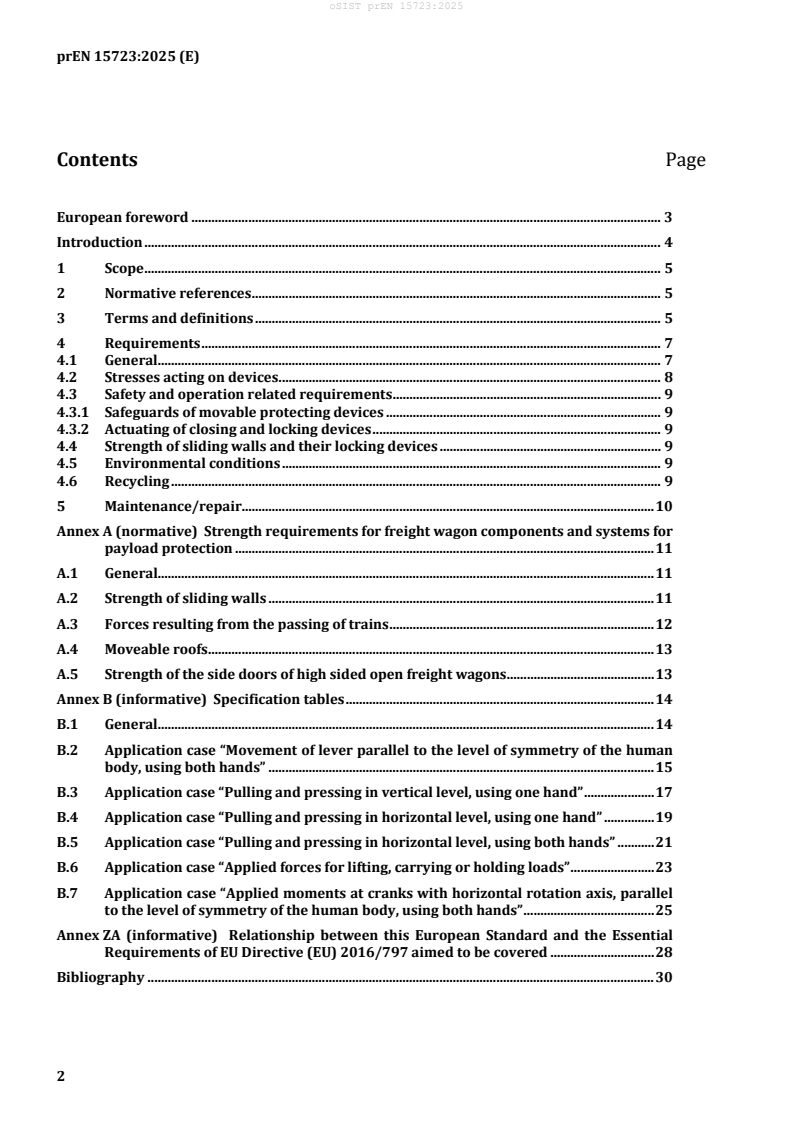
Contents Page
European foreword . 3
Introduction . 4
1 Scope . 5
2 Normative references . 5
3 Terms and definitions . 5
4 Requirements . 7
4.1 General. 7
4.2 Stresses acting on devices . 8
4.3 Safety and operation related requirements . 9
4.3.1 Safeguards of movable protecting devices . 9
4.3.2 Actuating of closing and locking devices . 9
4.4 Strength of sliding walls and their locking devices . 9
4.5 Environmental conditions . 9
4.6 Recycling . 9
5 Maintenance/repair . 10
Annex A (normative) Strength requirements for freight wagon components and systems for
payload protection . 11
A.1 General. 11
A.2 Strength of sliding walls . 11
A.3 Forces resulting from the passing of trains . 12
A.4 Moveable roofs . 13
A.5 Strength of the side doors of high sided open freight wagons . 13
Annex B (informative) Specification tables . 14
B.1 General. 14
B.2 Application case “Movement of lever parallel to the level of symmetry of the human
body, using both hands” . 15
B.3 Application case “Pulling and pressing in vertical level, using one hand” . 17
B.4 Application case “Pulling and pressing in horizontal level, using one hand” . 19
B.5 Application case “Pulling and pressing in horizontal level, using both hands” . 21
B.6 Application case “Applied forces for lifting, carrying or holding loads” . 23
B.7 Application case “Applied moments at cranks with horizontal rotation axis, parallel
to the level of symmetry of the human body, using both hands” . 25
Annex ZA (informative) Relationship between this European Standard and the Essential
Requirements of EU Directive (EU) 2016/797 aimed to be covered . 28
Bibliography . 30
European foreword
This document (prEN 15723:2025) has been prepared by Technical Committee CEN/TC 256 “Railway
applications”, the secretariat of which is held by DIN.
This document is currently submitted to the CEN Enquiry.
This document will supersede EN 15723:2010.
— simplification of title;
— clarification of Scope;
— normative references updated;
— wording adopted to EN 17343:2023;
— whole document restructured (based on sources of applicable loads instead of type of device);
— Annex ZA updated.
This document has been prepared under a standardization request addressed to CEN by the European
Commission. The Standing Committee of the EFTA States subsequently approves these requests for its
Member States.
For the relationship with EU Legislation, see informative Annex ZA, which is an integral part of this
document.
Introduction
To achieve an undisturbed, reliable and safe operation of heavy rail freight wagons it is essential to
specify common requirements for closing and locking devices for payload protecting devices of
interoperable freight wagons with respect to e.g. structural requirements, operating characteristics, way
of operation, maintenance as well as their handling.
1 Scope
This document specifies the requirements for closing and locking devices of heavy rail freight wagons
including durability, their status indication, maintenance and recycling.
Annex A specifies pass-fail criteria for the dimensioning tests.
This document is not applicable to closing and locking devices which are used to ensure a pressure
difference or to retain liquids/liquid payloads.
This document is not applicable to heavy rail freight wagons which are emptied by pressure, nor is it
applicable to lose tarpaulins.
2 Normative references
The following documents are referred to in the text in such a way that some or all of their content
constitutes requirements of this document. For dated references, only the edition cited applies. For
undated references, the latest edition of the referenced document (including any amendments) applies.
EN 12663-2:2010+A1:2023, Railway applications - Structural requirements of railway vehicle bodies - Part
2: Freight wagons
EN 50125-1:2014, Railway applications - Environmental conditions for equipment - Part 1: Rolling stock
and on-board equipment
EN 15877-1:2024, Railway applications - Markings of railway vehicles - Part 1: Freight wagons
EN 17343:2023, Railway applications - General terms and definitions
EN ISO 13854:2019, Safety of machinery - Minimum gaps to avoid crushing of parts of the human body (ISO
13854:2017)
3 Terms and definitions
For the purposes of this document, the terms and definitions given in EN 17343:2023 and the following
apply.
ISO and IEC maintain terminology databases for use in standardization at the following addresses:
— ISO Online browsing platform: available at https://www.iso.org/obp/
— IEC Electropedia: available at https://www.electropedia.org/
3.1
aerodynamic force
force affecting the rail vehicle and component assemblies by an air stream
3.2
movable protecting device
device to protect payload against environmental influences and exterior forces
Note 1 to entry: Loose tarpaulins are not considered as a movable protecting device.
EXAMPLES Sliding walls, flaps, rigid sliding hoods and covers, hinged doors, bottom doors.
3.3
closing and locking device
device for fixing a movable protecting device in a defined position
3.4
types of devices for closing and locking
3.4.1
door for discharge
unloading door of gravity discharge freight wagons and their closing and locking devices
Note 1 to entry: The door should be able to be secured against un-planned opening (category 2).
3.4.2
sliding wall
movable side wall with an opening length of ~50 % loading length of covered freight wagons for
particular freight and their closing and locking devices
3.4.3
side door
hinged door at the side of covered freight wagons for particular freight or cars or for high-sided open
freight wagons for scrap or bulk transport and their closing and locking devices
3.4.4
curtain side
movable curtain (instead of side walls) of covered freight wagons for particular freight and their closing
and locking devices
3.4.5
tarpaulin cover
movable tarpaulin roof with an opening length of ~2/3 loading length of flat freight wagons with end
walls for weather sensitive bulky goods or tarpaulin sliding cover of high-sided open freight wagons for
weather sensitive payload and their closing and locking devices
3.5
operating element
element which is operated during loading/unloading
EXAMPLES Removable stanchions, hand wheels, sliding walls, levers or movable tie-downs.
3.6
percentile
statement on how many participants of the test group (in percent) are able to summon up the applied
force or applied moment
Note 1 to entry: The applied forces or moments stated in the standards always refer to certain percentiles of the
test group.
Note 2 to entry: Typical values of percentiles are 1, 5, 15, 50 or 95. Here the difference between 100 and the
percentile value describes the percentage of the test group, which is able to summon up more than the respective
applied force or moment. When stating the 85th percentile this means for instance that 85 % of the test persons are
able to carry out the described activity – and 15 % will be able to carry out more than the described activity. When
stating the 15th percentile this means for instance that 15 % of the test persons are not able to carry out the
described activity – and 85 % will be able to carry out the described activity.
3.7
types of load
classification in two types of loads which are considered for the design of closing and locking devices
Note 1 to entry: These loads are either internal forces from the load itself or external forces during travelling.
Note 2 to entry: Examples for when these loads are considered for different door types are shown in Table 1.
3.8
automatic safety device
automatic device that prevents danger from wrong operation to and by the user
3.9
safeguard device
device that safely locks the movable items in their defined (open, close intermediate) position preventing
unintentional movements
4 Requirements
4.1 General
Doors and hatches of freight wagons shall be designed to be closed and locked.
This remains valid while the freight wagons are in a moving train (unless this is part of the procedure for
discharging the payload).
Suitable and clear instructions for use shall be applied near each locking device and shall be visible by the
operator.
The freight wagon shall bear inscriptions in one or more languages or pictograms showing the relevant
information for safe operation.
Wagons fitted with special equipment (automatic discharging, opening roof, etc.) shall have instructions
concerning operation of this equipment and the safety precautions to be taken, placed in a prominent
position in several languages. If this is not possible these instructions shall be accompanied by
appropriate pictograms.
Specifications regarding such pictograms and information shall be in accordance with EN 15877-1:2024.
Table 1 — Types of load
c
Type of device Examples of freight
Load types
wagon types
Category 1 Category 2
No forces from
Planned/accepted payload, dynamic
b
forces by payload forces from exterior
forces only
Doors for discharge Tanoos, Fal ., HAA,
X X
a
HHA CDA
Sliding walls X X Hbi ., VGA
Tarpaulin covers — X Shimms Rils
Sliding covers/side
X X S …, L …
doors
Curtain sides — X —
Side doors/end doors X X Ea …
Hoppers with opening Tamns
— X
roof
a
HAA, HHA, CDA, VGA are abbreviations used in the UK.
b
This includes forces during loading/unloading (e.g. by gravity loading and unloading).
c
Definition of types of devices, see Clause 3.
For all types of covered freight wagons with sliding side doors, they shall be equipped with suitably
dimensioned devices to prevent any unintended disengagement. The devices shall limit the vertical play
and shall take effect in any operating condition.
4.2 Stresses acting on devices
The closing and locking devices, when closed and locked, shall withstand a force from the inside of the
wagon outwards, representing the forces produced by the payload as well as by additional loads during
operation.
No permanent deformation or loss of functionality shall occur, either on the closing device itself
(discharge door, sliding wall and framework) or on the locking, sliding or guiding components as a result
of these loads except where other pass-fail-criteria are defined.
The load cases shall be in accordance with Annex A.
Stresses acting on devices are:
— stresses which are caused by the payload under normal, regular conditions, by static pressure (bulk)
of the payload and shift of the payload when the payload has been displaced in a foreseeable manner
(see Table 1, Category 1);
— loads which can affect freight wagons during operation. This can be caused during the shunting
process or while the train is moving as well as by pressure differences resulting from aerodynamic
forces during operation (particularly during passing of two trains or at the entrance of tunnels).
NOTE Information for possible additional aerodynamic loads in tunnels is given in EN 14067-3 and
EN 14067-5.
4.3 Safety and operation related requirements
4.3.1 Safeguards of movable protecting devices
Movable items (i.e. doors, sliding walls, sliding roofs, flaps, hoods) shall be provided with automatic safety
devices to avoid any wrong movement in the course of opening and closing operations.
Movable items, (i.e. doors, walls, roofs) shall be designed to be secured against unintentional movement
when placed in their defined position (open, close intermediate) by safeguard devices which shall work
automatically.
The final positions are to be fitted with fixed stops.
Movable items shall be secured positively in their final closing position against unintentional opening by
forces from inside the loading space or exterior forces.
Locking devices shall be used whose status (open/closed) is recognizable. Locking devices shall indicate
their status in a way that can be checked from outside of the freight wagon.
The locking devices shall be designed to be secured against unintentional opening during running.
4.3.2 Actuating of closing and locking devices
The forces, which are needed to actuate the closing and locking devices, shall be of a magnitude that can
be applied by an operator without additional tools. Exceptions are allowable when additional tools are
specifically made available or when motor driven systems are used.
The manual forces, which are needed to actuate the closing and locking devices, shall be of a magnitude
that can be applied by an operator without additional tools. Exceptions are allowable when additional
tools are specifically made available or when motor driven systems are used.
The requirements of EN ISO 13854:2019 shall apply.
Guidance concerning the determination of the maximum permissible manual forces is given in Annex B.
For this, locking devices shall be used which indicate their status (open/closed) and they shall be visible
by an operator outside the train.
4.4 Strength of sliding walls and their locking devices
The sliding walls and their locking devices, when closed and locked, shall resist the load cases in
accordance with Annex A.
4.5 Environmental conditions
The closing and locking devices shall fulfil as a minimum the environmental conditions applicable to the
complete freight wagon in accordance with EN 50125-1:2014.
4.6 Recycling
The closing and locking devices shall be designed to maximize the use of recyclable materials.
5 Maintenance/repair
Wear, failures and other damage may influence the operational safety of freight wagons. Depending on
the wear behaviour, the utilization parameters and the current condition of the railway vehicles, a
maintenance system shall be set up to ensure that the safe functional performance is always achieved.
This shall be included in the rail vehicle maintenance documentation.
The closing and locking systems shall be inspected at defined maintenance periods and remedial action
taken if signs of damage or malfunction are found.
Areas subject to wear shall be accessible for inspection and repair.
Documentation shall be provided on the areas to be inspected and the intervals of inspection.
Maintenance procedures and inspection requirements shall be specified in the maintenance file of the
wagon.
Annex A
(normative)
Strength requirements for freight wagon components and systems for
payload protection
A.1 General
Annex A provides the requirements for the design of freight wagon components and systems for payload
protection against environmental influences and exterior forces. The requirements shall be adopted only
where they are appropriate to the intended application.
The closing, rolling, guiding and locking devices shall withstand the forces transferred to them during the
tests, detailed below.
At the centre of the door a force of 8 kN applies over a 1 m × 1 m area. At each attachment point a force
of 5 kN applies over 300 mm × 1 300 mm area.
No permanent visible deformation or deterioration of the elements for closing, rolling, securing, guiding
and locking shall result from the application of these test loads.
A.2 Strength of sliding walls
a) Sliding walls which are less than 2,5 m long shall meet the same load cases as sliding doors.
b) Sliding walls from 2,5 m to 5 m long shall have a 20 kN load applied at mid-wall over a 1 m × 1 m
area.
Figure A
...