

EN 4689:2021
(Main)Aerospace series - Paints and varnishes - Two-components room temperature curing polyurethane finish - High flexibility and chemical agent resistance for military application
- Abstract
This document specifies the requirements for a two-components flexible polyurethane topcoat to be applied over EN 4687 and/or EN 4688 primers mainly for exterior aerospace applications.
The primer and the finish tested to this document will be from the same manufacturer applied in accordance with (i.a.w.) their instructions/Table 1.
- Status
- Published
- Publication Date
- 12-Jan-2021
- Withdrawal Date
- 30-Jul-2021
- Technical Committee
- ASD-STAN - Aerospace
- Drafting Committee
- ASD-STAN/D 4/S 6 - Surface treatments for Metallic
- Current Stage
- 6060 - Definitive text made available (DAV) - Publishing
- Start Date
- 13-Jan-2021
- Completion Date
- 13-Jan-2021



Overview
EN 4689:2021 is a CEN aerospace standard that defines requirements for a two-components room-temperature curing polyurethane topcoat intended primarily for exterior aerospace applications with high flexibility and chemical agent resistance for military use. The finish is formulated to be applied over EN 4687 and/or EN 4688 primers; the primer and topcoat used for testing must be from the same manufacturer and applied per their instructions. EN 4689:2021 supersedes EN 4689:2012 and is part of the aerospace paints and varnishes series.
Key topics and requirements
- Product scope: Two-component, cold-curing polyurethane topcoat (hydroxyl-functional polyester or acrylic base; polyisocyanate curing agent).
- Application: Applied over EN 4687 (chromate-free primer) and/or EN 4688 (chromated corrosion resistant primer) for exterior military aerospace surfaces.
- Performance focus: High flexibility, resistance to chemical agents, suitability for exterior exposure and military environments.
- Classification by VOC/solvent content:
- Type I - Standard solvent content (≤ 680 g/l)
- Type II - Low volatile organic content (≤ 420 g/l)
- Type III - Waterborne (≤ 250 g/l)
- Testing and qualification:
- Qualification tests and batch release follow EN 3840 requirements.
- Minimum of three batches required for product qualification.
- Batch release testing includes specified delivery-condition checks (non-volatiles, VOC, density, flash point, flow time, sedimentation, isocyanate value, IR spectroscopy, fineness of grind).
- Environmental and durability tests reference broader EN/ISO methods (humidity, salt spray, chemical resistance, gloss, adhesion, drying).
- Surface pretreatment: Aluminium substrate preparation per EN 3837 (pickling, chromic anodizing, chromate conversion, TSA anodizing).
- Application/drying conditions: Manufacturer’s instructions apply; typical conditioning before testing is (23 ± 2) °C and (50 ± 5) % RH. Primer drying period noted as 4–6 hours before finish application.
Applications and users
Who uses EN 4689:2021:
- Aircraft OEMs and component manufacturers specifying military-grade topcoats
- MRO (maintenance, repair and overhaul) organizations handling exterior military aircraft refinishing
- Coating manufacturers seeking qualification and batch-release protocols for aerospace polyurethane finishes
- Test laboratories performing qualification, batch release and acceptance testing
- Procurement/specification engineers and defense contractors requiring chemical agent–resistant, flexible topcoats
Keywords: EN 4689:2021, two-components polyurethane finish, aerospace paints, military topcoat, high flexibility, chemical resistance, EN 4687, EN 4688, batch release testing, qualification tests.
Related standards (select)
- EN 4687 - Chromate-free two-components primer (military)
- EN 4688 - Corrosion resistant chromated epoxy primer (military)
- EN 3840 - Paints and varnishes - Technical specification / quality assurance
- EN 3837 - Surface preparation of aluminium test pieces
- Relevant EN ISO test methods (e.g., ISO 2812, ISO 9227, ISO 2409) for durability and test procedures
Relations
- Effective Date
- 28-Jun-2017
- Effective Date
- 28-Jan-2026
- Effective Date
- 28-Jan-2026
- Refers
EN ISO/CIE 11664-2:2022 - Colorimetry - Part 2: CIE standard illuminants (ISO/CIE 11664-2:2022) - Effective Date
- 28-Jan-2026
- Refers
EN ISO 9117-6:2012 - Paints and varnishes - Drying tests - Part 6: Print-free test (ISO 9117-6:2012) - Effective Date
- 28-Jan-2026
- Effective Date
- 28-Jan-2026
- Effective Date
- 28-Jan-2026
- Refers
EN 2334:1997 - Aerospace series - Chromic-sulphuric acid pickle of aluminium and aluminium alloys - Effective Date
- 28-Jan-2026
- Refers
EN ISO 9227:2022 - Corrosion tests in artificial atmospheres - Salt spray tests (ISO 9227:2022) - Effective Date
- 28-Jan-2026
- Effective Date
- 28-Jan-2026
- Effective Date
- 28-Jan-2026
- Effective Date
- 28-Jan-2026
- Effective Date
- 28-Jan-2026
- Effective Date
- 28-Jan-2026
- Refers
EN 3847:2019 - Aerospace series - Paints and varnishes - Determination of sedimentation rating - Effective Date
- 28-Jan-2026
Get Certified
Connect with accredited certification bodies for this standard

BUREAU VERITAS Certification Germany
Bureau Veritas certification in Germany.

Element Materials Technology
Materials testing and product certification.

AQMS Ltd.
AQMS provides ISO certification to SMEs across the UK.
Sponsored listings
Frequently Asked Questions
EN 4689:2021 is a standard published by the European Committee for Standardization (CEN). Its full title is "Aerospace series - Paints and varnishes - Two-components room temperature curing polyurethane finish - High flexibility and chemical agent resistance for military application". This standard covers: This document specifies the requirements for a two-components flexible polyurethane topcoat to be applied over EN 4687 and/or EN 4688 primers mainly for exterior aerospace applications. The primer and the finish tested to this document will be from the same manufacturer applied in accordance with (i.a.w.) their instructions/Table 1.
This document specifies the requirements for a two-components flexible polyurethane topcoat to be applied over EN 4687 and/or EN 4688 primers mainly for exterior aerospace applications. The primer and the finish tested to this document will be from the same manufacturer applied in accordance with (i.a.w.) their instructions/Table 1.
EN 4689:2021 is classified under the following ICS (International Classification for Standards) categories: 49.040 - Coatings and related processes used in aerospace industry. The ICS classification helps identify the subject area and facilitates finding related standards.
EN 4689:2021 has the following relationships with other standards: It is inter standard links to EN 4689:2012, EN ISO 2409:2020, EN ISO/CIE 11664-1:2019, EN ISO/CIE 11664-2:2022, EN ISO 9117-6:2012, EN 4160:2011, EN ISO 3251:2019, EN 2334:1997, EN ISO 9227:2022, EN ISO 1519:2011, EN ISO 4628-2:2016, EN ISO 1518-1:2023, EN ISO 9514:2019, EN ISO 4628-8:2012, EN 3847:2019. Understanding these relationships helps ensure you are using the most current and applicable version of the standard.
EN 4689:2021 is available in PDF format for immediate download after purchase. The document can be added to your cart and obtained through the secure checkout process. Digital delivery ensures instant access to the complete standard document.
Standards Content (Sample)
SLOVENSKI STANDARD
01-marec-2021
Nadomešča:
SIST EN 4689:2012
Aeronavtika - Barve in laki - Dvokomponentni poliuretanski lak, ki se strdi pri
temperaturi okolja - Zelo elastičen in odporen proti kemikalijam, za vojaško
uporabo
Aerospace series - Paints and varnishes - Two-components room temperature curing
polyurethane finish - High flexibility and chemical agent resistance for military application
Luft- und Raumfahrt - Beschichtungsstoffe - Zweikomponenten-Polyurethan-
Deckbeschichtung, raumtemperaturhärtend - Hohe Verformbarkeit und Beständigkeit
gegen Chemikalien für militärische Anwendung
Série aérospatiale - Peintures et vernis - Peinture de finition polyuréthane à deux
composants polymérisant à température ambiante - Haute flexibilité et résistance aux
substances chimiques pour applications militaires
Ta slovenski standard je istoveten z: EN 4689:2021
ICS:
49.040 Prevleke in z njimi povezani Coatings and related
postopki, ki se uporabljajo v processes used in aerospace
letalski in vesoljski industriji industry
87.040 Barve in laki Paints and varnishes
95.020 Vojaštvo na splošno Military in general
2003-01.Slovenski inštitut za standardizacijo. Razmnoževanje celote ali delov tega standarda ni dovoljeno.
EN 4689
EUROPEAN STANDARD
NORME EUROPÉENNE
January 2021
EUROPÄISCHE NORM
ICS 49.040 Supersedes EN 4689:2012
English Version
Aerospace series - Paints and varnishes - Two-components
room temperature curing polyurethane finish - High
flexibility and chemical agent resistance for military
application
Série aérospatiale - Peintures et vernis - Peinture de Luft- und Raumfahrt - Beschichtungsstoffe -
finition polyuréthane à deux composants polymérisant Zweikomponenten Polyurethan- Decklack,
à température ambiante - Haute flexibilité et résistance raumtemperaturhärtend - Hohe Elastizität und
aux substances chimiques pour applications militaires Beständigkeit gegen Chemikalien für militärische
Anwendun
This European Standard was approved by CEN on 2 November 2020.
CEN members are bound to comply with the CEN/CENELEC Internal Regulations which stipulate the conditions for giving this
European Standard the status of a national standard without any alteration. Up-to-date lists and bibliographical references
concerning such national standards may be obtained on application to the CEN-CENELEC Management Centre or to any CEN
member.
This European Standard exists in three official versions (English, French, German). A version in any other language made by
translation under the responsibility of a CEN member into its own language and notified to the CEN-CENELEC Management
Centre has the same status as the official versions.
CEN members are the national standards bodies of Austria, Belgium, Bulgaria, Croatia, Cyprus, Czech Republic, Denmark, Estonia,
Finland, France, Germany, Greece, Hungary, Iceland, Ireland, Italy, Latvia, Lithuania, Luxembourg, Malta, Netherlands, Norway,
Poland, Portugal, Republic of North Macedonia, Romania, Serbia, Slovakia, Slovenia, Spain, Sweden, Switzerland, Turkey and
United Kingdom.
EUROPEAN COMMITTEE FOR STANDARDIZATION
COMITÉ EUROPÉEN DE NORMALISATION
EUROPÄISCHES KOMITEE FÜR NORMUNG
CEN-CENELEC Management Centre: Rue de la Science 23, B-1040 Brussels
© 2021 CEN All rights of exploitation in any form and by any means reserved Ref. No. EN 4689:2021 E
worldwide for CEN national Members.
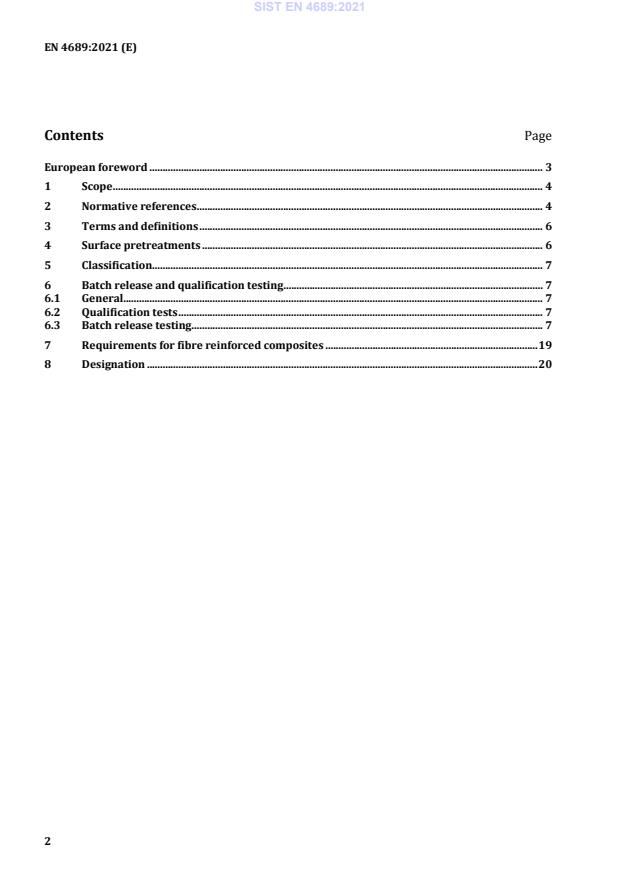
Contents Page
European foreword . 3
1 Scope . 4
2 Normative references . 4
3 Terms and definitions . 6
4 Surface pretreatments . 6
5 Classification. 7
6 Batch release and qualification testing . 7
6.1 General. 7
6.2 Qualification tests . 7
6.3 Batch release testing . 7
7 Requirements for fibre reinforced composites . 19
8 Designation . 20
European foreword
This document (EN 4689:2021) has been prepared by the Aerospace and Defence Industries
Association of Europe — Standardization (ASD-STAN).
After enquiries and votes carried out in accordance with the rules of this Association, this
document has received the approval of the National Associations and the Official Services of the
member countries of ASD, prior to its presentation to CEN.
This document shall be given the status of a national standard, either by publication of an identical
text or by endorsement, at the latest by July 2021, and conflicting national standards shall be
withdrawn at the latest by July 2021.
Attention is drawn to the possibility that some of the elements of this document may be the subject
of patent rights. CEN shall not be held responsible for identifying any or all such patent rights.
This document supersedes EN 4689:2012.
According to the CEN-CENELEC Internal Regulations, the national standards organizations of the
following countries are bound to implement this document: Austria, Belgium, Bulgaria, Croatia,
Cyprus, Czech Republic, Denmark, Estonia, Finland, France, Germany, Greece, Hungary, Iceland,
Ireland, Italy, Latvia, Lithuania, Luxembourg, Malta, Netherlands, Norway, Poland, Portugal,
Republic of North Macedonia, Romania, Serbia, Slovakia, Slovenia, Spain, Sweden, Switzerland,
Turkey and the United Kingdom.
1 Scope
This document specifies the requirements for a two-components flexible polyurethane topcoat to be
applied over EN 4687 and/or EN 4688 primers mainly for exterior aerospace applications.
The primer and the finish tested to this document will be from the same manufacturer applied in
accordance with (i.a.w.) their instructions/Table 1.
2 Normative references
The following documents are referred to in the text in such a way that some or all of their content
constitutes requirements of this document. For dated references, only the edition cited applies. For
undated references, the latest edition of the referenced document (including any amendments) applies.
EN 2101, Aerospace series — Chromic acid anodizing of aluminium and wrought aluminium alloys
EN 2334, Aerospace series — Chromic-sulphuric acid pickle of aluminium and aluminium alloys
EN 2437, Aerospace series — Chromate conversion coatings (yellow) for aluminium and aluminium alloys
EN 3837, Aerospace series — Paints and varnishes — Nature and method for surface preparation of test
pieces in aluminium alloys
EN 3840, Aerospace series — Paints and varnishes — Technical specification
EN 3847, Aerospace series — Paints and varnishes — Determination of sedimentation rating
EN 4160, Aerospace series — Paints and varnishes — Determination of the effect of thermal exposure
EN 4687, Aerospace series — Paints and varnishes — Chromate free (non corrosion inhibiting)
two-components room temperature curing primer — Chromate free primer for military application
EN 4688, Aerospace series — Paints and varnishes — Corrosion resistant chromated two-components
room temperature curing epoxy primer — High corrosion resistance for military application
EN 4704, Aerospace series — Tartaric-Sulphuric-Acid anodizing of aluminium and aluminium wrought
alloys for corrosion protection and paint pre-treatment (TSA)
1)
EN 6042, Aerospace series — Organic compounds — Test method — Analysis by infrared spectroscopy
EN ISO 1513, Paints and varnishes — Examination and preparation of test samples
EN ISO 1518-1, Paints and varnishes — Determination of scratch resistance — Part 1: Constant-loading
method
EN ISO 1519, Paints and varnishes — Bend test (cylindrical mandrel)
EN ISO 1520, Paints and varnishes — Cupping test
EN ISO 1524, Paints, varnishes and printing inks — Determination of fineness of grind
EN ISO 2409, Paints and varnishes — Cross-cut test
EN ISO 2431, Paints and varnishes — Determination of flow time by use of flow cups
EN ISO 2811-1, Paints and varnishes — Determination of density — Part 1: Pycnometer method
1)
Published as ASD-STAN Standard at the date of publication of this document by AeroSpace and Defence industries
Association of Europe — Standardization (ASD-STAN), http://www.asd-stan.org/
EN ISO 2811-2, Paints and varnishes — Determination of density — Part 2: Immersed body (plummet) method
EN ISO 2811-3, Paints and varnishes — Determination of density — Part 3: Oscillation method
EN ISO 2811-4, Paints and varnishes — Determination of density — Part 4: Pressure cup method
EN ISO 2812-1, Paints and varnishes — Determination of resistance to liquids — Part 1: Immersion in
liquids other than water
EN ISO 2812-2, Paints and varnishes — Determination of resistance to liquids — Part 2: Water immersion
method
EN ISO 2813, Paints and varnishes — Determination of gloss value at 20°, 60° and 85°
EN ISO 3251, Paints, varnishes and plastics — Determination of non-volatile-matter content
EN ISO 3675, Crude petroleum and liquid petroleum products — Laboratory determination of density —
Hydrometer method
EN ISO 3679, Determination of flash no-flash and flash point — Rapid equilibrium closed cup method
EN ISO 4628-2, Paints and varnishes — Evaluation of degradation of coatings — Designation of quantity
and size of defects, and of intensity of uniform changes in appearance — Part 2: Assessment of degree of
blistering
EN ISO 4628-8, Paints and varnishes — Evaluation of degradation of coatings — Designation of quantity
and size of defects, and of intensity of uniform changes in appearance — Part 8: Assessment of degree of
delamination and corrosion around a scribe or other artificial defect
EN ISO 6270-1, Paints and varnishes — Determination of resistance to humidity — Part 1: Condensation
(single-sided exposure)
EN ISO 9117-1, Paints and varnishes — Drying tests — Part 1: Determination of through-dry state and
through-dry time
EN ISO 9117-3, Paints and varnishes — Drying tests — Part 3: Surface-drying test using ballotini
EN ISO 9117-6, Paints and varnishes — Drying tests — Part 6: Print-free test
EN ISO 9227, Corrosion tests in artificial atmospheres — Salt spray tests
EN ISO 9514, Paints and varnishes — Determination of the pot life of multicomponent coating systems —
Preparation and conditioning of samples and guidelines for testing
*
EN ISO 11664- , Colorimetry
EN ISO 11890-1, Paints and varnishes — Determination of volatile organic compound (VOC) content —
Part 1: Difference method
EN ISO 11909, Binders for paints and varnishes — Polyisocyanate resins — General methods of test
EN ISO 16474-1, Paints and varnishes — Methods of exposure to laboratory light sources — Part 1:
General guidance
EN ISO 16474-3, Paints and varnishes — Methods of exposure to laboratory light sources — Part 3:
Fluorescent UV lamps
*
And all its parts quoted in this document.
MIL-PRF-5606H, Performance specification: Hydraulic fluid, petroleum base; aircraft, missile, and
2)
ordnance. (NATO H-515)
2)
MIL-PRF-6081D, Performance specification: Lubricating oil, jet engine. (NATO O-133)
MIL-PRF-23699F, Performance specification: Lubricating oil, aircraft turbine engine, synthetic base,
2)
NATO code number O-156
MIL-DTL-83133G, Detail specification: Turbine fuel, aviation, kerosene type, JP-8 (NATO F-34), NATO F-35,
2)
and JP-8+100 (NATO F-37)
3)
AMS 1526B, Cleaner for aircraft exterior surfaces water-miscible, pressure- spraying type
3)
AMS 1527B, Cleaner for aircraft exterior surfaces water-miscible, foam-on, pressure-spraying
3)
AMS 1533A, Cleaner for exterior aircraft surfaces gel-type, solvent-base
DEF STAN 68-10 Issue 5, Corrosion Preventive, Water Displacing NATO Code: C-634 Joint Service
Designation: PX-24
BS 1595-1:1986, Propan-2-ol (isopropyl alcohol) for industrial use — Part 1: Specification for propan-2-ol
(isopropyl alcohol)
3 Terms and definitions
For the purposes of this document, the terms and definitions given in EN 3840 apply.
ISO and IEC maintain terminological databases for use in standardization at the following addresses:
• ISO Online browsing platform: available at http://www.iso.org/obp
• IEC Electropedia: available at http://www.electropedia.org/
4 Surface pretreatments
In accordance with EN 3837, the surface pretreatments applicable to aluminium alloy test panels are
the following:
EN 3837 — Procedure A: Sulfochromic pickling in accordance with EN 2334
EN 3837 — Procedure B: Chromate acid anodizing in accordance with EN 2101
EN 3837 — Procedure C: Chromate conversion coating in accordance with EN 2437
EN 3837 — Procedure D: Tartaric-Sulphuric-Acid anodizing in accordance with EN 4704
2)
Published by: DoD National (US) MIL. Department of Defense http://www.defenselink.mil/.
3)
Published by: SAE International (US) Society of Automotive Engineers http://www.sae.org/.
5 Classification
The topcoat is classified according to the following types:
TYPE I: Standard solvent content (≤ 680 g/l);
TYPE II: Low volatile organic content (≤ 420 g/l);
TYPE III: Waterborne (≤ 250 g/l).
6 Batch release and qualification testing
6.1 General
The general requirements for qualification and batch release testing shall be in accordance with
EN 3840. A minimum of 3 (three) batches shall be tested for qualification purposes.
6.2 Qualification tests
For product qualification, all tests defined in this document, in Table 2 to Table 8, shall be performed.
The test work to be undertaken for product qualification shall be in accordance with this document.
In addition, the requirements for qualification of coatings in specific colours/gloss levels, shall be as
defined in EN 3840.
6.3 Batch release testing
The Manufacturer shall give evidence on the Test Report or the Certificate of Conformance that all the
tests marked with the symbol * in this document shall be performed for batch acceptance tests.
Table 1 — General requirements
Material description Two components cold curing polyurethane topcoat
Base: hydroxyl functional polyester or acrylic resins
Formulation Curing agent: a polyisocyanate activator solution
Thinner: if required
These components shall be mixed in simple proportions, by volume or weight,
Preparation
in accordance with the manufacturers' instructions.
Technical specification EN 3840
Marking EN 3840
Storage stability EN 3840
Application and use In accordance with manufacturers' instructions.
(23 ± 2) °C/(50 ± 5) % RH for 7 (seven) days before testing.
Drying conditions
Finish is applied to the primer (EN 4687 or EN 4688) following drying of the
primer for 4 (four) hours to 6 (six) hours as specified.
Quality assurance EN 3840
Designation Flexible polyurethane topcoat
Packaging EN 3840
Health and safety EN 3840
Table 2 — Physical and chemical characteristics — Delivery conditions (1 of 3)
Tests
according Test Test criteria Test requirements
to EN 3840
Test method EN ISO 1513 (As received in original container)
Shall be free from extraneous matter and show no skinning,
gelling, hard settlement or other defect which will prevent
* satisfactory application to produce a defect free film. The
— Condition
Requirements
base material and curing agent shall each be in a condition
such that stirring easily produces a smooth, uniform
material which, after mixing in the proportion specified by
the manufacturer, shall be suitable for spray application.
Test method EN ISO 3251
Non-volatile Base Curing agent Thinner
*
%
matter
Requirements
± 2 % ref. ± 2 % ref.
m/m
—
a,b a,b
value value
Test method EN ISO 11890-1
Volatile organic
49 Test condition Base + Curing agent + Thinner
content (VOC)
b
Requirements g/l < values stated in Clause 5
Test method EN ISO 3679
Base Curing agent Thinner
7 Flash point
Requirements °C
≥ Reference ≥ Reference ≥ Reference
a a a
value value value
Test method EN ISO 2431 (cup 3 or cup 4)
*
8 Flow time Test condition Base + Curing agent + Thinner
a,b
Requirements s ± 10 % Reference value
Test method EN 3847
Sedimentation
5 Test condition Base + Curing agent + Thinner
rating
Requirements ml/4 h ≤ 30
Test method EN ISO 2811-1 to EN ISO 2811-4 or ISO 3675
Test condition (23 ± 2) °C/(50 ± 5) % RH
*
3 Density 3
g/cm Base Curing agent Thinner
Requirements 3 3 3 3
± 0,03 g/cm ± 0,03 g/cm ± 0,03 g/cm ± 0,03 g/cm
ref value ref value ref value ref value
Test method EN ISO 11909
Test condition —
16 Isocyanate value
Base Curing agent Thinner
Requirements —
Reference
— —
b
value
*
See Subclause 6.3.
a b
The deviation is that compared to the reference value (see ).
b
The reference value is that established during qualification.
...