

EN 1775:2007
(Main)Gas supply - Gas pipework for buildings - Maximum operating pressure less than or equal to 5 bar - Functional recommendations
- Abstract
1.1 This standard specifies general recommendations for the design, construction, testing, commissioning, operation and maintenance of installation pipework; pipework between the delivery point of the gas and the inlet connection to the gas appliance.
This standard specifies common basic principles for gas installation pipework.
Users of this European standard need to be aware that more detailed national standards and/or codes of practice may exist in the CEN member countries.
This standard is intended to be applied in association with these national standards and/or codes of practice setting out the above mentioned basic principles.
In the event of conflicts in terms of more restrictive requirements in national legislation/regulation with the requirements of this standard, national legislation/regulation takes precedence as illustrated in CEN /TR 13737.
NOTE 1 CEN/TR 13737 contains:
- clarification of relevant legislation/regulations applicable in a country;
- if appropriate, more restrictive national requirements;
- national contact point for the latest information.
This standard applies to:
- gas installations in residential, commercial and public access building having a maximum operating pressure (MOP) less than or equal to 5 bar;
- industrial gas installations having a maximum operating pressure (MOP) less than or equal to 0,5 bar.
NOTE 2 For industrial gas installations having a MOP above 0,5 bar, or installations having a MOP above 5 bar, see prEN 15001-1.
This standard is applicable to new installation pipework as well as to replacements of, or extensions to, existing installation pipework.
This standard does not contain detailed recommendations relating to the laying of buried pipework.
NOTE 3 For more information on buried pipework, see EN 12007-1, EN 12007-2 and EN 12007-3.
NOTE 4 For more information on gas pressure regulating installations, see EN 12279.
NOTE 5 For more information on gas metering systems, see EN
- Status
- Published
- Publication Date
- 31-Jul-2007
- Withdrawal Date
- 28-Feb-2008
- Technical Committee
- CEN/TC 234 - Gas infrastructure
- Drafting Committee
- CEN/TC 234/WG 1 - Gas installations
- Current Stage
- 9060 - Closure of 2 Year Review Enquiry - Review Enquiry
- Start Date
- 02-Dec-2025
- Completion Date
- 02-Dec-2025

Overview
EN 1775:2007 - “Gas supply - Gas pipework for buildings - Maximum operating pressure less than or equal to 5 bar - Functional recommendations” is a CEN functional standard that provides general recommendations for the design, construction, testing, commissioning, operation and maintenance of gas installation pipework from the delivery point up to the appliance inlet. It applies to residential, commercial and public-access buildings with a maximum operating pressure (MOP) ≤ 5 bar and to industrial installations with MOP ≤ 0.5 bar. The standard is intended as a harmonized baseline; national codes and regulations may impose more restrictive requirements.
Key Topics and Requirements
- Scope and definitions: common terms for pressures, jointing methods, tests and commissioning to ensure consistent interpretation across projects.
- Design principles: component selection, pipe sizing, location of pipework, protection in case of fire, and specification of safety devices.
- Construction and jointing methods: threaded, welded, brazed and soldered, mechanical, pressed joints, and stainless steel corrugated tubing systems; guidance for entries through walls/floors and corrosion protection.
- Testing and commissioning: recommended test fluids, strength and tightness testing, safety measures during tests, admission of gas and commissioning procedures.
- Operation and maintenance: routine maintenance, handling abnormal situations, leak detection and purging procedures.
- Annex guidance: informative annexes give practical guidance on high-temperature resistance, welded/brazed/fusion joints, pressed fittings, and quality control/ documentation for joint construction.
Practical Applications and Users
EN 1775:2007 is practical for:
- Gas system designers and engineers specifying pipework for buildings and low-pressure industrial sites.
- Installers and contractors implementing safe jointing and commissioning practices (threaded, fusion, press fittings, corrugated tubing).
- Gas utilities and distribution companies setting functional requirements and inspection protocols.
- Building owners, facilities managers and safety inspectors establishing maintenance, leak detection and operation procedures.
- Training providers and manufacturers developing installation procedures and product instructions aligned with European best practice.
Using EN 1775:2007 helps ensure consistent, safe gas pipework design, compliant testing and clear handover practices that align with European functional recommendations.
Related Standards
- For buried pipework: EN 12007-1, EN 12007-2, EN 12007-3.
- For gas pressure regulation: EN 12279.
- For higher-pressure industrial systems: prEN 15001-1.
- Consult CEN/TR 13737 for national clarifications and any more restrictive national requirements or legal precedence.
EN 1775:2007 is a key reference for safe, compliant gas pipework in buildings and low-pressure industrial installations.
Relations
- Effective Date
- 22-Dec-2008
- Effective Date
- 22-Dec-2008
- Effective Date
- 22-Dec-2008
- Effective Date
- 28-Jan-2026
- Effective Date
- 28-Jan-2026
- Effective Date
- 28-Jan-2026
- Effective Date
- 28-Jan-2026
- Effective Date
- 28-Jan-2026
- Effective Date
- 28-Jan-2026
- Effective Date
- 28-Jan-2026
- Effective Date
- 28-Jan-2026
- Effective Date
- 28-Jan-2026
- Effective Date
- 28-Jan-2026
- Effective Date
- 28-Jan-2026
- Effective Date
- 28-Jan-2026
Get Certified
Connect with accredited certification bodies for this standard

DIBt (Deutsches Institut für Bautechnik)
German Institute for Building Technology.
DIN CERTCO
DIN Group product certification.

Aboma Certification B.V.
Specialized in construction, metal, and transport sectors.
Sponsored listings
Frequently Asked Questions
EN 1775:2007 is a standard published by the European Committee for Standardization (CEN). Its full title is "Gas supply - Gas pipework for buildings - Maximum operating pressure less than or equal to 5 bar - Functional recommendations". This standard covers: 1.1 This standard specifies general recommendations for the design, construction, testing, commissioning, operation and maintenance of installation pipework; pipework between the delivery point of the gas and the inlet connection to the gas appliance. This standard specifies common basic principles for gas installation pipework. Users of this European standard need to be aware that more detailed national standards and/or codes of practice may exist in the CEN member countries. This standard is intended to be applied in association with these national standards and/or codes of practice setting out the above mentioned basic principles. In the event of conflicts in terms of more restrictive requirements in national legislation/regulation with the requirements of this standard, national legislation/regulation takes precedence as illustrated in CEN /TR 13737. NOTE 1 CEN/TR 13737 contains: - clarification of relevant legislation/regulations applicable in a country; - if appropriate, more restrictive national requirements; - national contact point for the latest information. This standard applies to: - gas installations in residential, commercial and public access building having a maximum operating pressure (MOP) less than or equal to 5 bar; - industrial gas installations having a maximum operating pressure (MOP) less than or equal to 0,5 bar. NOTE 2 For industrial gas installations having a MOP above 0,5 bar, or installations having a MOP above 5 bar, see prEN 15001-1. This standard is applicable to new installation pipework as well as to replacements of, or extensions to, existing installation pipework. This standard does not contain detailed recommendations relating to the laying of buried pipework. NOTE 3 For more information on buried pipework, see EN 12007-1, EN 12007-2 and EN 12007-3. NOTE 4 For more information on gas pressure regulating installations, see EN 12279. NOTE 5 For more information on gas metering systems, see EN
1.1 This standard specifies general recommendations for the design, construction, testing, commissioning, operation and maintenance of installation pipework; pipework between the delivery point of the gas and the inlet connection to the gas appliance. This standard specifies common basic principles for gas installation pipework. Users of this European standard need to be aware that more detailed national standards and/or codes of practice may exist in the CEN member countries. This standard is intended to be applied in association with these national standards and/or codes of practice setting out the above mentioned basic principles. In the event of conflicts in terms of more restrictive requirements in national legislation/regulation with the requirements of this standard, national legislation/regulation takes precedence as illustrated in CEN /TR 13737. NOTE 1 CEN/TR 13737 contains: - clarification of relevant legislation/regulations applicable in a country; - if appropriate, more restrictive national requirements; - national contact point for the latest information. This standard applies to: - gas installations in residential, commercial and public access building having a maximum operating pressure (MOP) less than or equal to 5 bar; - industrial gas installations having a maximum operating pressure (MOP) less than or equal to 0,5 bar. NOTE 2 For industrial gas installations having a MOP above 0,5 bar, or installations having a MOP above 5 bar, see prEN 15001-1. This standard is applicable to new installation pipework as well as to replacements of, or extensions to, existing installation pipework. This standard does not contain detailed recommendations relating to the laying of buried pipework. NOTE 3 For more information on buried pipework, see EN 12007-1, EN 12007-2 and EN 12007-3. NOTE 4 For more information on gas pressure regulating installations, see EN 12279. NOTE 5 For more information on gas metering systems, see EN
EN 1775:2007 is classified under the following ICS (International Classification for Standards) categories: 91.140.40 - Gas supply systems. The ICS classification helps identify the subject area and facilitates finding related standards.
EN 1775:2007 has the following relationships with other standards: It is inter standard links to EN 1775:1998, EN 1775:1998/A2:2000, EN 1775:1998/A1:2000, EN 10242:2025, EN 14800:2007, EN 751-3:2022+A1:2023, EN 751-2:1996, EN 10226-1:2004, EN 1254-4:2021, EN 10226-2:2005, EN 1057:2006+A1:2010, EN 751-1:1996, EN 331:2015, EN 14291:2004, EN 1762:2018. Understanding these relationships helps ensure you are using the most current and applicable version of the standard.
EN 1775:2007 is associated with the following European legislation: EU Directives/Regulations: 93/38/EEC; Standardization Mandates: M/017. When a standard is cited in the Official Journal of the European Union, products manufactured in conformity with it benefit from a presumption of conformity with the essential requirements of the corresponding EU directive or regulation.
EN 1775:2007 is available in PDF format for immediate download after purchase. The document can be added to your cart and obtained through the secure checkout process. Digital delivery ensures instant access to the complete standard document.
Standards Content (Sample)
2003-01.Slovenski inštitut za standardizacijo. Razmnoževanje celote ali delov tega standarda ni dovoljeno.Gas supply - Gas pipework for buildings - Maximum operating pressure less than or equal to 5 bar - Functional recommendationsAlimentation en gaz - Tuyauteries de gaz pour les bâtiments - Pression maximale de service inférieure ou égale a 5 bar - Recommandations fonctionnellesGasversorgung - Gasleitungsanlagen für Gebäude - Maximal zulässiger Betriebsdruck kleiner oder gleich 5 bar - Funktionale EmpfehlungenTa slovenski standard je istoveten z:EN 1775:2007SIST EN 1775:2008en,de91.140.40Sistemi za oskrbo s plinomGas supply systemsICS:SIST EN 1775:1998/A2:2000SIST EN 1775:1998/A1:2003SIST EN 1775:19981DGRPHãþDSLOVENSKI
STANDARDSIST EN 1775:200801-januar-2008
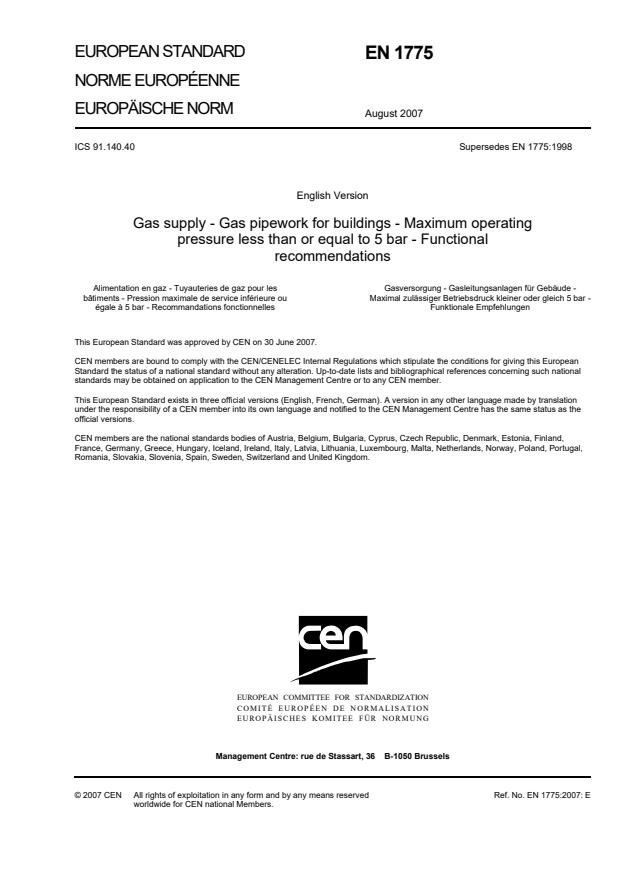
EUROPEAN STANDARDNORME EUROPÉENNEEUROPÄISCHE NORMEN 1775August 2007ICS 91.140.40Supersedes EN 1775:1998
English VersionGas supply - Gas pipework for buildings - Maximum operatingpressure less than or equal to 5 bar - FunctionalrecommendationsAlimentation en gaz - Tuyauteries de gaz pour lesbâtiments - Pression maximale de service inférieure ouégale à 5 bar - Recommandations fonctionnellesGasversorgung - Gasleitungsanlagen für Gebäude -Maximal zulässiger Betriebsdruck kleiner oder gleich 5 bar -Funktionale EmpfehlungenThis European Standard was approved by CEN on 30 June 2007.CEN members are bound to comply with the CEN/CENELEC Internal Regulations which stipulate the conditions for giving this EuropeanStandard the status of a national standard without any alteration. Up-to-date lists and bibliographical references concerning such nationalstandards may be obtained on application to the CEN Management Centre or to any CEN member.This European Standard exists in three official versions (English, French, German). A version in any other language made by translationunder the responsibility of a CEN member into its own language and notified to the CEN Management Centre has the same status as theofficial versions.CEN members are the national standards bodies of Austria, Belgium, Bulgaria, Cyprus, Czech Republic, Denmark, Estonia, Finland,France, Germany, Greece, Hungary, Iceland, Ireland, Italy, Latvia, Lithuania, Luxembourg, Malta, Netherlands, Norway, Poland, Portugal,Romania, Slovakia, Slovenia, Spain, Sweden, Switzerland and United Kingdom.EUROPEAN COMMITTEE FOR STANDARDIZATIONCOMITÉ EUROPÉEN DE NORMALISATIONEUROPÄISCHES KOMITEE FÜR NORMUNGManagement Centre: rue de Stassart, 36
B-1050 Brussels© 2007 CENAll rights of exploitation in any form and by any means reservedworldwide for CEN national Members.Ref. No. EN 1775:2007: E
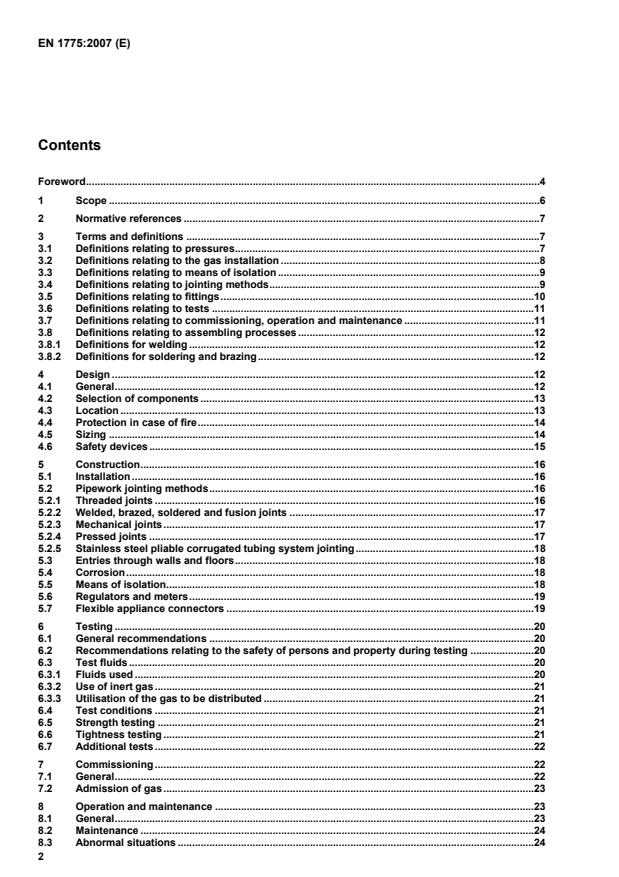
Resistance to high temperatures.27 A.1 General.27 A.2 Procedure A.27 A.2.1 Test criteria.27 A.2.2 Test method.27 A.3 Procedure B.28 A.3.1 Test criteria.28 A.3.2 Test method.29 Annex B (informative)
General guidelines for the construction of joints.30 B.1 General.30 B.2 Installation operatives.30 B.3 Quality Control.31 B.4 Documentation.31 Annex C (informative)
Guidelines for the construction of welded, brazed, soldered joints, and polyethylene fusion joints.32 C.1 Welding of steel.32 C.1.1 Materials.32 C.1.2 Approval of the welding procedure.32 C.1.3 Pipework with a maximum operating pressure (MOP) up to and including 0,1 bar and a wall thickness less than 4mm.32 C.1.4 Pipework with a maximum operating pressure (MOP) over 0,1 bar or wall thickness including and above 4 mm.33 C.2 Brazing and soldering of copper and copper alloys.34 C.2.1 Materials.34 C.2.2 Brazing and soldering procedure.34 C.2.3 Pipework with a maximum operating pressure (MOP) up to and including 0,1 bar.34 C.2.4 Pipework with a maximum operating pressure (MOP) over 0,1 bar.35 C.3 Fusion jointing of polyethylene.35 C.3.1 Materials.35 C.3.2 Polyethylene fusion jointing procedure.36 C.3.3 Qualification of personnel.36 C.3.4 Quality control.36 Annex D (informative)
Guidelines for the construction of pressed joints.39 D.1 Jointing procedure with press fittings on copper pipes.39 D.1.1 General.39 D.1.2 Installation
process.39 D.2 Jointing procedure with press fittings on multi-layer and PEX.40 D.2.1 General.40 D.2.2 Installation
process.40 Annex E (informative)
Guidelines for the construction of stainless steel pliable corrugated tubing systems.41 E.1 General.41 E.2 Components of the system.41 E.3 Stainless steel pliable corrugated tubing systems jointing procedure.41 E.3.1 General.41 E.3.2 Training of personnel.41 E.3.3 Quality control.42 Bibliography.43
This standard contains general recommendations for the safety of persons, animals and property and the protection of their environment. The recommendations in this standard are intended to be applied by competent persons who have suitable knowledge and experience. This standard does not consider contractual agreements, qualifications or authorizations imposed by gas distribution system operators, LPG suppliers or public authorities upon companies who design, construct or work on gas installations.
1 Scope 1.1 This standard specifies general recommendations for the design, construction, testing, commissioning, operation and maintenance of installation pipework; pipework between the delivery point of the gas and the inlet connection to the gas appliance. This standard specifies common basic principles for gas installation pipework.
Users of this European standard need to be aware that more detailed national standards and/or codes of practice may exist in the CEN member countries. This standard is intended to be applied in association with these national standards and/or codes of practice setting out the above mentioned basic principles.
In the event of conflicts in terms of more restrictive requirements in national legislation/regulation with the requirements of this standard, national legislation/regulation takes precedence as illustrated in CEN /TR 13737. NOTE 1 CEN/TR 13737 contains:
- clarification of relevant legislation/regulations applicable in a country;
- if appropriate, more restrictive national requirements;
- national contact point for the latest information. This standard applies to:
gas installations in residential, commercial and public access building having a maximum operating pressure (MOP) less than or equal to 5 bar; industrial gas installations having a maximum operating pressure (MOP) less than or equal to 0,5 bar.
NOTE 2 For industrial gas installations having a MOP above 0,5 bar, or installations having a MOP above 5 bar, see prEN 15001-1. This standard is applicable to new installation pipework as well as to replacements of, or extensions to, existing installation pipework. This standard does not contain detailed recommendations relating to the laying of buried pipework.
NOTE 3
For more information on buried pipework, see EN 12007-1, EN 12007-2 and EN 12007-3. NOTE 4
For more information on gas pressure regulating installations, see EN 12279. NOTE 5
For more information on gas metering systems, see EN 1776. 1.2 This standard is applicable to installation pipework supplied from gas distribution systems and from liquefied petroleum gases (LPG) storage vessels.
Excluded are: single appliance LPG installations without fixed pipework, achieved by a flexible appliance connector from an adjacent LPG storage cylinder. LPG storage vessels. 1.3 In this standard the term 'gas' refers to combustible gases, which are gaseous at 15 °C and 1 013,25 mbar. These gases, odorized for safety reasons, are commonly referred to as manufactured gas, natural gas or liquefied petroleum gases (LPG). They are also referred to as first, second or third family gases (see EN 437). In this standard, all pressures are gauge pressures, unless otherwise stated.
3.2.7 lateral section of generally horizontal installation pipework 3.2.8 ventilated space space where the air is continuously changed by natural or mechanical means 3.2.9 duct space specifically designed and constructed for the passage of building services
EXAMPLE Such a building can be an office block or a repair workshop. 3.2.14 high rise building building in which the height from the floor of the highest occupied level to ground level is: for a residential building greater than 50 m; other buildings greater than 30 m NOTE The design considerations relate to the use of the building and the vertical height of the sections of pipework. 3.3 Definitions relating to means of isolation 3.3.1 means of isolation device intended to interrupt the gas flow in pipework EXAMPLE This device can be a manually operable valve. 3.3.2 appliance means of isolation means of isolation intended to isolate an appliance 3.4 Definitions relating to jointing methods 3.4.1 joint means of connecting elements of a gas installation 3.4.2 threaded joint joint in which gas tightness is achieved by metal to metal contact within threads with the assistance of a sealant
A compression joint is a mechanical joint which is not normally intended to be disassembled and reassembled. 3.4.4 Definitions for pressed joints 3.4.4.1 pressed joint joint in which tightness is achieved by using an appropriate tool for either compressing a fitting to form the joint or expanding a pipe to enable forming the joint
NOTE Such a joint cannot be disassembled and reused. 3.4.4.2 pressed joint for copper pipe pressed joint whose jointing is carried out by a radial deformation of the end of a fitting body onto a tube and whose sealing is carried out by an elastomeric o-ring. NOTE 1 Some designs can incorporate an additional device to aid retention. NOTE 2 The press tool includes a press machine and a set of jaws or collars 3.4.4.3 pressed joint for multilayer or PEX pipe
pressed joint whose jointing is carried out by the insertion of a fitting body fitting inside a tube end followed by the mechanical compression of the tube onto the fitting body.
NOTE This jointing method can be achieved either by expansion followed by the radial compression of the tube onto the fitting body thanks to the memory effect of PEX materials or, by the axial or radial pressing of a sleeve onto the external wall of the tube. Sealing can require the use of elastomeric o-rings. 3.4.5 electrofusion joint joint formed between polyethylene components using fittings which have an integrated electric heating element 3.4.6 butt fusion joint joint formed between polyethylene components where the two pipe ends are heated and brought together to be fused directly without using a separate fitting or filler material 3.5 Definitions relating to fittings 3.5.1 regulator device that reduces the gas pressure to a set value and maintains it within prescribed limits 3.5.2 meter device for measuring a volume of gas or a quantity of energy 3.5.3 flexible appliance connector element of flexible pipework to be fitted between the end of the fixed pipework and the appliance inlet connection 3.5.4 insulating joint fitting installed to electrically interrupt one section of pipework from another
3.5.5 sleeve protective pipe through which a gas pipe passes
3.6 Definitions relating to tests 3.6.1 strength test specific procedure to verify that the pipework meets the requirements for mechanical strength 3.6.2 tightness test specific procedure to verify that the pipework meets the requirements for tightness 3.6.3 fitness test simple test to verify that gas can be admitted or re-admitted to the pipework NOTE This test is normally carried out at operating pressure by appropriate means (rotation of a meter dial, leak detection fluid, measuring apparatus, etc.). 3.6.4 leak detection fluid specially formulated fluid and foaming product that gives a clear indication that a leak exists when applied to a element of pressurized pipework 3.7 Definitions relating to commissioning, operation and maintenance 3.7.1 admission of gas operation of replacing the air or inert gas contained in pipework with distributed gas 3.7.2 purging operation of safely removing gas (normally air or inert gas) from pipework and replacing it with distributed gas, or the reverse process 3.7.3 commissioning activities performed to put a gas installation into operation 3.7.4 competent person person who is trained, experienced and approved to perform activities relating to gas supply systems or installation pipework NOTE Means of approval, if any, will be determined within each country 3.7.5 authorized person competent person who is appointed to fulfil a given task on pipework
3.8.1.3 arc welding fusion welding in which heat for welding is obtained from an electric arc 3.8.1.4 gas welding fusion welding in which the heat for welding is produced by the combustion of a fuel with oxygen gas 3.8.1.5 oxy-acetylene welding gas welding in which the fuel gas is acetylene 3.8.2 Definitions for soldering and brazing 3.8.2.1 soldering and brazing operations in which metal parts are joined by means of capillary action of a filler metal in the liquid state with a melting temperature lower than that of the parts to be joined and wetting the parent metal(s), which does not participate in the making of the joint 3.8.2.2 brazing / hard soldering jointing by means of capillary action of a filler metal having a melting (liquidus) temperature higher than 450 °C 3.8.2.3 soldering / soft soldering jointing by means of capillary action of a filler metal having a melting (liquidus) temperature lower than 450 °C 4 Design 4.1 General 4.1.1 Any person who is responsible for the design of gas pipework shall be a competent person. 4.1.2 The pipework designer shall provide detailed information on the design and location of the pipework to the persons responsible for the construction. 4.1.3 Installation pipework should be designed to be supplied from only one point of delivery. In exceptional cases, where installation pipework could be supplied by more than one point of delivery, a controlling system or an operating procedure shall be put in place to ensure that only one point of delivery is active at any time. 4.1.4 The pipework shall be designed and constructed to enable testing and purging to be carried out. 4.1.5 The choice of materials for pipework shall reflect the requirements of 4.3 for location, 4.4 for protection in case of fire, and when necessary 4.6 for safety devices. 4.1.6 All metallic parts of the pipework other than cathodically protected or electrically isolated systems shall
be at the same electrical potential. NOTE Equipotential bonding may be subject to national regulations. 4.1.7 Particular attention shall be paid to the design of pipework and selection of materials in areas known to be susceptible to ground movement, for example caused by mine working or seismic disturbances. 4.1.8 Pipework including joints and seals shall be designed to be in accordance with the expected lifetime of the building or to the first expected renovation period of the pipework. NOTE A period of at least 50 years is often used as a guide.
4.1.9 Pipework shall be designed and constructed to facilitate maintenance. 4.2 Selection of components 4.2.1 Pipework components shall conform to the appropriate European or national standard for gas applications for buildings. Copper pipes shall comply with EN 1057. The minimum wall thickness of copper pipes shall be suitable for the jointing method chosen.
4.2.2 The pipework components shall be appropriate for: types of gases being distributed; NOTE Particular attention should be given to hydrogen sulphide, water content, dust content and water/hydrocarbon dew point which can require adapted materials, drainage of low points and filtration. pipework design pressure; location of the pipework; pipework temperature under normal operating conditions; potentially corrosive environments. 4.2.3 Regulators and meters shall be suitable for the range of flow rates and pressures that will occur during use. 4.2.4 The type, number and strength of pipework supports shall be appropriate for the pipework materials. NOTE The wall thickness and material, jointing methods and pressure test procedure can also affect the requirements for spacing and strength of supports. 4.3 Location 4.3.1 The location of the pipework shall minimize the risk of damage caused by e.g. mechanical impact, UV exposure, accelerated corrosion, chemical attack, extreme temperatures, lightning … or additional safety measures shall be applied. See also 4.4 and 4.6. 4.3.2 The route and location of externally buried pipework or pipework built within the internal structure shall be such that third party damage is minimized and that any ground or building movement cannot lead to failure. 4.3.3 The route of pipework in buildings should preferably be located in ventilated spaces. The ventilation shall be adequate to safely dilute any small gas leak taking due account of the density of the gas (heavier than air e.g. LPG or lighter than air e.g. natural gas). Where it is not possible to achieve adequate ventilation, other solutions shall be applied, e.g. ventilated sleeves or ducts, pipes which are all welded, all brazed or joint-free, or the filling of the space around the pipe with inert materials, etc.
The use of diagonal routes should always be avoided. Where pipework is concealed, particular attention shall be given to the mode of construction and corrosion protection of the pipework. 4.3.5 The position of the pipework in relation to other services shall be such that it can function properly and be used with safety. Pipework shall not be located near to high voltage conductors or hot or chilled water systems nor subjected to vibrations unless appropriate precautions are taken. NOTE Spaces reserved for other uses, such as lift shafts, garbage chutes, transformers, sewage pipes and bomb shelters, should be avoided unless specific precautions are taken. 4.3.6 Where temperature change and building movements can lead to significant stresses on pipework, adequate provisions shall be made for moving the pipework. 4.3.7 The effects of lightning shall be taken into consideration when designing the pipework. 4.3.8 Where the distributed gas is wet or has a low vapour pressure, pipework shall be protected against frost and/or condensation and siphons shall be fitted at low points. 4.4 Protection in case of fire The designer shall consider the possibility of an outbreak of fire within a building containing installation pipework, that may cause damage to the fabric of the building and consequently or separately to the installation pipework. The design objective shall be to minimize the likelihood of an explosion, or serious aggravation of the fire. The design objective can be achieved for example by the use of one or more of the following:
accessible manual means of isolation, automatic means of isolation, use of materials, components and joints that withstand high temperatures, location of all or part of the pipework in an enclosure providing protection in the event of fire, coating pipework with a protective material to enable the pipework to withstand high temperatures for a given period of time. NOTE 1 Reference should be made to the national legislation/regulation. NOTE 2 Annex A gives, as examples, two procedures (A & B) for tests on components of pipework and their jointing for resistance to high temperatures. 4.5 Sizing 4.5.1 Gas pipework shall be sized so that the pressure at the inlet of all appliances is compatible with their safe and effective operation. The pressure at the inlet of gas appliances, which conform to the Gas Appliance Directive, shall remain within the limits prescribed in EN 437. NOTE Account should be taken of the maximum flow rate together with any foreseeable increase in the load. The maximum flow rate for sizing the pipework is not necessarily equal to the total gas flows to all appliances. 4.5.2 The gas velocity in the pipework shall not have a significant effect on the pipework, for example by erosion, nor shall it cause a nuisance due to noise.
= K (1 - d) ∆H (1) where K is equal to 0,123 millibars per metre;
∆p is the pressure change due to altitude, in millibars; ∆H is the altitude change, in metres (negative when pipe leads to lower level); d
is the density of gas relative to air (dimensionless). 4.5.5 The operation of gas appliances and machinery (for example compressors) shall not adversely affect the safe operation of the pipework and regulators or the accuracy of the meter system. 4.5.6 Billing meters, meter by-passes and regulators shall be chosen by agreement with the gas supplier/distribution system operator/LPG supplier. 4.6 Safety devices 4.6.1 Where a pressure relief valve is fitted, this gas shall be vented to a safe location, usually outside the building. NOTE Safety devices may be incorporated within regulators. If a vent pipe is fitted, it shall be dimensioned so as not to impair the safe operation of the safety device. The termination of vent pipes shall be protected against the ingress of foreign substances (such as dust, water, soil, snow). 4.6.2 The pipework shall be designed so that air, oxygen or other gases used in conjunction with the combustible gas cannot enter the pipework. This can require the use of a reverse flow protection system. 4.6.3 Where required by risk assessment, specific additional protection shall be installed to protect against the consequence of failure of any component within the pipework.
NOTE This may be a safety device (for example one that protects against excess temperatures or excess flow) or a passive protection measure (e.g. enclosure of the pipework). The number, location and sizing of excess flow device(s) shall be assessed and should be optimised during design to allow such a device to actuate when a failure of a pipework component occurs and to cope with the locally allowed pressure drop values. This process shall rely on accurate pressure drop values given by system/component manufacturers e.g. in design specification recommendations.
The construction of the gas pipework installation shall follow the design objectives of clause 4.
5.1.3 During the construction of pipework care shall be taken to prevent the ingress of foreign matter (e.g. dirt, water, flux, swarf, thread cutting oil) into the pipework. Foreign matter which has entered the pipework shall be removed. NOTE Thread cutting oil can affect thread sealants. 5.1.4 Open ends of pipework and valve outlets shall be sealed with appropriate fittings. 5.1.5 Pipework installed above ground shall be suitably supported. (see 4.2.4). 5.1.6 Pipework shall be protected against damage (see 4.3.1). 5.1.7 External above ground metallic pipework shall be protected against the effects of lightning where appropriate.
5.1.8 When an insulating joint is fitted in order to electrically isolate the pipework inside the building from the buried pipework, it shall not be fitted in
...